More on the “separating disease”, 1889.

Leaving the Bosom of the Parent and the Homeland.

I left my parent and the land of my birth in the famed cliffs in the mists of Honokohau, West Maui, and my path turned toward Honolulu, then I was sent away to Kalawao, with “That one there has leprosy.”

I was born in Honokohau, Maui, in the month of September, on the 12th, 1867; by Sam. L. Kalaola and Mrs. Keolamahunehune Kamoku Kalaola; and therefore, that is the land of my birth, and for that land is this pikake lei which I love:

O land of my birth,
My beloved land,
I aloha
Your beaches,
The uplands,
The ever green fields.

I was raised at Honokohau until older, and when I turned 6, I was sent by my parents to go to school, and A. W. Kanahi was my teacher; and to all of you my friends who suffered in the pursuit of education goes my aloha nui, and this maile lei which i wear:

Aloha to you my friends,
My classmates
It is time for me to go
Aloha nui
I will go singing
Put aside the lamentations
Aloha nui
Aloha to the fields
The ridges
My dear school house
Aloha nui
I will be leaving for somewhere else
With you always will be my appreciation
Aloha nui.

When I became 12 or so, at that school, I gained some knowledge; after that, I was sent to the English school at Kaluaaha, and later was sent back to the first school which I attended, and here I stayed until I became old; and in the year 1887, I returned to Kahikinui and my hands became deformed, and on a day in this past September, my father was ordered by the deputy marshal of Lahaina to take me to be sent to Honolulu, and from Honolulu to Kalawao.

My father assented in accordance with his occupation as a policeman of district of Lahaina, but not happily, but with bad feelings, left without aloha and without friends, but it was the right thing to do, for this was a person who contracted the disease, the disease called “the family separating disease;” and for this disease is this ahihi lei:

You go to Kalawao
You have the “Chinese disease”
The disease hated by the people
The brown-skinned and the white-skinned.
Your companions change
Before there were many times together
And you were with me, and I with you
One bite and we are severed.

On Friday evening, my father returned from Lahaina and told me the news about me going to Kalawao, and he said to me his last thoughts, saying with words of grief, “You go, stand tall, go to this place where the law of the land has set aside for those who contract this disease; this year God has put me in much difficulties, but don’t forget my words to you, and these are they: don’t forget God, our God who mad the ocean, the cliffs, the rain, the heat of the sun, and so forth.”

I went on Saturday, but there was no ship, and I returned. On Thursday of the next week, there again was no boat, and I waited in Lahaina for a boat; and at 9 at night on Saturday, I boarded the steamship Iwalani, and for this ship is this mele of affection:

The Iwalani turns back
To see the calm of Kona
We are outside of Kailua
Where the Wiliahiu wind blows
One push and we are in Honolulu
And I am at the hospital in Kalihi.

There are three of us from the same place, and at 6 in the morning on Sunday, we reached the landing at Ainahou. The officer was there, and were were taken to Kalakaua Hale and from there to Kalihi. We stayed there for a week and went immediately to Kalawao. And we now live in this friendless land, the land set apart for us, the grave for our bodies.

Here I will conclude my travels, and to the Editor my farewell, and to the metal typesetting boys my good bye.

Me,

Miss Sam. L. K. Kalaola.

Kalawao, Molokai.

[Don’t forget if you are free this evening, and on Oahu nei, there is this presentation at Native Books!]

(Kuokoa, 10/26/1889, p. 4)

KA HAALELE ANA I KA POLI O KA MAKUA A ME KA AINA HANAU

Ka Nupepa Kuokoa, Buke XXVIII, Helu 43, Aoao 4. Okatoba 26, 1889.
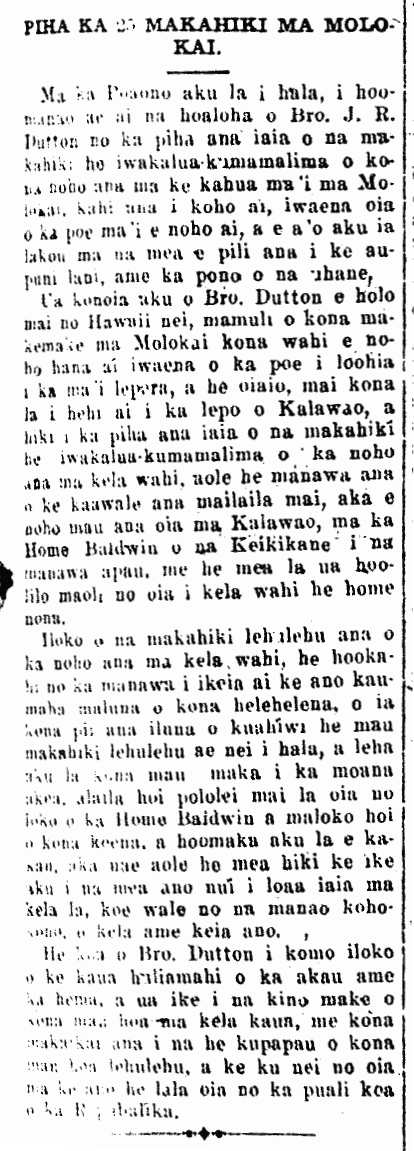
Brother Dutton on Molokai, 1911.

25 Years on Molokai.

Last Saturday, the friends of Bro. J. R. Dutton celebrated the twenty-fifth anniversary of his living at the sanatorium at Molokai, where he chose to be amongst the patients, and to teach them of the kingdom of heaven and the righteousness of the spirit.

Bro. Dutton was invited to come to Hawaii as a result of his desire to minister on Molokai amongst the people afflicted with leprosy; and it is true, from the moment he stepped upon the soil of Kalawao, until living there for 25 years, there was not a single moment he spent away, but he remained there at Kalawao at the Baldwin Boys’ Home at all times, as if he made this his home.

In his many years living there, there was only a single time he showed signs of grief, when he climbed into the hills many years ago, his eyes looked out to the wide ocean, and he returned immediately to the Baldwin Home to his room. He then began to write. However, it is unknown what happened that day, except through conjecture.

Bro. Dutton was a soldier engaged in a fierce battle between the north and the south; and he saw the dead bodies of his comrades in battle. He visited the graves of his many friends, and he remains a member of the soldiers of the Republic.

(Kuokoa, 8/4/1911, p. 5)

PIHA KA 25 MAKAHIKI MA MOLOKAI.

Ka Nupepa Kuokoa, Buke XLVII, Helu 31, Aoao 5. Augate 4, 1911.

Bonine brings movies to Kalawao and Kalaupapa, 1909.

FIRST MOVING PICTURE SHOW TAKES SETTLEMENT BY STORM

On Thursday evening last a new miracle happened at Kalaupapa. On that evening R. K. Bonine, the moving-picture expert, threw his first picture on the screen before an audience of a thousand lepers, and there was a great gasp of awed astonishment and keen delight when the pictures really moved and did things. Cheers, tears, gasps and soul-satisfying laughter greeted the pictures in turn, and when the reels put aside for the first entertainment had been exhausted, the people of Kalaupapa and Kalawao, in a body, cheered their thanks to the man who had brought these wonders to them and to those in Honolulu who had through their contributions made these miracles possible.

It was a great day for the people of the Molokai Settlement, and it was a great day for Bonine. To the lepers had come a new marvel, greater far than the sight of the mighty White Fleet, which maneuvered past their shores last summer, greater than anything that had come to them. No place the world over have motion pictures made such a hit. Continue reading

Hot air balloon in Paris, riding a camel in India, then an elephant in Egypt…, 1911.

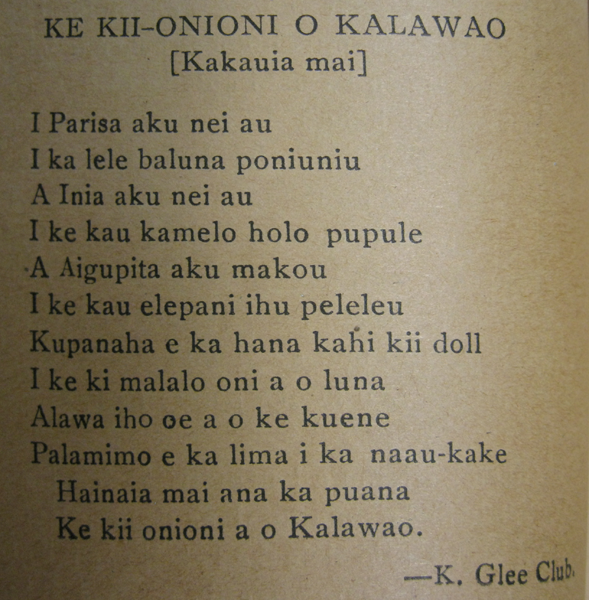
KE KII-ONIONI O KALAWAO
[Kakauia mai]

I Parisa aku nei au
I ka lele baluna poniuniu
A Inia aku nei au
I ke kau kamelo holo pupule
A Aigupita aku makou
I ke kau elepani ihu peleleu
Kupanaha e ka hana kahi kii doll
I ke ki malalo oni a o luna
Alawa iho oe a o ke kuene
Palamimo e ka lima i ka naau-kake
Hainaia mai ana ka puana
Ke kii onioni a o Kalawao
—K. Glee Club.

[Movie of Kalawao
(Submitted)

I was in Paris
On a dizzying hot-air balloon
I was in India
On a camel that went along crazily
We were in Egypt
On an elephant with a long trunk
Amazing is the action of this doll
Turn the key below and it moves above
Look at that waiter
Skilled are his hands with the sausage
Let the story be told
The movie of Kalawao.

Kalaupapa Glee Club.]

[Here is a mele about places far away, written it seems down in Kalawao after a movie of clips of various scenes was shown there. For the version more widely known today, see also “Palisa” in Na Mele o Hawaii Nei, pp. 84–85.]

(Au Hou, 8/24/1910, p. 12)

KE KII-ONIONI O KALAWAO

Ke Au Hou, Buke I, Helu 17, Aoao 12. Augate 24, 1910.

Donations to the Red Cross by the patients and residents of the leprosy colony, 1918.

THE PATIENTS OF MOLOKAI ASSIST THE RED CROSS.

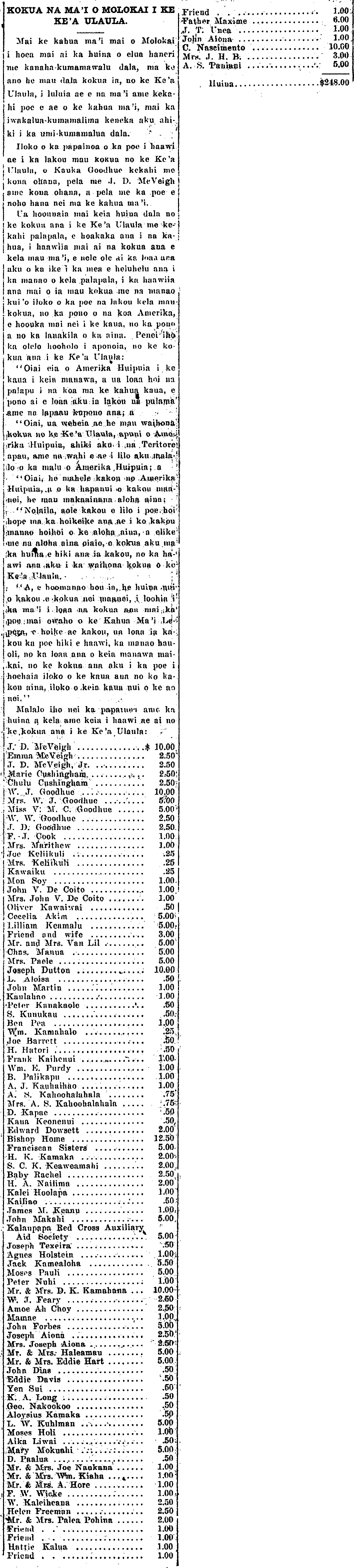
There arrived from the leprosy colony of Molokai, a total of two-hundred and forty-eight dollars, in the form of a donation for the Red Cross [Ke’a Ulaula], given by the patients and some others of the colony, from twenty-five cents to twelve dollars.

In the list of the donors to the Red Cross is Dr. Goodhue and his family, along with J. D. McVeigh and his family, and also those who reside there while working in the leprosy colony.

This sum of money to assist the Red Cross was sent along with a document explaining the reasons that this assistance was given by the patients, so that someone reading it would not be left without knowing that the assistance is given by them sincerely for the benefit of the American soldiers fighting the war for the good and the victory of the land. Here below is the agreed upon resolutions for the assistance of the Red Cross.

“Whereas, the United States of America is now at war, and soldiers are being injured on the battlefield, they should receive care and proper medicine; and

“Whereas, there have been established a number of collections for the Red Cross set up all around the United States, and every Territory, and the other areas under the protection of the United States; and

“Whereas, we are a part of the United States of America, and the majority of us here are patriotic citizens;

“Therefore, we will not fall back from showing our patriotic spirit, and with true patriotism, we give what we can for the donation to the Red Cross.

“And, let it once again be remembered that there are a great number of us being helped here stricken by disease who receive assistance from those outside of the Leprosy Colony; let us show that there are those of us here who can give and that we are happy for this fine opportunity to assist those injured fighting for our land, in this great war of the world.”

Here below is the list of names and the donations that each gave to assist the Red Cross:

J. D. McVeigh ….. $10.00
Emma McVeigh ….. 2.50
J. D. McVeigh, Jr. ….. 2.50
Marie Cushingham ….. 2.50
Chulu Cushingham ….. 2.50
W. J. Goodhue ….. 10.00
Mrs. W. J. Goodhue ….. 5.00
Miss V. M. C. Goodhue ….. 5.00
W. W. Goodhue ….. 2.50
J. D. Goodhue ….. 2.50
F. J. Cook ….. 1.00
Mrs. Marithew ….. 1.00
Joe Keliikuli ….. .25
Mrs. Keliikuli ….. .25
Kawaiku ….. .25
Mon Soy ….. 1.00
John V. De Coito ….. 1.00
Mrs. John V. De Coito ….. 1.00
Oliver Kawaiwai ….. .50
Cecelia Akim ….. 5.00
Lilian Keamalu ….. 5.00
Friend and wife ….. 3.00
Mr. and Mrs. Van Lil ….. 5.00
Charles Manua ….. 5.00
Mrs. Paele ….. 5.00
Joseph Dutton ….. 10.00
L. Aloisa ….. .50
John Martin ….. 1.00
Kaulahao ….. 1.00
Peter Kanakaole ….. .50
S. Kunukau ….. .50
Ben Pea ….. 1.00
William Kamahalo ….. .25
Joe Barrett ….. .50
H. Hatori ….. .50
Frank Kaihenui ….. 1.00
William E. Purdy ….. 1.00
B. Palikapu ….. 1.00
Al. J. Kauhaihao ….. 1.00
A. S. Kahoohalahala ….. .75
Mrs. A. S. Kahoohalahala ….. .75
D. Kapae ….. .50
Kaua Keonenui ….. .50
Edward Dowsett ….. 2.00
Bishop Home ….. 12.50
Franciscan Sisters ….. 5.00
H. K. Kamaka ….. 2.00
S. C. K. Keaweamahi ….. 2.00
Baby Rachel ….. 2.50
H. A. Nailima ….. 2.00
Kalei Hoolapa ….. 1.00
Kailiao ….. .50
James m. Keanu ….. 1.00
John Makahi ….. 5.00
Kalaupapa Red Cross Auxiliary Aid Society ….. 5.00
Joseph Texeira ….. .50
Agnes Holstein ….. 1.00
Jack Kamealoha ….. 5.50
Moses Pauli ….. 5.00
Peter Nuhi ….. 1.00
Mr. & Mrs. D. K. Kamahana ….. 10.00
W. J. Feary ….. 2.50
Amoe Ah Choy ….. 2.50
Mamae ….. 1.00
John Forbes ….. 5.00
Joseph Aiona ….. 2.50
Mrs. Joseph Aiona ….. 2.50
Mr. & Mrs. Haleamau ….. 5.00
Mr. & Mrs. Eddie Hart ….. 5.00
John Dias ….. .50
Eddie Davis ….. .50
Yen Sui ….. .50
K. A. Long ….. .50
George Nakookoo ….. .50
Aloysius Kamaka ….. .50
L. W. Kuhlman ….. 5.00
Moses Holi ….. 1.00
Aika Liwai ….. .50
Mary Mokuahi ….. 5.00
D. Paalua ….. .50
Mr. & Mrs. Joe Naukana ….. 1.00
Mr. & Mrs. William Kiaha ….. 1.00
Mr. & Mrs. A. Hore ….. 1.00
F. W. Wicke ….. 1.00
W. Kaleiheana ….. 2.50
Helen Freeman ….. 2.50
Mr. & Mrs. Palea Pohina ….. 2.00
Friend ….. 1.00
Friend ….. 1.00
Hattie Kalua ….. 1.00
Friend ….. 1.00
Friend ….. 1.00
Father Maxime ….. 6.00
J. T. Unea ….. 1.00
John Aiona ….. 1.00
C. Nascimento ….. 10.00
Mrs. J. H. B. ….. 3.00
A. S. Paniani ….. 5.00
Total ….. $248.00

[The patients of the leprosy colony might have often been forsaken by those on the outside, but it seems throughout history that those forced to live there did not forsake those on the outside.]

(Kuokoa, 2/1/1918, p. 2)

KOKUA NA MA'I O MOLOKAI I KE KE'A ULAULA.

Ka Nupepa Kuokoa, Buke LVI, Helu 5, Aoao 2. Feberuari 1, 1918.

Those afflicted with leprosy forsaken by the church? 1873.

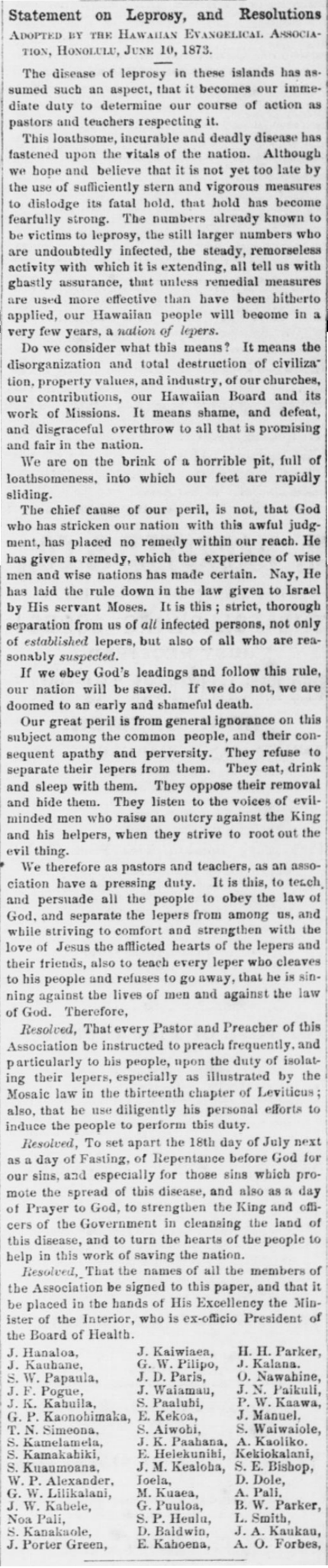
Statement on Leprosy, and Resolutions

Adopted by the Hawaiian Evangelical Association, Honolulu, June 10, 1873.

The disease of leprosy in these islands has assumed such an aspect, that it becomes our immediate duty to determine our course of action as pastors and teachers respecting it.

This loathsome, incurable and deadly disease has fastened upon the vitals of the nation. Although we hope and believe that it is not yet too late by the use of sufficiently stern and vigorous measures to dislodge its fatal hold, that hold has become fearfully strong. The numbers already known to be victims to leprosy, the still larger numbers who are undoubtedly infected, the steady, remorseless activity with which it is extending, all tell us with ghastly assurance, that unless remedial measures are used more effective than have been hitherto applied, our Hawaiian people will become in a very few years, a nation of lepers.

Do we consider what this means? It means the disorganization and total destruction of civilization, property values, and industry, of our churches, our contributions, our Hawaiian Board and its work of Missions. It means shame, and defeat, and disgraceful overthrow to all that is promising and fair in the nation.

We are on the brink of a horrible pit, full of loathsomeness, into which our feet are rapidly sliding.

The chief cause of our peril, is not, that God who has stricken our nation with this awful judgment, has placed no remedy within our reach. He has given a remedy, which the experience of wise men and wise nations has made certain. Nay, He has laid the rule down in the law given to Israel by His servant Moses. It is this; strict, thorough separation from us of all infected persons, not only of established lepers, but also of all who are reasonably suspected.

If we obey God’s leadings and follow this rule, our nation will be saved. If we do not, we are doomed to an early and shameful death.

Our great peril is from general ignorance on this subject among the common people, and their consequent apathy and perversity. They refuse to separate their lepers from them. They eat, drink and sleep with them. They oppose their removal and hide them. They listen to the voices of evil-minded men who raise an outcry against the King and his helpers, when they strive to root out the evil thing.

We therefore as pastors and teachers, as an association have a pressing duty. It is this, to teach and persuade all the people to obey the law of God, and separate the lepers from among us, and while striving to comfort and strengthen with the love of Jesus the afflicted hearts of the lepers and their friends, also to teach every leper who cleaves to his people and refuses to go away, that he is sinning against the lives of men and against the law of God. Therefore,

Resolved, That every Pastor and Preacher of this Association be instructed to preach frequently, and particularly to his people, upon the duty of isolating their lepers, especially as illustrated by the Mosaic law in the thirteenth chapter of Leviticus; also, that he use diligently his personal efforts to induce the people to perform this duty.

Resolved, To set apart the 18th day of July next as a day of Fasting, of Repentance before God for our sins, and especially for those sins which promote the spread of this disease, and also as a day of Prayer to God, to strengthen the King and officers of the Government in cleansing the land of this disease, and to turn the hearts of the people to help in this work of saving the nation.

Resolved, That the names of all the members of the Association be signed to this paper, and that it be placed in the hands of His Excellency the Minister of the Interior, who is ex-officio President of the Board of Health.

J. Hanaloa,  J. Kaiwiaea, H. H. Parker,
J. Kauhane,  G. W. Pilipo,  J. Kalana,
S. W. Papaula,  J. D. Paris,  O. Nawahine,
J. F. Pogue,  J. Waiamau,  J. N. Paikuli,
J. K. Kahuila,  S. Paaluhi,  P. W. Kaawa,
G. P. Kaonohimaka,  E. Kekoa,  J. Manuel,
T. N. Simeona,  S. Aiwohi,  S. Waiwaiole,
S. Kamelamela,  J. K. Paahana,  A. Kaoliko,
S. Kamakahiki,  E. Helekunihi,  Kekiokalani,
S. Kuaumoana,  J. M. Kealoha,  S. E. Bishop,
W. P. Alexander,  Ioela,  D. Dole,
G. W. Lilikalani,  M. Kuaea,  A. Pali,
J. W. Kahele,  G. Puuloa,  B. W. Parker,
Noa Pali,  S. P. Heulu,  L. Smith,
S. Kanakaole,  D. Baldwin,  J. A. Kaukau,
J. Porter Green,  E. Kahoena,  A. O. Forbes.

[How have things changed today? How have things remained the same? Find the Hawaiian-Language version printed in the Kuokoa, 6/18/1873, p. 3, here.]

(Pacific Commercial Advertiser, 6/14/1873, p. 3)

Statement on Leprosy, and Resolutions

The Pacific Commercial Advertiser, Volume XVII, Number 50, Page 3. June 14, 1873.

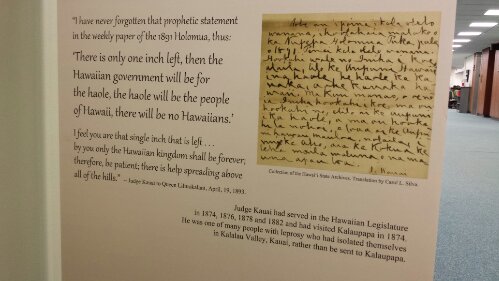
New Perspectives on the History of Kalaupapa, 2013.

[This talk by Anwei Skinsnes Law should be put on your calendar. There is so much more to discover about those sent to Kalaupapa and Kalawao, and also about those who were left behind. Much of the first and second-hand accounts can be found within the pages of the Hawaiian-Language Newspapers!]

Kokua being sent out of Kalawao and Kalaupapa, 1894.

To be Discharged.

Here below is the list of assistants [kokua] living in Kalawao and Kalaupapa who are being sent away.

Kaaihue (m), Kawika (m), Kalaeloa (m), Keliikipi (m), Makakoa (m), they are from Kohala, Hawaii. Nailima (m), Ku (m), S. Keanu, Kekua (m), Kaaikauna (m), Manua (m), Manua, Jr. (m), Kaoo (f), Kealohanui (f), Malia (f), and Kaia (f), they are from Maui along with Mele Paulina. Pukooku (m), Nailima 2 (m), Kamakau (m), Kalehua (f), and Umi (f), from Kona, Hawaii. C. Kopena, Hokela (f), and Keonaona (f), they are from Honolulu. Mihi (f) and Pahukoa (m), from Niihau. Alaala (m) and Hamea (f), from Kauai. Kanuha ka, from Ewa. Maiuli (m), from Molokai. Kahananui (m), Kamaka (m), Auau (m), Pookela (f), Maleka (f), it is not known where they are from. Kapoi (f) and Kaiakonui (f), from Kalaupapa. Hanaloa (m), from Hilo. Kapeka (f), from Waipio. Apikaila (f) and Kekuni (f), from Kohala.

Here are the kokua that are married. Kaaihue (m) to Kaoo (f), Kanua (m) to Pookela (f), Kamaka (m) to Kapoi (f), Keliikipi (m) to Kaleiolono (f), C. Kopena to Keonaona (f), Kaaikauna (m) to Apikaila (f), Alaala (m) to Hamea (f).

Here are the kokua who are married to a patient: Nailima (m) to Kealoha (f), Pahukoa (m) to Keoho (f), S. Keanu to Maikini (f), Manua, Jr. to Kaiwaokalani (f), Hanaloa (m) to Kalehua (f), Hokela (f) to Lopaka (m), Mihi (f) to Haili (m), Malia (f) to Punohu (m), Umi (f) to Punilio (m), Mele Paulina to Huelo Poki, Kekuni (f) to Kane (m). Most of the kokua live mixed in with the patients. As for Kaiakonui (f), she is married to A. Hutchison, the current Superintendent.

(Makaainana, 2/5/1894, p. 2)

E Kaiehuia aku ana.

Ka Makaainana, Buke I—-Ano Hou, Helu 6, Aoao 2. Feberuari 5, 1894.

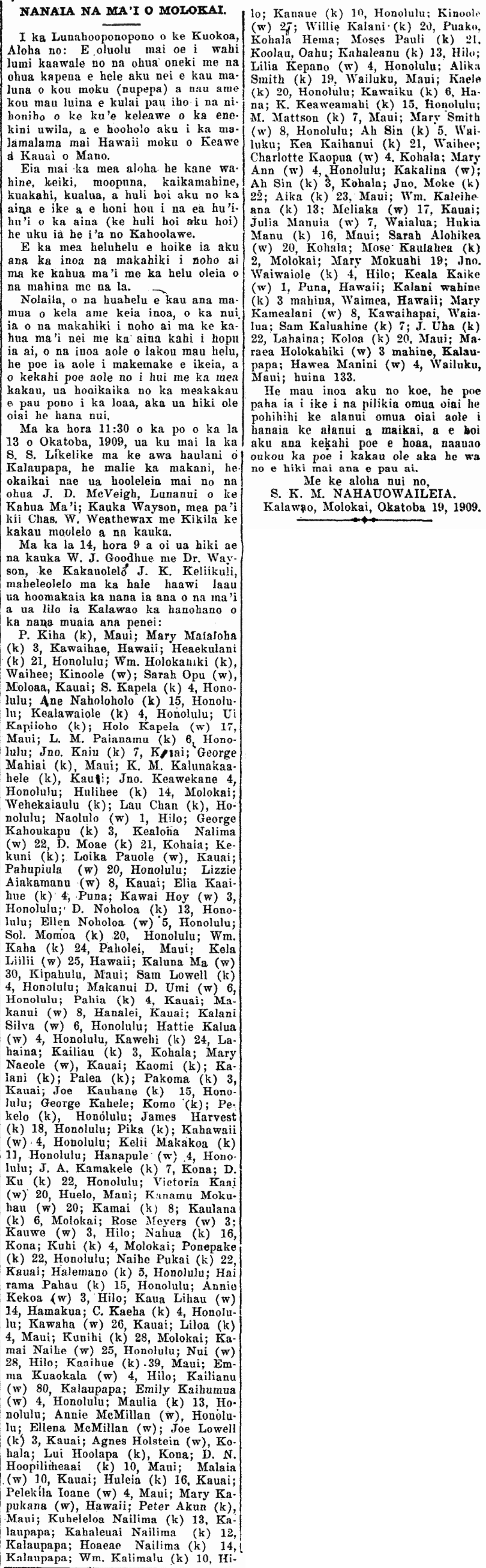
Detailed list of patients being examined at Kalawao, 1909.

THE PATIENTS OF MOLOKAI ARE EXAMINED.

To the Editor of the Kuokoa, Aloha no: Please allow me some space on your deck along with the captain’s passengers travelling aboard your ship (newspaper) and it is for you and your sailors to [anybody care to offer insight into this nautical allusion? “a nau ame kou mau luina e kulai pau iho i na nihoniho o ke ku’e keleawe o ka enekini uwila…”] and to send knowledge from Hawaii, the island of Keawe, all the way to Kauai of Manokalanipo.

Here are your loved ones, a husband, a wife, a child, a grandchild, a daughter, a grand, a great grand; and they turn towards home, to see and to smell once again the cool air of the land (should they return); the fish is an uku, a fish of Kahoolawe.¹

O Reader, shown will be the names and the years they have lived here in the land of the sick without counting the months and days.

Therefore, the number placed before [after] each name is the total years lived here in the land of the sick and the land where they were taken from; for the names without numbers, they don’t want it to be known, and some have not met with the writer; the writer put great effort into completing it, but he could not for it was a big task.

At 11:30 at night on the 13th of October, 1909, the S. S. Likelike arrived at the restless harbor of Kalaupapa; the wind was calm, but the disembarking of the passengers was still rough, they being J. D. McVeigh, Superintendent of the Leprosy Colony; Dr. Wayson; photographer Charles W. Weatherwax and Kikila the secretary of the doctors.

On the 14th, at 9 or so, the doctors W. J. Goodhue and Wayson arrived with the Secretary J. K. Keliikuli, interpreter at the dispensary; and the examination of the patients began; and to Kalawao went the honor of the first examination, as follows:

P. Kiha (m), Maui; Mary Maialoha (m), 3, Kawaihae, Hawaii; Heaekulani (m) 21, Honolulu; William Holokahiki (m), Waihee; Kinoole (f); Sarah Opu (f), Moloaa, Kauai; S. Kapela (m) 4, Honolulu; Ane Naholoholo (m) 15, Honolulu; Kealawaiole (m) 4, Honolulu; Ui Kapiioho (m); Holo Kapela (f) 17, Maui; L. M. Paianamu (m) 6, Honolulu; John Kaiu (m) 7, Kauai; George Mahiai (m), Maui; K. M. Kalunakaahele (m), Kauai; John Keawekane 4, Honolulu; Hulihee (m) 14, Molokai; Wehekaiaulu (m); Lau Chan (m), Honolulu; Naolulo (f) 1, Hilo; George Kahoukapu (m) 3; Kealoha Nalima (f) 22; D. Moae (m) 21, Kohala; Kekuni (m); Loika Pauole (f), Kauai; Pahupiula (f) 20, Honolulu; Lizzie Aiakamanu (f) 8, Kauai; Elia Kaaihue (m) 4, Puna; Kawai Hoy (f) 3, Honolulu; D. Noholoa (m) 13, Honolulu; Ellen Noholoa (f) 5, Honolulu; Solomon Momoa (m) 20, Honolulu; William Kaha (m) 24, Paholei, Maui; Kela Liilii (f) 25, Hawaii; Kaluna Ma (f) 30, Kipahulu, Maui; Sam Lowell (m) 4, Honolulu; Makanui D. Umi (f) 6, Honolulu; Pahia (m) 4, Kauai; Makanui (f) 8, Hanalei, Kauai; Kalani Silva (f) 6, Honolulu; Hattie Kalua (f) 4, Honolulu; Kawehi (m) 24, Lahaina; Kailiau (m) 3, Kohala; Mary Naeole (f), Kauai; Kaomi (m); Kalani (m); Palea (m); Pakoma (m) 3, Kauai; Joe Kauhane (m) 15, Honolulu; George Kahele; Komo (m); Pekelo (m), Honolulu; James Harvest (m) 18, Honolulu; Pika (m); Kahawaii (f) 4, Honolulu; Kelii Makakoa (m) 11, Honolulu; Hanapule (f) 4, Honolulu; J. A. Kamakele (m) 7, Kona; D. Ku (m) 22, Honolulu; Victoria Kaai (f) 20, Huelo, Maui; Kanamu Mokuhau (f) 20; Kamai (m) 8; Kaulana (m) 6, Molokai; Rose Meyers (f) 3; Kauwe (f) 3, Hilo; Nahua (m) 16, Kona; Kuhi (m) 4, Molokai; Ponepake (m) 22, Honolulu; Naihe Pukai (m) 22, Kauai; Halemano (m) 5, Honolulu; Hairama Pahau (m) 15, Honolulu; Annie Kekoa (f) 3, Hilo; Kaua Lihau (f) 14, Hamakua; C. Kaeha (m) 4, Honolulu; Kawaha (f) 26, Kauai; Liloa (m) 4, Maui; Kunihi (m) 28, Molokai; Kamai Naihe (f) 25, Honolulu; Nui (f) 28, Hilo; Kaaihue (m) 39, Maui; Emma Kuaokala (f) 4, Hilo; Kailianu (f) 80, Kalaupapa; Emily Kaihumua (f) 4, Honolulu; Maulia (m) 13, Honolulu; Annie McMillan (f), Honolulu; Ellena McMillan (f); Joe Lowell (m) 3, Kauai; Agnes Holstein (f), Kohala; Lui Hoolapa (m), Kona; D. N. Hoopilimeaai (m) 10, Maui; Malaia (f) 10, Kauai; Huleia (m) 16, Kauai; Pelekila Ioane (f) 4, Maui; Mary Kapukana (f), Hawaii; Peter Akua (m), Maui; Kuheleloa Nailima (m) 13, Kalaupapa; Kahaleuai Nailima (m) 12, Kalaupapa; Hoaeae Nailima (m) 14, Kalaupapa; William Kalimalu (m) 10, Hilo; Kanaue (m) 10, Honolulu; Kinoole (f) 27; Willie Kalani (m) 20, Puako, South Kohala; Moses Pauli (m) 21, Koolau, Oahu; Kahaleanu (m) 13, Hilo; Lilia Kepano (f) 4, Honolulu; Alika Smith (m) 19, Wailuku, Maui; Kaele (m) 20, Honolulu; Kawaiku (m) 6, Hana; K. Keaweamahi (m) 15, Honolulu; M. Mattson (m) 7, Maui; Mary Smith (f) 8, Honolulu; Ah Sin (m) 5, Wailuku; Kea Kaihanui (m) 21, Waihee; Charlotte Kaopua (f) 4, Kohala; Mary Ann (f) 4, Honolulu; Kakalina (f); Ah Sin (m) 3, Kohala; John Moke (m) 22; Alika (m) 23, Maui; William Kaleiheana (m) 13; Meliaka (f) 17, Kauai; Julia Manuia (f) 7, Waialua; Hukia Manu (m) 16, Maui; Sarah Alohikea (f) 20, Kohala; Mose Kaulahea (m) 2, Molokai; Mary Mokuahi 19; John Waiwaiole (m) 4, Hilo; Keala Kaike (f) 1, Puna, Hawaii; Kalani wahine (m) 3 months, Waimea, Hawaii; Mary Kamealani (f) 8, Kawaihapai, Waialua; Sam Kaluahine (m) 7; J. Uha (m) 22, Lahaina; Koloa (m) 20, Maui; Maraea Holokahiki (f) 3 months, Kalaupapa; Hawea Manini (f) 4, Wailuku, Maui; total 133.

There are names left; perhaps they are those who knew the troubles ahead, for the road ahead is unclear, as the path is not laid out well, and some will return in confusion; wise are those who did not sign, but there will come a time when this will end.

With great aloha,

S. K. M. NAHAUOWAILEIA.

Kalawao, Molokai, October 19, 1909.

¹”He uku ia he i’a no Kahoolawe.” A traditional saying playing off the word “uku “which is a type of fish, but also means reward or recompense.

[Wow… this took a long time, but i think it is an awesome document well worth the time put in. My aloha goes out to S. K. M. Nahauowaileia and the type-setting boys of the Kuokoa!!]

(Kuokoa, 10/29/1909, p. 6)

NANAIA NA MA'I O MOLOKAI.

Ka Nupepa Kuokoa, Buke XLVI, Helu 44, Aoao 6. Okatoba 29, 1909.