Import of Snakes to Hawaii? 1902.

Snakes are Allowed to be Imported to Hawaii.

THIS NEWS WAS REPORTED TO THE HEAD CUSTOMS INSPECTOR OF HAWAII.

It was thoroughly believed that a person or persons could not bring in snakes from foreign lands into Hawaii, but the head custom inspector received a letter telling him that there is no law prohibiting the import of this type of animal into Hawaii, and should it be brought in by a person or persons, he has not right to prevent the bringing of it ashore.

It is right for us to oppose this with what power we have. There are many pests currently brought into Hawaii, and we do not want to bring in others. Before the arrival to Hawaii nei, there were no mosquitoes here, and they could be up at night without their hands tiring out from constantly waving them off. That isn’t all, there is the mongoose that are eating chicks, and eggs, and we hear that a baby left somewhere by its mother while she was washing clothes, died because it was got by a mongoose which sucked all of its blood. There are also mynah birds, fleas, and many, many other pests brought into Hawaii after the arrival of the enlightened races into Hawaii, and here is another thing that is wanted to be open to a person or persons to bring into Hawaii.

If these snakes come into Hawaii nei, and they spread in the forests, we will not be able to let our children go out to those places without facing calamity. Not just the children, but animals will be in danger of being bit by these snakes. If the snakes are allowed, the time will perhaps come when lions and tigers will be imported, and we will be just like most of the lands of the world.

We want the beautiful things of the other lands, but the problems are what we don’t want. If they import beneficial things, we will happily take them let them free in our verdant fields of Hawaii nei for them to run about; however, if they are to bring in pests, we will stand and exterminate them when they step within the borders of this Territory.

[That was a close one! But lately, with all the budget cuts and the resulting lack of inspectors doing inspections, who knows what is being brought into Hawaii nei. Some things are too important to let fall to the side…]

(Kuokoa, 4/11/1902, p. 1)
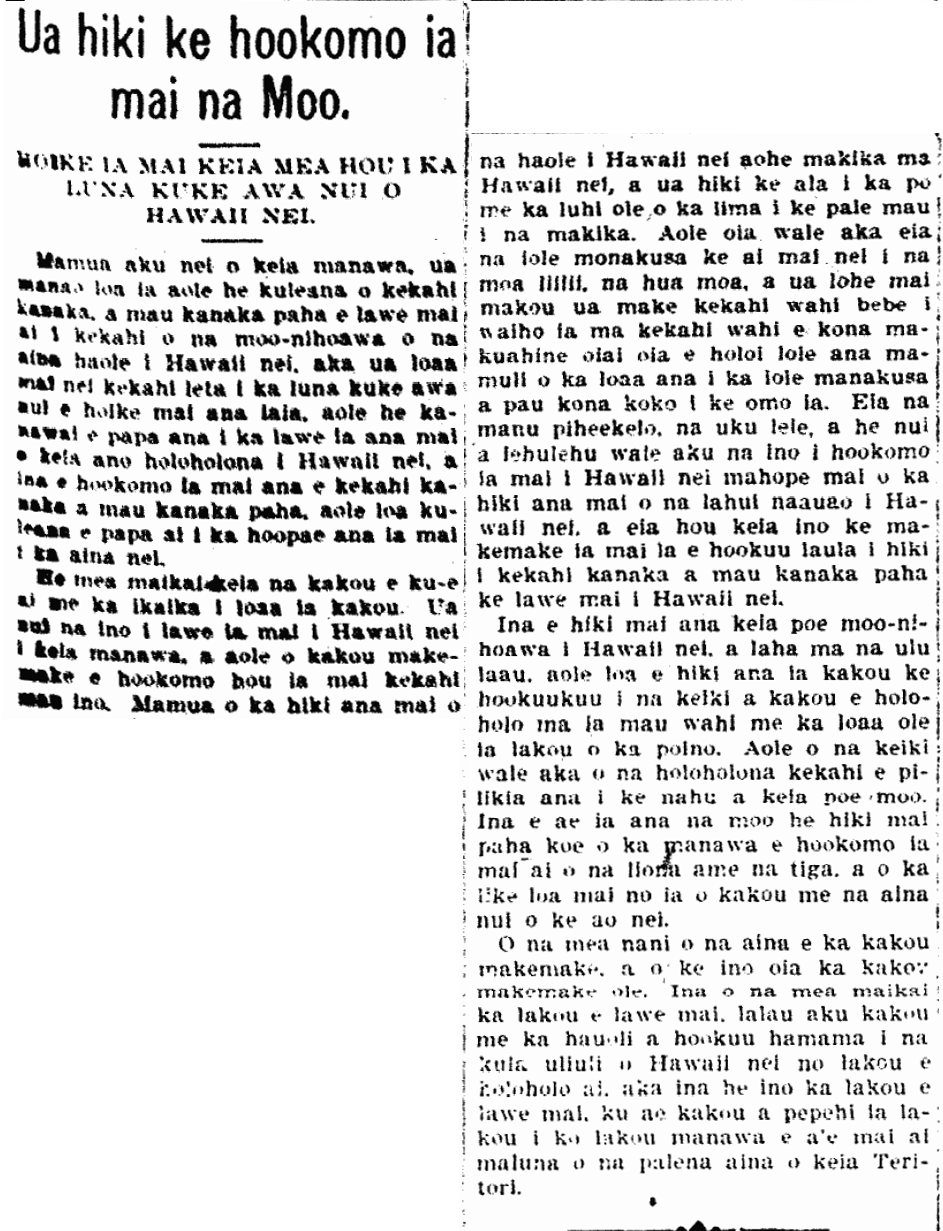
Ua hiki ke hookomo ia mai na Moo.

Ka Nupepa Kuokoa, Buke XL, Helu 15, Aoao 1. Aperila 11, 1902.
Night fishing violations, 1932.

There were many who were arrested by the Fishing Warden; these were people who had no rights to fish as per the Law dealing with people who are not natives [citizens?] of Hawaii.

They are allowed to fish at night, only if they get a license, which can be used for a year.

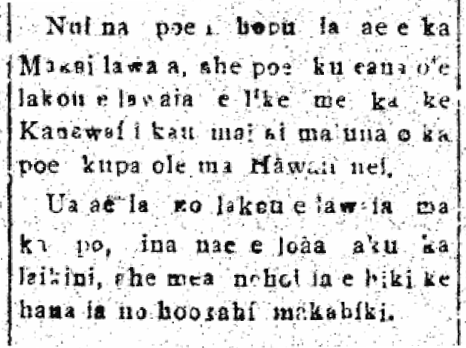
[I wonder if this gets typescripted by someone who has no Hawaiian language knowledge, if any of the key words will be found doing a word search (lawaia, kanawai, …) Or, will it look more like this:

Nui na poe i hoou la ae e ka Makai lawa a, ahe poe ku eana o’e lakou e la@aia e like me ka ke Kauewai i kau mai ai ma una o ka poe kupa ole ma Hawaii nei.

Ua ae la eo lakau e law@ia ma ka po, ina nac e loaa aku ka laikini, ahe mca nohoi ia e @iki ke haua ia no hookahi makahiki.

This is actually one of the articles that aren’t as bad as many…]

(Hoku o Hawaii, 4/5/1932, p. 3)

Nui na poe i hopu ia...

Ka Hoku o Hawaii, Buke XXV, Helu 43, Aoao 3. Aperila 5, 1932.

Keeping the streets of Honolulu clean? 1912.

TO PRESERVE THE CLEANLINESS OF THE STREETS OF HONOLULU.

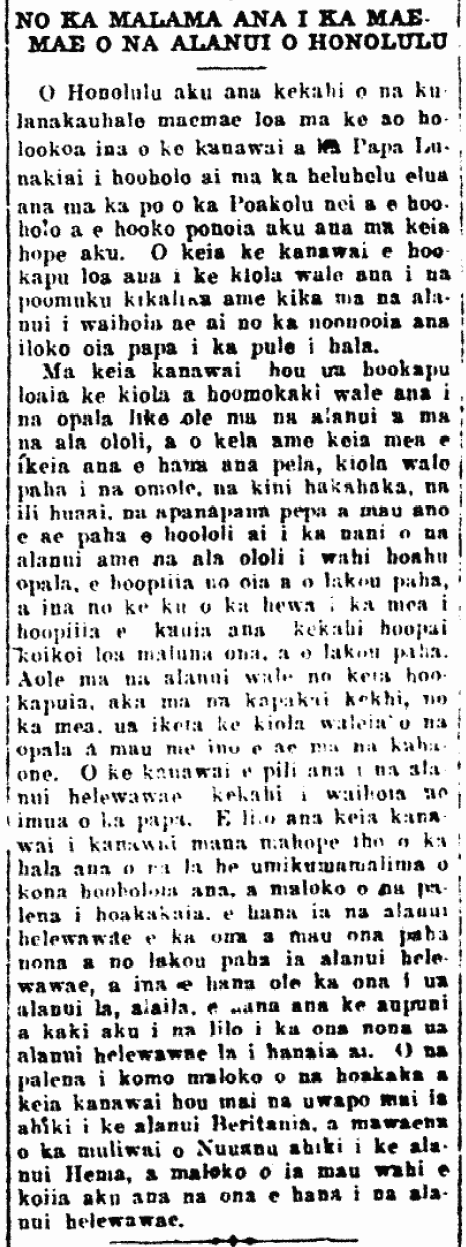
Honolulu will become one of the most cleanest cities in the world should the law that the Board of Supervisors [Papa Lunakiai] passed for the second reading on the night of this Wednesday, progress and go through in the future. This is the law that will outlaw the discarding of cigarette and cigar butts on the street which was put to consideration before the board last week.

In the new law, throwing and littering of all kinds of rubbish on streets and lanes is strictly prohibited, and all persons seen doing this: throwing a bottle or empty can, fruit peel, pieces of paper and other things that will alter the beauty of the streets and lanes into rubbish piles, he or they will be brought up on charges, and if found guilty, a heavy punishment will be doled out upon him or them. It is not only prohibited on streets, but also on beaches, because rubbish and other trash is seen being just thrown on the sand. There is a law pertaining to the sidewalks as well before the board. This law will go into effect after fifteen days from its passing, and within the area specified, sidewalks will be made by the owner or owners who the sidewalks belong to, and if he or they do not make them, the government will do so and charge the expenses to the owner to whom belongs the sidewalk that was made. The area covered in this new law is from the pier until Beritania Street and between Nuuanu River and South Street; and within this area, owners will be required to build sidwalks.

(Kuokoa, 3/29/1912, p. 8)

NO KA MALAMA ANA I KA MAEMAE O NA ALANUI O HONOLULU

Ka Nupepa Kuokoa, Buke XLVIII, Helu 13, Aoao 8. Maraki 29, 1912.

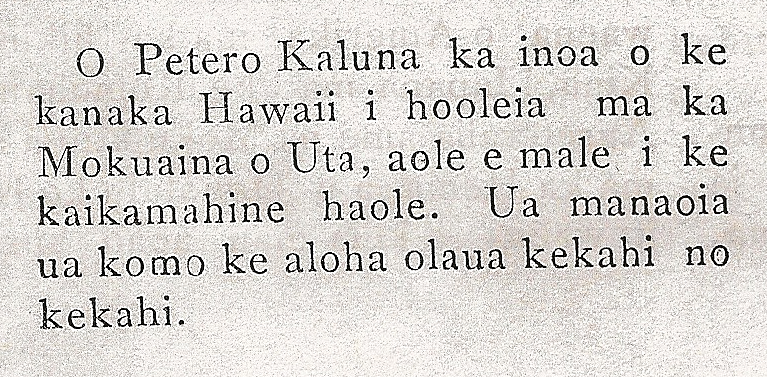
How sad it must be to be denied marriage to someone you love, 1902/2012.

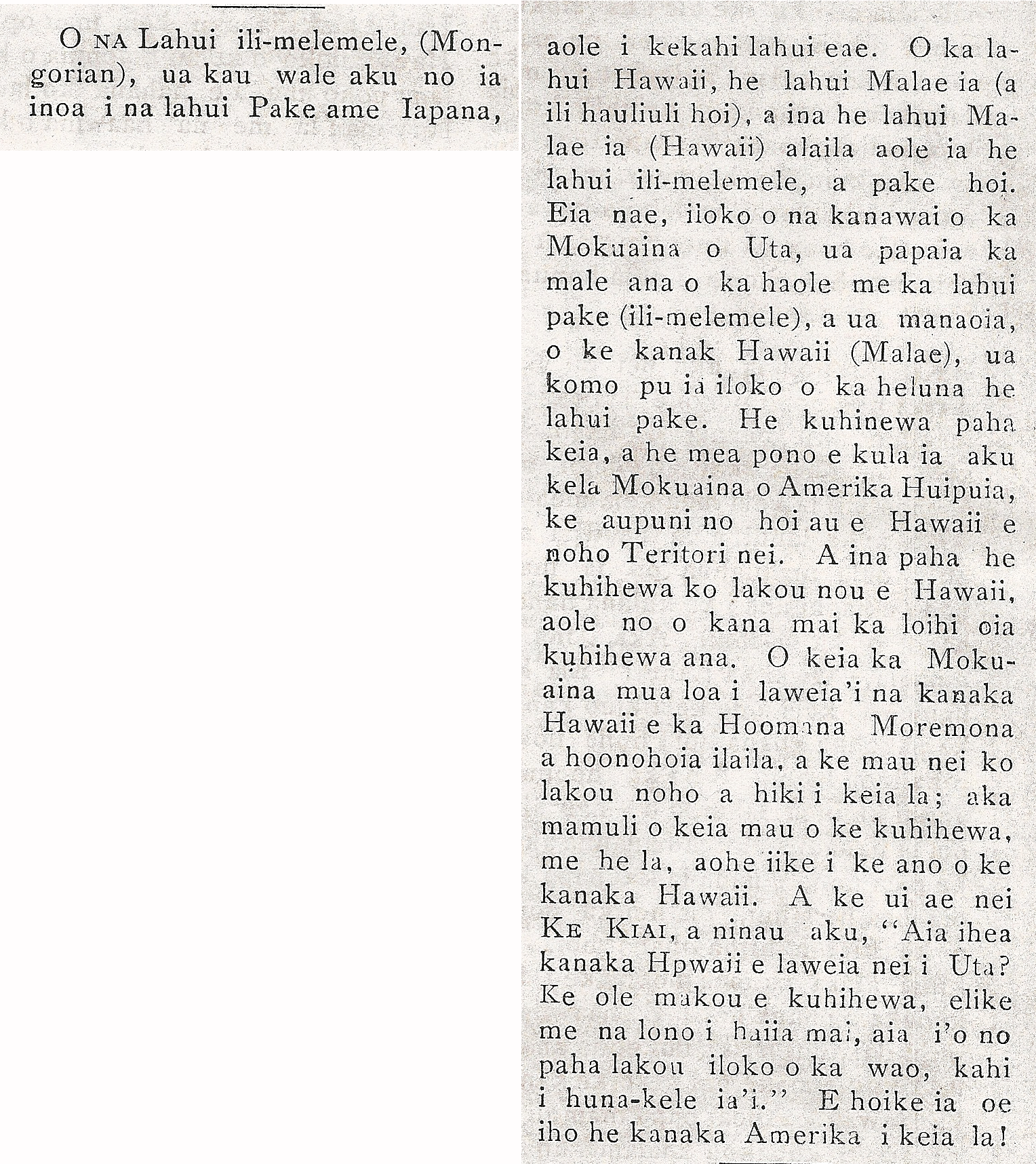
THE yellow-skinned races (Mongolian), include the Chinese and Japanese, and not other lahui. The Hawaiian Race is of the Malae race (the brown-skinned), and if the Hawaiians are Malae, then they are not yellow-skinned, or Chinese. And yet, under the law of the state o Utah, haole are not allowed to marry Chinese (yellow-skins), and it is believed that Hawaiians (Malae) are included amongst the Chinese. This is perhaps a mistake, and that state of the United States needs to be educated of the nation in which you live as a Territory. And if they are mistaken about you, O Hawaii, this error is incredibly long standing. This is the first state to which Hawaiians were brought by the Mormon Faith to live, and they are still there to this day; but because of this continued misunderstanding, it is as if they do not know the nature of Hawaiians. The Kiai questions and asks, “Where in Utah are Hawaiians being taken? If we are not mistaken, and according to what is reported, they are perhaps in the desert, where they are hidden away.” Reveal yourself to be an American today!

(Kiai, 9/11/1902, p. 1)

O NA Lahui ili-melemele...

Ke Kiai, Buke 1, Helu 3, Aoao 1. Sepatemaba 11, 1902.

More on the lowering of the flag, 1898.

WHO HATH EARS TO HEAR, LET HIM HEAR.*

Being that in time that news reported of earlier will come, about the raising of the American Flag above Hawaii, from the authority of the Republic of America; and in regard to this, word is being sent out to my beloved nation of Patriots.

DECLARATION TO THE LAHUI.

To all Patriots, we pray [ke Ka o ia aku nei? ke Kalo ia aku nei?] that you will not visit nor approach the area where the American Flag will be raised; let everyone remain at their own Home, kneel and look to the almighty one to ask for his help for the Hawaiian Nation, Land, and Kingdom.

All heads and leaders of the men’s and women’s Ahahui Aloha Aina [Hawaiian Patriotic League] and Hui Kalaiaina [Hawaiian Political Association], are directed to heed this as well.

JAMES K. KAULIA.

President.

*Mataio (Matthew) 13:9.

(Aloha Aina, 8/6/1898, p. 4)

O KA MEA PEPEIAO LOHE E HOOLOHE IA.

Ke Aloha Aina, Buke IV, Helu 32, Aoao 4. Augate 6, 1898.

Personal Lands of Kamehameha III, and Government Lands, 1848.

By the Government.

A LAW FOR THE PERSONAL LANDS OF THE KING,
AND THE LANDS OF THE NATION.

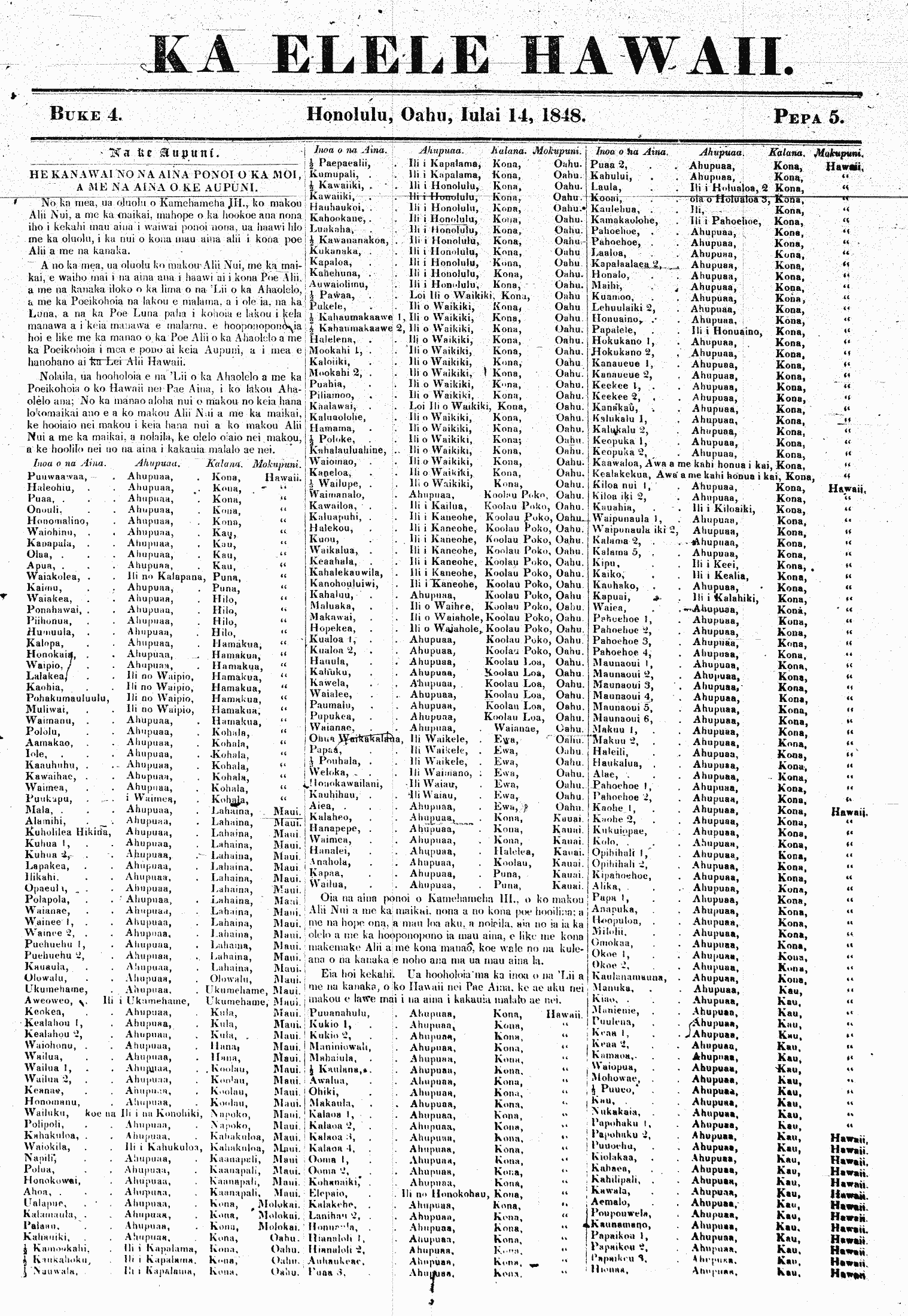
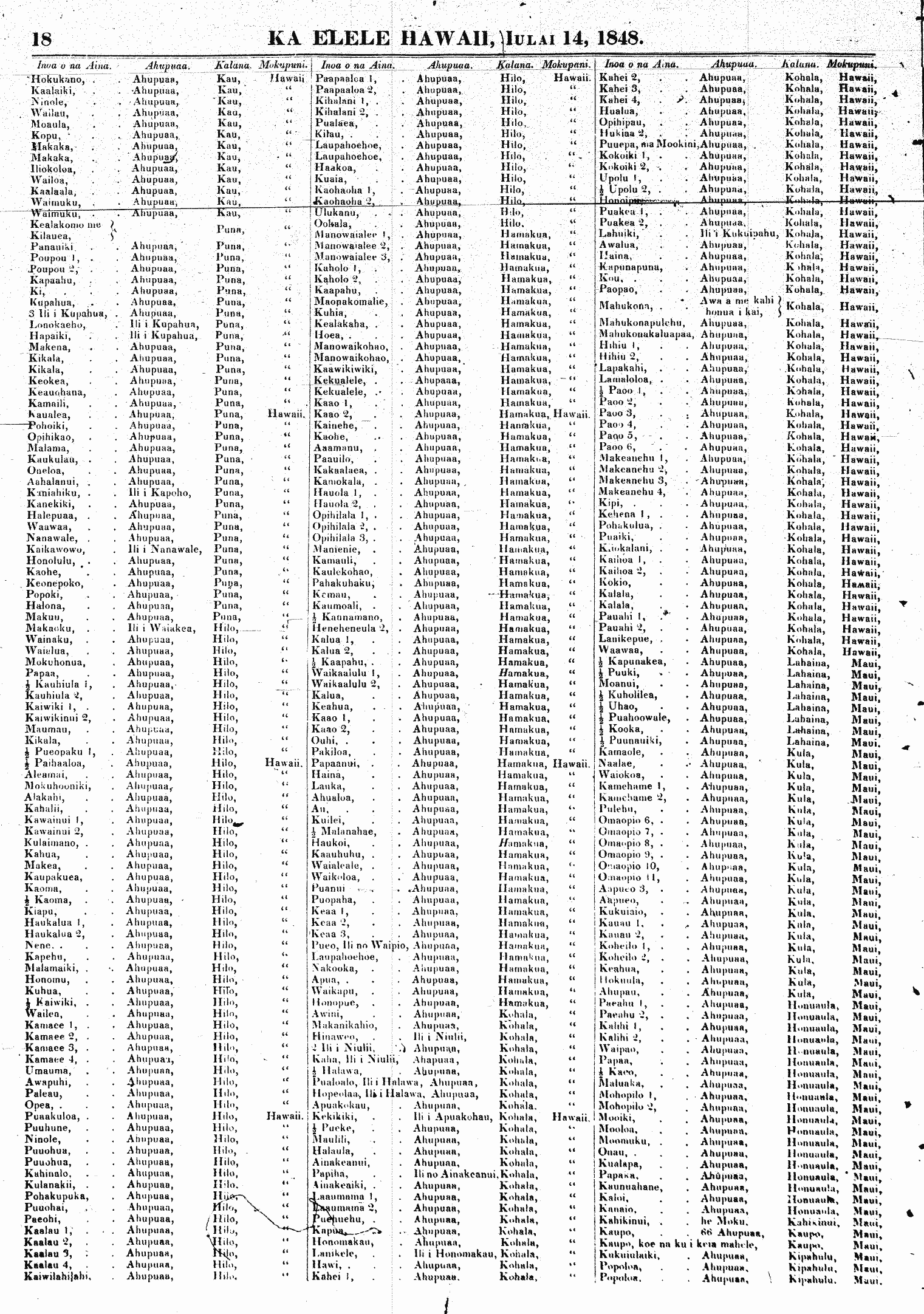
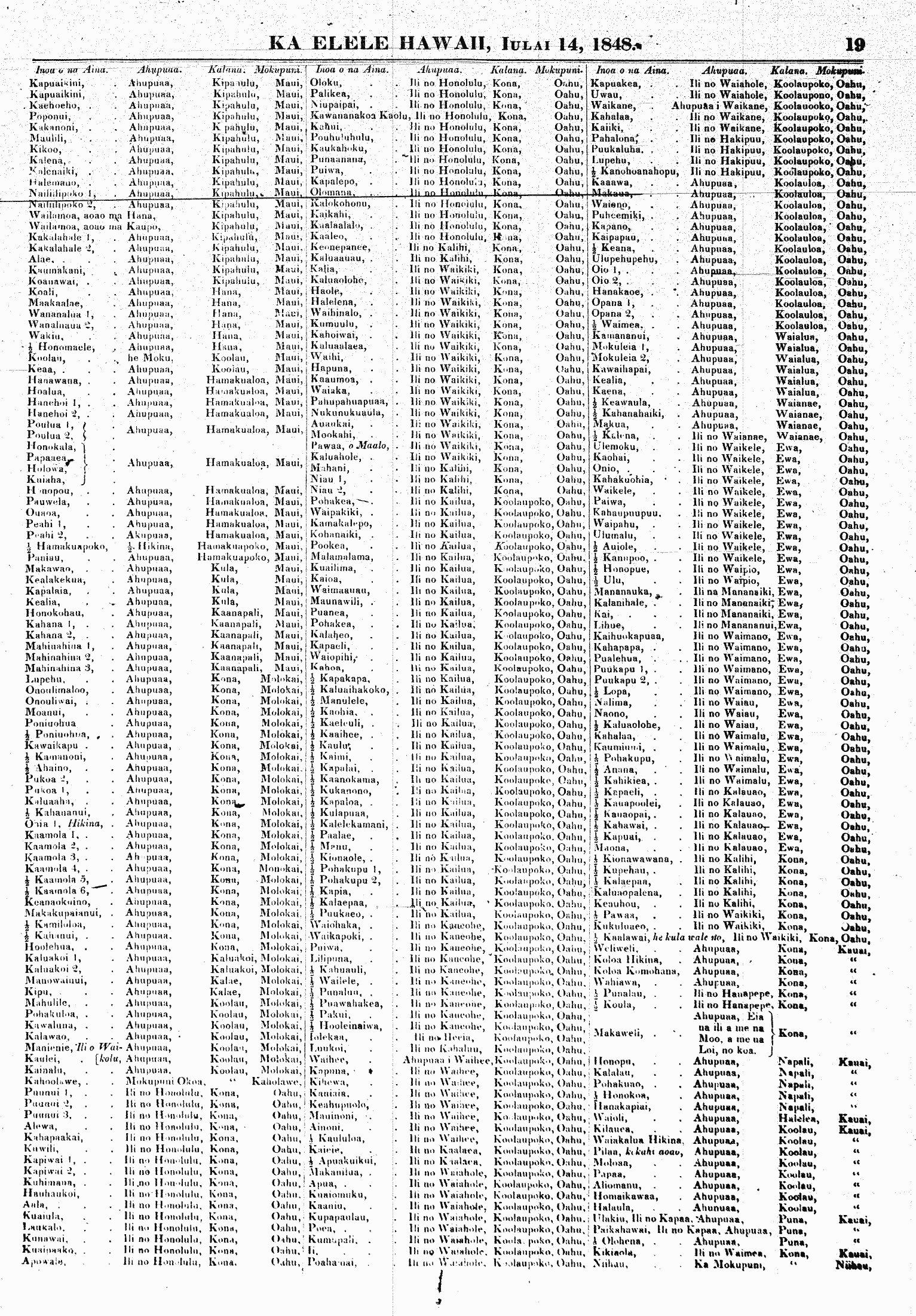
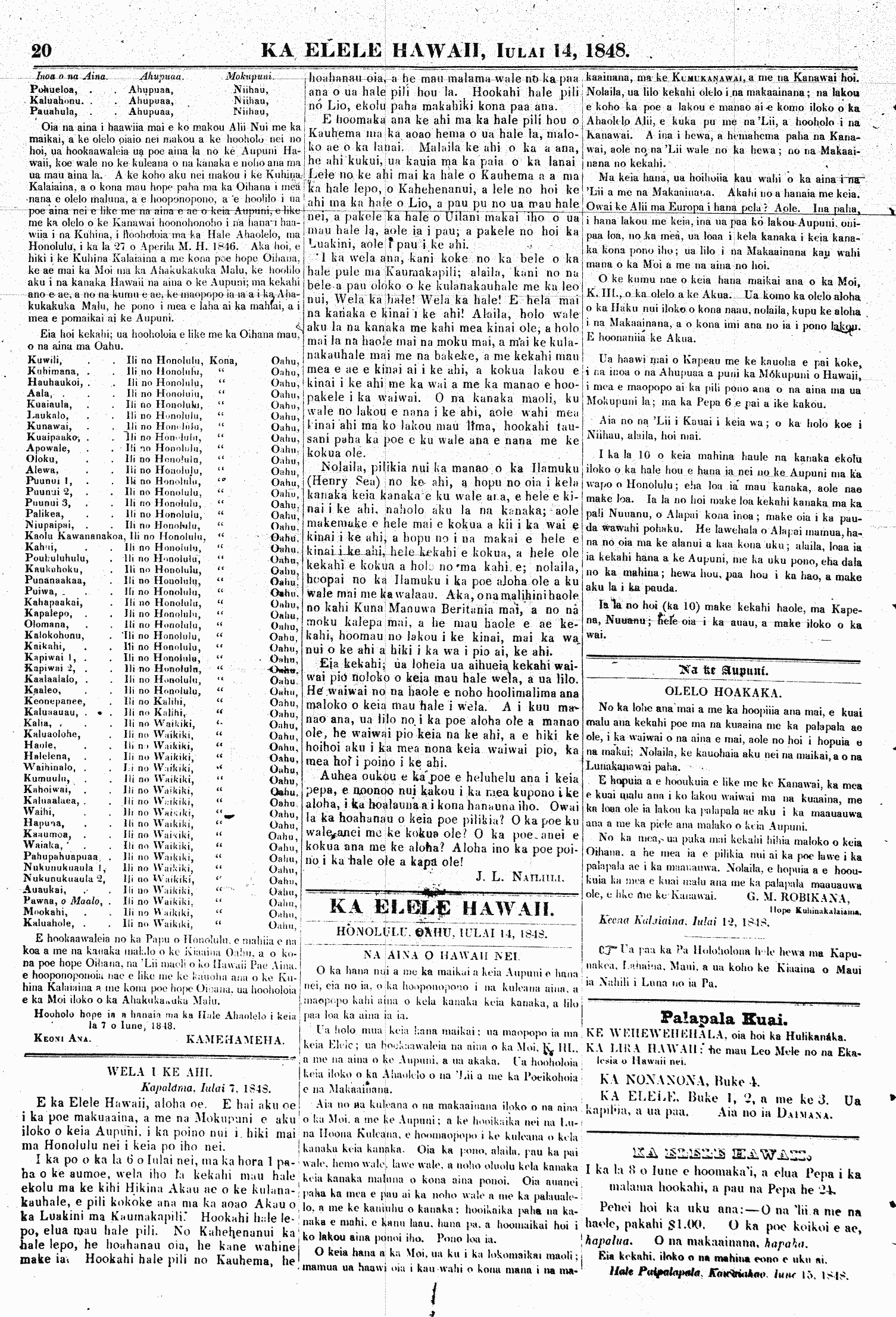
[Here is a newly passed law of the land appearing in the newspaper Elele Hawaii. One of the functions of the newspapers was to inform the nation’s citizens of new laws and proclamations from the government. This particular law establishes the Crown Lands (and Government Lands) which still holds much importance to this day.

For a translation see “A Supplement to the Statute Laws of His Majesty, Kamehameha III., King of the Hawaiian Islands, … 1848.” pp. 22–43.

What is also valuable about this listing is that it describes in 1848 what ahupuaa a certain land belonged to, and so forth.]

(Elele Hawaii, 7/14/1848, pp. 17–20.)

HE KANAWAI NO NA AINA PONOI O KA MOI, A ME NA AINA O KE AUPUNI.

Ka Elele Hawaii, Buke 4, Pepa 5, Aoao 17. Iulai 14, 1848.


HE KANAWAI NO NA AINA PONOI O KA MOI, A ME NA AINA O KE AUPUNI.

Ka Elele Hawaii, Buke 4, Pepa 5, Aoao 18. Iulai 14, 1848.

HE KANAWAI NO NA AINA PONOI O KA MOI, A ME NA AINA O KE AUPUNI.

Ka Elele Hawaii, Buke 4, Pepa 5, Aoao 19. Iulai 14, 1848.

HE KANAWAI NO NA AINA PONOI O KA MOI, A ME NA AINA O KE AUPUNI.

Ka Elele Hawaii, Buke 4, Pepa 5, Aoao 20. Iulai 14, 1848.

Kuhio and the water of Wahiawa, 1912.

KUHIO OPPOSES THE SALE OF WAHIAWA’S WATER

WASHINGTON, February 1.—Delegate Kuhio submitted a protest to the secretary of the department of war opposing the plan announced by the war department t0 lease out the rights to the water rights of Wahiawa to the highest bidder. He clarified in his complaint that the land and water rights of lands set aside for the military by the Federal Government for the use of the military, and by right it is improper that the water be taken as an income-making commodity for the Federal Government. The delegate feels that the Federal Government is allowed to take and use the water on the lands set aside for the military, but the the entirety of the remaining water should fall under the authority of the Territory of Hawaii; or perhaps a different route, that the income made from sale or lease of this water should all come back to the Territory and should not go to the Federal Government. This idea of Delegate Kuhio’s  is greatly supported by the representatives of this Territory in Washington.

(Kuokoa, 2/16/1912, p. 5)

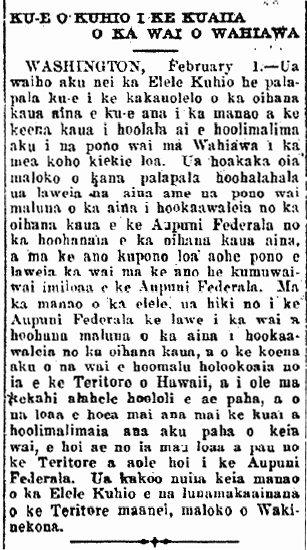
KU-E O KUHIO I KE KUAIIA O KA WAI O WAHIAWA

Ka Nupepa Kuokoa, Buke XLVIII, Helu 7, Aoao 5. Feberuari 16, 1912.

Romeo and Juliet of Hawaii? 1912.

HOPE LOST.

This Saturday Avira was returned to Honolulu nei; he is an 18 year-old Portuguese boy who left aboard the Maunakea on Tuesday to marry the young woman who he is deeply in love with, in Hawi, Kohala. This desire of the boy would have perhaps been fulfilled were it not interfered by the police of Kohala. When the young Avira arrived in Kohala, a wireless telegraph from Deputy Sheriff Charles Rose had already reached the police there, to watch for the young Avira and to stop him from marrying the young girl he loved, according to the request of Joe Augustine Avira, his father, who was opposed to the marriage of his son to this girl. According to the statement of the police department, these two sweethearts are children that have not reached the age of adulthood.

(Aloha Aina, 2/3/1912, p. 2)

POHO KA MANAOLANA.

Ke Aloha Aina, Buke XVI, Helu 5, Aoao 2. Feberuari 3, 1912.