Stanford University Hawaii Club, 1905.

LEIS AT STANFORD

AN INTERESTING SOCIETY FORMED AT THE UNIVERSITY AT PALO ALTO—LEIS OF ROSES AND SCORE CARDS OF LAUHALA AT A CARD PARTY OF THOSE WHO HAVE LIVED IN THE ISLANDS.

STANFORD UNIVERSITY, April 13, 1905.—A number of Island people met on the evening of April 7, at the home of Mr. and Mrs. A. D. Larnach, and formed what was named the “Hui Hawaii” which is intended to bring together the Hawaiians about Stanford University in a social way. It was decided to have this a most informal affair and not to choose any regular officer, but simply to have it made known at one meeting who is to entertain at the next one. Anyone who has been in the Islands is to be eligible to membership. Continue reading

Tourism and the revival of lauhala, 1936.

Tourist Business In Hawaii Booms As Result Of Publicity

An influx of visitors to the Hawaiian islands during the past few years has revived many of the interesting traditions and practices of Old Hawaii.

This paradox was recently pointed out by Percy A. Swift, manager of the merchandise department of American Factors, Ltd., in a discussion of Hawaii’s tourist industry.

“An interesting sidelight of the travel business here has been the way it has encouraged Island customs and activities,” he said. “The nourishing influence of tourist interest has given added impetus to the lei tradition, for example; and it has revived native sports such as surfing and outrigger canoe riding, which were on the point of dying out 15 years ago.” Continue reading

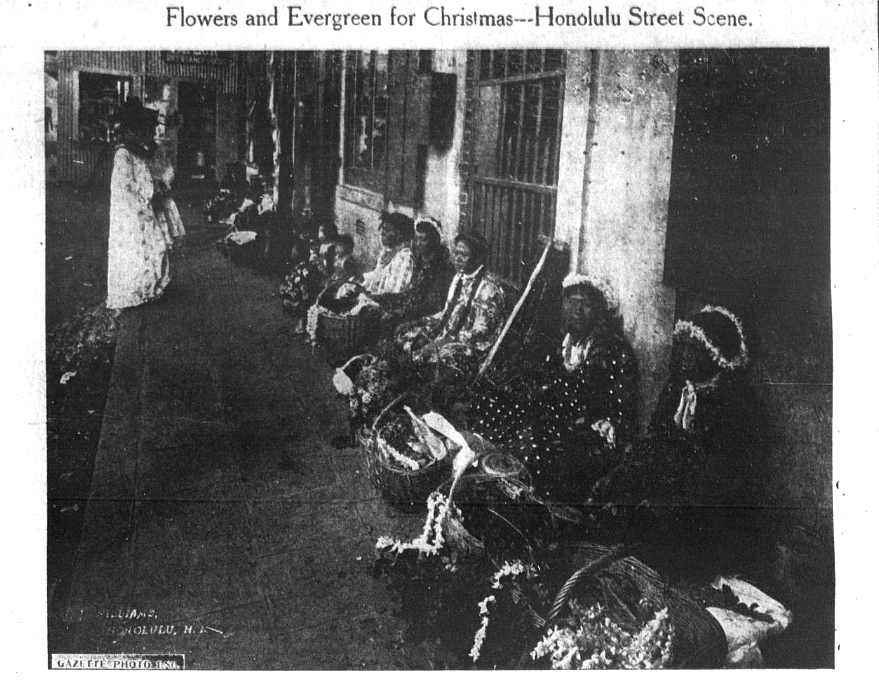
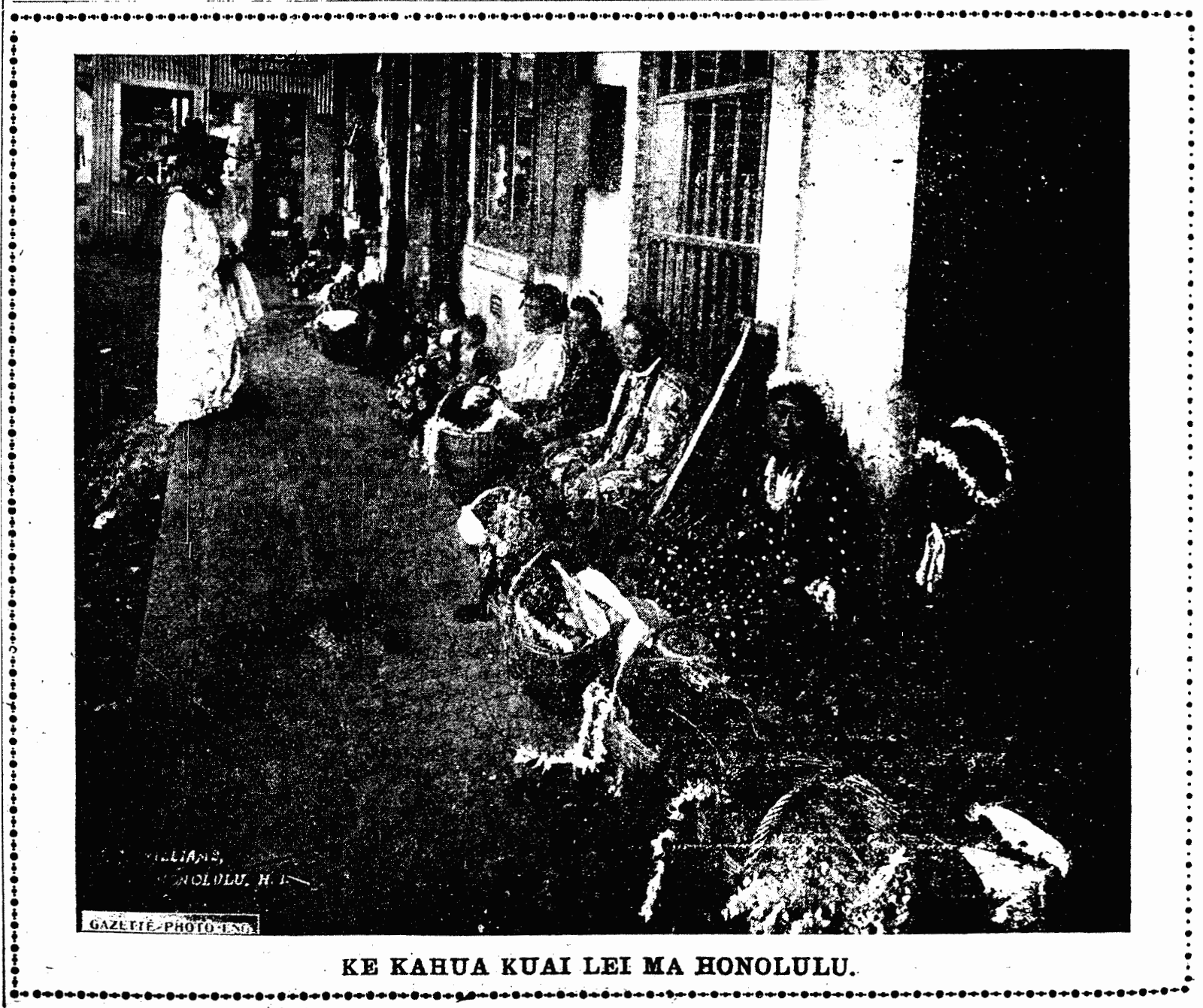
One more Christmas scene from Honolulu nei, 1910.

Flowers and Evergreen for Christmas—Honolulu Street Scene.

J. J. WILLIAMS

HONOLULU, H. I.

GAZETTE PHOTO ENG.

[I just realized now that this is a reused picture. It appears earlier in Kuokoa, 3/11/1904, p. 4! The reuse of stock photos is not unusual (even today)…]

(Hawaiian Gazette, 12/27/1910, p. 3)

Flowers and Evergreen for Christmas...

The Hawaiian Gazette, Volume LIII, Number 100, Page 3. December 27, 1910.

Treasures spread across the four corners of the earth? 1906.

Auction Sale

Tourists! Collectors!

Thursday, Feb. 1, 1906,

10 O’CLOCK A. M.,

At my salesroom, 847 Kaahumanu Street, I will sell, under instruction from the Administrators of the Estate of

MARY AILAU

the eminent Hawaiian collector, the following ancient and other relics of

Ancient Chiefs

Pig Platters,

Calabashes,

Cocos (Calabash Nets),

Tapas,

Stone Adzes,

Stone Lamps,

Mike Stones,

Poi Pounders,

49 Fans,

2 Kauila Aumakuas (War Spears),

2 Hula Drums (Ancient),

1 Idol—Kukaili-iki—One of Kamehameha’s War Gods,

1 Ipu Hula (Gourd Drum),

1 Pawehe Calabash,

1 Pawehe Water Bottle,

1 Newa (War Club),

2 Bamboo Cushions,

1 Hinai Opae,

2 Samoan War Clubs,

1 Koko (Ancient),

1 Black Kapa (Burial),

1 Lauhala Hall Mat,

7 Samoan Cocoanut Bowls,

1 Lauhala Bag,

1 Case Stuffed Hawaiian Birds,

1 Aumakua,

1 Kauila Kahili Stick,

1 Kahili Stick (Tortoise) and Ivory (Ancient),

2 Emu Eggs,

1 Carved Coco Bank,

1 Large Show Case,

4 Lei Hulus (Native Birds),

1 Samoan War Club,

1 Moss Album.

JAMES F. MORGAN,

AUCTIONEER.

(Pacific Commercial Advertiser, 1/29/1906, p. 8)

Auction Sale

The Pacific Commercial Advertiser, XLIII, Number 7324, Page 8. January 29, 1906.

More on the “separating disease”, 1889.

Leaving the Bosom of the Parent and the Homeland.

I left my parent and the land of my birth in the famed cliffs in the mists of Honokohau, West Maui, and my path turned toward Honolulu, then I was sent away to Kalawao, with “That one there has leprosy.”

I was born in Honokohau, Maui, in the month of September, on the 12th, 1867; by Sam. L. Kalaola and Mrs. Keolamahunehune Kamoku Kalaola; and therefore, that is the land of my birth, and for that land is this pikake lei which I love:

O land of my birth,
My beloved land,
I aloha
Your beaches,
The uplands,
The ever green fields.

I was raised at Honokohau until older, and when I turned 6, I was sent by my parents to go to school, and A. W. Kanahi was my teacher; and to all of you my friends who suffered in the pursuit of education goes my aloha nui, and this maile lei which i wear:

Aloha to you my friends,
My classmates
It is time for me to go
Aloha nui
I will go singing
Put aside the lamentations
Aloha nui
Aloha to the fields
The ridges
My dear school house
Aloha nui
I will be leaving for somewhere else
With you always will be my appreciation
Aloha nui.

When I became 12 or so, at that school, I gained some knowledge; after that, I was sent to the English school at Kaluaaha, and later was sent back to the first school which I attended, and here I stayed until I became old; and in the year 1887, I returned to Kahikinui and my hands became deformed, and on a day in this past September, my father was ordered by the deputy marshal of Lahaina to take me to be sent to Honolulu, and from Honolulu to Kalawao.

My father assented in accordance with his occupation as a policeman of district of Lahaina, but not happily, but with bad feelings, left without aloha and without friends, but it was the right thing to do, for this was a person who contracted the disease, the disease called “the family separating disease;” and for this disease is this ahihi lei:

You go to Kalawao
You have the “Chinese disease”
The disease hated by the people
The brown-skinned and the white-skinned.
Your companions change
Before there were many times together
And you were with me, and I with you
One bite and we are severed.

On Friday evening, my father returned from Lahaina and told me the news about me going to Kalawao, and he said to me his last thoughts, saying with words of grief, “You go, stand tall, go to this place where the law of the land has set aside for those who contract this disease; this year God has put me in much difficulties, but don’t forget my words to you, and these are they: don’t forget God, our God who mad the ocean, the cliffs, the rain, the heat of the sun, and so forth.”

I went on Saturday, but there was no ship, and I returned. On Thursday of the next week, there again was no boat, and I waited in Lahaina for a boat; and at 9 at night on Saturday, I boarded the steamship Iwalani, and for this ship is this mele of affection:

The Iwalani turns back
To see the calm of Kona
We are outside of Kailua
Where the Wiliahiu wind blows
One push and we are in Honolulu
And I am at the hospital in Kalihi.

There are three of us from the same place, and at 6 in the morning on Sunday, we reached the landing at Ainahou. The officer was there, and were were taken to Kalakaua Hale and from there to Kalihi. We stayed there for a week and went immediately to Kalawao. And we now live in this friendless land, the land set apart for us, the grave for our bodies.

Here I will conclude my travels, and to the Editor my farewell, and to the metal typesetting boys my good bye.

Me,

Miss Sam. L. K. Kalaola.

Kalawao, Molokai.

[Don’t forget if you are free this evening, and on Oahu nei, there is this presentation at Native Books!]

(Kuokoa, 10/26/1889, p. 4)

KA HAALELE ANA I KA POLI O KA MAKUA A ME KA AINA HANAU

Ka Nupepa Kuokoa, Buke XXVIII, Helu 43, Aoao 4. Okatoba 26, 1889.
A day to remember, 1924.

THE “DAY TO PLACE FLOWERS” WAS OBSERVED HERE IN HONOLULU

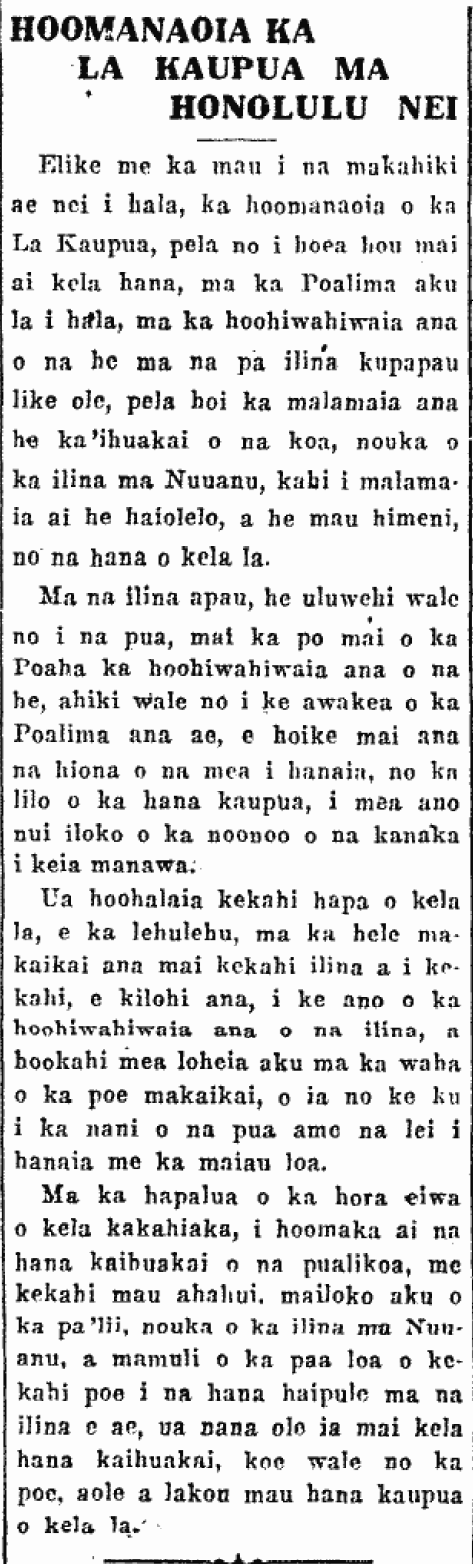
Just as in years past where Decoration Day [La Kaupua] was observed, so too has it come again on this past Friday, as the graves in the different cemeteries were decorated, and also a parade of soldiers was held upland of the cemetery of Nuuanu, where speeches were given as well as songs, for the observances on that day.

All of the cemeteries were decorated with flowers; from Thursday night the graves were being decorated until noon of the following Friday, showing that the observation of Decoration Day is given much thought to by the people these days.

A majority of the day was spent by the people going around from graveyard to graveyard looking at the adornments of the graves, and one thing heard amongst the people making their rounds was that the flowers and lei done with great care were beautiful.

At nine thirty in the morning, the parade of the soldiers and some organizations began from within the palace grounds up to the cemetery in Nuuanu, and being that some people were occupied with prayers at other cemeteries, this parade was not given any thought to, except by those who were not participating in decorating flowers on that day.

[Memorial Day (Decoration Day), which was held on the 30th of May and is now held on the last Monday of May, can be found in the Hawaiian-Language Newspapers as La Kaupua (“day to place flowers”) or La Lupua (“day to strew flowers”).]

(Kuokoa, 6/5/1924, p. 1)

HOOMANAOIA KA LA KAUPUA MA HONOLULU NEI

Ka Nupepa Kuokoa, Buke LXIII, Helu 23, Aoao 1. Iune 5, 1924.

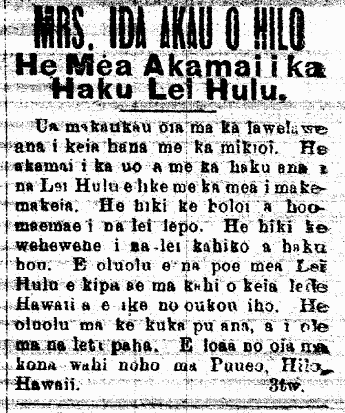
Hilo feather lei maker Ida Akau, 1901.

MRS. IDA AKAU OF HILO

A Person Skilled at Making Lei Hulu.

She is proficient at this work with fine workmanship. She is skilled at tying feathers [uo] and putting feather lei together [haku] as per one’s desires. She can clean soiled lei. She can undo old lei and remake them. Those who have Lei Hulu, pleace come and visit the place of this Hawaiian lady to see for yourselves.  Consultation by visit or by correspondence is welcomed. She can be found at her residence in Puueo, Hilo, Hawaii.

(Aloha Aina, 11/9/1901, p. 3)

MRS. IDA AKAU O HILO

Ke Aloha Aina, Buke VII, Helu 45, Aoao 3. Novemaba 9, 1901.

Lei Day in Lahaina, 1944.

[Found under: “Na Hunahuna Mea Hou O Maui”]

Lei Making is Held

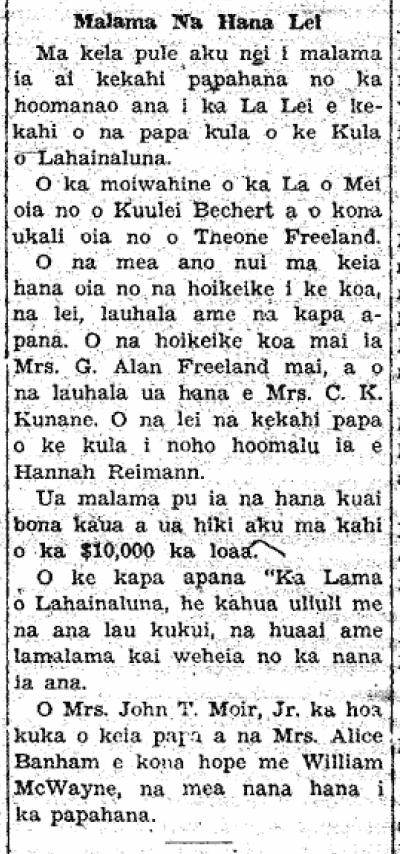
Last week, an event was held to commemorate Lei Day by the classes of Lahainaluna School.

The May Day queen was Kuulei Bechert and her attendant was Theone Freeland.

The featured things at this event were the display of items of koa, the lei, lauhala and applique quilt [kapa apana]. The koa display was from Mrs. G. Alan Freeland, and lauhala was done by Mrs. C. K. Kunane. The lei were done by some classes of the school watched over by Hannah Reimann.

Also undertaken was the selling of war bonds and the proceeds reached $10,000.

The quilt, “Ka Lama o Lahainaluna” [The Light of Lahainaluna] was on a dark background with a pattern of kukui leaves, fruit, and torch, which was spread out to be seen.

Mrs. John T. Moir, Jr., was the adviser of this event, and Mrs. Alice Banham was her assistant along with William McWayne; they were the supervisors of this program.

(Hoku o Hawaii, 5/17/1944, p. 1)

Malama Na Hana Lei

Ka Hoku o Hawaii, Volume XXXIX, Number 4, Aoao 1. Mei 17, 1944.

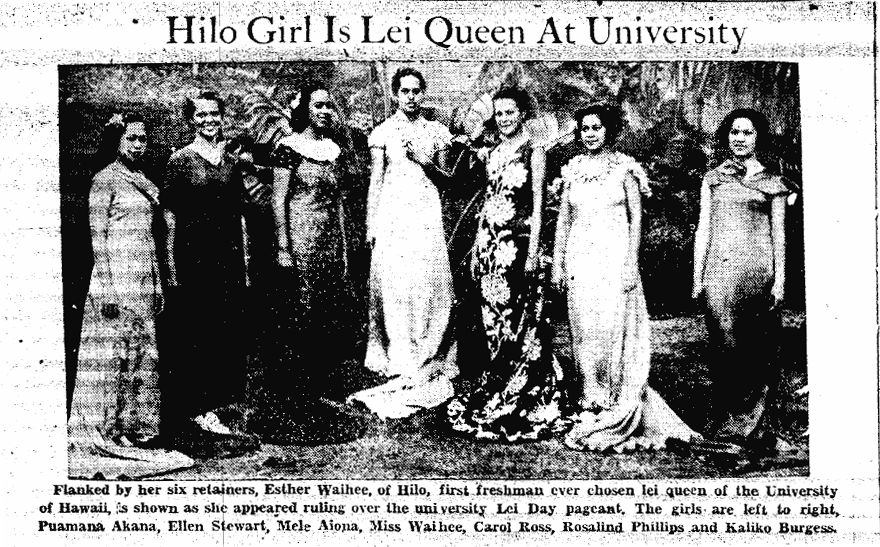
University of Hawaii Lei Day Queen, 1936.

Hilo Girl Is Lei Queen At University

Flanked by her six retainers, Esther Waihee, of Hilo, first freshman ever chosen lei queen of the University of Hawaii, is shown as she appeared ruling over the university Lei Day pageant. The girls are left to right, Puamana Akana, Ellen Stewart, Mele Aiona, Miss Waihee, Carol Ross, Rosalind Phillips and Kaliko Burgess.

(Hoku o Hawaii, 5/13/1936, p. 1)

Hilo Girl Is Lei Queen At University

Ka Hoku o Hawaii, Volume XXXI, Number 3, Aoao 1. Mei 13, 1936.