Mother’s Day at Honokaa Union Church, 1942.

[Found under: “Meahou O Na Kohala Ame Hamakua.”]

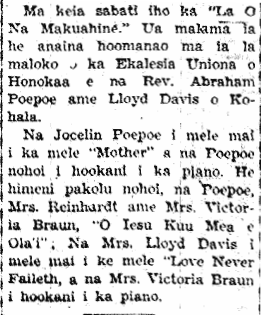
This past Sunday was the “Day of Mothers.” A commemoration was held at the Union Church of Honokaa by the Rev. Abraham Poepoe and Lloyd Davis of Kohala.

Jocelin Poepoe sang the song “Mother” and Poepoe [? Abraham] played the piano. There was a trio with Poepoe, Mrs. Reinhardt and Mrs. Victoria Braun, singing “O Iesu Kuu Mea e Ola’i,” and Mrs. Lloyd Davis sang “Love Never Faileth,” and Mrs. Victoria Braun played the piano.

[This was found in the regular column written by Hattie Linohaupuaokekoolau Saffery Reinhardt on news from North and South Kohala and Hamakua.]

(Hoku o Hawaii, 5/13/1942, p. 1)

Ma keia sabati iho ka "La o Na Makuahine."...

Ka Hoku o Hawaii, Volume XXXVII, Number 3, Aoao 1. Mei 13, 1942.

Mrs. Mileka Rose Silva passes on, 1922.

GREATEST OF ALL IS ALOHA, IT CANNOT BE DROWNED BY GREAT FLOODS.

MRS. MILEKA ROSE SILVA

Mr. Editor of the Newspaper Kuokoa; Much aloha to you:—Please extend your patience with this sad parcel we are sending, and allow it some open space in the Nupepa Kuokoa, should there be space, so that the family and friends of the one who left this life can know of it, from Hawaii, the island of Keawe, to Kauai of Mano with its twinned lei of mokihana.

At 2 a. m., on Monday, June 19, A. D. 1922, the angel of peace came and took the life spirit from the beloved body of Mrs. Mileka Rose Silva, at our beloved home at Number 1033 Wolters Lane, Kapalama, Honolulu, and left her spiritless remains for us, the ohana, with sadness in love, for our beloved who left this life.

Her body remained at our home until 3 p. m., Tuesday the 20th, and the Rev. Samuel K. Kaloa held a service at the home, as well as where her remains were laid to rest at the Cemetery of Pue’a. Continue reading

The Hawaiian Flag, an unwavering tree, 1893.

THE HAWAIIAN FLAG AT A GOVERNMENT OFFICE.

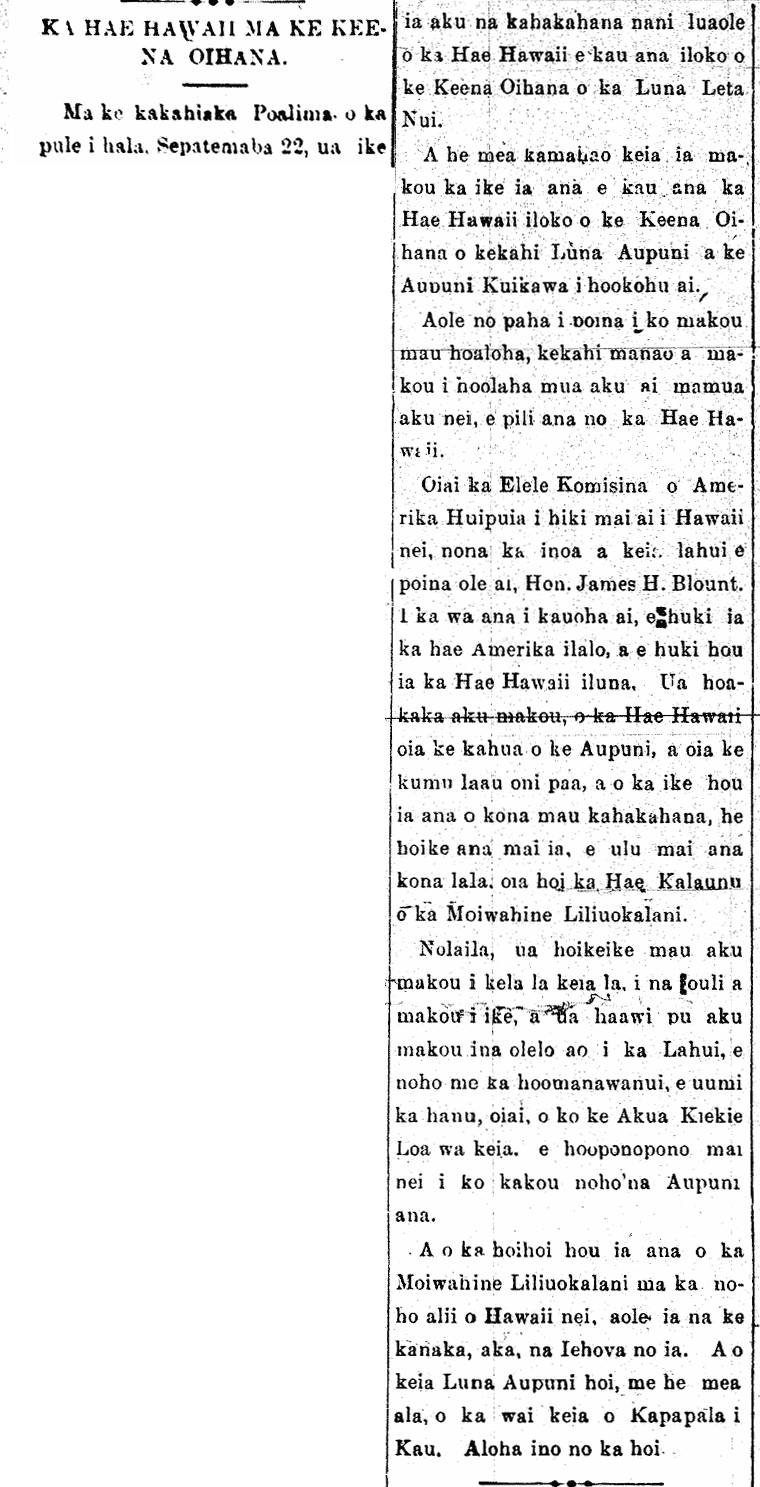
In the morning of Friday last week, September 22, the stripes of the Hawaiian Flag, second in beauty to no other, was seen in the Business Office of the Postmaster General [Luna Leta Nui].

And this is something astonishing for us to see that the Hawaiian Flag is placed in the Office of one of the Heads of Government appointed by the Provisional Government [Aupuni Kuikawa].

Our friends will perhaps not have forgotten the thoughts we published earlier pertaining to the Hawaiian Flag.

The Commissioner of the United States came to Hawaii, whose name will never be forgotten by this people, Hon. James H. Blount, When he ordered that the American flag be taken down and the Hawaiian Flag be raised once again. We made it clear that the Hawaiian Flag was the foundation of this Nation, and it is the unwavering tree; and seeing its stripes once more shows us that its branches are growing, that being the Royal Standard of Queen Liliuokalani.

Therefore we report to you each and everyday all the signs that we see, and we also give advice to the Lahui, to live with patience, to hold your breath, for it is Almighty God’s time now to make right our Nation’s leadership.

The reestablishing of Queen Liliuokalani to the throne of Hawaii nei, that is not something for man to do, but it is for Jehovah. And as for this Government Head, it is as if he is trying to cover up their wrongdoings.¹ How sad.

¹See Olelo Noeau, p. 313, no. 2859, for more on “Uhiuhi lau mamane ka wai o Kapapala.”

(Leo o ka Lahui, 9/25/1893, p. 3)

KA HAE HAWAII MA KE KEENA OIHANA.

Ka Leo o ka Lahui, Buke II, Helu 776, Aoao 3. Sepatemaba 25, 1893.

David Malo and a prediction, 1894.

The prediction of David Malo.

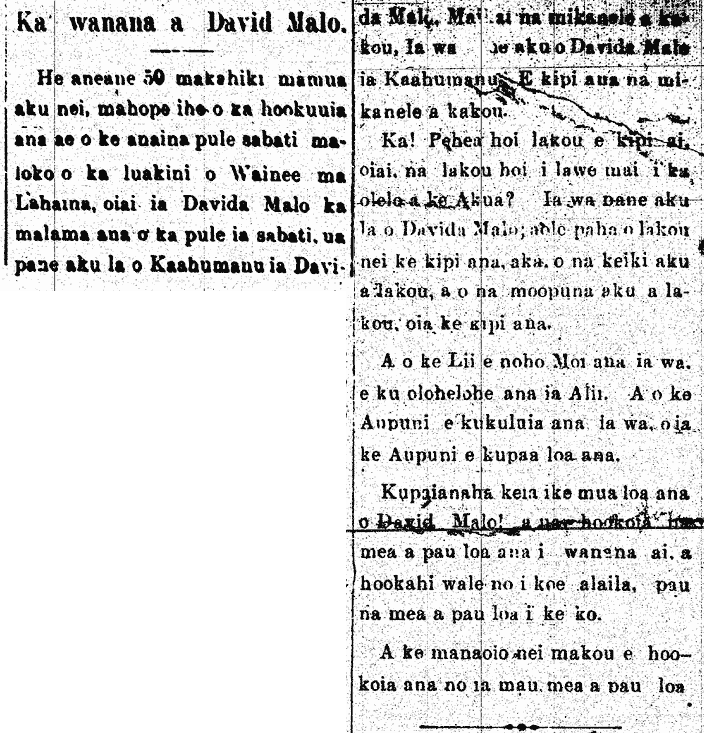
Nearly 50 years ago, after the sunday service was let out from the Wainee Church in Lahaina, while it was Davida Malo who gave the prayer that sunday, Kaahumanu said to Davida Malo, “Our missionaries are good.” Davida Malo then replied to Kaahumanu, “The missionaries of ours will conspire against us [kipi].

“Tsa! How will they revolt, being that it was they who brought the word of God?” To which Davida Malo answered, “Perhaps they will not revolt, but the children after them, and the grandchildren after them; they will be the rebels.

“And the Alii who is ruling as Monarch at the time, that Alii will stand bare. And the Nation built then, that is the Nation that will stand securely.”

How astonishing is this great foresight of David Malo! and everything he predicted [wanana] has come true, except one remains, and then everything will have come true.

And we believe that all of this will come true.

(Leo o ka Lahui, 9/7/1894, p. 2)

Ka wanana a David Malo.

Ka Leo o ka Lahui, Buke II, Helu 1022, Aoao 2. Sepatemaba 7, 1894.

A patriotic mele criticizing the Rev. Joseph S. Emerson, 1893.

THE KAPUUKOLO CHURCH SCANDAL.

There is a saintly son of a gun,
Whose name is J. S. Emerson,
Who goes about in pious style,
To ease his anti-monarch bile.
And enters with his devout brother,
Hawaiian’s meeting: tries to smother,
All aloha for their Queen and land,
By fairy tales of witchcraft brand.
And sweetly says: “My christian friends,
“In order now to gain our ends,
“Will you ally yourselves with one,
“Who being but a native son.
“Has dared to infringe the haole’s plan
“And makes himself (deceitful man)
“The priest of God and Baal too?
“Shall such associate with you?
“Perish the thought! No! brethren dear,
“Not though my father’s sons, ’tis clear,
“Have robbed you of your lands and living,
“And taught you not that way to heaven.
“We’ll sweetly sing, in chorus clear
“The haole takes the government here
“Having taken all else, and let your Queen,
“Rely on none who here are seen.
“Associate she with heathens foul,
“Pig, kahunas, chickens, awa bowl!
“Shall such be helped with christian prayer,
“And our God asked for her to care.”
He stayed his speech and called for votes,
The answer from indignant throats,
Came fast and furious on his ears:
“Take out from here your lying sneers.
“Hypocrite! usurper! rebel! beast!
“Such words become your family least,
“Who live on what the royal hand,
“Gave bounteous of Waialua’s land.
“As pay for early prayer and praise,
“Raised by your father in those days,
“When missionaries first came here,
“And taught us a new God to fear.
“Go, hound! unto your wealthy home,
“Reflect on whence your creature comforts come,
“Think if you can what doom will be,
“Ingratitude’s God will bring to thee.
“Hide your grey locks in deepest shame
“Let another take your father’s name,
“Go, and ne’er again pollute,
“This sacred place with your foul boot.”
They went: None blessed their homeward way:
All seemed relieved: Arose the lay,
Of praise to God: and all agree,
To pray for Queen and Hawaii.

[Here is an article with descriptions of what led to this mele.]

(Hawaii Holomua, 2/11/1893, p. 4)

THE KAPUUKOLO CHURCH SCANDAL.

Hawaii Holomua, Buke III, Helu 7, Aoao 4. Feberuari 11, 1893.

Joseph Emerson interrupts meeting at the Kapuukolo Church, 1893.

DEVOTIONS DISTURBED.

Disruption of a Prayer Meeting With Political Dynamite.

A Visitor Miscalculates Hawaiian Feeling On Affairs.

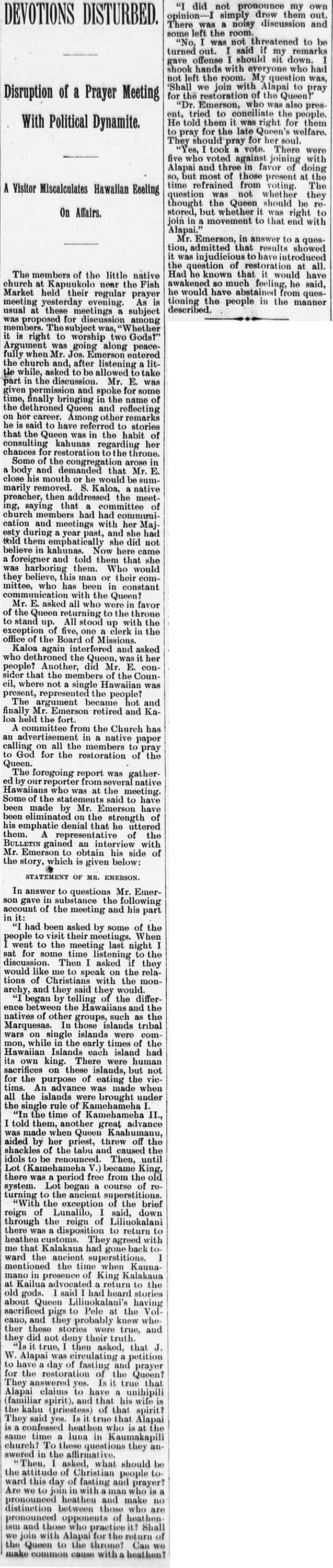
The members of the little native church at Kapuukolo near the Fish Market held their regular prayer meeting yesterday evening. As is usual at these meetings a subject was proposed for discussion among members. The subject was, “Whether it is right to worship two Gods?” Argument was going along peacefully when Mr. Jos. Emerson entered the church and, after listening a little while, asked to be allowed to take part in the discussion. Mr. E. was given permission and spoke for some time, finally bringing in the name of the dethroned Queen and reflecting on her career. Among other remarks he is said to have referred to stories that the Queen was in the habit of consulting kahunas regarding her chances for restoration to the throne.

 Some of the congregation arose in a body and demanded that Mr. E. close his mouth or he would be summarily removed. S. Kaloa, a native preacher, then addressed the meeting, saying that a committee of church members had had communication and meetings with her Majesty during a year past, and she had told them emphatically she did not believe in kahunas. Now here came a foreigner and told them that she was harboring them. Who would they believe, this man or their committee, who has been in constant communication with the Queen?

Mr. E. asked all who were in favor of the Queen returning to the throne to stand up. All stood up with the exception of five, one a clerk in the office of the Board of Missions.

Kaloa again interfered and asked who dethroned the Queen, was it her people? Another, did Mr. E. consider that the members of the Council, where not a single Hawaiian was present, represented the people?

The argument became hot and finally Mr. Emerson retired and Kaloa held the fort.

A committee from the Church has an advertisement in a native paper calling on all the members to pray to God for the restoration of the Queen.

The foregoing report was gathered by our reporter from several native Hawaiians who was at the meeting. Some of the statements said to have been made by Mr. Emerson have been eliminated on the strength of his emphatic denial that he uttered them. A representative of the Bulletin gained an interview with Mr. Emerson to obtain his side of the story, which is given below:

STATEMENT OF MR. EMERSON.

In answer to questions Mr. Emerson gave in substance the following account of the meeting and his part in it:

 “I had been asked by some of the people to visit their meetings. When I went to the meeting last night I sat for some time listening to the discussion. Then I asked if they would like me to speak on the relations of Christianity with the monarchy, and they said they would.

“I began by telling of the difference between the Hawaiians and the natives of other groups, such as the Marquesas. In those islands tribal wars on single islands were common, while in the early times of the Hawaiian Islands each island had its own king. There were human sacrifices on these islands, but not for the purpose of eating the victims. An advance was made when all the islands were brought under the single rule of Kamehameha I.

“In the time of Kamehameha II., I told them, another great advance was made when Queen Kaahumanu, aided by her priest, threw off the shackles of the tabu and caused the idols to be renounced. Then, until Lot (Kamehameha V.) became King, there was a period free from the old system. Lot began a course of returning to the ancient superstitions.

“With the exception of the brief reign of Lunalilo, I said, down through the reign of Liliuokalani there was a disposition to return to heathen customs. They agreed with me that Kalakaua had gone back toward the ancient superstitions. I mentioned the time when Kaunamano in the presence of King Kalakaua at Kailua advocated a return to the old gods. I said I had heard stories about Queen Liliuokalani’s having sacrificed pigs to Pele at the Volcano, and they probably knew whether these stories were true, and they did not deny their truth.

“Is it true, I then asked, that J. W. Alapai was circulating a petition to have a day of fasting and prayer for the restoration of the Queen? They answered yes. Is it true that Alapai claims to have a unihipili (familiar spirit), and that his wife is the kahu (priestess) of that spirit? They said yes. Is it tre that Alapai is a confessed heathen who is at the same time a luna in Kaumakapili church? To these questions they answered in the affirmative.

“Then, I asked, what should be the attitude of Christian people toward this day of fasting and prayer? Are we to join in with a man who is a pronounced heathen and make no distinction between those who are pronounced opponents of heathenism and those who practice it? Shall we join with Alapai for the return of the Queen to the throne? Can we make common cause with a heathen?

“I did not pronounce my own opinion—I simply drew them out. There was a noisy discussion and some left the room.

“No, I was not threatened to be turned out. I said if my remarks gave offense I should sit down. I shook hands with everyone who had not left the room. My question was, ‘Shall we join with Alapai to pray for the restoration of the Queen?’

“Dr. Emerson, who was also present, tried to conciliate the people. He told them it was right for them to pray for the late Queen’s welfare. They should pray for her soul.

“Yes, I took a vote. There were five who voted against joining with Alapai and three in favor of doing so, but most of those present at the time refrained from voting. The question was not whether they thought the Queen should be restored, but whether it was right to join in a movement to that end with Alapai.”

Mr. Emerson, in answer to a question, admitted that results showed it was injudicious to have introduced the question of restoration at all. Had he known that it would have awakened so much feeling, he said, he would have abstained from questioning the people in the manner described.

[This article was translated in Leo o ka Lahui, 2/9/1893, p. 2. It is interesting that there is a note appended to the end of the translated article that they did not have time to translate Emerson’s response.]

(Daily Bulletin, 2/7/1893, p. 3)

DEVOTIONS DISTURBED.

The Daily Bulletin, Volume V, Number 644, Page 3. February 7, 1893.
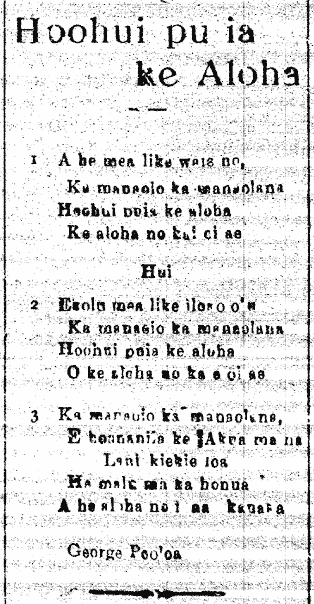
Above all is Aloha: a mele by George Pooloa, 1933.

Hoohui pu ia ke Aloha

1 A he mea like wale no,
Ka manaoio ka manaolana
Hoohui puia ke aloha
Ke aloha no kai oi ae

Hui

2 Ekolu mea like iloko o’u
Ka manaoio ka manaolana
Hoohui puia ke aloha
O ke aloha no ka e oi ae

3 Ka manaoio ka manaolana
E hoonaniia ke Akua ma na Lani keikie la
He malu ma ka honua
A he aloha no i na kanaka

[Along With Aloha

1 All are the alike
Faith, Hope
Along with Love
But the greatest is Love

Chorus

2 There are three things alike within me
Faith, Hope
Along with Love
But the greatest is Love

3 Faith and Hope
Glory to God in the high Heavens
Peace on earth
Goodwill toward men]

George Pooloa

(Hoku o Hawaii, 2/7/1933, p. 4)

Hoohui pu ia ke Aloha

Ka Hoku o Hawaii, Buke XXVI, Helu 36, Aoao 4. Feberuari 7, 1933.

Solomon W. Meheula passes on, 1925.

S. W. MEHEULA LEAVES THIS LIFE.

In the early morning of Wednesday last week, Solomon W. Meheula, one of the kamaaina of this district of Hanalei, Kauai, left this worldly life, after being sick for a short time, and in the afternoon of that Wednesday, his remains were carried to and buried at Anahola, his birth land.

He was a native and local that faced the showers [aloalo kuaua], that is of Hanalei, and as he now rests, he lived 51 years in this life. He left behind his wife and his four children, three daughters and one son.

He was educated at Kamehameha School for Boys, and he was one who was very enthusiastic in sports and he was often scene in the circle of those who know singing. He strove to do good works. He was ordained in the ministry for Kauai just a little while ago, and it was in this profession that he worked until his death.

He was a member of the local legislature in 1923 from Kauai, and for several years, he lived and worked on the homestead lands in Kapaa, and now that he has gone, he has become an unforgettable memorial for all the good works which he did.

(Kuokoa, 5/28/1925, p. 2)

HAALELE MAI O S. W. MEHEULA I KEIA OLA ANA.

Ka Nupepa Kuokoa, Buke LXIV, Helu 22, Aoao 2. Mei 28, 1925.

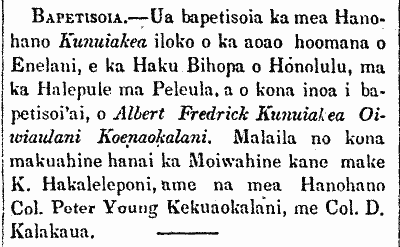
Albert Kunuiakea baptized, 1862.

[Found under: “NA MEA HOU O HAWAII NEI.”]

Baptized.—The Honorable Kunuiakea was baptized in the Anglican faith, by the Lord Bishop of Honolulu, at the Church at Peleula, and his name he was baptized with is Albert Fredrick Kunuiakea Oiwiaulani Koenaokalani. Present was his hanai mother, the dowager Queen K. Hakaleleponi, and the Honorable Col. Peter Young Kekuaokalani, and Col. D. Kalakaua.

(Kuokoa, 11/22/1862, p. 2)

Bapetisoia.

Ka Nupepa Kuokoa, Buke I, Helu 52, Aoao 2. Novemaba 22, 1862.

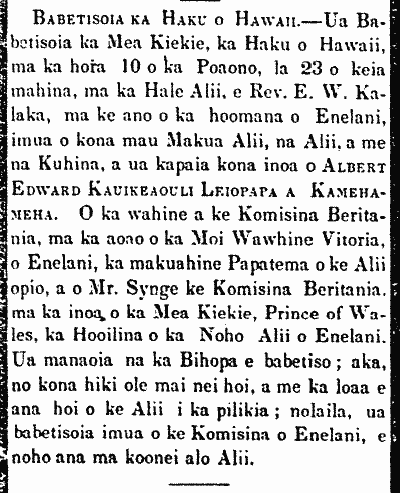
Prince Albert baptized, 1862.

[Found under: “NA MEA HOU O HAWAII NEI.”]

Ka Haku o Hawaii Baptized.—His Highness, ka Prince of Hawaii was baptized at 10 oʻclock on Saturday, the 23rd of this month at the Palace [Hale Alii], by Rev. E. W. Clark [E. W. Kalaka], in the Anglican faith, before his Royal Parents, the Alii, and the Ministers, and his was named Albert Edward Kauikeaouli Leiopapa a Kamehameha. The wife of the British Commissioner stood in for Queen Victoria of England, the godmother [makuahine Papatema] of the young chief, and Mr. Synge, the British Commissioner, stood in for the Prince of Wales, the Heir to the Throne of England. It was intended for the Bishope to do the baptismal, but because he has not arrived, and the Alii is in distress, therefore, he was baptized before the Commissioner of England who is among the Royal court here.

(Kuokoa, 8/30/1862, p. 2)

Babetisoia ka Haku o Hawaii.

Ka Nupepa Kuokoa, Buke 1, Helu 40, Aoao 2. Augate 30, 1862.