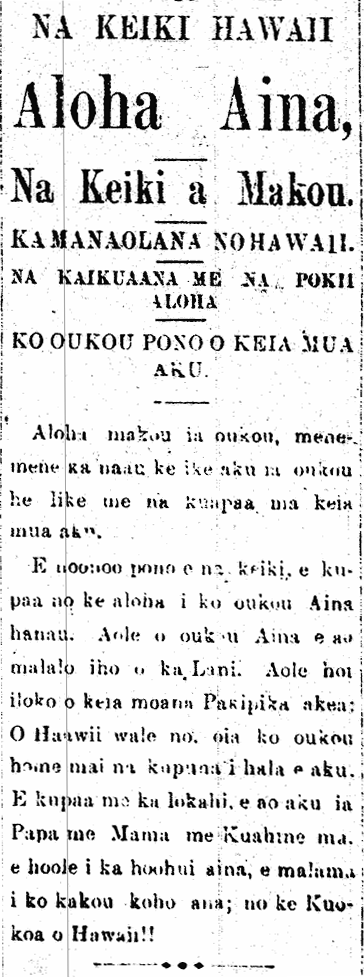
Words of advice to the children, 1893.

PATRIOTIC

HAWAIIAN YOUTH*

Children of Ours.

THE HOPE FOR HAWAII.

BELOVED ELDER AND YOUNGER SIBLINGS

YOUR WELL-BEING LIES IN THE FUTURE.

We have aloha for you; our hearts are fearful to see you like slaves in the future.

Consider carefully, O Children, and be steadfast in your aloha for the Land of your birth. You have no other Aina under the Heavens. None in the vast Pacific Ocean: You only have Hawaii; that is your home from your kupuna who have gone on before you. Be unified in your faithfulness, and teach Papa and Mama and Sister folk, to protest annexation, and to preserve our vote; for the Independence of Hawaii!!

*Here, “keiki” probably was referring to boys, as it often did, and that is why they were to instruct their “kuahine,” but today, 123 years later, I thought I would like it to address the youth in general.

(Leo o ka Lahui, 3/6/1893, p. 3)

LOKL_3_6_1893_3.png

Leo o ka Lahui, Buke II, Helu 665, Aoao 3. Maraki 6, 1893.

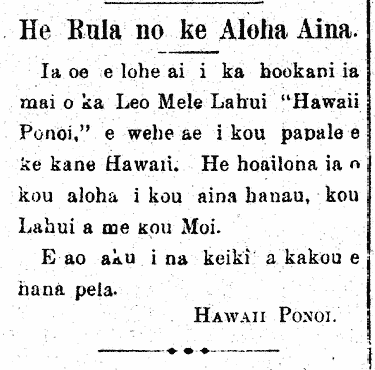
E ui e! 1893.

Protocol for Patriots.

When you hear the Strains of the National Anthem “Hawaii Ponoi,” men, remove your hats. It is a sign of your aloha for your land of birth, your Lahui, and your Monarch.

Teach our children to do the same.

Hawaii Ponoi.

(Leo o ka Lahui, 11/10/1893, p. 2)

LOKL_11_10_1893_2.png

Ka Leo o ka Lahui, Buke II, Helu 810, Aoao 2. Novemaba 10, 1883.

Lai Toodle? 1878.

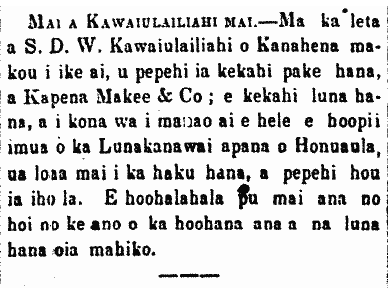
From Kawaiulailiahi.—In a letter from S. D. W. Kawaiulailiahi of Kanahena we saw that a Chinese laborer of the Captain Makee & Co. was beaten by a supervisor [luna hana], and when he decided to go to bring charges before the Judge of the Honuaula district, he was found by the boss [haku hana], and was beaten again. He will also complain about how the luna of that sugar plantation make them work.

(Kuokoa, 10/26/1878, p. 2)

Kuokoa_10_26_1878_2.png

Ka Nupepa Kuokoa, Buke XVII, Helu 43, Aoao 2. Okatoba 26, 1878.

Thoughts for the upcoming Kamehameha Day, 1920.

THEY ARE TRUE HAWAIIANS BUT THEY CANNOT SING HAWAIIAN SONGS.

Mr. Editor of the Kuokoa Newspaper, Aloha oe:—Maybe at 3 o’clock or so in the morning of Friday, June 11, 1920, that being the birthday of the Nation Conqueror Kamehameha, there came to my home some singing boys, and this was something; it was a familiar thing where on holidays this and that person came around singing at houses lived in by Hawaiians.

Before the singers came, I got the idea that since these singers were coming to my home, I would get up and listen to the singing outside on the lanai like I was accustomed to in past years; it was not long before I heard strains of a guitar, and the singing started, but it was from my bedroom that I was listening. Continue reading

Hasn’t the time come that Hawaiians try to help in the economic endeavors of their own people? 1914.

Announcement

KA HUI KUAI POI O KALIHI (“KALIHI TARO AND LAND CO., LTD.”)

To those who read this.

With aloha:—Whereas all of the shares of the Company named above has been acquired by W. C. Achi and some Hawaiians, and being that they are the only Hawaiians carrying out the growing of taro and the selling of poi, the food of our kupuna and makua; therefore, they humbly ask you, O Hawaiians, that you give them your assistance, by you buying your poi from their group.

The production of the poi at their poi factory is truly sanitary, and your orders will be filled with great haste.

Hasn’t the time come that Hawaiians try to help in the economic endeavors of their own people? Continue reading

Hula fought against by the church, 1917.

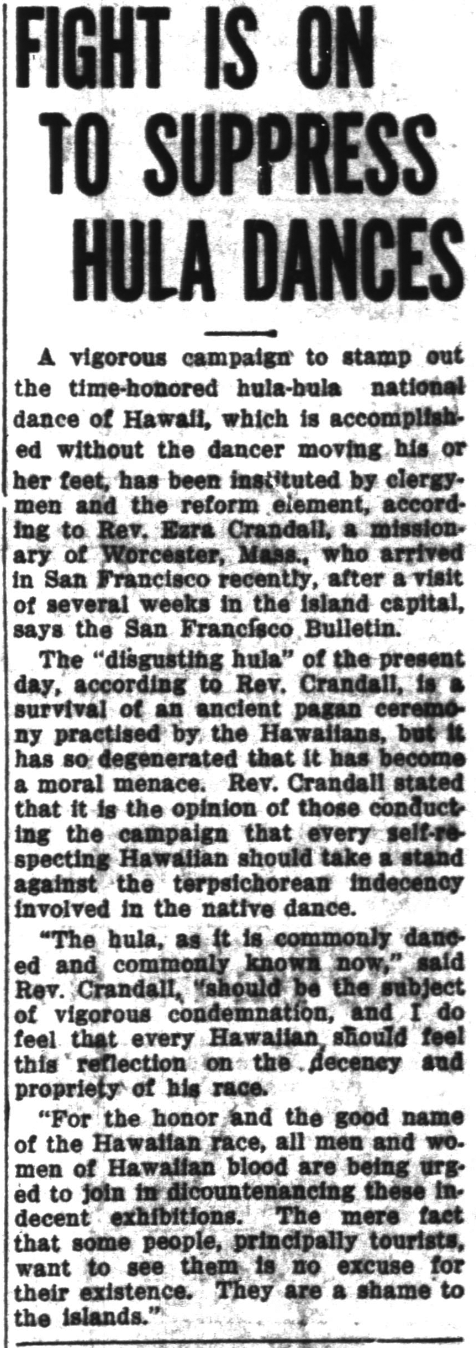
FIGHT IS ON TO SUPPRESS HULA DANCES

A vigorous campaign to stamp out the time-honored hula-hula national dance of Hawaii, which is accomplished without the dancer moving his or her feet, has been instituted by clergymen and the reform element, according to Rev. Ezra Crandall, a missionary of Worcester, Mass., who arrived in San Francisco recently, after a visit of several weeks in the island capital, says the San Francisco Bulletin.

The “disgusting hula” of the present day, according to Rev. Crandall, is a survival of an ancient pagan ceremony practiced by the Hawaiians, but is has so degenerated that it has become a moral menace. Rev. Crandall stated that it is the opinion of those conducting the campaign that every self-respecting Hawaiian should take a stand against the terpsichorean indecency involved in the native dance.

“The hula, as it is commonly danced and commonly know now,” said Rev. Crandall, “should be the subject of vigorous condemnation, and I do feel that every Hawaiian should feel this reflection on the decency and propriety of his race.

“For the honor and the good name of the Hawaiian race, all men and women of Hawaiian blood are being urged to join in discountenancing these indecent exhibitions. The mere fact that some people, principally tourists, want to see them is no excuse for their existence. They are a shame to the islands.”

(Star-Bulletin, 6/15/1917, p. 14)

StarBulletin_6_15_1917_14

Honolulu Star-Bulletin, Volume XXIV, Number 7854, Page 14. June 15, 1917.

Kalaniopuu’s fame as told by S. M. Kamakau, 1867.

[Found under: “KA MOOLELO O KAMEHAMEHA I.”]

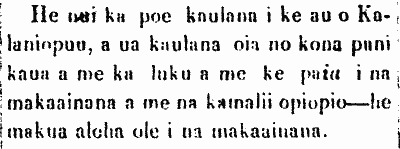
He nui ka poe kaulana i ke au o Kalaniopuu, a ua kaulana oia no kona puni kaua a me ka luku a me ka paia i na makaainana a me na kamalii opiopio—he makua aloha ole i na makaainana.

There were many famous ones during the era of Kalaniopuu, and he himself was well known, as someone who loved war, and massacring, and the striking of the makaainana and small children—he was a father who had no aloha for the makaainana.

[Although Kamakau describes many a chief as “war loving,” he describes Kalaniopuu as particularly cruel. This passage can be found in “Ruling Chiefs of Hawaii,” page 115.]

(Kuokoa, 2/23/1867, p. 1)

Kuokoa_2_23_1867_1.png

Ka Nupepa Kuokoa, Buke VI, Helu 8, Aoao 1. Feberuari 23, 1867.

Hawaiian-language interpretation of Longfellow’s “Psalm of Life,” 1871.

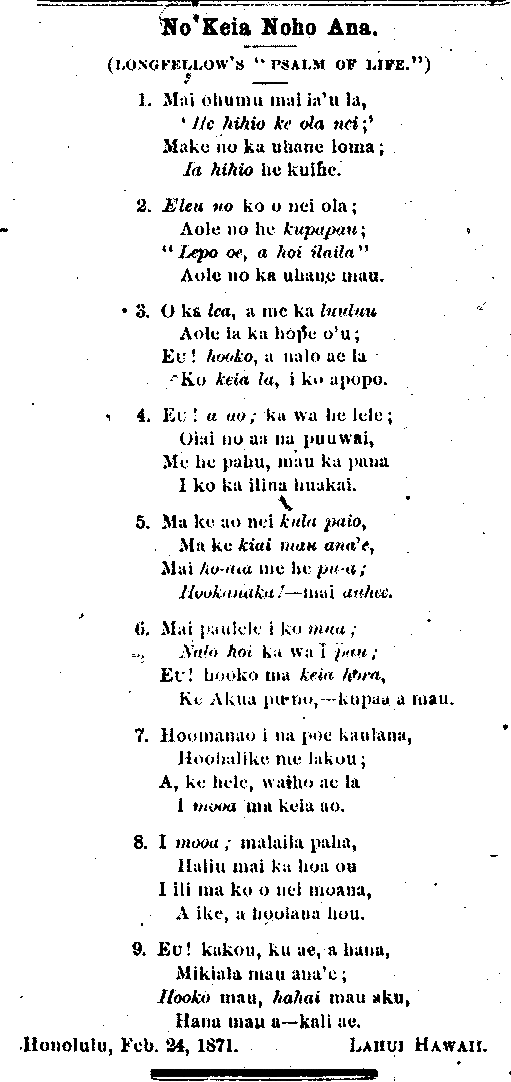
No Keia Noho Ana.

(LONGFELLOW’S “PSALM OF LIFE.”)

1. Mai ohumu mai ia’u la,
‘He hihio ke ola nei;’
Make no ka uhane loma;
Ia hihio he kuihe.

2. Eleu no ko o nei ola;
Aole no he kupapau;
“Lepo oe, a hoi ilaila”
Aole no ka uhane mau.

3. O ka lea, a me ka luuluu
Aole ia ka hope o’u;
Eu! hooko, a nalo ae la
Ko keia la, i ko apopo.

4. Eu! a ao; ka wa he lele;
Oiai no aa na puuwai
Me he pahu, mau ka pana
I ko ka ilina huakai.

5. Ma ke ao nei kula paio,
Ma ke kiai mau ana’e
Mai ho-aia me he pu-a;
Hookanaka!—mai auhee.

6. Mai paulele i ko mua;
Nalo hoi ka wa i pau;
Eu! hooko ma keia hora,
Ke Akua pu no,—kupaa a mau.

7. Hoomanao i na poe kaulana,
Hoohalike me lakou;
A, ke hele, waiho ae la
I mooa ma keia ao.

8. I mooa; malaila paha,
Haliu mai ka hoa ou
I ili ma ko o nei moana,
A ike, a hoolana hou.

9. Eu! kakou, ku ae, a hana,
Mikiala mau ana’e;
Hooko mau, hahai mau aku,
Hana mau a—kali ae.

Honolulu, Feb. 24, 1871.  Lahui Hawaii.

[A PSALM OF LIFE

What the Heart of the Young Man Said to the Psalmist

Tell me not, in mournful numbers,
Life is but an empty dream!—
For the soul is dead that slumbers,
And things are not what they seem.

Life is real! Life is earnest!
And the grave is not its goal ;
Dust thou art, to dust returnest,
Was not spoken of the soul.

Not enjoyment, and not sorrow,
Is our destined end or way;
But to act, that each to-morrow
Find us farther than to-day.

Art is long, and Time is fleeting,
And our hearts, though stout and brave,
Still, like muffled drums, are beating
Funeral marches to the grave.

In the world’s broad field of battle,
In the bivouac of Life,
Be not like dumb, driven cattle!
Be a hero in the strife!

Trust no Future, howe’er pleasant!
Let the dead Past bury its dead!
Act,—act in the living Present!
Heart within, and God o’erhead!

Lives of great men all remind us
We can make our lives sublime,
And, departing, leave behind us
Footprints on the sands of time ;

Footprints, that perhaps another,
Sailing o’er life’s solemn main,
A forlorn and shipwrecked brother,
Seeing, shall take heart again.

Let us, then, be up and doing,
With a heart for any fate;
Still achieving, still pursuing,
Learn to labor and to wait.

(Lau Oliva, 3/1871, p. 1)
LauOliva_3_1871_1

Ka Lau Oliva, Buke I, Helu 3, Aoao 1. Maraki 1871.

Hula thriving in Heeia, 1876.

[Found under: “PALAPALA I KE KUOKOA.”]

Useless activities of adults.

O KUOKOA NEWSPAPER; Aloha oe:—

Please grasp this bundle with your right hand, so that our friends will see from Hilo to Waioli, with Niihau to boot, that being the words above, “useless activities,” that being the hula.

Here in Heeia, Koolaupoko, there is much hula now; at Iolekaa there is 1 hula school with Hopa the male kumu hula; at Heeia Waena, Palau (m) and Naholowaa (f), those two are the kahu hula and Ioane (m) is the kumu; Continue reading

Alakai o Hawaii prints mele without any accreditation, 1930.

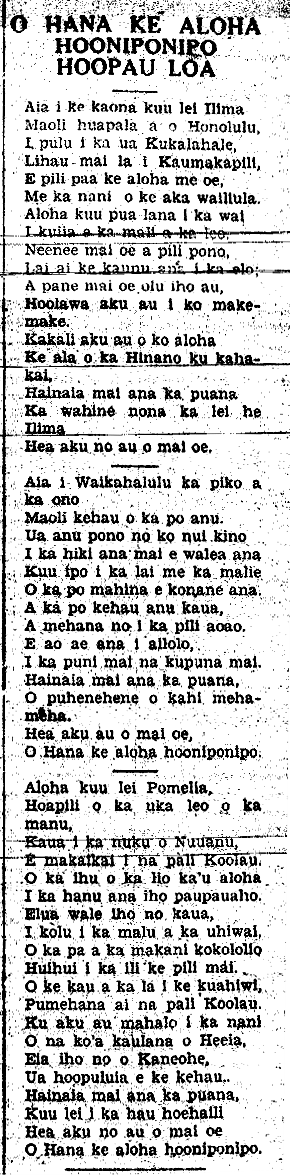
O HANA KE ALOHA HOONIPONIPO HOOPAU LOA

Aia i ke kaona kuu lei Ilima
Maoli huapala a o Honolulu,
I pulu i ka ua Kukalahale,
Lihau mai la i Kaumakapili,
E pili paa ke aloha me oe,
Me ka nani o ke aka wailiula.
Aloha kuu pua lana i ka wai
I kuiia e ka mali a ka leo,
Neenee mai oe a pili pono,
Lai ai ke kaunu ana i ka elo;
A pane mai oe olu iho au,
Hoolawa aku au i ko makemake.
Kakali aku au o ko aloha
Ke ala o ka Hinano ku kahakai,
Hainaia mai ana ka puana
Ka wahine nona ka lei he Ilima
Hea aku no au o mai oe.

———

Aia i Waikahalulu ka piko a ka ono
Maoli kehau o ka po anu
Ua anu pono no ko nui kino
I ka hiki ana mai e walea ana
Kuu ipo i ka lai me ka malie
O ka po mahina e konane ana
A ka po kehau anu kaua
A mehana no i ka pili aoao.
E ao ae ana i ailolo,
I ka puni mai na kupuna mai
Hainaia mai ana ka puana,
O puhenehene o kahi mehameha.
Hea aku au o mai oe,
O Hana ke aloha hooniponipo.

———

Aloha kuu lei Pomelia,
Hoapili o ka uka leo o ka manu,
Kaua i ka nuku o Nuuanu,
E makaikai i na pali Koolau
O ka ihu o ka lio ka’u aloha
I ka hanu ana iho paupauaho
Elua wale iho no kaua,
I kolu i ka malu a ka uhiwai
O ka pa a ka makani kokololio
Huihui i ka ili ke pili mai
O ke kau a ka la i ke kuahiwi,
Pumehana ai na pali Koolau
Ku aku au mahalo i ka nani
O na ko’a kaulana o Heeia.
Eia iho no o Kaneohe,
Ua hoopuluia e ke kehau
Hainaia mai ana ka puana,
Kuu lei i ka hau hoehaili
Hea aku no au o mai oe
O Hana ke aloha hooniponipo.

[Perhaps this printing of the three mele without any credit given is what caused the letter to the Editor from Mrs. Kaholopololei in the previous post.]

(Alakai o Hawaii 3/13/1930, p. 4)

AlakaioHawaii_3_13_1930_4.png

Ke Alakai o Hawaii, Buke 2, Helu 45, Aoao 4. Maraki 13, 1930.