Mele ownership, 1930.

LET THE TAKING OF OTHER PEOPLE’S MELE BE PUT TO AN END.

Mr. Jonah Kumalae,

Editor of Ke Alakai o Hawaii,

Aloha oe:—

I am Mrs. Kaholopololei, and I am resending to you a copy of these mele, with an explanation for the second time.

That is, do disseminate in the precious KE ALAKAI O HAWAII so that the people who love hula and who take the mele of others and bequeath it to whom they want will know.

Instruct them to stop this taking, for still living today is the one to whom the mele belong.

I and some women members of the Ahahui o na wahine Poola of the town of Honolulu, during the term when Mrs. Apoki Kauhini served as President, and Mrs. Holi Kealohahooniponipo Thornton was secretary of that Association.

Kanekoa was her husband, and Holi Thornton the other’s husband. Continue reading

John Wise on Hawaiian Homes and more, 1921.

The Question about the Work Ethic of Hawaiians.

Your writer [John Wise], continues to defend the Hawaiian lahui from being attacked by that question above.

The Hawaiians have perhaps become much talked about amongst those who do not know them and who are not familiar with their accomplishments of today and of the past. And maybe mostly these days for the land being given to us. Your writer frequently clashes with all kinds of other people who protest the giving of land to Hawaiians, because of the ridiculous idea that they don’t know how to work or that they are lazy.

In these attacks, we can see, O Lahui, that they are carried with criticisms and that it is would be a waste to confirm their misbeliefs. But so that the Hawaiians may answer these questions, your writer wants to be made known for all times the sound justification for our side. The readers of past issues of the Kuokoa have seen the responses given by the Commissioner in Washington, and they have seen also the other justifications given, in the newspaper.

The ultimate representation of the skill of a people is their supplying themselves with food and the things necessary for their livelihood. There perhaps is no better response than that. This lahui was living by  themselves for centuries, supplying themselves with everything, and received no assistance from the outside.

But there are things made by this lahui, things that attest to their fine craftsmanship, that will serve as a measure of their skills. Those that see Hawaiian canoes and their manufacture and how they can get Hawaiians through great gales, remaining solid in the dangers of the pounding of waves; how they could make beautiful canoes by using stone adzes; the distance they were taken from mountain to the sea; the patience of the canoe makers. All of these things will show, without being contradicted, that just by seeing the quality of the canoes can one see that this is a lahui that knows how to work. We see the canoes of today being made by people from other lands, and the canoes made by Hawaiians are far more well made and beautiful.

The beauty of things crafted by a people are undeniable proof of the work ethic of that people. Where will you find things more beautiful, O Hawaiians, if you travel all over the world, than the ahuula that are preserved at the Museum of Kamehameha School. Where is the lahui that lives on today, or perhaps has disappeared, that can make these outstanding works, with a beauty second to none, with fine craftsmanship, and patience; with a true sense of work ethic. Snaring birds is a great task all in itself, the inserting [kuku ana] of the feathers is a big job. One mamo feather cloak was said to have been started during the time of Umi and completed during the time of Kamehameha. For this ahu, the entire ahu were done with mamo feathers. And by our counting back, we see that ten generations of ancient kings passed on before the completion of this ahu; showing that it took from about 250 to 300 years of work. Where is there a great work that was completed by a people taking hundreds of years to construct? We perhaps can think of huge things, but as for something of this nature which required the knowledge and patience of men, there is no equal. Continue reading

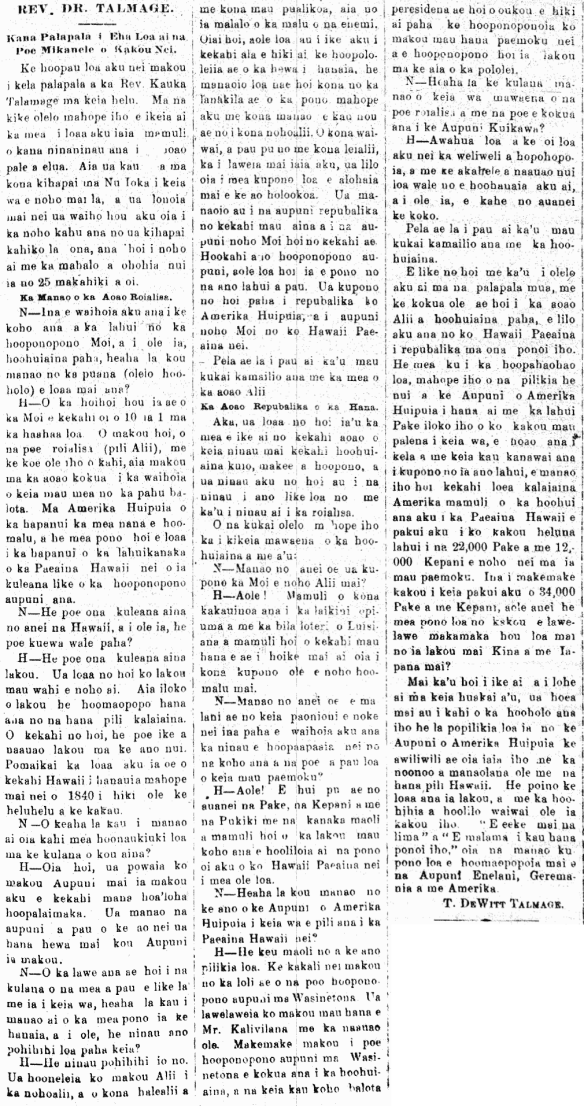
Unheeded words of Talmage to the United States of America, 1894.

REV. DR. TALMAGE.

His Article Which Greatly Hurt the Missionaries Amongst Us.

The article below written by the Rev. Doctor Talmage of New York and published in a newspaper there was translated and published in the newspaper “Aloha Aina;” however,  because of the difference between our understanding of the translation and theirs, we took it and translated it once more and am putting it before our readers. Here is our translation of the said article:

Honolulu, June 18, 1894.

The chamberlain came to invite the two of us to go to the residence of the former Monarch, and had suggested 11 o’clock that morning as the best hour for our visit…

[This is what sent me looking for the article I posted earlier today. Unfortunately, the previous translation is not found online. It must have been printed in the paper, “Nupepa Aloha Aina” which ran from 1/6/1894 to 1/5/1895. The entire run is in the holdings of the Mission Children’s Society Library. This is a paper that is well worth digitizing and OCRing. I am excited to see what the translation differences could be!]

Makaainana_11_12_1894_1.png

Ka Makaainana, Buke II—Ano Hou, Helu 20, Aoao 1. Novemaba 12, 1894.

Makaainana_11_26_1894_1.png

Ka Makaainana, Buke II—Ano Hou, Helu 22, Aoao 1. Novemaba 26, 1894.

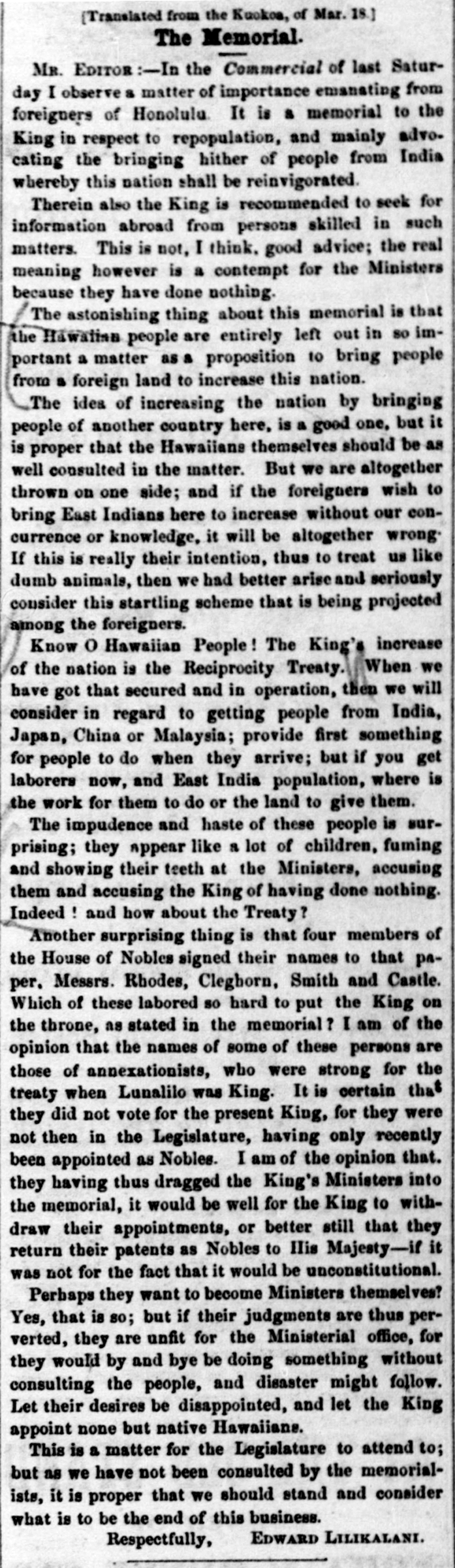
Translation of Edward Lilikalani’s response to the haole Memorial, 1876.

[Translated from the Kuokoa, of Mar. 18.]

The Memorial.

Mr. Editor:—In the Commercial of the last Saturday I observe a matter of importance emanating from foreigners of Honolulu. It is a memorial to the King in respect to repopulation, and mainly advocating the bringing hither of people from India whereby this nation shall be reinvigorated.

 Therein also the King is recommended to seek for information abroad from persons skilled in such matters. This is not, I think, good advice; the real meaning however is a contempt for the Ministers because they have done nothing.

The astonishing thing about this memorial is that the Hawaiian people are entirely left out in so important a matter as a proposition to bring people from a foreign land to increase this nation.

The idea of increasing the nation by bringing people of another country here, is a good one, but it is proper that the Hawaiians themselves should be as well consulted in the matter. But we are altogether thrown on one side; and if the foreigners wish to bring East Indians here to increase without our concurrence or knowledge, it will be altogether wrong. If this is really their intention, thus to treat us like dumb animals, then we had better arise and seriously consider this startling scheme that is being projected among the foreigners.

Know O Hawaiian People! The King’s increase of the nation is the Reciprocity Treaty. When we have got that secured and in operation, then we will consider in regard to getting people from India, Japan, China or Malaysia; provide first something for people to do when they arrive; but if you get laborers now, and East India population, where is the work for them to do or the land to give them.

The impudence and haste of these people is surprising; they appear like a lot of children, fuming and showing their teeth at the Ministers, accusing them and accusing the King of having done nothing. Indeed! and how about the Treaty?

Another surprising thing is that four members of the House of Nobles signed their names to that paper, Messrs. Rhodes, Cleghorn, Smith and Castle. Which of these labored so hard to put the King on the throne, as stated in the memorial? I am of the opinion that the names of some of these persons are those of annexationists, who were strong for the treaty when Lunalilo was King. It is certain that they did not vote for the present King, for they were not then in the Legislature, having only recently been appointed as Nobles. I am of the opinion that they having thus dragged the King’s Ministers into the memorial, it would be well for the King to withdraw their appointments, or better still that they return their patents as Nobles to His Majesty—if it was not for the fact that it would be unconstitutional.

Perhaps they want to become Ministers themselves? Yes, that is so; but if their judgments are thus perverted, they are unfit for the Ministerial office, for they would by and bye be doing something without consulting the people, and disaster might follow. Let their desires be disappointed, and let the King appoint none but native Hawaiians.

This is a matter for the Legislature to attend to; but as we have not been consulted by the memorialists, it is proper that we should stand and consider what is to be the end of this business.

Respectfully,  Edward Lilikalani.

[Here is a translation of Edward Kamakau Lilikalani’s response to the repopulation memorial that was printed in the Kuokoa on 3/18/1876.]

(Pacific Commercial Advertiser, 3/25/1876, p. 3)

The Memorial.

The Pacific Commercial Advertiser, Volume XX, Number 39, Page 3. March 25, 1876.

Edward Lilikalani responds to the Memorial by the haole, 1867.

Ka palapala Memoriala.

E ka Nupepa Kuokoa e; Aloha oe:—

Ua ike iho wau ma ka nupepa Kalepa o kela Poaono i hala ae nei, i kahi mau mea nui i hanaia e na haole o ke kulanakauhale nei o Honolulu, oia hoi he Palapala Memoriala maloko o laila, he mau kumu hoopii i ka Moi, e hooulu i ka lahui, a o ke ano nui o ka hooulu i oleloia ma ua palapala nei, oia no ke kii ana i ka Lahui Inia, a e hoopae mai i kumu e hoowelo hou aku ai i keia lahui kanaka.

A maloko no hoi oia palapala, he noi ana kekahi i ka Moi, e hele ae mawaho e kuka ai me kekahi poe akamai e ae. Ma keia ke manao nei au ua alakai hewa ka Memoriala i ka Moi; o ke ano maoli nae o keia o ka hoowahawaha i na Kuhina no ko lakou hana ole.

Eia ka mea kupaianaha o keia palapala Memoriala, o ke kapae loa ia ana o na kanaka Hawaii ma keia noi ano nui, e hoopae mai i ka lahui kanaka o ko na aina e ma ko kakou aina nei, e hooulu i keia lahui.

He manao maikai ka hooulu ana i ka lahui, mai ko na aina e mai, aka, e pono o kakou o na kanaka Hawaii kekahi e kuka pu no keia mea. Aka, ua kiloi loa ia kakou ma kahi e; ina paha ua makemake na haole e hoopae mai i keia lahui o Inia me ke kuka ole me kakou, ka poe a ua Inia nei e hele mai ana e hooulu, alaila, he mea hewa loa ko kakou ike e ole. A ina ua kiola loaia kakou a hooliloia me he mau holoholona’la, ka i ae no o ua poe haole nei e hoopae mai i ka Inia, na lakou no e onou okoa mai, me ko kakou ae ole; alaila, e pono no e ku kakou, a noonoo nui no keia hana i ulu kamahao ae iwaena o na haole.

E ike e ka Lahui Hawaii! O ka Hooulu Lahui a ka Moi ma ke kalaunu, oia no ke Kuikahi Panailike. A loaa mai ia a noho pu, a paa i ko kakou lima, alaila, noonoo ae, no ke kii ana’ku i na Inia, Iapana, Kina, a Malaea paha, i loaa mua na kumu hana a keia poe e hana ai, ke hiki mai, aka, ina e kii wale ia no na paahana, a me na Inia hooulu lahui, auhea ka hana, a me ka aina e haawi ai ia lakou.

He kupanaha ka mahaoi, a me ka lele e o lakou nei; ua hoolilo lakou ia lakou iho me he mau kamalii liilii’la, e hakaka ana, e hookeke wale ana no i na niho i na Kuhina o ka Moi, me ka olelo iho aole ka a lakou hana, aole ka a ka Moi hana. He kupaianaha, pehea ka ke Kuikahi?

Eia kekahi mea kupaianaha, he eha mau alii o ka Hale Ahaolelo alii i kakau i ko lakou mau inoa ma ia palapala. Oia o Kapena Loke, o Ake, Kamika, a me Kakela; owai o keia poe i hooikaika e hoonoho i ka Moi ma ka noho alii, e like me ka olelo o ua palapala la? Ke manao nei au o kekahi mau inoa o keia poe he mau hoohui aupuni lakou, i ikaika loa no ke kuikahi ia Lunalilo ka Moi, o ka mea i maopopo lea o ka Ahaolelo no, aole lakou nei ia wa, eia wale mai no mahope nei ko lakou lilo ana i mau alii no ka Hale Ahaolelo. A ke manao nei au, o ko lakou pakui ana aku i na Kuhina o ka Moi ma keia palapala noi, me ke kumu ole, e  pono e hoihoi mai ka Moi i ko lakou mau palapala hookohu, o ka pono loa no ko lakou hoihoi okoa aku i ko lakou mau hookohu alii i ka Moi, ina aole he paku nui nana e alai nei oia no ke kumukanawai.

E makemake ana paha e lilo lakou i mau kuhina ea. Ae! oia maoli no, aka, ina pela iho la ke kau kapakahi o ko lakou mau manao, alaila, aole lakou e pono e lilo i mau kuhina, mamuli hana lakou i na hana me ka ui ole mai ia kakou, a poino kakou. E pono no e hoohokaia ko lakou manao, a e koho ka Moi i poe kanaka Hawaii wale no.

He hana keia na ke kau Ahaolelo e hana ai, aka, no ko lakou ui ole ia mai e pono no e ku kakou a noonoo i ka hopena o keia hana. Me ka mahalo.

Edward Lilikalani.

[Find a translation of this rebuke by Edward Kamakau Lilikalani in the Advertiser of 3/25/1876.]

(Kuokoa, 3/18/1876, p. 4)

Ka palapala Memoriala.

Ka Nupepa Kuokoa, Buke XV, Helu 12, Aoao 4. Maraki 18, 1876.

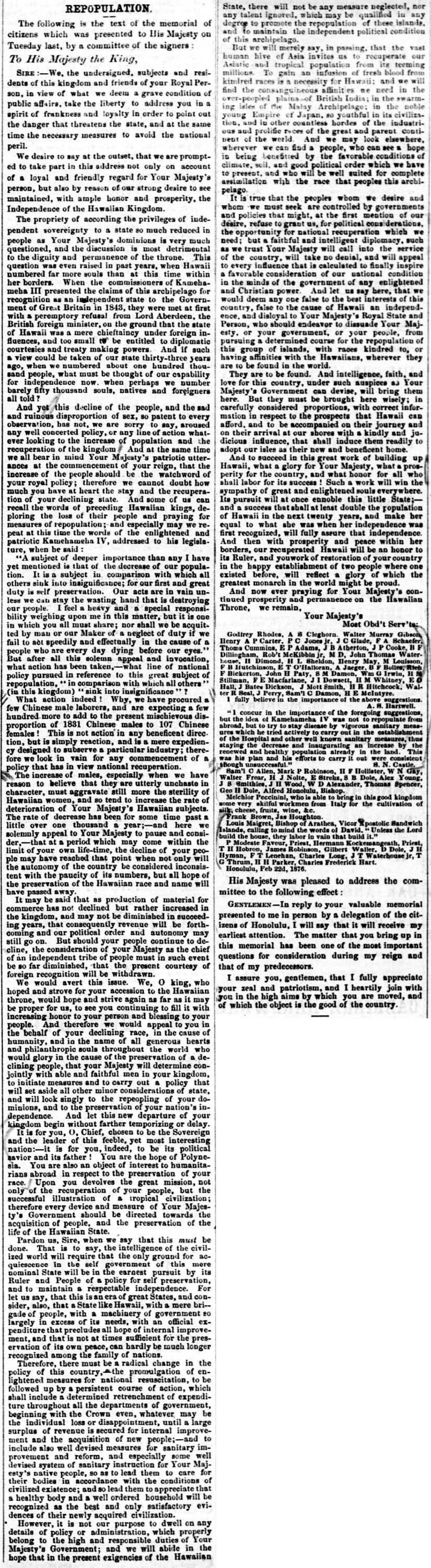
A memorial on repopulation, 1876.

REPOPULATION.

The following is the text of the memorial of citizens which was presented to His Majesty on Tuesday last, by a committee of the signers:

To His Majesty the King,

Sire:—We, the undersigned, subjects and residents of this kingdom and friends of your Royal Person, in view of what we deem a grave condition of public affairs, take the liberty to address you in a spirit of frankness and loyalty in order to point out the danger that threatens the state, and at the same time the necessary measures to avoid the national peril.

We desire to say at the outset, that we are prompted to take part in this address not only on account of a loyal and friendly regard for Your Majesty’s person, but also by reason of our strong desire to see maintained, with ample honor and prosperity, the Independence of the Hawaiian Kingdom.

 The propriety of according the privileges of independent sovereignty to a state so much reduced in people as Your Majesty’s dominions is very much questioned, and the discussion is most detrimental to the dignity and permanence of the throne. This question was even raised in past years, when Hawaii numbered far more souls than at this time within her borders. When the commissioners of Kamehameha III presented the claims of this archipelago for recognition as an independent state to the Government of Great Britain in 1843, they were met at first with a peremptory refusal from Lord Aberdeen, the British foreign minister, on the ground that the state of Hawaii was a mere chieftaincy under foreign influences, and too small to be entitled to diplomatic courtesies and treaty making powers. And if such a view could be taken of our state thirty-three years ago, when we numbered about one hundred thousand people, what must be thought of our capability for independence now, when perhaps we number barely fifty thousand souls, natives and foreigners all told?

And yet this decline of the people, and the sad and ruinous disproportion of sex, so patent to every observation, has not, we are sorry to say, aroused any well concerted policy, or any line of action whatever looking to the increase of population and the recuperation of the kingdom. And at the same time we all bear in mind Your Majesty’s patriotic utterances at the commencement of your reign, that the increase of the people should be the watchword of your royal policy; therefore we cannot doubt how much you have at heart the stay and the recuperation of your declining state. And some of us can recall the words of preceding Hawaiian kings, deploring the loss of their people and praying for measures of repopulation; and especially may we repeat at this time the words of the enlightened and patriotic Kamehameha IV, addressed to this legislature, when he said:

“A subject of deeper importance than any I have yet mentioned is that of the decrease of our population. It is a subject in comparison with which all others sink into insignificance; for our first and great duty is self preservation. Our acts are in vain unless we can stay the wasting hand that is destroying our people. I feel a heavy and a special responsibility weighing upon me in this matter, but it is one in which you all must share; nor shall we be acquitted by man or our Maker of a neglect of duty if we fail to act speedily and effectually in the cause of a people who are every day dying before our eyes.” But after all this solemn appeal and invocation, what action has been taken,—what line of national policy pursued in reference to this great subject of repopulation, “in comparison with which all others” (in this kingdom) “sink into insignificance”?

What action indeed! Why, we have procured a few Chinese male laborers, and are expecting a few hundred more to add to the present mischievous disproportion of 1831 Chinese males to 107 Chinese females! This is not action in any beneficent direction, but is simply reaction, and is a mere expediency designed to subserve a particular industry; therefore we look in vain for any commencement of a policy that has in view national recuperation.

 The increase of males, especially when we have reason to believe that they are utterly unchaste in character, must aggravate still more the sterility of Hawaiian women, and so tend to increase the rate of deterioration of Your Majesty’s Hawaiian subjects. The rate of decrease has been for some time past a little over one thousand a year;—and here we solemnly appeal to Your Majesty to pause and consider,—that at a period which may come within the limit of your own life-time, the decline of your people may have reached that point when not only will the autonomy of the country be considered inconsistent with the paucity of its numbers, but all hope of the preservation of the Hawaiian race and name will have passed away.

 It may be said that as production of material for commerce has not declined but rather increased in the kingdom, and may not be diminished in succeeding years, that consequently revenue will be forthcoming and our political order and autonomy may still go on. But should your people continue to decline, the consideration of your Majesty as the chief of an independent tribe of people must in such event be so far diminished, that the present courtesy of foreign recognition will be withdrawn.

We would avert this issue. We. O king, who hoped and strove for your accession to the Hawaiian throne, would hope and strive again as far as it may be proper for us, to see you continuing to fill it with increasing honor to your person and blessing to your people. And therefore we would appeal to you in the behalf of your declining race, in the cause of humanity, and in the name of all generous hearts and philanthropic souls throughout the world who would glory in the cause of the preservation of a declining people, that your Majesty will determine conjointly with able and faithful men in your kingdom, to inititate measures and to carry out a policy that will set aside all other minor considerations of state, and will look singly to the repeopling of your dominions, and to the preservation of your nation’s independence. And let this new departure of your kingdom begin without farther temporizing or delay.

It is for you, O, Chief, chosen to be the Sovereign and the leader of this feeble, yet most interesting nation:—it is for you, indeed, to be its political savior and its father! You are the hope of Polynesia. You are also an object of interest to humanitarians abroad in respect to the preservation of your race. upon you devolves the great mission, not only of the recuperation of your people, but the successful illustration of a tropical civilization; therefore every device and measure of Your Majesty’s Government should be directed towards the acquisition of people, and the preservation of the life of the Hawaiian State.

 Pardon us, Sire, when we say that this must be done. That is to say, the intelligence of the civilized world will require that the only ground for acquiescence in the self government of this mere nominal State will be in the earnest pursuit by its Ruler and People of a policy for self preservation, and to maintain a respectable independence. For let us say, that this is an era of great States, and consider, also, that a State like Hawaii, with a mere brigade of people, with a machinery of government so largely in excess of its needs, with an official expenditure that precludes all hope of internal improvement, and that is not at times sufficient for the preservation of its own peace, can hardly be much longer recognized among the family of nations.

Therefore, there must be a radical change in the policy of this country,—the promulgation of enlightened measures for national resuscitation, to be followed up by a persistent course of action, which shall include a determined retrenchment of expenditure throughout all the departments of government, beginning with the Crown even, whatever may be the individual loss or disappointment, until a large surplus of revenue is secured for internal improvement and the acquisition of a new people;—and to include also well devised measures for sanitary improvement and reform, and especially some well devised system of sanitary instruction for Your Majesty’s native people, so as to lead them to appreciate that a healthy body and a well ordered household will be recognized as the best and only satisfactory evidences of their newly acquired civilization.

However, it is not our purpose to dwell on any details of policy or administration, which properly belong to the high and responsible duties of Your Majesty’s Government; and we will abide in the hope that in the present exigencies of the Hawaiian State, there will not be any measure neglected, nor any talent ignored, which may be qualified in any degree to promote the repopulation of these islands, and to maintain the independent political condition of this archipelago.

But we will merely say, in passing, that the vast human hive of Asia invites us to recuperate our Asiatic and tropical population from its teeming millions. To gain an infusion of fresh blood from kindred races is a necessity for Hawaii; and we will find the consanguineous affinities we need in the over-peopled plains—of British India; in the swarming isles of the Malay Archipelago; in the noble young Empire of Japan, so youthful in its civilization, and in other countless hordes of the industrious and prolific races of the great and parent continent of the world. And we may look elsewhere, wherever we can find a people, who can see a hope in being benefitted by the favorable conditions of climate, soil, and good political order which we have to present, and who will be well suited for complete assimilation with the race that peoples this archipelago.

It is true that the peoples whom we desire and whom we must seek are controlled by governments and policies that might, at the first mention of our desire, refuse to grant us, for political considerations, the opportunity for national recuperation which we need; but a faithful and intelligent diplomacy, such as we trust Your Majesty will call into the service of the country, will take no denial, and will appeal to every influence that is calculated to finally inspire a favorable consideration of our national condition in the minds of the government of any enlightened and Christian power. And let us say here, that we would deem any one false to the best interests of this country, false to the cause of Hawaii an independence, and disloyal to Your Majesty’s Royal State and Person, who should endeavor to dissuade Your Majesty, or your government, or your people, from pursuing a determined course for the repopulation of this group of islands, with races kindred to, or having affinities with the Hawaiians, wherever they are to be found in the world.

They are to be found. And intelligence, faith, and love for this country, under such auspices as Your Majesty’s Government can devise, will bring them here. But they must be brought here wisely; in carefully considered proportions, with correct information in respect to the prospects that Hawaii can afford, and to be accompanied on their journey and on their arrival at our shores with a kindly and judicious influence, that shall induce them readily to adopt our isles as their new and beneficent home.

And to succeed in this great work of building up Hawaii, what a glory for Your Majesty, what a prosperity for the country, and what honor for all who shall labor for its success! Such a work will win the sumpathy of great and enlightened souls everywhere. Its pursuit will at once ennoble this little State;—and a success that shall at least double the population of Hawaii in the next twenty years, and make her equal to what she was when her independence was first recognized, will fully assure that independence. And then with prosperity and peace within her borders, our recuperated Hawaii will be an honor to its Ruler, and youwork of restoration of your country in the happy establishment of two people where one existed before, will reflect a glory of which the greatest monarch in the world might be proud.

And now every praying for Your Majesty’s continued prosperity and permanence on the Hawaiian Throne, we remain,

Your Majesty’s

Most Obd’t Serv’ts:

Godfrey Rhodes, A. S. Cleghorn, Walter Murray Gibson, Henry A. P. Carter, P. C. Jones jr, J. C. Glade, F. A. Schaefer, Thomas Cummins, E. P. Adams, J. B. Atherton, J. P. Cooke, B. F. Dillingham, Robert McKibbin jr, M. D., John Thomas Waterhouse, H. Dimond, H. L. Sheldon, Henry May, M. Louisson, F. B. Hutchinson, E.T. O’Halloran, A. Jaeger, B. F. Bolles, Richard F. Bickerton, John H. Paty, S. M.Damon, William G. Irwin, H. M. Stillman, F. E. Macfarlane, J. I Dowsett, H. M. Whitney, E. O. Hall, J. Bates Dickson, J. Mott Smith, H. R. Hitchcock, Walter R. Seal, J. Perry, Samuel C. Damon, H. E. McIntyre.

I fully believe in the importance of the above suggestion.

A. S. Hartwell.

“I concur in the importance of the foregoing suggestions, but the idea of Kamehameha IV was not to repopulate from abroad, but to try to stay disease by vigorous sanitary measures which he tried actively to carry out in the establishment of the Hospital and other well known sanitary measures, thus staying the decrease and inaugurating an increase by the renewed and healthy population already in the land. This was his plan and his efforts to carry it out were consistent through unsuccessful.”  S. N.Castle.

Samuel C. Allen, Mark P. Robinson, H. F. Hollister, W. N. Gay, Walter Frear, H. J. Nolte, E. Strehz, S. B. Dole, Alex Young, J. S. Smithies, J. H. Wood, W. D Alexander, Thomas Spencer, George H. Dole, Alfred Honolulu, Bishop.

Melchior Peccinini, who is able to bring in this good kingdom some very skillful workmen from Italy for the cultivation of silk, cheese, fruits, wine, &c.

Frank Brown, James Houghton.

Louis Maigret, Bishop of Arathea, Vicor Apostollic Sandwich Islands, calling to mind the words of David, “Unless the Lord build the house, they labor in vain that builds it.”

P. Modeste Faveur, Priest, Hermann Kockemangeath, Priest, T. H. Hobron, James Robinson, Gilbert Waller, D. Dole, J.H. Hyman, F. T. Lenehan, Charles Long, J. T. Waterhouse jr, T. G. Thrum, H. H. Parker, Charles Frederick Hart.

Honolulu, Feb 22d, 1876.

His Majesty was pleased to address the committee to the following effect:

Gentlemen—In reply to your valuable memorial presented tome in person by a delegation of the citizens of Honolulu, I will say that it will receive my earliest attention. The matter that you bring up in this memorial has been one of the most important questions for consideration during my reign and that of my predecessors.

I assure you, gentlemen, that I fully appreciate your zeal and patriotism, and I heartily join with you in the high aims by which you are moved, and of which the object is the good of the country.

(Pacific Commercial Advertiser, 3/4/1876, p. 3)

REPOPULATION.

The Pacific Commercial Advertiser, Volume XX, Number 36, Page 3. March 4, 1876.

Samuel K. Kekoowai on the Daughters of Hawaii and Hanaiakamalama, 1923.

HANAIAKAMALAMA

This is a building near the end of the route of the electric car, and it stands on a hill.

As a result of the graciousness of one of the members of the Daughters of Hawaii [Ahahui o na Kaikamahine o Hawaii], this writer [Samuel K. Kekoowai] was introduced to Mrs. J. Swanzy, the leader of this association, and by her kindness I was welcomed to see the walls of that house which is filled with beautiful decorations of the monarchy, and their images hanging from the walls, set up almost like the museum of Kamehameha [Bernice Pauahi Bishop Museum].

This group, the Daughters of Hawaii, upholds the name of Queen Emma Kaleleonalani, and her birthday is cherished by them, and the writer observed the commemoration held by the association which holds dear the name placed upon them, the Daughters of Hawaii.

In the story told to me within the house, Kaleleonalani was raised by her hanai guardian [kahu hanai], Dr. Rooke [Kauka Luka], until she married Liholiho Kamehameha 4, however, there is another version that I have been told by another.

On that 20th day of this June, I saw the back room totally filled with those who came, from the members to visitors, and most were whites and there were a few Hawaiians [??? a o-a na Hawaii].

The story of the circuit of Queen Emma Kaleleonalani around Oahu nei was told, beginning at Waimanalo at the place of John Cummins [Keoni Kamaki], and to Kaneohe at the place of Wainui Pii, and then on to Waikane at the place of Kameaaloha; at Kahana there was a Chinese named Apakana, on to Punaluu there was Naili, to Laie at the place of Kupau, to Kahuku at the place of Kaluhi, to Waialua at the place of Kaiaikawaha. Continue reading

A pair of patriotic mele by John G. M. Sheldon, 1893.

KE KUOKOA PUKA LA.

He malihini hoi keia,
E auwana hele ae nei,
Aihemu manienie,
Ai uhini o ka nahele.

O ke ano iho la no ia,
Malimali i kinohou,
A ku ae i ka moku,
Ko-we-iu-Kanaka.

O ko lakou ano iho la ia,
O hoolilo aina ma,
Mai punihei aku,
I ka mali hoohui aina.

[The Daily Kuokoa Newspaper¹

This is a newcomer
Wandering about
Devouring until barren
Eater of grasshoppers in the wilderness.

That’s its nature
Sweet words at first
Then taking rule of the land
“Go away you Kanaka.”

That is how they are
Those who will turn over the land
Don’t get tricked
By the sweet-talking annexationists.

¹Nupepa Puka La Kuokoa me Ko Hawaii Pae Aina i Huiia was a daily pro-annexation Hawaiian-Language newspaper that ran from 1/26/1893 through 1896.

KA’U MELE.

Pehea la e hiki ai,
Ia’u ke uumi iho,
I ko’u aloha e ka aina hanau,
Nau wau i hoohua mai.

O kou kuakoko no’u ia,
Eha oe, no’u ia eha,
Mailani oe ia’u, he milimili,
I ole ai kakou, ma o ka Haku.

E ka Haku—e—Puuhonua,
Kalahea o ko ke ao nei,
Ina ua hewa au, ke noi nei au,
Ma Ou ‘la, e ola au.

Kahikina Kelekona.

[My Song

How would it be possible
For me to hold back
My aloha, O Land of my birth,
You gave birth to me.

Your birth pangs are for me
When you are pained, those pains are for me
You treasure me, as something dear
We live through the Lord.

O Lord, O Refuge
Redeemer of this world
If I am wrong, I beseech
Through You, let me live.

Kahikina Kelekona.]

(Hawaii Holomua, 1/25/1893, p. 2)

KE KUOKOA PUKA LA.

Hawaii Holomua, Buke III, Helu 446 [146], Aoao 2. Ianuari 25, 1893.

The Hawaiian Flag and those who worked against it, 1893.

THE NATURE OF THE HAWAIIAN FLAG.

The Hawaiian Flag is one of the most glorious Flags, and it is so pleasant to look upon, and like the nature of the Flag, so too the People.

The brown-skinned [ili ulaula] Hawaiian Lahui are a kind People, are modest, treasure malihini, are welcoming, have open hearts, and so forth.

But even if the Hawaiian Flag and her People are kindhearted, they have been trampled upon by the descendants of the missionaries, and are being paid back with poisonous words, even more so than the Auhuhu.¹

It is being said that they are a Lahui that is stupid, know nothing, pagan, idol worshiper, and on and on.

That is what we the Hawaiian People get in return.

But notwithstanding all of their abuse, we are not full of hate at the actions of these missionary descendants. Continue reading

Change name, change history, 1894 / Timeless.

The Daily Bulletin.

Pledged to neither Sect nor Party,
But Established for the Benefit of All.

TUESDAY, JAN. 16, 1894.

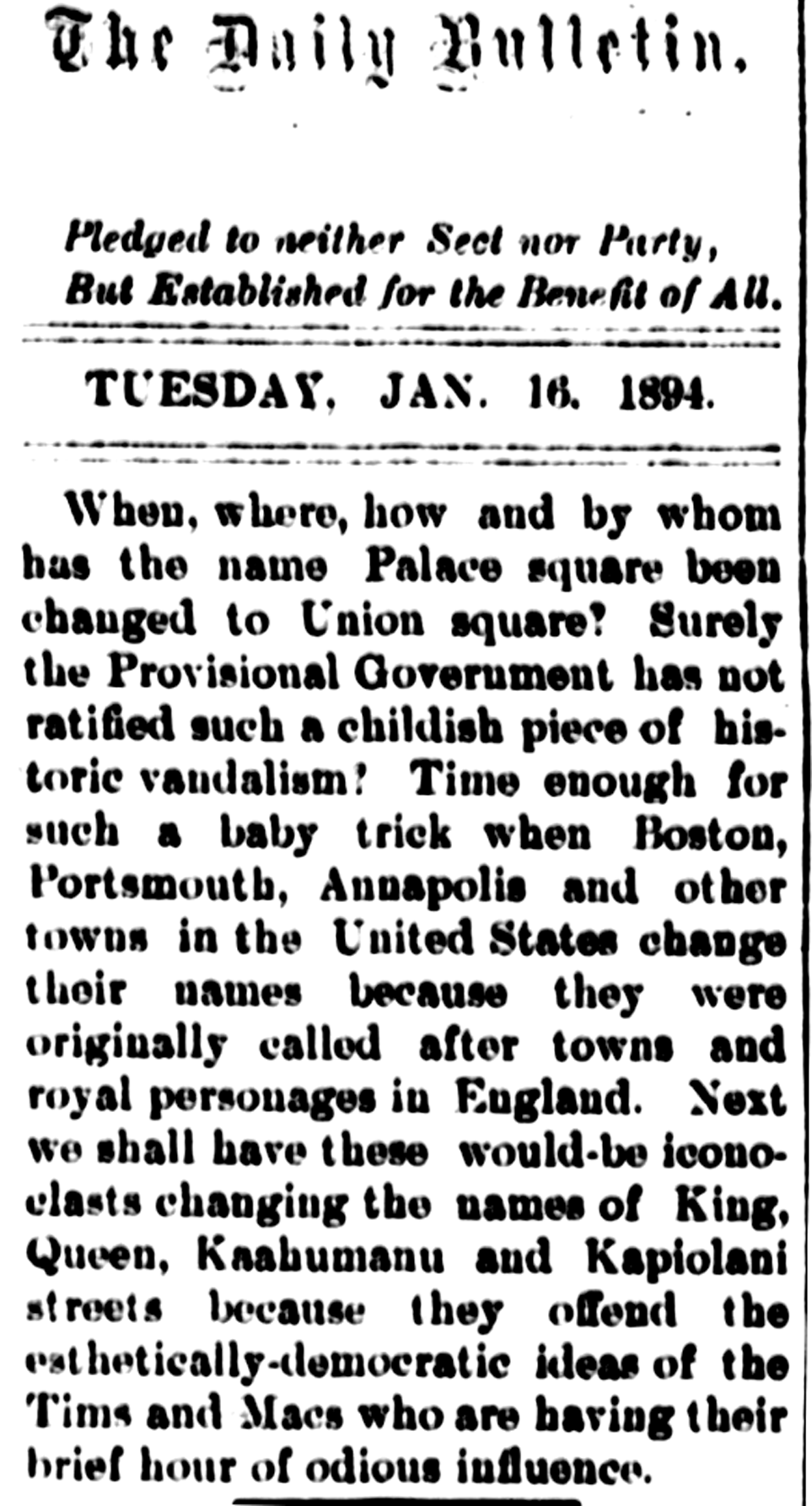
When, where, how and by whom has the name Palace square been changed to Union square? Surely the Provisional Government has not ratified such a childish piece of historic vandalism? Time enough for such a baby trick when Boston, Portsmouth, Annapolis and other towns in the United States change their names because they were originally called after towns and royal personages in England. Next we shall have these would-be iconoclasts changing the names of King, Queen, Kaahumanu and Kapiolani streets because they offend the esthetically-democratic ideas of the Tims and Macs who are having their brief hour of odious influence.

(Daily Bulletin, 1/16/1894, p. 2)

When, where, how and by whom...

The Daily Bulletin, Volume VII, Number 932, Page 2. January 16, 1894.