John Kaina, Kamehameha senior classman, 1941.

KAMEHAMEHA SCHOOLS NEWS

(Written by Louis Agard)

JOHN KAINA

The Bishop Museum [hale hoahu o na mea kahiko o Bihopa] published picture postcards [pepa kii haleleka] showing Hawaiian pictures. Amongst the cards printed is a picture of John Kaina, a senior classman at Kamehameha. John Kaina’s picture is printed in this group of postcards. The first group is made up of twelve eleven cards. Continue reading

Another stone kanoa, 1900.

AN AMAZING AWA BOWL.

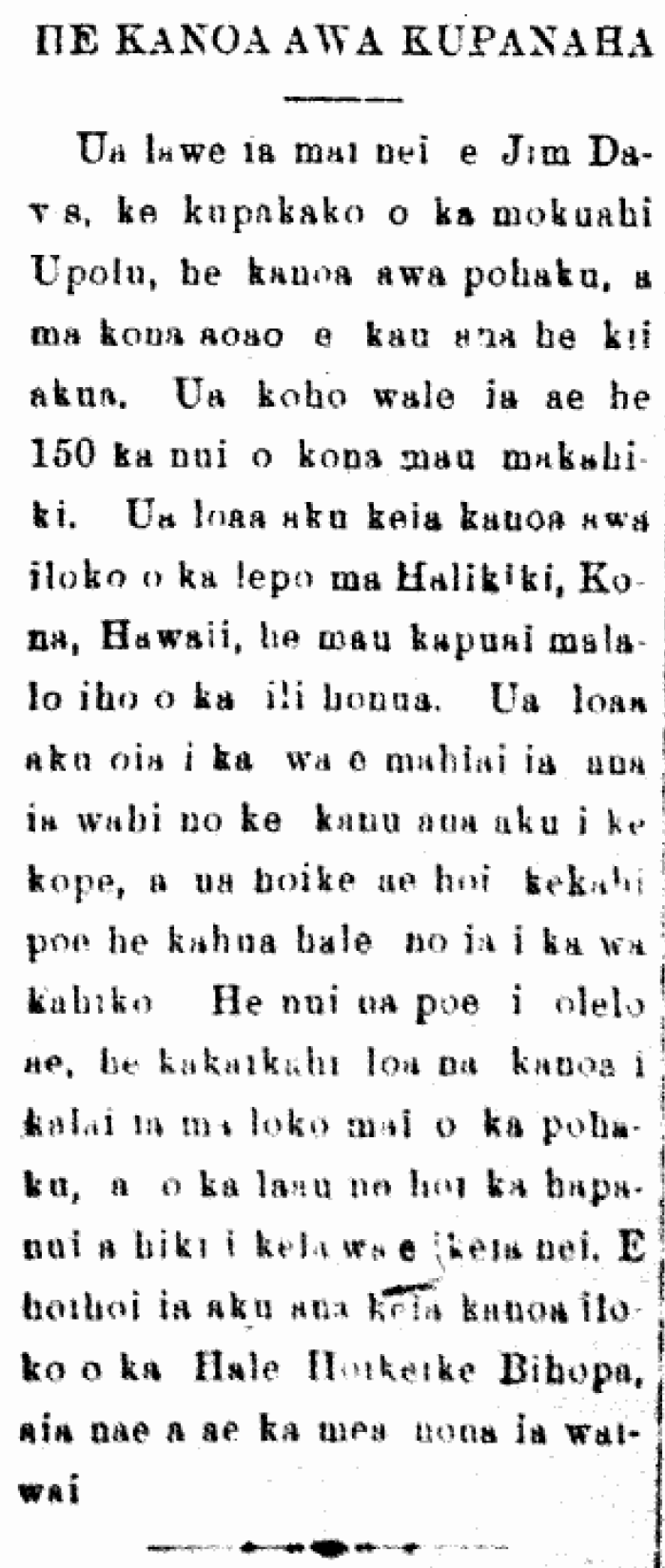
Brought over by Jim Davis, the supercargo [kupakako] of the steamer Upolu, was a stone awa bowl that has a god image [kii akua] on its side. It is estimated to be 150 years old. This kanoa was found in the earth of Halikiki, Kona, Hawaii, a few feet underground. It was found when the land was being worked to plant coffee, and some people said there was a house foundation there in the olden days. There are many who say that a kanoa carved out of stone is very rare, and that most seen to this day are made from wood. This kanoa will be taken to the Bishop Museum after the one who it belongs to gives his consent.

[There was also this story on a stone kanoa at the Museum. And this did not i hear make its way to the Bishop Museum…]

(Aloha Aina, 6/9/1900, p. 6)

HE KANOA AWA KUPANAHA

Ke Aloha Aina, Buke VI, Helu 23, Aoao 6. Iune 9, 1900.

Princess Kaiulani celebrates the new year in Waimea, 1899.

New Year’s Celebration in Waimea.

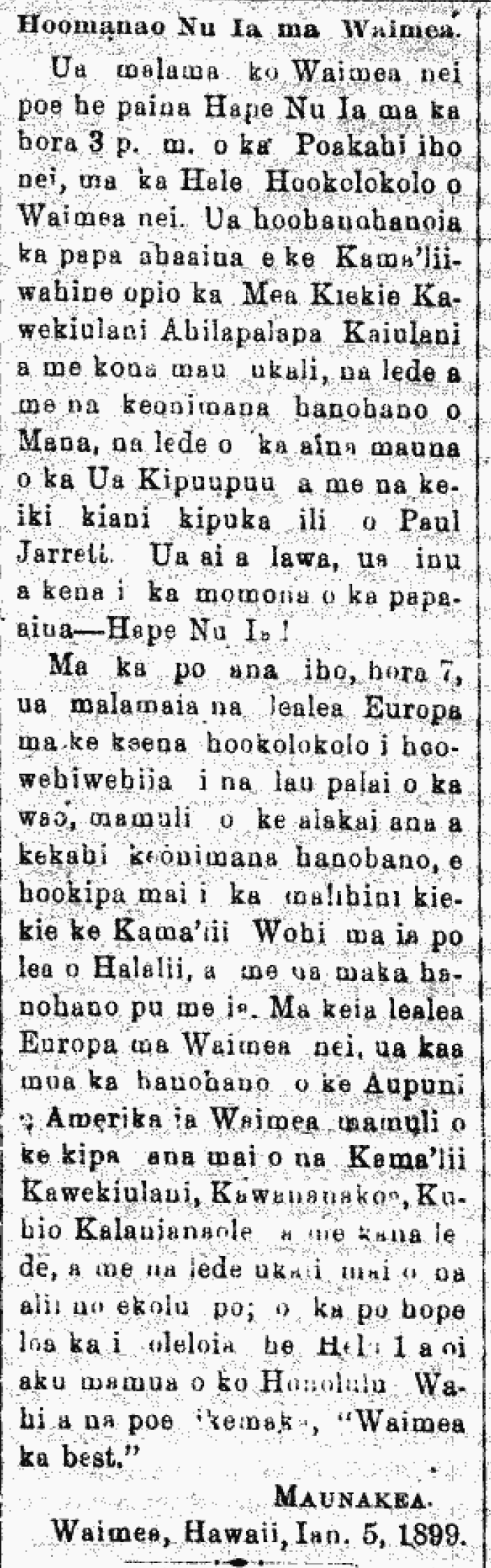
The people of Waimea held a Happy New Year party at 3 p. m. on this past Tuesday [1/3/1899], at the Courthouse here in Waimea. The table was given honor by the young Princess, Her Highness Kawekiulani Ahilapalapa Kaiulani and her entourage: the honorable ladies and gentlemen of Mana; the ladies of the mountainous land of the Kipuupuu Rain [Waimea]; and the lasso-flicking youth, Paul Jarrett. They ate until full, and drank until satiated of the delicacies of the table—Hape Nu Ia!

On the following night at 7 o’clock, European entertainment was held in the courtroom decorated with palai fronds of the forests, under the direction of an honorable gentleman giving welcome to the esteemed guest, the Wohi Princess, on that night of festivities, along with the other dignified ones accompanying her. In this European entertainment, the honor of the American Nation was paid first to Waimea, by the visit of the Young Alii Kawekiulani, Kawananakoa, Kuhio Kalanianaole, and his wife, along with the attending ladies of the alii for three nights; and it is said of the final night that it was Number 1 and better than Honolulu. According to the witnesses, “Waimea is the best.”

Maunakea.

Waimea, Hawaii, Jan. 5, 1899.

(Makaainana, 1/9/1899, p. 1)

Hoomanao Nu Ia ma Waimea.

Ka Makaainana, Buke XI—-Ano Hou, Helu 2, Aoao 1. Ianuari 9, 1899.

Wind and Rain and Lighting, oh my, 1863.

Wind and Rain.

O Kuokoa Newspaper: Aloha oe:

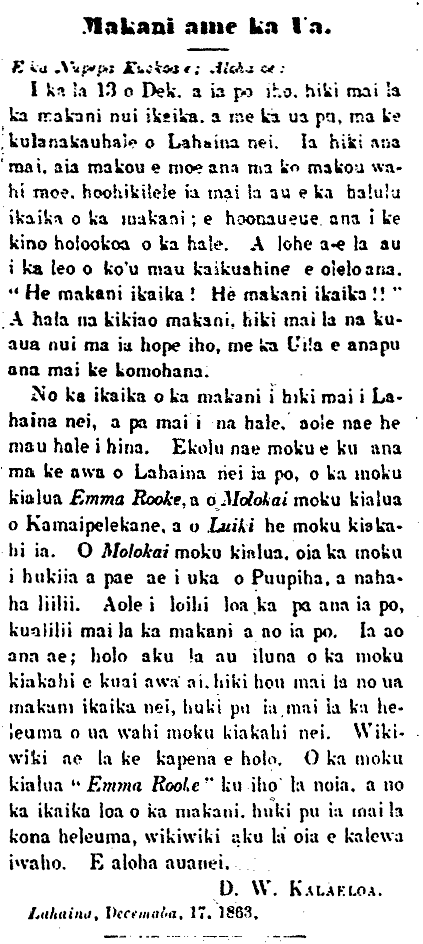
On the 13th of Dec. and that night, a very strong wind appeared, along with rain, here in the town of Lahaina. When it came, we were sleeping in our beds, and I was startled by the great roaring of the wind shaking up the whole house. I heard the voice of my sister call out, “It’s a huge wind! It’s a huge wind!!” The buffeting winds passed and following it came heavy showers and Lightning flashing in the west.

The strong winds which appeared here in Lahaina blew against the houses but did not blow any of them down. There were however three ships in the harbor of Lahaina that night: the double-masted Emma Rooke; the Molokai, the double-masted ship of Kamaipelekane; and the Luiki, a single-masted ship. The double-masted Molokai was the ship that was dragged ashore at Puupiha and which broke up into pieces. The wind did not blow very long that night and it abated as night became day.  In the morning, I sailed aboard the single-masted ship to go sell awa; the strong winds reappeared and the anchor of the ship was pulled up. The captain made quick to sail. The double-masted Emma Rooke remained, but because of the terribly strong winds, it weighed anchor and made quick to lie off outside. Aloha by-and-by.

D. W. Kalaeloa.

Lahaina, December 17, 1863.

(Kuokoa, 12/26/1863, p. 3)

Makani ame ka Ua.

Ka Nupepa Kuokoa, Buke II, Helu 52, Aoao 3. Dekemaba 26, 1863.

Native plants! 2013.

There are many descriptions of plants and their uses and where they grew, found in the Hawaiian-Language Newspapers.

Check out this site from Kapiolani Community College and Leeward Community College, described as:

The goal of Native Plants Hawaiʻi (NPH) is to create and establish a single, comprehensive and searchable online knowledgebase of endemic and indigenous plants of Hawaiʻi.

NPH seeks to connect local nurseries to landscape architects and home growers to promote the purchase, use and understanding of local native plants. Information is constantly updated by participating nurseries and plant specialists.

Hopefully they will be able to integrate relevant articles from the Hawaiian-Language Newspapers into their descriptions!

More on the state of taro, 1911.

Don’t Neglect the Planting of Kalo

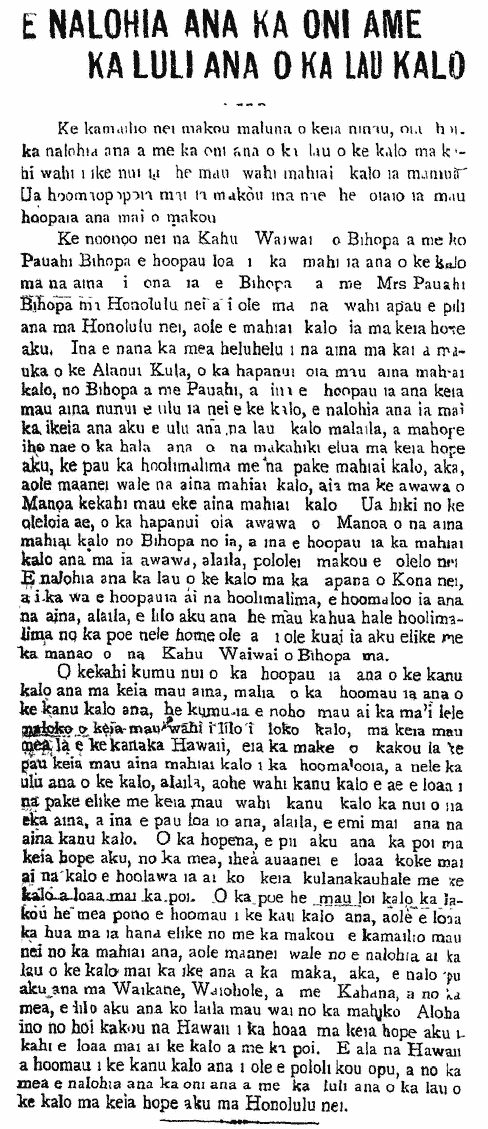
It is to you, O Hawaiians, who we strongly encourage in regard to this question about kalo here forward, for large kalo-growing lands here in Honolulu will be dried out and put an end to by those who own them. Should those lands where kalo is being grown today truly be left to dry out, by our estimation, nearly 300 acres of kalo lands will be lost here in Honolulu, or perhaps four hundred or more acres of kalo lands will not be planted anymore. Therefore, to make up for this lost acreage, it is for all of you people outside of Honolulu to plant dry-land taro in fields and small patches, or in large loi where taro can constantly be cultivated.

If you have an abundance of kalo, then feed the sows, the hens, the turkeys, the ducks, and animals from which a person who plants a lot of taro can benefit; for you can eat the kalo, and the animals can eat the stalks [haha kalo], the leaves [luau], the watery residue from poi making [kale ai]; all these things are of great help to the farmer of kalo. Therefore, O Hawaiians, don’t be weary to grow kalo, and don’t neglect this lively endeavor on the land.

(Kuokoa Home Rula, 8/18/1911, p. 2)

Mai Hoopalaleha i ke Kanu Kalo

Kuokoa Home Rula, Buke IX, Helu 33, Aoao 2. Augate 18, 1911.

Something to consider as more and more agricultural lands get covered over by concrete, 1911 / 2013.

THE STIRRING AND FLUTTERING OF TARO LEAVES TO DISAPPEAR

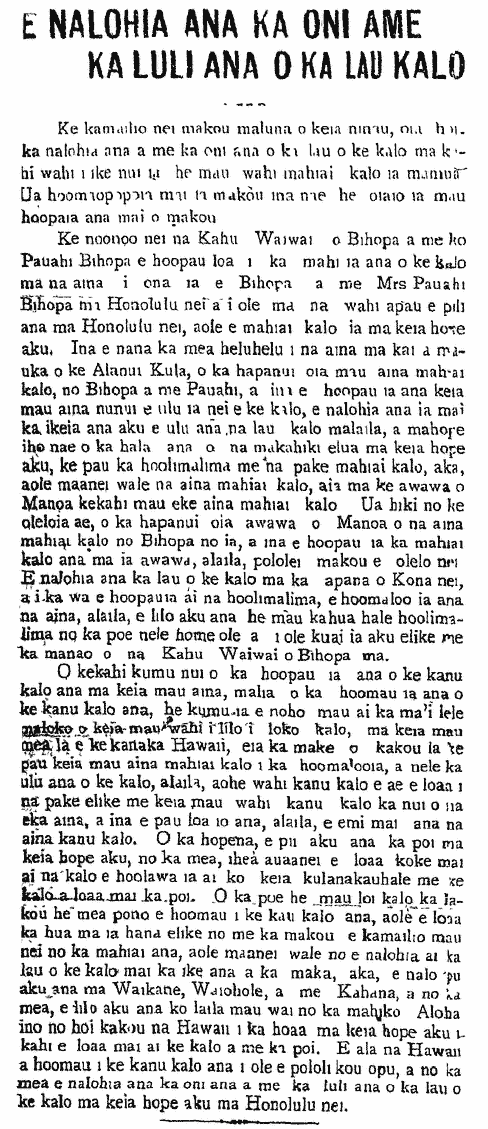
 We are discussing this problem, that being the disappearance of the fluttering taro leaves from places where kalo farming was seen often before. This is clear should our speculation be true.

The Bishop Trustees and those of Pauahi Bishop are considering putting an end for all time to the farming of kalo on lands owned by Bishop and Mrs. Pauahi Bishop here in Honolulu, or in all areas near Honolulu; there will be no more farming of kalo from now on. Should the reader take a look at the lands towards the ocean and towards the uplands of School Street, the majority of those kalo lands belong to Bishop and Pauahi, and should these large tracts of kalo-growing lands be put an end to, taro leaves growing there will no longer be seen, and two years hence, the leases with the Chinese taro farmers will come to an end; but these are not the only taro lands; in Manoa Valley, there are acres of kalo land. It can be said that most of the taro-farming lands in Manoa Valley belong to Bishop, and should the kalo farming be put to an end in that valley, then it is appropriate for us to say that taro leaves will disappear from the district of Kona, and when the leases are stopped, the lands will be dried up, and they will be made into lots to lease to those who have no homes, or they will be sold, like what is being considered by the Trustees of Bishop folks.

 One of the main reasons to end the farming of kalo on these lands is perhaps because if the farming of kalo continues, these areas will be places for infectious diseases to reside; through this, O Hawaiians, our end will come; if these kalo lands are dried out and kalo is not grown, then there will be no other lands for the Chinese to lease like these tracts of lands of many acres, and should they indeed be done away with, then the places where kalo is grown will decrease. As a result, the poi prices will increase, for where will kalo be readily obtained to supply this town and to get poi? For those who have taro fields, it is important that they continue to plant taro; there will not be the profits in that work like what we always speak of when talking of farming; and it is not just here that the leaves of the taro will no longer be seen, but it will disappear from Waikane, Waiahole, and Kahana, for the water there is going to the sugarcane plantations. Alas for us Hawaiians who hereafter will be left wandering, looking for kalo and poi. Rise O Hawaiians and continue to farm kalo lest you be left hungry, being that the stirring and fluttering of kalo leaves will disappear from Honolulu nei.

[This deserves to be retranslated nicely…]

(Kuokoa Home Rula, 8/18/1911, p. 2)

E NALOHIA ANA KA ONI AME KA LULI ANA O KA LAU KALO

Kuokoa Home Rula, Buke IX, Helu 33, Aoao 2. Augate 18, 1911.

Kuakini, and Hawaiian tradition, 1845.

BIOGRAPHY OF KUAKINI.

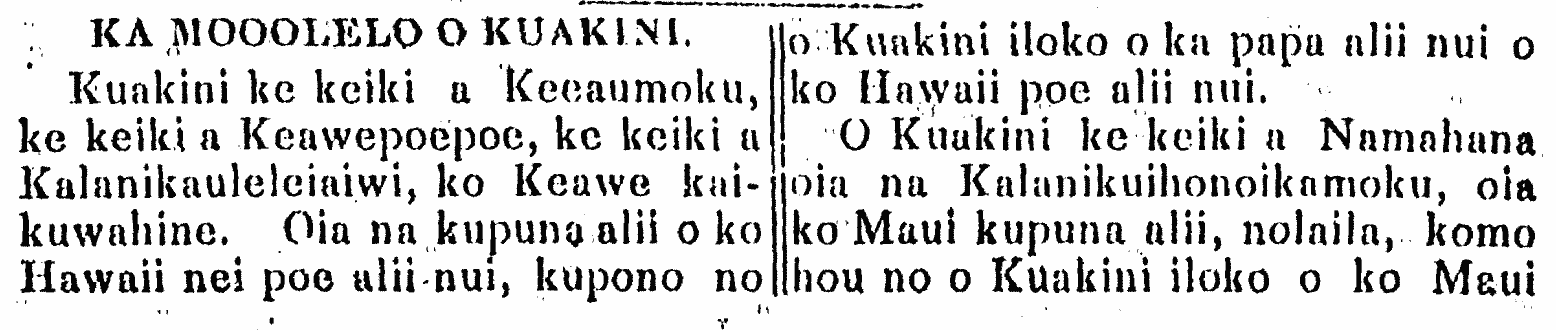
Kuakini was the son of Keeaumoku, the son of Kalanikauleleiaiwi, the sister of Keawe. They are the royal ancestors of Hawaii Island’s high chiefs, Kuakini was befitting the class of high chiefs amongst Hawaii’s alii nui.

Kuakini was the son of Namahana who was born from Kalanikuihonoikamoku, and they are Maui’s royal ancestors, and therefore, Kuakini is amongst Maui’s…

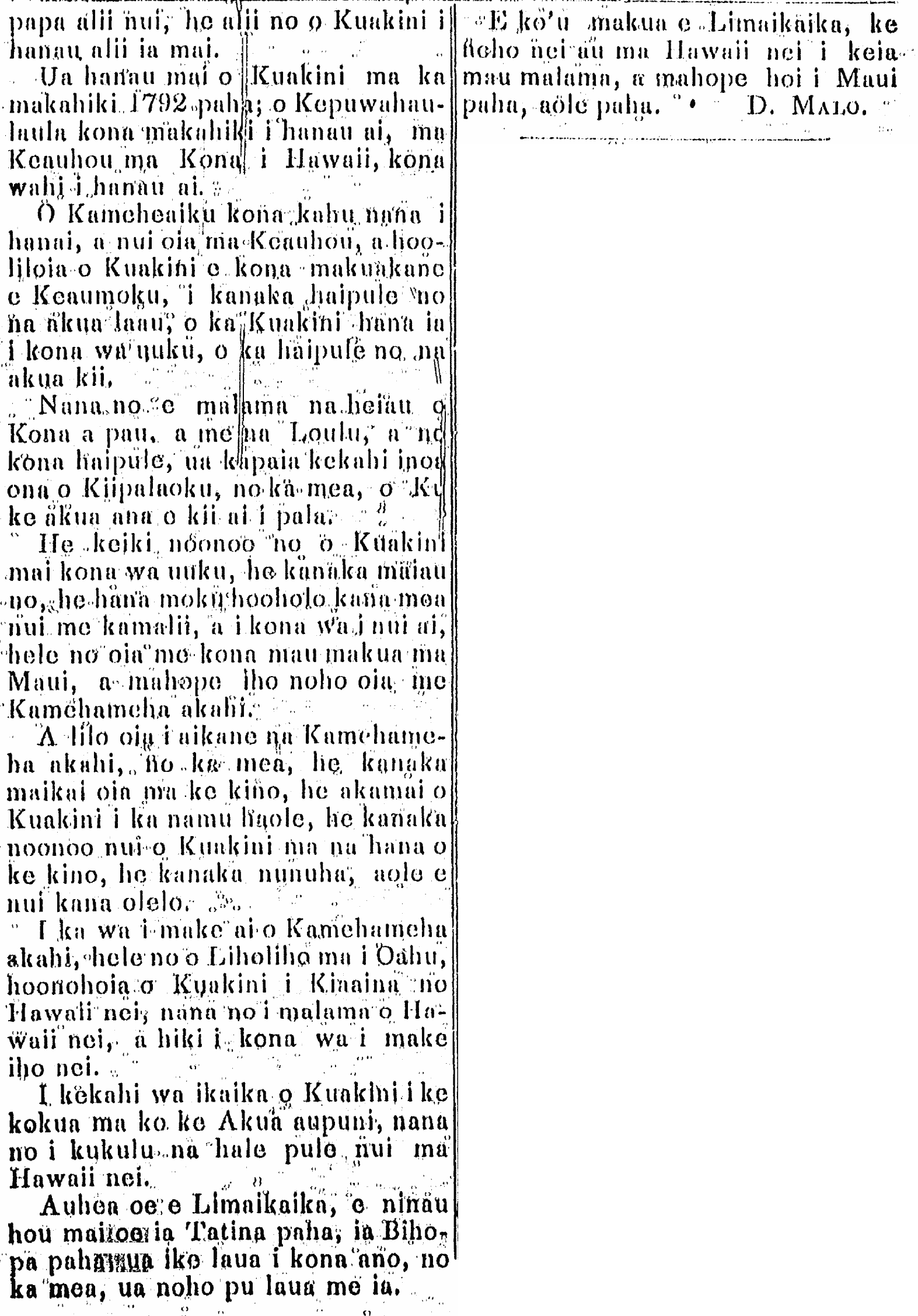
…class of high chiefs; Kuakini was born as an alii.

Kuakini was born in the year 1792 perhaps; he was born in the year of [battle of] Kepuwahaulaula; at Keauhou in Kona in Hawaii was where he was born.

His caretaker [kahu hanai] was Kameheaiku, and Kuakini grew up at Keauhou, and he was made by his father, Keeaumoku, to pray to the wooden gods; this was Kuakini’s duties in his youth, the worship of the wooden gods.

He was the one who cared for all the temples in Kona, along with the Loulu temples, and in regard to his worshiping, one of the names Kuakini was called was Kiipalaoku, for Ku was the god for whom he would fetch pala fern.

Kuakini was a thinker from when he was small; he was meticulous; he often would sail boats with the other children in his youth, and when he grew up, he went with his parents to Maui, and thereafter he lived with Kamehameha I.

He became an aikane of Kamehameha I, because Kuakini possessed a fine body, he was skilled in English, he thought much about the way a body functions, he was sullen, and was a man of few words.

When Kamehameha I died, Liholiho them went to Oahu, and Kuakini was appointed Governor of Hawaii, and it was he that was to care for Hawaii until his recent death.

When Kuakini was assisting intently with the kingdom of God, it was he who built the great churches here on Hawaii Island.

O Armstrong [Limaikaika], please ask of Thurston [Tatina] or Bishop [Bihopa], for they know what he was like for both of them lived with him.

O Father Armstrong, I am living here on Hawaii these months, and will then return to Maui, or perhaps not. D. MALO.

(Nonanona, 1/7/1845, pp. 89–90)
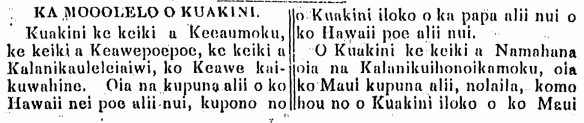
KA MOOOLELO O KUAKINI.

Ka Nonanona, Buke 4, Pepa 19, Aoao 89. Ianuari 7, 1845.
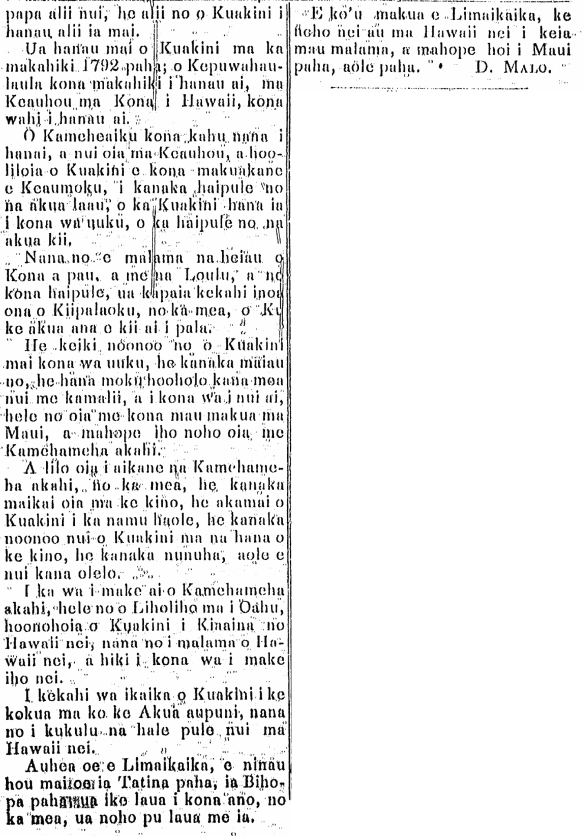
papa alii nui, he alii no o Kuakini...

Ka Nonanona, Buke 4, Pepa 19, Aoao 90. Ianuari 7, 1845

More on the building of the Bishop Museum, 1902.

Sent to Minnesota

KOA TREES FOR THE MUSEUM.

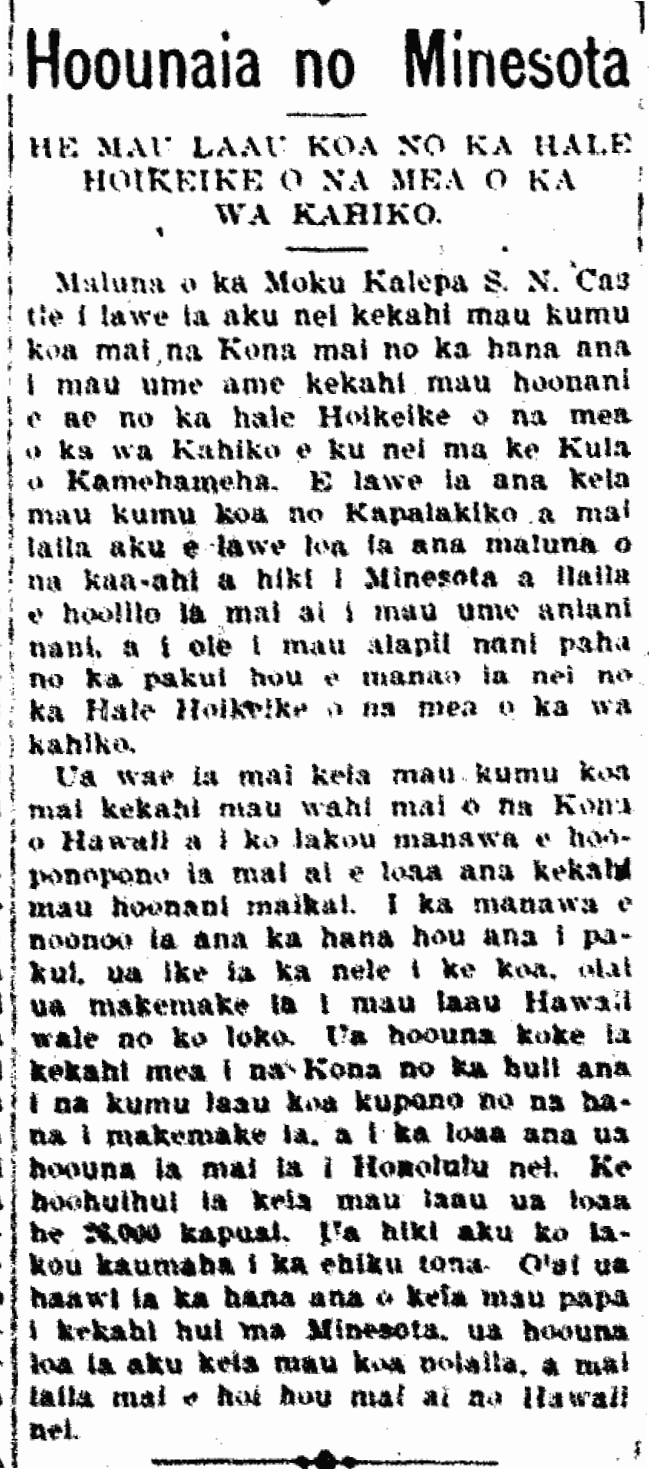
Aboard the Clipper Ship, S. N. Castle, were taken koa trees from the two Kona [North and South Kona] for cases and other decorations for the Museum standing at the Kamehameha School. The koa trees will be taken to San Francisco and from there they will be taken aboard steam locomotive to Minnesota, and there they will be made into beautiful glass cases [ume aniani] or perhaps beautiful stairs for the planned annex for the Museum.

These koa trees were selected from places in Kona, Hawaii, and when they are fashioned, they will be fine decorations. When the idea for a new annex first came up, the lack of koa was noticed, being that only native woods were wanted for the interior. People were soon sent to the two Kona to search for koa fitting for the purpose, and when it was found, it was sent here to Honolulu. All together, the gathered lumber totals 26,000 feet. They weigh seven tons. Being that the job was given to a company in Minnesota, the koa was sent there, and from there it will return to Hawaii nei.

(Kuokoa, 1/31/1902, p. 6)

Hoounaia no Minesota

Ka Nupepa Kuokoa, Buke XL, Helu 5, Aoao 6. Ianuari 31, 1902.

More on Liliu’s 73rd birthday celebration, 1911.

BIRTHDAY OF LILIUOKALANI

Honolulu, Sept. 2—The commemoration of Queen Liliuokalani’s birthday was held today, and according to what the Queen said to some of her friends:

“This is my seventy-third birthday, and i am in good health; i have left behind the disturbing things of this world in which we live, and have surrounded myself with many friends.”

The Queen’s health is fine indeed, and in the morning, the Band of the County [? Royal Hawaiian Band] arrived to play while she dined on breakfast until 10 a. m. Several associations arrived to giver their congratulations to the Alii; and at 11 o’clock, the procession of haole friends to see the Alii began, and this perhaps is the grandest royal audiences of haole giving their congratulations to the Queen.

The Queen was attired in a beautiful garments fitting of her stature, and attended by the Princess Kalanianaole and Mrs. Irene Holloway and Mrs. C. P. Iaukea. The place where the Queen sat was surrounded by many different kahili, and it was her steward, the Honorable C. P. Iaukea who introduced the many strangers. The Alii, the Queen, met each one who came to visit her and she placed a kind smile upon her Royal visage. When the writer for the Hoku [this newspaper, Hoku o Hawaii] appeared before the Alii, she immediately asked, “How are the famous lehua of the land, the lehua of Hilo; are the famous blossoms of the land still beautiful?”

The Queen wore a white lehua [lehua puakea] lei from Hilo, and on her Royal countenance was happiness. On that morning of her birthday, she presented the water leaping land of Waikahalulu as a Park for the public, and it will be administered for the benefit of the people.

The Hoku o Hawaii prays for the long life of the beloved Queen of Hawaii, and although she has no throne upon to rule, hers is the throne of aloha within the hearts of her loving people. May the Queen live in God.

[Unfortunately the issues of Hoku o Hawaii from 1906 to the early part of 1917 (including this article) are not available online! The more people talk about the importance of the information in the Hawaiian-Language Newspapers and the need to rescan those newspapers clearly and make them accurately searchable, the more chance there will be funding for it!]

(Hoku o Hawaii, 9/7/1911, p. 2)

LA HANAU O LILIUOKALANI.

Ka Hoku o Hawaii, Buke 6, Helu 18, Aoao 2. Sept. 7, 1911.