Lorrin Andrews’ Hawaiian language dictionary, 1862.

Kumu Olelo Hawaii.

We are thrilled to hear that the Hawaiian Language Manual being assembled by the esteemed L. Andrews [ka mea Mahaloia L. Aneru]. It is a Book that explains the essence of words, like the haole; only the letter P remains, and then it is finished. There was a great resolution by the Legislature to set aside funds for this endeavor; but not a penny has been given by the Government Treasury. It can be made ready for printing should there be a skilled Hawaiian, and if there is not, it will take about three months before it can be printed. And now, there are many haole who want to know the Hawaiian language; and so too of the Hawaiians, they want to know English; therefore, we believe that it is appropriate that the money is spent on this. Continue reading

More on the Hawaiian Board of Health, 1886.

A KAHUNA CASE.

An Incomprehensible Law—Discrepancy Between the English and Hawaiian Versions.

In the case of an appeal from the Waialua District Court, respecting an alleged kahuna, Judge Preston yesterday rendered a decision in the Intermediary Court substantially as follows: Continue reading

Another “blue” story translated by J. W., 1862.

[Unuhiia no ke Kuokoa.]

UMIUMI ULIULI.

MAMUA AKU NEI, E NOHO ANA kekahi kanaka waiwai loa, paapu kona mau hale maikai, o kona mau pa, he gula a me ke dala; o na moe a me na noho, ua uhiia i ke kilika maikai loa, o kona mau kaa, ua hamoia i ke gula a maikai loa. O ka mea i apiki loa ai o ua kanaka nei, o ke ahinahina o ka umiumi; nolaila, weliweli ke nana aku, a makau na wahine o kona wahi ke hui aku i kona Comepane. He wahine hanohano e noho ana ma ia wahi, a elua ana mau kaikamahine, he mau wahine ui no laua a elua.

[This is the beginning of J. W.’s translation of Charles Perrault’s “Bluebeard.” Continue reading

The Blue Bird, 1862.

KA MANU ULIULI.

[Unuhiia no ke Kuokoa.]

HELU 1.

I KEKAHI MANAWA, E NOHO ANA kekahi Moi waiwai loa; a o kana wahine, ua make; a noho iho la ia me ka oluolu ole. Ewalu la o kona noho ana iloko o kekahi lumi uuku, o kana hana ka hookui i ke poo ma ka paia; aka, ua uhiia nae i ka pulu  i mea e eha ole ai ia. O na makaainana ona a pau loa, manao iho la e hele aku e ike, a e hooluolu ia ia; aole nae ona manao i ka lakou olelo. A Mahope, hele aku imua ona, he wahine i uhiia a paa i ka lole eleele, me ka uhimaka kanikau, me ka uwe ikaika loa, a kunana iho la ua Alii nei. Hookomo mai la ua Alii nei me ka oluolu, a no ka lilo loa i ke kamailio; nolaila, aole o laua olelo no ke kumu o ko laua pilikia.

[This is the beginning of another foreign kaao translated by J. W. Continue reading

Hawaiian version of “Beauty and the Beast,” 1893.

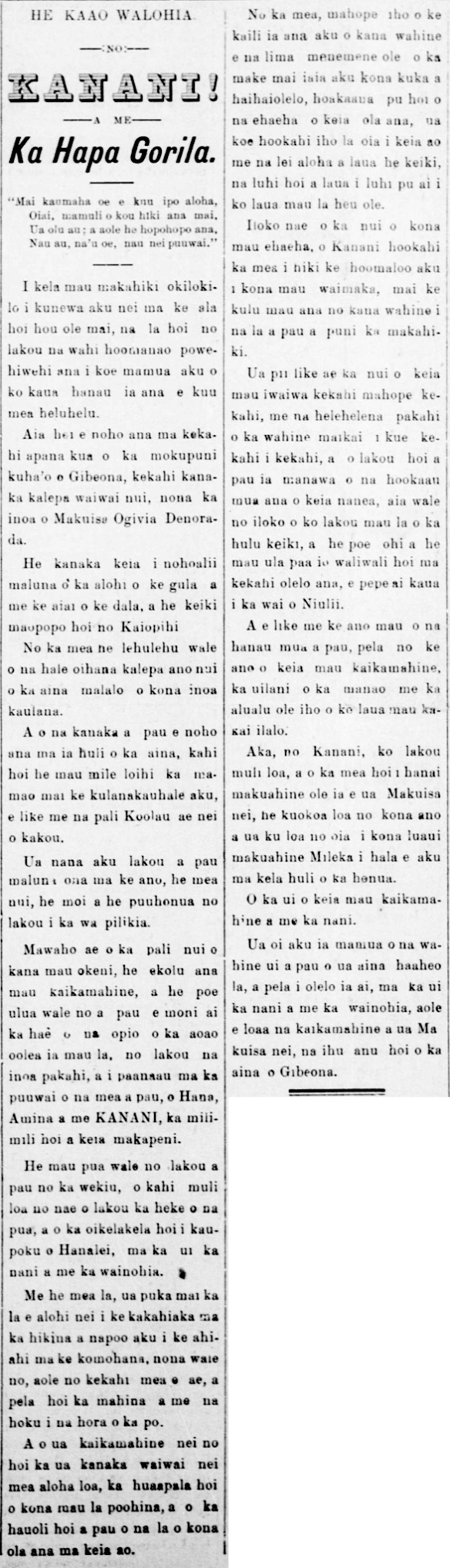
HE KAAO WALOHIA
—:NO:—
KANANI!
—:A ME:—
Ka Hapa Gorila.

“The Heart-Wrenching Tale of Beauty and the Half Gorilla” ran in Hawaii Holomua from 4/10/1893 and concluded on 5/26/1893. There is no attributed translator. I am not sure what work it was translated from.

[Much earlier in 1862, Jeanne-Marie LePrince de Beaumont’s “Beauty and the Beast” was translated as “He Kaao no Kanani! me ka Holoholona,” by J. W. Click here for my earlier post.]

(Hawaii Holomua, 4/10/1893, p. 1)

HawaiiHolomua_4_10_1893_1.png

Hawaii Holomua, Buke III, Helu 197, Aoao 1. Aperila 10, 1893.

Translation of G. W. M. Reynolds’ “Kenneth: A Romance of the Highlands,” 1865.

KENETE:

He Mooolelo no Sekotia.

MOKUNA 1.

KA HOOMAKA ANA.

I ka mahina o Sepatemaba, M. H. 1493, i ka wa a ka la e pii ae ana mai ka ili kai ae, a e kiei mai ana kona mau kukuna maluna o na mauna Garamapia; i ka wa a ke kahuhipa e hoa ana i kana pu-a i hanai ia ai i na mauu uliuli o na puu. Ike ia aku la kekahi wahine e hele ana i ke kulanakauhale o Edineboro, me ke keiki e hii ana ma kona lima.

O ua wahine nei he kanakolu ka nui o kona mau makahiki, me he mea la he wahine ui ia i kona mau la. A i ka wa i ike ia ai ka wahine me ua wahi keiki nei, ua kahakaha ia kona mau maka e ka popilikia, a ua noho ia kona mau papalina e ka hakahaka a me ka pololi, a o kona aahu ua weluwelu, koe nae ke kihei i wahi ia ai kahi keiki, ka mea nona ka mooolelo, oia wale no kahi mea maemae iki. I ke awakea, hiki aku la ua wahine nei me kahi keiki mawaho o kekahi pakaua, a noho iho la ia maluna o kekahi pohaku paepae; kuu aku la ia i ua wahi keiki nei, a hoouna ae la ia i ka uwe ana iho ka u ole, a mokumokuahua iho la ka naau o ua wahine nei, i ka lohe aku i ka uwe mai o ke keiki. A i ka poeleele, hiki aku la laua nei iloko o ke kulana kauhale, mamua ponoi iho o kekahi hale hiehie i hoomalamalama ia i na kukui; ua uhiia na papakaukau o ua hale nei i na mea ai o na ano a pau.

[This is the opening to one of the early large-scale translations of a foreign story published in the Hawaiian Language Newspapers. This telling of G. W. M. Reynolds’ “Kenneth: A Romance of the Highlands” by John M. Kapena, runs in the newspaper Au Okoa from its inaugural issue on 4/24/1865 to 12/10/1866.]

(Au Okoa, 4/24/1865, p. 1)

AuOkoa_4_24_1865_1.png

Ke Au Okoa, Buke I, Helu 1, Aoao 1. Aperila 24, 1865.

Hawaiian-language interpretation of Longfellow’s “Psalm of Life,” 1871.

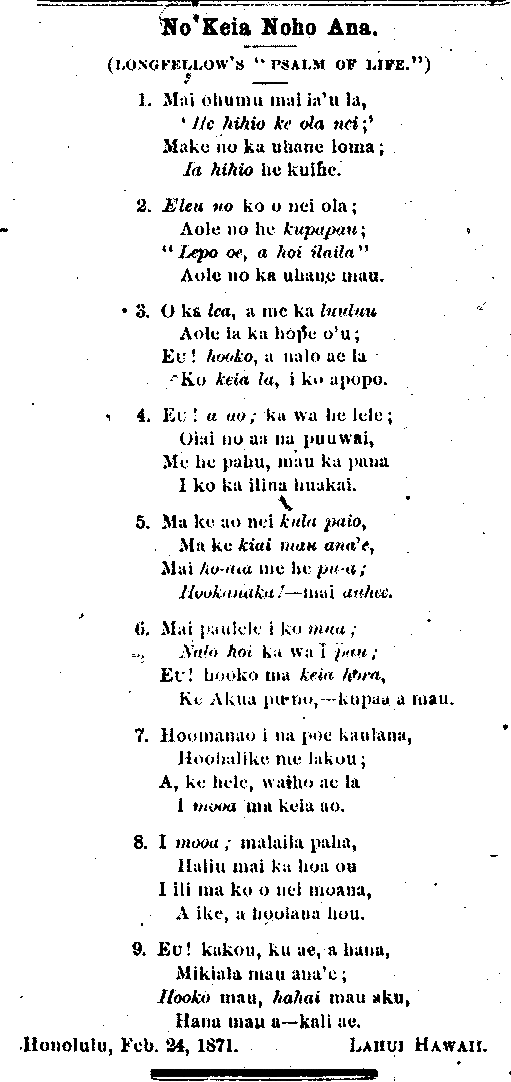
No Keia Noho Ana.

(LONGFELLOW’S “PSALM OF LIFE.”)

1. Mai ohumu mai ia’u la,
‘He hihio ke ola nei;’
Make no ka uhane loma;
Ia hihio he kuihe.

2. Eleu no ko o nei ola;
Aole no he kupapau;
“Lepo oe, a hoi ilaila”
Aole no ka uhane mau.

3. O ka lea, a me ka luuluu
Aole ia ka hope o’u;
Eu! hooko, a nalo ae la
Ko keia la, i ko apopo.

4. Eu! a ao; ka wa he lele;
Oiai no aa na puuwai
Me he pahu, mau ka pana
I ko ka ilina huakai.

5. Ma ke ao nei kula paio,
Ma ke kiai mau ana’e
Mai ho-aia me he pu-a;
Hookanaka!—mai auhee.

6. Mai paulele i ko mua;
Nalo hoi ka wa i pau;
Eu! hooko ma keia hora,
Ke Akua pu no,—kupaa a mau.

7. Hoomanao i na poe kaulana,
Hoohalike me lakou;
A, ke hele, waiho ae la
I mooa ma keia ao.

8. I mooa; malaila paha,
Haliu mai ka hoa ou
I ili ma ko o nei moana,
A ike, a hoolana hou.

9. Eu! kakou, ku ae, a hana,
Mikiala mau ana’e;
Hooko mau, hahai mau aku,
Hana mau a—kali ae.

Honolulu, Feb. 24, 1871.  Lahui Hawaii.

[A PSALM OF LIFE

What the Heart of the Young Man Said to the Psalmist

Tell me not, in mournful numbers,
Life is but an empty dream!—
For the soul is dead that slumbers,
And things are not what they seem.

Life is real! Life is earnest!
And the grave is not its goal ;
Dust thou art, to dust returnest,
Was not spoken of the soul.

Not enjoyment, and not sorrow,
Is our destined end or way;
But to act, that each to-morrow
Find us farther than to-day.

Art is long, and Time is fleeting,
And our hearts, though stout and brave,
Still, like muffled drums, are beating
Funeral marches to the grave.

In the world’s broad field of battle,
In the bivouac of Life,
Be not like dumb, driven cattle!
Be a hero in the strife!

Trust no Future, howe’er pleasant!
Let the dead Past bury its dead!
Act,—act in the living Present!
Heart within, and God o’erhead!

Lives of great men all remind us
We can make our lives sublime,
And, departing, leave behind us
Footprints on the sands of time ;

Footprints, that perhaps another,
Sailing o’er life’s solemn main,
A forlorn and shipwrecked brother,
Seeing, shall take heart again.

Let us, then, be up and doing,
With a heart for any fate;
Still achieving, still pursuing,
Learn to labor and to wait.

(Lau Oliva, 3/1871, p. 1)
LauOliva_3_1871_1

Ka Lau Oliva, Buke I, Helu 3, Aoao 1. Maraki 1871.
Death of the translator of Twenty-Thousand Leagues Beneath the Sea, Oniula, George W. Kanuha, 1876.

A Solemness, an  Expression of Affection for G. W. Kanuha.

[Aia aku la paha oe i ka aina hanau,
Ia Kona kai opua i ka lai,
Opua hinano ua malie
Hiolo na wainaoa a ke kehau,
Aole—eia ka paha i na hono a Piilani,
I ka lai o Hauola,
I ka malu o ka Ulu o Lele
E holoholo kuaua paupili ana.
Auwe! Aloha ino.]

Perhaps you are at the land of your birth,
Kona of the billowing clouds on the sea in the calm,
The clouds white like hinano blossoms,
Where the chilling waters of the Kehau mists fall,
No—maybe you are here amongst the bays of Piilani,
In the calm of Hauola,
In the shade of the Breadfruit of Lele,
Travelling about like the Paupili showers.
Auwe! How sad.

George W. Kanuha was born in 1845 in the town of Kailua, North Kona, Hawaii, of the streaked sea, the peaceful sea at Kalaiaehu, ever moistened by the amazing rains of the land of his birth in the face of the clouds. And he passed on to the other side of the black river, that line before the animals life and plant life which forever moves toward the final Great Revelation in the City of heaven. On the 16th day of this month, G. W. Kanuha travelled one last time in the shade of the ulu trees of Lele [Lahaina] in the sparkling sun and the red dirt of his welcoming home, sinking into the eternal home, the belly of the earth following after papa and mama. Aloha ino.

Ahukinialaa Wahineiki was his father, a student of Lahainaluna College, from the very beginning of the school in 1831, he boarded at that school until he graduated with the fluttering flag upon his Diploma. Mrs. Kealoha Wahineiki was his mother. G. W. Kanuha was an only child. Continue reading