Story of Kamapuaa by G. W. Kahiolo, 1861.

HE MOOLELO NO KAMAPUAA.

Helu.—1.

Ma ka mookuauhau no Kamapuaa a loaa mai oia; oia keia e hoikeia aku nei, i mea e ikeia ai kona ano kupanaha, a me kona ikaika ma ke kaua ana, a me ke ano e o kona kino, a me kana mau hana. O keia kanaka, ua hoomana ia no i akua e ko Hawaii nei poe; aka, aole o’u manao lana, ua ku like loa ka poe kuauhau a pau e noho mai nei, aole no hoi akaka ka mea pololei loa; no ka mea, aole hookahi o lakou mea e ola ana, i ike i na mea i hanaia ia wa, aole no hoi o lakou mea i kakau buke mookuauhau nana, a waiho mai na kana mau pua; no ka mea, he pono paanaau wale no, a nalowale iho.

….

[This is the opening of the Kamapuaa story by G. W. Kahiolo [aka G. W. Poepoe]. It ran as a serial in the newspaper Hae Hawaii from 6/26 to 9/25/1861. This story was translated by Esther T. Mookini and Erin C. Neizmen with the assistance of David Tom, and put out by the University of Hawaii at Manoa Hawaiian Studies Program in 1978. In it, they say of Kahiolo:

The author G. W. Kahiolo, is not known otherwise to us. For other materials written by him, see Kukini ‘Aha’ilono, edited by Rubellite K. Johnson, Topgallant Publishing Col., Ltd., Honolulu, 1976: page 150, “Inoa o na Laau,” a list of names of plants, and pages 187–188, “He Mele no ka Nupepa Kuokoa,” a song in celebration of the start of the Hawaiian language newspaper, Ka Nupepa Kuokoa. We were unable to find any biographical material on him. However, because Ka Hae Hawaii was the official organ of the Department of Instruction (Mookini 9), Kahiolo may have been a Protestant educator as his tale is given a prominent place in the layout of the paper.]

(Hae Hawaii, 6/26/1861, p. 52)
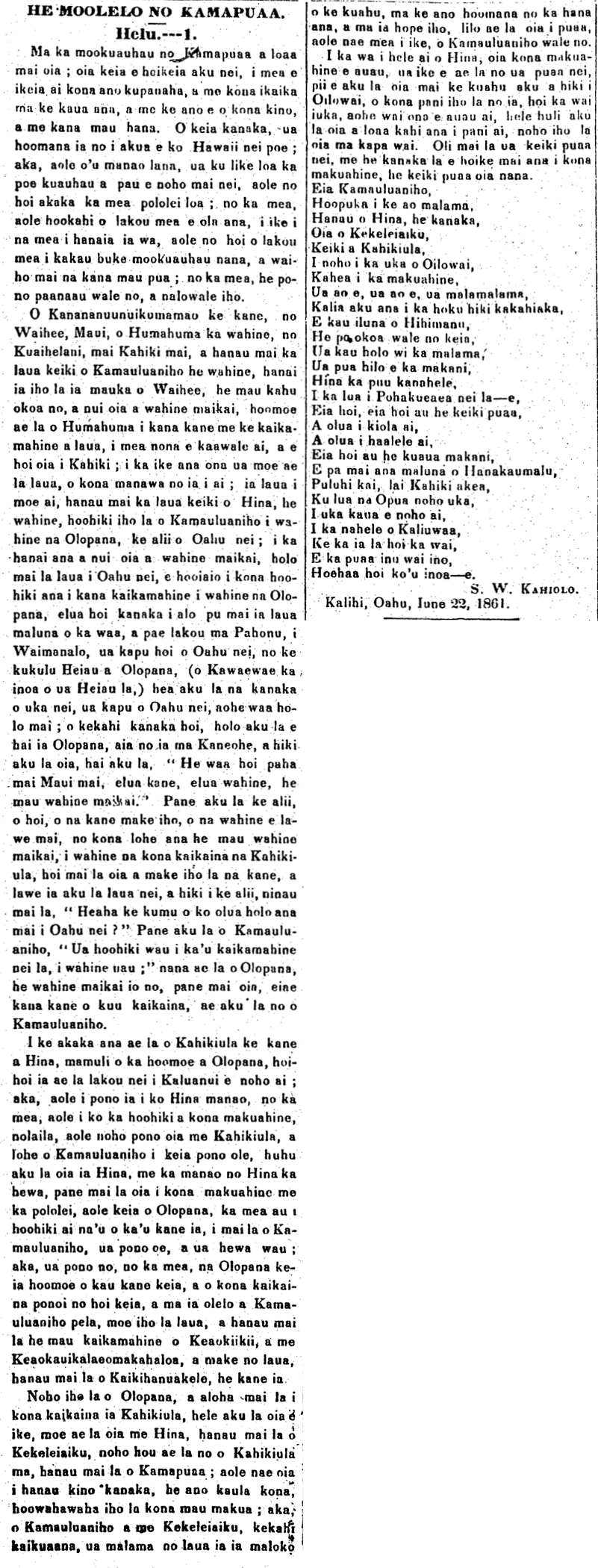
HE MOOLELO NO KAMAPUAA.

Ka Hae Hawaii, Buke 6, Ano Hou—Helu 13, Aoao 52. Iune 26, 1861.
Hawaiian-language versus English historical documents, 2014 and beyond.

When researching anything relating to Hawaii nei, it goes without saying that it is imperative that we look at the Hawaiian-language documents left by the people of old. However, it is important to look at all the other documents available to us written in other languages as well.

The three different articles covering the 100th birthday celebration of Kauikeaouli recently posted is a simple case in point. Each of the three supply information not provided by the other two. Continue reading

Hawaiian Language information from English-language newspapers! 1887.

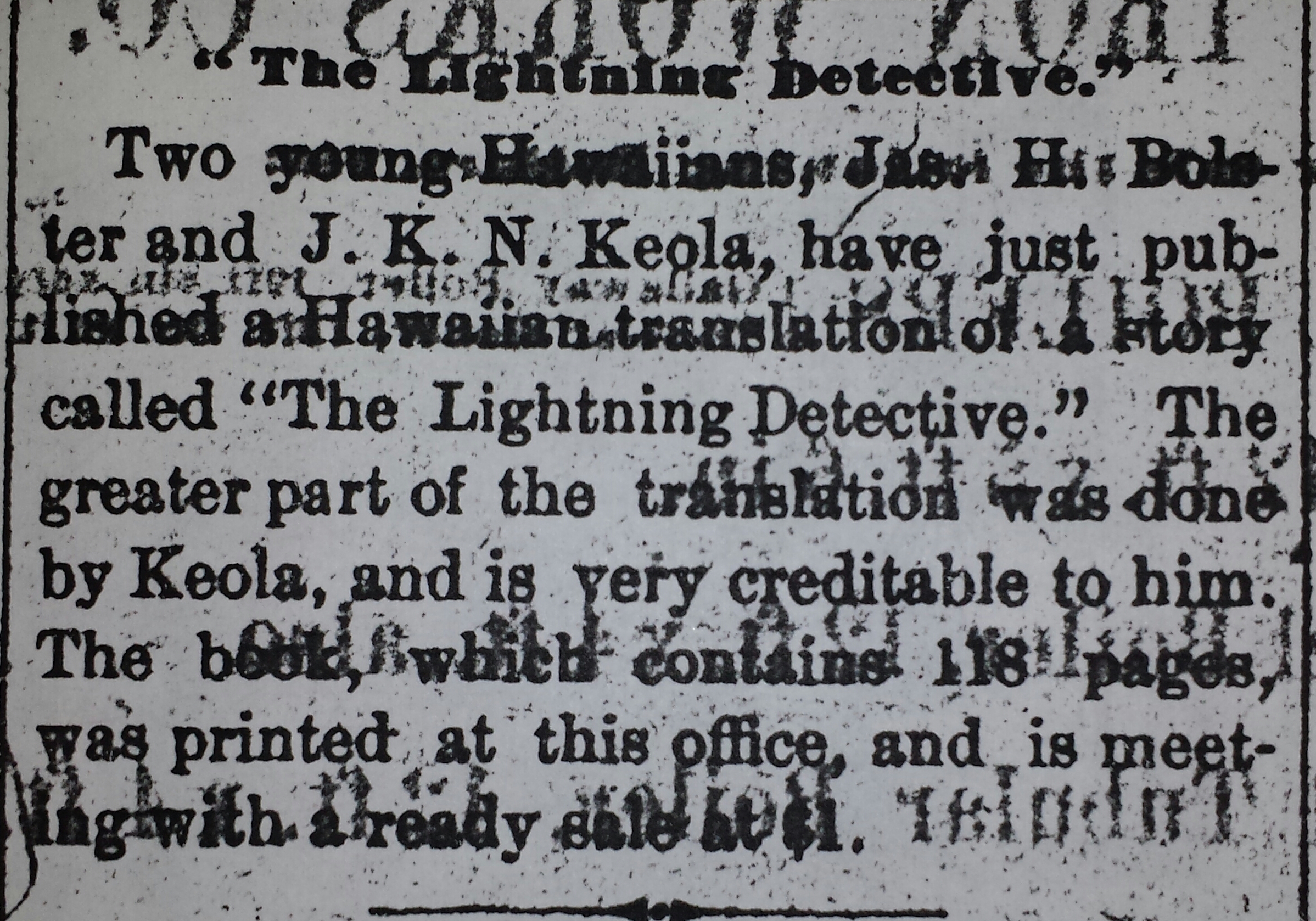
“The Lightning Detective.”

Two young Hawaiians, Jas. H. Boster and J. K. N. Keola, have just published a Hawaiian translation of a story called “The Lightning Detective.” The greater part of the translation was done by Keola, and is very creditable to him. The book, which contains 118 pages, was printed at this office, and is meeting with a ready sale at $1.

[There doesn’t seem to be a translator credited on the actual book, “He Buke Moolelo no Ka Makai Kiu Uila” published in 1887 by the P. C. Advertiser.¹ Who would have thought that translators of a Hawaiian book would be mentioned in an English newspaper (even if it was a newspaper printed by the company that did the publishing). This goes to show you that it is important to look at all sources available, whatever language it may be in, to find information!

Copies of this book are available at the Hawaiian Historical Society and Mission Children Society, photocopies are available at Hamilton Library at UHM.]

¹See David Forbes’ Hawaiian National Bibliography, vol. 4.

(Pacific Commercial Advertiser, 5/3/1887, p. 3)

"The Lightning Detective."

Pacific Commercial Advertiser, Volume VI, Number 104, Page 3. May 3, 1887.

Translations and vocabulary not found in dictionaries, 1903.

HEAHA LA KA PAIN BALM?

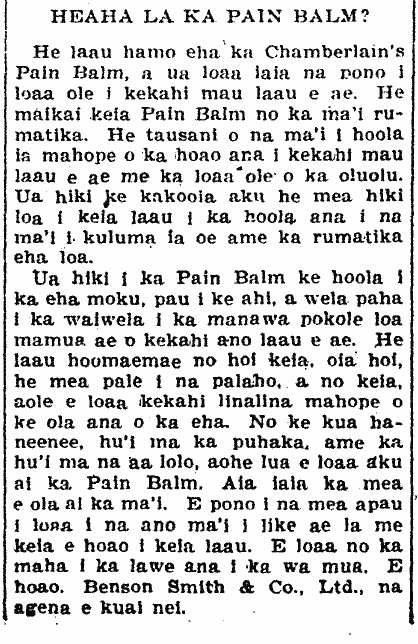
He laau hamo eha ka Chamberlain’s Pain Balm, a ua loaa iaia na pono i loaa ole i kekahi mau laau e ae. He maikai keia Pain Balm no ka ma’i rumatika. He tausani o na ma’i i hoola ia mahope o ka hoao ana i kekahi mau laau e ae me ka loaa ole o ka oluolu. Ua hiki ke kakooia aku he mea hiki loa i keia laau i ka hoola ana i na ma’i i kuluma ia oe ame ka rumatika eha loa.

Ua hiki i ka Pain Balm ke hoola i ka eha moku, pau i ke ahi, a wela paha i ka waiwela i ka manawa pokole loa mamua ae o kekahi ano laau e ae. He laau hoomaemae no hoi keia, oia hoi, he mea pale i na palaho, a no keia, aole e loaa kekahi linalina mahope o ke ola ana o ka eha. No ke kua haneenee, hu’i ma ka puhaka, ame ka hu’i ma na aa lolo, aohe lua e loaa aku ai ka Pain Balm. Aia iaia ka mea e ola ai ka ma’i. E pono i na mea apau i loaa i na ano ma’i i like ae la me keia e hoao i keia laau. E loaa no ka maha i ka lawe ana i ka wa mua. E hoao. Benson Smith & Co., Ltd., na agena e kuai nei.

(Kuokoa, 4/3/1903, p. 5)

HEAHA LA KA PAIN BALM?

Ka Nupepa Kuokoa, Buke XLI, Helu 14, Aoao 5. Aperila 3, 1903.

WHAT IS PAIN BALM?

Chamberlain’s Pain Balm is a liniment and, while adapted to all the ordinary uses of a liniment, has qualities which distinguish it from other remedies of this class. Pain Balm is especially beneficial for rheumatism. Thousands of cases can be cited in which it has effected a cure when the sufferer had previously tried the best medical service without securing relief. Pain Balm is positively guaranteed to give relief  in the most severe cases of chronic or acute rheumatism.

Pain Balm heals bruises, burns and scalds in less time than any other treatment. It is “antiseptic” that is, it prevents putrefaction and by so doing, generally prevents and unsightly scar remaining after the injury is healed. For lame back, lumbago and neuralgia, Pain Balm has no equal. It has the quality of “getting to the right spot.” No sufferer from these distressing affections should defer a trial of this remedy. One application gives relief. Try it. For sale by all dealers. Benson, Smith & Co., general agents.

[Actual translations of almost anything like this advertisement done in the past can shed light on vocabulary, turns of phrase, and so much more!]

(Hawaiian Star, 9/5/1903, p. 3)

WHAT IS PAIN BALM?

The Hawaiian Star, Volume XI, Number 3576, Page 3. September 5, 1903.

Kamehameha Schools Song Contest, yesterday and today, 1944 / 2014.

[Found under: “News From Boys, Girls Kamehameha School”]

By HARRIETTE HURLEY

People who enjoy Hawaiian music have expressed the desire to know the meanings of the Hawaiian songs. Translations of the two prize songs to be used in the Kamehameha School for Girls’ song contest to be held on February 13, appear below.

Mrs Mary Kawena Pukui, translator at the Bishop Museum and director of Hawaiian activities at the Kamehameha Preparatory School, has translated the songs.

The junior division prize song is Pa’au’au Waltz. Selected for the senior division prize song is Lei Awapuhi.

Translation of Lei Awapuhi

I hear the voice of a loved one say
Let me pluck and wear the flower
To string a lei for my leaf bud to wear
My love was strongly attracted
To the choicest flower that ever bloomed
Let me, darling, string it into a lei,
O let your ginger lei be mine. Continue reading

Lahaina, and Hawaii through history, 1941.

OLD LAHAINA PRISON
and
ANCIENT LAHAINA

By INEZ ASHDOWN

According to information gleaned from the Bishop Museum records and the Archives of Mr. E. Bryan Jr., curator at the Museum, the old Lahaina Prison was built in 1851 and completed in April 1852. This was during the reign of Kamehameha III, who ruled until 1854.

For “local color” at that time I have talked with old Hawaiians who are from 70 to 80 years of age, and have also spent many hours at the Wailuku library reading old volumes supplied by Mrs. Juliette Davis, Librarian. Continue reading

Interesting translation, 1908.

HOW DIPHTHERIA IS CONTRACTED.

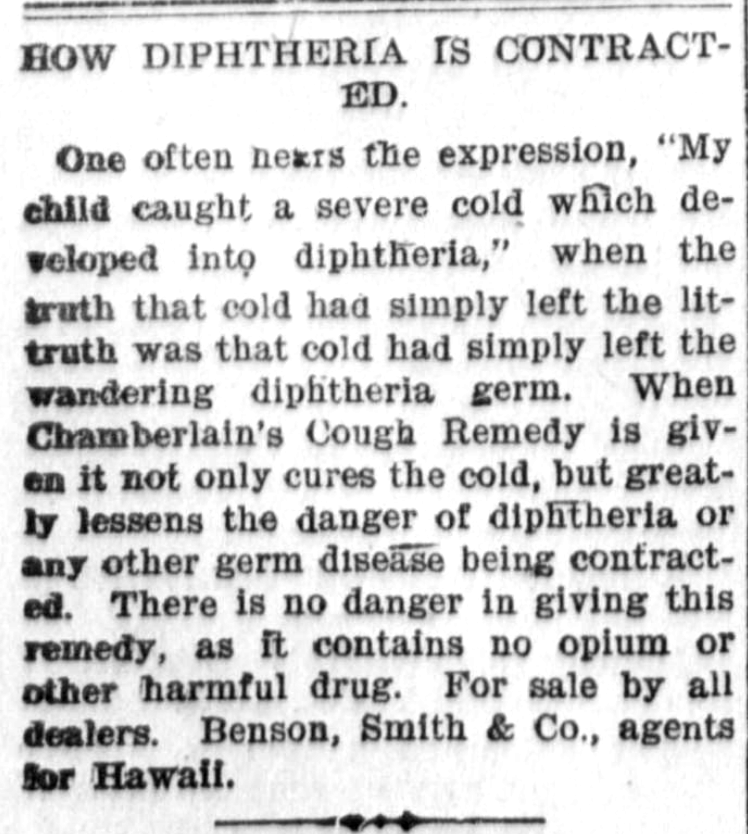
One often hears the expression, “My child caught a severe cold which developed into diphtheria,” when the truth that cold had simply left the lit- truth was that cold had simply left the wandering diphtheria germ. When Chamberlain’s Cough Remedy is given it not only cures the cold, but greatly lessens the danger of diphtheria or any other germ disease being contracted. There is no danger in giving this remedy, as it contains no opium or other harmful drug. For sale by all dealers. Benson, Smith & Co., agents for Hawaii.

(Hawaiian Star, 3/13/1908, p. 6)

HOWA DIPHTHERIA IS CONTRACTED.

The Hawaiian Star, Volume XV, Number 4978, Page 6. March 13, 1908.

KE ANO I HOOPAUIA AI O KA MA’I O KA PUU.

Ua lohe pinepineia keia olelo i ke kamailioia, “Ua loaa ka’u keiki i ke anu, a ku a puu maoli ae ma ka a-i,” a o ka mea oiaio no ea, mai ke anu mai i loaa mai ai ka anoano liilii a hiki i ke ku a puu maoli ana o ka a-i. I ka manawa i haawiia aku ai o ka Laau Kumu a Chamberlain, aole wale no o ke anu kana i hoola ai, aka ua hoopauia a hoemiia mai ka ma’i puu o ka a-i, a mau anoano e ae paha o kekahi ano ma’i. Aole loa he pilikia iki o ka haawi ana aku i keia laau oiai aole he opiuma iloko olaila, a laau hoopilikia e ae paha. Eia ke kuaiia nei e Benson, Smith & Co., Ltd., na akena no ka Paeaina Hawaii.

(Kuokoa, 3/13/1908, p. 4)

KE ANO I HOOPAUIA AI O KA MA'I O KA PUU.

Ka Nupepa Kuokoa, Buke XLIII, Helu 11, Aoao 4. Maraki 13, 1908.

More familiar mele, with English translation, 1909.

Our English Items.

Ahi Wela.

[THE FIRE OF LOVE]

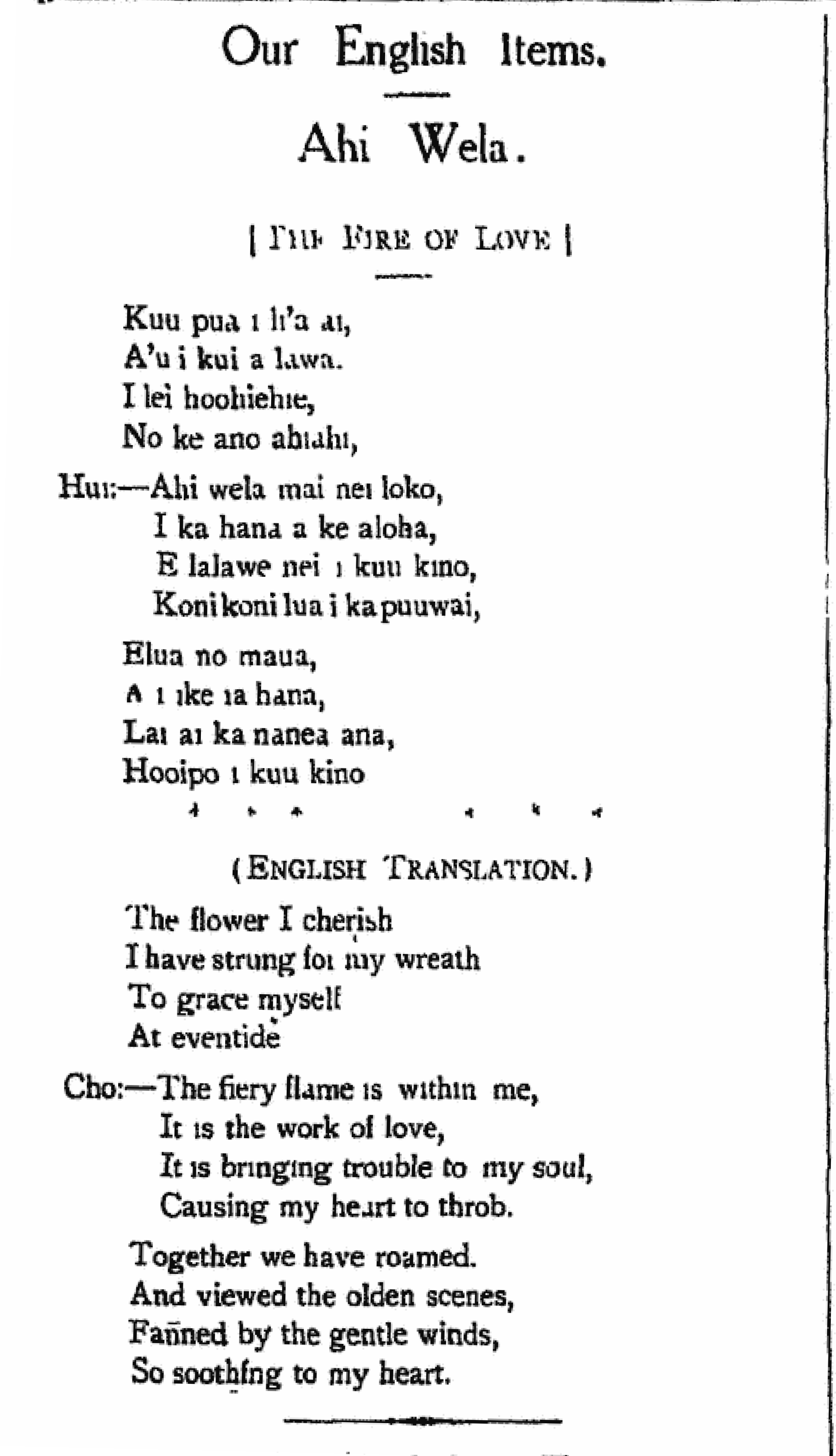
Kuu pua i li’a ai,
A’u i kui a lawa,
I lei hoohiehie,
No ke ano ahiahi,

Hui:—Ahi wela mai nei loko,
I ka hana a ke aloha,
E lalawe nei i kuu kino,
Konikoni lua i ka puuwai,

Elua no maua,
A i ike ia hana,
Lai ai ka nanea ana,
Hooipo i kuu kino.

(English Translation.)

The flower I cherish
I have strung for my wreat
To grace myself
At eventide

Cho:—The fiery flame is within me,
It is the work of love,
It is bringing trouble to my soul,
Causing my heart to throb.

Together we have roamed,
And viewed the olden scenes,
Fanned by the gentle winds,
So soothing to my heart.

(Kuokoa Home Rula, 5/21/1909, p. 1)

Our English Items.

Kuokoa Home Rula, Bukke VII, helu 21, Aoao 1. Mei 21, 1909.

New Hawaiian Language Textbook, 1939.

Hawaiian Language Book

A BOOK EDITED BY HENRY P. JUDD

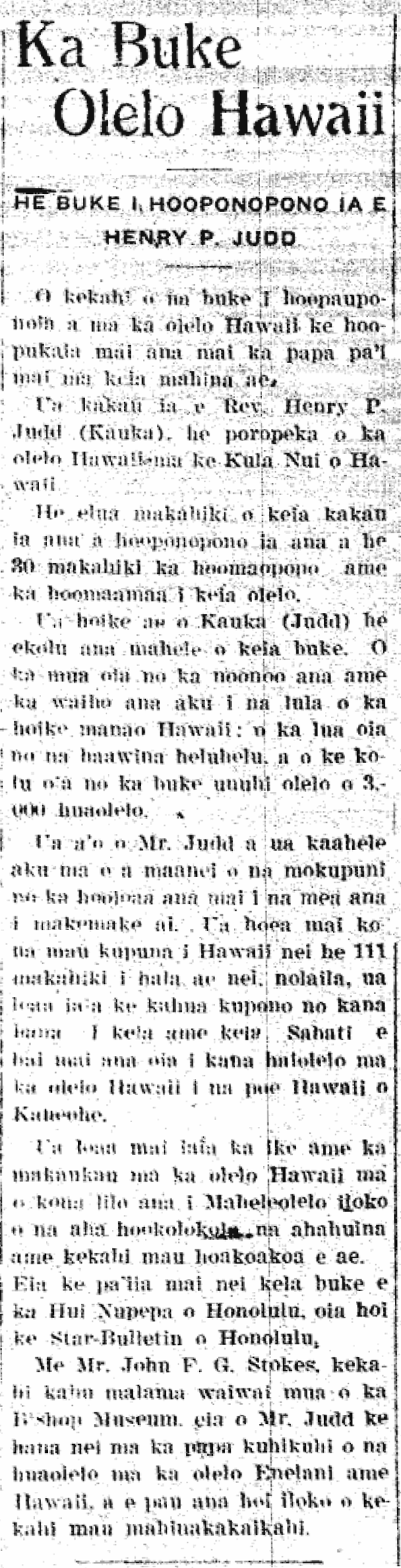
A book completed in the Hawaiian language is being published by the press next month.

It was written by Rev. Henry P. Judd (Kauka), a professor of the Hawaiian language at the University of Hawaii.

The writing and editing took two years, and it was 30 years of learning and practicing of the language.

Kauka (Judd) says there are three sections to this book. The first part is the studying and the giving of rules of Hawaiian expression; the second is reading lessons; and the third is the translation of 3,000 words.

Mr. Judd has taught and travelled here and there in the islands obtaining what he was after. His kupuna came to Hawaii nei 111 years ago, and therefore, he has the appropriate place for his work. Every Sunday, he gives his sermons in Hawaiian to Hawaiians in Kaneohe.

He gained his knowledge and proficiency in the Hawaiian language through his becoming a translator [Maheleolelo] in the courts, the [Evangelical] Conferences, and other gatherings.

This book is being published by the Newspaper Company of Honolulu, that is the Star-Bulletin of Honolulu.

With Mr. John F. G. Stokes, one of the first trustees of the Bishop Museum, Mr. Judd is now in the process of making a word list in English and Hawaiian, which will be completed in a few months.

[This is referring to the book: Judd, Henry P. The Hawaiian language. Honolulu: Honolulu Star-Bulletin, Ltd., 1939.]

(Hoku o Hawaii, 7/26/1939, p. 1)

Ka Buke Olelo Hawaii

Ka Hoku o Hawaii, Volume XXXIV, Number 13, Aoao 1. Iulai 26, 1939.

Faith, Hope, Love, and Tradition, 1874.

The Key to open the door of heaven, and all of its rooms.

Keys are important. You go somewhere, and see a beautiful structure, perhaps it is a church, or a home, a store, or a building filled with wonderful things. And you want to enter into these buildings. The doors however are locked. You have no Key to open the doors. You are not given the key. You can obtain key if you ask of the Owner, and they perhaps will accompany you and let you in.

We have heard that there is a beautiful city up above, with its lovely houses filled with many great wonderful things. And should one want to enter into this city after they die. They cannot enter should they be without the key. What is this key? It is this, Aloha. There are three great things: faith [manaoio], hope [manaolana], and love [aloha]; but aloha is the greatest of all things.

Are you heading, O Friend, for heaven, with faith and hope, while believing that with these things you will open up the door of heaven and enter within? You can’t with just those two things, without Aloha.

Aloha is the single golden key that can open the door of heaven. Faith and hope are keys that can open some of the houses here in this world. With these keys, you perhaps have entered Churches down here.

However, should you be without true aloha, you shall not enter into heaven. Do you possess this great key? Aloha? Here are the signs that you have it:

1. You uphold the commandments of Jesus.

2. You listen to the words of the teachers, the church pastor, and you do what is righteous as per their desires and you don’t do what is wrong as per their desires.

4. Give more aloha to those who give you little aloha.

5. To cease totally begrudging others.

6. Set aside slander, gossip, and hearsay.

7. Do good always and never do bad.

Should we have these seven signs, we may perhaps be in possession of true aloha, the single golden key that can open the door of heaven, and we will be allowed within. HAWAII.

[It is also interesting to note that while the Bible was being translated into the Hawaiian Language, Hawaiians of course traditionally had the word, “Aloha.” As for “Manaolana” and “Manaoio,” (and “enemi” [enemy] as well), those had to be made up just for the Bible. See “No ka unuhi ana i ka Palapala Hemolele iloko o ka Olelo Hawaii.” Hae Hawaii, Iulai 8, 1857, 57–58.]

(Kuokoa, 5/16/1874, p. 4)

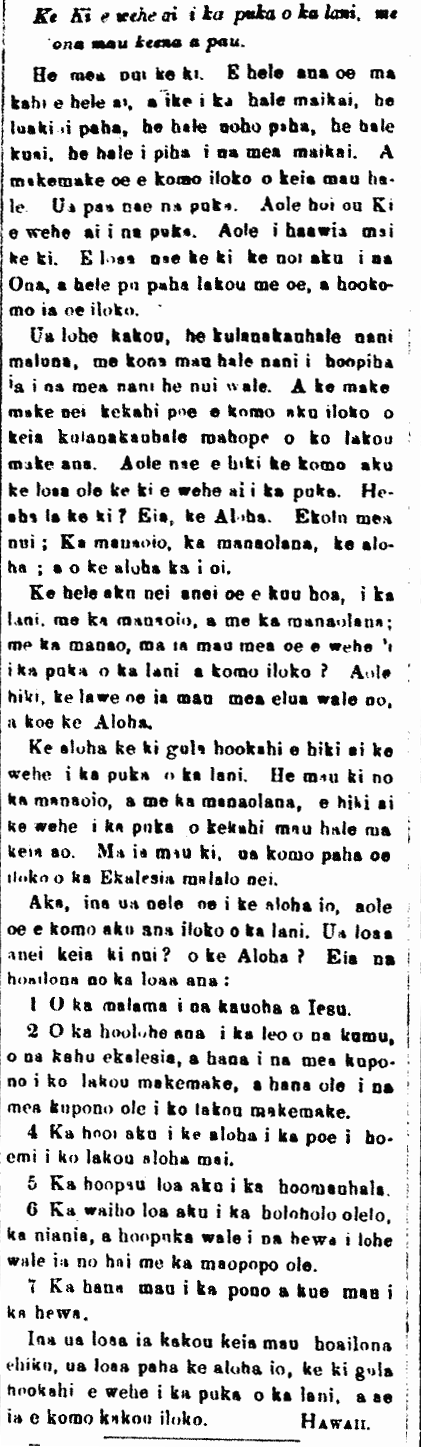
Ke Ki e wehe ai i ka puka o ka lani, me ona mau keena a pau.

Ka Nupepa Kuokoa, Buke XIII, Helu 20, Aoao 4. Mei 16, 1874.