Recollections of Kauai boy, William E. Rowell, 1916.

INTERVIEW WITH W. E. ROWELL
Dec. 6, 1915

The following interview with the late W. E. Rowell, who died recently in Honolulu, was read at the meeting of the Kauai Historical Society last week by J. M. Lydgate:

I was born at Hanalei in 1845. My father followed Alexander there for a couple of years. When I was about one year old were moved to Waimea. We came by canoe I believe, bag and baggage. No I don’t remember anything about it. Mr. Gulick I understand had built the house at Waimea. Mr. Whitney had died I think just before our arrival or soon after so that the whole work and responsibility of the station fell on my father. The Whitney house stood just about where the Hofgaard house is now, while ours stood near by. No, no, the Whitney house wasn’t built of adobie, but of stone coral sand stone. I remember very distinctly how it cracked because of imperfect foundation and the walls bulged out and had to be shoved up with heavy timber props. The house was demolished finally for the stone which was taken to build the Kekaha chimney. I think they paid $100 for it. Mother Whitney lived there for a good many years. In the division of the mission sands there was some difficulty about coming to an amicable decision, for, you know, these old missionaries were quite human in spite of the fact that they were missionaries. Mrs. Whitney wanted about everything that was any good.

We got a piece of pasture land on the east of the river called Mahai-hai: it was there we kept our stock, and in dry times they fairly grubbed up the roots of the manienie.

We had an old man who took the stock back and forth: he took them to the river and they swam across and when he wanted them he called them and they came across the river.

When Mrs. Whitney died she left her land to the native church. The minister was to live at the Whitney place, but that was inconvenient so an exchange was made for a kuleana in the valley, and I bought the balance of the land for $1800. That is the basis of the church fund to this day.

There was a grass church in those days down on the beach west of the river, where afterwards the school house stood and about where the Chinese church is now. There were two services on Sunday and a prayer meeting on Wednesday afternoon. No, the crowds were not very large and the church was not as big as the stone church built later. The church was built of pili grass, closed in, as I remember it, on the mauka and windward side, but open makai on the lee side. There were no windows, at least no glazed windows. The people sat on mats on the floor. The matter of windows, reminds me that I made quite a little money in my boyhood days, making window and door cases for Hawaiian grass houses. Yes, all the houses at that time were of grass. Continue reading
Kamehameha Day preparations, 1916.

Please Give Your Help for Our Holiday

THE EVENTS FOR KAMEHAMEHA DAY ON THE COMING JUNE 11

At the discussion meeting held at the office of Edgar Henriques in the McCandless Brothers Building, chaired by Mayor John C. Lane of the executive committee and the secretary of that committee William E. Miles. The members who gathered for that meeting other than those named above were: Edgar Henriques, Jesse Uluihi, Mrs. H. H. Webb [Lahilahi Webb], Mrs. S. C. Dwight, Mrs. Abraham Fernandez, Louis Makanani and James K. Nakila.

The schedule prepared for the coming birthday of Kamehameha, that is Monday, the 12th of June, being that the 11th is a Sunday, is like this: Parade in the morning from Aala Park of the various Societies and the public. 8:30 a. m., under the direction of the Marshal of the day, Robert Waipa Parker, when reaching the government building where the statue of Kamehameha stands, the procession will surround the statue with each tossing flowers by the statue, and everyone in the parade should please have a bouquet of flowers in their hands.

Those that stand near the Kamehameha statue will be the Hale o na Alii Association with the war god of Kamehameha, Kukailimoku; from there the procession will go on to the palace grounds [palii] for short speeches given that morning, but the speakers have not been chosen as of yet. It was left for the chairman of the executive committee to decide, that being Mayor John C. Lane, and the names of the speakers will be announced at the appropriate time. Continue reading

Devastating Tsunami, 1946.

Kai Hoee

When the tsunami [kai hoee] hit, it reached all the large islands of this archipelago. It hit Kauai, Oahu, Molokai, Maui and Hawaii. But the island of Hawaii received the heaviest damages. The tsunami caused damages and took lives on the other islands, but the most severe was on Hawaii Island.

But from the death reports, of all the ethnicities, the Japanese made up most of deaths. On Hawaii Island, there were maybe four of five Hawaiians that died. On Kauai Island, there were many Hawaiians that died, and so too on Oahu and Maui.

A report from West Hawaii said the tsunami reached there as well. Hookena was reached by the tsunami but it probably lives nor houses were damaged. From what witnesses say, the ocean reached the level of the pier of Hookena, but it did not damage buildings. Continue reading

No fooling in Lahaina a hundred years ago, 1916.

ALL WERE DELIGHTED

Mr. Sol Hanohano, Aloha oe:—Please allow me some open space on the wings of  the seagull of ours, so the words above have somewhere to nest.

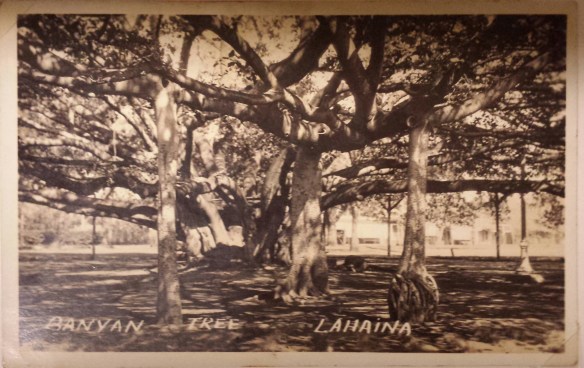
While everyone was sitting around in the shade of the ulu grove of Lele, enjoying the softly blowing Ma-aa breeze, the local wind of the land, the people were surprised to see a notice put up: “Band concert tomorrow afternoon at 3 o’clock p.m. The Lahaina Public Band will give a public concert under the banyan tree, court house grounds. All welcome! Come one! Come all!”

And being that it was on the 1st of April that this announcement was seen, and the words said that it was the following day at 3 o’clock p.m. that the band would play, Apr. 2, 1916, the announcement was not reliable, because it was the 1st of April, maybe the intent of that announcement is an April Fool; so when going to the place directed, you would find something like the kids saying, “Go to school, tell your teacher you’re a fool,” but for this,  “Go to courthouse grounds, and call yourself you’re a fool!”

But these guesses were put aside until the prescribed time was at hand, and the band members were indeed seen seated in the place made ready for them. And for the first time, the realization came that this was not an April fool.

When the clock struck 3 o’clock, we saw Lowell Kupau bow and as he rose up he was holding his instrument, and with a wink of an eye, the voice of the band burst forth. It was just so lovely! it was a beauty that could not be faulted for they were only taught for a very short few days. The songs played were “Kaua i ka la i pohina,” “Silver Threads Amongst the Gold,” “Maui Beauty me Roselani,” composed by William J. Coelho. “Maui no ka oi,” composed by Rev. S. Kapu, “Mai poina oe ia’u,” and “Aloha oe.” “Hawaii Ponoi.” Continue reading

E o e Kuini Kapiolani! 1898.

HANOHANO NUUANU.

Hanohano Nuuanu aia iuka,
Kahiko i ka Ua Popokapa,
Ke nihi ae la Waolani,
A loaa maua i Kanenelu,
Wai auau a kuu aloha,
Me Eha hua hiu a wela,
Ua ahi ua wela Wananakoa,
I ka hooni a nei kupueu,
A he eueu au no Kahikina,
No na pali hulaana o Maui,
O ke ewe ia a o’u mau kupuna,
I lohe mai oe Koleakani,
Aulii ma hana a Piilani,
A he lani a he kupa no ka aina,
Haina ia mai ana ka puana,
Na Eha Hua hiu a Wela.

EHAHUA.

(Loea Kalaiaina, 7/30/1898, p. 4)

LoeaKalaiaina_7_30_1898_4.png

Ka Loea Kalaiaina, Buke II, Helu 30, Aoao 4. Iulai 30, 1898.

Hula fought against by the church, 1917.

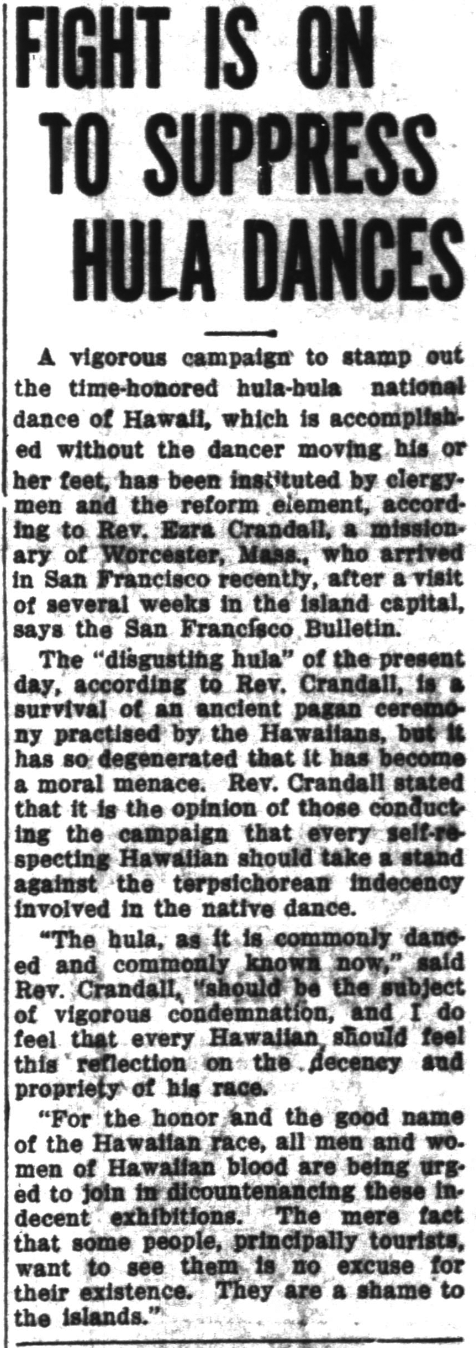
FIGHT IS ON TO SUPPRESS HULA DANCES

A vigorous campaign to stamp out the time-honored hula-hula national dance of Hawaii, which is accomplished without the dancer moving his or her feet, has been instituted by clergymen and the reform element, according to Rev. Ezra Crandall, a missionary of Worcester, Mass., who arrived in San Francisco recently, after a visit of several weeks in the island capital, says the San Francisco Bulletin.

The “disgusting hula” of the present day, according to Rev. Crandall, is a survival of an ancient pagan ceremony practiced by the Hawaiians, but is has so degenerated that it has become a moral menace. Rev. Crandall stated that it is the opinion of those conducting the campaign that every self-respecting Hawaiian should take a stand against the terpsichorean indecency involved in the native dance.

“The hula, as it is commonly danced and commonly know now,” said Rev. Crandall, “should be the subject of vigorous condemnation, and I do feel that every Hawaiian should feel this reflection on the decency and propriety of his race.

“For the honor and the good name of the Hawaiian race, all men and women of Hawaiian blood are being urged to join in discountenancing these indecent exhibitions. The mere fact that some people, principally tourists, want to see them is no excuse for their existence. They are a shame to the islands.”

(Star-Bulletin, 6/15/1917, p. 14)

StarBulletin_6_15_1917_14

Honolulu Star-Bulletin, Volume XXIV, Number 7854, Page 14. June 15, 1917.

Pele makes lei of lehua from the very beginning, 1862.

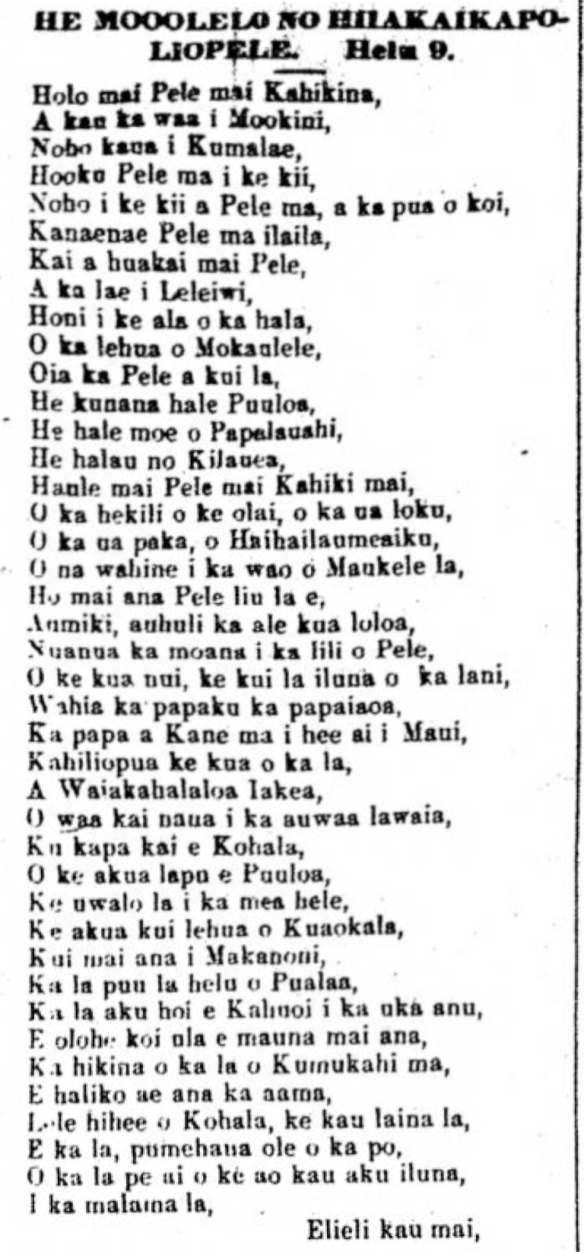
[Found under: “HE MOOLELO NO HIIAKAIKAPOLIOPELE. HELU 9.”]

Holo mai Pele mai Kahikina,
A kau ka waa i Mookini,
Noho kaua i Kumalae,
Hooku Pele ma i ke kii,
Noho i ke kii a Pele ma, a ka pua o koi,
Kanaenae Pele ma ilaila,
Kai a huakai mai Pele,
A ka lae i Leleiwi,
Honi i ke ala o ka hala,
O ka lehua o Mokaulele,
Oia ka Pele a kui la,
He kunana hale Puuloa,
He hale moe o Papalauahi,
He halau no Kilauea,
Haule mai Pele mai Kahiki mai,
O ka hekili, o ke olai, o ka ua loku,
O ka ua paka, o Haihailaumeaiku,
O na wahine i ka wao o Maukele la,
Ho mai ana Pele liu la e,
Aumiki, auhuli, ka ale kua loloa,
Nuanua ka moana i ka lili o Pele,
O ke kua nui, ke kui la iluna o ka lani,
Wahia ka papaku, ka papaiaoa,
Ka papa a Kane ma i  hee ai i Maui,
Kahiliopua ke kua o ka la,
A Waiakahalaloa iakea,
O waa kai nana i ka auwaa lawaia,
Ku kapa kai e Kohala,
O ke akua lapu e Puuloa,
Ke uwalo la i ka mea hele,
Ke akua kui lehua o Kuaokala,
Kui mai ana i Makanoni,
Ka la puu la helu o Pualaa,
Ka la aku hoi e Kahuoi i ka uka anu,
E olohe koi ula e mauna mai ana,
Ka hikina o ka la o Kumukahi ma,
E haliko ae ana ka aama,
Lele hihee o Kohala, ke kau laina la,
E ka la pumehana ole o ka po
O ka la pe ai o ke ao kau aku iluna,
I ka malama la,
Elieli kau mai.

[From the time of her arrival to Hawaii, Pele fashions lei of lehua blossoms from Mokaulele in Hilo. May the majestic trees live forever. Until a solution is found to Rapid Ohia Death, wear your lehua in your heart, not in your lei!]

(Hoku o ka Pakipika, 3/6/1862, p. 4)

HokuoHawaii_3_6_1862_4.png

Ka Hoku o ka Pakipika, Buke I, Helu 24, Aoao 4. Maraki 6, 1862.

For all of you hula people down in Hilo this week, 1929.

HE HOOHENO NO KEAUKAHA

Noho ana au i ka lai
I ka ulu hala o Keaukaha

Me he ala e i mai ana
Maanei mai kaua e ka hoa

Huli nana i ka lae kai
I ka holu mai a ka nalu kai

Pa mai ana ke ala
O ka limu lipoa me ka nahenahe

Hookahi no au hana nui
O ke kui pua leihala o Keaukaha

Ke au ae nei ka manao
E kii e ako pua lehua

E ula mai la i ke kumu
E lei kohu no ko kino

Ko kino nui nepunepu
Hewa e ka maka ke ike aku

O ke kuko o ka lia ke loaa ana
I na pua lehua me ka hala

Aole la he hala e ka hoa
E kipa ole aku ai i ka home

Ho mai ke aloha la e ka makamaka
I kuleana ai au ilaila

Haina ia mai ana ka puana
Ka olu ulu hala o Keaukaha

HAKU IA E E—A—E—E—A

[A SONG OF AFFECTION FOR KEAUKAHA

I repose in the calm
In the hala groves of Keaukaha

It is as if it says
Come here, let us be together, O friend

I turn to look at the ocean cape
As the waves ripple forth

The scent wafts by
Softly of the lipoa seaweed

I have bu one thing to do
String lei of the hala of Keaukaha

My thoughts turn to
Going to gather lehua blossoms

Reddening the trees
For a lei fitting for you body

Your voluptuous body
They eyes are content to look at

My desire, my yearning, is to have
The blossoms of the lehua and the hala

There is no offense my companion
That does not call at the home

Give to me your aloha, my dear
So I might have kuleana there

Let the story be told
Of the sweet hala groves of Keaukaha]

[Let the lehua live forever! Wear it in your heart and not in your lei!!]

(Hoku o Hawaii, 10/8/1929, p. 2)

HokuoHawaii_10_8_1929_2.png

Ka Hoku o Hawaii, Buke XXIII, Helu 17, Aoao 2. Okatoba 8, 1929.