Curious mele, 1892.

KA’U MELE.

Lohe mai au ulalaeho
Me Kahikina oe ulalaeho
Kahi niniau ai alalaeho
A niniau iho ulalaeho
O kou mau ia ulalaeho
A e ike ia nei ulalaeho
O ka holo mamua ulalaeho
Haule hope ai ulalaeho
Hawaii hope ai ulalaeho
Heaha keia ulalaehe
Kahikina Kelekona ulalaeho
Ua eha ke poo ulalaeho
Ke kulou nei ulalaeho
I ke koa wiwo ole ulalaeho
Ka Leo o ka Lahui ulalaeho
Heaha kou mai ulalaeho
E wilinau nei ulalaeho
E inu paakai ulalaeho
I pau ko lena ulalaeho

[I am not sure what this complaint against John G. M. Sheldon is about.]

(Leo o ka Lahui, 11/21/1892, p. 4)

KA'U MELE.

Ka Leo o ka Lahui, Buke II, Helu 586, Aoao 4. Novemaba 21, 1892.


Music and dance, 1911.

A CONCERT AND DANCE.

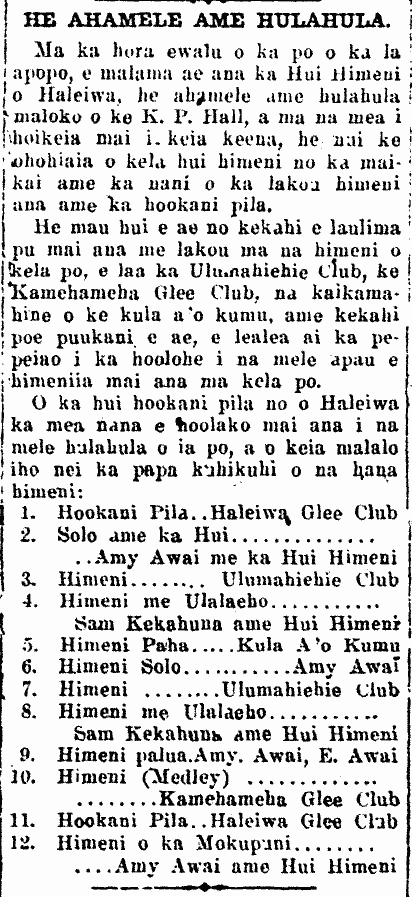
At eight o’clock tomorrow night, the Haleiwa Choir [Hui Himeni o Haleiwa] will hold a concert and dance in the K. P. Hall [Knights of Pythias Hall], and from what was told to this office, the Choir is highly acclaimed for the beauty of their singing and their music.

There will be other groups as well joining with them singing that night, like the Ulumahiehie Club, Kamehameha Glee Club, the girls of the teachers’ school, and some other singers; the ears will be entertained listening to all the mele that will be sung that night.

The band of Haleiwa will be the ones to provide the songs to dance to that night, and this below is the program of the singing:

1. Instrumental [Hookani Pila] . . . . . Haleiwa Glee Club
2. Solo and Group . . . . . Amy Awai and Glee Club
3. Singing . . . . . Ulumahiehie Club
4. Singing and Yodeling [? Ulalaeho] . . . . . Sam Kekahuna and Glee Club
5. Quartet . . . . . Teachers’ School
6. Solo . . . . . Amy Awai
7. Singing . . . . . Ulumahiehie Club
8. Singing and Yodeling . . . . . Sam Kekahuna and Glee Club
9. Duet . . . . . Amy Awai, E. Awai
10. Singing (Medley) . . . . . Kamehameha Glee Club
11. Instrumental . . . . . Haleiwa Glee Club
12. Song of the Island . . . . . Amy Awai and Glee Club

(Kuokoa 7/7/1911, p. 10)

HE AHAMELE AME HULAHULA.

Ka Nupepa Kuokoa, Buke XLVII, Helu 27, Aoao 10. Iulai 7, 1911.

Lydia Panioikawai French, 1880.

Mrs. Panioikawai French.

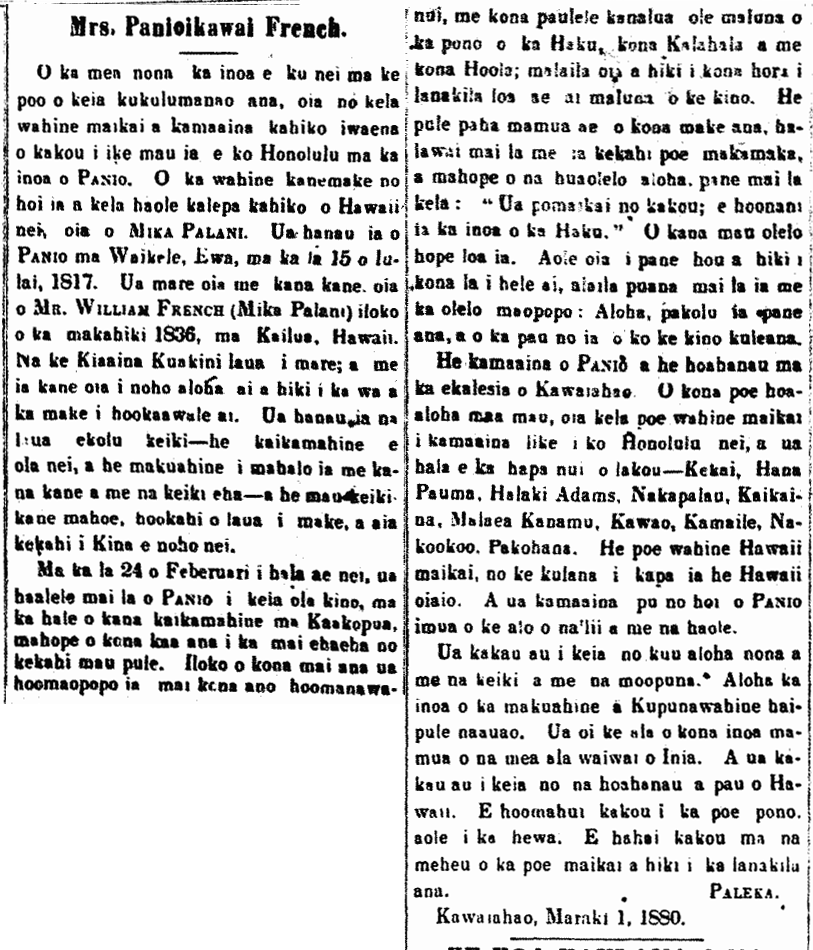
The person whose name appears at the top of this article is that fine woman and old-time kamaaina amongst we the people who always see her in Honolulu going by the name Panio. She is the widow of the old haole trader of Hawaii nei, Mika Palani. Panio was born in Waikele, Ewa, on the 15th of July, 1817. She married her husband, Mr. William French (Mika Palani) in 1836 at Kailua, Hawaii. Governor Kuakini was the one who married them; and it was with this husband who she lived in aloha with until death separated them. The two of them had three children—a daughter that is still living, and a mother that is admired along with her husband and four children—and twin sons, one who has died, and one who is living in China.

On the 24th of February past, Panio left this life, at the home of her daughter in Kaakopua, after being in pain for several weeks. In her sickness, her great patience was made clear, along with her unwavering faith in the goodness of the Lord, her Redeemer, and her Savior; and she was there until the victorious hour upon her body. She perhaps had a prayer before she died; she met with some friends, and after words of aloha, she said: “We are fortunate; blessed be the name of the Lord.” These were her last words. She did not say anything until the day she left, then she said clearly: Aloha, three times, and her body’s work was done.

Panio was a kamaaina and a brethren of Kawaiahao Church. Her regular friends were the fine women who are also well known here in Honolulu, and most of them have already passed on—Kekai, Hana Pauma, Halaki Adams, Nakapalau, Kaikaina, Malaea Kanamu, Kawao, Kamaile, Nakookoo, Pakohana. They were good Hawaiian women, who are amongst those called true Hawaiians. And Panio was a kamaaina amongst the royal court and amongst the haole.

I write this because of my aloha for her and her children and grandchildren. Beloved is the name of this enlightened devout mother and Grandmother. The fragrance of her name is stronger than the treasured perfumes of India. And I write this for all of the brethren of Hawaii. Let us copy the righteous, and not the wicked. Let us follow in the footsteps of the good until we are victorious.

PALEKA.

Kawaiahao, March 1, 1880.

(Kuokoa, 3/6/1880, p. 4)

Mrs. Panioikawai French.

Ka Nupepa Kuokoa, Buke XIX, Helu 10, Aoao 4. Maraki 6, 1880.

Kou trees, 1875.

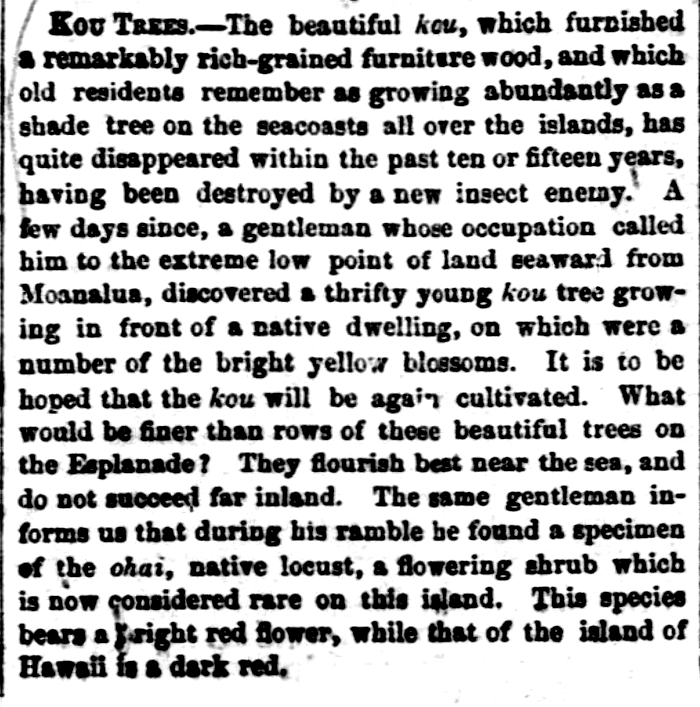
Kou Trees.—The beautiful kou, which furnished a remarkably rich-grained furniture wood, and which old residents remember as growing abundantly as shade tree on the seacoasts all over the islands, has quite disappeared within the past ten or fifteen years, having been destroyed by a new insect enemy. A few days since, a gentleman whose occupation called him to the extreme low point of land seaward from Moanalua, discovered a thrifty young kou tree, growing in front of a native dwelling, on which were a number of bright yellow blossoms. It is to be hoped that the kou will be again cultivated. What would be finer than rows of these beautiful trees on the Esplanade? They flourish best near the sea, and do not succeed far inland. The same gentleman informs us that during his ramble he found a specimen of the ohai, native locust, a flowering shrub which is now considered rare on this island. This species bears a bright red flower, while that of the island of Hawaii is a dark red.

(Pacific Commercial Advertiser, 7/10/1875, p. 3)

Kou Trees.

The Pacific Commercial Advertiser, Volume XX, Number 2, Page 3. July 10, 1875.

Lunalilo Crypt, 1875.

[Found under: “Nu Hou Kuloko.”]

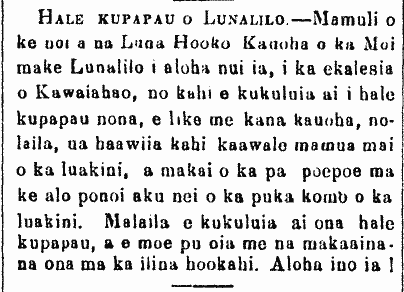
Crypt of Lunalilo.—Because of the request by the Executor of the Will of the Deceased dearly beloved King Lunalilo to Kawaiahao Church, for a place to build his crypt, as per his will, therefore, an open space in front of the church was given, makai of the circular yard right in front of the entrance to the church. There will be built his crypt and he will sleep there with his people in the same cemetery. How sad this is!

(Kuokoa, 9/19/1875, p. 2)

Hale Kupapau o Lunalilo.

Ka Nupepa Kuokoa, Buke XIII, Helu 38, Aoao 2. Sepatemaba 19, 1874.


Licensed kahuna and non-licensed kahuna, 1875.

[Found under: “Nu Hou Kuloko.”]

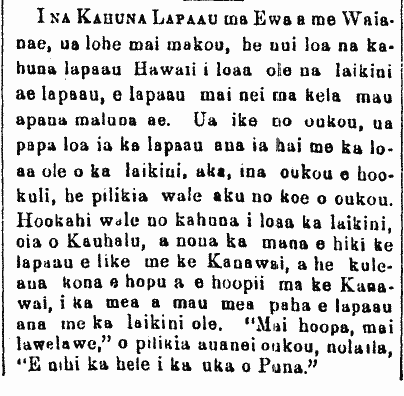
To the Medical Kahuna in Ewa and Waianae, we have heard that there are many Hawaiian medical kahuna without licenses to practice medicine who are treating patients in those districts. You know that the treating of others without a license is prohibited, and if you do not listen, you will be in trouble. There is but one kahuna who is licensed, and that is Kauhalu; and he has the power to arrest and sue under Law the one or ones who doctor people without license. “Don’t touch, don’t undertake this,” or you will face troubles, therefore, “Beware when treading in the uplands of Puna.”¹

¹”E nihi ka hele i ka uka o Puna,” is a famous warning given by Hiiaka to her aikane Wahineomao. It became used as a general warning to be careful of what you are doing.

(Kuokoa, 9/19/1874, p. 2)

I na kahuna lapaau...

Ka Nupepa Kuokoa, Buke XIII, Helu 38, Aoao 2. Sepatemaba 19, 1874.

Newly pardoned, 1891.

[Found under: “By Authority.”]

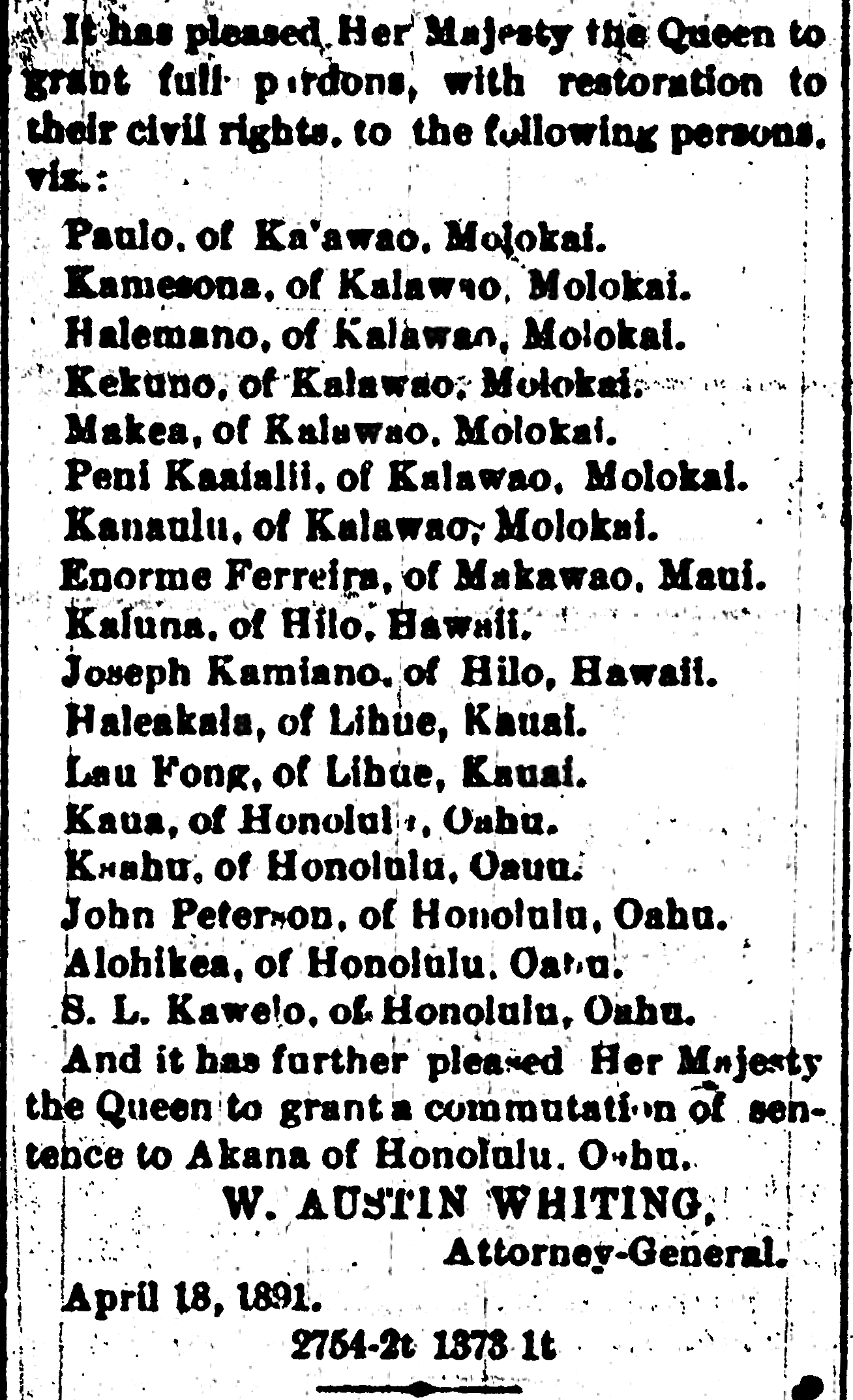
It has pleased Her Majesty the Queen to grand full pardons, with restoration to their civil rights, to the following persons, viz:

Paulo, of Kalawao, Molokai.
Kamesona, of Kalawao, Molokai.
Halemano, of Kalawao, Molokai.
Kekuno, of Kalawao, Molokai.
Makea, of Kalawao, Molokai.
Peni Kaaialii, of Kalawao, Molokai.
Kanaulu, of Kalawao, Molokai.
Enorme Ferreira, of Makawao, Maui.
Kaluna, of Hilo, Hawaii.
Joseph Kamiano, of Hilo, Hawaii.
Haleakala, of Lihue, Kauai.
Lau Fong, of Lihue, Kauai.
Kaua, of Honolulu, Oahu.
Kaahu, of Honolulu, Oahu.
John Peterson, of Honolulu, Oahu.
Alohikea, of Honolulu, Oahu.
S. L. Kawelo, of Honolulu, Oahu.

And it has further pleased Her Majesty the Queen to grant a commutation of sentence to Akana of Honolulu, Oahu.

W. AUSTIN WHITING,
Attorney-General.

April 18, 1891.

(Hawaiian Gazette, 5/5/1891, p. 4)

It has pleased Her Majesty the Queen...

Hawaiian Gazette, Volume XXVI, Number 18, Page 4. May 5, 1891.

A feast given at the Sacred Hearts Church, 1913.

[Found under: “Nuhou Kuloko”]

There will be a grand feast held, full of rich delicacies like pig laulau, fatty kalua pig, opihi, opae, aku, kawakawa, kulolo, haupia, koelepalau, fatty amaama, poi, sweet potato, Portuguese bread, and other delights. It is being given by the Sacred Hearts Church, at the corner of Miller and Beretania streets. The attendees will be entertained while they are eating by the two bands, the St. Louis Band and the Catholic Mission Band.

(Kuokoa, 2/21/1913, p. 8)

He papa ahaaina hanohano...

Ka Nupepa Kuokoa, Buke L, Helu 8, Aoao 8. Feberuari 21, 1913.

John Harbottle visits Hilo, 1943.

Just in Hilo.

This past week the kamaaina of the land renowned for the Apaapaa Wind, of Kohala with its hills that move along together, Kalahikiola and Pili, that is John Harbottle, and after some days he returned to his famous lands.

Looking at him, he is still in good health, he has not changed, as if it is still in the days of his youth, when I first met him 27 years ago, when I arrived in his famous aina.

He spent some days with his daughter and son-in-law, Mr. and Mrs. Eddie Nelson, of Keaukaha.

(Hoku o Hawaii, 9/8/1943, p. 1)

Ka Hoku o Hawaii, Volume XXXVIII, Number 20, Aoao 1. Sepatemaba 8, 1943.

Ka Hoku o Hawaii, Volume XXXVIII, Number 20, Aoao 1. Sepatemaba 8, 1943.