Ka Lama Hawaii, Lahainaluna, and the Bailey House Museum, 2014.

Ka Lama Hawaii, 180th Anniversary Special Exhibition & Talk Story Session

In celebration of the 180th anniversary of the printing of the very first newspaper in Hawaii, Ka Lama Hawaii “The Hawaiian Luminary”, written in Hawaiian language and printed at Lahainaluna School, the Maui Historical Society is hosting a panel discussion and special exhibition of our original, 180-year-old copy at the Bailey House Museum on Sunday, August 31st, 2014 from 6 pm to 9 pm.  Panelists include noted Maui Hawaiian language/studies professionals, Ki`ope Raymond, Kapolei Ki`ili, and Pulama Collier.  Tickets are $15 for the general public, $10 for MHS members and students (must present ID).  Newspaper-themed merchandise, craft vendors, and food & drink will be available for purchase.  For more information, call 244-3326 or e-mail Info@MauiMuseum.org.

[If you are in and about Lahaina this weekend, this sounds like it could be interesting! Go check it out!!]

Ka Lama Hawaii 180th Anniversary Talk at Bailey House Museum

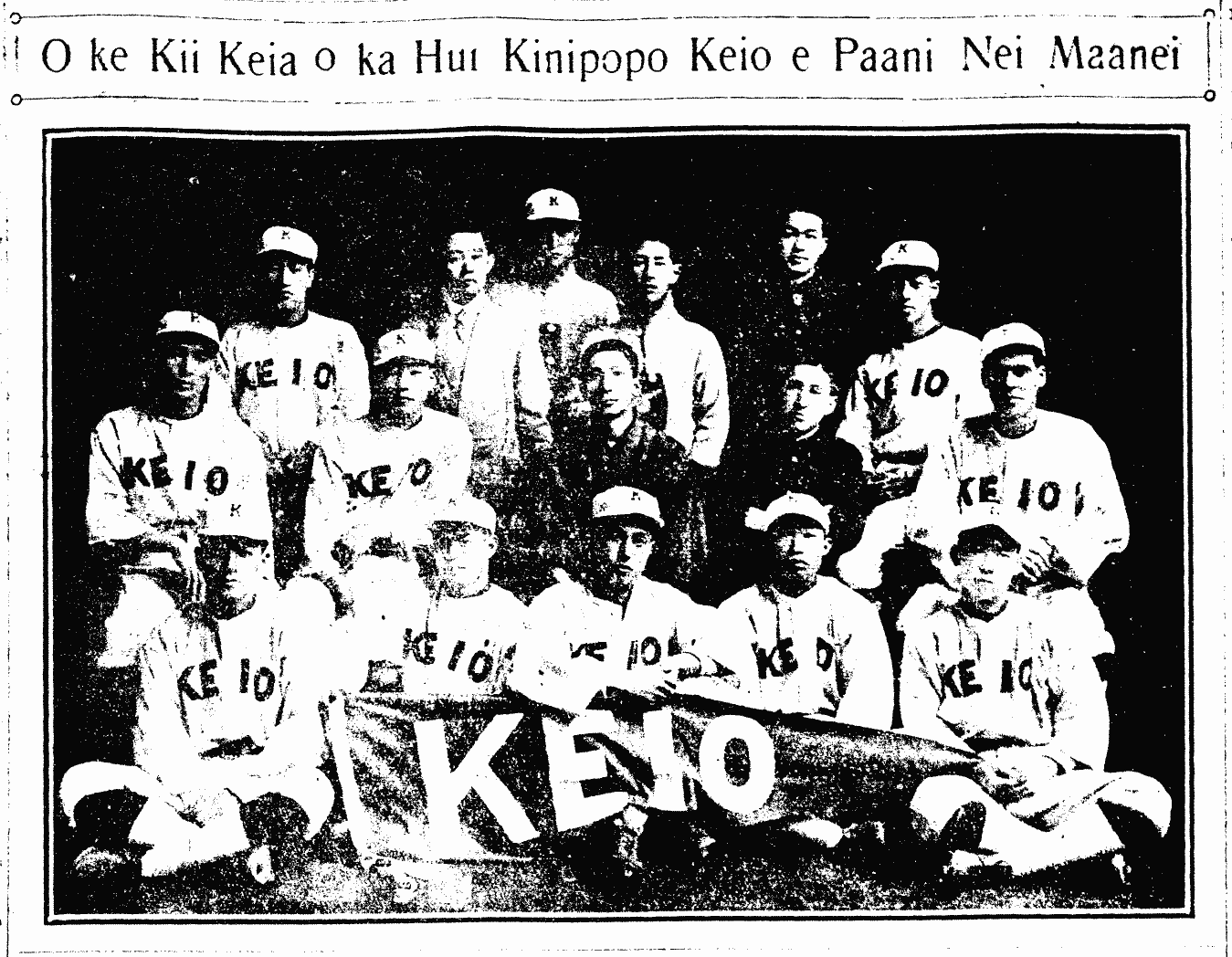
Sumo in Hawaii, 1914.

BRAWNY MEN OF JAPAN HERE TO SHOW THEIR ART

Big Troupe of Wrestles Arrives on Tenyo Maru—Matches Begin Saturday

Headed by Tachiyama, mightiest wrestler of all Japan, a troupe of 54 of the greatest mat artists of Dai Nippon arrived this morning on the T. K. K. liner Tenyo Maru. They have come to Honolulu for a series of performances, beginning on Saturday night at Athletic park.

Tremendous big fellows, mighty of girth and of limb, are these  Japanese wrestlers, and as they lined the deck of the Tenyo Maru this morning they attracted the immediate attention of the thousands of Japanese and others who had assembled at the dock. The picturesque dress of the Nipponese wrestler—silken over-kimono, a sort of under-garment falling below the knees, girdle, and above all the peculiar headdress—make the athletes conspicuous anywhere, and they are still more conspicuous because of their size, far greater than that of the ordinary Japanese.

The wrestlers will be in Hawaii for several weeks. The arrangements for the series of matches at Athletic park are nearly complete. The matches start at 7 o’clock on Saturday night, and a number of local Japanese athletes are anxious to match skill and brawn against the famed champions from the empire.

This morning and informal committee of Japanese went out to the Tenyo Maru to receive the wrestlers. Arthur K. Ozawa, who has been somewhat in charge of the advance arrangements here, and several Japanese newspapermen met the steamer off port. At the dock to receive their comrades were W. Uchiumi and K. Yamanishi, who arrived here on May 22 as advance agents for the troupe. Uchimi is a retired wrestler and will probably act as referee at some of the matches.

The wrestlers will be matched somewhat according to weight and previous records. Tachiyama is billed to appear every night. He has been the undisputed champion of Japan since he won the title in a series of desperate matches with contenders for the crown left by Hitachiyama, an old veteran who was declared to be the greatest of all Japan’s champions.

Tachiyama has amassed a fortune estimated at half a million dollars during his career. He is a big, good-natured man, standing about six feet three inches and weighing in the neighborhood of 315 pounds. He is said to be quick in spite of his enormous size. Many of these wrestlers seem to be mountains of flesh, which is an advantage at the Japanese style of wrestling in short, furious bouts much like two bulls locking horns.

Spectators at Athletic park recently have noticed a high skeleton tower of wood being erected in deep center field and wondered what the structure was for. This is put up to observe and old custom in Japanese wrestling circles. Early in the morning on the day when matches are to take place, a gong is beaten for a half hour to an hour by a herald who announces the matches.

Champion Wrestler of All Japan Here With Comrades

Tachiyama (“Mountain of Swords”), who is the premier mat artist of Japan, will appear nightly at the local matches.

(Honolulu Star-Bulletin, 7/9/1914, p. 9)
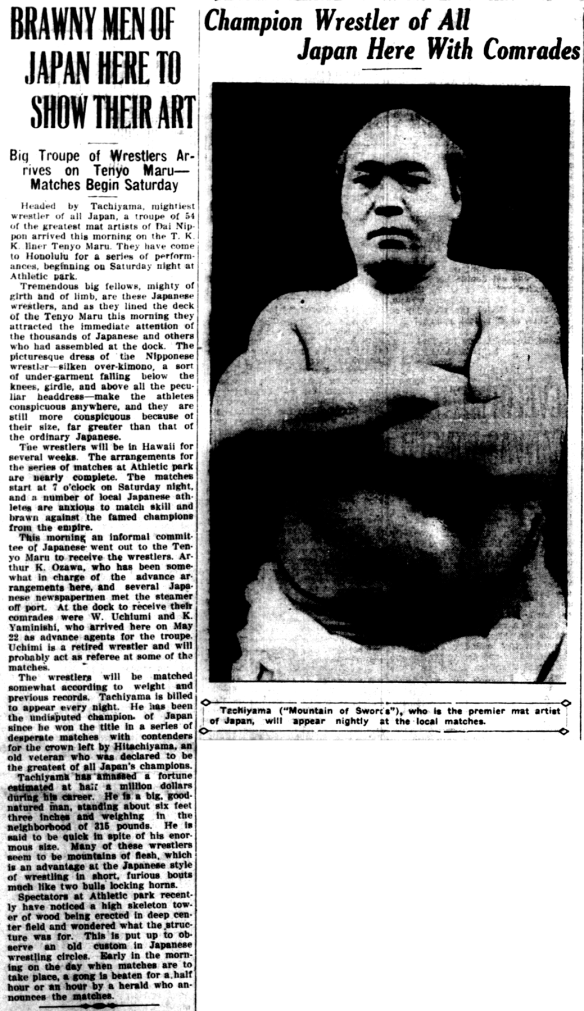
BRAWNY MEN OF JAPAN HERE TO SHOW THEIR ART

Honolulu Star-Bulletin, Volume XXII, Number 6940, Page 9. July 9, 1914.
Fun mele about the latest heard over the telephone, 1921.

HULA HA’I MEAHOU.

O ke anuenue ko’u papale,
Hokuwelowelo ko’u lipine,
Hae ka ilio ma Puuloa,
He alahula ia na Kaahupahau,
Nanea i ka holo a ke kaaahi,
Ua like me ka lio waha uaua,
Ka ihona au a o Kekele,
Ike i ka nani a o Kilohana,
Hele kuu hoa a maeele,
Aole wai e maalili ai,
Iluna au a o Daimana Hila,
Ike i ka nani o ka mahina,
Kukuna o ka la ko’u kamaa,
Olapa hele nei puni ke kaona,
I ka po mahina o Mahealani,
Paia o ka hale haulani ana,
Kelepona au i hai mai,
Hu e ka pele kai a o Hilo,
I alohaia no a o Aala Paka,
Kahi a na iwa e hiolani nei,
Hainaia mai ana ka puana,
Kaula kelepona aha’i meahou.

KAKAAKO BOY.

[This song is also reminiscent of the mele still sung widely today, “Kukuna o ka La.”]

(Kuokoa, 11/11/1921, Mahele Elua, p. 1)

HULA HA'I MEAHOU.

Ka Nupepa Kuokoa, Buke LIX, Helu 45, Mahele Elua, Aoao 1. Novemaba 11, 1921.

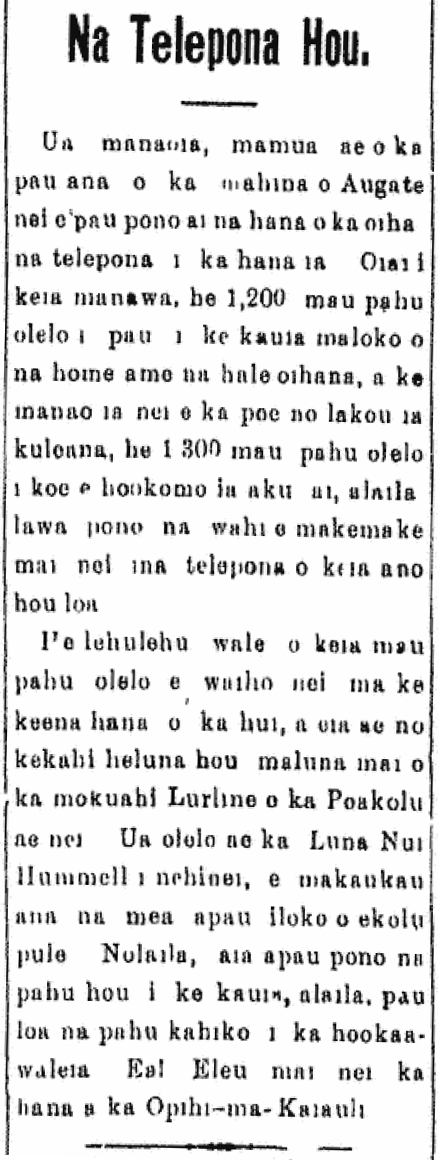
Telephones in Hawaii, 1910.

New Telephones.

It is believed that before the end of August, all of the work of the telephone company will be completed. Currently, there are 1,200 sets mounted in homes and businesses, and it is thought by those in charge, that there are 1,300 more sets to be installed, then all those wanting this new type of telephone will be supplied.

There are lots of this type of devices in the business office of this company, and there is more on the way aboard the steamer Lurline of this coming Wednesday. Supervisor Hummell stated yesterday, everything will be ready in three weeks. So after all of the sets are installed, all the old ones will be taken away. My! So speedy is the work of that Opihi Makaiauli.

[It seems that any box-like device that voice came out of was considered a “pahu olelo,” including, and perhaps more commonly seen when referring to a phonograph.]

(Kuokoa Home Rula, 8/12/1910, p. 3)

Na Telepona Hou.

Kuokoa Home Rula, Buke VIII, Helu 32, Aoao 3. Augate 12, 1910.

Tragedy shaping Duke Kahanamoku, 1910.

DROWNED WITHOUT RECEIVING HELP.

In the afternoon of this past Sunday at perhaps 4 or so, while a group of young children were swimming ocean side of the Moana Hotel, there was a youngster swimming with them by the name of John A. Aguiar, a 12 years old Portuguese child. While this crowd of children were surfing and playing in the ocean, a group of them swam out to a bunch of boards floating in the ocean, and when they reached this heap of boards, the boy was with them, the one amongst them who was tired out from being buffeted and overwhelmed by the waves. After resting and regaining their breath, they all returned back to the shore, and the Aguiar boy amongst them swam all the way to Seaside Hotel; he had not swam very far when he called out for help.  His swimming friends thought that this was him joking, so they paid him no attention.

When these children came ashore, one of their fellow children asked about Aguiar, and this is what some of them said. “He was calling for help. Why didn’t you help him?” They said, “It was probably Aguiar’s fooling around.” But because Aguiar’s clothes were found laying out, it was realized that this boy was lost.

This Monday morning, the body of this child was found in the shallows near the Moana Hotel by Duke Kahanamoku, Jr. There were no bruises on his body except for the ears where it was nibbled and nipped at by the small fish of the shore.

In Monday evening, his funeral was performed with sadness, regret, and aloha of the his family and friends.

[Perhaps this is one of the reasons why Duke was so involved in water safety and rescue. And if anyone is motioning or calling for help in the water, don’t assume that they are playing around!]

(Kuokoa Home Rula, 8/12/1910, p. 3)

PIHOLO A MAKE ME KE KOKUA OLE IA.

Kuokoa Home Rula, Buke VIII, Helu 32, Aoao 3. Augate 12, 1910.


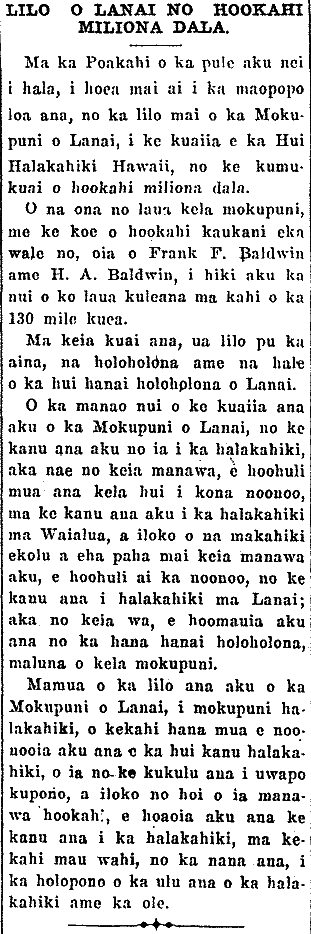
The beginning of the “Pineapple Island,” 1922.

LANAI SOLD FOR A MILLION DOLLARS.

Last week Monday, it was confirmed that Lanai was purchased by Hawaiian Pineapple Company [Hui Halakahiki Hawaii] for the price of a million dollars.

The two owners of the island, except for a remainder of but a thousand acres, are Frank F. Baldwin and H. A. Baldwin, giving them ownership of about 130 square miles.

Included in this purchase was the land, animals, and the buildings of Lanai Ranch [hui hanai holoholona o Lanai].

The main purpose for buying the island of Lanai was to plant pineapple, but for the time being, the company will explore planting pineapple in Waialua, and within three or four years from now, they will think about planting pineapple on Lanai; but for now, ranching will continue on the island.

Before Lanai becomes a pineapple island, one of the things that the pineapple company must think about first is the building of a proper pier, and at the same time, to do test plantings of pineapple at different places to see how the pineapple grows or does not grow.

(Kuokoa, November 23, 1922, p. 3)

LILO O LANAI NO HOOKAHI MILIONA DALA.

Ka Nupepa Kuokoa, Buke LXI, Helu 47, Aoao 3. Novemaba 23, 1922.

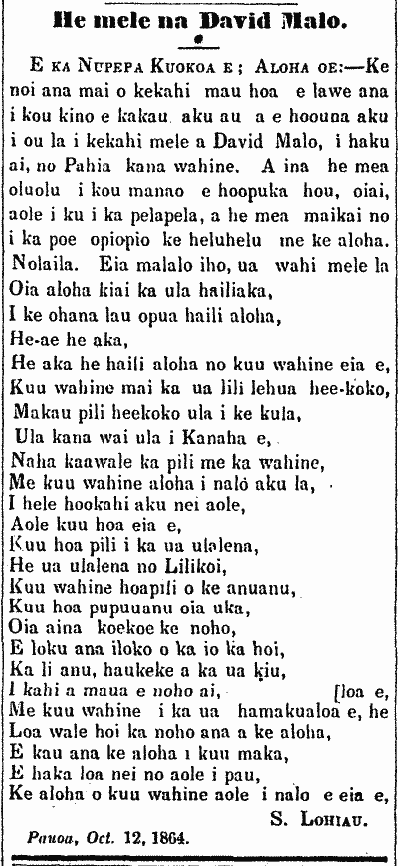
A composition by Davida Malo, 1864.

A mele by David Malo.

O Nupepa Kuokoa; Aloha oe:—Some subscribers of your newspaper have asked me to send in to you a mele by David Malo written for his wife, Pahia. And should it please you to print it once more, being that it is not offensive, and it is fine thing for the youth to read with aloha. Therefore. Here below is the mele:

Oia aloha kiai ka ula hailiaka,
I ke ohana lau opua haili aloha,
He-ae he aka,
He aka he haili aloha no kuu wahine eia e,
Kuu wahine mai ka ua lili lehua hee-koko,
Makau pili heekoko ula i ke kula,
Ula kana wai ula i Kanaha e,
Naha kaawale ka pili me ka wahine,
Me kuu wahine aloha i nalo aku la,
I hele hookahi aku nei aole,
Aole kuu hoa eia e,
Kuu hoa pili i ka ua ulalena,
He ua ulalena no Lilikoi,
Kuu wahine hoapili o ke anuanu,
Kuu hoa pupuuanu oia uka,
Oia aina koekoe ke noho,
E loku ana iloko o ka io ka hoi,
Ka li anu, haukeke a ka ua kiu,
I kahi a maua e noho ai,
Me kuu wahine i ka ua hamakualoa e, he loa e,
Loa wale hoi ka noho ana a ke aloha,
E kau ana ke aloha i kuu maka,
E haka loa nei no aole i pau,
Ke aloha o kuu wahine aole i nalo e eia e.

S. Lohiau.

Pauoa, Oct. 12, 1864.

[David Malo’s wife died on January 5, 1845, and this kanikau is first printed in the newspaper Nonanona, 3/18/1845, pp. 113–114.]

(Kuokoa, 10/15/1864, p. 3)

He mele na David Malo.

Ka Nupepa Kuokoa, Buke III, Helu 42, Aoao 3. Okatoba 15, 1864.

Mafia? 1893.

AN AMERICAN MAFIA.

“The Queen never will be restored to the throne, for she will be shot within 24 hours, and every man who takes office under her will be shot also—we have men secretly sworn to do it.”

Such was the remark made to the writer by a brainless young sprig of the “citizens reserve,” such is the tenor of numerous open threats of the canaille composing the annexation club, the citizens reserve and the American league organizations that pretending to be patriotically American are in fact veritable nests of socialism, fenianism and mafia.

To their shame be it said that these mafias are organized under men calling themselves Americans, men who heretofore have been regarded as respectable and intelligent citizens: Hatch, Castle, Wilder, Jones, Smith, McGrew, Emerson, and so on, whose names will pass into history as knavish pirates in a plot to steal a nation and compel America to receive the stolen goods.

A recent article in the Holomua warned that a wave of insanity had struck Honolulu in accordance with a well known theory of cycles. The malady appears to be growing worse, for certain it is, that all the men and women concerned in the overthrow of the Queen, the terrorism and misgovernment of a P. G. military despotism, and the present display of hostilities against the United States, all act like people demented. Continue reading