Excursion of the Princess Regent Liliuokalani, 1881.

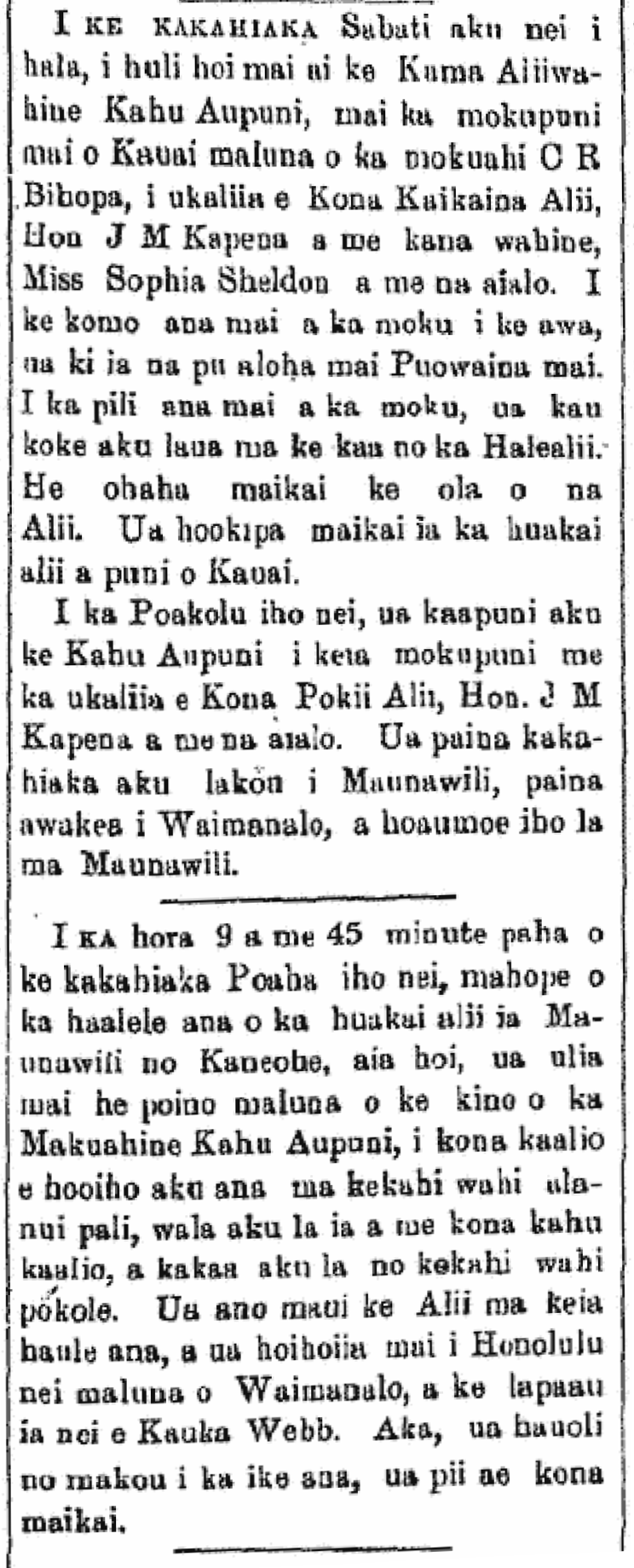
On the morning of this past Sunday, the Princess Regent [Kahu Aupuni] returned from the island of Kauai aboard the steamship C. R. Bishop, accompanied by Her Royal Younger Sister [Likelike], Miss Sophia Sheldon, and her attendants. When the ship entered the harbor, guns of salute were shot from Puowaina. When the ship landed, the two of them immediately boarded a car for the Palace. The Alii was in fine health. The royal excursion was welcomed warmly all around Kauai.

This past Wednesday, the Regent did a circuit of this island accompanied by Her Royal Younger Sibling, Hon. J. M. Kapena, and her attendants. They had breakfast in Maunawili, had lunch at Waimanalo, and spent the night in Maunawili.

———————

At perhaps 45 minutes past the hour of 9 on the morning of this past Thursday, after the royal excursion left Maunawili for Kaneohe, an accident befell the Mother Regent, when her carriage was descending a cliff road, she was thrown backwards along with her driver, and tumbled for a short time. The Alii was somewhat bruised in the fall, and was brought back to Honolulu aboard the Waimanalo, and she is being treated by Doctor Webb. But we are happy to see that she is improving.

[Perhaps the newspaper is playing down the severity of Liliuokalani’s injuries. In “Hawaii’s Story,” she sounds like she is in quite a lot of pain.]

(Ko Hawaii Pae Aina, 10/8/1881, p. 2)

I ke kakahiaka Sabati aku nei...

Ko Hawaii Pae Aina, Buke IV, Helu 41, Aoao 2. Okatoba 8, 1881.

The Queen’s protest to treaty, 1897.

THE COCK CROWS, HAWAII HAS DAWNED.

Liliuokalani Moves the Pebbles on the Konane Board of Hawaii.

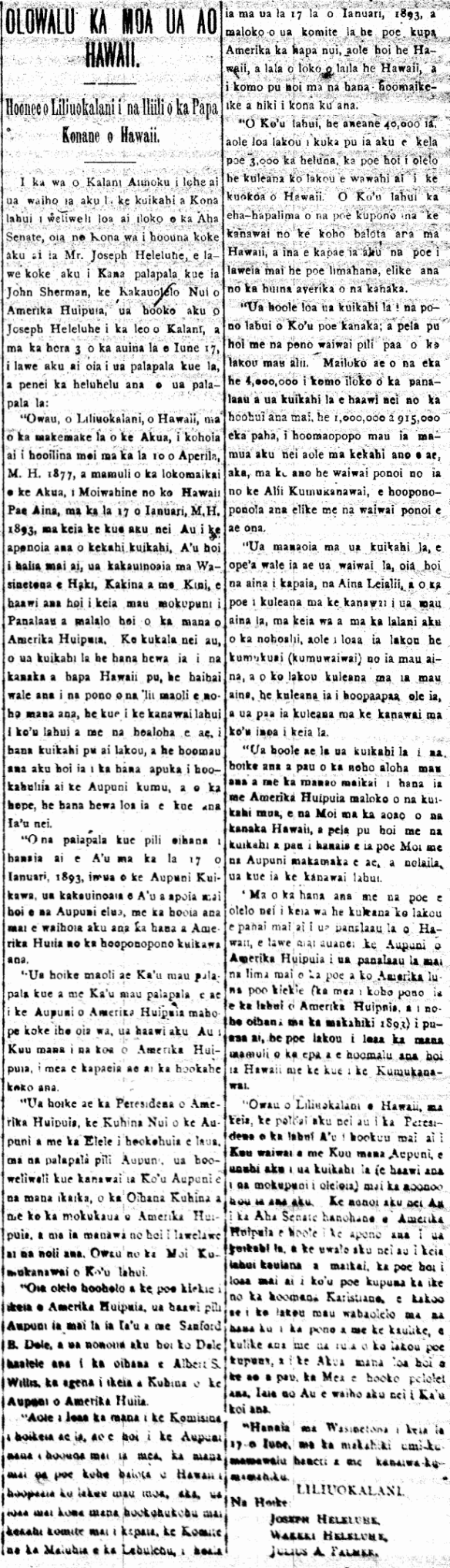
When the Queen heard that the treaty which Her lahui greatly feared was put before the Senate, this was when She quickly sent Mr. Joseph Heleluhe to deliver Her protest to John Sherman, the Secretary of State [Kakauolelo Nui o Amerika Huipuia]; Joseph Heleluhe carried out the command of the Queen, and at 3 o’clock in the afternoon of June 17th, he delivered the protest, and this is how the document reads:

“Owau, o Liliuokalani, o Hawaii, ma o ka makemake la o ke Akua, i kohoia ai i hooilina moi ma ka la 10 o Aperila, M. H. 1877, a mamuli o ka lokomaikai o ke Akua, i Moiwahine no ko Hawaii Pae Aina, ma ka la 17 o Ianuari, M. H. 1893, ma keia ke kue aku nei Au i ke aponoia ana o kekahi kuikahi, A’u hoi i haiia mai ai, ua kakauinoaia ma Wasinetona e Haki, Kakina a me Kini, e haawi ana hoi i keia mau mokupuni i Panalaau a malalo hoi o ka mana o Amerika Huipuia. Ke kukala nei au, o ua kuikahi la he hana hewa ia i na kanaka a hapa Hawaii pu, he haihai wale ana i na pono o na ‘lii maoli e noho mana ana, he kue i ke kanawai lahui i ko’u lahui a me na hoaloha e ae, i hana kuikahi pu ai lakou, a he hoomau ana aku hoi ia i ka hana apuka i hookahuliia ai ke Aupuni kumu, a o ka hope, he hana hewa loa ia e kue ana Ia’u nei.

“O na palapala kue pili oihana i hanaia ai e A’u ma ka la 17 o Ianuari, 1893, imua o ke Aupuni Kuikawa, ua kakauinoaia e A’u a apoia mai hoi e na Aupuni elua, me ka hooia ana mai e waihoia aku ana ka hana a Amerika Huiia no ka hooponopono kuikawa ana.

“Ua hoike maoli ae Ka’u mau palapala kue a me Ka’u mau palapala e ae i ke Aupuni o Amerika Huipuia mahope koke iho oia wa, ua haawi aku Au  i Kuu Mana i na koa o Amerika Huipuia, i mea e kapaeia ae ai ka hookahe koko ana.

“Ua hoike ae ka Peresidena o Amerika Huipuia, ke Kuhina Nui o ke Aupuni a me ka Elele i hookohuia e laua, ma na palapala pili Aupuni, ua hooweliweli kue kanawai ia Ko’u Aupuni e na mana ikaika, o ka Oihana Kuhina a me ko ka mokukaua o Amerika Huipuia, a ma ia manawa no hoi i lawelawe ai na noii ana. Owau no ka Moi Kumukanawai o Ko’u lahui.

“Oia olelo hooholo a ke poe kiekie i ikeia o Amerika Huipuia, ua haawi pili Aupuni ia mai la ia Ia’u a me Sanford B. Dole, a ua nonoiia aku hoi ko Dole haalele ana i ka oihana e Albert S. Willis, ka agena i ikeia a Kuhina o ke Aupuni Amerika Huiia.

“Aole i loaa ka mana i ke Komisina i hoikeia ae la, aole hoi i ke Aupuni nana i hoouna mai ia mea, ka mana mai na poe koho balota o Hawaii i hoopaaia ko lakou mau inoa, aka, ua loaa mai kona mana hookohukohu mai kekahi komite mai i kapaia, ke Komite na ka Maluhia o ka Lehulehu, i hoala ia ma ua la 17 la o Ianuari, 1893, a maloko o ua komite la he poe kupa Amerika ka hapa nui, aole hoi he Hawaii, a lala o loko o laila he Hawaii, a i komo pu hoi ma na hana hoomaikeike a hiki i kona ku ana.

“O Ko’u lahui, he aneane 40,000 ia, aole loa lakou i kuka pu ia aku e kela poe 3,000 ka heluna, ka poe hoi i olelo he kuleana ko lakou e wawahi ai i ke kuokoa o Hawaii. O Ko’u lahui ka eha-hapalima o na poe kupono ma ke kanawai no ke koho balota ana ma Hawaii, a ina e kapae ia aku na poe i laweia mai he poe limahana, elike ana no ka huina averika o na kanaka.

“Ua hoole loa ua kuikahi la i na pono lahui o Ko’u poe kanaka; a pela pu hoi me na pono waiwai pili paa o ka lakou mau alii. Mailoko ae o na eka he 4,000,000 i komo iloko o ka panalaau a ua kuikahi la e haawi nei no ka hoohui ana mai, he 1,000,000 a 915,000 eka paha, i hoomaopopo mau ia mamua aku nei aole ma kekahi ano e ae, aka, ma ke ano he waiwai ponoi no ia no ke Alii Kumukanawai, e hooponoponoia ana elike me na waiwai ponoi e ae ona.

“Ua manaoia ma ua kuikahi la, e ope’a wale ia ae ua waiwai la, oia hoi na aina i kapaia, na Aina Leialii, a o ka poe i kuleana ma ke kanawai i ua mau aina la, ma keia wa a ma ka lalani aku o ka nohoalii, aole i loaa ia lakou he kumukuai (kumuwaiwai) no ia mau aina, a o ko lakou kuleana ma ia mau aina, he kuleana ia i hoopaapaa ole ia, a ua paa ia kuleana ma ke kanawai ma ko’u inoa i keia la.

“Ua hoole ae la ua kuikahi la i na hoike ana a pau o ka noho aloha mau ana a me ka manao maikai i hana ia me Amerika Huipuia maloko o na kuikahi mua, e na Moi ma ka aoao o na kanaka Hawaii, a pela pu hoi me na kuikahi a pau i hanaia e ia poe Moi me na Aupuni makamaka e ae, a nolaila, ua kue ia ke kanawai lahui.

“Ma o ka hana ana me na poe e olelo nei i keia wa he kuleana ko lakou e panai mai ai i ua panalaau la o Hawaii, e lawe mai auanei ke Aupuni o Amerika Huipuia i ua panalaau la mai na lima mai o ka poe a ko Amerika luna poo kiekie (ka mea i koho pono ia e ka lahui o Amerika Huipuia, a i noho oihana ma ka makahiki 1893) i puana ai, he poe lakou i loaa ka mana mamuli o ka epa a e hoomalu ana hoi ia Hawaii me ke kue i ke Kumukanawai.

“Owau o Liliuokalani o Hawaii, ma keia, ke poloai aku nei au i ka Peresidena o ka lahui A’u i hookuu mai ai i Kuu waiwai a me Kuu mana Aupuni, e unuhi aku i ua kuikahi la (e haawi ana i na mokupuni i oleloia) mai ka noonoo hou ia ana aku. Ke nonoi aku nei Au i ka Aha Senate hanohano o Amerika Huipuia e hoole i ke apono ana i ua kuikahi la, a ke uwalo aku nei au i keia lahui kaulana a maikai, ka poe hoi i loaa mai ai i ko’u poe kupuna ka ike no ka hoomana Karistiano, e kakoo ae i ko lakou mau wahaolelo ma na hana ku i ka pono a me ke kaulike, e kulike ana me na rula o ko lakou poe kupuna, a i ke Akua mana loa hoi o ke ao a pau, ka Mea e hooko pololei ana, Iaia no Au e waiho aku nei i Ka’u koi ana.

“Hanaia ma Wasinetona i keia la 17 o Iune, ma ka makahiki umi-kumamawalu haneri a me kanaiwa-kumamahiku.

LILIUOKALANI.

Na Hoike:

Joseph Heleluhe.
Wakeki Heleluhe.
Julius A. Palmer.

[See the English of the Queen’s Protest in Chapter Fifty-Five of “Hawaii’s Story.” See the text of the treaty in Appendix D of the same publication.]

(Aloha Aina, 7/10/1897, p. 6)
OLOWALU KA MOA UA AO HAWAII.

Ke Aloha Aina, Buke III, Helu 28, Aoao 6. Iulai 10, 1897.
Alekoki, 1896.

KAHI WAI O ALEKOKI.

(An expression of affection by King Kalakaua.)

Aole i manaoia
Kahi wai o Alekoki
Hookohu ka ua iuka
Noho mai la i Nuuanu
Anuanu makehewa au
Ke kali ana ilaila
Kai no paha ua paa
Kou manao ia nei
Au i hoomalu ai
Hoomalu oe a malu
Ua malu keia kino
Mamuli o ko leo
Kau nui aku ka manao
Kahi wai o Kapena
Pania paa ia mai
Na manowai o uka
Ahuwale na kiowai
Na papahele o luna
Maluna ae no au
Ma na rumi liilii
Ma na keena o waho
A waho o Mamala
Hao mai nei ehuehu
Pulu au i ka huna kai
Kai he’ahe’a i ka ili
Hookahi no koa nui
Nana e alo ia ino
Inoino mai nei luna
I ka hao a ka makani
He makani ahailono
Lohe ka luna i Pelekane
Oia pouli nui
Mea ole i kuu manao
I o ia nei au
Ka piina o Maemae
E kilohi au o ka nani
Na pua i Maunaala
He ala onaona kou
Ke pili mai ia nei
Aole i billwi ia [Aole i biliwi ia]
Kahi pali o Leahi
Ku kilakila i ka lai
Lai hohola i ke pili
Pili paa o Kawaihoa
Hoa oe o ka inoino
O oe owau kekahi
Pau keia pilikia

(Leo o ka Lahui, 2/3/1896, p. 3)

KAHI WAI O ALEKOKI.

Ka Leo o ka Lahui, Buke II, Helu 1390, Aoao 3. Feberuari 3, 1896.

In anticipation of King Kalakaua’s return from his tour around the world, 1881.

HONORING THE ALII, KING KALAKAUA.

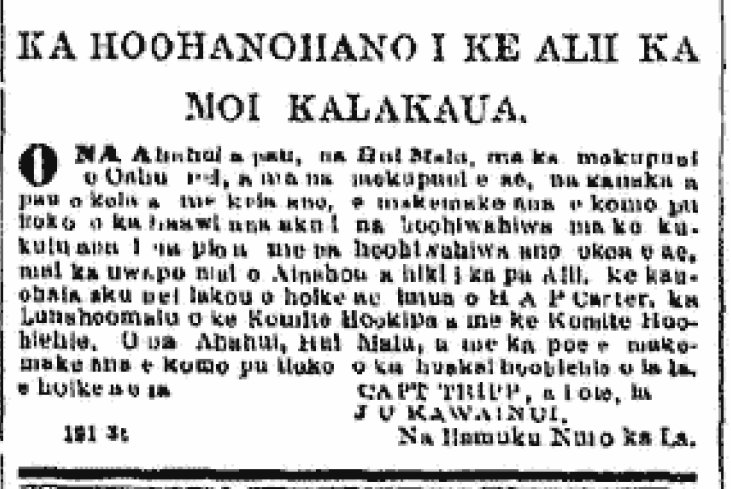
All of the Associations, the Secret Societies, on this island of Oahu, and the other islands, people of all ethnicities, who want to join in giving glory by putting up arches and other public displays from the wharf of Ainahou until the Palace grounds, are ordered to appear before H. A. P. Carter, the Chairman of the Welcoming Committee and the Exaltation Committee. The Associations, the Secret Societies, and those who want to join in the parade of the day, notify CAPT. TRIPP or

J. U. Kawainui,

The Marshals of the Day.

[In “Hawaii’s Story,” Liliuokalani looks back to the day of her brother’s return:

“…With that enthusiasm always shown by the Hawaiian people in doing honor to their sovereigns, the grandest preparations were made throughout the islands to welcome the arrival of the king. In Honolulu the joy was general, and the foreign element was well represented in the festivities. The streets were given up to the people, and and were crowned with triumphal arches. Before the day of his expected landing at the wharf, the most elaborate preparations had been made to give him a royal greeting. The mottoes, in the selection of which numberless parties had consulted me, were displayed in every part of the city, and there was an especial arch designed for each district of the island of Oahu.]

(Ko Hawaii Pae Aina, 10/8/1881, p. 2)

KA HOOHANOHANO I KE ALII KA MOI KALAKAUA.

Ko Hawaii Pae Aina, Buke IV, Helu 41, Aoao 2. Okatoba 8, 1881.

More on Mrs. Heleluhe going to take the place of Kahele Nahaolelua, and name variations, 1897.

MRS. HELELUHE HEADED FOR AMERIKA.

Because Mrs. Kahele Nahaolelua has been away from the presence of the Queen due to her illness, Mrs. Vakeki Heleluhe has been ordered to  seek out the Royal One in Washington; she will be leaving the mother land on the Australia of this next Wednesday, May 5th, for the skin-nipping cold of America, and while she is treads through San Francisco, her care will be under the guidance of J. A. Palmer [Pama], the Queen’s secretary. And for you, O Mrs. Vakeki Heleluhe, is our prayer, that your ocean voyage be accompanied by God’s protection and may he put you ashore on dry land in good health, and may he be with you on water and on land. And when you meet with the Heavenly Alii of the lahui, give the royal one our great aloha.

[According to David Forbes, from the new edition of “Hawaii’s Story,” Mrs. Heleluhe was sometimes referred to as “Waikiki”. Here we see her as “Vakeki”.

See another article on Mrs. Heleluhe’s departure here.

Also, to be added to the index of the new edition should be:

Heleluhe, Wakeke Ululani, 106, 258, 338, 385, 391]

(Aloha Aina, 5/1/1897, p. 6)

MRS. HELELUHE NO AMERIKA.

Ke Aloha Aina, Buke III, Helu 18, Aoao 6. Mei 1, 1897.

Words of praise for C. R. Bishop on today, his birthday, 1896.

MEMORIALS.

….¹

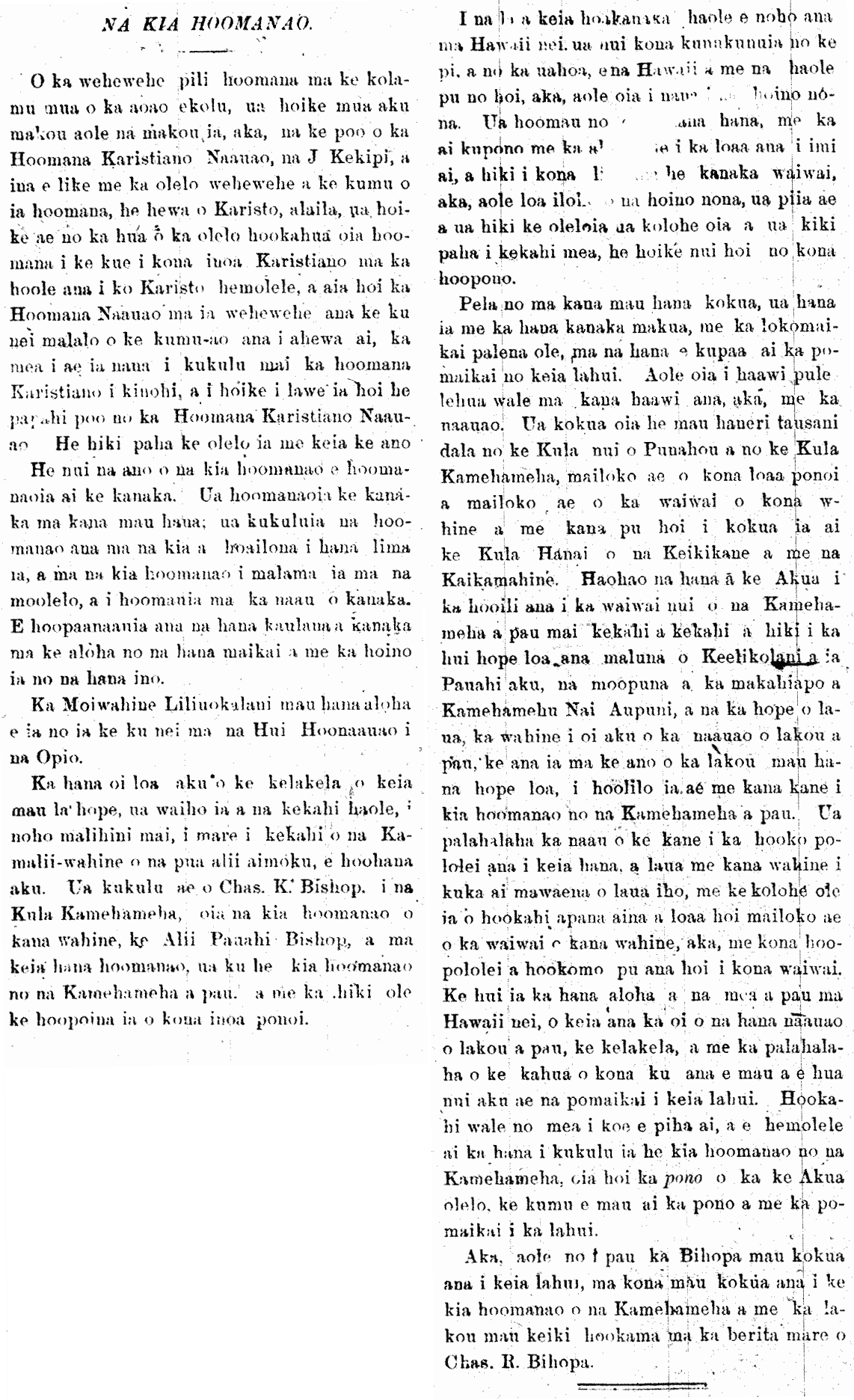
There are many kinds of memorials [kia hoomanao] to remember people by. A person is remembered for his deeds, in memorials built as pillars and monuments, in reminiscences, and preserved in the hearts of the many. Famous deeds of people are remembered with aloha for the good, and with scorn for the bad.

Queen Liliuokalani’s beloved efforts stand today as the Hui Hoonaauao i na Opio [Liliuokalani Educational Society].

The epitome of great deeds of these past days was done by a haole who lived here as a malihini and married one of the Princesses amongst the royal youth. Charles R. Bishop built the Kamehameha Schools, the memorial for his wife, the Alii Pauahi Bishop; and by this act of commemoration, a memorial now stands for all of the Kamehamehas, and it is impossible to forget their name.

 In the days when this haole friend was living here in Hawaii, he was often criticized for his stinginess and defiance by Hawaiian and haole alike, but he paid no care to this criticism. He continued with his work, ate healthily, [illegible digital image], until he was a rich man; but in all the criticism for him, there is no way that it could be said that he was a scoundrel or that he cheated someone; and this says a lot for his uprighteousness.

Likewise with his charity work, he acted with maturity and kindness without end in his steadfast support for the benefit of this lahui. In giving, he was not frivolous in his giving, but gave wisely. He donated hundreds of thousands of dollars to the Punahou College and to the Kamehameha Schools, from his own estate and from that of his wife’s; and from his own, also benefited were the Boarding School for  Boys and Girls. How wondrous is God in his passing down the great entire wealth of the Kamehamehas from one to another until it all came down to Keelikolani and then to Pauahi, the grandchildren of the first born of Kamehameha Nai Aupuni; and it was the last of the two, the one most knowledgeable of them all, as measured by their final deeds, which she created with her husband as a memorial for all of the Kamehamehas. This man was of a great mind in his carrying out meticulously this work which he and his wife discussed between themselves, without misappropriating a single parcel of land included in the estate of his wife, but instead he was conscientious and included his own estate. When put together with all the other beloved deeds by everyone in Hawaii nei, this is measured as the most wise of them all, the height and breadth of its foundation will go on and bear forth much benefits for this lahui. There is but yet one thing to complete and to perfect the building of this memorial to the Kamehamehas, that being the righteousness of God’s words, the basis upon which the good and the blessings of the lahui will continue.

But Bishop’s help for our people is not done in his continued assistance to the memorial to the Kamehamehas and their foster children [keiki hookama] in the covenant of marriage of Charles R. Bishop.

¹The first paragraph was left out because it was somewhat irrelevant to this particular post, and was commentary on J. Kekipi and the Christian Science [Hoomana Karistiano Naauao] faith.

(Oiaio, 2/21/1896, p. 2)

NA KIA HOOMANAO.

Ka Oiaio Puka La, Buke I, Helu 37, Aoao 2. Feberuari 21, 1896.

Marriage of Pauahi and Charles Reed Bishop, 1850.

Queen Liliuokalani reminisces in “Hawaii’s Story”:

“[Bernice] was one of the most beautiful girls I ever saw; the vision of her loveliness at that time can never be effaced from remembrance; like a striking picture once seen, it is stamped upon memory’s page forever. She married in her eighteenth year. She was betrothed to Prince Lot, a grandchild of Kamehameha the Great; but when Mr. Charles R. Bishop pressed his suit, my sister smiled on him, and they were married. It was a happy marriage.

[I was going to put up an article from the newspapers announcing their wedding, but it seems that there are none online. As for the Polynesian, the issues from March 23 to May 11, 1850 are missing. For the Honolulu Times which begins in 1849, there are none online at this time. The Hawaiian-Language Newspaper, Elele, is not currently available online (or on microfilm) after Augate 14, 1849. And it doesn’t seem to be covered in The Friend, which can be found here online through the efforts of the Mission Houses Museum.

150 years ago—The beginnings of the Kaahumanu Society, 1864.

Ahahui Kaahumanu.

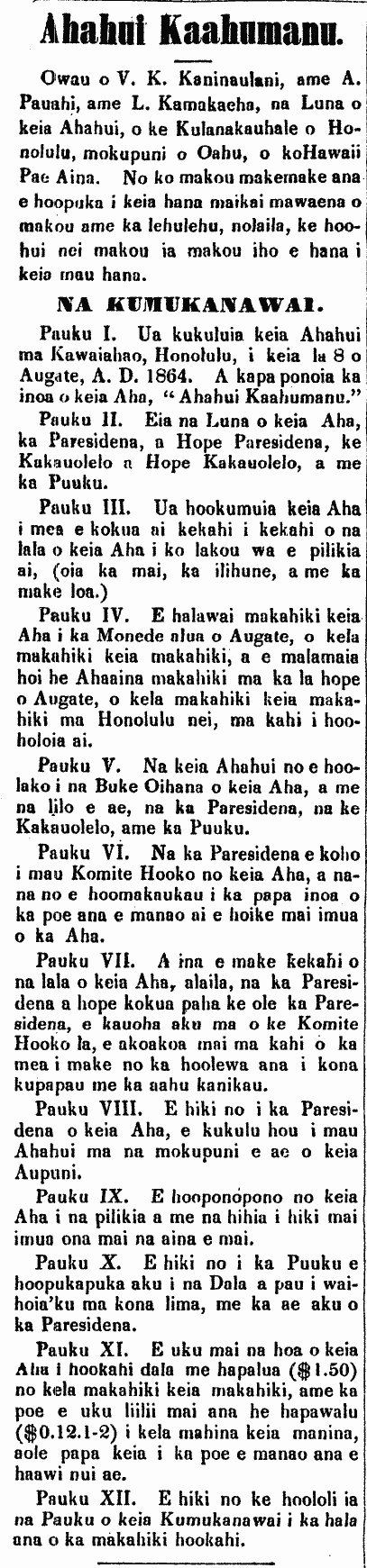
I am V. K. Kaninaulani, along with A. Pauahi,¹ and L. Kamakaeha, are the Officers of this Association, of the Town of Honolulu, Island of Oahu, of the Hawaiian Archipelago. Because of our desire to announce this fine endeavor amongst ourselves and the people, we come together to undertake these tasks.

CONSTITUTION.

Clause I. This Association was established at Kawaiahao, Honolulu, on this day the 8th of August, 1864. This Association is officially called, “Ahahui Kaahumanu.”

Clause II. The Officers of this Association are the President, the Vice President, the Secretary, the Vice Secretary, and the Treasurer.

Clause III. This Association was established to assist each other member of this Association when they are in need (in sickness, poverty, and death)

Clause IV. The yearly meeting of this Association will be on the second Monday of August of each year, and a yearly Banquet will be held on the last day of August every year in Honolulu nei, at the location designated.

Clause V. The Association will supply Record Books [Buke Oihana] of the Association, as well as any other expenses for the President, Secretary, and the Treasurer.

Clause VI. The President will select Executive Committees for this Association, and they will prepare lists of names of those who want to present themselves before the Association.

Clause VII. Should a member of this Association die, then the President or if not the President, then a representative will order by Executive Committee to gather in mourning attire at the place of the deceased for the funeral over her body.

Clause VIII. The President of this Association is empowered to establish other Associations on the other islands of this Nation.

Clause IX. The Association shall resolve all problems and difficulties brought before it from other lands.

Clause X. The Treasurer may expend all funds at her disposal with the approval of the President.

Clause XI. Members of this Association shall pay a dollar and a half ($1.50) yearly, or installments of an eighth ($0.12.1-2) every month; it is not prohibited to give more.

Clause XII. Clauses of this Constitution may be changed after one year.

¹Pauahi is often referred to as A. Pauahi. [Would there be anyone who knows what that initial stands for?]

(Kuokoa, 8/20/1864, p. 4)

Ahahui Kaahumanu.

Ka Nupepa Kuokoa, Buke III, Helu 34, Aoao 4. Augate 20, 1864.

One more on the passing of Jane Loeau, 1873.

The Death of Jane Loeau.

On Wednesday, July 30, Mrs. Jane Loeau Kaelemakule died, at Puunui, in this town. She died quickly; she had a pain in her chest after bathing in water; this is the ailment she died of, while still strong in body. She was born in Waimea, Kauai, in the year 1828, therefore she was 45 years old when she died. Her rank and ancestry is very famous in the history of succession of alii of Hawaii nei. Her father was Kalaniulumoku, and Liliha was her mother. On her mother’s side, it can be said that she was a great-granddaughter [moopuna kualua] of Kamehameha I. Here is clarification: Kamehameha lived with Kualii (f) and bore Loeau (the first) (f). Koakanu lived with Loeau (the first) and bore Liliha, the mother of Jane Loeau. During her childhood, she was educated under the teaching of Mr. and Mrs. Cooke, and she was a schoolmate of the past two Monarchs who passed away as well as our present King, and also the royal descendants living today. Her passing may not be something that will greatly mourned by the people, as that blossom was plucked from the generation of alii; however, it is the moolelo of her ancestry that will show us these features [? na ka moolelo o kona hanauna e hoike mai ia kakou i na hiohiona i like pela]. Being that:

“Ua hala ka pili ka owa o Hakalau,
Hala ke kaha, ke ohi kumano ia mano,
I Kaumakaamano i ke kapu ka ai,
I ka ouli maka o Hanaimalama,
Ke ohi la i ka liko lau o ke Pahili,
I Hili mo—e, i Hili pawa, o Hele—i—pa—wa,
Mea e ka hele a hoi mai e,
E waiho ia hoi ka hele a kipakuia—a.

(Ko Hawaii Ponoi, 8/6/1873, p. 2)

Ka make ana o Jane Loeau.

Ko Hawaii Ponoi, Buke I, Helu 8, Aoao 2. Augate 6, 1873.

Short biography of Jane Loeau by her husband, S. L. Kaelemakule, 1873.

A History of Jane Loeau.

In the year 1847, Jane Loeau was boarding at the school of Mr. and Mrs. Cooke [Kuke], and she married John Robert Jasper [Keoki-pu], and he died. In the year 1855 perhaps, she married Marvin Seger [Sika] [? Martin Seger], and he died. In the year 1862, she married me. We were together for 10 years, 7 months, and 25 days in the covenant of marriage in peace and happiness. We did not leave one another, but it was the angel of heaven who has separated us, and I live with sadness and never-ending regret.

She is one of the royal descendants of Hawaii nei, born of alii “Papa.” From ancient times, her rank was of royalty, but she humbled herself, befriended and warmly welcomed newcomers, she was loving, and she was kind in actions and words, and she was a follower of the Lord. In the year 1865, she joined the church at West Hamakua, Hawaii, and this past July, the Rev. J. Bicknell [Bikanele] released our covenant at Kawaiahao Church, to Rev. H. H. Parker [Paleka] [? ua hookuu mai la o Rev. J. Bikanele i ko maua berita ma ka ekalesia o Kawaiahao, ia Rev. H. H. Paleka.]. “Blessed are those who die in the Lord.” I composed this loving chant [kanaenae] for her below:

Ke aoa lani ulu haoa o ke kapu,
Ke aoa lani o Haholua o Palena,
O ke Kihenelani nei a Kauhi—e,
Na Kauhikealani o Kama,
Oia no—a.

Ka Punua ula ku i ka moku,
I hoopunanaia iloko o ka lani,
O ka lani me he aka la i ka wai,
He akamai i ke kui lani,
Kuiia ae kani kui hono i ka moku,
Ka mai kaupoa ma ke kua,
I ku ka hene ma ka houpo,
Poaha ia hemo ka Haku,
Ma ka manawa o ka ua kapu,
O Holani nui kaipo,
Ma ka loko mai o Holani na ‘lii,
Oia no—a.

Hoopuka i Nuuanu ka ua a ka makani,
Haiki ka pili hau i Kahaukomo,
Komo i na kiowai a ke Kiowao,
Aleale i ke alo ua o Lanihuli,
Hala i ka na’ki o Konahuanui,
Nui ka ua, mahimahi nui ka makani,
Na hookoikoi a ka waahia,
He hilahila oe ke hai mai—e,
Iini ana loko,
Oia no—a.

O Hanalei ua pehu ka lani,
Pohu ka lani, loloa ka opua,
Opua lani uli ku hakakai,
Kai ka ua e—e ua i ka liko,
A ka liko awe loloa ka ua iluna,
Lele pulelo iluna o ka lau o ka laau,
Ukuhi i na pakeke wai o Neki,
Piha Hilo ke kaheka kulu a ka wai,
Wahiaia aku la Waioli e ka ua,
Naha Hanalei ke kahe nei ke one,
Oia ua e—e ua i Hanalei,
Oia no—a.

Hanalei lani kupilikii, kupilikii mau a ka lani,
Huikau ae la he hooilo, mahiki mai la ka lehua,
Ka lehua hale, ka lehua makanoe,
Ka naele i o ia e ka wai ka lepo,
O Hiku iluna o Maunahina,
Kupeke, kapekepeke iluna o Hauai’liki,
Iliki ka noe, anu ka nahele,
He nahele anu, me ua hoa’la i na lae ino o ka moe,
E poi ana a ku he ‘hu,
Moe aku ka luhi i Kauakanana—e,
E hoonana ae ana i ka moe—e,
O oni mai auanei ma ka hope,
Mahope mai—a,
Oia no—a.

(To be continued.)

S. L. Kaelemakule.

Honolulu, August 6, 1873.

[I am not sure if there is a continuation to this.

S. L. Kaelemakule doesn’t live that many years after that. He dies on March 3, 1878, at Kepahoni, Honolulu.]

(Ko Hawaii Ponoi, 8/13/1873, p. 4)

He Moolelo no Jane Loeau.

Ko Hawaii Ponoi, Buke I, Helu 9, Aoao 4. Augate 13, 1873.