The famous Niihau protest mat on display at the Bishop Museum, 1874 / 2015.

[Found under: “NOTES OF THE WEEK.”]

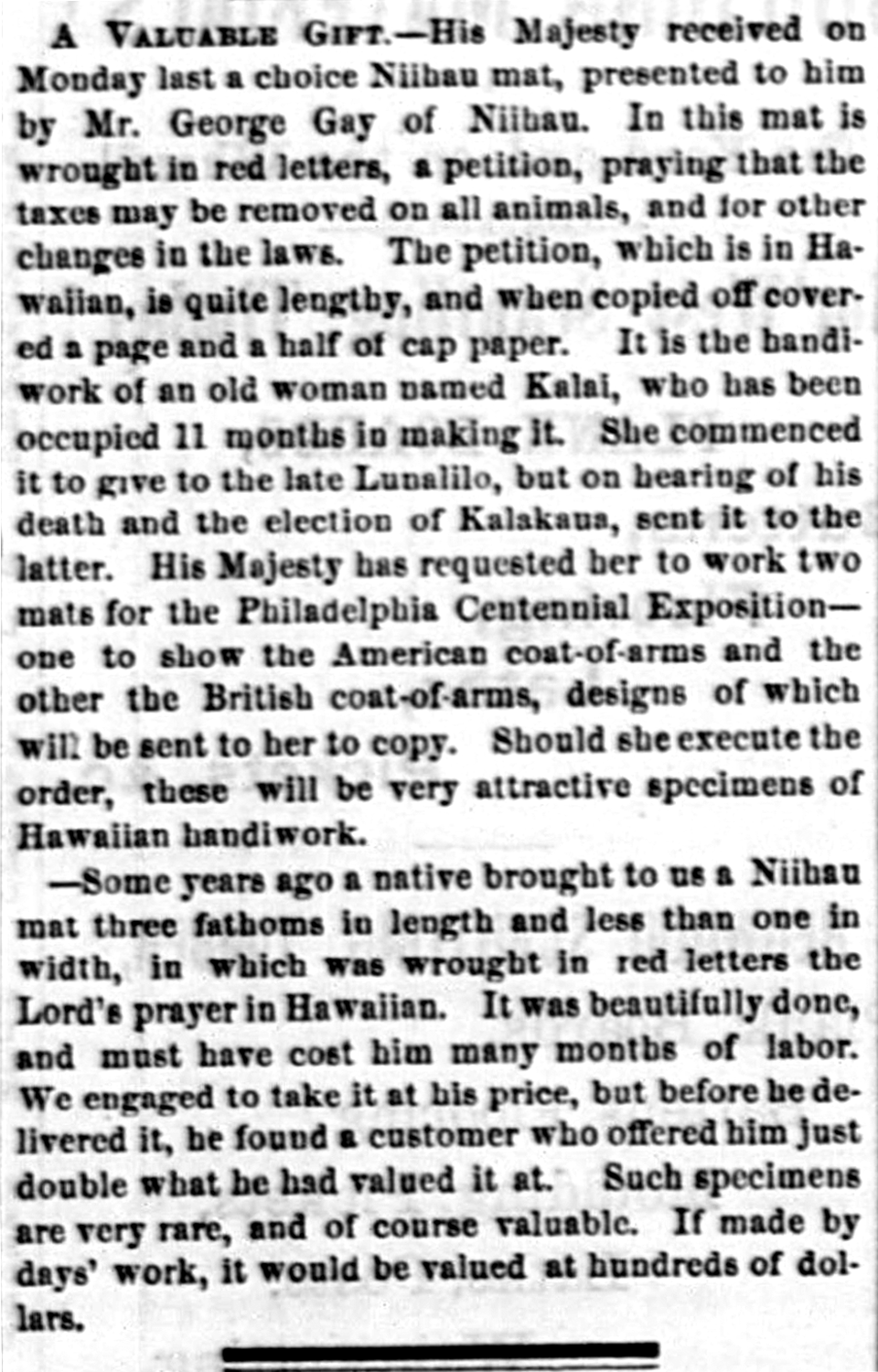
A Valuable Gift.—His Majesty received on Monday last a choice Niihau mat, presented to him by Mr. George Gay of Niihau. In this mat is wrought in red letters, a petition, praying that the taxes may be removed on all animals, and for other changes in the laws. The petition, which is in Hawaiian, is quite lengthy, and when copied off covered a page and a half of cap paper. It is the handiwork of an old woman named Kalai, who has been occupied 11 months in making it. She commenced it to give to the late Lunalilo, but on hearing of his death and the election of Kalakaua, sent it to the latter. His Majesty has requested her to work tow mats for the Philadelphia Centennial Exposition—one to show the American coat-of-arms and the other the British coat-of-arms, designs of which will be sent to her to copy. Should she execute the order, these will be very attractive specimens of Hawaiian handiwork.

—Some years ago a native brought to us a Niihau mat three fathoms in length and less than one in width, in which was wrought in red letters the Lord’s prayer in Hawaiian. It was beautifully done, and must have cost him many months of labor. We engaged to take it at his price, but before he delivered it, he found a customer who offered him just double what he had valued it at. Such specimens are very rare, and of course valuable. If made by days’ work, it would be valued at hundreds of dollars.

[This mat was put on display at the Bishop Museum just yesterday. Go check it out if you are on Oahu nei.]

(Hawaiian Gazette, 4/29/1874, p. 3)

A Valuable Gift.

Hawaiian Gazette, Volume X, Number 17, Page 3. Aprila 29, 1874.

Greatest Mariners, 1938 / 2015.

POLYNESIANS AS MARINERS SEEN

Dr. Buck Terms Early Polynesians Greatest Mariners World Has Ever Known

HONOLULU, Nov. 29—Dr. Peter Buck, director of the Bishop Museum, last night termed the early Polynesians the greatest mariners the world has ever known.

Dr. Buck, who will leaves soon for Yale University to lecture on primitive religions, spoke at a dinner in his honor attended by almost 200 persons. He was introduced by Frank Atherton.

He said it was probable that some of the early Polynesians reached the shores of America. He traced the possibility in similarity of certain words, such as that for sweet potato itself was brought into the South Seas from the American continent. Continue reading

Peter Buck to become an American citizen, 1943.

Resolution Approved

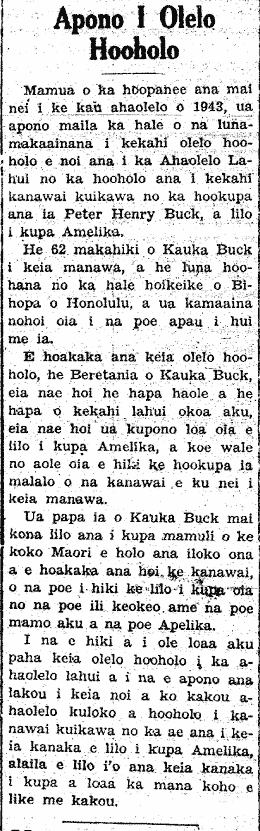
Before the session of the legislature of 1943 was postponed, the house of representatives approved a resolution asking Congress [Ahaolelo Lahui] to pass a special law to naturalize Peter Henry Buck, and make him an American citizen.

Dr. Buck is 62 years old now, and he is the director of the Bishop Museum of Honolulu, and he is a kamaaina to all the people he meets.

This resolution clarifies that Dr. Buck is English, however he is half haole and half another ethnicity, but it is appropriate that he be naturalized as an American citizen, but he cannot become a citizen under the current laws.

Dr. Buck is restricted from becoming a citizen because of the Maori blood flowing through him, and the law states that those who are able to become citizens a whites and descendants of African people.

If this resolution reaches or is received by the senate, and should they approve this request of our local legislature, and they pass a special law to allow this man to become an American citizen, then this man will indeed become a citizen and he will be able to vote like we do.

(Hoku o Hawaii, 5/5/1943, p. 1)

Apono I Olelo Hooholo

Ka Hoku o Hawaii, Volume XXXVIII, Number 2, Aoao 1. Mei 5, 1943.

More on the wax cylinder of Kalakaua, 1891.

A VOICE FROM THE DEAD.

Just before the last call of the reaper whose powerful scythe severed the connections of King Kalakaua with mundane matters, His Majesty was visited by Mr. Louis Glass, agent of the Edison Phonograph Co., and by request spoke into a cylinder of the machine. His Majesty spoke the following, as an experimental trial, having intended, when in better health to speak more at length. The Editor of the Paradise of the Pacific obtained the following carefully prepared translation of His Majesty’s words, the rendition being made by Mr. James I Dowsett, Jr., of Honolulu, at his request:

“Aloha kaua—Aloha kaua. Ke hoi nei no paha makou ma keia hope aku i Hawaii, i Honolulu. A ilaila oe e hai aku ai oe i ka lehulehu i kau mea e lohe ai ianei.”

[Translation.]

“We greet each other—We greet each other. We will very likely hereafter go to Hawaii, to Honolulu. There you will tell my people, what you have heard me say Here.”

(Paradise of the Pacific, 2/1891, p. 2)

A VOICE FROM THE DEAD.

Paradise of the Pacific, Volume IV, Number 2. February 1891.


Last words of the King, 1891.

Kalakaua’s Last Words Preserved by Phonograph.

Outside the little circle of immediate friends and attendants upon the late King Kalakaua who were admitted into the sick chamber it is not known that for the ten days prior to the monarch’s death an Edison phonograph stood near the bedside. Many who saw the instrument daily never suspected its character or use, and during the excitable days preceeding the King’s death, during which every nerve was taxed to its greatest tension, the innocent-looking little machine reposed in its shaded corner unnoticed and unobserved by all except the King’s chamberlain and his secretary. Continue reading

More on Lady Franklin and ahuula and upcoming events, 1861 / 2015–2016.

While in Hawaii in 1861, Lady Franklin enjoyed the company often of King Kamehameha IV and Queen Emma. According to newspaper reports, the relationship between them was very cordial. She was given this treasured ahuula in commemoration of this bond.

If you find yourself in San Francisco at the end of this summer until the early part of next year (8/29/2015–2/28/2016), do make your way to the de Young Museum:

Lady Franklin cape

Lady Franklin cape (detail) (#5948). ‘apapane feathers, ‘ō‘ō feathers. Bernice Pauahi Bishop Museum, Ethnology Collection, 09670/1909.007

Royal Hawaiian Featherwork: Nā Hulu Ali‘i

August 29, 2015February 28, 2016

Explore the distinctive art, culture, and history of Hawai‘i with the first exhibition of Hawaiian featherwork on the U.S. mainland, developed in partnership with the Bernice Pauahi Bishop Museum, Honolulu. Presented in San Francisco, which is considered to be the gateway to the Pacific, the exhibition will feature approximately 75 rare and stunning examples of the finest featherwork capes and cloaks in existence, as well as royal staffs of feathers (kāhili), feather lei (lei hulu manu), helmets (mahiole), feathered god images (akua hulu manu), and related eighteenth- and nineteenth-century paintings and works on paper. Continue reading →

William Hyde Rice’s Hawaiian Legends in English, 1923.

[From the Preface of “Hawaiian Legends by William Hyde Rice”]

The collection of Hawaiian legends of which a translation is given in the following pages represents the work of many years by William Hyde Rice of Kauai. However, it is only within the last few years that Mr. Rice has translated the legends from his Hawaiian manuscripts. He has tried to make his version as literal as possible, preserving at the same time the spirit of the original Hawaiian, its flavor, rhythm, and phrasing. He has avoided adding modern embroidery of fancy, as well as figures of speech foreign to the Hawaiian language and to its thought and expression.

….

Mr. Rice has been exceptionally well prepared for this work, as he has been familiar with the Hawaiian language from his earliest childhood. In fact until he was twenty, he never thought in English but always in Hawaiian, translating mentally into his mother tongue. In 1870 when he became a member of the House of Representatives, during the reign of Kamehameha V, Governor Paul Kanoa and S. M. Kamakau, the historian, both well-known Hawaiian scholars, gave Mr. Rice much help with his Hawaiian, especially teaching him the proper use of various complicated grammatical constructions, and explaining obscure variations in pronunciation and meaning.

The sources of the legends in this collection are varied. A number of the stories Mr. Rice remembers having heard as a child, and now rare ones were gathered in later years. Many are from more than one source, but have corresponded even in details, and almost word for word. The legend of Kamapuaa, for instance, is one of the first which Mr. Rice remembers hearing. When a boy, the places mentioned in this story were pointed out to him: the spot where the demi-god landed, where he found the hidden spring, and where he rooted up the natives’ sugar-cane and sweet potatoes. The story of “The Small Wise Boy and the Little Fool” he has also been familiar with since childhood. The places mentioned in this tale can likewise be pointed out.

Most of the legends are from Kauai sources, but a number have been gathered from the other islands of the group. Whenever Mr. Rice heard of an old Hawaiian who knew any legends, he went to him, sometimes going to several to trace a special story, as for instance, the “Jonah and the Whale” story, “Makuakaumana”, which after a long search he finally procured from Mr. Westervelt. This curious story seem to be more modern than the others of the collection. While hunting for a reliable version of this story, Mr. Rice incidentally heard the story of “Manuwahi” at Heeia from an old Hawaiian.

“The Bird Man”, “Holuamanu”, “The Destruction of Niihau’s Akua”, and “The Girl and the Mo-o”, were obtained from Mr. Francis Gay, who is one of the best living scholars of the Hawaiian language. The Niihau legend was heard from several other sources as well. Mr. Gay also gave the legends of the “Rainbow Princess” and the “Shrimp’s Eyes”; the ti plants mentioned in the latter legend can still be pointed out, growing at the mouth of a little valley near Holuamanu. The Hawaiian manuscript of part of the Menehune story was obtained from J. A. Akina, while the story of the “Rain Heiau” was told to him in 1912 by a man named Naialau, who has since died at Kalaupapa. “How Lizards Came to Molokai” and Paakaa and Ku-a-paakaa” were told Mr. Rice by a man from Hawaii named Wiu, while the Rev. S. K. Kaulili, who is still living at Koloa, Kauai, gave him the most complete version of the “Rolling Island”.

During Mr. George Carter’s term as Governor, a reception was given in his honor, at Hanalei, where Mr. Rice was much interested in the very fine oli (chanting) of an old Hawaiian, named Kaululua. From him he obtained a number of legends, including that of “Ulukaa” from corresponding versions of other already in his collection. Other legends have been lost forever on account of ill-timed ridiculing by some chance companion, for Mr. Rice has found that the old people who know the legends are very sensitive, and when they find an unsympathetic auditor, refuse to continue their stories.

[It is often just as important to read the front matter and the back matter of a book than simply heading straight to the main text itself. Many times you can learn a lot of important information.

The stories credited to W. H. Rice found in the Hoku o Hawaii are probably the ones Rice collected over the years.]

(Rice, William Hyde. “Hawaiian Legends. Bernice P. Bishop Museum Bulletin 3.” Honolulu: The Museum, 1923.)
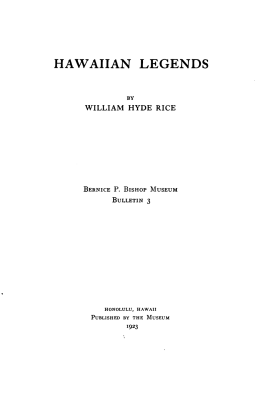
Hawaiian Legends

Hawaiian Legends by William Hyde Rice
Te Rangi Hiroa in Honokaa, 1940.

[Found under: “HUNAHUNA MEA HOU HAMAKUA AME KOHALA”]

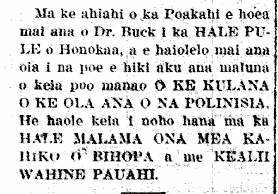
In the evening of this coming Monday, Dr. Buck will appear at the Honokaa CHURCH, and he will speak to those who come on the topic of THE WAY OF LIFE OF THE POLYNESIANS. He is a haole who is working at the MUSEUM OF BISHOP AND THE CHIEFESS PAUAHI.

[Dr. Peter Buck is the renown director of the Bernice Pauahi Bishop Museum from 1936–1951.]

(Hoku o Hawaii, 10/16/1940, p. 1)

Ma ke ahiahi o ka Poakahi...

Ka Hoku o Hawaii, Volume XXXV, Number 25, Aoao 1. Okakoba 16, 1940.

New exhibit at Bishop Museum, 2014.

Check out the new exhibit at the Museum commemorating the very beginnings of the Bernice Pauahi Bishop Museum in 1889.¹ Take your parents, and aunties and uncles, and your children, and take a walk with them into the past. Perhaps it will help in bringing back to life family stories! History is cool.

Bishop Museum Change Exhibit

.

In this exhibit, explore how everyday life in Hawai‘i has changed since Bishop Museum was founded in 1889. Some changes have been for the worse and some for the better, and the future holds still more changes that will inevitably transform this place and the people who call it home. [For more, see here at the Bishop Museum page.]

¹The Museum however did not open to the public until 1891.

Bishop Museum, 1891.

NOTICE.

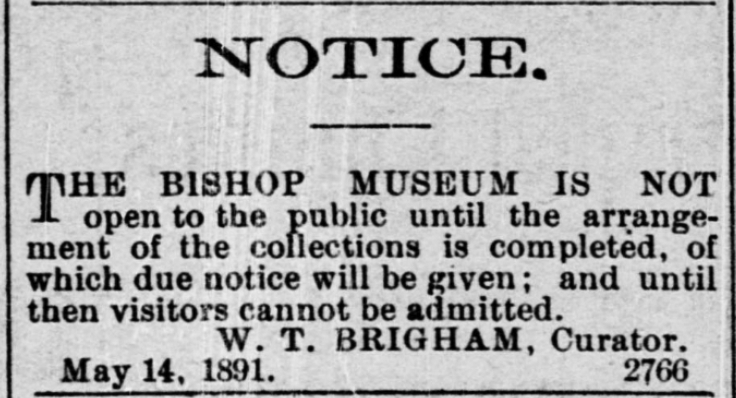
THE BISHOP MUSEUM IS NOT open to the public until the arrangement of the collections is completed, of which due notice will be given; and until then visitors cannot be admitted.

W. T. BRIGHAM, Curator.

May 14, 1891.

(Pacific Commercial Advertiser, 5/16/1891, p. 2)

NOTICE.

The Pacific Commercial Advertiser, Volume XIII, Number 2766, Page 2. May 16, 1891.