Hawaiian Star’s coverage of the protest rally of July 2, 1894.

The noticable lack of enthusiasm at the Royalist mass meeting yesterday afternoon was not surprising. The half-dozen foreigners who got up the affair, to protest against the Republic, will now probably admit it is a hard matter to work up native enthusiasm at a political funeral.

(Hawaiian Star, 7/3/1894, p. 2)

The noticable lack of enthusiasm...

The Hawaiian Star, Volume III, Number 86, Page 2. July 3, 1894.

Newspaper in favor of the Republic and the mass protest of July 2, 1894.

THEIR LAST POLITICAL ABSURDITY.

Those who have hung a last hope on a turn in the political tide favorable to royalism have again been disappointed. The eager anticipation that the new constitution would not receive the support of the radical element of the political clubs has been dashed by the unanimity and enthusiasm with which the call for to-night’s ratification meeting has been received. Hope deferred hath surely made the heart of the royalist politician heavy; and that “terrible tired feeling” has, since the passage of the Senate resolution, characterized the actions and scheming of the ex-queen’s street politicians. They have not learned of wisdom, though tutored thus far by a kind fate; and they refuse to abate one jot of their absurd pretentions, though a point has been reached where the royalist faith-cure and racial egotism will avail no more forever.

The crowning absurdity of all the royalist planning since the overthrow of the monarchy, has been reached in the mass meeting “to protest” against the establishment of the Republic and the new constitution. Wiser heads have already entered similar protests—protests with somewhat of weight and prestige back of them, made both here and abroad; but they have amounted to naught, not being more substantial under the circumstances than the breath with which they were projected.

It has been certainly an untoward fate that has snapped off the daily yearnings of retrogression and restoration almost as soon as they have been made public through diplomatic or local channels. It seem not yet to have dawned upon the monarchists and their more influential backers of different sorts and conditions that the royalist leaders are failing to play political trumps because the people of Hawaii have refused to deal them the necessary cards. The present, in fact, is a clear case of “new deal” where “bluffs” do not count.

It is pretty safe to say the Royalist mass meeting announced for this afternoon at 5 o’clock is another little game of political bluff gotten up by the usual coterie of anti-Republicans to give color to some little scheme of their own. Or it may be that this time the many desertions an general tendency of the natives during the past two weeks to come over to the Republic and the cause of Annexation has so chilled the political atmosphere that the half dozen foreigners from everywhere, who have been misleading and misadvising the natives for the past year, feel the absolute necessity of an immediate display of vocal fireworks to sustain their fading influence with the natives yet a little longer.

The public will remember the little mass meeting dodge of Mr. C. W. Ashford and other men of the stripe some months ago, when several hundred Chinese were present on special invitation to make a respectable showing. The meeting, however, as far as representing anything or anybody, except the three or four anti-American speakers on the stand, was an unqualified fizzle. Such will be the unlamented fate of the alleged mass meeting this afternoon to protest against the establishing of the Republic of Hawaii. This time the royalist braves will not even have the countenance of the Chinese who have sense enough to see the destinies of Hawaii are pointing elsewhere.

[Just as there were English newspapers in Hawaii with different stances, so too were there different stances taken by the different  Hawaiian-Language Newspapers.]

(Hawaiian Star, 7/2/1894, p. 2)

THEIR LAST POLITICAL ABSURDITY.

The Hawaiian Star, Volume III, Number 85, Page 2. July 2, 1894.

The people speak, 1894.

PROTEST OF THE PEOPLE.

Three Thousand Hawaiians Declare Their Objection to the Republic.

A very short and a very insufficient call was made for a mass meeting on Palace Square at 5 o’clock yesterday afternoon, to protest against the promulgation of the Republic while the question of the revolution was still in the hands of the United States Executive as arbitrator. Scarcely anybody knew a meeting of the kind was intended until yesterday morning. Nevertheless, when the hour arrived there had assembled a thousand people, this number being tripled by the time proceedings began.

The premises of Mr. Nacayama were kindly allowed for the use of the meeting. In the small elevated pavilion overlooking the square were seated Mr. and Mrs. H. A. Widemann, Mr. and Mrs. James Campbell, Mr. and Mrs. John A. Cummins, Mrs. Nawahi, Mrs. Aholo, Mrs. Fernandez and Miss Peabody. In front were Messrs. J. O. Carter, J. Nawahi, J. E. Bush, R. W. Wilcox, J. K. Kaulia and press reporters. There were also stationed at the front the Government shorthand reporter, J. W. Jones, and interpreter, W. L. Wilcox, to catch any sedition that might be talked to the crowd.

Mr. Nawahi called the meeting to order and introduce in turn Mr. Kaulia to read the resolution in Hawaiian, and Mr. Carter to perform the same office in English. The resolution is a follows:

“Be it resolved, that the Hui Aloha Aina and other Patriotic Leagues, together with the Loyal subjects of the Hawaiian Kingdom, in Mass Meeting assembled, representing by far the greater majority of the legitimate voters of this country, do hereby most solemnly protest against the promulgation of a new Constitution, formed without the consent and participation of the People, and we also protest against changing the form of government from the one under which we have lived peacefully and prosperously for many years. And that we maintain that the will of the majority of the legitimate voters of Hawaii should be the supreme power of the land, as such power is so recognized and accepted by all the enlightened countries and by all the enlightened governments of the world.”

Mr. Bush then delivered the following address in both languages:

Fellow Citizens and Friends:

We are convened here this afternoon under the broad canopy of heaven, to enunciate broad and important principles. We are not here to express any personal grievances, nor to make any personal complaints, but as a large body of the people we are here, to express our wishes in a peaceful and orderly manner, against the promulgation  of a document which we deem subversive of our rights as free citizens of this country. We are here in the interests of every individual present, and of every individual absent, whom some of us as associated bodies here represent, and of every unit of this government. We are here to set forth the inherent rights of every man and woman in Hawaii nei, and to object to any act restrictive of their rights, and are doing our duty. However, we are not unmindful of the just and legitimate authority vested in those who have assumed the governmental power to administer the affairs of the governed. We recognize the right of civil government to be, and the duty is divinely enjoined upon all rendering to the governmental power, provisional as well as permanent, that which legitimately belongs to it.

We believe that civil governments are ordained of God for the good of every man, woman and child, through the will of the people, and as long as so administered for their good and with their consent, we should give our adherence to it. We are not in sympathy with anarchy or with the creation of social disorder, believing that all our troubles can be more easily and more intelligently adjusted by the peaceful process of free and untrammeled appeal to the people, from whom all just power to govern belongs, and from whence it should emanate.

And it is because the fundamental principles of just government have been studiously and wilfully ignored by the powers that have been set up over us, through the armed intervention of the forces of a nation presumed to be on friendly intercourse with us, that we are gathered here to make protest against the further encroachment upon those principles and upon our rights as free citizens of an independent country, and especially against the promulgation of a constitution in which, by unusual restrictions, the people have been debarred from participating in, if they so desired. However, we have had other reasons for not participating in the framing of such a document, i.e., that we are pledged to respect the position of the Chief Executive of the American Nation, who, for the honor of his country, and for our benefit, is made a party to our affairs, as arbiter.

Until the United States, through its chosen head, is heard from, we find ourselves on the verge of being made a party, by tacit consent, to an act that sets aside all sense of honor, all moral obligation, yes, to participate in a flagrant insult toward and breach of confidence in a nation to whom we have submitted our differences for arbitration and readjustment. If for no other rea-

(Daily Bulletin, 7/3/1894, p. 1)

PROTEST OF THE PEOPLE.

The Daily Bulletin, Volume VII, Number 1074, Page 1. July 3, 1894.

son than the last, we should all the more loudly proclaim our disapproval of the proposed institution of a new for of Government, under a new constitution formed by an oligarchy, until the arbiter of our dispute is heard from, and until if need be the voice of the people of Hawaii is heard, whose right it is to speak upon Hawaii’s future destiny.

We regret, deeply regret, the necessity that calls for this protest from us. But duty to ourselves and honor to those whom we have appealed to demand that we should give utterance to our views in brief and in unmistakable language, without being personal or vituperative. It is a God-given right, and we would be derelict in duty if we refrained from exercising it, and unanimously sustaining the resolution just read, which embodies all that is necessary to express our principles and by thus publicly and peacefully putting ourselves upon record before the world, absolve ourselves from the charge of being partakers in arbitrary and high-handed measures, the culmination of successive unprincipled acts, which began nearly two years ago.

We have met here to protest against personal government, against every act which restricts the inherent rights of the people. No one can deny that the constitution proposed by the Provisional Government is based upon a fraudulent foundation. The whole fabric from which it emanated is one of injustice, fraud and fiction, and it will end, as all such acts of Neroism should end, by disgrace to the inceptors and disaster to the State that should be unfortunate enough to have such retrogressive principles for its foundations, whereby and by which to rule and govern its people.

Mr. Bush had thrown a few impromptu remarks into his written address, which caused laughter and applause. In arguing that the Constitution of the Republic did not assure stable government, he referred to the quarrel in the Convention between “Brother Damons and Brother Smith.” He asked if men born under the free flag of America could support the conduct of the authors of the Constitution. Cries of “No” answered him.

Mr. Nawahi in a few words spoke of the action in proclaiming a republic as premature, while Hawaiian affairs were yet under consideration by the United States. If he were the American Minister he would tell those people to keep to their provisional status until the matter was settled. He called for the ratification of the resolution by three cheers.

The call was responded to by a roar of voices which could be heard a mile away.

Messrs. Cummins, Widemann and Nawahi were named as a committee to present the resolution to the foreign representatives.

[The “Nacayama” who offers his premises to be used for this meeting must be G. O. Nacayama, seen also as G. O. Nakayama, the Inspector-in-Chief of Japanese Immigrants who lived on Merchant Street near the Opera House, as per PCA article 7/11/1894, p. 3.]

(Daily Bulletin, 7/3/1894, p. 4)
 

son than the last...

The Daily Bulletin, Volume VII, Number 1074, Page 4. July 3, 1894.

The great protest of July 2, 1894.

A SOLEMN PROTEST!

Five Thousand Loyalist Protest Against the So-Called Republic.

Without advertising, without preparations, a crowd of loyal citizens met yesterday on Palace Square, and then there did solemnly protest against the proclamation of a republic, not representing the people, not established for the benefit of the masses but virtually made for the sole benefit of the small and insignificant clique placed in power by J. L. Stevens and American troops in controversy of justice, honor, and popular will.

Over five thousand people gathered, among whom were all classes, all nationalities and all friends of popular government. The meeting was most orderly, and as Nawahi urged in opening the meeting, free from any undue demonstration, free from noise generally attached to a political meeting. Mr. J. O. Carter, one of the oldest and best known citizens in the country read the resolution, protesting against the so-called republic. Messrs. Bush, Nawahi and Kaulia spoke to the Hawaiians in most eloquent terns, and translated the resolution which was received with tremendous cheering by the Hawaiians. The following is the text of the resolution.

Be it resolved. That the Hui Aloha Aina and other patriotic leagues, together with the loyal subjects of the Hawaiian Kingdom, in mass meeting assembled, representing by far the greater majority of the legitimate voters of this country, do hereby most solemnly protest against the promulgation of a new Constitution, formed without the consent and participation of the people, and we also protest against changing the form of government from the one under which we have lived peacefully and prosperously for many years. And that we maintain that the will of the majority of the legitimate voters of Hawaii should be the supreme power of the land, as such power is so recognized and accepted in all civilized countries, and by all the enlightened governments of the world.

(Hawaii Holomua, 7/3/1894, p. 2)

A SOLEMN PROTEST!

Hawaii Holomua, Volume III, Number 154, Page 2. July 3, 1894.

The call to protest in English, 1894.

A SOLEMN PROTEST.

The People of Hawaii protest against the New Constitution and Mr. Dole’s Republic.

This afternoon at five o’clock the loyal citizens of Hawaii will meet on Palace Square, and enter a solemn and earnest protest against the infamous outrage, which it is proposed to perpetuate on Wednesday—the proclaiming of a republic of filibusters, the proclamation of a constitution framed by aliens and for the sole benefit of certain classes.

The temporary power invested in the provisional government was obtained through a most contemptible conspiracy, and through underhanded tricks. The revolt of January 1893 was not the outcome of a spontaneous outburst of the popular will. It was the most contemptible act on record in history. The hired brigand John L. Stevens used his brief authority to further this scheme. The country which he represented disavowed his actions and thought that the honor of the United States was saved by dismissing him, and in six lines in a message to congress rebuking him.

The world thinks differently, and there are no reasons to believe hat President Cleveland will allow himself, and his administration to be covered with infamy by leaving an admitted wrong unrepaired.

In this, the fin de siecle, the bloody ravage of war and revolution is out of fashion and arbitration has taken the place of force. But, it is necessary to show to the world that the Hawaiian People are not participating in the revolutionary movement of the oath-breaking ex-Judge, who now maskerades as a president of a republic. The People of Hawaii believe in self-government and, by the Heavens they will have it. The people shall rule. The will of the people shall be the force which makes the government.

When, this afternoon, Hawaiians and foreigners be the Anglo-Saxons, Portuguese or Chinese, stand sholder to shoulder and listen to J. O. Carter, Hawaii’s best citizen, reading the protest of Hawaii against the usurpers the loyal men they can rest assured that their protest will be heard and echoed all over the civilized world, and that the unrelenting and solid opposition to the junta, now calling themselves a republic, will be supported and admired by every power that knows the existence of these fair isles. Let therefore every man, woman and child of every race, nationality and birth be present on Palace Square, and by their presence testify to the true desire of the people of Hawaii, and quietly, orderly and peacefully prove to the world that the new government is unpopular, detested, and created against the will of the Hawaiian nation.

(Hawaii Holomua, 7/2/1894, p. 2)

A SOLEMN PROTEST.

Hawaii Holomua, Volume III, Number 153, Page 2. July 2, 1894.

D. L. Conkling, from bicyclist to treasurer, 1909.

BICYCLE RACER IS NOW TERRITORIAL TREASURER

David L. Conkling Is Given Fat Job in Hawaii

[Special Correspondence of the Call]

HONOLULU, July 2.—David Lloyd Conkling, formerly chief clerk of the territory, has been appointed territorial treasurer to succeed A. M. Campbell, whom the senate refused to confirm.

Conkling is a young man who came to Hawaii from San Francisco as a fancy bicycle rider and racer, having been well known on the coast tracks 10 years ago.

After the bicycle craze died out he became purser on one of the inter-island steamers and later was a reporter for the Honolulu papers. He was appointed chief clerk by Governor Carter and received his promotion from Governor Frear.

Conkling’s appointment has been received with general favor.

(San Francisco Call, 7/11/1909, p. 28)

BICYCLE RACER IS NOW TERRITORIAL TREASURER

San Francisco Call, Volume CVI, Number 41, Page 28. July 11, 1909.

Lohiauipo’s house disappears, 1892.

That Stone House.

A number of people at Kilauea, Kauai, on hearing of the excavation by the sea of the ancient stone house of Lohiau at Haena, started on Sunday, the 4th inst., to see that treasure, but they were greatly disappointed, as the sea had buried it again after it had remained in view for a week only.

The kamaainas of Haena showed the spot where the relic was, but no one dared to unearth it again. According to them, the stone was of immense dimensions, and required the combined strength of a large number of people to remove it.

(Pacific Commercial Advertiser, 12/13/1892, p. 3)

That Stone House.

The Pacific Commercial Advertiser, Volume XVI, Number 3251, Page 3. December 13, 1892.

More on the stone house of Lohiau, 1892.

A RELIC UNEARTHED.

A Tidal Wave Brings a Stone House to View.

A correspondent from Kilauea, Kauai, writes to the Advertiser that during the recent tidal wave at Kauai, the sea washed off the beach at Haena for a considerable distance inland, bringing a big stone to view. The stone is said to be cut in the shape of a house, every part being complete. The stone was hollow inside, representing sleeping apartments. The writer, however, does not state whether an ordinary man could sleep in it or not. The sea is now dashing upon the house, and it may be totally destroyed if not removed soon. The stone is situated at the base of the Pali of Ke-e, where the remains of the heathen temple of Lohiau now stands. The residents of Haena claim the stone to be the dwelling house of Lohiau, as it answers to the descriptions of it handed down in history. The neighborhood where the ancient stone-house now stands is supposed to be the exact spot where Lohiau’s stood. Not far from it, about three or four hundred yards inland, are the wonderful caves of Kanaloa and Kapalae, whose strange waters have mystified the Hawaiians since the days of Papa and Wakea.

(Pacific Commercial Advertiser, 12/5/1892, p. 3)

A RELIC UNEARTHED.

The Pacific Commercial Advertiser, Volume XVI, Number 3244, Page 3. December 5, 1892.

More on the Alaska-Yukon-Pacific Expo, 1909.

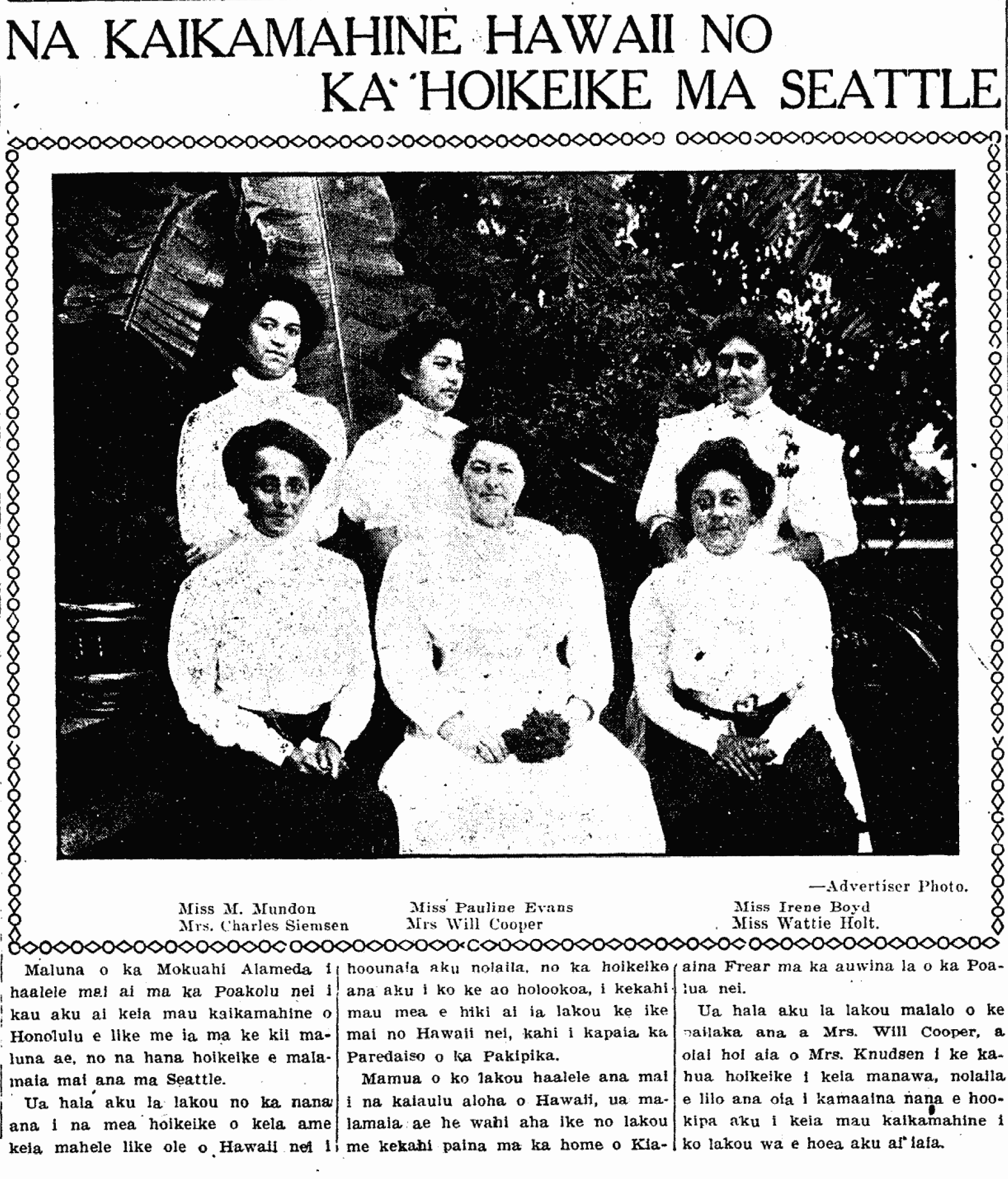
THE HAWAIIAN GIRLS HEADED TO THE EXPOSITION IN SEATTLE

—Advertiser Photo.

Miss M. Mondon  Miss Pauline Evans  Miss Irene Boyd

Mrs. Charles Siemsen  Mrs. Will Cooper  Miss Wattie Holt

It was aboard the steamship Almeda which left on Wednesday that these girls of Honolulu, as shown above in the picture, to go to the exposition being held in Seattle.

They went to go  view the various displays of Hawaii nei sent there to show the world some things from Hawaii nei, the place called the Paradise of the Pacific.

Before their leaving of the beloved community of Hawaii nei, there was held an audience with them along with a party at the residence of Governor Frear on the afternoon of this Tuesday.

They left under the care of Mrs. Will Cooper, and being that Mrs. Knudsen is already at the exposition ground, she will be the kamaaina there who will welcome these girls when they get there.

[See how much clearer the digital image available on Chronicling America is of the same picture in the Pacific Commercial Advertiser from the front page of 5/26/1909. Hopefully someday soon we will be able to rescan all of the Hawaiian-Language Newspapers to get the clearest images of not only the pictures, but of the text, so everything is clearly legible!]

(Kuokoa, 5/28/1909, p. 1)

NA KAIKAMAHINE HAWAII NO KA HOIKEIKE MA SEATTLE

Ka Nupepa Kuokoa, Buke XLVI, Helu 22, Aoao 1. Mei 28, 1909.

Kamehameha boys graduate, 1917.

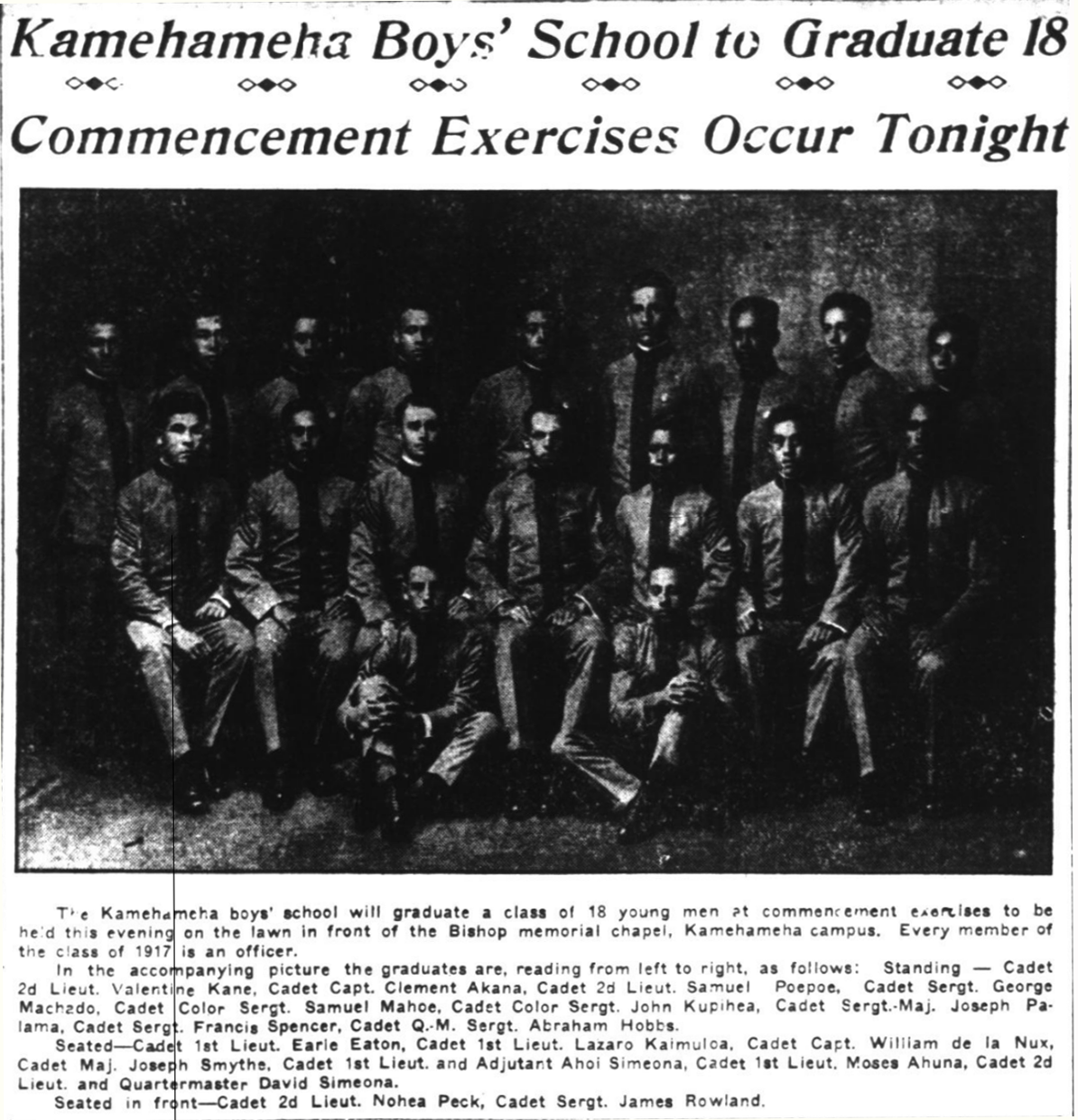
Kamehameha Boys’ School to Graduate 18 Commencement Exercises Occur Tonight

The Kamehameha boys’ school will graduate a class of 18 young men at commencement exercises to be held this evening on the lawn in front of the Bishop memorial chapel, Kamehameha campus. Every member of the class of 1917 is an officer.

In the accompanying picture the graduates are, reading from left to right, as follows: Standing—Cadet 2d Lieut. Valentine Kane, Cadet Capt. Clement Akana, Cadet 2d Lieut. Samuel Poepoe, Cadet Sergt. George Machado, Cadet Color Sergt. Samuel Mahoe, Cadet Color Sergt. John Kupihea, Cadet Sergt.-Maj. Joseph Palama, Cadet Sergt. Francis Spencer, Cadet Q. M. Sergt. Abraham Hobbs.

Seated—Cadet 1st Lieut. Earle Eaton, Cadet 1st Lieut. Lazaro Kaimuloa, Cadet Capt. William de la Nux, Cadet Maj. Joseph Smythe, Cadet 1st Lieut. and Adjutant Ahoi Simeona, Cadet 1st Lieut. Moses Ahuna, Cadet 2d Lieut. and Quartermaster David Simeona.

Seated in front—Cadet 2d Lieut. Nohea Peck, Cadet Sergt. James Rowland.

(Honolulu Star-Bulletin, 6/7/1917, p. 5)

Kamehameha Boys' School to Graduate 18...

Honolulu Star-Bulletin, Volume XXIV, Number 7847, Page 5. June 7, 1917.