Death of Mary Ann Kaaumokulani Kinoole Pitman Ailau, 1905.

DIED.

AILAU—In Hilo, Hawaii. February 11, 1905. Mrs. Mary Ann Kaaumokulani Kinoole Pitman Ailau, daughter of the High Chiefess Kinoole and the late Benjamin Pitman, and widow of John Keakaokalani Ailau, aged 67 years.

Mrs. Ailau was known from one end of the group to the other, and in Boston and many of the Atlantic watering places.

She was born at Hilo 67 years ago, and with the exception of a number of years spent in Boston and New England completing her education, she always resided in the islands. She was a daughter of Benjamin Pitman a capitalist, who resided both in Hilo and Honolulu. The Pitman home was at the corner of Alakea and Beretania streets, on the site now occupied by the C. Q. Yee Hop building.

The Pitmans came here from Boston, where they were well connected. Mrs. Ailau’s father-in-law also resided here for a number of years. Her father married the High Chiefess Kinoole, daughter of the High Chief Hoolulu. Continue reading

Kamehameha School graduation, 1893.

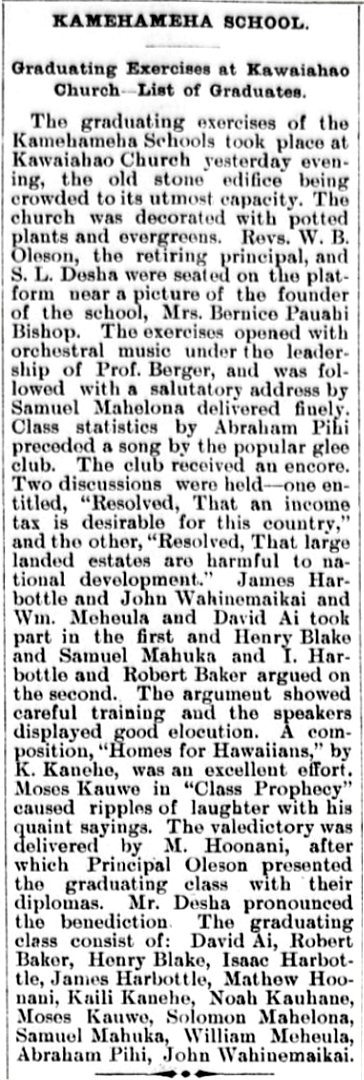
KAMEHAMEHA SCHOOL.

Graduating Exercises at Kawaiahao Church—List of Graduates.

The graduating exercises of the Kamehameha Schools took place at Kawaiahao Church yesterday evening, the old stone edifice being crowded to its utmost capacity. The church was decorated with potted plants and evergreens. Revs. W. B. Oleson, the retiring principal, and S. L. Desha were seated on the platform near a picture of the founder of the school, Mrs. Bernice Pauahi Bishop. The exercises opened with orchestral music under the leadership of Prof. Berger, and was followed with a salutatory address by Samuel Mahelona delivered finely. Class statistics by Abraham Pihi preceded a song by the popular glee club. The club received an encore. Two discussions were held—one entitled, “Resolved, That an income tax is desirable for this country.” and the other, “Resolved, That large landed estates are harmful to national development.” James Harbottle and John Wahinemaikai and William Meheula and David Ai took part in the first and Henry Blake and Samuel Mahuka and I. Harbottle and Robert Baker argued on the second. The argument showed careful training and the speakers displayed good elocution. A composition, “Homes for Hawaiians,” by K. Kanehe, was an excellent effort. Moses Kauwe in “Class Prophecy” caused ripples of laughter with his quaint sayings. The valedictory was delivered by M. Hoonani, after which Principal Oleson presented the graduating class with their diplomas. Mr. Desha pronounced the benediction. The graduating class consist of: David Ai, Robert Baker, Henry Blake, Isaac Harbottle, James Harbottle, Matthew Hoonani, Kaili Kanehe, Noah Kauhane, Mose Kauwe, Solomon Mahelona, Samuel Mahuka, William Meheula, Abraham Pihi, John Wahinemaikai.

[Here is a picture of the class of 1893 found on the Kamehameha Schools Archives page. Some names given on the Archives page are not the same as found here.

Here is perhaps a more detailed article on the graduation appearing in the Hawaiian Gazette.

Yet another article in the Pacific Commercial Advertiser.

And this as well.

Also, see this touching follow up post on one of the graduates, Abraham Pihi!]

(Daily Bulletin, 6/16/1893, p. 3)

KAMEHAMEHA SCHOOL.

The Daily Bulletin, Volume V, Number 754, Page 3. June 16, 1893.

Charles Nakao, survivor of the Aztec, writes home to Hawaii, 1917.

HAWAIIAN SURVIVOR OF AZTEC TELLS HIS STORY IN LETTER TO THE STAR-BULLETIN

A MESSAGE from a Hawaiian survivor of the steamship Aztec, sunk by a German submarine, came to the Star-Bulletin in yesterday’s mail from Brooklyn, New York.

Charles Nakao in a letter to this paper tells how some of his comrades were lost in trying to launch a lifeboat, and of the suffering of those on the wintry sea. Five Hawaiians were among those who perished, and a few weeks ago the legislature held a public memorial in their honor.

The letter says:

“Brooklyn, New York, April 26, 1917.

“Dear Sir: I, Chas. Nakao, was one of the members of the crew of the S. S. Aztec which was the first American vessel armed with two three-inch guns. Number of crew was 49, including 12 navy gunners and an officer of the U. S. S. Dolphin. We sailed from New York March 18, 1917, and were torpedoed by a submarine April 1, 1917, Sunday night, at 9:30 o’clock, off the coast of France. It was very stormy weather, the seas were about 30 feet in height and the current from English channel was running about 7 miles an hour. It were dark hail storm and were impossible to launch any lifeboat over the weather side. Seven of the crew got excited and try to launch the boat No. 2, which were on the weather side they were all smashed between the life boat and the ship side one of the boys were from Honolulu, Ekela Kaohi, the other were Chinese boy from Puna Pahoa Henry Look. No. 3 boat there were Hail Rice of Honolulu, Chas. Pumoku, Julian Makama of Honolulu, one from Tahiti Islands, John Davis. I were on board the No. 1 boat which I suppose to be the gunners’ boat. There were 19 of the crew on board. The vessel had sunk within 15 minutes it took 9 minutes because we were away from the ship side. After we were probably about 100 yards away some one gave four long blasts. Nobody knows how it happened. After four hours and a half in lifeboats on the high seas and hail storms and rain and darkness we were sighted by a French patrol boat. We had signaled to the boat with flashlights. They got full speed away from us. The second one had passed by and we lighted a torch and they came and picked us up. The temperature of the water was 40 degrees and I didn’t have any shoes or hat on. I was frozen and could hardly speak for about two hours after we got picked up. It was 1:30 o’clock in the early Monday…

Charles Nakao, survivor of the torpedoed Aztec

…morning and we had looked around for about 18 hours for the other boat. There were know sign whatsoever. So we landed at Brest, France, the American consul came and met us at the dock and over 6 hundred Frenchmen were treated fine. I got warm and were send to Brest hospital. From Brest we were send to Bourdeaux, France, about 48 hours ride train.

“We got on board the S. S. La Tourine, the French passenger boat from Bourdeaux, and we got back to New York safe.

“I remain yours truly,

CHAS. NAKAO,

Waiakea, Hilo, Hawaii.

“If any of boys’ family wants to get any information about the clothes or anything else please sent me your address and I will try my best to send it over. This is my address: Chas. Nakao, 324-32th street, Brooklyn, New York.

“P. S.—Thinking our Queen for her kindly remembrance to us boys off the ill-fated S. S. Aztec.

“Yours sincerely,

“C. N.”

[This article seems to be summarized in the Kuokoa of Iune 1, 1917, p. 5]

(Honolulu Star-Bulletin, 5/9/1917, p. 1)
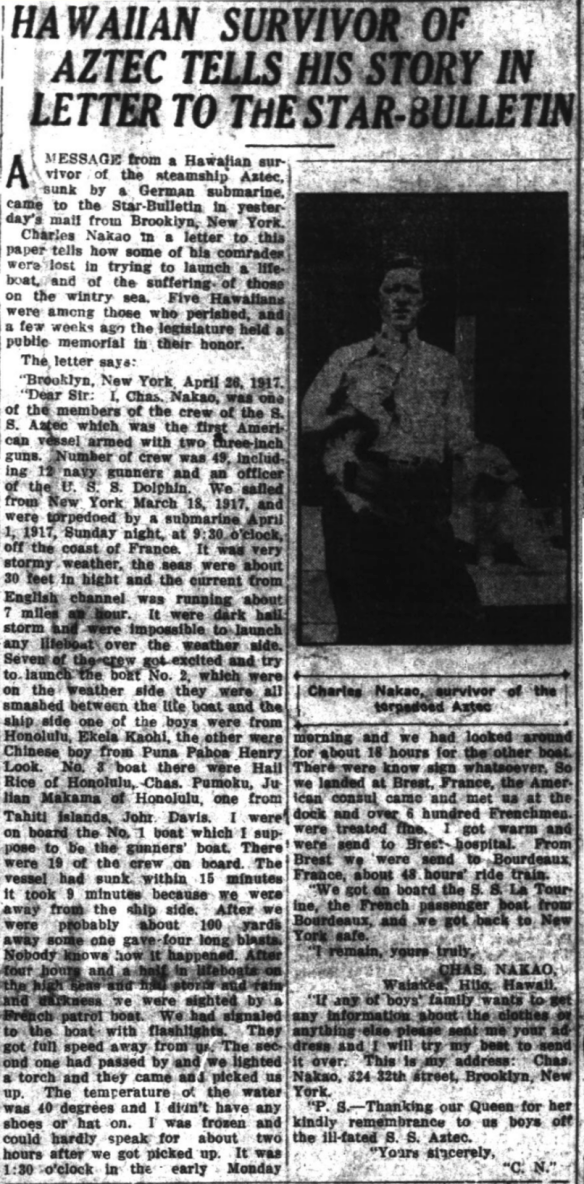
HAWAIIAN SURVIVOR OF AZTEC TELLS HIS STORY IN LETTER TO THE STAR-BULLETIN

Honolulu Star-Bulletin, Volume XXIV, Number 7822, Page 1. May 9, 1917.

Island Princesses, 1908.

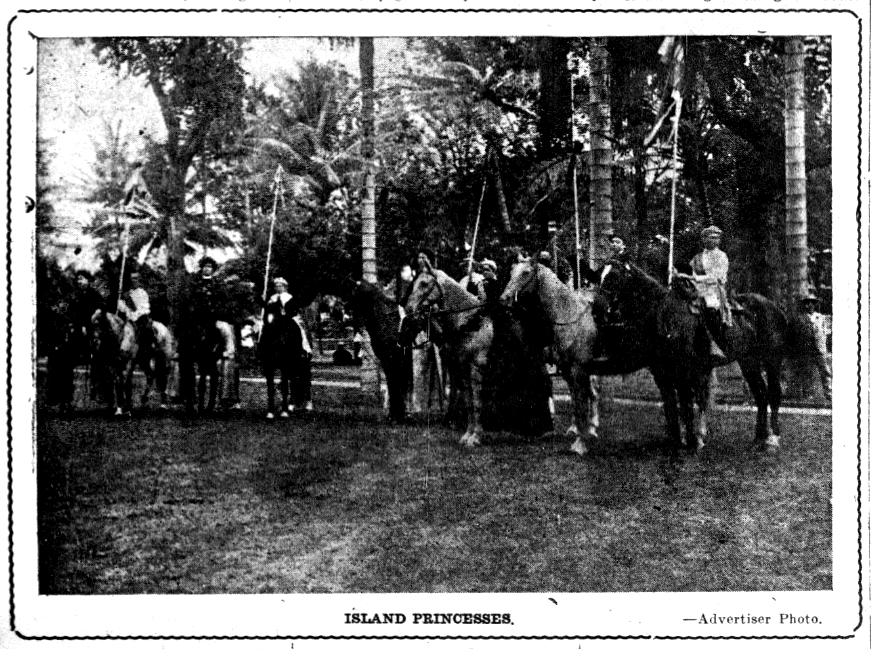
ISLAND PRINCESSES.

ISLAND PRINCESSES.

Pacific Commercial Advertiser, Volume VI, Number 269, Page 2. February 23, 1908.

THE PA-U RIDERS.

Thirty-four pa-u riders came cantering along in four sections of color: yellow, red, orange and pink, led by Judge Andrade and Mrs. Puahi. The Kaonohiokala Club sent fifteen horse women and the Wakinekona Club eighteen equestiennes. A brave sight they made with their long pa-us fluttering in the breeze and their garlands showing bright in the sunshine.

Several of the older riders were in the parade, ladies who wore the pa-u in the pleasure-loving days of the monarchy. Very dignified were these elderly dames and very well they rode. The younger women were out for fun and they certainly had it, galloping wherever there was room to and urging their steeds on with merry shouts. The riders included the following from the Kaonohiokala Club: Mrs. Puahi, Mrs. Kaumaka, Mrs. Dias, Mrs. Kaluapapakini, Mrs. Kailianu, Mrs. Nakapaahu, Mrs. Irene Silva, Mrs. Kauwa, Mrs. Haalou, Miss Lucy Woodward, Mrs. M. Hoonani, Mrs. Maluae, Mrs. Anehilo Keama, Mrs. Stahle, Mrs. Johnson; and the following members of the Wakinekona Club: Mrs. Horn, Mrs. Kapio, Mrs. Liau, Mrs. Aiwohi, Mrs. Jackson, Mrs. Pumehia, Mrs. Mahi, Mrs. Isaac, Mrs. Fairman, Mrs. Kekuewa, Mrs. Kapulani, Mrs. Tuck Williams, Miss Kekua, Miss M. Hao, Mrs. Emakai, Miss Marie Hiram, Miss Julia Lui, Miss Mary Wood. Continue reading

More pāʻū riders, 1909.

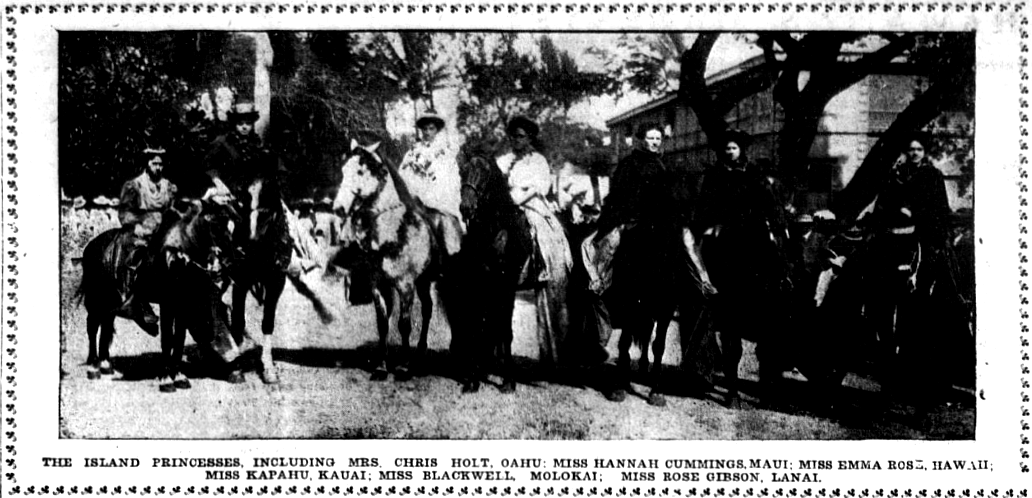
THE ISLAND PRINCESSES, INCLUDING MRS. CHRIS HOLT, OAHU; MISS HANNAH CUMMINGS, MAUI; MISS EMMA ROSE, HAWAII; MISS KAPAHU, KAUAI; MISS BLACKWELL, MOLOKAI; MISS ROSE GIBSON, LANAI.

(Hawaiian Gazette, 2/23/1909, p. 5)

THE ISLAND PRINCESSES...

Hawaiian Gazette, Volume LI, Number 120, Page 5. February 23, 1909.

Hawaiian Hotel on Hotel Street, 1899.

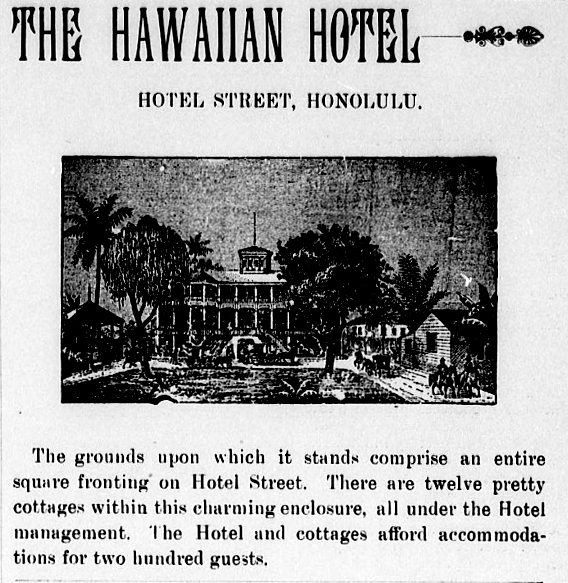
THE HAWAIIAN HOTEL

HOTEL STREET, HONOLULU.

The grounds upon which it stands comprise an entire square fronting on Hotel Street. There are twelve pretty cottages within this charming enclosure, all under the Hotel management. The Hotel and cottages afford accommodations for two hundred guests.

(Austin’s Hawaiian Weekly, 6/24/1899, p. 11)

THE HAWAIIAN HOTEL

Austin’s Hawaiian Weekly, Volume I, Number 2, Page 11. June 24, 1899.

Bonin Islands and Hawaiians abroad, 1830 / 2014.

ADVENTURERS IN HAWAII WENT TO SETTLE BONIN ISLANDS IN 1830

Historical Work Soon to Be Published Will Contain Letters From Honolulans

New and interesting facts concerning the conditions and history of the Hawaiian Islands during the first few decades of last century are promised in a history of the Bonin Islands which will be published in October by Constable London.

One feature is the tale of how the British consul in Honolulu in 1830 sent out a band of colonists to settle the Bonin Islands an attempt at colonizing the tiny archipelago for the British Empire which was destined to failure, for the islands now belong to Japan.

The book is by Rev. L. B. Cholmondeley, honorary chaplain of the British embassy at Tokio, who was for many years in charge of the mission at the Bonin group, and has since made frequent visits there. Continue reading

Democratic candidates, 1910.

W. S. EDINGS, For Senator

M. E. SILVA, For Supervisor

E. K. RATHBURN, 4th District

SOLOMON MEHEULA, For Representative, 4th District

W. P. JARRETT, For Sheriff

CHARLES H. ROSE, For Deputy Sheriff of Honolulu

H. H. PLEMER, For Supervisor

WADE WARREN THAYER, For City and County Attorney

F. COSTA BENEVEDES, For Representative, 4th District

J. S. KALAKIELA, For Senator

W. M. McCLELLAN, For Supervisor

E. H. F. WOLTERS, For Representative, 4th District

J. C. ANDERSON, For Auditor

EDWARD HANAPI, For Senator

FRED TURRILL, For Representative, 4th District

M. C. PACHECO, For Supervisor

[This is an interesting group of Democratic candidates for the race in 1910.]

(Democrat, 11/5/1910, p. 4)

PAGE 4

The Democrat, Volume I, Number 11, Page 4. November 5, 1910.

John G. M. Sheldon passes away, 1914.

SUDDEN DEATH OF J. G. M. SHELDON

John G. M. Sheldon, brother of Henry Sheldon, of Lihue, and Wm. J. Sheldon, formerly of Waimea, died in Honolulu of hemorrhage last Friday morning. He had been in rather poor health for several years. Henry Sheldon left by the Kinau Saturday for Honolulu to attend the funeral, which took place Sunday afternoon.

Mr. Sheldon was one of the oldest printers in the Islands, having begun work as such when quite young. Being proficient in both the English and Hawaiian languages, he was frequently employed as interpreter in the courts and elsewhere. He had many friends by whom he was well liked.

(Garden Island, 3/31/1914, p. 1)

SUDDEN DEATH OF J. G. M. SHELDON

The Garden Island, Volume 10, Number 12, Page 1. March 31, 1914.

Kahikina Kelekona, John G. M. Sheldon, editor of the Hawaii Holomua, arrested for speaking, 1893.

LIBERTY OF THE SUBJECT.

Has Anybody Any Rights Under the Provisional Government?

Argument of the Question in the Circuit Court.

John G. M. Sheldon, editor of the Holomua, who is deprived of his liberty under a warrant issued by the President of the Provisional Government, was produced in the First Circuit Court before Judge Frear, at 11 o’clock this forenoon, under a writ of habeas corpus. Attorney-General Smith and F. M. Hatch appeared for the Government, and C. W. Ashford, C. Creighton, A. Rosa and J. L. Kaulukou for the prisoner.

Mr. C. W. Ashford argued for the discharge of the prisoner, speaking to the following effect: There was no authority vested in the Executive and Advisory Councils to issue warrants of arrest. President Dole had no right in the Proclamation of the Provisional Government to issue a warrant of arrest. The Government could not go behind that proclamation, he presumed. “We the People of the Hawaiian Islands” gave him no such power. If “We the People of the Hawaiian Islands” had intended to exercise that power they would have given it to him. The Proclamation stated that the President’s duties were to preside over the meetings of the Executive Council. Mr. Dole now holds no judicial position in these islands. He did hold such position before, but resigned it to become President of the Provisional Government. If that warrant, of President Dole was valid, then there was no security of liberty for any man, woman or child under these tropic skies. There was then nothing to prevent any resident of this country being consigned to a dungeon or bound in irons. It should be known whether the Provisional Government had such tremendous powers. He was not making a covert attack on the late revolution. He believed in the sacred right of revolution, and he considered the late revolution was a good thing. But it might not be good if the Provisional Government introduced anarchy and despotism. Some persons were led by their philosophy to believe that a beneficent despotism was the best form of government, and he believed that members of this school of philosophy had seats in the Advisory Council. Continue reading