Queen Emma baptized, 1862.

[Found under: “NA MEA HOU O HAWAII NEI.”]

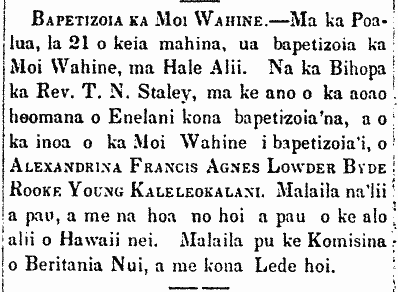
The Queen Baptized.—On Tuesday, the 21st of this month, the Queen was baptized at the Palace [Hale Alii]. Bishop Rev. T. N. Staley performed the baptism in the fashion of the Anglican faith, and the name of the Queen that she was baptized with is Alexandrina Francis Agnes Lowder Byde Rooke Young Kaleleokalani. Present were all the alii and the friends of the royal court of Hawaii nei. There as well was the Commissioner of Great Britain and his Wife as well.

(Kuokoa, 10/25/1862, p. 2)

Bapetizoia ka Moi Wahine.

Ka Nupepa Kuokoa, Buke I, Helu 48, Aoao 2. Okatoba 25, 1862.

Lucy Kaheiheimalie Peabody Henriques has gone on, 1928.

MUCH ALOHA FOR THAT ALII WHO WAS FULL OF ALOHA

That chiefess born of the land, Mrs. Lucy Kaheiheimalie Peabody Henriques has gone. She was loved by all of us, and she was a precious one among the people. She was going silently away these past weeks. Aloha with unending tears. She went to see the sacred bosom of Kane. The rejected flowers were strewn at Wailua [?? Ua ahu iho la na pua wahawaha i Wailua]; she left grieving behind, her beloved lei, her daughter, Kalanikiekie Henriques. Continue reading

Hawaii at the Great London Exposition, 1862.

The Sandwich Islands.—During the last few days a stall has been fitted up near the department of the Ionian Islands which represents the latest and most distant echo in response to the invitation given to all nations and peoples to exhibit their natural and artificial products under the domes of South Kensington. The Hawaiian, or, as they are better known, the Sandwich Islands, were unrepresented in 1851, owing to the collection made there not reaching England till the Exhibition had finally closed, the voyage by a sailing vessel occupying five or six months. This year a similar fate threatened this remote group in the Pacific, and it seemed likely that the name of Hawaii would only be known in connexion with the International Exhibition of 1862 by a pair of silk banners in the nave, and a foreign commissioner with nothing to do. Continue reading

Episcopal Church in Hawaii, 1861.

[Found under: “NOTES OF THE WEEK.”]

We are frequently inquired of whether anything definite has been done towards establishing an Episcopal Church at Honolulu. By the following, which we extract from the London Examiner of March 9, our readers will be gratified to learn that the matter is in progress and has been referred to a committee consisting of responsible and intelligent men, who will probably see that it is carried to a successful issue. It will be a source of great pleasure not only to us but to all interested in the progress of religion in the Pacific, to announce that the establishment of an Episcopal Church here, has been fully decided upon: Continue reading

More on Lady Franklin and ahuula and upcoming events, 1861 / 2015–2016.

While in Hawaii in 1861, Lady Franklin enjoyed the company often of King Kamehameha IV and Queen Emma. According to newspaper reports, the relationship between them was very cordial. She was given this treasured ahuula in commemoration of this bond.

If you find yourself in San Francisco at the end of this summer until the early part of next year (8/29/2015–2/28/2016), do make your way to the de Young Museum:

Lady Franklin cape

Lady Franklin cape (detail) (#5948). ‘apapane feathers, ‘ō‘ō feathers. Bernice Pauahi Bishop Museum, Ethnology Collection, 09670/1909.007

Royal Hawaiian Featherwork: Nā Hulu Ali‘i

August 29, 2015February 28, 2016

Explore the distinctive art, culture, and history of Hawai‘i with the first exhibition of Hawaiian featherwork on the U.S. mainland, developed in partnership with the Bernice Pauahi Bishop Museum, Honolulu. Presented in San Francisco, which is considered to be the gateway to the Pacific, the exhibition will feature approximately 75 rare and stunning examples of the finest featherwork capes and cloaks in existence, as well as royal staffs of feathers (kāhili), feather lei (lei hulu manu), helmets (mahiole), feathered god images (akua hulu manu), and related eighteenth- and nineteenth-century paintings and works on paper. Continue reading →

Queen Emma, 25th birthday, 1861.

Birthday of the Queen.

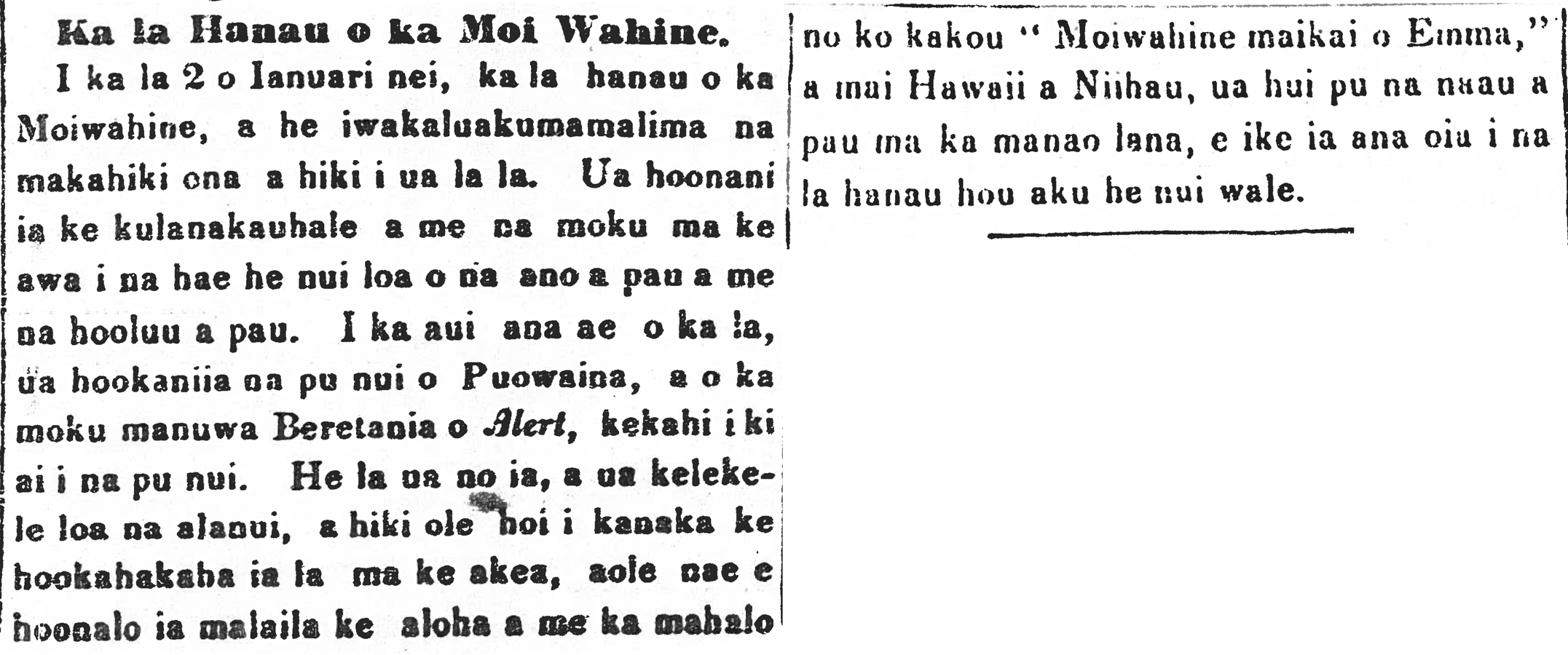
This past 2nd of January was the birthday of the Queen, and she made twenty-five years old that day. The town and ships at port were decorated with many flags of all sorts and colors. When the sun began it descent, the great artillery at [the fort of] Puowaina was sounded, and the British warship, Alert, also shot off its cannons. It was a rainy day, and the streets were very muddy, so the people were not able to parade in public, however, this did not cause the love and appreciation for our “good Queen Emma” to wane, and from Hawaii to Niihau, our hearts are as one in our hope that she will see many a more birthday.

(Hae Hawaii, 1/9/1861, p. 168)

Ka la Hanau o ka Moiwahine.

Ka Hae Hawaii, Buke V, Ano Hou.—-Helu 42, Aoao 168. Ianuari 9, 1861.

Queen Emma, Honolulu Library and Reading Room, and the Hawaiian Historical Society, 1886 / 2014.

[Found under: “LOCAL NEWS”]

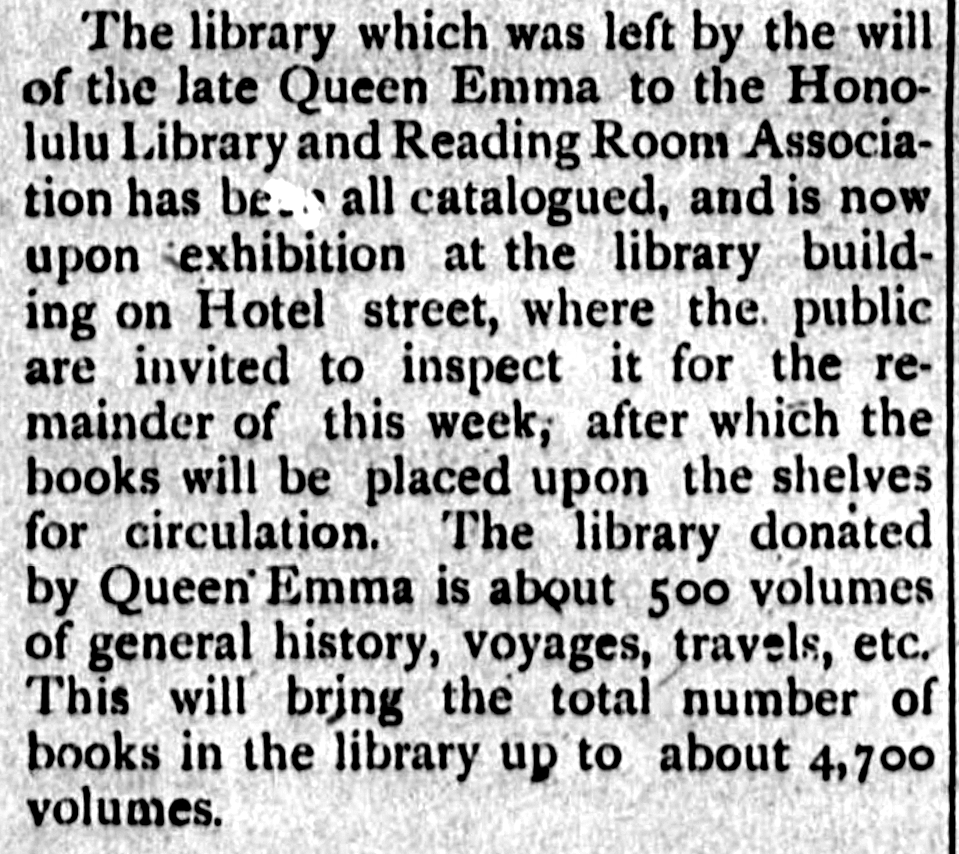
The library which was left by the will of the late Queen Emma to the Honolulu Library and Reading Room Association has been all catalogued, and is now upon exhibition at the library building on Hotel street, where the public are invited to inspect it for the remainder of this week, after which the books will be placed upon the shelves for circulation. The library donated by Queen Emma is about 500 volumes of general history, voyages, travels, etc. This will bring the total number of books in the library up to about 4,700 volumes.

[Queen Emma’s books eventually found their way to the Hawaiian Historical Society, where they are cared for today!]

(Daily Honolulu Press, 1/12/1886, p. 3)

The library which was left by the will of the late Queen Emma...

The Daily Honolulu Press, Volume I, Number 113, Page 3. January 12, 1886.

Queen Emma on Kauai, 1871.

The Queen’s Travels to the Island to the West.

O Ke Au Okoa;—Aloha oe:

At 3 o’clock yesterday afternoon, Lawai was left by the entourage of

“Maikai ka Waikini he nani ke nana,
Ka hemolele oia uka me ke onaona,
Ua hele a nolu pe i ka lehua maka noe,
Ua ike maka iho nei i ka nani o Aipo.”

[Fine is Kawaikini, beautiful to see,
The uplands are perfect in its fragrance,
The misty-eyed lehua are drenched
Beheld was the beauty of Aipo.]

The travels of Kaleleonalani continued on into dusk; the good home of the Hon. J. Kauai in Waimea nei was visited, and he gave them the entire house for the alii to do as she pleased. That is the fashion in which the well-to-do son of Waimea gave. Continue reading

Tahitian mele for La Kuokoa, 1861.

Songs of Polapola

Aue oe tau hoa hele e,
E fiteri tou e,
Tai ta pea ta te fa tu,
O Iesu ta haa maitai.

Eau ia oe te oa oa,
Eau ia oe te haa maitai,
Ia oe nae te fei a haa wale,
I loto i te au ahi oia nae.

Aue oe e ta Moi e,
He aroha to oe,
Mai horoa i te hau ia Mareta,
E ta pea maitai.

Iaorana oe e ta Hatu o Hawaii,
Tai haapao ia tai haapao hia,
E mono i tooe toloa.

Iaorana oe e Ema,
Te Alii Vahine e,
Faatere maitai to otou haue,
E mau te ora o te Alii e amuri no atu.

Auwe oe tou hoa he re e,
Pi te ri tou e tei ta pea i ta te fatu,
Oietu te parau maitai,
eau ia oe te oaoa,
Eau ia oe te haa maitai,
Ia oto nae te feia faa vare,
I roto o te au ahi oia nae.

Auwe oe e ta Moi e,
E aroha to oe e,
Mai ho roa i te hau,
Ia Amerita,
E ta pea maitai mai,
Iaorana oe e ta Hatu Hawaii e,
Tei haa pao hia i mano to oe to roa,
Iaorana oe e Ema te Rii vahine e,
Faa te re maitai to otou hau,
E mau te aroha o te Rii e,
Ea muri noatu.

Himeni 27.

1 Te ra, te aoae, te fetia,
Maramarama ai te ao,
Maitai atoa ai te po,
Na te Atua i faaue iho,

2 Ia ara, e ia moe tatou,
Te merahi maitai tei mau,
To ratou tiai ia tatou,
Aore e ino i roohia mai.

3 Te rai anaana i nia ae,
Te aihere rii i raro nei,
Te miti atoa e ati ae,
Na te Atua i hamani.

4 Te puapua, noanoa,
Unauna ai te raau nei,
Te raau maa na tatou a,
Na te Atua i horoa mai.

5 Te ata i pee, te ua i pou,
Te matai farara e oraʻi,
Te manu, i rere nei,
Te mau puaa nana anae,

6. Te ia e tere i te tai,
Tei nee i raro i te repo,
Tatiou atoa te taata nei,
Ohipa na te Atua mau.

7 Ia hamanihia ra tatou
Ia hau tu teie i te maitai,
E ia ra oe ta te Arii parau,
Ma te aau au i a rue ai.

[These are some of the mele performed on the 28th of November, 1861, at Kawaiahao Church in celebration of Independence Day.

For more Tahitian mele, see this composition of Ninito and Manaiula Sumner for Victoria Kaahumanu from 1862.]

(Kuokoa, 12/2/1861, p. 2)

He Mele Polapola.

Ka Nupepa Kuokoa, Buke I, Helu 4, Aoao 2. Dekemaba 2, 1861.

Death of Mary Ann Kaaumokulani Kinoole Pitman Ailau, 1905.

DIED.

AILAU—In Hilo, Hawaii. February 11, 1905. Mrs. Mary Ann Kaaumokulani Kinoole Pitman Ailau, daughter of the High Chiefess Kinoole and the late Benjamin Pitman, and widow of John Keakaokalani Ailau, aged 67 years.

Mrs. Ailau was known from one end of the group to the other, and in Boston and many of the Atlantic watering places.

She was born at Hilo 67 years ago, and with the exception of a number of years spent in Boston and New England completing her education, she always resided in the islands. She was a daughter of Benjamin Pitman a capitalist, who resided both in Hilo and Honolulu. The Pitman home was at the corner of Alakea and Beretania streets, on the site now occupied by the C. Q. Yee Hop building.

The Pitmans came here from Boston, where they were well connected. Mrs. Ailau’s father-in-law also resided here for a number of years. Her father married the High Chiefess Kinoole, daughter of the High Chief Hoolulu. Continue reading