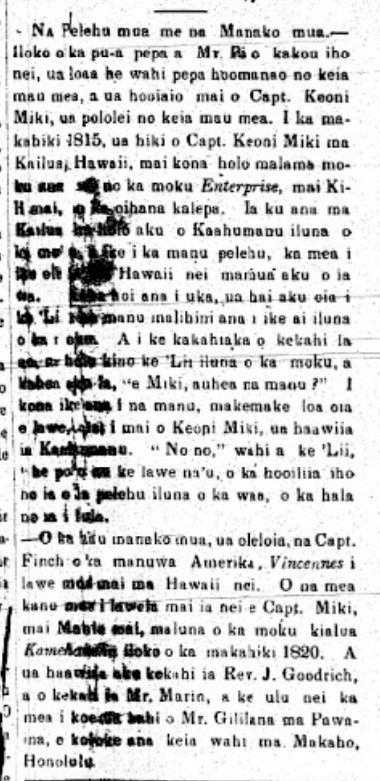
The first turkeys and mangoes.

The first Turkeys and the first Mangoes.–In the sheaves of paper belonging to our Mr. ???, there was a memo pertaining to these things, and Captain John Meek [Capt. Keoni Miki] confirmed the information. In 1815, Capt. John Meek arrived in Kailua, Hawaii, as a mate of the ship Enterprise, from Chili, on a trading voyage. When he landed in Kailua, Kaahumanu boarded the ship and saw the turkeys, which were not seen here in Hawaii before that. She went back to shore and told the King about the unfamiliar birds she saw on the ship. In the morning of some following day, the King boarded the ship in person and called out, “O Miki, where are the birds?” When he saw the birds, he very much wanted to take them, but John Meek said that they were given to Kaahumanu. “No, no,” said the King, “I should take them for myself.[“] They were placed upon a canoe and taken ashore.

The first mango tree, it is said that it was Capt. Finch of the American warship Vincennes who first brought it to Hawaii nei. The first plants imported by Capt. Meek from Manila [Mania], were aboard the double-masted Kamehameha in 1820. Some were given to Rev. J. Goodrich, and some to Mr. Marin, and the others are growing at Mr. Gilliland’s place at Vineyard; this place is near Makaho, Honolulu.

(Ko Hawaii Ponoi, 6/18/1873, p. 2)
Ko Hawaii Pae Aina, Buke I, Helu 1, Aoao 2. Iune 18, 1873.

Translations of Manini, Francisco de Paula Marin, 1838.

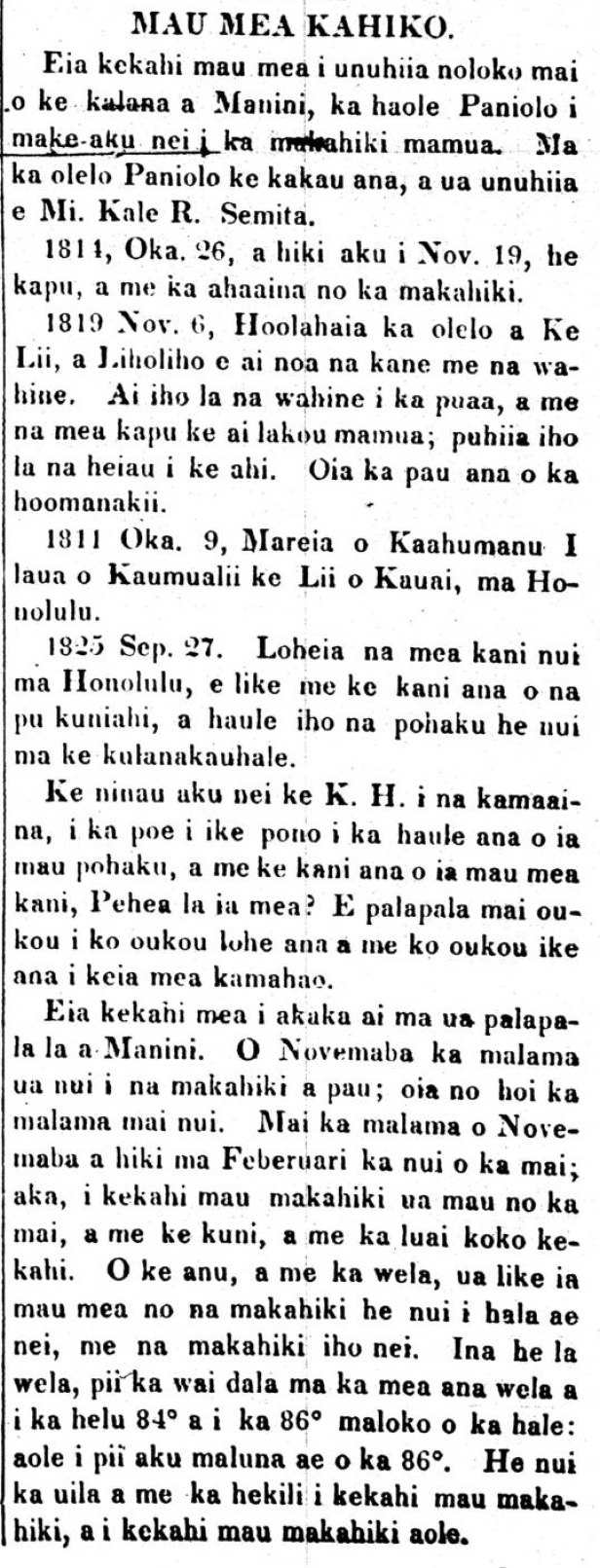
SOME OLD THINGS.

Here are some things translated from the writings of Francisco de Paula Marin [Manini], the Spanish haole who died the previous year. The writing was done in Spanish, and they were translated by Mr. Charles R. Smith [Mi. Kale R. Semita].

1814, Oct. 26, until Nov. 19, there was a kapu, and a feast for the Makahiki.

1819, Nov. 6, The word of the King, Liholiho, that the men and women would eat freely. The women ate pig, and other foods that were kapu to them previously; the heiau were burned down. It was the end of idolatry [hoomanakii].

1811, Oct. 9, Kaahumanu I was married to Kaumualii, the King of Kauai, at Honolulu.

1825, Sep. 27. There was a great noise heard in Honolulu, like the sound of canons; there were a lot of rocks which rained down upon the town.

Ke Kumu Hawaii newspaper asks the kamaaina, the ones who witnessed the falling of these rocks, and the sound of it [falling]. What was this like? Write to us how it sounded to you and how this amazing thing appeared to you.

Here is another thing that was clear through those writings of Manini. November is the month that there is much rain every year, and that is the month when there is much sickness. From the month of November to February there is much sickness; but some years, the sicknesses go on, along with fever, and also vomiting blood. Cold and heat, they are the same as many years before, as well as recent years. If it is a hot day, the mercury rises in the thermometer to 84° to 86° indoors; it does not go above 86°. There is much lightning and thunder some years, and in others there is none.

(Kumu Hawaii, 12/5/1838, p. 55)

Ke Kumu Hawaii, Buke 4, Pepa 14, Aoao 55. Dekemaba 5, 1838

[Found under: “KA MOOLELO O NA KAMEHAMEHA. Na S. M. Kamakau.”]

The year 1828 was famous for Kaahumanu going to Hawaii and retrieving Lilinoe on Mauna Kea, who was an ancient woman; a thousand and more years she was left on the mountain of Mauna Kea, according to her sworn statement. It was said that Lilinoe remained with body unspoiled, her hair remained affixed and had not fallen out. And should you want to see her descendants, they can be found by way of Huanuiikalailai; she became a kupuna of the alii, and came forth was Umiokalani, the son of Keawenuiaumi and Hoopiliahoe. But it was stated that Lilinoe was not found by Kaahumanu and that she was hidden away. Liloa, Lonoikamakahiki, Kauhoa, and Lole are the only ones who were found by Kaahumanu at Waipio, and they were brought to Kaawaloa. The alii in Hale o Keawe were from the ancestral chiefs to Kalaniopuu and Kiwalao. Hale o Keawe was filled with the bones of the alii, they were arranged and secured in kaai. They were taken to Kaawaloa and a majority of them were burned in fire. That is a very wicked example in Boti’s mind.

Here is another, Kaikioewa was indebt to Mikapalani [William French], that being the haole trader; the other alii were greatly indebted to him, but in his transactions he was a haole who was beyond reproach. The sandalwood that was thrown away by some haole traders were purchased by Mr. French, and therefore he was also called by the name Hapuku because of he indiscriminately gathered [hapuku] the white sandalwood as well as the very small branches, and he was relied upon by the alii and greatly liked; therefore, the alii were much indebted to him. Kaikioewa was one who was indebted, and because he had no sandalwood to pay his debt, therefore Kaikioewa paid his debt with the land of Kawalo [Kewalo] and Kulaokahua which went to Mr. French. So Mr. French prepared to build wooden structures at Kulaokahua adjacent to Waikiki where the Olohe sank.

(Kuokoa, 6/13/1868, p. 1)

Ka Nupepa Kuokoa, Buke VII, Helu 24, Aoao 1. Iune 13, 1868.

Death of Pilipo Naone, John K. Naone’s father, 1882.

PILIPO NAONE.

On the 16th of February past, Naone let out his last breath, and the man returned to his Lord whom he loved greatly, for whom he was a servant in many good works; Naone died at eighty or so years old. He was born up in Pauoa. His father was Mahi and his  mother was Hama [?? it is hard to read]; his parents were from Kauai and then resided in Pauoa; these parents had three children: Pokaakua, along with P. Naone and D. Lima; Pokaakua and Lima died ealier, and only Naone lived until old age, living for more than 80 years. Continue reading

The pillow mele for Kaahumanu, and the power of the newspapers, 1907.

One reason why the newspapers were/are so important was because they were “immediate,” just as I suppose Facebook and Twitter is today. One person claims something in the newspaper one day, and a few days later you could see more information or contradicting information by someone else, and not necessarily even in the same newspaper. Because people back in the day wanted the latest news, they would subscribe to the different newspapers being printed at the time, or at least would share them with each other. Continue reading

More on the death of Lilia Kaleikau, 1922.

KAUAI’S OLDEST WOMAN DIES AT THE AGE OF 96 YEARS

Lilia Davis Kaleikau, grandmother of Senator John Andrew Kealoha passed away at her home in Kapaa on Sunday morning at the ripe age of 96 years, and was probably the oldest living Hawaiian woman on Kauai at the time of her death. Continue reading

Kaumualii and Kaahumanu seek out Nihoa, 1868.

[Found under: “KA MOOLELO O NA KAMEHAMEHA.”]

Kaumualii built several large houses for Kaahumanu at Papaenaena. When Kaahumanu was staying on Kauai. A great desire grew within her to search for Nihoa, a land that was not known to the new generations. But Nihoa was found in the stories and the mele of the ole people. When Kaahumanu heard the chant of Kaweloamahunaalii. Continue reading

The death of Jonah Piikoi and his autobiography, 1859.

The death of J. Piikoi.

On the 26th of April, the Honorable J. Piikoi, one of the alii of this Hawaiian archipelago died. He was a much admired man for his competence and his determination in the duties given to him. He was 55 years old, and the sickness he died of was of quick pulse [? aalele nui], and problems with his blood flow, and he died.

Before the death of Piikoi, he prepared a story of his life, from his birth until the day he wrote it, that being the 7th of April. This is it below:

The Autobiography of J. Piikoi

I was born in the month of Ikuwa, that being January, in the year of the Lord 1804.

I was born in Waimea, Kauai, and that was where I was raised until the first Liholiho landed on Kauai on the 22nd of the month of  July, 1821. Continue reading