Great historian Samuel Manaiakalani Kamakau dies, 1876.

Hon. S. M. Kamakau has gone!

With sadness we announce the somber news before our friends this morning, of the passing of the spirit of the Hon. S. M. Kamakau at his home, leaving behind his earthly body. He died at 2 in the afternoon this past Tuesday [September 5th] at his home in Kahehuna. This famous Hawaiian was born in Ewa, at Mokuleia, Waialua, on Oahu, on the 29th of October, 1815. His father was Kapakanaka, the child of Kuhemu, the child of Haupu. His mother was Kaaoaoakahaiaka, daughter of Leihulu and Kaonohiakala. He wed his wife, S. Hai, who is grieving, at the sheltering breadfruit of Lele, Lahaina, on the 24th of November, 1844. During their days together living quietly, they had seven children, four who died and three still living. He was known by the lahui as one who kept the genealogies of the alii of Hawaii nei, and the history of this archipelago, and with his death, it is like Hawaii has been dealt with a great loss of an adviser in such things, being that it was as if he was the only one who reached such a rank.

He was a man that was proficient in governmental duties, he was employed in that capacity often, and he was a Representative for many sessions until he died, he being a Representative for this district. His name was famous in the newspapers with his thoughts on the history of the alii, and mostly for the history of Kamehameha I, and we believe that his death is a disaster for Hawaii. He was a man who thought much of the Bible, he was pious and lived righteously. He joined the Catholic faith recently because of his opposition to some things, however, he was devout in the word of God. He was 61 years old and 10 months. Yesterday, his earthly body was carried to its final home and there was a grand and stately funeral to be remembered hereafter. How sad!

(Lahui Hawaii, 9/7/1876, p. 2)
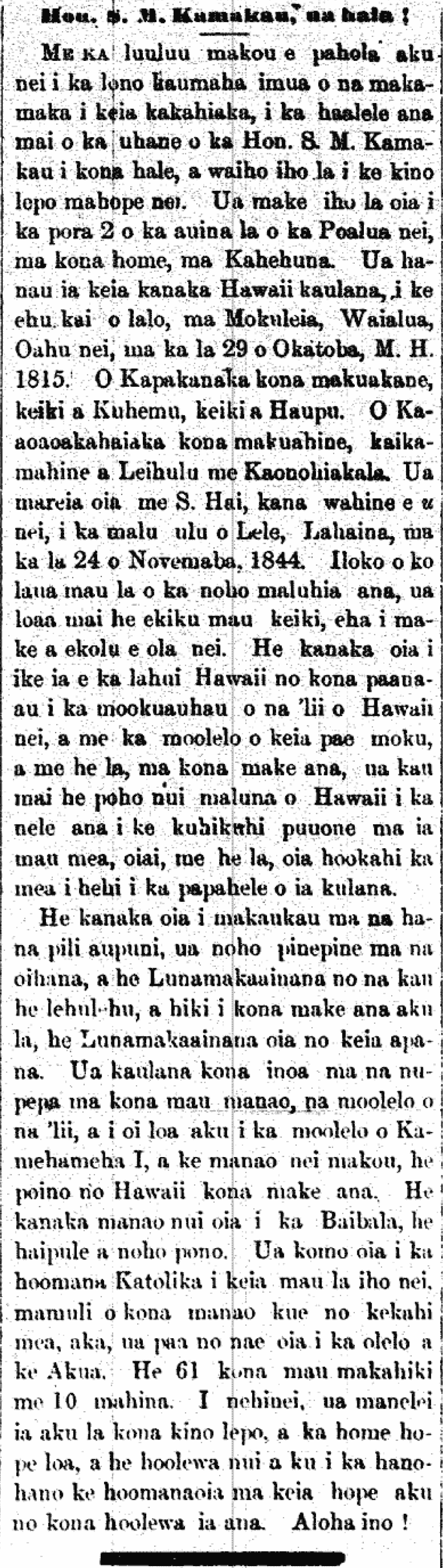
Hon. S. M. Kamakau, ua hala!

Ka Lahui Hawaii, Buke II, Helu 37, Aoao 2. Sepatemaba 7, 1876.
On Kaumualii and Kaahumanu, 1880.

[From: “Ka Moolelo o Kaahumanu”]

Kaahumanu was one of them who made a circuit of Maui, Oahu, and Kauai with Liholiho. When Kaahumanu arrived on Kauai, she took Kaumualii, the alii of Kauai, as a kane [husband] for herself. When Liholiho returned to Oahu, it was with Haakulou, the woman of Kaumualii; because Liholiho took Haakulou as a wahine [wife] for himself, along with his other wahine.

Kaahumanu lived on Kauai along with Kaumualii in the year 1822. Perhaps in the month of August.

Kaahumanu wanted to seek out Nihoa. It was the very first time that Nihoa was found, that tiny island to the North-West of Niihau. Continue reading

Celebrated historian Samuel Manaiakalani Kamakau passes away, 1876.

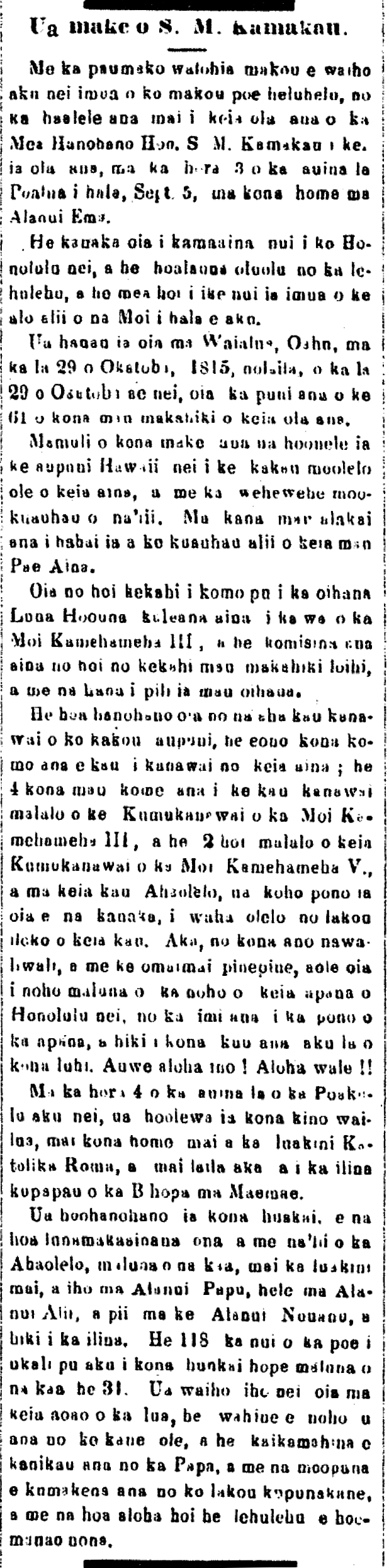
S. M. Kamakau Dies.

With heartfelt grief we put before you, our readers, news of the leaving of this life of the Honorable S. M. Kamakau, at 3 o’clock in the afternoon of this past Tuesday, Sept. 5, at his home on Emma Street.

He was a man greatly familiar to Honolulu’s people, and he was a good-hearted companion of the people, and he was someone that was seen often in the courts of the Monarchs past.

He was born in Waialua, Oahu, on the 29th of October, 1815, therefore, on the upcoming 29th of October, he would have made 61 years of this life.

As a result of his death, the nation of Hawaii is without a historian of this land, and an interpreter of genealogies of the chiefs. The alii genealogies of this archipelago follow his guidance.

He was a part of the board of commissioners to quiet land titles during the time of King Kamehameha III, and he was a commissioner of land surveying for many years, along with work associated with it.

He was an honorable member of the legislature of our kingdom; he joined this body six times to pass laws for this land; he was in 4 sessions under the Constitution of King Kamehameha III, and 2 under this Constitution of King Kamehameha V, and in this Legislative session, he was rightly chosen by his constituents as a spokesman for them in this session. But because of his infirmity, and his getting sick often, he did not sit in the seat of this district of Honolulu, to search for the good of the district, until he was freed from his weariness. Auwe, how sad! How pitiful!!

At 4 o’clock in the afternoon of this past Wednesday, a funeral was held over his body, from his home until the Roman Catholic Church, and from there to the cemetery of the Episcopalians at Maemae.

His procession was given honor by his fellow representatives, and the nobles of the Legislature, on cars, from the church and down Fort Street, onto King Street, and up Nuuanu Avenue until the cemetery. There were 118 people who accompanied his last journey in 31 cars. He has left behind on this side of the grave, a wife grieving over her lost husband, and a daughter mourning her Papa, and grandchildren bewailing their grandfather, along with the many friends reminiscing over him.

(Kuokoa, 9/9/1876, p. 2)

Ua make o S. M. Kamakau.

Ka Nupepa Kuokoa, Buke XV, Helu 37, Aoao 2. Sepetemaba 9, 1876.

Astronomy, 1909.

The Hawaiian Astronomy.

It is a great pity that David Malo, the Hawaiian Historian and Antiquarian, did not preserve in his “Moolelo Hawaii” or Hawaiian Antiquities, some account on Ancient Hawaiian Astronomy. S. M. Kamakau, a contemporary of David Malo, and also a writer on the Ancient History of Hawaii nei, is little better off, about this matter than his colleague. He wrote an article on “Instructions in Ancient Hawaiian Astronomy” and was published in the Nupepa Kuokoa of Aug. 5th, 1865. It was translated into English by Prof. W. D. Alexander for Maile Wreath (Lei Maile), and was republished by Mr. Thos. G. Thrum, in his “Hawaiian Annual” for 1890.

In the year 1885, we found in the monthly newspaper, “Ka Hoku o ke Kai,” that subject was treated again, only to last a very short time. And about twelve or thirteen years ago we again found certain very valuable statements pertaining to the Ancient History of Hawaii by Kanalu, said to be the priestly ancestor of the priesthood or order of Kanalu.

We saw in “The Journal of the Polynesian Society,” Vol. XVI, No. 2, an article on “Tahitian Astronomy” by Miss Teuira Henry. It treats the “Birth of the Heavenly Bodies.” It is very interesting.

In order to preserve these accounts relating to Hawaiian Astronomy, we give our English translation here, starting first from the account in Ka Hoku o ke Kai (1885).

In ancient times, the class of people studying the positions of the moon, the rising and setting of certain fixed stars and constellations, and also of the sun, are called the kilo-hoku or astrologers. Their observations of these heavenly bodies might well be called the study of astronomy. The use of astrology anciently, was to predict certain events of fortunes and misfortunes, victory or defeat of a battle, death of king or queen, or any high chief; it also foretells of pestilence, famine, fine or stormy weather and so forth.

The old Hawaiians knew some names of certain planets and several constellations. The names of planets are somewhat slightly different in corresponding English names, rendered by Andrews, Alexander and the late Dr. Bishop.

HAW. NAMES OF PLANETS ANDREWS. ALEXANDER. BISHOP.
1 Ukali Mercury Mercury Mercury
2 Hokuao
Hokuloa Venus Venus Venus
Mananalo
3 Holoholopinaau Mars Saturn Mars
4 Kaawela Venus (an evening star) Jupiter Jupiter
5 Naholoholo Saturn (See No. 3) Saturn

The Hawaiian name for Mars according to Prof. Alexander is Hokuula (red star). In the newspaper “Ka Hoku o ka Pakipika,” published about the year 1860, the name for the planet Saturn was Makalii, Kauopae for Jupiter and Polowehilani for Mars.

(To be Continued)

(Kuokoa Home Rula, 4/2/1909, p. 2)

The Hawaiian Astronomy.

Kuokoa Home Rula, Buke VII, Helu 14, Aoao 2. Aperila 2, 1909.

A New Year’s Gift: a Genealogy of Rulers, 1874.

A NEW YEAR’S GIFT.

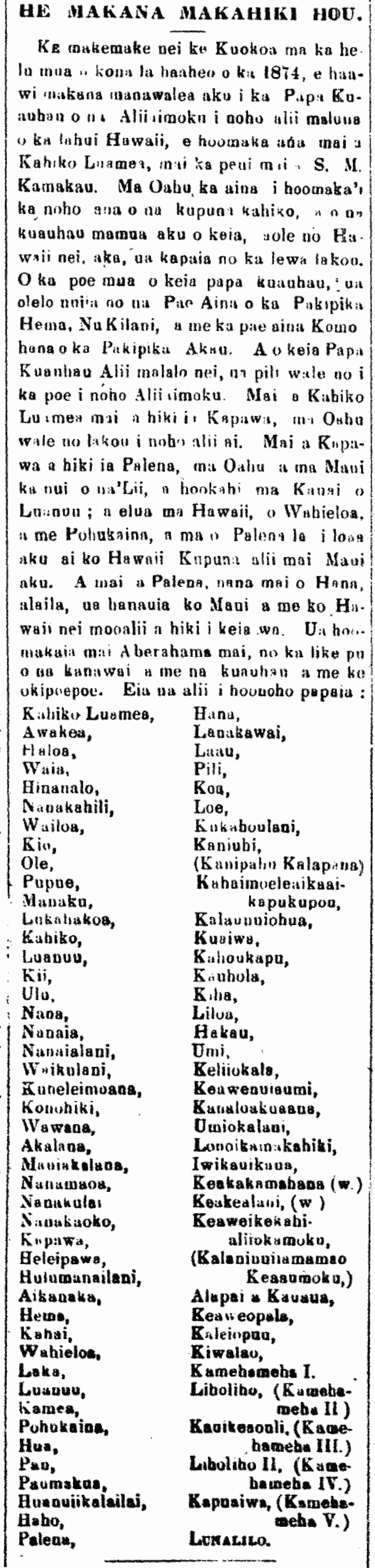
The Kuokoa, on this first issue of its proud days of 1874, wants to gift this Genealogical List of the Rulers over the Hawaian people, starting from Kahiko Luamea, from the pen of S. M. Kamakau. It was upon Oahu that the ancient ones first lived, and the genealogy from before this is not from here in Hawaii, but it is said that they were from the sky [lewa]. The first people in this genealogy, it is widely stated that they are from the Islands of the South Pacific, New Zealand, and the islands to the Western North Pacific. And the listing of Alii Genealogy below just pertains to those who were Aliiaimoku. From Kahiko Luamea to Kapawa, they just ruled on Oahu. From Kapawa to Palena, most of the Alii were on Oahu and Maui; one was from Kauai, Luanuu; and two on Hawaii, Wahieloa and Pohukaina; and from Palena is where Hawaii’s royal Ancestry from Maui come from. And from Palena was born Hana, thereafter Maui’s and Hawaii’s chiefly line have been born until this time. It began from Abraham, being that the laws were the same, the genealogy was the same, and the circumcision was the same. Here are the alii listed out:

Kahiko Luamea,
Awakea [Wakea],
Haloa,
Waia,
Hinanalo,
Nanakahili,
Wailoa,
Kio,
Ole,
Pupue,
Manaku,
Lukahakoa,
Kahiko,
Luanuu,
Kii,
Ulu,
Nana,
Nanaia,
Nanaialani,
Waikulani,
Kuheleimoana,
Konohiki,
Wawana,
Akalana,
Mauiakalana,
Nanamaoa,
Nanakulai,
Nanakaoko,
Kapawa,
Heleipawa,
Hulumanailani,
Aikanaka,
Hema,
Kahai,
Wahieloa,
Laka,
Luanuu,
Kamea,
Pohukaina,
Hua,
Pau,
Paumakua,
Huanuiikalailai,
Haho,
Palena,
Hana,
Lanakawai,
Laau,
Pili,
Koa,
Loe,
Kukahoulani,
Kaniuhu,
(Kanipahu Kalapana)
Kahaimoeleaikaaikapukupou,
Kalaunuiohua,
Kuaiwa,
Kahoukapu,
Kauhola,
Kiha,
Liloa,
Hakau,
Umi,
Keliiokala,
Keawenuiaumi,
Kanaloakuaana,
Umiokalani,
Lonoikamakahiki,
Iwikauikaua,
Keakakamahana (w [wahine])
Keakealani (w),
Keaweikekahialiiokamoku,
(Kalaninuiiamamao Keeaumoku),
Alapai a Kauaua,
Keaweopala,
Kaleiopuu,
Kiwalao,
Kamehameha I.
Liholiho (Kamehameha II),
Kauikeaouli (Kamehameha III),
Liholiho II (Kamehameha IV),
Kapuaiwa (Kamehameha V),
Lunalilo.

[This seems to be a little different from what is seen in the appendix of Kamakau’s “Ruling Chiefs of Hawaii”.]

(Kuokoa, 1/3/1874, p. 2)

HE MAKANA MAKAHIKI HOU.

Ka Nupepa Kuokoa, Buke XIII, Helu 1, Aoao 2. Ianuari 3, 1874.

Hawaiian Language banned at Lahainaluna and Hawaii to become a state of the United States? 1868.

Hawaiian Banned at

LAHAINALUNA.

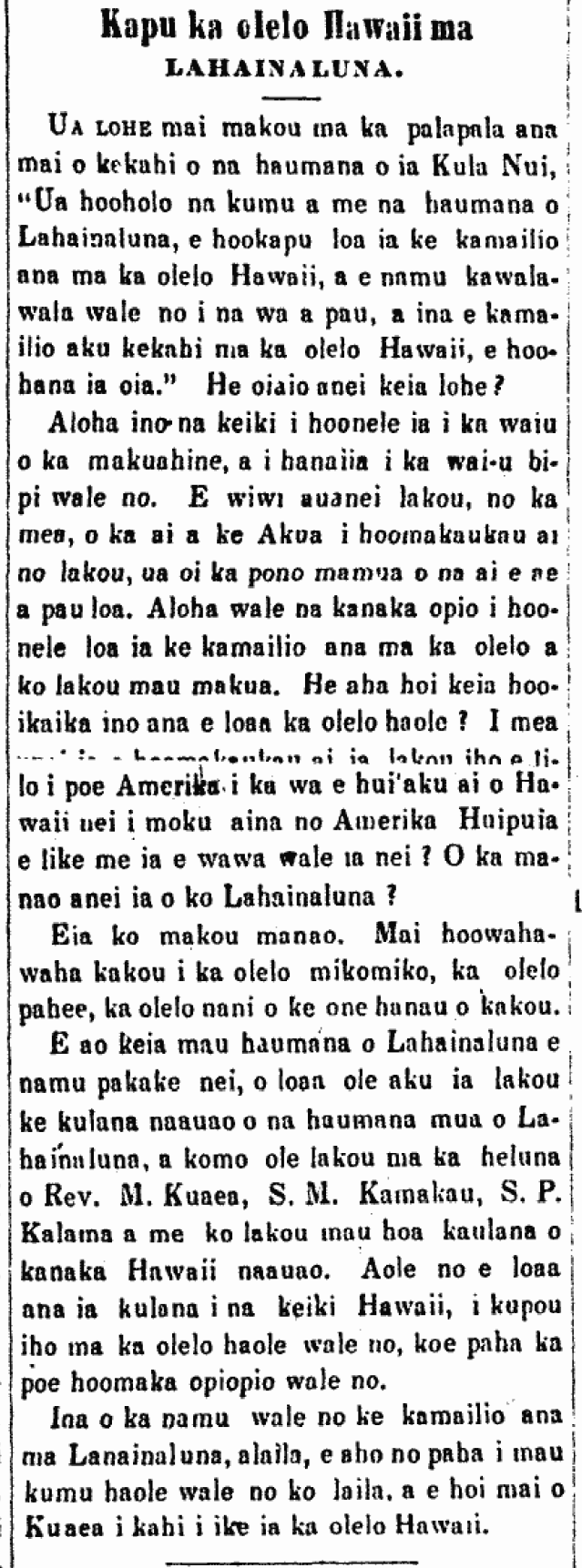
We have heard through a letter from one of the students at the College, “The teachers and students have decided to ban the speaking of Hawaiian, and instead to speak English [namu kawalawala] all the time; and should anyone speak in Hawaiian, he will be made to work.” Is what we hear correct?

How sad for children to be denied their mother’s milk, and fed only cow’s milk. They will end up malnourished, for the nourishment God prepared for them is better than all other foods. How tragic is it for the youth to be denied speaking the language of their parents. What is this big push to acquire the English language [olelo haole]? Is it to prepare them to become Americans when Hawaii joins as a state of the United States as is being rumored about? Is that the idea at Lahainaluna?

This is what we think. Let us not treat with contempt this eloquent language, this graceful language, this beautiful language of our homeland.

These students of Lahainaluna who speak English [namu pakake] will not attain the high education of the early students of Lahainaluna, and they will not join the ranks of Rev. M. Kuaea, S. M. Kamakau, S. P. Kalama, and their fellow famed educated Hawaiians. This level will not be reached by the Hawaiian youth who attempt to speak only English, except perhaps for those who start young.

If only English is spoken at Lahainaluna, then it would be better were there only haole teachers there, and Kuaea should be sent somewhere that Hawaiian Language is recognized.

[Does anyone know if this ban ever took place in the late 1860s?

And what does “S. P.” stand for in “S. P. Kalama”?]

(Kuokoa, 3/7/1868, p. 2)

Kapu ka olelo Hawaii ma LAHAINALUNA.

Ka Nupepa Kuokoa, Buke VII, Helu 10, Aoao 2. Maraki 7, 1868.

Changing Hawaiian Language, 1844.

February 20, 1844.

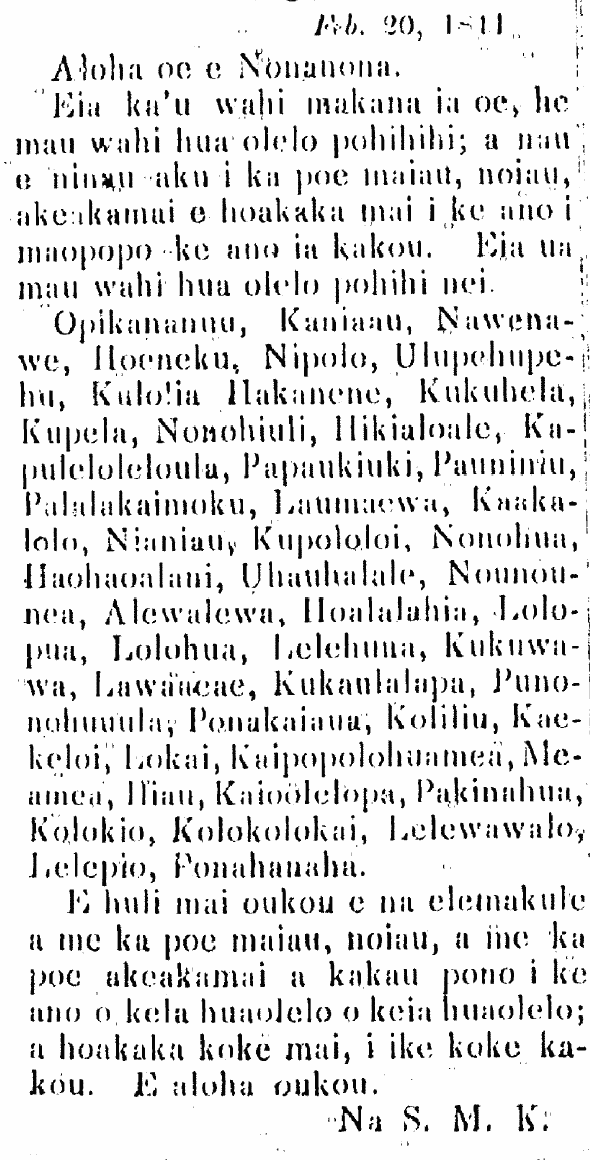
Aloha to you, O Nonanona.

This is my gift to you, some unclear words; and it is for you to asks the skilled, the wise, the seekers of knowledge to clarify their nature, so that it is understood by us. And here are those unclear words.

Opikananuu, Kaniaau, Nawenawe, Hoeneku, Nipolo, Ulupehupehu, Kulolia, Hakanene, Kukuhela, Kupela, Nonohiuli, Hikialoale, Kapuleloleloula, Papaukiuki, Pauniniu, Palalakaimoku, Laumaewa, Kaakalolo, Nianiau, Kupololoi, Nonohua, Haohaoalani, Uhauhalale, Nounounea, Alewalewa, Hoalalahia, Lolopua, Lolohua, Lelehuna, Kukuwawa, Lawaaeae, Kukaulalapa, Punonohuuula, Ponakaiaua, Koliliu, Kaekeloi, Lokai, Kaipopolohuamea, Meamea, Iliau, Kaioolelopa, Pakinahua, Kolokio, Kolokolokai, Lelewawalo, Lelepio, Ponahanaha.

All you oldsters, and the skilled, the wise, and the seekers of knowledge, set down in writing the meanings of each word, and clarify them soon so that we may quickly know. Aloha to you all.

By S. M. K. [Samuel Manaiakalani Kamakau]

[It is only 1844, and the young Kamakau is asking for clarification of vocabulary. The Hawaiian language apparently is already changing quickly, and Kamakau has already began collecting. He will be printing many traditional mele in the papers and does his famous history in the 1860s…]

(Nonanona, 3/5/1844, p. 109.)

Feb. 20, 1844...

Ka Nonanona, Buke 3, Pepa 21, Aoao 109. Maraki 5, 1844.

Hawaiians abroad and the Hawaiian-Language Newspapers, 1867.

“Let’s subscribe to the Newspaper

Kuokoa, the Greatest Prize of the
Hawaiian Nation.”

VALLECITO, CALAVERAS COUNTY,

CALIFORNIA, March 25, 1867.

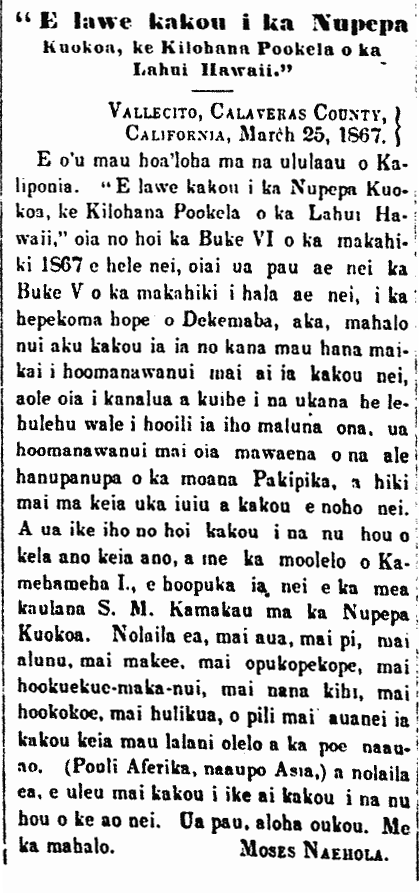
O My friends of the forests of California, “Let’s subscribe to the Newspaper Kuokoa, the Greatest Prize of the Hawaiian Nation,” that is the ongoing Volume VI of the year 1867, being that Volume V of this past year, is over, with the last week of December; we are grateful for its patient work done for us; it was not uncertain or hesitant of all the parcels sent upon it, but it persevered upon the surging billows of the Pacific Ocean until reaching this towering lands upon which we live. And thus we see the news of this sort and that, and the history of Kamehameha I., that is being published by the famed S. M. Kamakau in the Kuokoa. Therefore, don’t hold back, don’t scrimp, don’t be greedy, don’t be covetous, don’t surly, don’t scowl, don’t look to the side, don’t look away, don’t turn you back; lest these lines by the enlightened by applied to us. (Dark Africa, ignorant Asia), and so, let’s act quickly so that we can see the news of the world. I am done, aloha to you all. With thanks.

MOSES NAEHOLA.

[For more on the serial by S. M. Kamakau, see: Ruling Chiefs of Hawaii, Tales and Traditions of the People of Old, Ka Po’e Kahiko: The People of Old, The Works of the People of Old, Ke Kumu Aupuni, and Ke Aupuni Mō‘ī.

As for Moses Naehola, does anyone know if this is the same person as Moses Nahora, who is also living in California during the same period?

One more thing… This article has an awesome listing of negative attributes (which by no means are adequately translated here). ]

(Kuokoa, 6/1/1867, p. 4)

"E lawe kakou i ka Nupepa...

Ka Nupepa Kuokoa, Buke VI, Helu 22, Aoao 4. Iune 1, 1867.