Donations for the commission carrying the anti-annexation petitions to America, 1898.

OLIVE LEAVES OF ALOHA

FOR THE REPRESENTATIVES

FROM BALDWIN HOME

We are the Aloha Aina boys whose hearts are full of true aloha from deep within.

We are donating our few cents for the well-being of the Representatives with unified hearts and to attest to this, we affix our names.

MOLOKAI.

B. Lapilio, 50 cents

Nakeu, 50 ”

Halekauhola, 50 ”

E. D. T. Sing, 50 ”

John Lono, 50 ”

Moluhi, 50 ”

John Hao, 50 ”

Kukaukama, 50 ”

Kaomea Kaui, 50 ”

J. Namaielua, 50 ”

Jeo Kahilahila, 50 ”

Kalua, 50 ”

Mahi Kaio, 50 ”

S. Pilipo, 50 ”

Kauluwehiwehi, 50 ”

Hanaole, 50 ”

Micah Kaui, 50 ”

Kalauahea, 50 ”

Pohano, 50 ”

Kaukua, 50 ”

Kihauna, 50 ”

Ake, 50 ”

Hoopii, 50 ”

Moses Holi, 50 ”

S. Kauhahaa, 50 ”

Pihana, 50 ”

Isaia Wai, 50 ”

Pali, 50 ”

Hukia, 25 ”

Kanakahoa, 25 ”

Lai Kilauea, 25 ”

John Papu, 10 ”

Hakau, 10 ”

Kaonohiliilii, 10 ”

Kahikina, 1.00 ”

John Haloi, 1.00 ”

J. K. Laanui, 1.95 ”

D. W. J. Kaopuiki, 1.00 ”

Total: $20.00

D. W. J. Kaopuiki

Committee.

The boys of Baldwin Home are speedy.

[The newspaper Ka Loea Kalaiaina (and many other Hawaiian-Language Newspapers) are for some reason still not available online in searchable text form or even in image form. This is unfortunate, for although most people are familiar with the anti-annexation petitions (“Kū‘ē Petitions”), many have not seen the many lists of donations collected from all over the islands for the expenses of the commission carrying the petition to Washington D. C.

This particular list of donors and donations are from Kalawao! These patients were forced to live isolated from mainstream society, and yet they remained staunch patriots!!

This image is difficult to read, and I hope that clear images of these pages will be made, so if they are typed out to be word-searchable online, people will be able to find their kupuna—it will be near impossible to find a name if there is an “@” somewhere within it…]

(Loea Kalaiaina, 3/14/1898, p. 3)
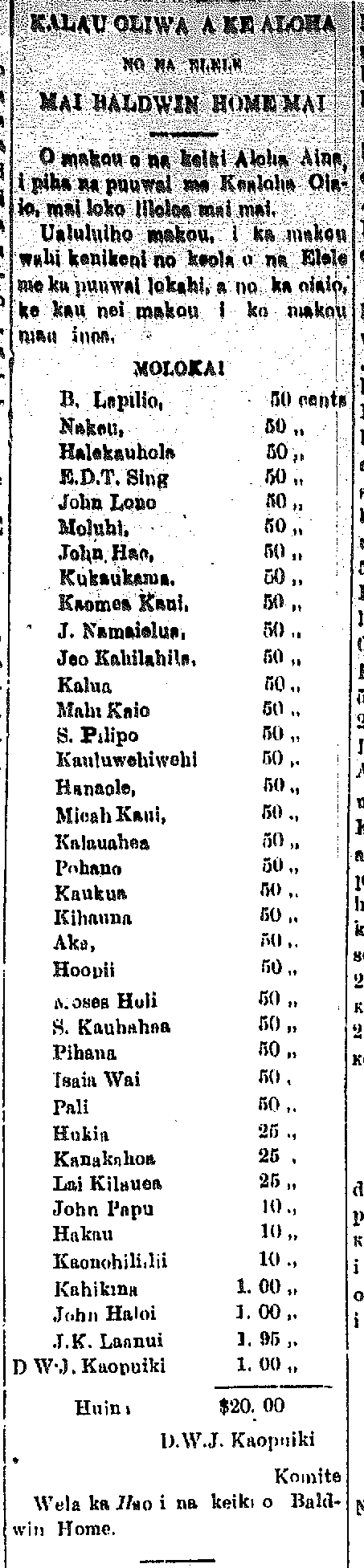
KALAU OLIWA A KE ALOHA

Ka Loea Kalaiaina, Buke II, Helu 11, Aoao 3. Maraki 14, 1898.
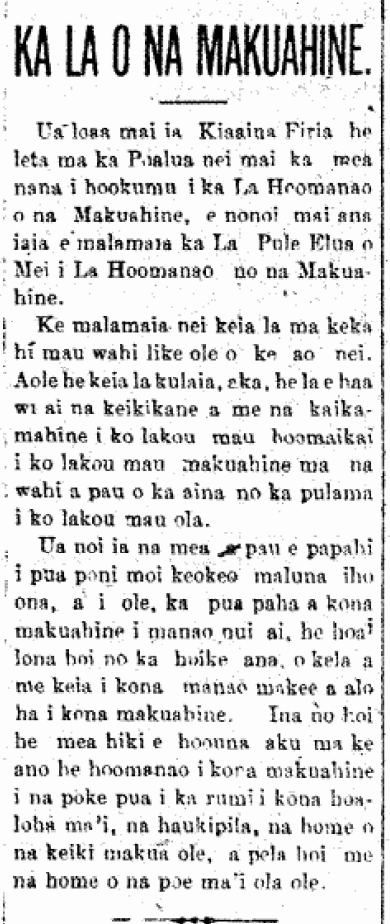
Mothers’ Day should be everyday, but… 1912.

DAY FOR MOTHERS.

Governor Frear received a letter this past Tuesday from the person who started Mothers’ Day [Julia Ward Howe?], asking him to make the second Sunday of May a Day to Remember Mothers.

This day is celebrated in places all over the world. This is not a holiday, but it is a day where boys and girls all over the land give their thanks to their mothers and cherish their lives.

Everyone is asked to adorn themselves with a white carnation, or a flower which their mother is fond of, which will be a show from each and everyone of their affection and love for their mother. If possible, send in remembrance of a mother a bouquet of flowers to the room of a sick friend, or the hospital, or the orphanage home, and also to the home for the incurable.

(Aloha Aina, 3/9/1912, p. 4)

KA LA O NA MAKUAHINE.

Ke Aloha Aina, Buke XVI, Helu 10, Aoao 4. Maraki 9, 1912.

More on Orramel Gulick, 1874.

[Found under: “Local News”]

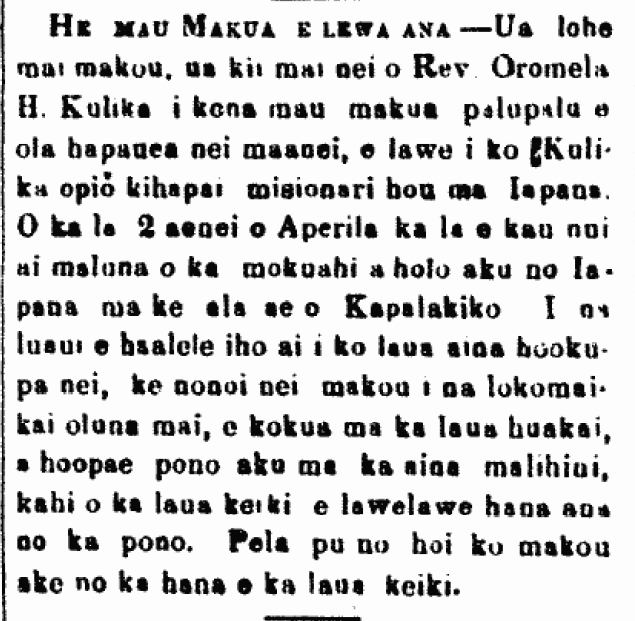
Parents will be voyaging—We hear that Rev. Orramel H. Gulick came to get his weak parents [Peter Johnson Gulick and Fanny Hinckley Thomas Gulick] living here in a feeble state to take them to the young Gulick’s [Luther Halsey Gulick] new missionary parish in Japan.It is on the coming 2nd of April that they will all board the steamship to make their journey to Japan by way of San Francisco. To his parents who are leaving this land which they grew accustomed, we hope for blessings from above, to help them on their journey, and to give them safe landing at this foreign land, where their child works for righteousness. So too is our hopes for the endeavors of their child.

[For more on Orramel Hinckley Gulick, see also: The Pilgrims of Hawaii, by Rev. and Mrs. Orramel Hinckley Gulick (1918).]

(Kuokoa, 3/14/1874, p. 2)

He mau Makua e lewa ana...

Ka Nupepa Kuokoa, Buke XIII, Helu 11, Aoao 2. Maraki 14, 1874.

More criticism of hula, 1874.

[Found under: “Local News”]

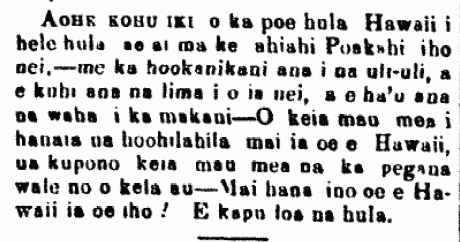
Not appropriate at all were the Hawaiian dancers who went around doing hula on this Monday evening—rattling their uliuli, their hands pointing this way and that, and their mouths huffing away in the wind—These things that were done shame you, O Hawaii; this kind of thing is appropriate only for the pagan of the past—O Hawaiians, stop hurting yourselves! Hula is strictly banned.

(Kuokoa, 3/21/1874, p. 3)

Aohe kohu iki...

Ka Nupepa Kuokoa, Buke XIII, Helu 12, Aoao 3. Maraki 21, 1874.

One of many congratulatory messages to the newly elected king, Kalakaua, 1874.

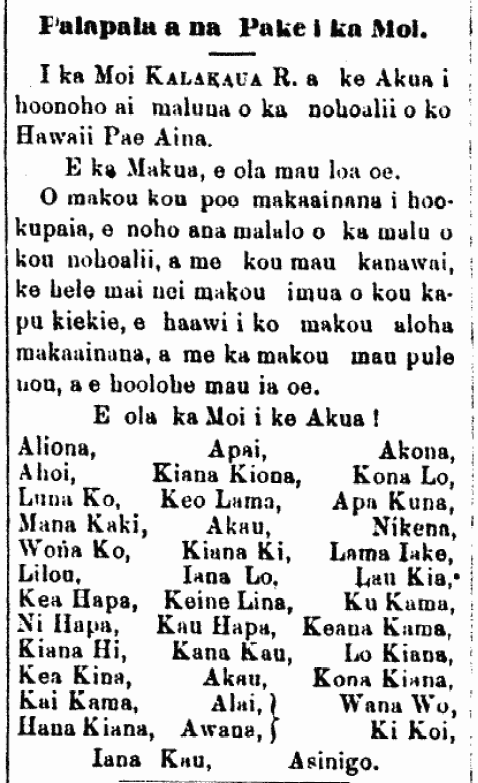
Letter from the Chinese to the King.

To King Kalakaua Rex, whom God has placed on the throne of the Hawaiian Archipelago.

Oh Father, long may you live.

We are your citizens who have been naturalized, living in under the protection of your rule and your laws; we come before your high kapu, to offer you our aloha from your citizens, as well as our prayers for you, and we shall always heed you.

Let the King live Through God!

Aliona, Apai, Akona, Ahoi, Kiana Kiona, Kona Lo, Luna Ko, Keo Lama, Apa Kuna, Mana kaki, Akau, Nikena, Wona Ko, Kiana Ki, Lama iake, Lilou, Iana Lo, Lau Kia, Kea Hapa, Keine Lina, Ku Kama, Ni Hapa, Kau Hapa, Keana Kama, Kiana Hi, Kana Kau, Lo Kiana, Ke Kina, Akau, Kona Kiana, Kai Kama, Alai, Wana Wo, Hana Kiana, Awana, Ki Koi, Iana Kau, Asinigo.

(Kuokoa, 3/21/1874, p. 1)

Palapala a na Pake i ka Moi.

Ka Nupepa Kuokoa, Buke XIII, Helu 12, Aoao 1.

More news out of Lahainaluna, 1874.

[Found under: “Local News”]

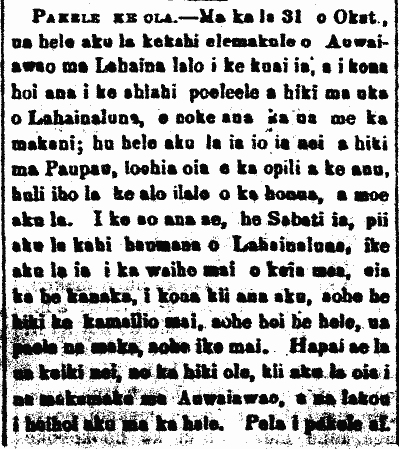
Life is saved.—On the 31st of Oct., an old man from Auwaiawao went to Lahainalalo to go shop, and when he was returning in the evening, it was dark and he reached Lahainaluna; the rain kept falling and the wind kept blowing; the old man wandered here and there until Paupau, and he was numbed with cold and fell face down to the ground and slept. In the morning, it was a Sunday, a student from Lahainaluna was walking up and spotted this thing, come to find out it was a man; when he went to fetch him, the man couldn’t speak, or walk, his eyes were blackened and he couldn’t see. The boy went to carry him, but because he couldn’t, he went to get friends from Auwaiawao, and they carried the man back to his home. That is how he survived.

(Kuokoa, 12/5/1874, p. 2)

Pakele ke ola.

Ka Nupepa Kuokoa, Buke XIII, Helu 49, Aoao 2. Dekemaba 5, 1874.

Newspapers coming out of Lahainaluna School! 1874.

[Found under: “Local News”]

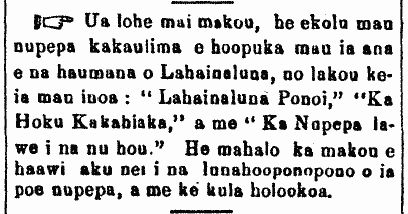
We’ve heard that there are three handwritten newspapers put out by the students of Lahainaluna, named: “Lahainaluna Ponoi,” [Lahainaluna’s Own], “Ka Hoku Kakahiaka,” [The Morning Star], and “Ka Nupepa lawe i na nu hou” [The Newspaper bringing the news]. We offer our praise to the editors of those newspapers, as well as to the entire school.

[It would be a great find if someone had a copy/copies of these newspapers lying around!!]

(Kuokoa 12/5/1874, p. 2)

Ua lohe mai makou...

Ka Nupepa Kuokoa, Buke XIII, Helu 49, Aoao 2. Dekemaba 5, 1874.

No matter how drastically some things may change, other things just seem to remain the same? 1912.

TINY PARKS ON KALAKAUA AVENUE

In between Kalakaua Avenue are being placed tiny Parks, fifty feet long by twenty feet wide. These parks are right in front of D. Kalauokalani’s place, and parks of those type are being built until Pawaa, and perhaps all the way until the Moana Hotel. The insides of these tiny parks will be planted with all sorts of flowers to delight the eyes of the travellers when they see them.

These types of parks have been built in the father land [America] and the large countries of the world, and this is perhaps the first to be seen here in Honolulu nei. Maybe it will raise the status of this city, but the strange thing about this type of construction is that the bad conditions of the roads still remain, and that there are others that want the same for their streets; but the response from the government is that there is no money—yet this costly endeavor is being taken care of quickly. So very humorous.

(Kuokoa Home Rula, 3/1/1912, p. 1)

MAU PAKA LIILII MA KALAKAUA AVENUE

Kuokoa Home Rula, Buke X, Helu 9, Aoao 1. Maraki 1, 1912.

Election season, 1912.

LINEKONA THE REPRESENTATIVE FOR THE WELL-BEING OF HAWAII.

Lincoln is the Morning Star,
The shining lantern,
Appointed by you, O Heavenly Powers,
Assisted by the Trinity.

Rise, O people of Hawaii,
The descendants of the I and the Mahi,
One in heart until victorious,
From Hawaii to Niihau.

Heard across the Islands,
Here is the one who will save the Lahui,
The eagle* will make right,
The Equal Rights of the land.

Let the story be told,
Lincoln the Representative for the Well-Being of Hawaii.

Composed by

George Kelii,

Honolulu, February 29, 1912.

*The eagle is used to represent the United States.

[Back in the day, there were many mele composed to support candidates. This one is for Lincoln Loy McCandless, who is famous for drilling for water here, and thus is also known as Likana or Linekona Eliwai (water driller). He will also be seen referred to as Lina (from Link).]

(Aloha Aina, 3/2/1912, p. 1)

LINEKONA KA ELELE OLA HAWAII.

Ke Aloha Aina, Buke XVI, Helu 9, Aoao 1. Maraki 2, 1912.