You could make out where the moon was, and it appeared red, 1848.

THE ECLIPSE OF THE MOON.

On the 12th of September, at six o’clock in the evening, when the sun went down, the eclipsing of the moon began. It began on the eastern side of the moon. That is how the shadow of the Earth rose; in one hour, the Moon was totally darkened, at seven in the evening. However, the moon didn’t totally disappear. You could make out where the moon was, and it appeared red.

It remained that way until after half past eight. And then the total darkness subsided and the shining started from the eastern side, just as the darkening began. That is how the light began until the shadow of the Earth passed by to the west, at half past nine; just as was explained in the American Almanac.

I was negligent in reporting this darkening of the Moon earlier in the Elele.  K.

Honolulu, September 13, 1848.

(Elele Hawaii, 9/18/1848, p. 31)
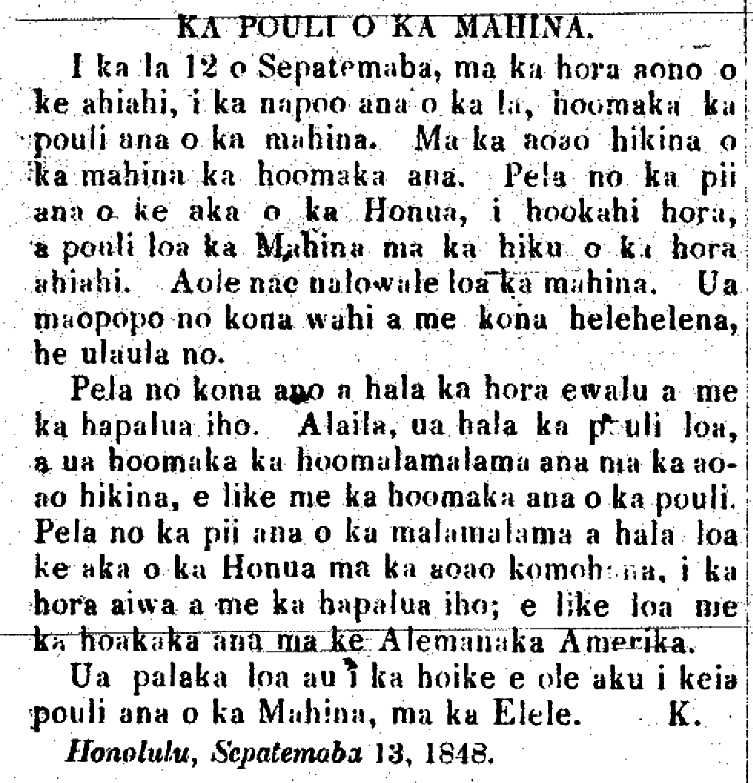
KA POULI O KA MAHINA.

Ka Elele Hawaii, Buke 4, Pepa 8, Aoao 31. Sepatemaba 18, 1848.
The moon like a red ball, 1907.

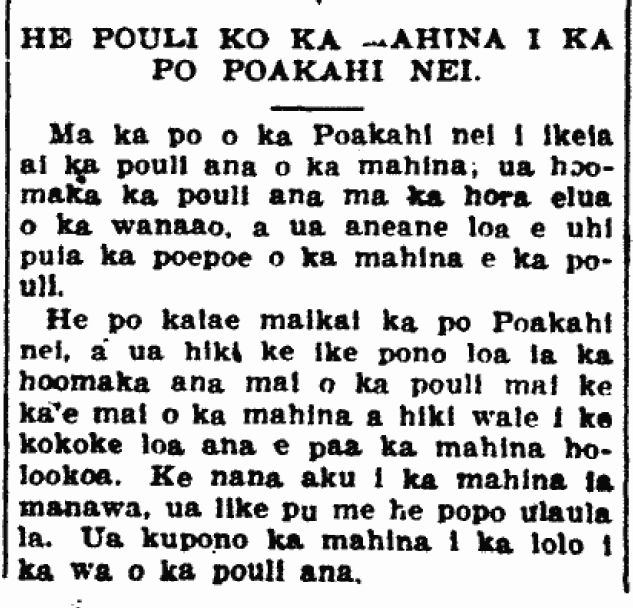
THE LUNAR ECLIPSE ON MONDAY NIGHT.

On the night of this past Monday a lunar eclipse was seen; the beginning of the eclipse began at two in the morning, and eventually almost the entire circle of the moon was covered in darkness.

This Monday night was a nice and clear, and it was possible to see perfectly the start of the eclipse from one side of the moon all the way until the entire moon was covered. When you saw the moon then, it looked like a red ball. The moon stood directly above at the time of the eclipse.

[This Monday night once again (4/14/2014), there will be a lunar eclipse viewable from Hawaii! Hopefully it will be a po kalae maikai like it was back a hundred and seven years ago! For more information on the phenomena, see here for a nice description from KHON2. And make reservations for ringside seats at the Bernice Pauahi Bishop Museum!!]

(Kuokoa, 2/1/1907, p. 8)

HE POULI KO KA MAHINA I KA PO POAKAHI NEI.

Ka Nupepa Kuokoa, Buke XLII, Helu 5, Aoao 8. Feberuari 1, 1907.

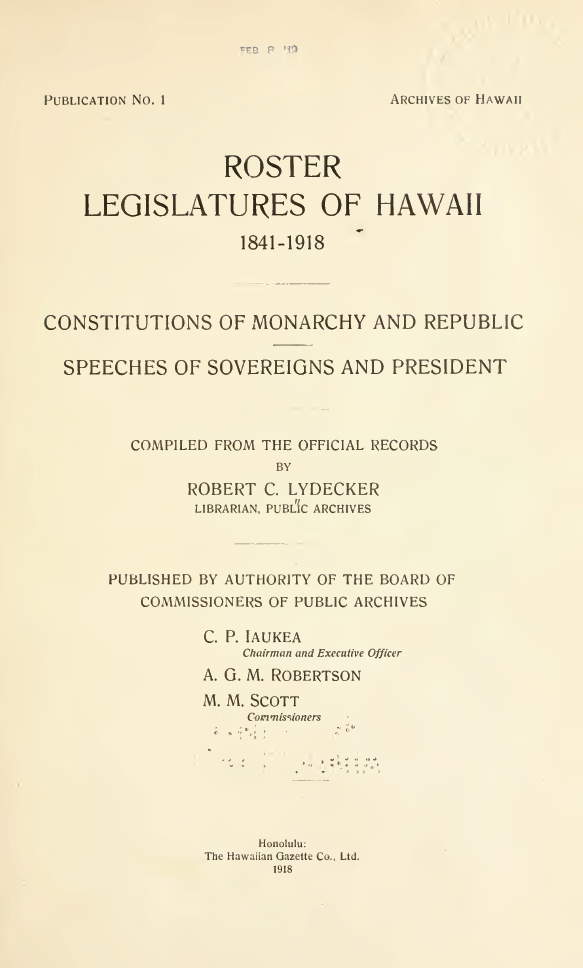
Roster Legislatures of Hawaii, 1841–1918.

ROSTER
LEGISLATURES OF HAWAII
1841–1918

CONSTITUTIONS OF MONARCHY AND REPUBLIC

SPEECHES OF SOVEREIGNS AND PRESIDENT

COMPILED FROM THE OFFICIAL RECORDS

BY

ROBERT C. LYDECKER

LIBRARIAN, PUBLIC ARCHIVES

PUBLISHED BY AUTHORITY OF THE BOARD OF

COMMISSIONERS OF PUBLIC ARCHIVES

C. P. IAUKEA
Chairman and Executive Officer

A. G. M. ROBERSTON

M. M. SCOTT
Commissioners

Honolulu:
The Hawaiian Gazette Co., Ltd.
1918

[This is a great reference on various information about the Legislature of Hawaii from 1841 all the way to 1918! It can be found word-searchable online here!!]


ROSTER LEGISLATURE OF HAWAII 1841–1914

ROSTER LEGISLATURE OF HAWAII 1841–1914

And more on the passing of John G. M. Sheldon, 1914.

JOHN KAHIKINA KELEKONA HAS PASSED.

At nine o’clock in the morning of this past Friday, the life breath of John Kahikina Kelekona left forever at his home; he was a very famous historian, and an old newspaperman in this town in years past, and his famous works will become an unforgettable monument to him.

He left behind many children, six daughters and two sons. The girls are: Mrs. I. Cockett; Mrs. J. R. Francis; Mrs. Ernest Kaai; Mrs. Joseph Namea; Mrs. M. Dutro, of Wailuku, Maui; Miss Emma Sheldon; and the boys are: D. K. Sheldon and Henry Sheldon, who work as clerks on inter-island steamships.

He left also two brothers [hoahanau]: William J. Sheldon, one of the esteemed members of the legislature some sessions ago, and Lawrence K. Sheldon who is with the law enforcement office in Honolulu. Continue reading

More on John G. M. Sheldon’s passing, 1914.

[Found under: “NUHOU KULOKO”]

On the morning of this Friday, John Kahikina Sheldon, one of the old typesetters, a famous newspaper writer, and translator and interpreter for the court, left this life. He was a fellow laborer in this work. He has gone, but his work will not be forgotten. Aloha indeed.

(Holomua, 3/28/1914, p. 8)

Ua haalele mai i keia ola ana...

Ka Holomua, Buke I, Helu 26, Aoao 8. Maraki 28, 1914.

John G. M. Sheldon passes away, 1914.

SUDDEN DEATH OF J. G. M. SHELDON

John G. M. Sheldon, brother of Henry Sheldon, of Lihue, and Wm. J. Sheldon, formerly of Waimea, died in Honolulu of hemorrhage last Friday morning. He had been in rather poor health for several years. Henry Sheldon left by the Kinau Saturday for Honolulu to attend the funeral, which took place Sunday afternoon.

Mr. Sheldon was one of the oldest printers in the Islands, having begun work as such when quite young. Being proficient in both the English and Hawaiian languages, he was frequently employed as interpreter in the courts and elsewhere. He had many friends by whom he was well liked.

(Garden Island, 3/31/1914, p. 1)

SUDDEN DEATH OF J. G. M. SHELDON

The Garden Island, Volume 10, Number 12, Page 1. March 31, 1914.

Kahikina Kelekona, John G. M. Sheldon, editor of the Hawaii Holomua, arrested for speaking, 1893.

LIBERTY OF THE SUBJECT.

Has Anybody Any Rights Under the Provisional Government?

Argument of the Question in the Circuit Court.

John G. M. Sheldon, editor of the Holomua, who is deprived of his liberty under a warrant issued by the President of the Provisional Government, was produced in the First Circuit Court before Judge Frear, at 11 o’clock this forenoon, under a writ of habeas corpus. Attorney-General Smith and F. M. Hatch appeared for the Government, and C. W. Ashford, C. Creighton, A. Rosa and J. L. Kaulukou for the prisoner.

Mr. C. W. Ashford argued for the discharge of the prisoner, speaking to the following effect: There was no authority vested in the Executive and Advisory Councils to issue warrants of arrest. President Dole had no right in the Proclamation of the Provisional Government to issue a warrant of arrest. The Government could not go behind that proclamation, he presumed. “We the People of the Hawaiian Islands” gave him no such power. If “We the People of the Hawaiian Islands” had intended to exercise that power they would have given it to him. The Proclamation stated that the President’s duties were to preside over the meetings of the Executive Council. Mr. Dole now holds no judicial position in these islands. He did hold such position before, but resigned it to become President of the Provisional Government. If that warrant, of President Dole was valid, then there was no security of liberty for any man, woman or child under these tropic skies. There was then nothing to prevent any resident of this country being consigned to a dungeon or bound in irons. It should be known whether the Provisional Government had such tremendous powers. He was not making a covert attack on the late revolution. He believed in the sacred right of revolution, and he considered the late revolution was a good thing. But it might not be good if the Provisional Government introduced anarchy and despotism. Some persons were led by their philosophy to believe that a beneficent despotism was the best form of government, and he believed that members of this school of philosophy had seats in the Advisory Council. Continue reading

On Aloha Aina, 1893.

“Breathes there a man with soul so dead,
Who never to himself hath said,
This is my own my native land.”
(Scott.)

Many of those who support honestly the present state of affairs, have done so in the full hope and belief, that thereby the flag of their country—the Stars and Stripes—will float over the land in perpetuity. Not a single Hawaiian, however, even those few whose signatures to annexation petitions (not 200 in number and mostly convicts.) have been bought or forced by necessity from them, desires to see any foreign flag replace his own. Continue reading

Liliuokalani’s horse riding association, 1892.

[Found under: “NU HOU KULOKO.”]

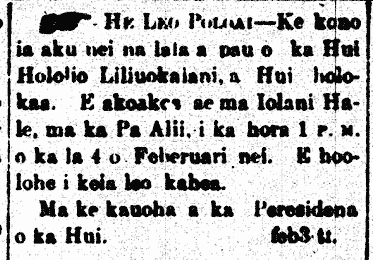
A Summons—All the members of the Liliuokalani Horse Riding Association and Carriage Riding Association are invited. To gather at Iolani Palace, on the Palace Grounds, at 1 p. m. on the 4th of February. Heed this call.

By the orders of the President of the Association.

(Leo o ka Lahui, 2/3/1892, p. 3)

He Leo Poloai

Ka Leo o ka Lahui, Buke II, Helu 382, Aoao 3. Feberuari 3, 1892.


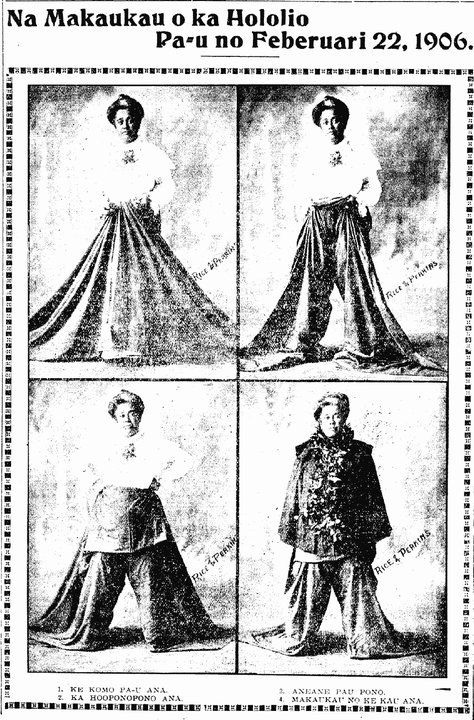
Putting on a Pāʻū, 1906.

Preparations for the Pa-u Riding of February 22, 1906.

1. Putting on a pa-u.
2. The adjusting.
3. Almost done.
4. Ready to ride.

[This was for the parade on Washington’s birthday. An article describing these steps was printed in the 2/4/1906 issue of the Sunday Advertiser.]

(Kuokoa, 2/9/1906, p. 4)

Na Makaukau o ka Hololio Pa-u no Feberuari 22, 1906.

Ka Nupepa Kuokoa, Buke XLIV, Helu 6, Aoao 4. Feberuari 9, 1906.