Unknown's avatar

About nupepa

Just another place that posts random articles from the Hawaiian Newspapers! It would be awesome if this should become a space where open discussions happen on all topics written about in those papers!! And please note that these are definitely not polished translations, but are just drafts!!! [This blog is not affiliated with any organization and receives no funding. Statements made here should in now way be seen as a reflection on other organizations or people. All errors in interpretation are my own.]

Samuel Kahanamoku saves a tourist’s life, 1916.

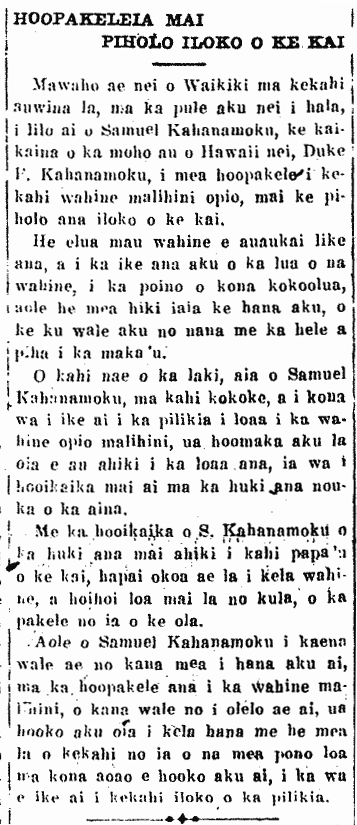
SAVED AFTER ALMOST DROWNING IN THE OCEAN

Outside of Waikiki one afternoon last week, Samuel Kahanamoku, the younger brother of the champion of Hawaii nei, Duke P. Kahanamoku, became  the rescuer of a young visiting woman from drowning in the ocean.

There were two women swimming together and when the second woman saw that her partner was in trouble, there was nothing she could do; she could just stand and watch as she was filled with fear.

Luckily Samuel Kahanamoku was nearby, and when he saw the trouble that the young visiting woman was in, he began to swim until he reached her and he worked to pull her to shore.

With effort, S. Kahanamoku pulled her to the shallows, carried the woman up to land, and her life was saved.

Samuel Kahanamoku did not boast of his deed in saving the visiting woman, the only thing he said was that he carried out that action as if it was something he had to do when he saw someone in trouble.

(Kuokoa, 3/17/1916, p. 2)
Kuokoa_3_17_1916_2.png

Ka Nupepa Kuokoa,  Buke LIV, Helu 11, Aoao 2. Maraki 17, 1916.

The story of Umi, by Simeon Keliikaapuni and J. H. Z. Kalunaaina, 1862.

HE MOOLELO NO UMI.

KEKAHI ALII KAULANA O KO HAWAII NEI PAE AINA

HELU 1.

I laweia mai e a’u noloko mai o kekahi Buke Moolelo Hawaii, i paiia ma Lahainaluna, M. H. 1838, a ke manao nei au e paiia kona Moolelo ma ka Nupepa Kuokoa, a me ke ano o kana hana i ka wa kahiko.

O Umi ke keiki a Liloa, aole nae oia ka Liloa keiki mua, aka, o Hakau ka mua a Liloa laua me Piena, ka Liloa wahine hoao maole ia; nolaila, ua kapaia o Hakau he alii nui, no ka mea, ua like pu ko Piena alii me ko Liloa; aka, o Umi, he keiki oia na Liloa me kekahi wahine ana i launa wale aku ai, o Akahiakuleana ka inoa o ua wahine la. Ua manao nuiia oia he wahine alii ole; aka, ma kona kuauhau, he alii no, hookahi o laua kupuna me Liloa. He mau mamo laua na Kanipahu.

[This is the beginning of the story of Umi as told by Simeon Keliikaapuni which he says he based off of the story in “Ka Mooolelo Hawaii.” This ran in the Kuokoa from 1/25/1862 to 2/8/1862. The telling of Umi’s story was then continued by J. H. Z. Kalunaaina from 2/22/1862 and concluded on 4/26/1862. Check out a translation of this serial column by Noʻeau Peralta, on the cool page of the Hamakua community group Hui Mālama i ke Ala ʻŪlili (huiMAU). Take a look also at all the other activities being done by huiMAU shown on their page. Wouldn’t it be awesome if other communities could look to this group as an example!]

 (Kuokoa, 1/25/1862, p. 1)

Kuokoa_1_25_1862_1.png

Ka Nupepa Kuokoa, Buke I, Helu 9, Aoao 1. Ianuari 25, 1862.

Umi, the son of Liloa and Akahiakuleana, 1859.

[Found under: “MOOOLELO HAWAII.—Helu 49.”]

Pertaining to Umi.—Umi was an alii of the people of Hawaii. Here is the history of this alii:

Umi was the son of Liloa, he was not the first son of Liloa, but Hakau was the first son of Liloa with Pinea, who was Liloa’s true “wife” [wahine hoao maoli]; therefore, Hakau was called a high chief, for the rank of Pinea was equal to that of Liloa. Umi however was the child of Liloa with a woman who he just took, her name being Akahiakuleana. It was widely thought that she was not an alii, but according to her genealogy she is indeed an alii; she and Liloa had a common ancestor. They were both descendants of Kanipahu.

Here is the genealogy of that Akahiakuleana from Kanipahu and Liloa’s genealogy from Kanipahu.

Kanipahu dwelt with Alaikauakoke, born was Kalapana, that being Liloa’s ancestor; Kanipahu dwelt with Hualani, born was Kalahumoku, that being Akahiakuleana’s ancestor. Continue reading

Hula thriving in Heeia, 1876.

[Found under: “PALAPALA I KE KUOKOA.”]

Useless activities of adults.

O KUOKOA NEWSPAPER; Aloha oe:—

Please grasp this bundle with your right hand, so that our friends will see from Hilo to Waioli, with Niihau to boot, that being the words above, “useless activities,” that being the hula.

Here in Heeia, Koolaupoko, there is much hula now; at Iolekaa there is 1 hula school with Hopa the male kumu hula; at Heeia Waena, Palau (m) and Naholowaa (f), those two are the kahu hula and Ioane (m) is the kumu; Continue reading

Ninia Haihailauahiku Kanae dies, 1926.

THAT OLD MOTHER OF WAIKIKI, MRS. N. H. KANAE, PASSES ON.

At 4 o’clock in the morning of Saturday of last week, Mrs. Ninia Haihailauahiku Kanae grew weary of this worldly life at the home of her granddaughter, Mrs. Eva Laupoli Perkins, on Liholiho Street in Makiki, at ninety or more years of elderly age, and with her passing to the other side, it would seem that no more are the old-time locals who accompanied the sea spray of Waikiki. Continue reading

Hawaiian birds, 1874.

Hawaiian Birds.—A letter from Hilo says: “There is in this town a beautiful collection of Hawaiian birds, finely preserved. It would be a valuable acquisition to the Government Museum, if Mr. Mills, the gentleman to whom it belongs, and who has been some years and at considerable expense in the work of collection, would part with it. Among the specimens is one called ‘the wingless bird,’ now nearly if not quite extinct on these islands. They are, however, numerous on Wake’s and Laysan [Laysin] Islands, where I have seen them, and supposed they were a new species. The body is about the size of a pigeon’s, they have no feathers on the flipper-like wings, and they run with such speed that one would take them for rats at first sight.”

[I wonder what became of this collection. Perhaps they went to the National Museum and then to the Bishop Museum. And it seems that among the different upcoming exhibits at the Bishop Museum is one on birds!]

(Pacific Commercial Advertiser, 10/3/1874, p. 3)

PCA_10_3_1874_3

The Pacific Commercial Advertiser, Volume XIX, Number 14, Page 3. October 3, 1874.

More on the parentage of Kalaniopuu from S. M. Kamakau, 1867.

[Found under: “KA MOOLELO O NA KAMEHAMEHA”]

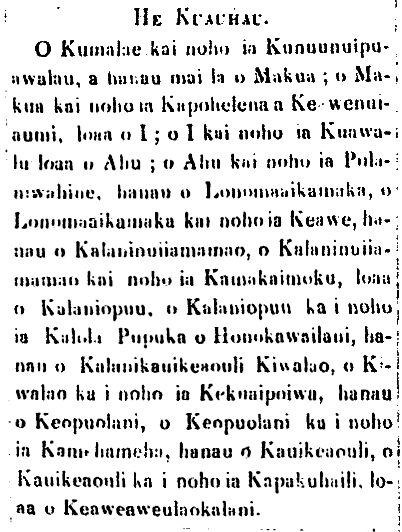
A GENEALOGY

Kumalae dwelt with Kunuunuipuawalu, and born was Makua; Makua dwelt with Kapohelena, child of Keawenuiaumi, and born was I; I dwelt with Kuawalu, born was Ahu; Ahu dwelt with Piilaniwahine, and born was Lonomaaikanaka; Lonomaaikanaka dwelt with Keawe, born was Kalaninuiamamao, Kalaninuiiamamao dwelt with Kamakaimoku, born was Kalaniopuu; Kalaniopuu dwelt with Kalola Pupuka o Honokawailani, born was Kalanikauikeaouli Kiwalao; Kiwalao dwelt with Kekuiapoiwa, born was Keopuolani; Keopuolani dwelt with Kamehameha, born was Kauikeaouli; Kauikeaouli dwelt with Kapakuhaili, born was Keaweaweulaokalani.

(Kuokoa, 11/16/1867, p. 1)

Kuokoa_11_16_1867_1

Ka Nupepa Kuokoa, Buke VI, Helu 46, Aoao 1. Novemaba 16, 1867.

The parentage of Kalaniopuu, 1867.

[Found under: “KA MOOLELO O KAMEHAMEHA I.”]

It is said that Kalaniopuu was the child of Peleioholani, the King of Oahu, and that he was called Kalaniopuu, that being Kaleiopuu, the lei of Kualii, that is the tooth of the whale and whale ivory made smooth in the shape of a chicken spur [opuu], and that is what was the royal adornment of the alii of Oahu—this was not the case with Hawaii Island [who wore tongue-shaped lei niho palaoa]. Continue reading

Bumper crop of mangos, 1868.

[Found under: “NU HOU KULOKO: Oahu.”]

Mango Fruit.—The past days, and these days as well, a lot [makena wale] of this delicious fruit is seen often at the markets and on the street sides of this town, but other fruits are very rare. We have seen thirty or more or less being sold for an eighth of a dollar [hapawalu], but it was not so recently when there wasn’t any; at that time at the Chinese stores it was six or ten for an eighth of a dollar. Those who crave mango are saved these days, and the adults and children peel them as they walk about the streets; and much is the diarrhea.

(Kuokoa, 8/8/1868, p. 2)

Kuokoa_8_8_1868_2.png

Ka Nupepa Kuokoa, Buke VII, Helu 32, Aoao 2. Augate 8, 1868.