Unknown's avatar

About nupepa

Just another place that posts random articles from the Hawaiian Newspapers! It would be awesome if this should become a space where open discussions happen on all topics written about in those papers!! And please note that these are definitely not polished translations, but are just drafts!!! [This blog is not affiliated with any organization and receives no funding. Statements made here should in now way be seen as a reflection on other organizations or people. All errors in interpretation are my own.]

Easter Sunday in Honokaa, 1942.

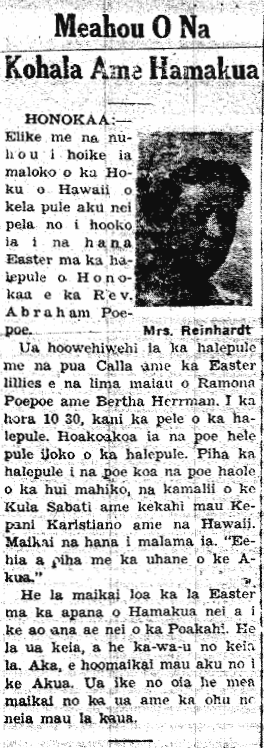
News of the Kohala Districts and Hamakua

HONOKAA:—Just like the news announced last week in the Hoku o Hawaii, the Easter events were carried out at the church of Honokaa by the Rev. Abraham Poepoe.

The church was decorated with Calla and Easter lily flowers by the meticulous hands of Ramona Poepoe and Bertha Herrman. At the hour of 10:30, the church bell rang. The church goers gathered in the church. It was filled with soldiers, haole from the sugarcane plantations, the children of the Sunday School, and some Japanese Christians as well as Hawaiians. The services held that day were beautiful. “Awe inspiring and filled with the spirit of God.”

Easter day was a very nice day here in the Hamakua district and the dawning of this Monday. This is a rainy day, and this is a humid day. However, praised always is God. He knows that it is good for there to be rain and fog these days of war.

(Hoku o Hawaii, 4/8/1942, p. 1)

HokuoHawaii_4_8_1942_1

Ka Hoku o Hawaii, Volume XXXVI, Number 42, Aoao 1. Aperila 8, 1942.

An adornment for Prince Kuhio by Mrs. Annie Freitas, 1922.

HE WEHI ALOHA NO KALANIANAOLE.

He inoa nou e Kalanianaole,
Ka onohi momi a o Hawaii nei.

He mea nui oe na ka lahui,
Milimili na ka Ua Kukalahale.

Ua ku’i e ka lono puni na moku,
O Kalanianaole ua hele loa.

Aia paha oe i Amerika,
I ka uluwehi a o Wakinekona.

Ua kohoia oe e ka lahui,
I wahaolelo no Hawaii.

Kakooia e ka ili keokeo,
Repubalika kou baloka. Continue reading

Bill to make the birthday of Kalanianaole a holiday, 1923.

THE BILL FOR THE BIRTHDAY OF KALANIANAOLE PASSES.

Unexpected opposition raised against the B. H. 21 which was introduced by Representative John W. Kalua to make the birthday of Prince Kuhio Kalanianaole into a government holiday [kulaia aupuni] was seen last Monday when the bill was taken up for the third reading in the house of representatives [hale o na lunamakaainana]. Notwithstanding the great opposition, the bill passed the third reading, 20 to 10 opposing. This was the first time that great number of people opposing a bill was seen. Continue reading

Birthday of Prince Kuhio commemorated, 1922.

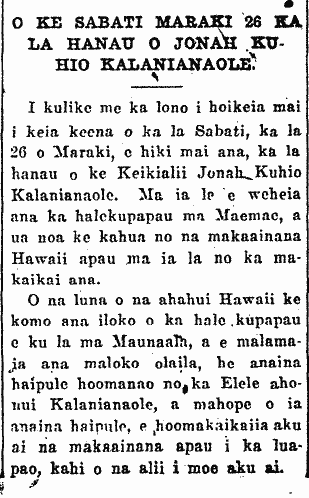
SUNDAY, MARCH 26, IS THE BIRTHDAY OF JONAH KUHIO KALANIANAOLE.

According to what is heard by this office, this coming Sunday, the 26th of March, is the birthday of Prince Jonah Kuhio Kalanianaole. And on that day the tomb at Maemae will be opened and the grounds will be free that day to all the makaainana of Hawaii to visit.

The officers of the Hawaiian 0rganizations will enter into the tomb standing at Maunaala, and and a religious service will be held within it for the persevering Representative Kalanianaole, and after that service, all of the makaainana will taken on tour of the mausoleum in which the chiefs rest.

(Kuokoa, 3/17/1922, p. 1)

Kuokoa_3_17_1922_1

Ka Nupepa Kuokoa, Buke LXI, Helu 11, Aoao 1. Maraki 17, 1922.

Praise for Prince Kuhio and Hawaiian Homesteads by Phillip Luahiwa, 1926.

HE INOA NO KALANIANAOLE

1 He inoa nou e Kalanianaole
He hiwahiwa oe o ka lahui.

2 Eia makou ou mau kini
I ka aina hoopulapula.

3 Ua imi oe i ka pono me [ke] ahonui
I pono au mau kini.

4 E ola mau na kini opio ou e Kalani
Mai na lani kiekie loa mai. Continue reading

Kalaniopuu’s fame as told by S. M. Kamakau, 1867.

[Found under: “KA MOOLELO O KAMEHAMEHA I.”]

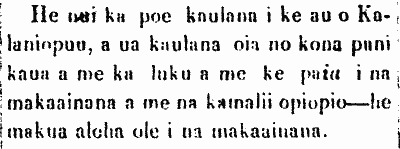
He nui ka poe kaulana i ke au o Kalaniopuu, a ua kaulana oia no kona puni kaua a me ka luku a me ka paia i na makaainana a me na kamalii opiopio—he makua aloha ole i na makaainana.

There were many famous ones during the era of Kalaniopuu, and he himself was well known, as someone who loved war, and massacring, and the striking of the makaainana and small children—he was a father who had no aloha for the makaainana.

[Although Kamakau describes many a chief as “war loving,” he describes Kalaniopuu as particularly cruel. This passage can be found in “Ruling Chiefs of Hawaii,” page 115.]

(Kuokoa, 2/23/1867, p. 1)

Kuokoa_2_23_1867_1.png

Ka Nupepa Kuokoa, Buke VI, Helu 8, Aoao 1. Feberuari 23, 1867.

Some of the battles of Kalaniopuu, 1866.

[Found under: “Ka Moolelo o Kamehameha I.”]

The battles between Kalaniopuu, the King of Hawaii, with Kahekili, the King of Maui.

The years 1775, 1776, 1777, 1778, and 1778. Kalaniopuu went to war at Kaupo on Maui, with his Alii, his war Officers, and his soldiers. Kalaniopuu first went to war at Kaupo, and he tortured the makaainana of Kaupo by clubbing their foreheads with his war club [newa]. This battle was called Kalaehohoa [“Clubbing-of-the-Forehead”] Continue reading

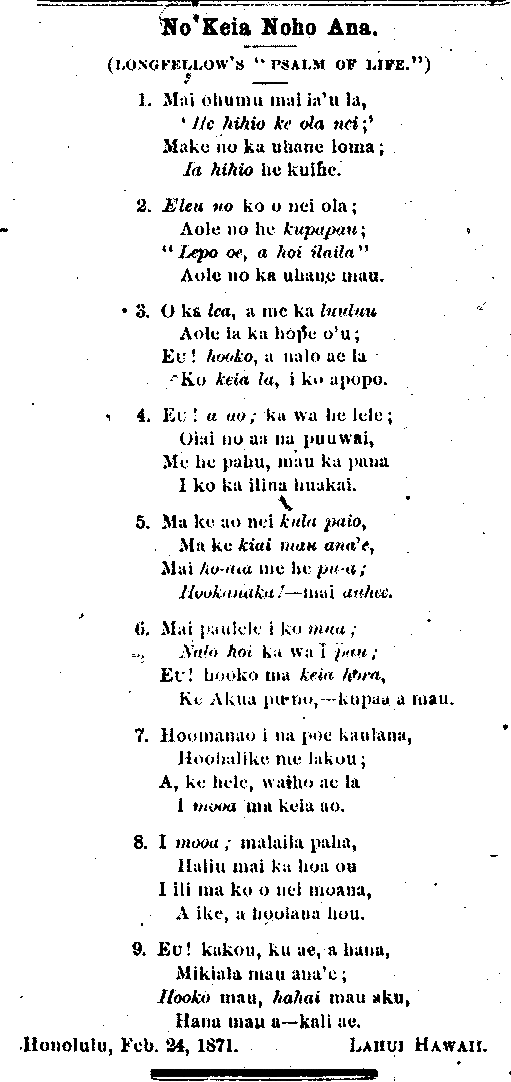
Hawaiian-language interpretation of Longfellow’s “Psalm of Life,” 1871.

No Keia Noho Ana.

(LONGFELLOW’S “PSALM OF LIFE.”)

1. Mai ohumu mai ia’u la,
‘He hihio ke ola nei;’
Make no ka uhane loma;
Ia hihio he kuihe.

2. Eleu no ko o nei ola;
Aole no he kupapau;
“Lepo oe, a hoi ilaila”
Aole no ka uhane mau.

3. O ka lea, a me ka luuluu
Aole ia ka hope o’u;
Eu! hooko, a nalo ae la
Ko keia la, i ko apopo.

4. Eu! a ao; ka wa he lele;
Oiai no aa na puuwai
Me he pahu, mau ka pana
I ko ka ilina huakai.

5. Ma ke ao nei kula paio,
Ma ke kiai mau ana’e
Mai ho-aia me he pu-a;
Hookanaka!—mai auhee.

6. Mai paulele i ko mua;
Nalo hoi ka wa i pau;
Eu! hooko ma keia hora,
Ke Akua pu no,—kupaa a mau.

7. Hoomanao i na poe kaulana,
Hoohalike me lakou;
A, ke hele, waiho ae la
I mooa ma keia ao.

8. I mooa; malaila paha,
Haliu mai ka hoa ou
I ili ma ko o nei moana,
A ike, a hoolana hou.

9. Eu! kakou, ku ae, a hana,
Mikiala mau ana’e;
Hooko mau, hahai mau aku,
Hana mau a—kali ae.

Honolulu, Feb. 24, 1871.  Lahui Hawaii.

[A PSALM OF LIFE

What the Heart of the Young Man Said to the Psalmist

Tell me not, in mournful numbers,
Life is but an empty dream!—
For the soul is dead that slumbers,
And things are not what they seem.

Life is real! Life is earnest!
And the grave is not its goal ;
Dust thou art, to dust returnest,
Was not spoken of the soul.

Not enjoyment, and not sorrow,
Is our destined end or way;
But to act, that each to-morrow
Find us farther than to-day.

Art is long, and Time is fleeting,
And our hearts, though stout and brave,
Still, like muffled drums, are beating
Funeral marches to the grave.

In the world’s broad field of battle,
In the bivouac of Life,
Be not like dumb, driven cattle!
Be a hero in the strife!

Trust no Future, howe’er pleasant!
Let the dead Past bury its dead!
Act,—act in the living Present!
Heart within, and God o’erhead!

Lives of great men all remind us
We can make our lives sublime,
And, departing, leave behind us
Footprints on the sands of time ;

Footprints, that perhaps another,
Sailing o’er life’s solemn main,
A forlorn and shipwrecked brother,
Seeing, shall take heart again.

Let us, then, be up and doing,
With a heart for any fate;
Still achieving, still pursuing,
Learn to labor and to wait.

(Lau Oliva, 3/1871, p. 1)
LauOliva_3_1871_1

Ka Lau Oliva, Buke I, Helu 3, Aoao 1. Maraki 1871.

The death of Kaoleioku Pauli, 1874.

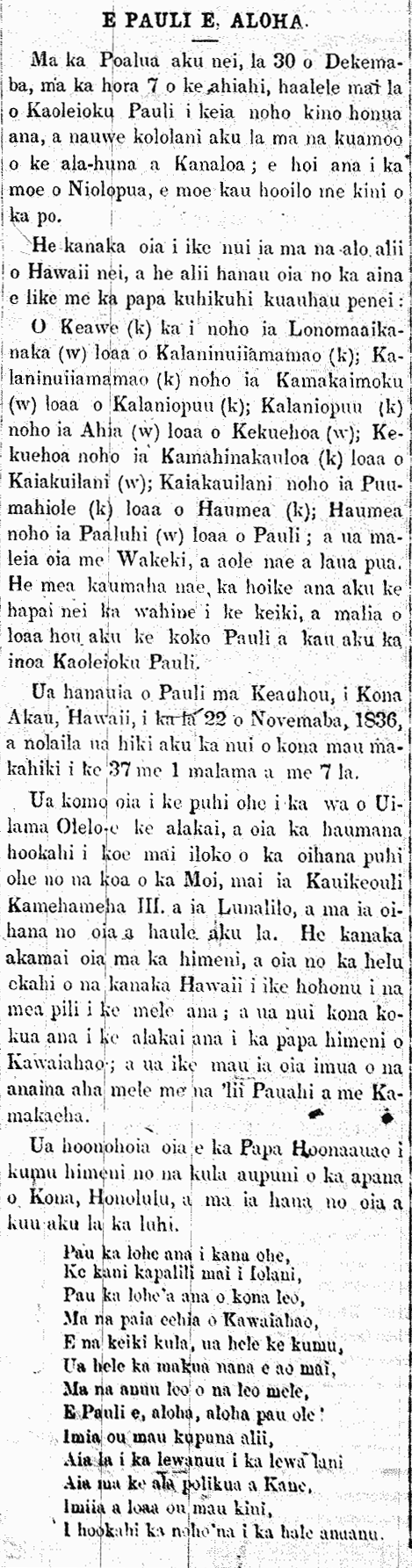
O PAULI, ALOHA

This past Tuesday, the 30th of December, at 7 o’clock in the evening, Kaoleioku Pauli left this earthly body and silently went on to the hidden pathway of Kanaloa; to return to the slumber of Niolopua, the eternal rest.

He was a man who was often seen in the royal courts of Hawaii nei, and he was a chief born of the land as shown in the genealogy chart below:

Keawe (m) dwelt with Lonomaaikanaka (f), begot was Kalaninuiiamamao (m); Kalaninuiiamamao (m) dwelt with Kamakaimoku, begot was Kalaniopuu (m); Kalaniopuu (m) dwelt with Ahia (f), begot was Kekuehoa (f); Kekuehoa dwelt with Kamahinakauloa (m), begot was Kaiakuilani (f); Kaiakauilani dwelt with Puumahiole (m), begot was Haumea (m); Haumea dwelt with Paaluhi (f), begot was Pauli; and he married Wakeki, but they have no offsrping. But it is sad that it was revealed that his wife is now pregnant with child, and perhaps the blood of Pauli will be begotten anew, and the name Kaoleioku Pauli will be given.

Pauli was born at Keauhou, in North Kona, Hawaii, on the 22nd of November 1836, and therefore he reached 37 years old and 1 month and 7 days.

He began playing the band during the time it was lead by William Merseburgh [?? Uilama Olelo-e], and he was the only student left from the band of the Kings, from Kauikeaouli Kamehameha III to Lunalilo, and while in that occupation, he fell. He was a man that was skilled at singing, and he was the greatest of Hawaiians in his deep knowledge of singing; and he greatly assisted in leading the choir of Kawaiahao; and he was always seen in front of song concerts with the alii Pauahi and Kamakaeha.

He was assigned by the Board of Education as a singing teacher for the government school for the district of Kona, Honolulu, and while in that position he let go of his burdens.

Pau ka lohe ana i kana ohe,
Ke kani kapalili mai i Iolani,
Pau ka lohe’a ana o kona leo,
Ma na paia eehia o Kawaiahao,
E na keiki kula, ua hele ke kumu,
Ua hele ka makua nana e ao mai,
Ma na anuu leo o na leo mele,
E Pauli e, aloha, aloha pau ole!
Imia ou mau kupuna alii,
Aia ia i ka lewanuu i ka lewa lani,
Aia ma ke ala polikua a Kane,
Imiia a loaa ou mau kini,
I hookahi ka noho’na i ka hale anuanu.

[No more will we hear wind instrument,
Its trilling song from Iolani,
No more will his voice be heard,
In the solemn walls of Kawaiahao,
O Schoolchildren, your teacher has gone,
Went is the father who taught,
The intervals in singing,
O Pauli, aloha, our never-ending aloha!
Seek out your chiefly ancestors,
They are in the sky up above, the sky in the heaven,
On the dark path of Kane,
Search out and find your relatives,
You will live as one in the cold house.

This is not the Pauli Kaoleioku who was the son of Kamehameha I and Kanekapolei.]

(Nuhou, 1/6/1874, p. 6)

Nuhou_1_6_1874_6

Ka Nuhou Hawaii, Buke I, Helu 10, Aoao 6. Ianuari 6, 1874.

Sweet voices, 1916.

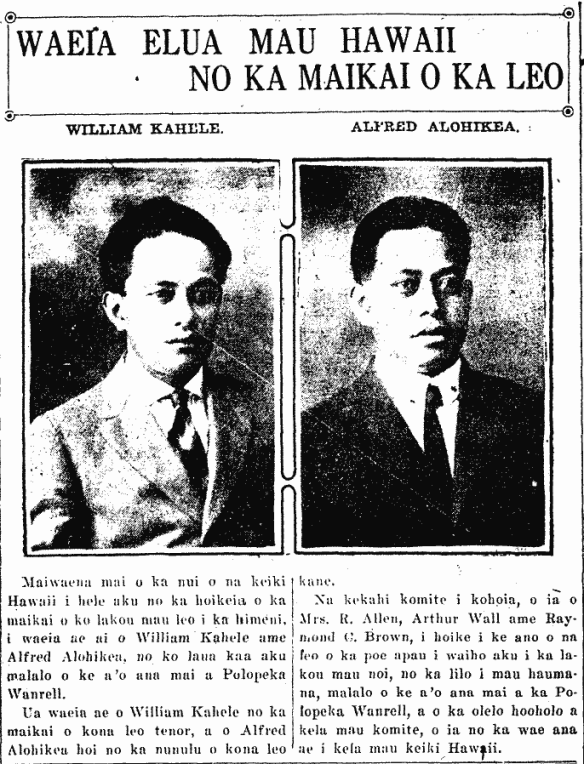
TWO HAWAIIAN SELECTED FOR THEIR FINE VOICES

WILLIAM KAHELE.  ALFRED ALOHIKEA.

From amongst many Hawaiian youths who went to show the quality of their singing voices, chosen  were William Kahele and Alfred Alohikea for them to study under Professor Wanrell.

William Kahele was selected for quality of his tenor voice, and Alfred Alohikea for his reverberating bass [leo kane].

They were picked by a committee, that being Mrs. R. Allen, Arthur Wall and Raymond C. Brown, who tested all of the voices who put in the application to become students under the tutelage of Professor Wanrell, and the decision of the committee was the choosing of those Hawaiian boys.

(Kuokoa, 10/20/1916, p. 3)

Kuokoa_10_20_1916_3

Ka Nupepa Kuokoa, Buke LIV, Helu 42, Aoao 3. Okatoba 20, 1916.