Found this postcard a while back in a box at home. Aren’t these the very trees that the Lahaina Public Band was playing under a hundred years ago?
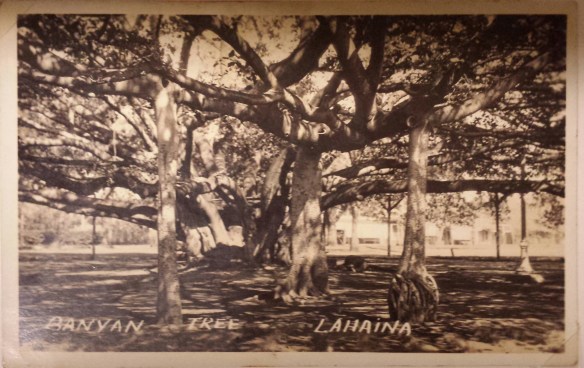
BANYAN TREE, LAHAINA


Found this postcard a while back in a box at home. Aren’t these the very trees that the Lahaina Public Band was playing under a hundred years ago?
BANYAN TREE, LAHAINA
Mr. Sol Hanohano, Aloha oe:—Please allow me some open space on the wings of the seagull of ours, so the words above have somewhere to nest.
While everyone was sitting around in the shade of the ulu grove of Lele, enjoying the softly blowing Ma-aa breeze, the local wind of the land, the people were surprised to see a notice put up: “Band concert tomorrow afternoon at 3 o’clock p.m. The Lahaina Public Band will give a public concert under the banyan tree, court house grounds. All welcome! Come one! Come all!”
And being that it was on the 1st of April that this announcement was seen, and the words said that it was the following day at 3 o’clock p.m. that the band would play, Apr. 2, 1916, the announcement was not reliable, because it was the 1st of April, maybe the intent of that announcement is an April Fool; so when going to the place directed, you would find something like the kids saying, “Go to school, tell your teacher you’re a fool,” but for this, “Go to courthouse grounds, and call yourself you’re a fool!”
But these guesses were put aside until the prescribed time was at hand, and the band members were indeed seen seated in the place made ready for them. And for the first time, the realization came that this was not an April fool.
When the clock struck 3 o’clock, we saw Lowell Kupau bow and as he rose up he was holding his instrument, and with a wink of an eye, the voice of the band burst forth. It was just so lovely! it was a beauty that could not be faulted for they were only taught for a very short few days. The songs played were “Kaua i ka la i pohina,” “Silver Threads Amongst the Gold,” “Maui Beauty me Roselani,” composed by William J. Coelho. “Maui no ka oi,” composed by Rev. S. Kapu, “Mai poina oe ia’u,” and “Aloha oe.” “Hawaii Ponoi.” Continue reading
Hanohano Nuuanu aia iuka,
Kahiko i ka Ua Popokapa,
Ke nihi ae la Waolani,
A loaa maua i Kanenelu,
Wai auau a kuu aloha,
Me Eha hua hiu a wela,
Ua ahi ua wela Wananakoa,
I ka hooni a nei kupueu,
A he eueu au no Kahikina,
No na pali hulaana o Maui,
O ke ewe ia a o’u mau kupuna,
I lohe mai oe Koleakani,
Aulii ma hana a Piilani,
A he lani a he kupa no ka aina,
Haina ia mai ana ka puana,
Na Eha Hua hiu a Wela.
EHAHUA.
(Loea Kalaiaina, 7/30/1898, p. 4)

Ka Loea Kalaiaina, Buke II, Helu 30, Aoao 4. Iulai 30, 1898.
The Hula-hula doll has broken into society, at least into flapper society, as proved by this photograph from the Atlantic City Parade.
(Big Sandy News, 5/12/1922, p. 6)

Big Sandy News, Volume XXXVII, Number 36, Page 6. May 12, 1922.
A vigorous campaign to stamp out the time-honored hula-hula national dance of Hawaii, which is accomplished without the dancer moving his or her feet, has been instituted by clergymen and the reform element, according to Rev. Ezra Crandall, a missionary of Worcester, Mass., who arrived in San Francisco recently, after a visit of several weeks in the island capital, says the San Francisco Bulletin.
The “disgusting hula” of the present day, according to Rev. Crandall, is a survival of an ancient pagan ceremony practiced by the Hawaiians, but is has so degenerated that it has become a moral menace. Rev. Crandall stated that it is the opinion of those conducting the campaign that every self-respecting Hawaiian should take a stand against the terpsichorean indecency involved in the native dance.
“The hula, as it is commonly danced and commonly know now,” said Rev. Crandall, “should be the subject of vigorous condemnation, and I do feel that every Hawaiian should feel this reflection on the decency and propriety of his race.
“For the honor and the good name of the Hawaiian race, all men and women of Hawaiian blood are being urged to join in discountenancing these indecent exhibitions. The mere fact that some people, principally tourists, want to see them is no excuse for their existence. They are a shame to the islands.”
(Star-Bulletin, 6/15/1917, p. 14)
Honolulu Star-Bulletin, Volume XXIV, Number 7854, Page 14. June 15, 1917.
Holo mai Pele mai Kahikina,
A kau ka waa i Mookini,
Noho kaua i Kumalae,
Hooku Pele ma i ke kii,
Noho i ke kii a Pele ma, a ka pua o koi,
Kanaenae Pele ma ilaila,
Kai a huakai mai Pele,
A ka lae i Leleiwi,
Honi i ke ala o ka hala,
O ka lehua o Mokaulele,
Oia ka Pele a kui la,
He kunana hale Puuloa,
He hale moe o Papalauahi,
He halau no Kilauea,
Haule mai Pele mai Kahiki mai,
O ka hekili, o ke olai, o ka ua loku,
O ka ua paka, o Haihailaumeaiku,
O na wahine i ka wao o Maukele la,
Ho mai ana Pele liu la e,
Aumiki, auhuli, ka ale kua loloa,
Nuanua ka moana i ka lili o Pele,
O ke kua nui, ke kui la iluna o ka lani,
Wahia ka papaku, ka papaiaoa,
Ka papa a Kane ma i hee ai i Maui,
Kahiliopua ke kua o ka la,
A Waiakahalaloa iakea,
O waa kai nana i ka auwaa lawaia,
Ku kapa kai e Kohala,
O ke akua lapu e Puuloa,
Ke uwalo la i ka mea hele,
Ke akua kui lehua o Kuaokala,
Kui mai ana i Makanoni,
Ka la puu la helu o Pualaa,
Ka la aku hoi e Kahuoi i ka uka anu,
E olohe koi ula e mauna mai ana,
Ka hikina o ka la o Kumukahi ma,
E haliko ae ana ka aama,
Lele hihee o Kohala, ke kau laina la,
E ka la pumehana ole o ka po
O ka la pe ai o ke ao kau aku iluna,
I ka malama la,
Elieli kau mai.
[From the time of her arrival to Hawaii, Pele fashions lei of lehua blossoms from Mokaulele in Hilo. May the majestic trees live forever. Until a solution is found to Rapid Ohia Death, wear your lehua in your heart, not in your lei!]
(Hoku o ka Pakipika, 3/6/1862, p. 4)
Ka Hoku o ka Pakipika, Buke I, Helu 24, Aoao 4. Maraki 6, 1862.
Noho ana au i ka lai
I ka ulu hala o Keaukaha
Me he ala e i mai ana
Maanei mai kaua e ka hoa
Huli nana i ka lae kai
I ka holu mai a ka nalu kai
Pa mai ana ke ala
O ka limu lipoa me ka nahenahe
Hookahi no au hana nui
O ke kui pua leihala o Keaukaha
Ke au ae nei ka manao
E kii e ako pua lehua
E ula mai la i ke kumu
E lei kohu no ko kino
Ko kino nui nepunepu
Hewa e ka maka ke ike aku
O ke kuko o ka lia ke loaa ana
I na pua lehua me ka hala
Aole la he hala e ka hoa
E kipa ole aku ai i ka home
Ho mai ke aloha la e ka makamaka
I kuleana ai au ilaila
Haina ia mai ana ka puana
Ka olu ulu hala o Keaukaha
HAKU IA E E—A—E—E—A
[A SONG OF AFFECTION FOR KEAUKAHA
I repose in the calm
In the hala groves of Keaukaha
It is as if it says
Come here, let us be together, O friend
I turn to look at the ocean cape
As the waves ripple forth
The scent wafts by
Softly of the lipoa seaweed
I have bu one thing to do
String lei of the hala of Keaukaha
My thoughts turn to
Going to gather lehua blossoms
Reddening the trees
For a lei fitting for you body
Your voluptuous body
They eyes are content to look at
My desire, my yearning, is to have
The blossoms of the lehua and the hala
There is no offense my companion
That does not call at the home
Give to me your aloha, my dear
So I might have kuleana there
Let the story be told
Of the sweet hala groves of Keaukaha]
[Let the lehua live forever! Wear it in your heart and not in your lei!!]
(Hoku o Hawaii, 10/8/1929, p. 2)

Ka Hoku o Hawaii, Buke XXIII, Helu 17, Aoao 2. Okatoba 8, 1929.
Hanohano Hilo kuu onehanau,
Haaheo na kuahiwi ekolu;
Lamaku iluna ke ahi a ka wahine,
Moiwahine o ke alohilohi.
Kaulana Hawaii puni ka honua,
O Pele ke kupua aiwaiwa;
Hui mai na mana o ke ao nei,
Haawi i ka momi no Hawaii.
He nani na kualono iuiu,
He u’i ka mamo hulupala Olaa;
He nu’a na lehua o Mokaulele,
O Hilo nei ua kau ka Hoaka.
Haina ke’lii nona ka lei,
Likelike Kekaeikapuokalani.
Hakuia e Keahikuniaalapalapa.
[A LOVING MEMORY FOR MY DEAR HOMELAND.
Hilo my hometown is grand,
Proud are the three mountains;
The flames of the woman blaze above,
The Queen of radiance.
Hawaii is famed around the world,
Pele, the amazing supernatural one;
The powers of the world gather together,
Giving pearls for Hawaii.
Beautiful are the majestic ridges,
Handsome are lovely mamo birds of Olaa;
The lush lehua blossoms of Mokaulele,
It is Hilo, the Hoaka rises.
Let the story be told of the alii for whom is the lei,
Likelike Kekaeikapuokalani.*
Composed by Keahikuniaalapalapa.]
*Likelike Kekaeikapuokalani is probably Elizabeth Likelike Kekaeikapuokalani Coney, the wife of Heinrich H. Renjes.
(Kuokoa, 4/25/1919, p. 2)

Ka Nupepa Kuokoa, Buke LVII, Helu 17, Aoao 2. Aperila 25, 1919.
They Object to the Wording of a Memorial.
The Hawaiian Women’s Patriotic League held its third business meeting yesterday morning at Arion Hall. Mrs. F. W. Macfarlane, President, called the meeting to order promptly at 10 o’clock. After reading the minutes by the Secretary, Mrs. Grace Kahalewai, the proposed memorial to United States Commissioner Jas. H. Blount was taken up. The Secretary read it once in Hawaiian, but the ladies in the rear part of the building could not hear her. They requested her to again read the rather lengthy memorial, which was done. The memorial was briefly in this wise: Continue reading
A GREAT FALSEHOOD. We were clearly shown that the words printed by the traitor newspaper “Advertiser” this morning pertaining to the memorial of the Patriotic League Ladies was a big lie, and that it was not the truth, and that is not what is thought, it is very different. That newspaper is becoming very prone to telling falsehoods.
(Hawaii Holomua, 4/13/1893, p. 2)
 nupepa