Unknown's avatar

About nupepa

Just another place that posts random articles from the Hawaiian Newspapers! It would be awesome if this should become a space where open discussions happen on all topics written about in those papers!! And please note that these are definitely not polished translations, but are just drafts!!! [This blog is not affiliated with any organization and receives no funding. Statements made here should in now way be seen as a reflection on other organizations or people. All errors in interpretation are my own.]

Maori in Hawaii, 1899.

Speech of the New Zealander.

Wheraliko Rawei, a man from New Zealand [Nu Kilani], gave [a speech] in the YMCA building [Hale o ka Hui Opio] of Honolulu nei. The topic of his presentation pertained to New Zealand, the land of the Maori people.

He is a native New Zealander, and is fluent in English. He was well educated in that language in schools of the land of his birth.

His presentation was enhanced with lime light pictures [kii hoolele aka]; these pictures were of the very famous places of his homeland. His speech was made very delightful with songs of New Zealand.

There were many people of this town who showed up to listen to his speech. All of the seats were filled by the spectators, and some people stood. He gave another presentation on this past Thursday.

(Kuokoa, 9/29/1899, p. 1)

Haiolelo a ka Nu Kilani.

Ka Nupepa Kuokoa, Buke XXXVIII, Helu 39, Aoao 1. Sepatemaba 29, 1899.

Hawaii at the Paris International Exposition, 1867.

[Found under: “KA HOIKEIKE NUI MA PARISA.”]

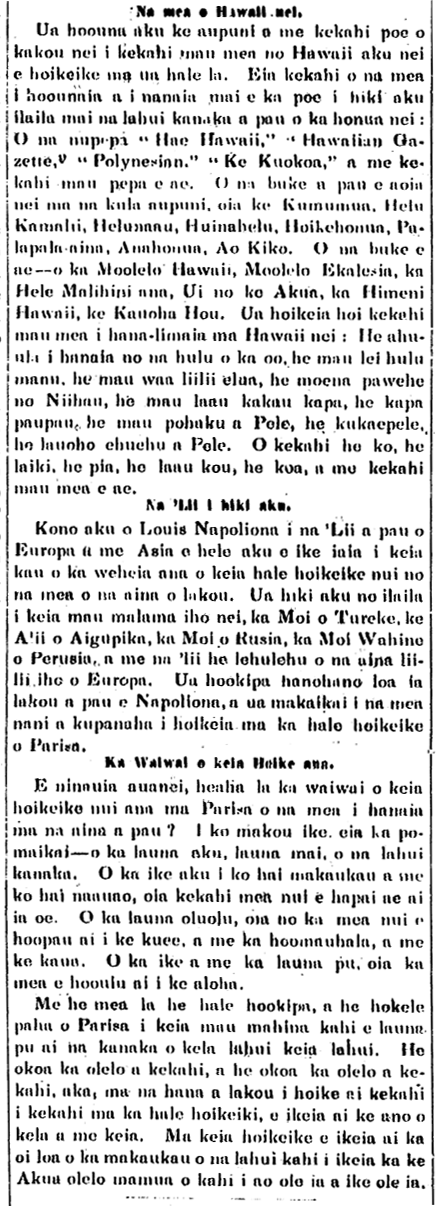
Hawaiian things.

The government and some of our people have sent some items to display in that building from Hawaii. These are some of the things sent and that are being seen by those going there from all the different races of the world: The newspapers “Hae Hawaii,” “Hawaiian Gazette,” “Polynesian,” “Ke Kuokoa,” and some other papers. All of the books being taught in the public schools; those being the Kumumua, Helu Kamalii, Helunaau, Huinahelu, Hoikehonua, Palapala-aina, Anahonua, Ao Kiko. Other books—Ka Moolelo Hawaii, Moolelo Ekaleisa, Ka Hele Malihini ana, Ui no ke Akua, Ka Himeni Hawaii, Ke Kauoha Hou. There are items handcrafted in Hawaii nei: An ahuula made of oo feathers, some bird feather lei, two small canoes, a patterned mat [moena pawehe] from Niihau, some wooden kapa printers [? laau kakau kapa], a kapa paupau, some volcanic rocks, sulfur [kukae pele], and Pele’s hair. Other things are sugar, rice, pia, kou wood, koa, and some other items.

The Value of this Exhibition.

It may be asked, what is the value of this great exhibition in Paris of things made in all the lands? In our minds, this is the what is gained—the intermingling of the different lahui. Seeing the abilities and intelligence of others is something that will carry you higher. Meeting amicably is something that will end disputes and grudges and war. The getting together and associating with each other is something that will foster aloha.

It is as if Paris is a house of welcome or a hotel these past months, where people of all ethnicities meet. Their languages are different, but through the work they displayed to each other at the exhibition hall, the nature of each other will be seen. In this exhibition, it will be seen that the nations that know the word of God are much more advanced than those that do not.

(Alaula, 9/1867, p. 22)

Na mea o Hawaii nei.

Ke Alaula, Buke II, Helu 6, Aoao 22. Sepatemaba 1867.

Wahi Pana of Oahu nei, 1899.

[Found under: “NU HOU HAWAII”]

I ka i’a hamau leo—ikea ke kula o Kaupea—kiei ia Nanakuli—oku ana kahi mea hewa—hoomaha i Poka-i—kaalo ae o Mauna Lahilahi—lele mai Makaha me he ao opua la—”malolo kai me moana kai” ka’u i lohe—ne hone ana ke one kani o aMkua [Makua], alawa iho oe ma ka aoao, he neneeia na ke one opiopio—hoea i Keawaula—ike ia Kilauea—noho mai Pohaku-o-Kauai—maopopo ka Lae-o-Kaena—ike i ka pohaku olelo—maalo ana Leina-a-ka-Uhane—o ana i Aiea—pawehe o Kawaihapai—laula o Mokuleia—hoea makou ilaila, ua hele a Walikanahele—O Waimea i ka pohina a ka noe, pulupe i ka hunakai—pupuu a hoolei loa “na u o Lewa” kau iluna—hoaumoe i Kihene, ilaila makou ike i ka iniki huihui a ke kehau—hooipo me Laieikawai, i ke kiowai kapu o Waiapuka.

(Kuokoa, 1/20/1899, p. 3)

I ka i'a hamau leo...

Ka Nupepa Kuokoa, Buke XXXVIII, Helu 3, Aoao 3. Ianuari 20, 1899.

King Kalakaua’s address in English, 1874.

[Found under: “THE ROYAL BIRTH-DAY.”]

My People: On this the first anniversary of my birth-day occurring after my accession to the Throne, I have thought it fit and proper that it should be made a day of national thanksgiving to the Almighty God, for His many mercies and blessings to us as a people; and, as it occurs on the eve of my undertaking a long journey to a far country, that you may also on this day implore the Divine protection for me in my absence, and a blessing on my mission. Continue reading

King Kalakaua’s stirring address to his people on his 38th birthday, 1874.

[Found under: “La Hanau o ka Moi ma Honolulu.”]

“ALOHA TO YOU ALL:

I take this day, that being my birthday, to thank the Powerful One for the blessings of our lives as this year nears its close. And also, the time is near for My travels to the foreign lands in search of benefits for the industries of our nation is quickly upon us; I seize this time now to express my Aloha for all of you, my makaainana.

I am leaving to carry out what was recently decided in the Legislative session. Continue reading

A mele for Kalakaua, 1874.

A Song for the King.

(This below is a mele sung by the students of the school run by the Catholic Roman Nuns, before the Alii, the King, when He went to see them on this past Sunday, February 22.)

Tune.—Par la voix du canon d’alarmes.

O ka Moi e noho nei
O Kalakaua ia;
Mai ke Kiekie mai
Kona lei, kona mana.

E kuokoa mau
Kona Aupuni a mau loa’ku.

Oluolu ka noho ana,
Pomaikai kakou,
Na keiki me na makua,
Malalo o kona malu.

E kuokoa mau, &c.

Like pu ka helehelena,
Aole he olelo e,
Ka olelo a na kupuna
Ko kakou makemake.

E kuokoa mau, &c.

Mamalahoa kanawai
E kau mau no ia,
Mai Hilo a Kauai
I ko ka Moi aloha.

E kuokoa mau, &c.

Ola ko kakou aina
Mai na kupuna mai,
Ola ia Kalakaua
I ko kakou Alii.

E kuokoa mau, &c.

Mai kanalua kakou
Na ‘Lii me na kanaka,
I hookahi ka naau,
I hookahi ke aloha.

E kuokoa mau
Ko kakou Moi o ke one hanau.

(Ko Hawaii Ponoi, 3/4/1874, p. 1)

He Mele no ka Moi.

Ko Hawaii Ponoi, Buke I, Helu 37 [38], Aoao 1. Maraki 4, 1874.

Abraham Kaulukou to study law at Yale, 1902.

LEAVING TO STUDY LAW IN AMERICA.

ABERAHAMA KAULUKOU HEADED FOR YALE UNIVERSITY—ASSISTED BY THE ALUMNI OF YALE.

In the coming September, Aberehama Kaulukou, the son of the Hon. John L. Kaulukou will go to enter into the school of law at Yale. This is help from the Yale alumni of this town. These former students thought a great deal to do something for their school, and after prior investigation, they unanimously chose to send this intelligent Hawaiian youth of the land. Continue reading

Language, 2014.

Here is something to think about. The olelo noeau is indeed true, “Make ke kalo a ola i ka palili.” (The oldsters die, but they live on through their offspring.)* Language however is something that needs to be consciously worked at, for if we let it disappear, “when you cover him with dirt, language is not like a plant that grows again…”

*The old taro stalk dies, but lives on through the shoots. Also seen as “Make ke kalo, ola i ka naio.”

Plans for Independence Day, 1885.

The heads of the nation are planning on a great celebration on the 28th of November, that being La Kuokoa. Therefore, there will be a parade on that day; a speech by Robert Hoapili Baker [R. Hoapili Beka] at Kaumakapili for independence day, the one that we are questioning as to whether he has a brain that can compose a speech for that day by himself; and a banquet for the benefit of Kaumakapili Church after the activities at the church are through. This is something new that we see, that the heads of the nation themselves are doing this, and not the makaainana. Perhaps it was seen that the makaainana were neglectful in observing this day because of their lack of trust in the ministers of the government.

(Ko Hawaii Pae Aina, 11/14, 1885, p. 2)

Ke manao nei na luna aupuni...

Ko Hawaii Pae Aina, Buke VIII, Helu 46, Aoao 2. Novemaba 14, 1885.