Unknown's avatar

About nupepa

Just another place that posts random articles from the Hawaiian Newspapers! It would be awesome if this should become a space where open discussions happen on all topics written about in those papers!! And please note that these are definitely not polished translations, but are just drafts!!! [This blog is not affiliated with any organization and receives no funding. Statements made here should in now way be seen as a reflection on other organizations or people. All errors in interpretation are my own.]

More coverage of Hui Nalu Singing Group, 1912.

THE HUI HIMENI HUI NALU IS HEADED TO CHINA

To fulfill their contract with the head of the Carlton Cafe, Mr. L. Ladow, in Shanghai, China, the singing boys of the Hui Nalu will leave aboard the Tenyo Maru yesterday, and they will spend a long period of time there before returning to Hawaii nei.

They were supposed to leave this town on Monday, however because what was planned earlier did not go well, their trip to foreign lands has been postponed for a bit.

There are five of these singers, they being: Alex. Holstein, Willie Opunui, James K. Ii, Jr., Peter Opunui, and William Punohu.

(Kuokoa, 12/20/1912, p. 4)
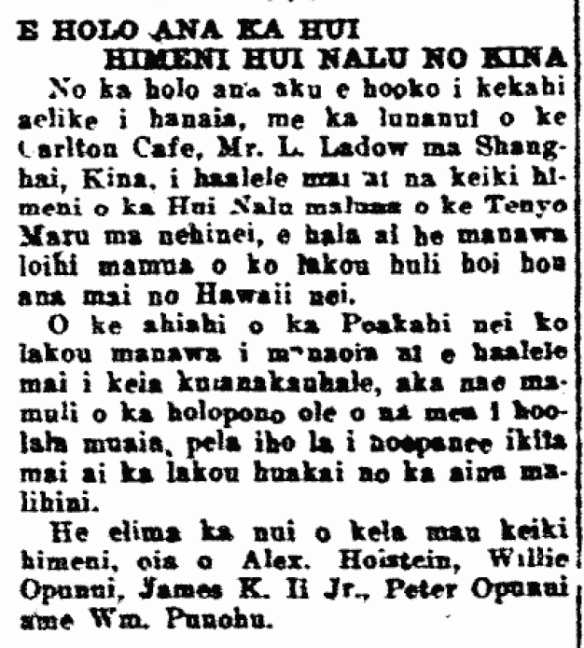
E HOLO ANA KA HUI HIMENI HUI NALU NO KINA

Ka Nupepa Kuokoa, Buke XLVIII, Helu 51, Aoao 4. Dekemaba 20, 1912.
Musicians travel to Japan and China, 1912.

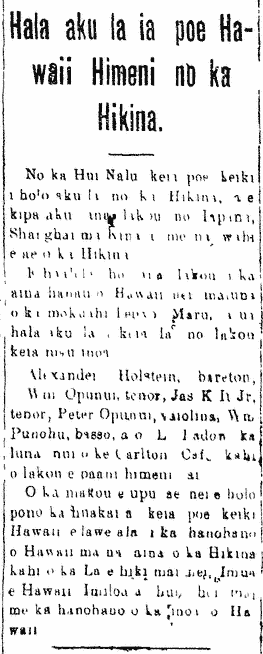
Those Hawaiian Singers Leave for the East.

These youths are from the Hui Nalu [Singing Club] who left for the East; and they will visit Japan and Shanghai in China and other locations in the East.

They will leave the land of their birth aboard the steamship Tenyo Maru [?], and they left this day, their names being:

Alexander Holstein, baritone,

William Opunui, tenor, James K. Ii, Jr., tenor, Peter Opunui, violin, William Punohu, bass, and L. Ladon [Louis Ladow] the head of the Carlton Cafe, where they are to perform.

Our hope is that the journey of these Hawaii boys carrying with them the pride of Hawaii to East, to the land of the rising Sun, goes well. Go forward, go forward O Great-Travelling Hawaiians and return with glory in the name of Hawaii.

(Kuokoa Home Rula, 12/19/1912, p. 1)

Hala aku la ia poe Hawaii Himeni no ka Hikina

Kuokoa Home Rula, Buke X, Helu 51, Aoao 1. Dekemaba 19, 1912.

Smuggled goods, 1912.

SMUGGLED GOODS AUCTIONED OFF

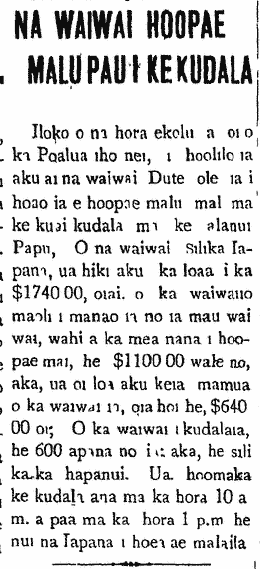
In three hours or so this past Tuesday, items attempted to be smuggled in without paying Duty were auctioned off on Fort Street. Japanese Silk goods made $1,740.00 whereas the actual value of the items is believed to be only $1,100.00 according to the person who imported them; and so it was much more than the real value, being that it was $640.00. There were 600 items that were auctioned and the majority was silk goods. The auction began at 10 a. m. and closed at 1 p. m.; there were many Japanese who showed up.

(Kuokoa Home Rula, 12/19/1912, p. 1)

NA WAIWAI HOOPAE MALU PAU I KE KUDALA

Kuokoa Home Rula, Buke X, Helu 51, Aoao 1. Dekemaba 19, 1912.

Vital Statistics, 1912.

MARRIAGES.

Opela Keanu to Haleakala Ka-la [This probably means it is pronounced Kalā.], Nov. 28.
Levi Kalauli to Mary Iona, Nov. 30.
Paul Beyer to Ida Kapeleila, Dec. 7.
James U. Swansen to Philomina Makaena, Dec. 8.

BIRTHS.

To Henry Turner and Lucille K. Wahinemakaole, a son, Nov. 29.
To Manuel R. Burgess, Jr. and Julia Heines, a son, Nov. 30.
To James M. Keanu and Helen Apo, a son, Dec. 4.
To Ching Loy Fat and Rose Kimo, a son, Dec. 8.

DEATHS.

Dora P. M. Clark, on Emma Street, Dec. 6.
Lokalia Pahu, on Beritania Street, Dec. 7.
William Kawaiaea, at the Insane Asylum, Dec. 9.
Nawahi Hopeole, at the Insane Asylum, Dec. 9.
Peter Kane, Jr., on School Street, Dec. 10.
Sam Lono, at the corner of Queen and Punchbowl Streets, Dec. 10.
Sam Kaia Poepoe, in Kalihiwaena, Dec. 10.

(Kuokoa, 12/13/1912, p. 8)

NA HANAU. / NA MARE. / NA MAKE.

Ka Nupepa Kuokoa, Buke XLVIII, Helu 50, Aoao 8. Dekemaba 13, 1912.

Queen Liliuokalani and the Red Cross, 1917.

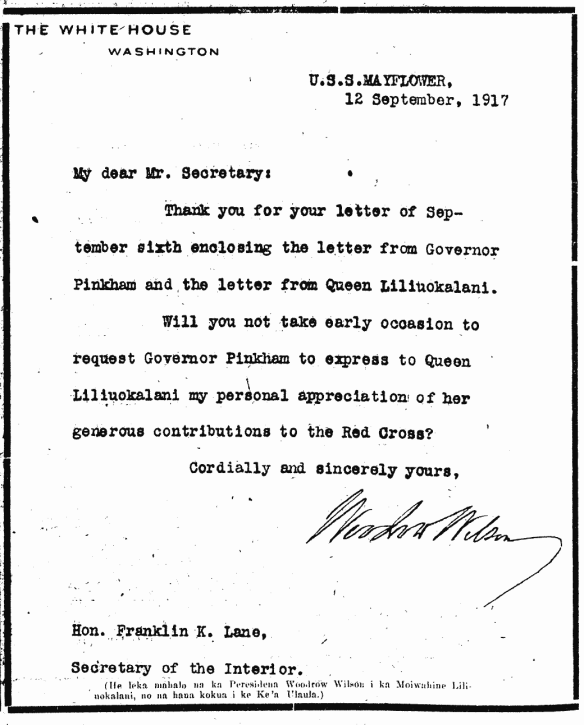
THE WHITE HOUSE

WASHINGTON

U. S. S. MAYFLOWER

12 September, 1917

My dear Mr. Secretary:

Thank you for your letter of September sixth enclosing the letter from Governor Pinkham and the letter from Queen Liliuokalani.

Will you not take early occasion to request Governor Pinkham to express to Queen Liliuokalani my personal appreciation of her generous contributions to the Red Cross?

Cordially and sincerely yours,

[signed] Woodrow Wilson

Hon. Franklin K. Lane,

Secretary of the Interior.

(A letter of appreciation from President Woodrow Wilson to Queen Liliuokalani, for her assistance to the Red Cross.)

[The Queen dies just two months later on November 11th…]

(Kuokoa, 9/28/1917, p. 2)

THE WHITE HOUSE

Ka Nupepa Kuokoa, Buke LV, Helu 39, Aoao 2. Sepatemaba 28, 1917.

Near tragedy caused by Kamehameha V’s deer, 1868.

[Found under: “LOCAL NEWS: Maui”]

Life saved from deer.—P. Kawelakawai of Kawela, Molokai wrote to us like this: On the 29th of April, I saw Kaukino, the one who barely survived. Here is the reason; one of the animals of our King, a deer set loose on his ranch, entered the sweet potato patch of at Kalamaula to eat the uala, and this man saw this and went to shoo it off; the animal rushed forward but he saw it coming, and it was but a few feet away and it caught him and thrust its antlers, whereupon he fell down, face thrown back. He was jabbed in the armpit, and the antler pierced through. His wife saw this happen and she brought him back to the houses and the man was very weak. We are relieved at the news following that letter that he has recovered.

[See earlier articles on the deer gifted to Kamehameha V. Deer imported from Japan in 1867. and Deer of Kamehameha V., 1867.]

(Kuokoa, 5/23/1868, p. 3)

Pakele ke ola i ke dia.

Ka Nupepa Kuokoa, Buke VII, Helu 21, Aoao 3. Mei 23, 1868.

Fish market affected by weather, 1929.

DECREASE IN THE CATCH OF OCEAN FISH

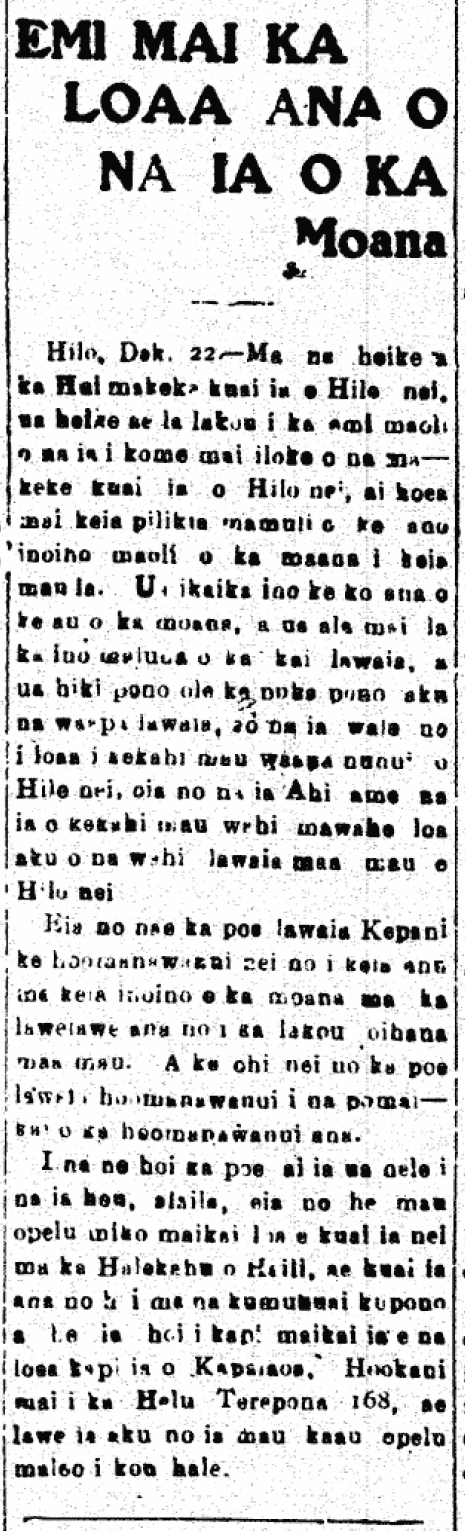
Hilo, Dec. 22—According to a report by the fish market association of Hilo, they said that there is a marked decrease in the amount of fish brought in to the fish markets of Hilo nei, and this is a result of the difficulty brought on by the very stormy seas these days. The pull of the currents is very strong, and this occurs in the fishing waters, so the fishing boats cannot head straight for them; the only fish caught by the large fishing vessels of Hilo are Ahi and other fish from far outside of the normal fishing areas of Hilo.

Here however are the Japanese, still persevering these stormy conditions of the sea by carrying out their regular work. And the determined fishermen are reaping the benefits of their persistence.

If those who eat fish are without fresh fish, here are nicely-salted opelu being sold at the pastor’s residence of Haili and it is being sold for a good price; it is fish salted well by the expert fish salters of Kapalaoa. Ring the Telephone Number 168, and the dried opelu in forties [kaau] will be delivered to your house.

(Hoku o Hawaii, 12/24/1929, p. 2)

EMI MAI KA LOAA ANA O NA IA O KA Moana

Ka Hoku o Hawaii, Buke XXIII, Helu 28, Aoao 2. Dekemaba 24, 1929.

Anyone know if this is Johnny Noble, the famous singer? 1912.

Here is the Cure for Hawaiians!

This is the medicine made with skill by John A. Noble, called NEWTON OINTMENT, which cures all type of skin ailments like rashes, eczema, skin odor, hemorrhoids, cuts, burns, and so forth.

This Medicine is available at Drug Stores and other stores around the Island for 25c. for a box.

THERE HAVE BEEN MANY WHO daubed this Medicine, and they all were cured. Therefore, to all those who have skin ailments, try the ointment of the Hawaiian Boy, called

—NEWTON OINTMENT—

If it is not available at the stores, send to JOHN A. NOBLE through the post office, Number 2450 Puunui. 6 boxes for $1.50; 25c. for one box.

(Hawaii Holomua, 4/10/1912, p. 16)

Eia ke Ola o na Hawaii!

Hawaii Holomua, Buke I, Helu 6, Aoao 16. Aperila 10, 1912.

In response to gas illumination at the opening of Iolani Palace, 1913.

Palace Never Had Gas–First Electric Light

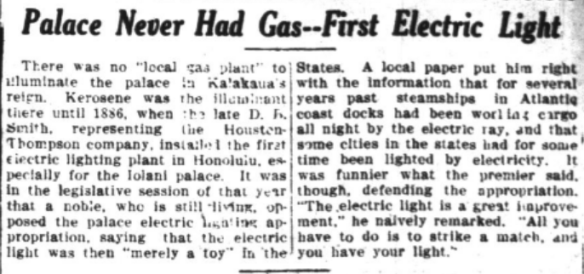
There was no “local gas plant” to illuminate the palace in Kalakaua’s reign. Kerosene was the illuminant there until 1886, when the late D. P. Smith, representing the Houston-Thompson company, installed the first electric lighting plant in Honolulu, especially for the Iolani palace. It was in the legislative session of that year that a noble, who is still living, opposed the palace electric lighting appropriation, saying that the electric light was then “merely a toy” in the States. A local paper put him right with the information that for several years past steamships in Atlantic coast docks had been working cargo all night by the electric ray, and that some cities in the states had for some time been lighted by electricity. It was funnier what the premier said, though, defending the appropriation. “The electric light is a great improvement,” he naively remarked. “All you have to do is to strike a match, and you have your light.”

(Honolulu Star-Bulletin, 1/11/1913, p. 8)

Palace Never Had Gas--First Electric Light

Honolulu Star-Bulletin, Volume XX, Number 6482, Page 8. January 11, 1913.