ALIKA
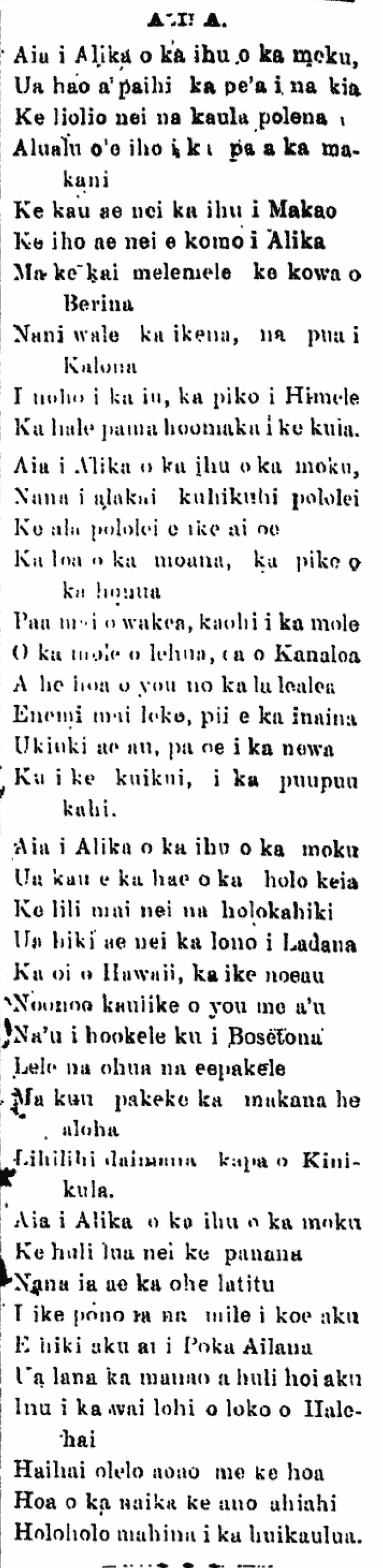
Lei Momi, Buke I, Helu 9, Aoao 4. Iulai 1, 1883.


Lei Momi, Buke I, Helu 9, Aoao 4. Iulai 1, 1883.
1—Liliu e, noho nani mai,
Ko kino e, kii milimili.
2—Ko maka e, noweo wale,
Ko papalina, e kuku ana.
3—Ko poohiwi, kii peahi,
Ko poli e, nahenahe wale.
4—Ko kuli e, nuku moi oe,
Ko wawae, Pahu ai luna.
5—E o e Liliu i ko wehi,
Ko hae kalaunu a o Hawaii.
6—Haina ia mai ana ka puana,
Liliuokalani noho nani mai.

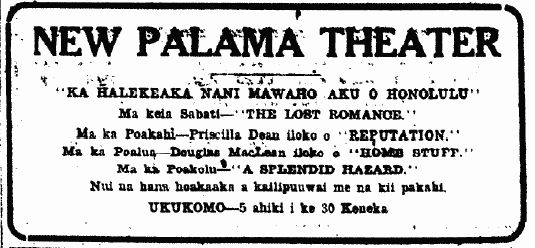
Nupepa Kuokoa, Buke LXI, Helu 3, Aoao 2, Ianuari 20, 1922.
“The Beautiful Theater Outside of Honolulu”
This Sunday—”The Lost Romance”
On Monday—Priscilla Dean in “Reputation”
On Tuesday—Douglas MacLean in “Home Stuff”
On Wednesday—”A Splendid Hazard”
Each movie is filled with scenes that make you laugh and tug at your heartstrings
Entrance—5 to 30 cents
(Kuokoa, 9/9/1921, p. 5)
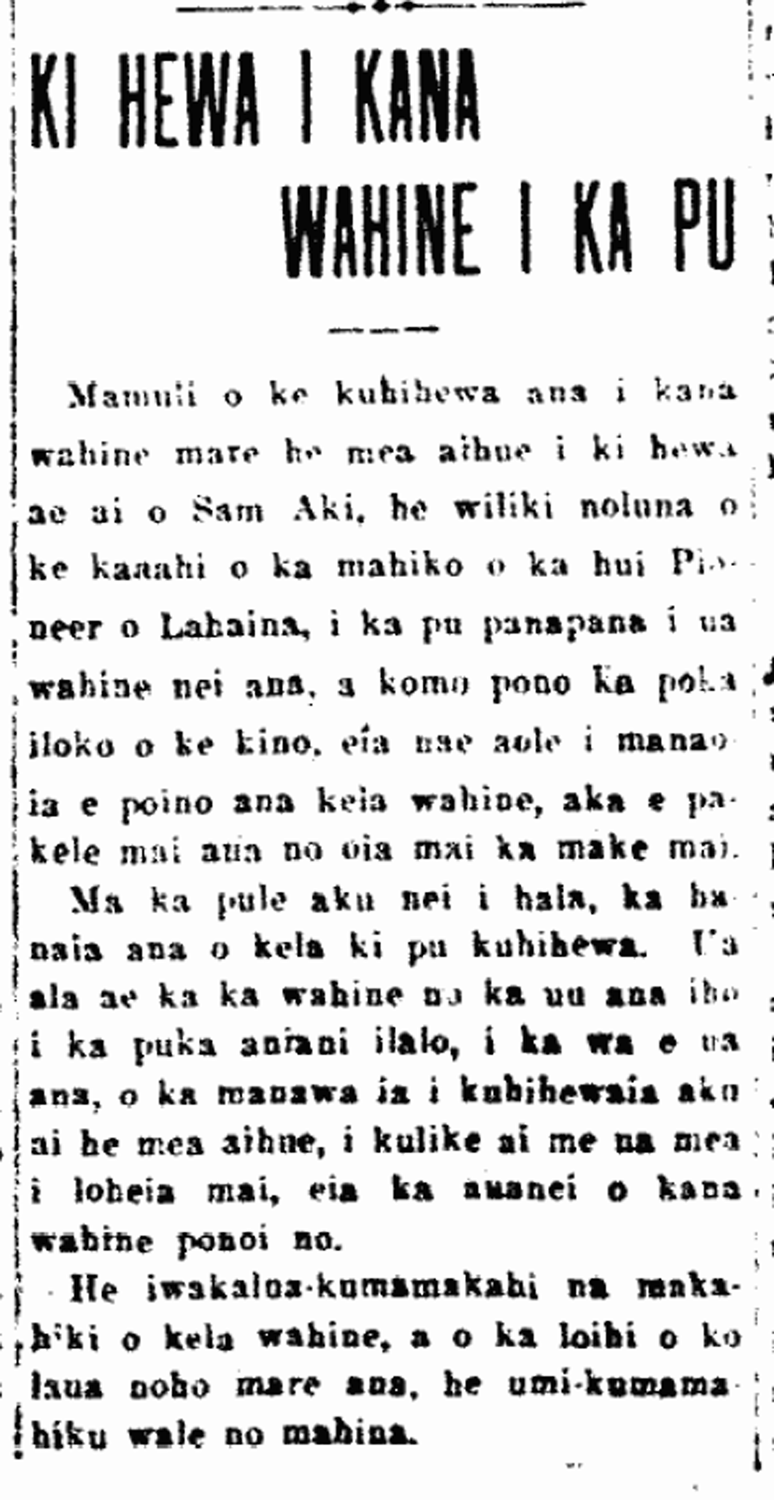
Nupepa Kuokoa, Buke LIX, Helu 49, Aoao 5. Dekemaba 9, 1921.
Because he mistook his wife to be a robber, Sam Aki, an engineer for the steam engine of the Pioneer Mill in Lahaina, shot his wife by mistake, and the bullet pierced her body although it is believed that she is not facing danger and will escape death.
This shooting by mistake took place this past week. The wife woke up to pull down the window while it was raining, and that is when she was mistaken for a thief, like what is being heard; but to his surprise, it was his own wife.
The woman is twenty-one years old, and they have been married for only seventeen months.
(Kuokoa, 10/17/1913, p. 1)
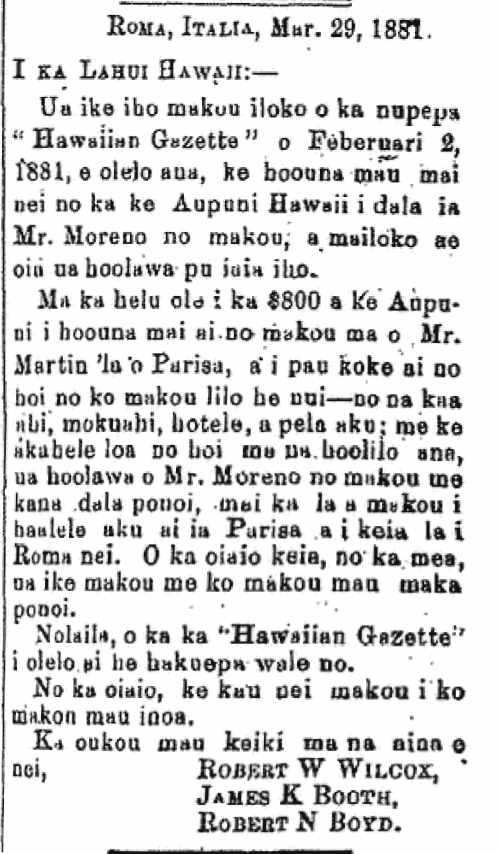
Nupepa Kuokoa, Buke LI, Helu 41, Aoao 1. Okatoba 17, 1913.
TO THE LAHUI HAWAII:—
We saw in the newspaper “Hawaiian Gazette” of February 2, 1881, where it states, that the Hawaiian Government constantly sends money to Mr. Moreno for us, and from within this sum, he supports himself.
Without counting the $800 that the Government sent for us by way of Mr. Martin of Paris, that was soon spent on our many expenses—for the trains, steamships, hotels, and so forth; while being careful with our spending; Mr. Moreno took care of the remainder with his own money, from the day we left Paris until this day here in Rome. This is the truth, for we saw this with our own eyes.
Therefore, what the “Hawaiian Gazette” said was plain deception.
To attest to the truth, we affix our names.
Your children in foreign lands,
Robert W. Wilcox,
James K. Booth,
Robert N. Boyd.
(Ko Hawaii Pae Aina, 5/14/1881, p. 3)
Ko Hawaii Pae Aina, Buke IV, Helu 20, Aoao 3. Mei 14, 1881.
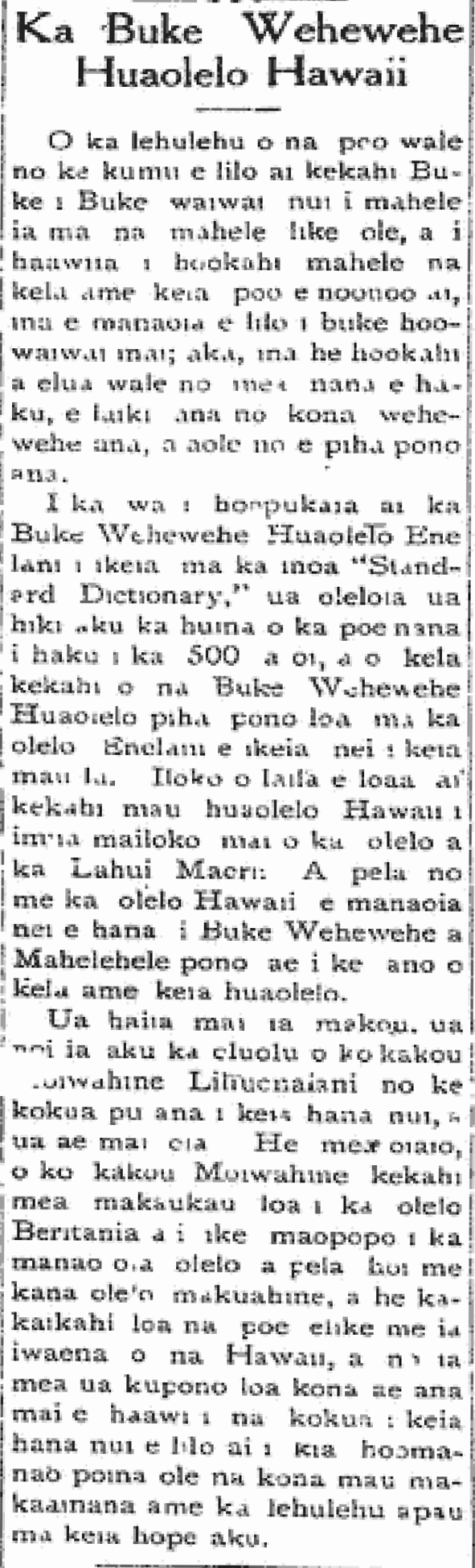
A great number of experts makes a Book a highly valuable Book, divided into many categories, each of which is given to a certain leader to think over, should it be intended to become a useful book; however, if it is composed by just one or two, the explanations will be limited and not complete.
When the English Dictionary, known as the “Standard Dictionary,” was published, it is said that the number of people who produced it is 500 or more, and that is one of the most complete dictionaries of the English language known these days. Within it, there are some Hawaiian words found within the language of the Maoris. And so too with the Hawaiian language, the producing of a Dictionary which clearly defines each word, is now being considered.
We have been told that our Queen Liliuokalani has been asked to help in this great endeavor, and she agreed. It is true, our Queen is very adept at English and understands that language, as well as her own mother tongue, and it is rare to find a person like her amongst the Hawaiians; therefore, it is proper that she agreed to give her assistance to this big project which will become an unforgettable monument for her people and for all people in the future.
(Holomua, 10/4/1913, p. 4)
Holomua, Buke I, Helu 1, Aoao 4. Okatoba 4, 1913
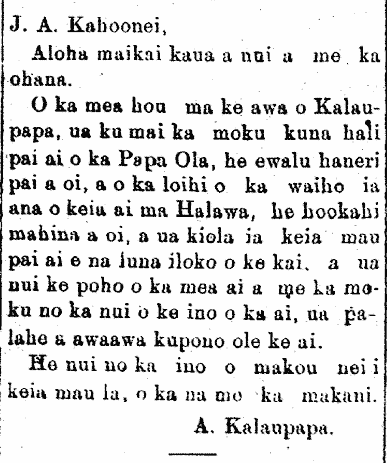
J. A. Kahoonei [of the newspaper “Nupepa Elele”],
Much aloha between us and the family.
The news from the port of Kalaupapa is that the rations-bearing schooner of the Board of Health arrived; there was eight-hundred pa‘i ‘ai or more which were left at Halawa for a whole month or more and then dumped into the ocean by the luna; a lot was wasted, being thrown into the sea [a me ka moku?] because of the great spoilage—it was rotten and too sour to eat.
It has been very stormy these past days with rain and wind.
A. Kalaupapa
(Nupepa Elele, 2/28/1891, p. 4)
Nupepa Elele, Buke XII, Helu 29, Aoao 4. Feberuari 28, 1891.
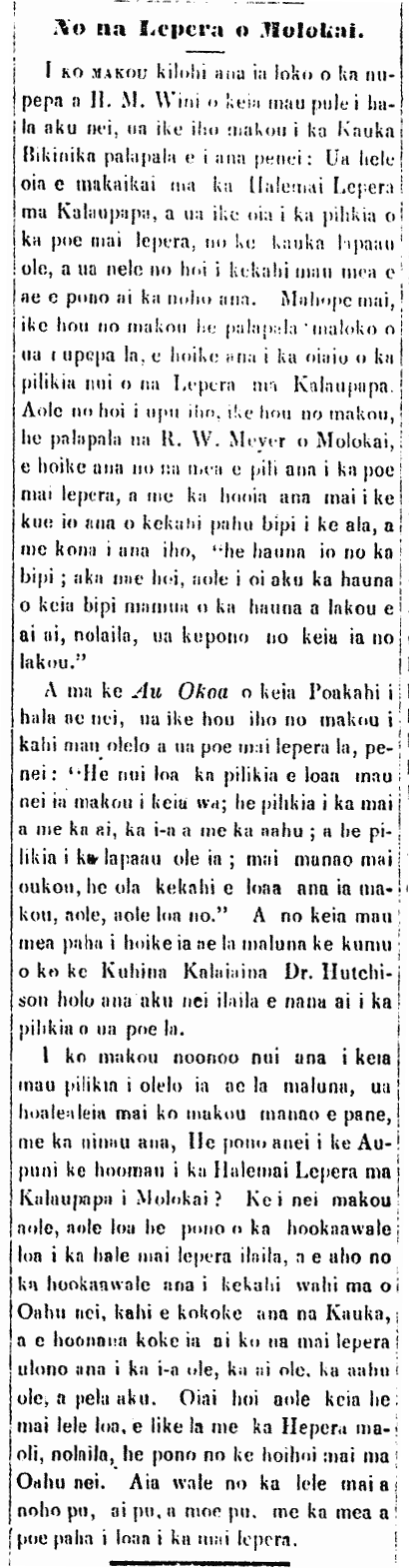
Looking through H. M. Whitney’s newspaper [Pacific Commercial Advertiser? Nupepa Kuokoa?], of these past weeks, we came upon Dr. Bikinika [?]’s letter stating that he went to tour the Leprosy Hospital in Kalaupapa, and witnessed the plight of the leprosy patients—the lack of doctors and the lack of other living necessities. Later, we saw another letter in the same paper confirming the many difficulties of the patients in Kalaupapa. We did not imagine we’d see another letter, by R. W. Meyer of Molokai, speaking about things relating to the patients, and saying that there indeed was a crate of beef on the street, adding, “The beef was spoiled, but it was no more spoiled than what they eat, so it is fine for them.”
And in the Au Okoa of this past Monday, we again saw talk of the leprosy patients, as follows: “We are always facing many difficulties these days; there are problems with sickness, food (‘ai and i‘a), and clothing; we are troubled because we have no medical care—do not imagine that there is a life for us, for that is not at all the case, not at all.” And it is perhaps because of this statement above that the Minister of the Interior, Dr. Hutchison went there to see the difficulties of those people.
After much consideration of these problems shown above, we are stirred to respond with the question, “Is is right for the Government to continue the Leprosy Hospital in Kalaupapa, Molokai?” We say, “No, it is definitely not right to totally separate the leprosy housing there, and instead, to set aside a place here on Oahu, someplace close to Doctors; and the cries of the patients for lack of food, clothing, and so forth, can be immediately looked at. Being that this is not an extremely contagious disease like smallpox, they should be returned to Oahu. It can only be spread by living together, eating together, sleeping together with one or more of the people who have leprosy.
(Kuokoa, 2/23/1867, p. 2)
Nupepa Kuokoa, Buke VI, Helu 8, Aoao 2. Feberuari 23, 1867.
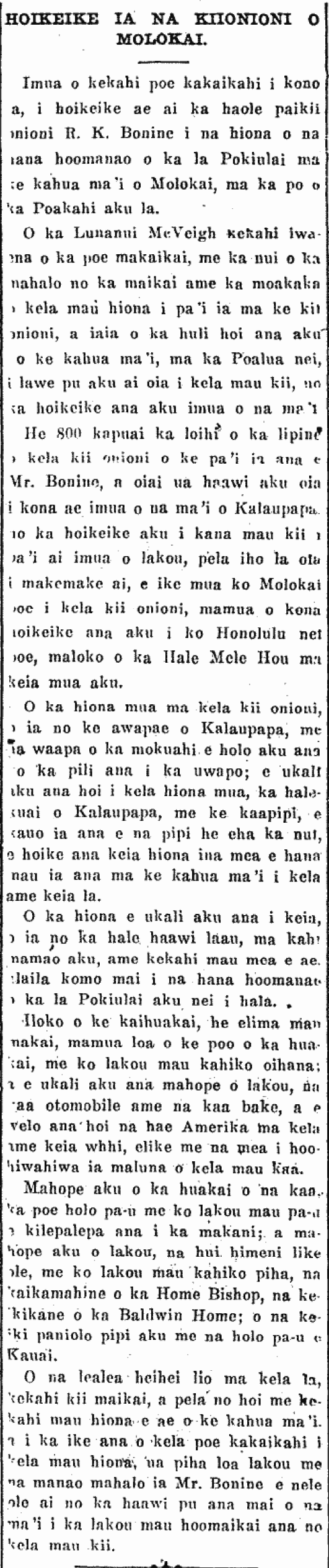
Before a few invited people, the haole film maker, R. K. Bonine showed views of the celebration of the fourth of July at the land of the patients on Molokai, on the night of this past July 4th.
Superintendent McVeigh was amongst the audience, and was much appreciative of the quality and clarity of these views shot on film; and when he returned to the land of the patients this Tuesday, he took with him the movie to show before the patients.
The movie taken by Mr. Bonine was 800 feet in length, and as he agreed before the patients of Kalaupapa to show the movie he shot before them, therefore, he wanted Molokai’s people to see that movie first before him showing it to Honolulu’s people at the Opera House in the future.
The first scene in the movie is the port of Kalaupapa, with the skiffs of the steamship approaching the harbor; accompanying this first scene is the store of Kalaupapa, with a oxcart pulled by four oxen—this scene shows everyday life at the land of the patients.
The scene following this is the infirmary, which is far away, and some other things; and then it moves to the celebration of this past fourth of July.
In the parade are five police, all the way at the head of the parade, with their uniforms; following behind them are the automobiles and the Chinese carts [kaa bake?], and American flags wave everywhere like the ones decorating those vehicles.
After the parading cars were those pa-u riders with their skirts fluttering in the wind; and after them were the various singing groups all dressed up in their uniforms, the girls of Bishop Home, the boys of Baldwin Home; and following that was the cowboys and the pa-u riders of Kauai.
The entertaining horse races of the day is another good scene, along with some other views of the land of the patients; and when that small crowd saw these scenes, they were full of appreciation for Mr. Bonine, and the patients will certainly not fail to give their thanks for the movie.
(Kuokoa, 8/15/1915, p. 3)
Nupepa Kuokoa, Buke LIII, Helu 33, Aoao 3. Augate 13, 1915.
Thank you to Aiko for sharing this page put up by Kapiolani Community College Library! It is always interesting to see how Hawaii was/is seen by the outside world.

