Our Museum, continued, 1900.

OUR MUSEUM

The Bishop Collection of Curios.

One of the Most Interesting Sights In Honolulu Pleasantly Described.

(Concluded.)

Death seems to have played an important part in the ancient regime, as the kings and chiefs had the power of life and death over their subjects. Then too, the priesthood, or kahunas, exercised what is termed the “tabu,” which prescribed certain rules and regulations for the natives, any violation of which was punishable by death; for instance a chief placed “tabu” sticks at the entrance to his hut; that meant to one and all, “Do not enter or pass within the shadow of the tabu sticks under pain of death;” if a Hawaiian subject, and even a petty chief, violated this tabu, he was instantly put to death; supplication was of no avail. The power of the kahunas in their exercise of the tabu, was so great and the superstitious awe of the common native so intense, that its effects have not died out even in this day and age. The common natives are yet prone to believe in their kahunas, and believe that they have the power to pray them to death; in olden days, if an enemy obtained any part of the body of another, a hair, a part of the finger nail, spittle, or anything of the body itself, he would give it to a kahuna and ask him to pray the other one to death; with great ceremony the kahuna would perform certain mysterious functions over the hair, say strange words, offer it before the poison god, and then announce that he was praying the native to death; this being told to the native so great his superstitious fear, he would go to his hut and in reality become sick over the thought of the dread summons made by the kahuna, and in many cases they actually died of the fright thus given them; and to this day many of the natives place more faith in their kahunas than in the “haole” or foreign physicians. If the praying did not perform the evil work, then a piece of the poison god was steeped and the fluid given the sufferer, it is said, which, acting upon his heart, killed him. On every hand in the museum are the evidences of kahunaism and death. There are stones, peculiarly shaped, (like a gourd,) with a small neck; these stones were suspended from the low door of a grass house in such a way that the person entering after the trap was set, would probably be crushed by the fall of the stone. They are made from lava rock. Continue reading

Still Our Museum Today! 1900.

OUR MUSEUM

The Bishop Collection of Curios.

One of the Most Interesting Sights In Honolulu Pleasantly Described.

HONOLULU, Feb. 8.—Above the inner entrance to the Museum of Hawaiian and Polynesian History is a tablet of polished mottled stone, in which is engraved in letters of gold the following inscription:

To the Memory of
BERNICE PAUAHI BISHOP,
FOUNDER OF THE KAMEHA-
MEHA SCHOOLS OF HO-
NOLULU.
A Bright Light Among Her Peo-
ple; Her Usefulness Survives
Her Earthly Life.

A Bernice Pauahi, she was related to the royal family of the Kamehameha dynasty, and the cousin of Queen Emma, two women who have indelibly inscribed their names upon the hearts of…

BERNICE PAUAHI BISHOP.

…all Hawaiians, whether by birth of association. She married the Hon. C. R. Bishop, and with her immense wealth and her kindly deeds through life, created a new life among the Hawaiians. Upon her death she left most of her wealth to endow the Kamehameha Schools, a separate school for boys and a separate one for girls. These schools are kept up entirely from the income of her estates, which have become so vast as to render it necessary to erect other buildings throughout the Islands in order to expend the revenue. In memory of his wife, the Hon. C. R. Bishop dedicated the museum in her name, laying aside a princely endowment. Collectors have scoured the Hawaiian Islands for curios of historical and intrinsic value and have succeeded by the most diligent effort and at great expense, in depositing in the museum an invaluable collection of ancient materials which would warm the cockles of the antiquarian’s heart beyond measure. Calabashes, large and small, ancient and modern, have come into the museum; some were in the possession of families, relics passed from one generation to another; others were found in the caves where in ancient times were buried kings and chiefs. Idols of grotesque shapes, dedicated to all the elements of nature, good and evil; some dedicated to Pele, the Goddess of Volcanoes; others to the poison god and to the fish god; some made of stone, others of the valuable koa and kou woods; one made of the trunk of the poison tree, its wood, upon being steeped in water, being a most powerful, yet undetectable poison which acts upon the heart, and which was used by the kahunas and chiefs. Beautiful feather cloaks of wonderful sheen and delicate texture, worn by Kamehameha the Great during his tour of conquest a century ago. Continue reading

Queen Emma sends condolences to Mataio Kekuanaoa, 1866.

News of the Royal Court

Through the kindness of His Highness Mataio Kekuanaoa, we put before our readers these loving words of our Queen Emma.

Upper Gore Lodge, England
Kensington, July 23, 1866.

My Father; Much Aloha:

During these dark days of distress of ours and the nation, I have much aloha for you and the One who left us. Alas for my sister-in-law [kaikoeke], my companion of the land from when we were children. The sun and the rain are companions, joined together by us are the sea spray and the rains steady on the barren fields and the forests; your leader of the islands. How sad; aloha for that lei of ours, my child, and aloha for my dear husband. Alas for you all! My heart is troubled as I am separated alone in a foreign land. It is as if this trip to introduce the Archipelago to the Great Nations of the World is a waste of time. But be patient, O Father, don’t give up, and leave us. For there is one who remains from your loins. Be patient.

With a heavy heart,

Your child,

(Signed) Kaleleonalani.

[There were so many deaths amongst the alii during these years, Ka Haku o Hawaii and Kamehameha IV, and now, Victoria Kamamalu. Not long after, her hanai mother, Grace Kamaikui Young Rooke would pass on. These were indeed dark days for Queen Emma.]

(Kuokoa, 10/6/1866, p. 2)

Kuokoa_10_6_1866_2.png

Ka Nupepa Kuokoa, Buke V, Helu 40, Aoao 2. Okatoba 6, 1866.

Queen Emma in New York, 1866.

THE DISTINGUISHED VISITOR.

Emma, the Queen Dowager of the Sandwich Islands, Visits Brooklyn, the Navy Yard, and Sails Down the Bay—Callers at Her Hotel Yesterday, &c.

Her Majesty of the Sandwich Islands, Emma, is determined, it would appear, to see the lions of the famed city of New York while she has the opportunity, and yesterday she extended the pardonable curiosity, which it is not scandalum magnatum to say her Majesty shares with the rest of her sex, to the sister city of Brooklyn. At half-past nine in the morning Queen Emma left her hotel, accompanied by Miss Grinnell, Miss Spurgeon, Major Hopkins, and lady-in-waiting, and drove down Broadway, to the Fulton ferry, whence Her Majesty and suite crossed to Brooklyn. The first place visited was Greenwood cemetery, with the beautiful scenery around which the party was much delighted. On the way back, they stopped at the photographic gallery in Fulton street, where the Queen sat for her portrait.

VISIT TO THE BROOKLYN NAVY YARD.

Pursuant to the announcement made in yesterday’s Herald the entire party then paid a visit to the Brooklyn Navy Yard. The hour appointed for her arrival was half-past one o’clock, and for one hour an assemblage of the citizens of Brooklyn and elsewhere commenced collecting until the mass numbered upwards of three thousand persons. The gates of the yard were closed to all persons except those who had passes signed by the chief officers. Half-past one arrived, but no tidings were received of the Queen. The crowd commenced to get impatient, jokes were passed to and fro to the parties on both sides of the street, when at length, at twenty minutes to two, two open carriages appeared in sight, containing the Queen, suite and attendants. It was observed as the carriages entered the yard that the first one contained her Majesty, Miss Spurgen, maid of honor; Mr. and Miss Odell; and the second Major C. Gordon Hopkins, of the Hawaiian army, and Miss Grinnell, maid of honor. As the party entered the gates the marine guard were formed in line and received her Majesty at “present arms.” She returned the compliment with a polite bow, the carriages proceeding to Admiral Bell’s quarters, in the Lyceum building. Arriving at this point the honored guest was received and assisted from her carriage by Captain Alexander M. Pennock, chief executive officer of the Navy Yard, who in turn introduced her to Rear Admiral Charles H. Bell, the commandant. The Admiral tendered his arm to the Queen, who promptly accepted it, and the party proceeded to the portico on the second story of the Lyceum. When Queen Emma alighted, the Marine battalion, commanded by Captain Collier, were drawn up in line, presented arms, while the Navy Yard band played the air of “Hail Columbia.” A detachment of the crew of the United States ship Vermont fired a salute of twenty-one guns from the Cob deck battery, and the Hawaiian flag was displayed at the main topgallant masthead. Continue reading

Queen Emma travelling abroad a hundred and fifty years ago, 1866.

Queen Emma.

From what we heard last of our beloved Queen, she is staying at Hyeres in the south of France. We are happy to say that she is in very good health, and so too her entourage. In accordance with the kind invitation by His Highness, the Minister of the Navy [??? Kuhina o na moku], she went to tour the areas where the weapons are stored and the port of Toulon, and she was welcomed hospitably and treated with all honors appropriate to her position. A great feast was given in the evening of the day she went there. Continue reading

Uluniu, land of the former home of King Kalakaua, sold, 1915.

A PORTION OF THE HOUSE LOT OF KUHIO WAS SOLD.

That section of the land known as Uluniu which faces Kalakaua Avenue stretching from Ainahau to the area very close to the residence of Representative Kuhio, went to the new owner, Percy M. Pond, through a sale on the morning of this past Friday.

The land is almost six acres, and includes a majority of the house lot in Waikiki previously owned by Prince Kuhio. According to what is being said in public, it went for the price of $32,500. Continue reading

“What always carries the crowd away,” 1893 / today / forevermore.

WHAT THEY SING.

What Always Carries the Crowd Away.

The patriotic song, “Kaulana na Pua o Hawaii,” composed and sung by the Hawaiian National Band at their concerts, has been put into English by “Makee Aupuni”:

Standing by our native land
Are we sons of Hawaii nei,
Daring a false and treacherous band,
Whose minions come from o’er the sea.

Responds our hearts from isle to isle,
Resolved to die before we yield,
Our ancient birthright ne’er defile,
We’ll spill our blood on freedom’s shield.

Responds Hawaii of Keawe
To farthest sands of green Mano,
Piilani’s land, and Kakuhihewa’s sand,
Shall witness that we face the foe. Continue reading

“An Adornment for the Patriots,” 1893.

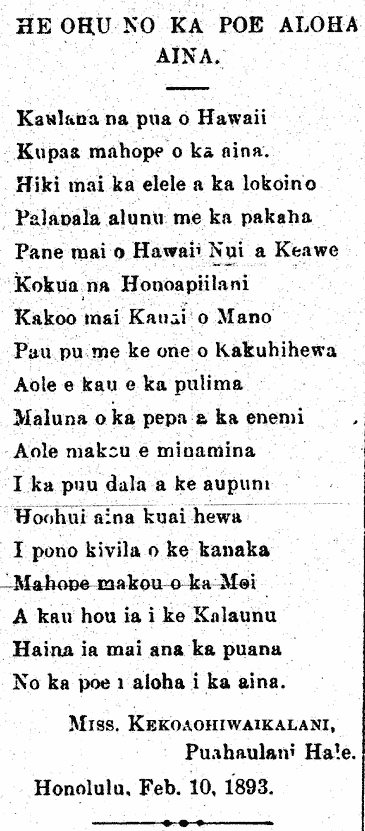
HE OHU NO KA POE ALOHA AINA.

Kaulana na pua o Hawaii
Kupaa mahope o ka aina
Hiki mai ka elele o ka lokoino
Palapala alunu me ka pakaha
Pane mai o Hawaii Nui a Keawe
Kokua na Honoapiilani
Kakoo mai Kauai o Mano
Pau pu me ke one o Kakuhihewa
Aole e kau e ka pulima
Maluna o ka pepa a ka enemi
Aole makou e minamina
I ka puu dala a ke aupuni
Hoohui aina kuai hewa
I pono kivila o ke kanaka
Mahope makou o ka Moi
A kau hou ia i ke Kalaunu
Haina ia mai ana ka puana
No ka poe i aloha i ka aina.

Miss Kekoaohiwaikalani,

Puahaulani Hale.

Honolulu, Feb. 10, 1893.

[This is perhaps the very first publication of Ellen Kekoaohiwaikalani Prendergast’s “Kaulana na Pua:” “An Adornment for the Patriots.” Was the idea about eating stones not in the original composition and added on after the Hawaiian National Band [Bana Lahui] was told by Herny Berger that they would have to sign their names to the annexation club roll lest they end up having to eat stones? The first time it seems that the lines about eating stones was published was under the title “He Inoa no na Keiki o ka Bana Lahui” [A Name Song for the Boys of the Hawaiian National Band]  in 3/23/1893 on the second page of Hawaii Holomua.]

(Leo o ka Lahui, 2/24/1893, p. 3)

LOKL_2_24_1893_3.png

Ka Leo o ka Lahui, Buke II, Helu 649, Aoao 3. Feberuari 24, 1893.

Cannons from the Haaheo o Hawaii wreck, 1857.

Wreck of the “Pride of Hawaii.”

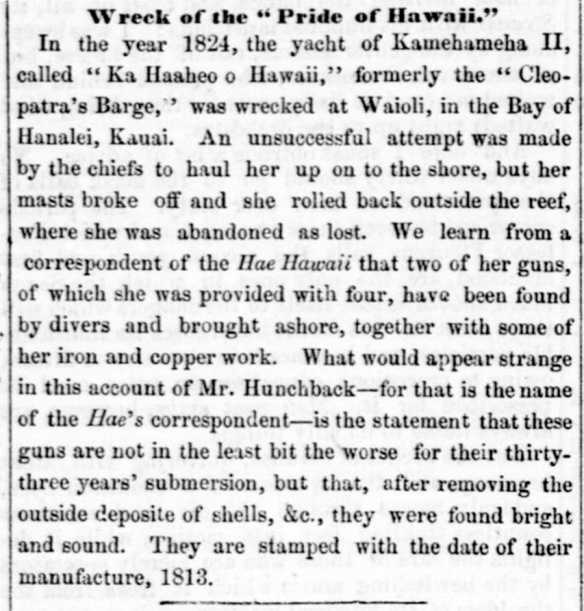
In the year 1824, the yacht of Kamehameha II, called “Ka Haaheo o Hawaii,” formerly the “Cleopatra’s Barge,” was wrecked at Waioli, in the Bay of Hanalei, Kauai. An unsuccessful attempt was made by the chiefs to haul her up on to the shore, but her masts broke off and she rolled back outside the reef, where she was abandoned and lost. We learn from a correspondent of the Hae Hawaii that two of her guns, of which she was provided with four, have been found by divers and brought ashore, together with some of her iron and copper work. What would appear strange in the account of Mr. Hunchback—for that is the name of the Hae‘s correspondent—is the statement that these guns are not in the last bit the worse for their thirty-three year’s submersion, but that, after removing the outside deposite of shells, &c., they were found bright and sound. They are stamped with the date of their manufacture, 1813.

(Polynesian, 5/23/1857, p. 5)

Polynesian_5_23_1857_5.png

The Polynesian, Volume XIV, Number 3, Page 5. May 23, 1857.

What was the Bishop Museum Director thinking, 1898.

OLD CANNONS.

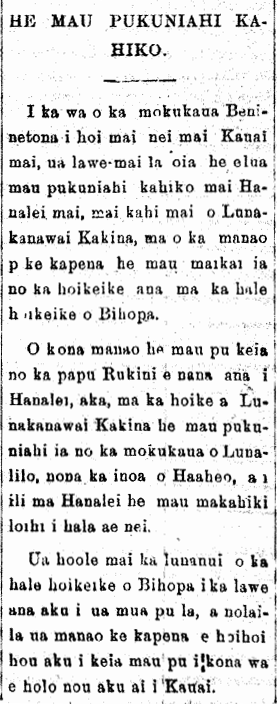
When the warship Bennington returned from Kauai, it brought two old cannons from Hanalei, from the place of Judge Thurston [Lunakanawai Kakina], with the thought of the captain that these would be fine objects for the Bishop Museum to display.

He believed that these were cannons from the Russian fort facing Hanalei, but according to Judge Thurston’s statement, they were cannons form the warship of Lunalilo named Haaheo [Haaheo o Hawaii], and it ran aground at Hanalei many years ago.

The director of the Bishop Museum refused to take the guns, and so the captain thinks he will return the guns when he returns to Kauai.

[This was the ship of Liholiho, Kamehameha II, and not Lunalilo. There was much press about it last year! Go check out the exhibit at Kauai Museum on the Haaheo, showing now!! Does anyone know what became of these cannons?]

(Aloha Aina, 12/3/1898, p. 1)

AlohaAina_12_3_1898_1.png

Ke Aloha Aina, Buke VI, Helu 49, Aoao 1. Dekemaba 3, 1898.