Why are some religions “real” while others are “superstitions,” “myths,” and “legends”? 1905 / today.

WAKEA THE POLYNESIAN

(By Rev. W. D. Westervelt in Paradise of the Pacific.)

The fountain source of the Mississippi has been discovered and re-discovered. The origin of the Polynesian race has been a subject for discovery and re-discovery. The older theory of Malay origin as set forth in the earlier encyclopædias is now recognized as untenable. The Malays followed the Polynesians rather than preceded them. The comparative study of Polynesian legends leads almost irresistibly to the conclusion that Polynesians were Aryans, coming at least from India to Malaysia and possibly coming from Arabia, as Fornander of Hawaii so earnestly argues. It is now accepted that the Polynesians did not originate from Malay parentage, and that they did occupy for an indefinite period the region around the Sunda Straits from Java to the Molucca Islands, and also that the greater portion of the Polynesians was driven out from this region and scattered over the Pacific in the early part of the Christian Era. The legends that cluster around Wakea have greatly aided in making plain some things concerning the disposition of the Polynesians. By sifting the legends of Hawaii-loa, we learn how the great voyager becomes one of the first Vikings of the Pacific. His home at last is found to be Gilolo of the Molucca Islands. From the legends we become acquainted with Wakea (possibly meaning “noonday” or “the white time” and his wife Papa (“earth”), the most widely remembered of all the ancestors of the Polynesian race. Their names are found in the legends of the most prominent island groups, and the highest places are granted them among the chief dieties. Their deeds belong to the most ancient times—the creation or discovery of the various islands of the Pacific world. Those who worshipped Wakea and Papa are found in such widely separated localities that it must be considered impossible for even a demi-god to have had so many homes. Atea or Wakea was one of the highest gods of the Marquesas islands. Here his name means “light.” The Marquesans evidently look back of all their present history and locate Atea in the ancient home land. Va-tea, in the Society Islands, Wakea in Hawaii and New Zealand, Makea-Vakea and Akea are phonetic variations of the one name when written down by the students who made a written form for words repeated from generation to generation by word of mouth alone. Even under the name Wakea this ancient chief is known by most widely separated islands. The only reasonable explanation for this widespread reference to Wakea is that he was an ancestor belonging in common to all the scattered Polynesians. It seems as if there must have been a period when Wakea was king of chief of a united people. He must have been of great ability and probably was the great king of the United Polynesians. If this were the fact it would naturally result that his memory would be carried wherever the dispersed race might go.

In the myths and legends of the Hervey Islands, Vatea is located near the beginning of their national existence.” Then there came upon the ancient world Te Vaerua, “the breath” or “the life.” Then came the god time—Te Manawa roa, “the long ago.” Then their creation legends locate Vari, a woman whose name means “the beginning,” a name curiously similar to the Hebrew word bara, to create, as in Gen. 1:1. Her children were torn out of her breasts and given homes in the ancient mist land, with which without any preparation or introduction, Hawa-iki is confused in a part of the legend. One of the children of Vari dwelt in a “sacred tabu island” and became the god of the fish. Another sought a home “where the red parrots’ feathers were gathered”—the royal feathers for the high chief’s garments. Another became the echo-god and lived in the “hollow grey rocks.” Another as the gods of the winds went far out “on the deep ocean.” Another, a girl, found a home, “the silent land,” with her mother. Wakea, or Vatea, the eldest of this family remained in Avaiki (Hawaii) the ancestral home—”the bright land of Vatea.” Here he married Papa. This Ava-iki was to the Herveyites of later generations the fiery volcanic under-world. When the long sea voyages ceased after some centuries, the islanders realized that Ava-iki was very closely connected with their history. They had but a misty idea of far off lands, and they did know of earthquakes and lava caves and volcanic fires—so they located Ava-iki as the secret world under their islands. This underworld with legendary inconsistency was located on the ocean’s surface, when it became necessary to have their islands discovered by the descendants of Vatea. According to the Hervey legends, Vatea is the father of Lono and Kanaloa, two of the great gods of the Polynesians. They are twins. Lono has three sons, whom he sends away. They sail out through many heavens and from Ava-iki “pull up” out of the deep ocean two of the Hervey islands. The natives of the Hervey group supposed that the horizon around their group inclosed the world. Beyond this world were heaves after heavens. A daring voyager by sailing through the sky line would break out from this world into an unknown world or a heaven bounded by new horizons. Strangers thus “broke through” from heaven to heaven, sometimes making use of the path of the sun. Thus about twenty-five generations ago Raa (possibly Laa, the Hawaiian), broke down the horizon’s bars and established a line of kings in Raiatea. So also when Captain Cook came to the Hervey Islands the natives said: “Whence comes this strange thing? It has climbed up (come up forcibly) from the thin land the home of Wakea.” He had pierced the western heavens from which their ancestors had come. Continue reading
Hula and the play “Umi-a-Liloa,” 1917.

TRULY HAWAIIAN IS ‘UMI-A-LILOA’

The hula alaapapa will be one of the special entre act features of the performance of “Umi-a-Liloa” at the opera house next Thursday evening. This hula is danced standing in contradiction to the older hulas which is called for a sitting position. It will be interpreted by a band of four young girls, who are experts in the art of the real Hawaiian dance. They are assisted by a man who beats the hula drum in old-time style. It is only in recent years that the hula has been accompanied by the music of instruments.

The second act contains an elaborate representation of the court of the king of Hawaii in the year 1640 and during the scene of the royal festivity some of the very ancient dances are introduced. They are danced, if one may call it so, sitting cross-legged upon the floor and the beauty of the performance lies in the grace and graphic intensity of the gestures of the body and arms of the dancers. Continue reading

Dirge for Abner Kahekili, 1843.

KANIKAU FOR ABENERA KAHEKILI, A CHIEF OF THIS ARCHIPELAGO WHO DIED.

1 O ke ano aloha o Liawahine
O ka maka aloha o Hikuanaka
O ke kino oioio o ka lapu loku
I moe nounounea me Hikuikapua
I luna o ke opu hiwa a Kane
I loko o ke kapa auaiku a Lono oe—
He leo keia e mapu nei
E ano nei i ke kahakai
O ka maka aloha o kuu makuakane
I walea i ka ai kihamu pua niu
Uhane auaukai o Ulakua oe—
Hoakua ka lokoino oia la—la—ia—oe—e—

2 Mehameha ia ka hele a ke aloha
Ka pee’na ku nei nanowale
Hele i Kuahaehae ka hele ana
I paepae leo me Kupinai
Me na hoa hui wale i ka nahele
Halawai ae la me Anowahine
Me ka wahine i ka iukapu o mua oe—
Eia au la i ka lipo
I walea au i ke kui pua
Lililo ai maua i ka nahele
He kamaaina no ka ua waahila
Uhane peepeeua Kukalahale oe—
Oe wale mai ana no ka manao
Aole i hoike mai i ka maka he alo—ha—ia—oe—e— Continue reading

Kahekili dies, 1843.

DEATH.

On the past 14th of March, Kahekili, an alii of Hawaii nei died here in Honolulu. He was ill for a long time, but the sickness of his body is over; he has gone far away to the place of no return. Some people will perhaps ask what was his thoughts when he was alive recently. He revealed… Continue reading

Charles Mathews performs at the Royal Hawaiian Theatre, 1871.

[Found under: “NOTES OF THE WEEK.”]

Charles Mathews in the Cannibal Islands.—This celebrated Comedian, who gave us a taste of his powers last February, writes a characteristic letter, in which he gives his impressions of us. We copy:

Reached Honolulu the capital of the Island of Oahu, and the seat of the government of the Hawaiian group, on Saturday, the 19th; eighteen days, four thousand and thirteen miles and three quarters! (accuracy again—exact as an architect’s estimate £4,000 35s. 1–2d.). Head winds (of course) all the way; longest passage (of course) ever known, and certainly the weariest. Heavy rolling seas, not a sail, or fish sighted, the only excitement we had arisen from the odd novelty of two Thursdays coming together in one week, two 9ths of February, arm-in-arm. At Honolulu, one of the loveliest little spots upon earth, I acted one night “by command, and in the presence of His Majesty Kamehameha V, King of the Sandwich Islands” (not ‘Hoky Poky Wonky Fong’ as erroneously reported), and a memorable night it was. Continue reading

More on the “King of the Cannibal Islands,” 1873.

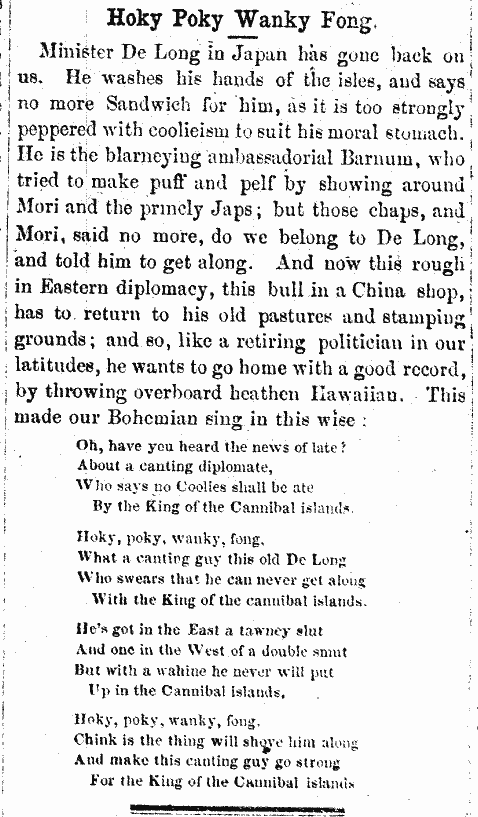
Hoky Poky Wanky Fong.

Minister De Long in Japan has gone back on us. He washes his hands of the isles, and says no more Sandwich for him, as it is too strongly peppered with coolieism to suit his moral stomach. He is the blarneying ambassadorial Barnum, who tried to make a puff and pelf by showing around Mori and the princly Japs; but those chaps, and Mori said no more, do we belong to De Long, and told him to get along. And now this rough in Eastern diplomacy, this bull in a China shop, has to return to his old pastures and stamping grounds; and so, like a retiring politician in our latitudes, he wants to go home with a good record, by throwing overboard heathen Hawaiian. This made our Bohemian sing in this wise:

Oh, have you heard the news of late?
About a canting diplomate,
Who says no Coolies shall be ate
By the King of the Cannibal islands.

Hoky, poky, wanky, fong,
What a canting guy this old De Long
Who swears that he can never get along
With the King of the cannibal islands.

He’s got in the East a tawney slut
And one in the West of a double smut
But with a wahine he never will put
Up in the Cannibal islands.

Hoky, poky, wanky, fong,
Chink is the thing will shove him along
And make this canting guy go strong
For the King of the Cannibal islands.

(Nuhou, 4/15/1873, p. 3)

Hoky Poky Wanky Fong.

Nuhou, Volume I, Number 15, Aoao 3. Aperila 15, 1873.

“Queen of the Cannibal Islands,” 1894.

A Tale for the Nursery.

Beyond the green Pacific shore,
Westward, 2,000 miles, or more,
Dwelt a lady-monarch, with griefs galore—
The queen of the Cannibal Islands.

Some people describe her as “fair,” and yet,
It must be admitted, with much regret,
She’s unmistakably a brunette,
This queen of the Cannibal Islands.

Her lot was pleasant, they say, until
Her subjects kicked ‘gainst the royal will,
And smashed the throne and christened her “Lil,”
Ex-queen of the Cannibal Islands. Continue reading

“King of the Cannibal Islands,” 1830 / 1872.

By 1830 at least, there was a mocking ballad called “King of the Cannibal Islands” that was popular in the United Kingdom (as seen in newspaper advertisements for various concerts). Click here for lyrics printed on a broadside in 1858. By many accounts this was written in response to Kamehameha II going to England in 1824.

As a result of another famous trip taken by a Hawaiian monarch in 1874, the lyrics are adapted in America (the original song popular there much earlier).

THE KING OF THE CANNIBAL ISLANDS.

[From the N. Y. Graphic.]

Tam? Tam! Kalakaua the great
Is booming through the Golden Gate;
The Polynesian potentate,
The King of the Cannibal Islands.

Chorus—Hunki-dori-doodle-dum,
Ministers all upon a bum;
Honolulu! How they come
With the King of the Cannibal Islands.

From sugar-coated Hawaii
He comes strange countries for to see;
And ‘Frisco greets him: “How are ye?
O King of the Cannibal Islands.
Hunki-dori, etc. Continue reading

Albert Kunuiakea baptized, 1862.

[Found under: “NA MEA HOU O HAWAII NEI.”]

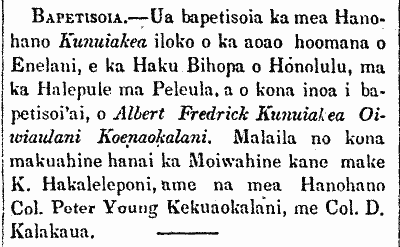
Baptized.—The Honorable Kunuiakea was baptized in the Anglican faith, by the Lord Bishop of Honolulu, at the Church at Peleula, and his name he was baptized with is Albert Fredrick Kunuiakea Oiwiaulani Koenaokalani. Present was his hanai mother, the dowager Queen K. Hakaleleponi, and the Honorable Col. Peter Young Kekuaokalani, and Col. D. Kalakaua.

(Kuokoa, 11/22/1862, p. 2)

Bapetisoia.

Ka Nupepa Kuokoa, Buke I, Helu 52, Aoao 2. Novemaba 22, 1862.