More on Kaheleiki trial: “Something not to be forgotten.” 1863.

Voyage of the Hawaiian Chiefs to San Francisco.

This past Wednesday morning [4/15/1863], the Honorable C. Gordon Hopkins [Hapakini], John Ii [Ioane Ii], Kaisara Kapaakea [Caesar Kapaakea], and J. Koii Unauna, along with the one who is involved in the dispute for whom they went to testify for, namely Harry Kaheleiki, came to shore riding aboard the ship, Yankee; and we are pleased to report the public that they are in good health.

During the trial of Harry Kaheleiki in San Francisco, there were many witnesses strongly against him; however, with the arrival of the alii mentioned above, there was true testimony in favor of the accused, and the error of those who testified against him was clear. The newspapers of San Francisco were filled with thoughts of appreciation for this Nation sending witnesses at much expense to have one of its citizens wrongly charged in a foreign land set free; according to one of the papers, this is a benevolent act not done by the enlightened Nations of the world, and so the Hawaiian Nation has taken the lead in this fine action. This is truly an act of aloha, and it is something not to be forgotten for all times.

The reason it was heard that a Hawaiian was being imprisoned in San Francisco was because of Doctor Gulick [Gulika], the one who was previously living in the islands of Micronesia, and due to weakening health, arrived in California. While he was in San Francisco several months ago, he heard that there was a Hawaiian man being held in one of the Jails there on the charge of murder; he therefore went quickly to meet with the man, and when he got there, he spoke with the aforementioned Kaheleiki, and though this conversation, it was clear in Doctor Gulick’s mind that the accused was innocent. And because Kaheleiki asked him if they could wait until witnesses were sent for from Hawaii for him, there would be many who would testify that he was innocent of the charges against him. So Doctor Gulick immediately went to the office of the Hawaiian Consul, Mr. Hitchcock [Kanikela Hawaii o Mr. Hikikoki], and told him about the circumstances of Kaheleiki and how he was certain that Kaheleiki was innocent of the charges. When the Hawaiian Consul heard of this, he went at once to meet with the accused, and upon seeing his demeanor and what he had to say, he knew for himself that Kaheleiki was innocent. He then went quickly to see the Judge to ask that the trial of Kaheleiki be postponed until he heard from here; for he had witnesses here for him. And that is how time was given to send his witnesses, and that is how he was freed. And when he sent for witnesses here, along with a letter from Doctor Gulick, and when His Highness L. Kamehameha heard of this, he along with Sheriff W. C. Parke put great effort into finding appropriate witnesses to testify for Kaheleiki, the one who was falsely charged. We are filled with appreciation for the Royal One, His Highness, and the Sheriff.

We must thank Doctor Gulick, and we are truly thankful for him in the name of all who desire that the innocent who are persecuted be freed, and in the name of all who strive to find ways to free the innocent from the hands of those who oppose them, while they live in foreign lands. God shall free the righteous.

[There are countless stories like this in the Hawaiian-Language Newspapers that should be relearned and retold and retold again, so they are not forgotten!]

(Kuokoa, 4/18/1863, p. 3)

Ka Huakai a na 'Lii Hawaii i Kapalakiko.

Ka Nupepa Kuokoa, Buke II, Helu 16, Aoao 3. Aperila 18, 1863.

More on the Kaheleiki trial, 1863.

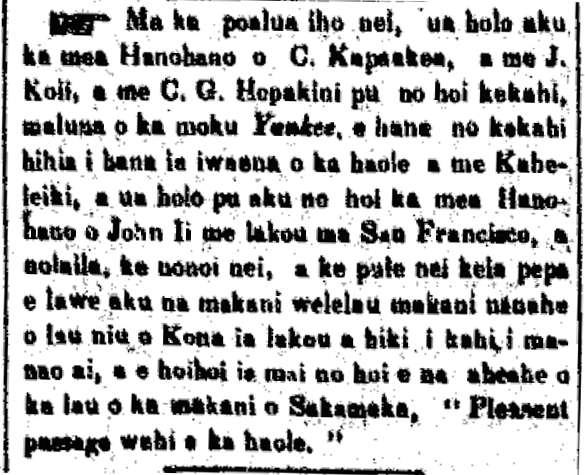
This past Tuesday [2/17/1863], the Honorable C. Kapaakea, and  J. Koii, and C. G. Hopkins also went aboard the ship Yankee, to appear in a case raised between the haole and Kaheleiki; the Honorable John Ii also accompanied them to San Francisco, and this paper hopes and prays that the fringes of the winds; the gentle winds of the coconut fronds of Kona take them to their destination, and that they are brought back by the soft puffs of the wind of Sakameka [? Sacramento]; “Pleasant passage,” according to the haole.

(Hoku o ka Pakipika, 2/19/1863, p. 2)

Ma ka poalua iho nei...

Ka Hoku o ka Pakipika, Buke 2, Helu 19, Aoao 2. Feberuari 19, 1863.

Mahalo to MAB for pointing to this article on the Kaheleiki trial, 1863.

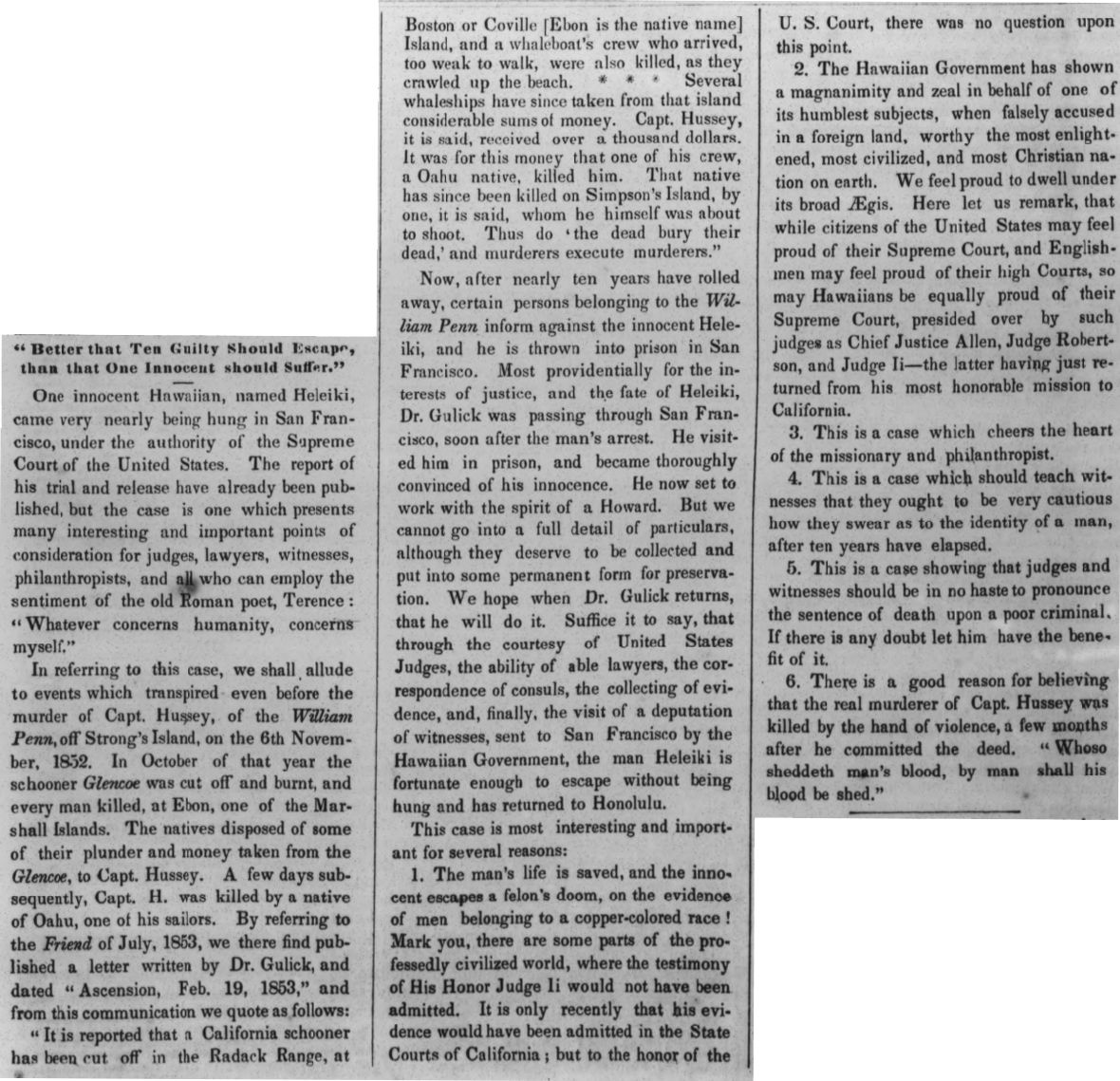
“Better that Ten Guilty Should Escape, than that One Innocent should Suffer.”

One innocent Hawaiian, named Heleiki, came very nearly being hung in San Francisco, under the authority of the Supreme Court of the United States. The report of his trial and release have already been published, but the case is one which presents many interesting and important points of consideration for judges, lawyers, witnesses, philanthropists, and all who can employ the sentiment of the old Roman poet, Terence: “Whatever concerns humanity, concerns myself.”

In referring to this case, we shall allude to events which transpired even before the murder of Capt. Hussey, of the William Penn, off Strong’s Island, on the 6th of November, 1852. In October of that year the schooner Glencoe was cut off and burnt, and every man killed, at Ebon, one of the Marshall Islands. The natives disposed of some of their plunder and money taken from the Glencoe, to Capt. Hussey. A few days subsequently, Capt. H. was killed by a native of Oahu, one of his sailors. By referring to the Friend of July, 1853, we there find published a letter written by Dr. Gulick, and dated “Ascension, Feb. 19, 1853,” and from this communication we quote as follows:

“It is reported that a California schooner has been cut off in the Radack Range, at Boston or Coville (Ebon is the native name) Island, and a whaleboat’s crew who arrived, too weak to walk, were also killed, as they crawled up the beach. * * * Several whaleships have since taken from that island considerable sums of money. Capt. Hussey, it is said, received over a thousand dollars. It was for this money that one of his crew, a Oahu native, killed him. That native has since been killed on Simpson’s Island, by one, it is said, whom he himself was about to shoot. Thus do ‘the dead bury their dead,’ and murderers execute murderers.”

Now, after nearly ten years have rolled away, certain persons belonging to the William Penn inform against the innocent Heleiki, and he is thrown into prison in San Francisco. Most providentially for the interests of justice, and the fate of Heleiki, Dr. Gulick was passing through San Francisco, soon after the man’s arrest. He visited him in prison, and became throughly convinced of his innocence. He now set to work with the spirit of a Howard. But we cannot go into a full detail of particulars, although they deserve to be collected and put into some permanent form for preservation. We hope when Dr. Gulick returns, that he will do it. Suffice it to say, that through the courtesy of United States Judges, the ability of able lawyers, the correspondence of consuls, the collecting of evidence, and, finally, the visit of a deputation of witnesses, sent to San Francisco by the Hawaiian Government, the man Heleiki is fortunate enough to escape without being hung and has returned to Honolulu.

This case is most interesting and important for several reasons:

1. The man’s life is saved, and the innocent escapes a felon’s doom, on the evidence of men belonging to a copper-colored race! Mark you, there are some parts of the professedly civilized world, where the testimony of His Honor Judge Ii would not have been admitted. It is only recently that his evidence would have been admitted in the State Courts of California; but to the honor of the U. S. Court, there was no question upon this point.

2. The Hawaiian Government has shown a magnanimity and zeal in behalf of one of its humblest subjects, when falsely accused in a foreign land, worthy the most enlightened, most civilized, and most Christian nation on earth. We feel proud to dwell under its broad Ægis. Here let us remark, that while citizens of the United States may feel proud of their Supreme Court, and Englishmen may feel proud of their high Courts, so may Hawaiians be equally proud of their Supreme Court, presided over by such judges as Chief Justice Allen, Judge Roberson, and Judge Ii—the latter having just returned from his most honorable mission to California.

3. This is a case which cheers the heart of the missionary and philanthropist.

4. This is a case which should teach witnesses that they ought to be very cautious how they swear as to the identity of a man, after ten years have elapsed.

[See earlier article: Government officials to go to California to defend a Hawaiian citizen. 1863.]

(Friend, 5/1/1863, p. 33)

"Better that Ten Guilty Should Escape, than that One Innocent should Suffer."

The Friend, New Series, Volume 12, Number 5, Page 33. May 1, 1863.

Government officials to go to California to defend a Hawaiian citizen. 1863.

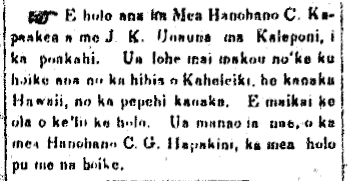
The Honorable C. Kapaakea and J. K. Unauna are headed to California on Monday. We have heard it is to serve as witness in the murder case of Kaheleiki, who is a Hawaiian. May the alii going remain in good health. It is however believed that the Honorable C. G. Hopkins [Hapakini] will accompany the witnesses.

(Hoku o ka Pakipika, 2/5/1863, p. 2)

E holo ana ka Mea Hanohano C. Kapaakea...

Ka Hoku o ka Pakipika. Buke 2, Helu 17, Aoao 2. Feberuari 5, 1863.

A newspaper called, “Lunalilo” 1873.

[Found under: “DOMESTIC NEWS”]

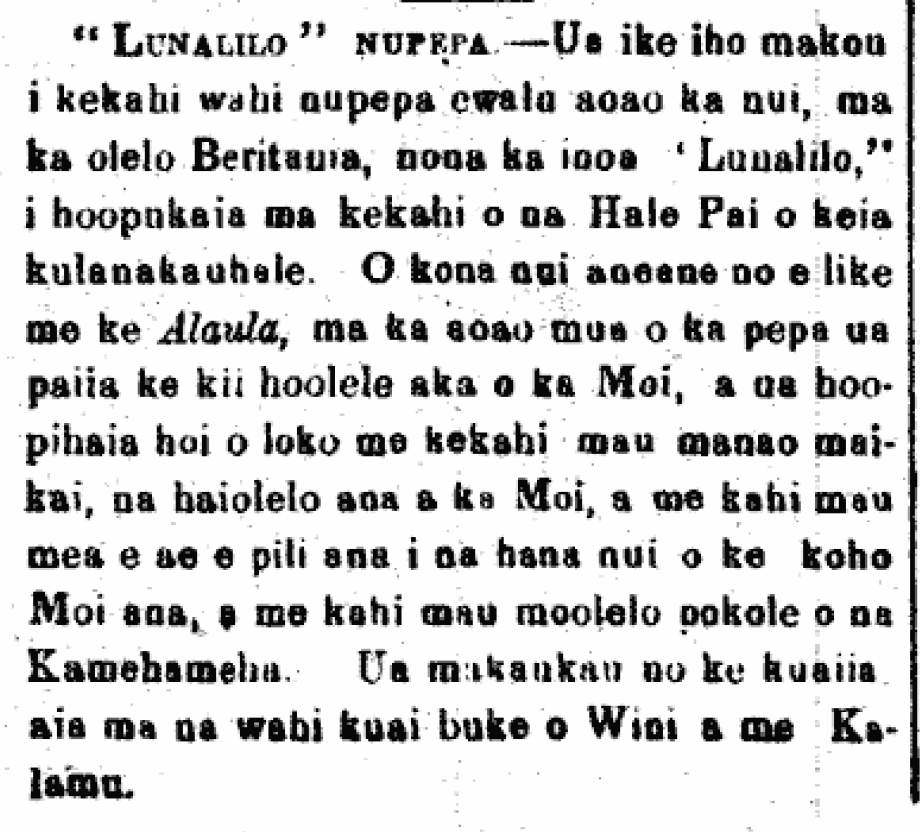
“Lunalilo” Newspaper.—We have seen a newspaper of eight sides, in the English language, with the name, “Lunalilo,” which was printed at one of the Printing Houses of this town. Its size is about the size of the Alaula, and on the first page of the paper is printed with a silhouette [kii hoolele aka] of the King, and the inside is filled with good ideas, the speeches of the King, and some other things pertaining to the election of the King, as well as some short stories about the various Kamehameha. It is ready for sale at the bookstores of Whitney [Wini] and Kalamu [Thrum].

[This is documented in the great four-volume Hawaiian bibliography by David Forbes, “Hawaiian National Bibliography, 1780-1900”]

(Au Okoa, 1/30/1873, p. 3)

"Lunalilo" nupepa.

Ke Au Okoa, Buke VIII, Helu 42, Aoao 3. Ianuari 30, 1873.

Keolaokalani Paki Bishop, 1863.

There was a Baptism at the Residence of the Honorable C. R. Bishop, “Haleakala;” baptized was the child of the honorable R. Keelikolani and J. Y. Davis, and he was called, “Keolaokalani Paki Bihopa.”

The Honorable C. R. Bishop and Pauahi (the wife of Bishop) were those who bestowed the name, and Rev. C. Corwin is the one who performed the baptism.

(Hoku o ka Pakipika, 2/12/1863, p. 2)

"He Babetizo ma ka Hale..."

Ka Hoku o ka Pakipika, Buke 2, Helu 18, Aoao 2. Feberuari 12, 1863.

Death announcement for John W. Moanauli, 1913.

THE HONORABLE MOANAULI PASSES.

He Grew Weary of this Life at His Daughter’s Place in Waikiki.

After many months of his body growing thinner with sickness, the Honorable J. W. Moanauli passed away, this Monday morning at the home of this daughter, Mrs. Kanakanui, in Waikiki.

He was seen for many sessions of the legislature in the past, a representative from the island of Hawaii; and there were many important positions that he held during various times, up until he went to sleep for all times.

The Honorable Moanauli was born in Kohala, Hawaii. He was the child of Kainapau, the first cousin of the kaukau alii Naihe of Kohala, and his mother was Namoomoo, who was a kaukau alii from Kohala.

It was at Lahainaluna School where he was educated during his youth, and he was a lawyer practicing law. For a number of sessions of the legislature, he was chosen as the representative from Hawaii, and outside of that position, he was a judge, as well as a sheriff of Hawaii for several terms.

In the year 1881, J. W. Moanauli married Mrs. Henry A. Beers of Honolulu, and he leaves his widow and children and many grandchildren behind to grieve for him.

Mr. Moanauli was a stepfather [makuakane kolea] to Mrs. S. M. Kanakanui of Honolulu; Mrs. James Cornwell of Waikapu, Maui; William Henry Beers, the county attorney [loio kalana] of Hawaii; and Mrs. Namohala of Hilo.

[Much of the more detailed genealogical information is usually available outside of the regular Vital Statistics Column. Many times beginning in the early 1900s, there is a photograph attached to death notices.

Compare this to the Vital Statistics Column announcing John W. Moanauli’s death in the same issue of the Kuokoa.]

(Kuokoa, 1/24/1913, p. 1)

HALA KA MEA HANOHANO MOANAULI

Ka Nupepa Kuokoa, Buke XLIX, Helu 4, Aoao 1. Ianuari 24, 1913.

The Bernice Pauahi Bishop Museum, and the stone awa bowl, 1919.

SEEING ONCE AGAIN THE MUSEUM AT KAMEHAMEHA SCHOOL.

Twenty years or more has past since I first saw exhibits of the antiquities of Hawaii nei and the tiny islands of Polynesia that are stored in that building, and it is of great value to those who wish to see, and it is true, there are more things stored there from when I first saw it; and there were things which shocked me while other things made me sad.

When I arrived at the museum, it was already filled with foreigners and locals going upstairs and downstairs, and soldiers were the majority, from the military ships docked those days; officers as well as enlisted men returning and going back to the battlefield, they were awestruck; and being that there was only three hours allowed for going around, and while I looked, peeped, and peered here and there, I looked at my watch and more than an hour had past, and here I was on the first floor with so much more of the building to see; therefore, I tried to quicken my pace so that I see things; but if you intended to see everything, you would not be able to do that walking around the whole day because there are so many things that catch your attention and you’d spend some minutes looking at them; and because I wanted to read the explanations and all of the stories, minutes were spent there.

There were all types of fish, birds, and fruits, war implements of all sorts of that time, and they were amazing to see; plus the animals of the land and the sea, it was as if they were living.

On the second floor were the thrones of the beloved monarchs of Hawaii nei who passed, and it was painful in my gut to see this touching sight; and their portraits hung all about, looked as if they were watching you; yes, aloha, aloha for the chiefs of the land.

The time was going quickly, and I was intent on seeing everything, and yet the time was short.

With every step on the third floor, everything was fascinating to see, and looking blow, the winding stairs were just so beautiful and everything was kept so nicely. But amongst everything I saw, there were but two most important things: the first being the thrones and all of their belongings, and the second was a huge stone which weighed more or less a ton; when I entered and met the greeter, I was given a piece of tin stamped with a number, and was asked to leave my hat and coat, and then I stood at the base of the stairs thinking where should I go first; that is when I entered the room on the mauka side of the building, greatly delighted by everything until I reached the place where the great stone stood, and I was astonished at the look and appearance of this stone;  as if it was something I saw before, but when; that is what I thought to myself; and because I was very unclear about it, I looked here and there and I saw a haole sitting at a desk reading a book; I gave my aloha and he looked at me and asked if there was something he could do for me; I said yes, if he could explain to me the story of the stone.

“Yes,” he said, “that stone is the grinding stone of the Hawaiians in the old days; it was upon that stone that adzes were sharpened, and that is the reason for that smooth indentation on the top.”

While I was listening to the explanation of that fine friend, my eyes were set directly upon that stone, and that is when I saw the description printed below it; I immediately left him and I went to read, and I was shocked and for several minutes I stood there, astounded that I met up again with this rock after a span of 55 years gone by.

That label explained that this rock was sent from Kilauea, Kauai, when George R. Ewart was boss of the Kilauea sugar plantation, in 1897, and then I went and joined my friend, and told him the truth about that stone, and its name, and its function; it wasn’t a grindstone like what he believed; and as he heard my story he began to write.

Therefore my news loving friends, so that your confusion over this stone is put to an end, and for when you go to visit this building, you won’t fail to meet up with this rock, and you will have an understanding through this story I am revealing:

The name of this stone is Kanoa, and this was a awa bowl [Kanoa awa] for the alii of that time, and this is the reason why that depression was made right on the top, and there is a place between Kilauea and Pilaa called Kanoa until this day,  named for this stone; and from this spot, the sto0ne was taken away by the boss George R. Ewart when he was the head of that sugar plantation, and this place became the graveyard for the Portuguese, and a Catholic Church [Saint Sylvester Church] stands there until today near the government road.

It was 55 years ago that I first set my eyes on this stone, during those days when the land was forested, and beneath a pandanus tree was where this stone was placed; its height from the ground was perhaps a foot or so, and this Kanoa awa was crafted with great skill and at its side was the cup [apu], which was a smaller stone fashioned like an awa cup.

From what my kupuna told me, this Kanoa belonged to some chiefs and where the Kanoa was left was where a great house one stood, which was a place where the alii of the old times would enjoy themselves. And I was also informed of the alii to whom belonged the Kanoa; Kamoku was the man, and this is a hill that stands to this day in the middle of a field, and should a malihini go and see that Catholic church mentioned earlier, that place is Kanoa, and if you turn to look inland, about two miles away a hill stands like a heap of lava, and below all around it grow all sorts of plants, and from the middle until the top is pilipiliula grass, and today on its peak is a grove of tall pine trees planted after the owner of this land, Mr. C. Bertelman, died and his body was brought and buried some years ago; as for the chiefly woman, she was Kahili, and this is a land immediately seaward of this place, with a huge estuary where fishes of all types swim today.

Should the alii want to have fun, the chiefess went up with poi and fish, and Kamoku went down with the intoxicating awa of the uplands of Kahua-a, bundles of oopu fish, mokihana lei of Kahihikolo, dark shrimps [opae kuauli] of Kaluaokalani, and it was in this house that they would enjoy themselves with their people; that is the whole story dealing with this stone, a awa bowl for the chiefs.

If Mr. George R. Ewart had known of yet another stone that is in Kilauea in Kalihiwai, which rings like a bell, and it is rounded flat, and its sound can be heard for a mile or more if it is struck with a hammer or a rock in other times, and it was something played with by school children; then it would have probably been taken by Mr. Ewart to the museum to be viewed.

I give my appreciation to him being that in that year that this stone was sent, I was working at that sugar plantation, but I had no prior knowledge of this until I saw it once again in this museum.

With the Editor and the metal type setting boys go my valediction.

Me ka mahalo,

Charles K. Nawaiula.

Honolulu, Dec. 2, 1919.

(Kuokoa, 12/12/1919, p. 3)
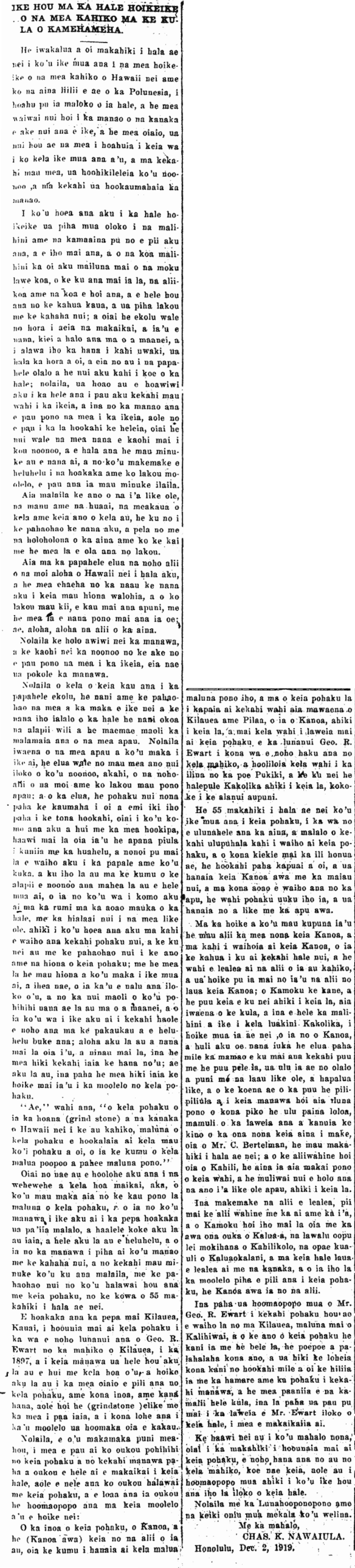
IKE HOU MA KA HALE HOIKEIKE O NA MEA KAHIKO MA KE KULA O KAMEHAMEHA.

Ka Nupepa Kuokoa, Buke LVII, Helu 50, Aoao 3. Dekemaba 12, 1919.The

Looking back at Princess Kaiulani, 1904.

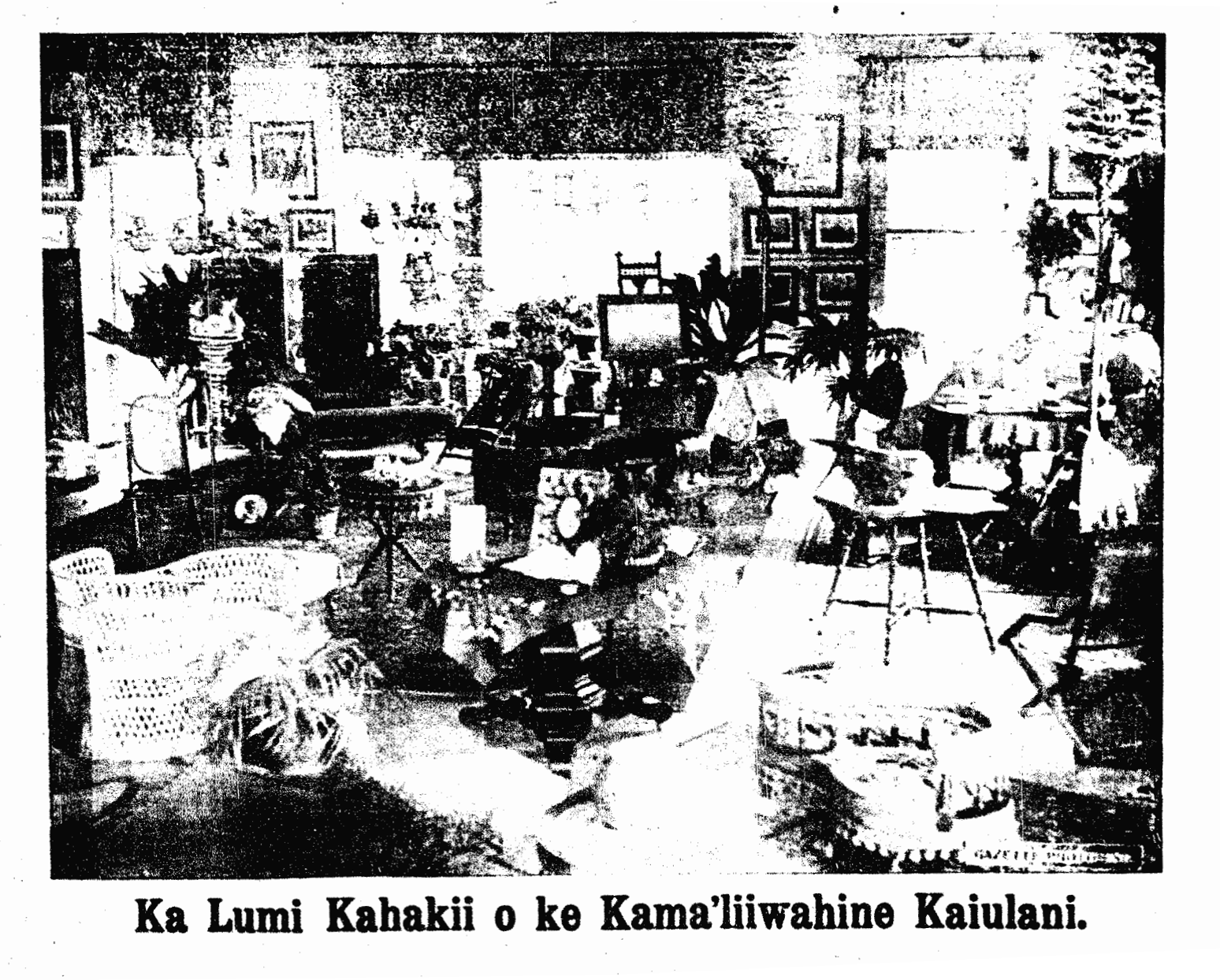
The Drawing Room [Lumi Kahakii] of Princess Kaiulani.

[Does anyone know where this room was? I am sure the original image in the newspaper is much more clear. This is yet another reason to reshoot the Hawaiian-Language Newspapers before it is too late and they crumble into pieces…]

Ka Lumi Kahakii o ke Kama'liiwahine Kaiulani.

Ka Nupepa Kuokoa, Buke XLII, Helu 18, Aoao 4. Aperila 29, 1904.

More on the alalaua, 1917.

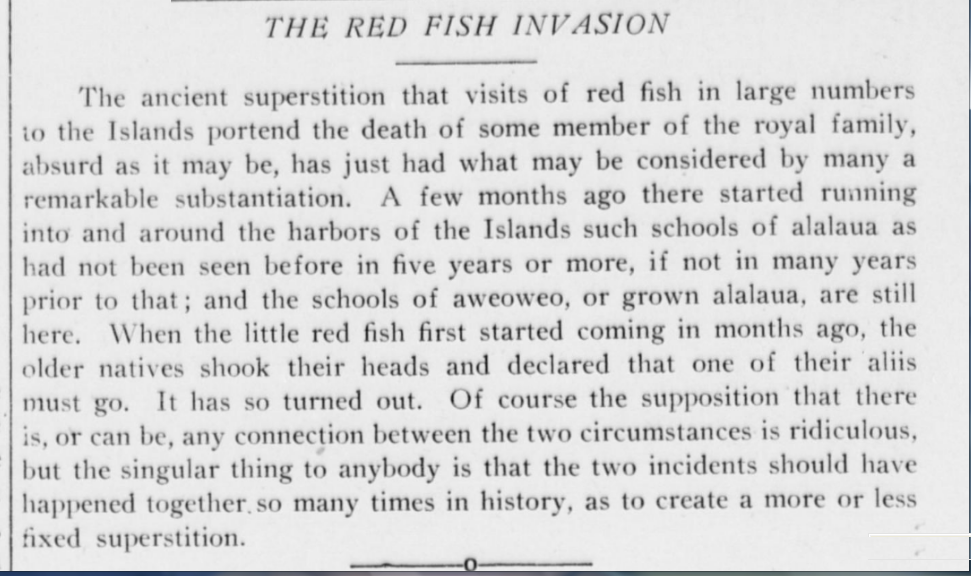
THE RED FISH INVASION

The ancient superstition that visits of red fish in large numbers to the Islands portend the death of some member of the royal family, absurd as it may be, has just had what may be considered by many a remarkable substantiation. A few months ago there started running into and around the harbors of the Islands such schools of alalaua as had not been seen before in five years or more, if not in many years prior to that; and the schools of aweoweo, or grown alalaua, are still here. When the little red fish first started coming in months ago, the older natives shook their heads and declared that one of their aliis must go. It has so turned out. Of course the supposition that there is, or can be, any connection between the two circumstances is ridiculous, but the singular thing to anybody is that the two incidents should have happened together so many times in history, as to create a more or less fixed superstition.

(Maui News, 11/16/1917, p. 4)

THE RED FISH INVASION

The Maui News, Eighteenth Year, Number 923, Page 4. November 16, 1917.