A new scathing “Hawaii Ponoi,” 1894.

TOPICS OF THE DAY.

The Advertiser with its usual ingenuity has finally found the cause for all the opposition among the Hawaiians to the P. G., and to the annexation cause. It is all on account of Hawaii Ponoi, our national anthem, and the morning organette demands, and immediate change in the words of that time-honored song. The new version given by the Advertiser will hardly be adopted, and we therefore take the liberty to substitute some words which we submit to the kind consideration of all loyal Hawaiians who are to be forbidden to sing the anthem of their native land. How is this brother Castle?

HAWAII PONOI HOU.

Pakaha Hawaii,
Kipi i ka lahui,
Na welo mikanele,
Na Pi Gi.

Ino ka ia e,
Ia Kolekaaka,
Pale i ka nani,
Me ka uahoa.

[NEW HAWAII PONOI

They plunder Hawaii
Conspire against the people,
Those missionary descendants,
The P. G.

How vile he is,
That Kole Kaaka,*
Pushing aside beauty,
With his cruelty.]

*”Kole Kaaka” can be found in the dictionary. Look it up. This term with a negative connotation is used often during this period. Might it also be a play on the name Dole? “Wretched Dole”?

(Hawaii Holomua, 1/9/1894, p. 2)

HawaiiHolomua_1_9_1894_2.png

Hawaii Holomua, Volume II, Number 7, Page 2. January 9, 1894.
Book of Nationalistic Songs, 1896.

He Buke Mele Lahui.

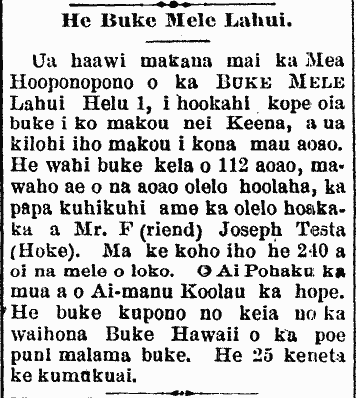
The Editor gifted a copy of the Buke Mele Lahui, Volume 1 to this Office, and we glanced through its pages. It is a book of 112 pages aside from the advertisements, table of contents and introduction by Mr. F (riend) Joseph Testa (Hoke). There are approximately 240 or more mele within. The first mele is Ai Pohaku and the last is Ai-manu Koolau. This is a good book for the Hawaiian libraries of those who like to keep books. The price is 25 cents.

[This publication was reprinted by the Hawaiian Historical Society in 2003, and is available in hardback for $60, or if you are a member of the Historical Society, $48! Check out the many books available from the Historical Society here.]

(Kuokoa, 1/10/1896, p. 2)

Kuokoa_1_10_1896_2

Ka Nupepa Kuokoa, Buke XXXV, Helu 2, Aoao 2. Ianuari 10, 1896.

“What always carries the crowd away,” 1893 / today / forevermore.

WHAT THEY SING.

What Always Carries the Crowd Away.

The patriotic song, “Kaulana na Pua o Hawaii,” composed and sung by the Hawaiian National Band at their concerts, has been put into English by “Makee Aupuni”:

Standing by our native land
Are we sons of Hawaii nei,
Daring a false and treacherous band,
Whose minions come from o’er the sea.

Responds our hearts from isle to isle,
Resolved to die before we yield,
Our ancient birthright ne’er defile,
We’ll spill our blood on freedom’s shield.

Responds Hawaii of Keawe
To farthest sands of green Mano,
Piilani’s land, and Kakuhihewa’s sand,
Shall witness that we face the foe. Continue reading

“An Adornment for the Patriots,” 1893.

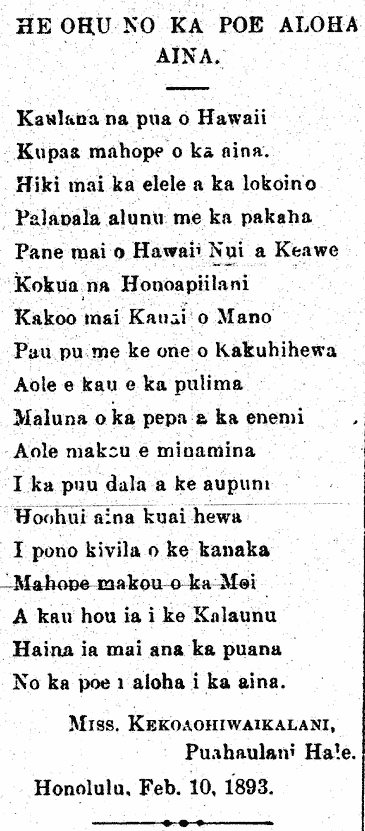
HE OHU NO KA POE ALOHA AINA.

Kaulana na pua o Hawaii
Kupaa mahope o ka aina
Hiki mai ka elele o ka lokoino
Palapala alunu me ka pakaha
Pane mai o Hawaii Nui a Keawe
Kokua na Honoapiilani
Kakoo mai Kauai o Mano
Pau pu me ke one o Kakuhihewa
Aole e kau e ka pulima
Maluna o ka pepa a ka enemi
Aole makou e minamina
I ka puu dala a ke aupuni
Hoohui aina kuai hewa
I pono kivila o ke kanaka
Mahope makou o ka Moi
A kau hou ia i ke Kalaunu
Haina ia mai ana ka puana
No ka poe i aloha i ka aina.

Miss Kekoaohiwaikalani,

Puahaulani Hale.

Honolulu, Feb. 10, 1893.

[This is perhaps the very first publication of Ellen Kekoaohiwaikalani Prendergast’s “Kaulana na Pua:” “An Adornment for the Patriots.” Was the idea about eating stones not in the original composition and added on after the Hawaiian National Band [Bana Lahui] was told by Herny Berger that they would have to sign their names to the annexation club roll lest they end up having to eat stones? The first time it seems that the lines about eating stones was published was under the title “He Inoa no na Keiki o ka Bana Lahui” [A Name Song for the Boys of the Hawaiian National Band]  in 3/23/1893 on the second page of Hawaii Holomua.]

(Leo o ka Lahui, 2/24/1893, p. 3)

LOKL_2_24_1893_3.png

Ka Leo o ka Lahui, Buke II, Helu 649, Aoao 3. Feberuari 24, 1893.

Death of John Polapola, 1896.

[Found under: “KELA A ME KEIA.”]

A little after 10 o’clock on the night of Tuesday last, the breath of Keoni Polapola left him, at his residence makai of Honuakaha, Queen Street. He was seen that afternoon in good health, and as it got dark, he started having a pain in his head until his death. His land of birth was Tahiti, and he lived in Hawaii nei becoming a citizen and kamaaina, and married a woman and had children. Aloha for him!

(Makaainana, 4/27/1896, p. 8)

Makaainana_4_27_1896_8

Ka Makaainana,  Buke V—-Ano Hou, Helu 17, Aoao 8. Aperila 27, 1896.

John Polapola, proud eater of stones! 1893.

I SHALL EAT STONES.

This past Wednesday, John Polapola was dragged along by a traitor to his motherland. This is what he said to Jno. Polapola, as he held on tightly to his hand.

Let’s go.

Where are we going? said John [Keoni].

The traitor responded: To the Annexation Office, where you will sign your name, because you should think about your crackers and beef, and how you can continue to work.

This is the answer of the patriotic man: The job that I have now is in no way sufficient; Not at all! But I tell you, “I will eat stones;” that is better than me agreeing to sign my name under the Annexationists. For I love my land, and my Queen, and if you want to take away your jobs, I am now prepared. Continue reading

Cannons from the Haaheo o Hawaii wreck, 1857.

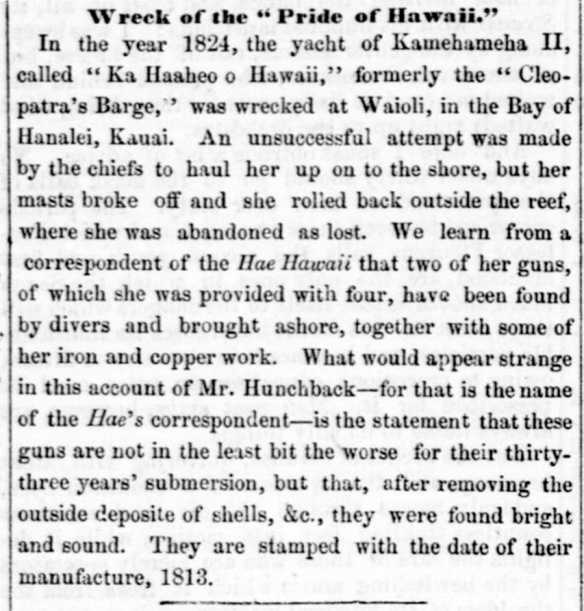
Wreck of the “Pride of Hawaii.”

In the year 1824, the yacht of Kamehameha II, called “Ka Haaheo o Hawaii,” formerly the “Cleopatra’s Barge,” was wrecked at Waioli, in the Bay of Hanalei, Kauai. An unsuccessful attempt was made by the chiefs to haul her up on to the shore, but her masts broke off and she rolled back outside the reef, where she was abandoned and lost. We learn from a correspondent of the Hae Hawaii that two of her guns, of which she was provided with four, have been found by divers and brought ashore, together with some of her iron and copper work. What would appear strange in the account of Mr. Hunchback—for that is the name of the Hae‘s correspondent—is the statement that these guns are not in the last bit the worse for their thirty-three year’s submersion, but that, after removing the outside deposite of shells, &c., they were found bright and sound. They are stamped with the date of their manufacture, 1813.

(Polynesian, 5/23/1857, p. 5)

Polynesian_5_23_1857_5.png

The Polynesian, Volume XIV, Number 3, Page 5. May 23, 1857.

What was the Bishop Museum Director thinking, 1898.

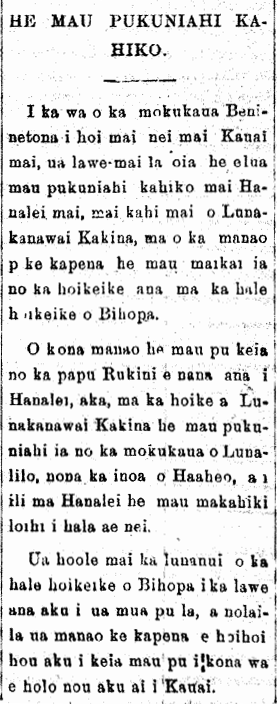
OLD CANNONS.

When the warship Bennington returned from Kauai, it brought two old cannons from Hanalei, from the place of Judge Thurston [Lunakanawai Kakina], with the thought of the captain that these would be fine objects for the Bishop Museum to display.

He believed that these were cannons from the Russian fort facing Hanalei, but according to Judge Thurston’s statement, they were cannons form the warship of Lunalilo named Haaheo [Haaheo o Hawaii], and it ran aground at Hanalei many years ago.

The director of the Bishop Museum refused to take the guns, and so the captain thinks he will return the guns when he returns to Kauai.

[This was the ship of Liholiho, Kamehameha II, and not Lunalilo. There was much press about it last year! Go check out the exhibit at Kauai Museum on the Haaheo, showing now!! Does anyone know what became of these cannons?]

(Aloha Aina, 12/3/1898, p. 1)

AlohaAina_12_3_1898_1.png

Ke Aloha Aina, Buke VI, Helu 49, Aoao 1. Dekemaba 3, 1898.

Kamehameha Day preparations, 1916.

Please Give Your Help for Our Holiday

THE EVENTS FOR KAMEHAMEHA DAY ON THE COMING JUNE 11

At the discussion meeting held at the office of Edgar Henriques in the McCandless Brothers Building, chaired by Mayor John C. Lane of the executive committee and the secretary of that committee William E. Miles. The members who gathered for that meeting other than those named above were: Edgar Henriques, Jesse Uluihi, Mrs. H. H. Webb [Lahilahi Webb], Mrs. S. C. Dwight, Mrs. Abraham Fernandez, Louis Makanani and James K. Nakila.

The schedule prepared for the coming birthday of Kamehameha, that is Monday, the 12th of June, being that the 11th is a Sunday, is like this: Parade in the morning from Aala Park of the various Societies and the public. 8:30 a. m., under the direction of the Marshal of the day, Robert Waipa Parker, when reaching the government building where the statue of Kamehameha stands, the procession will surround the statue with each tossing flowers by the statue, and everyone in the parade should please have a bouquet of flowers in their hands.

Those that stand near the Kamehameha statue will be the Hale o na Alii Association with the war god of Kamehameha, Kukailimoku; from there the procession will go on to the palace grounds [palii] for short speeches given that morning, but the speakers have not been chosen as of yet. It was left for the chairman of the executive committee to decide, that being Mayor John C. Lane, and the names of the speakers will be announced at the appropriate time. Continue reading

E o e Kuini Kapiolani! 1898.

HANOHANO NUUANU.

Hanohano Nuuanu aia iuka,
Kahiko i ka Ua Popokapa,
Ke nihi ae la Waolani,
A loaa maua i Kanenelu,
Wai auau a kuu aloha,
Me Eha hua hiu a wela,
Ua ahi ua wela Wananakoa,
I ka hooni a nei kupueu,
A he eueu au no Kahikina,
No na pali hulaana o Maui,
O ke ewe ia a o’u mau kupuna,
I lohe mai oe Koleakani,
Aulii ma hana a Piilani,
A he lani a he kupa no ka aina,
Haina ia mai ana ka puana,
Na Eha Hua hiu a Wela.

EHAHUA.

(Loea Kalaiaina, 7/30/1898, p. 4)

LoeaKalaiaina_7_30_1898_4.png

Ka Loea Kalaiaina, Buke II, Helu 30, Aoao 4. Iulai 30, 1898.