Sweet Emalia is out in Honolulu! 1908.

LUNATICS, VAGS AND MUTINEERS IN COURT

Police Court Judge Frank Andrade this morning felt that he sat on the edge of an active volcano, for through the window over his starboard shoulder, up from the pit at the bottom of which in a cell grovelled Sweet Emalia, came discordant beseechments for a renovation of the universe and the making of a new world.

It was difficult to size up the merits between a man with an attacking hoe and a gentleman with a damaged cow when such sounds soared benchward.

“Has not the doctor been sent for to examine Sweet Emalia?” inquired His Honor.

Chief of Detectives Kalakiela stated that he had been summoned.

Then Emalia took up singing, having torn her garments to shreds, and this was less upsetting that her howling and cursing.

Emalia was taken to the station about breakfast time today from the parish of Kalihi. Neighbors rang in, calling loudly for Thwing or Parkhurst, declaring that a large lady who had forgotten her wardrobe was roaming the streets. The patrol wagon hurried out and Emalia was found without covering, making morning calls on the neighbors.

When she sighted the hurry-up she hastened to her home and donned a garment in which she was taken to the police station. There having the covering of a cell, she found the clothing superfluous and straightway made fricasee of them. She is alleged to be insane.

A lolo or stupid boy received the court’s attention. He was charged with vagrancy, sleeping in sawdust in the back parlor of a planing mill. He was open-mouthed and stare-eyed and committed to be examined with Sweet Emalia by Dr. Moore, Dr. Emerson taking a vacation.

…..

[After coming across this article from 1908 showing Sweet Emalia out in Honolulu, I am now thinking that the Emily Kaihumua sent to Kalawao in 1906 and being examined there in 1909 by Dr. Goodhue might not be the same person…

Hopefully one day soon, all the Hawaiian-Language Newspapers will be rescanned clearly so that if there is ever enough money to do once again an OCR project, or a hand transcription project, it can be done accurately so that hopefully we can find each and every available article that could clarify what became of Emalia, or any other person or event in Hawaiian history for that matter!!]

(Hawaiian Star, 8/13/1908, p. 5)
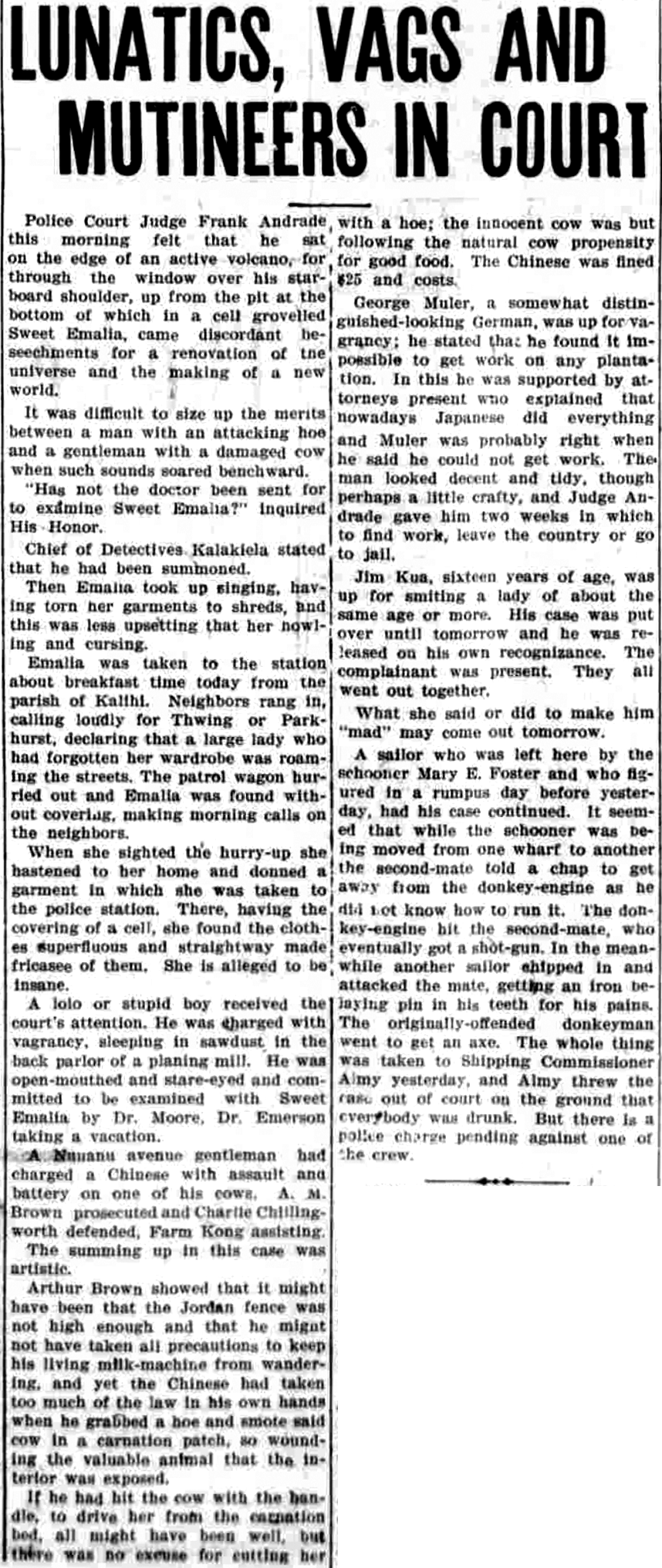
LUNATICS, VAGS AND MUTINEERS IN COURT

The Hawaiian Star, Volume XVI, Number 5708, Page 5. August 13, 1908.

Sweet Emalia out and about, 1901.

[Found under: “LOCAL ‘HAWKSHAWS’ OWN UP IDENTITY … Sweet Emalia Denied the Oft-Repeated Impeachment]

“Sweet Emalia” was brought before the bar of justice to answer to the charge of being drunk. The fair defendant denied the soft impeachment, meanwhile shedding a copious flow of tears. Emalia was given a reprimand and discharged.

[Yes, Emalia Kaihumua made it out from the insane asylum!]

(Honolulu Republican, 6/2/1901, p. 1)

"Sweet Emalia" was brought...

The Honolulu Republican, Volume II, Number 305, Page 1. June 2, 1901.

More on Emalia Kaihumua out and about, 1901.

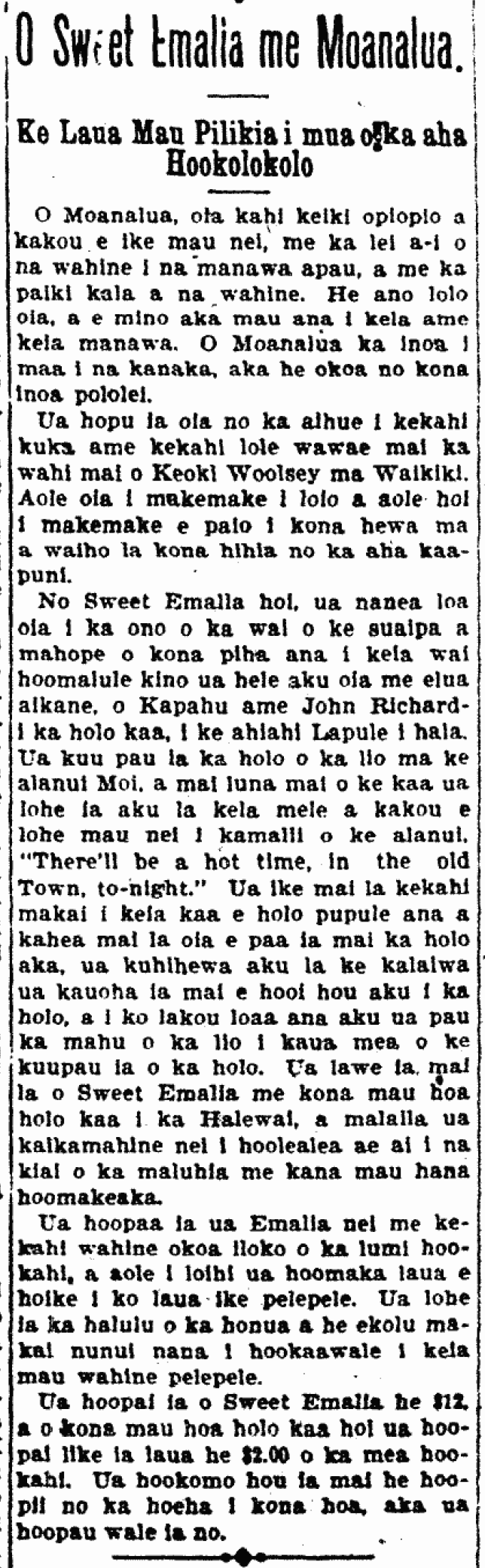
Sweet Emalia and Moanalua.

Their Problems Before the Court

Moanalua is a youth that we often see with a woman’s necklace all the time, and a women’s pocketbook. He is somewhat feeble-minded, and is always smiling. Moanalua is the name that people know him by, but his real name is something else.

He was arrested for stealing a suit and a pair of slacks from Keoki Woolsey’s place in Waikiki. He did not want a lawyer, and did not want to contest his guilt, and his case is left for the circuit court.

As for Sweet Emalia, she was enjoying the tasty water, swipe [suaipa], and after being filled with this intoxicating liquid, she went along with the two aikane, Kapahu and John Richard [?] on a car ride, in the evening of this past Sunday. The horse was exerted as they sped along King Street, and from the car came that song often heard from children on the streets, “There’ll be a hot time, in the old town, tonight.” This car was seen by a policeman as it sped on crazily, and he called out to stop, but the driver misheard and thought he was being told to speed up; and when the were caught, all the steam was exhausted from the horse resulting from it being run hard. Sweet Emalia and her riding companions were taken to jail [Halewai], and there she entertained the peace officers with her funny antics.

That Emalia was detained with another woman in a single room, and it wasn’t long when they began to display their skill in boxing. The rumbling of the earth was heard, and it was three large officers that separated the two women fighters.

Sweet Emalia was fined $12, and her fellow joy riders were each fined $2.00. Another suit was filed for injuring her companion, but it was dismissed.

(Kuokoa, 10/4/1901, p. 5)

O Sweet Emalia me Moanalua.

Ka Nupepa Kuokoa, Buke XXXIX, Helu 14, Aoao 5. Okatoba 4, 1901.

James Kaulia injured, 1899.

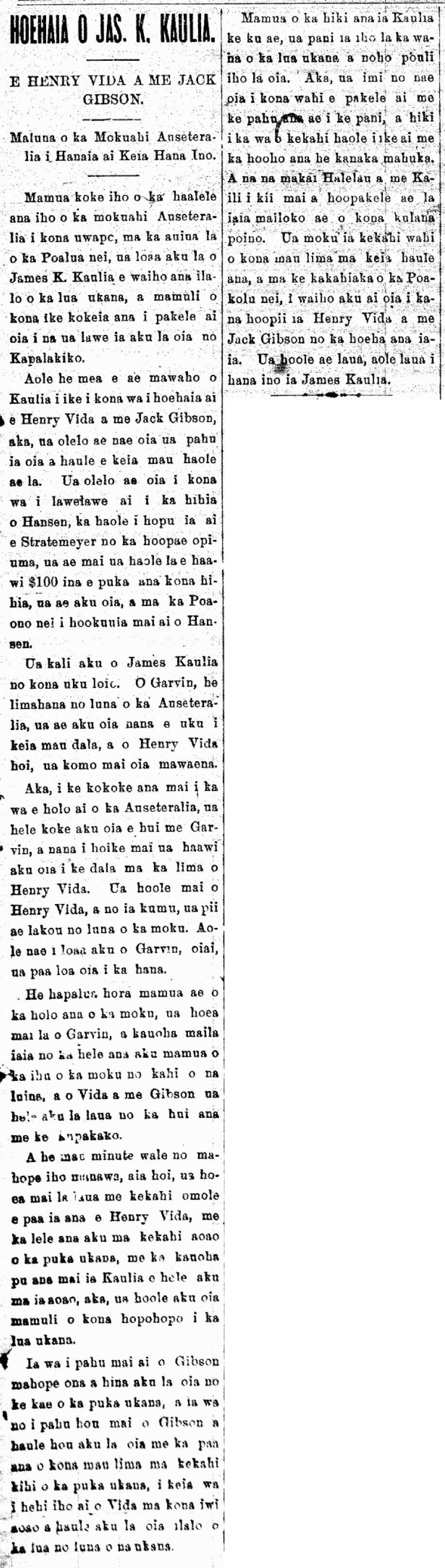
James Kaulia Injured

BY HENRY VIDA AND JACK GIBSON.

Aboard the Steamer Australia is Where This Evil Act Was Done.

Right before the Steamship Australia [Auseteralia] left its mooring, on the evening of this Tuesday, James K. Kaulia was found left below in the storage hold, and because he was found quickly that he was saved, lest he have been taken to San Francisco.

There was no one else other than Kaulia who witnessed him being hurt by Henry Vida and Jack Gibson, but he stated that he was shoved by these haole men and fell. He says that when he took the case of Hansen, the haole that was arrested by Stratemeyer for importing opium, that haole agreed to pay $100 if his charges were overturned, he [Kaulia] agreed, and this Saturday, Hansen was set free.

James Kaulia waited for his lawyer fees. Garvin, a worker aboard the Australia agreed that he’d pay the money, and Henry Vida stood as an intermediary.

But when it grew near to the time when the Australia was to leave, he went to go see Garvin, who told him that he gave the money in the hands of Henry Vida. Henry Vida denied this, and for this reason they all went aboard the ship. Garvin however was not found, for he was busy working.

Half and hour prior to the ship’s departure, Garvin appeared, and he told him [Kaulia] to go up front to the prow, where the sailors were; and as for Vida and Gibson, they went to meet with the purser.

And just a few minutes after that, the two of them suddenly showed with a jug being held by Henry Vida; and they jumped to one side of the opening of the storage, while telling Kaulia to come over to that side, but he refused because he was hesitant about the storage hold.

That was when Gibson pushed him from behind and he fell on the side of the door to the storage, at which point Gibson shoved him again and he fell once more, his hands grabbing on to a corner of the door; then Vida stomped on his ribs and he fell into the room on top of the baggage.

Before Kaulia was able to stand, the entrance to the storage was shut, and he sat there in the dark. However, he sought a way for him to get out, pounding at the door until he was found by a haole who exclaimed that there was a runaway. And officers Halelau and Kaili came to rescue him from his precarious situation. Some parts of his arms were broken when he fell, and in the morning of this Wednesday, he filed a suit against Henry Vida and Jack Gibson for injuring him. The two of them deny harming James Kaulia.

(Aloha Aina, 2/25/1899, p. 2)

HOEHAIA O JAS. K. KAULIA.

Ke Aloha Aina, Buke V, Helu 8, Aoao 3. Feberuari 25, 1899.

More on Kaheleiki trial: “Something not to be forgotten.” 1863.

Voyage of the Hawaiian Chiefs to San Francisco.

This past Wednesday morning [4/15/1863], the Honorable C. Gordon Hopkins [Hapakini], John Ii [Ioane Ii], Kaisara Kapaakea [Caesar Kapaakea], and J. Koii Unauna, along with the one who is involved in the dispute for whom they went to testify for, namely Harry Kaheleiki, came to shore riding aboard the ship, Yankee; and we are pleased to report the public that they are in good health.

During the trial of Harry Kaheleiki in San Francisco, there were many witnesses strongly against him; however, with the arrival of the alii mentioned above, there was true testimony in favor of the accused, and the error of those who testified against him was clear. The newspapers of San Francisco were filled with thoughts of appreciation for this Nation sending witnesses at much expense to have one of its citizens wrongly charged in a foreign land set free; according to one of the papers, this is a benevolent act not done by the enlightened Nations of the world, and so the Hawaiian Nation has taken the lead in this fine action. This is truly an act of aloha, and it is something not to be forgotten for all times.

The reason it was heard that a Hawaiian was being imprisoned in San Francisco was because of Doctor Gulick [Gulika], the one who was previously living in the islands of Micronesia, and due to weakening health, arrived in California. While he was in San Francisco several months ago, he heard that there was a Hawaiian man being held in one of the Jails there on the charge of murder; he therefore went quickly to meet with the man, and when he got there, he spoke with the aforementioned Kaheleiki, and though this conversation, it was clear in Doctor Gulick’s mind that the accused was innocent. And because Kaheleiki asked him if they could wait until witnesses were sent for from Hawaii for him, there would be many who would testify that he was innocent of the charges against him. So Doctor Gulick immediately went to the office of the Hawaiian Consul, Mr. Hitchcock [Kanikela Hawaii o Mr. Hikikoki], and told him about the circumstances of Kaheleiki and how he was certain that Kaheleiki was innocent of the charges. When the Hawaiian Consul heard of this, he went at once to meet with the accused, and upon seeing his demeanor and what he had to say, he knew for himself that Kaheleiki was innocent. He then went quickly to see the Judge to ask that the trial of Kaheleiki be postponed until he heard from here; for he had witnesses here for him. And that is how time was given to send his witnesses, and that is how he was freed. And when he sent for witnesses here, along with a letter from Doctor Gulick, and when His Highness L. Kamehameha heard of this, he along with Sheriff W. C. Parke put great effort into finding appropriate witnesses to testify for Kaheleiki, the one who was falsely charged. We are filled with appreciation for the Royal One, His Highness, and the Sheriff.

We must thank Doctor Gulick, and we are truly thankful for him in the name of all who desire that the innocent who are persecuted be freed, and in the name of all who strive to find ways to free the innocent from the hands of those who oppose them, while they live in foreign lands. God shall free the righteous.

[There are countless stories like this in the Hawaiian-Language Newspapers that should be relearned and retold and retold again, so they are not forgotten!]

(Kuokoa, 4/18/1863, p. 3)

Ka Huakai a na 'Lii Hawaii i Kapalakiko.

Ka Nupepa Kuokoa, Buke II, Helu 16, Aoao 3. Aperila 18, 1863.

More on the Kaheleiki trial, 1863.

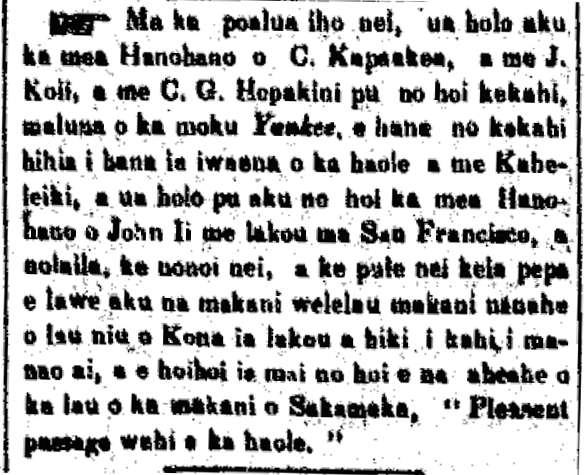
This past Tuesday [2/17/1863], the Honorable C. Kapaakea, and  J. Koii, and C. G. Hopkins also went aboard the ship Yankee, to appear in a case raised between the haole and Kaheleiki; the Honorable John Ii also accompanied them to San Francisco, and this paper hopes and prays that the fringes of the winds; the gentle winds of the coconut fronds of Kona take them to their destination, and that they are brought back by the soft puffs of the wind of Sakameka [? Sacramento]; “Pleasant passage,” according to the haole.

(Hoku o ka Pakipika, 2/19/1863, p. 2)

Ma ka poalua iho nei...

Ka Hoku o ka Pakipika, Buke 2, Helu 19, Aoao 2. Feberuari 19, 1863.

Mahalo to MAB for pointing to this article on the Kaheleiki trial, 1863.

“Better that Ten Guilty Should Escape, than that One Innocent should Suffer.”

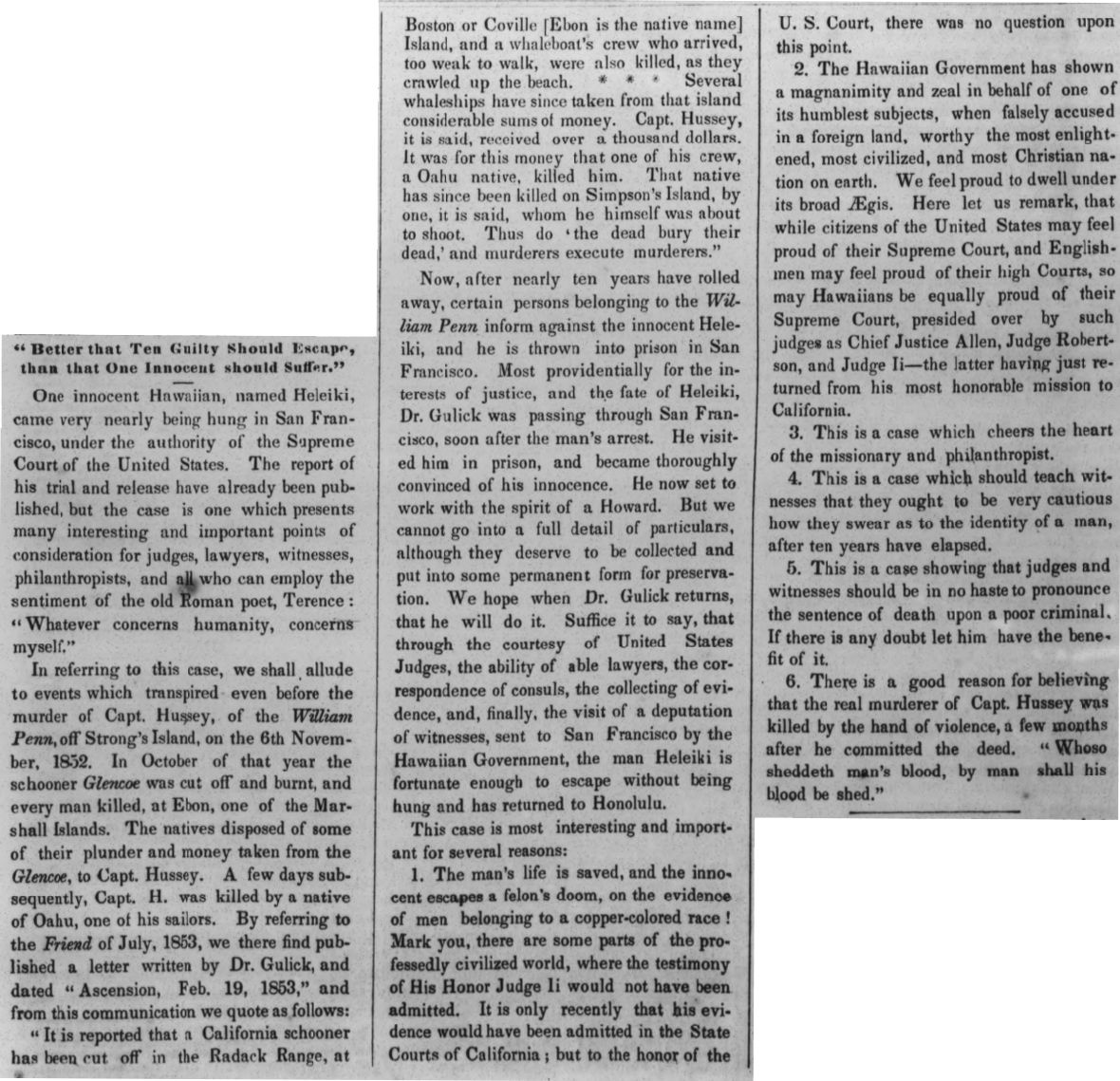
One innocent Hawaiian, named Heleiki, came very nearly being hung in San Francisco, under the authority of the Supreme Court of the United States. The report of his trial and release have already been published, but the case is one which presents many interesting and important points of consideration for judges, lawyers, witnesses, philanthropists, and all who can employ the sentiment of the old Roman poet, Terence: “Whatever concerns humanity, concerns myself.”

In referring to this case, we shall allude to events which transpired even before the murder of Capt. Hussey, of the William Penn, off Strong’s Island, on the 6th of November, 1852. In October of that year the schooner Glencoe was cut off and burnt, and every man killed, at Ebon, one of the Marshall Islands. The natives disposed of some of their plunder and money taken from the Glencoe, to Capt. Hussey. A few days subsequently, Capt. H. was killed by a native of Oahu, one of his sailors. By referring to the Friend of July, 1853, we there find published a letter written by Dr. Gulick, and dated “Ascension, Feb. 19, 1853,” and from this communication we quote as follows:

“It is reported that a California schooner has been cut off in the Radack Range, at Boston or Coville (Ebon is the native name) Island, and a whaleboat’s crew who arrived, too weak to walk, were also killed, as they crawled up the beach. * * * Several whaleships have since taken from that island considerable sums of money. Capt. Hussey, it is said, received over a thousand dollars. It was for this money that one of his crew, a Oahu native, killed him. That native has since been killed on Simpson’s Island, by one, it is said, whom he himself was about to shoot. Thus do ‘the dead bury their dead,’ and murderers execute murderers.”

Now, after nearly ten years have rolled away, certain persons belonging to the William Penn inform against the innocent Heleiki, and he is thrown into prison in San Francisco. Most providentially for the interests of justice, and the fate of Heleiki, Dr. Gulick was passing through San Francisco, soon after the man’s arrest. He visited him in prison, and became throughly convinced of his innocence. He now set to work with the spirit of a Howard. But we cannot go into a full detail of particulars, although they deserve to be collected and put into some permanent form for preservation. We hope when Dr. Gulick returns, that he will do it. Suffice it to say, that through the courtesy of United States Judges, the ability of able lawyers, the correspondence of consuls, the collecting of evidence, and, finally, the visit of a deputation of witnesses, sent to San Francisco by the Hawaiian Government, the man Heleiki is fortunate enough to escape without being hung and has returned to Honolulu.

This case is most interesting and important for several reasons:

1. The man’s life is saved, and the innocent escapes a felon’s doom, on the evidence of men belonging to a copper-colored race! Mark you, there are some parts of the professedly civilized world, where the testimony of His Honor Judge Ii would not have been admitted. It is only recently that his evidence would have been admitted in the State Courts of California; but to the honor of the U. S. Court, there was no question upon this point.

2. The Hawaiian Government has shown a magnanimity and zeal in behalf of one of its humblest subjects, when falsely accused in a foreign land, worthy the most enlightened, most civilized, and most Christian nation on earth. We feel proud to dwell under its broad Ægis. Here let us remark, that while citizens of the United States may feel proud of their Supreme Court, and Englishmen may feel proud of their high Courts, so may Hawaiians be equally proud of their Supreme Court, presided over by such judges as Chief Justice Allen, Judge Roberson, and Judge Ii—the latter having just returned from his most honorable mission to California.

3. This is a case which cheers the heart of the missionary and philanthropist.

4. This is a case which should teach witnesses that they ought to be very cautious how they swear as to the identity of a man, after ten years have elapsed.

[See earlier article: Government officials to go to California to defend a Hawaiian citizen. 1863.]

(Friend, 5/1/1863, p. 33)

"Better that Ten Guilty Should Escape, than that One Innocent should Suffer."

The Friend, New Series, Volume 12, Number 5, Page 33. May 1, 1863.

Government officials to go to California to defend a Hawaiian citizen. 1863.

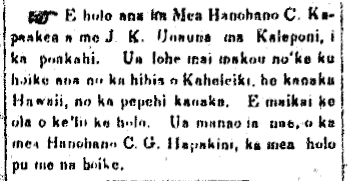
The Honorable C. Kapaakea and J. K. Unauna are headed to California on Monday. We have heard it is to serve as witness in the murder case of Kaheleiki, who is a Hawaiian. May the alii going remain in good health. It is however believed that the Honorable C. G. Hopkins [Hapakini] will accompany the witnesses.

(Hoku o ka Pakipika, 2/5/1863, p. 2)

E holo ana ka Mea Hanohano C. Kapaakea...

Ka Hoku o ka Pakipika. Buke 2, Helu 17, Aoao 2. Feberuari 5, 1863.

Father’s pleads for his son’s release, 1913.

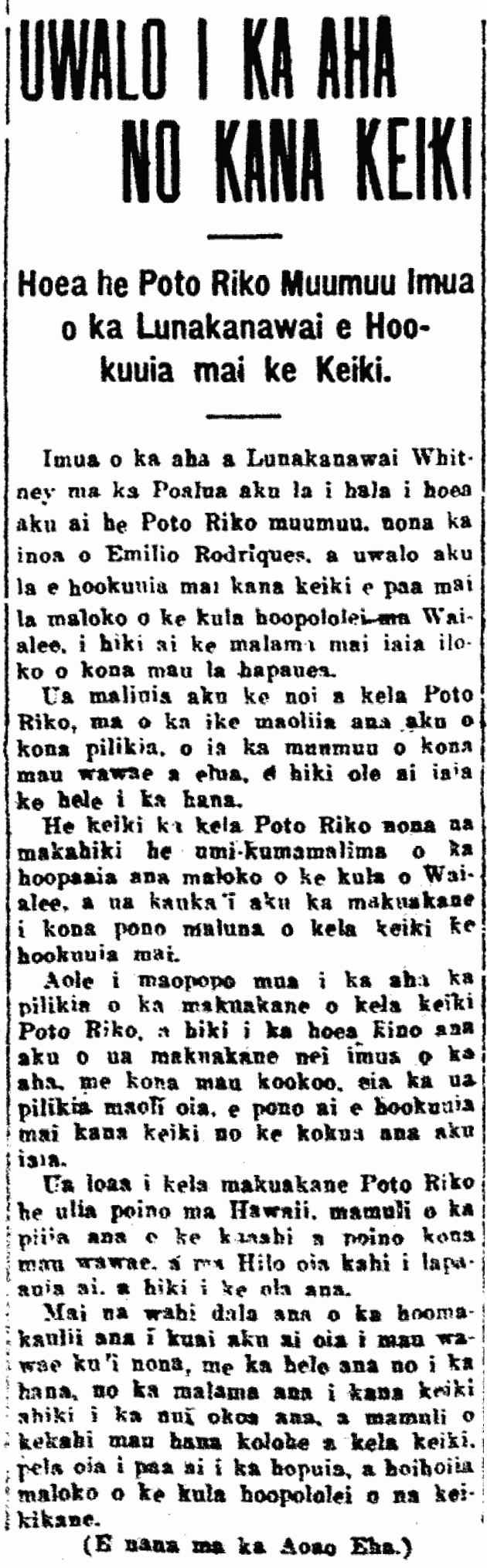
ASKED FOR HELP FROM THE COURT FOR HIS SON

A Crippled Puerto Rican Appeared Before the Judge to Have His Son Released.

Before the court of Judge Whitney last Tuesday, a crippled Puerto Rican appeared named Emilio Rodriques, and pleaded that his son detained in the reform school at Waialee be released so that his son could take care of him in his old age.

The request of that Puerto Rican was heard because his plight was obvious to see, that being both his legs were amputated and he could not go to work.

That Puerto Rican has a son of fifteen who is detained in the school of Waialee, and the well being of this father depends on his son being released.

The court was not previously aware of the plight of the father of that Puerto Rican child, not until the father appeared before the court with his crutches; he is in much difficulty necessitating the release of his child to help him.

That Puerto Rican father was in an accident on Hawaii when he was run over by a train and injured his legs; he was treated in Hilo and survived.

With the money he had saved, he purchased false legs for himself, and went to work to care for his son until he was of age, but due to the child misbehaving, he was caught and sent to the reform school for boys.

(See on Page Four.)

ASKED FOR HELP FROM THE COURT FOR HIS SON

(From page One.)

This crippled Puerto Rican for some time went to work for the livelihood of himself and his child, but his false legs became rotten so that he could not use them again, and it is his crutches that assist him with walking, while he hopes to have his son take care of him.

He received many letters from his child assuring the father that he would be a good boy when he was released, and when the letters were shown to the judge, he immediately decided that it was right to release that boy immediately.

This made the father happy, that he received assurance that his son would be released, and he awaits the return of his child from Waialee on this coming Saturday.

(Kuokoa, 2/7/1913, pp. 1 & 4.)

UWALO I KA AHA NO KANA KEIKI

Ka Nupepa Kuokoa, Buke XLIX, Helu 6, Aoao 1. Feberuari 7, 1913.

UWALO I KA AHA NO KANA KEIKI

Ka Nupepa Kuokoa, Buke XLIX, Helu 6, Aoao 4. Feberuari 7, 1913.

More from Puheemiki on C. Strawn in Kalawao, 1883.

THE NEWS OF KALAWAO

The sun is shining; this wind is howling in the Koolau of Kalawao; their path lies to the west.

These days, it is the first time the brows of the cliffs of the mountains have been sighted, which are constantly blocked by floating clouds; the fields are constantly covered by gray mist; and the voice of the ocean constantly roars in the sea cliffs both night and day.

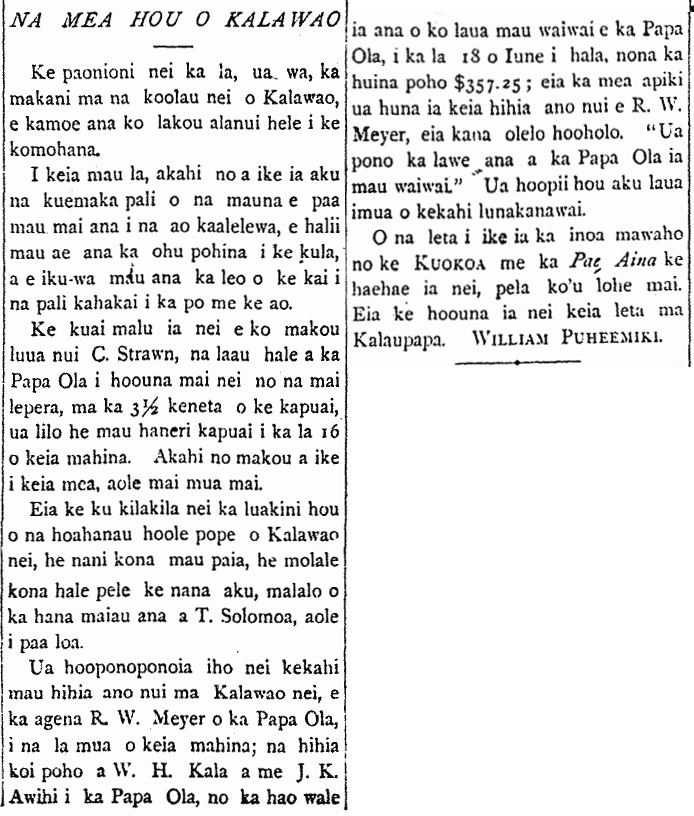
Our superintendent, C. Strawn, is secretly selling the house lumber that the Board of Health sent for the patients, at 3½ cents per yard, and hundreds of yards were sold on the 16th of this month. We just found out about this, we didn’t know from earlier.

The new church of the protestant brethren of Kalawao stands proudly, her walls are beautiful, and her bell tower is stands unobstructed; this was done skillfully under T. Solomoa [T. Solomona], but it is not completed.

Some major problems here in Kalawao were remedied by the agent of the Board of Health, R. W. Meyer, earlier this month; the claim for damages by W. H. Kala and J. K. Awihi against the Board of Health, for the seizing of their property by the Board of Health on the 18th of this past June, totaling $357.25; here is the deceitful thing: this important claim was hidden away by R. W. Meyer, and this was his decision. “The Board of Health was justified in the seizing of this property.” They two of them filed suit once again before a judge.”

Letters seen addressed outside to the Kuokoa or the Pae Aina¹ are torn apart; that is what I hear. This letter is being sent at Kalaupapa.  William Puheemiki.

[Does anyone know which Protestant church in Kalawao this would be being built in 1883?]

¹Ko Hawaii Pae Aina

(Kuokoa, 8/25/1883, p. 3)

NA MEA HOU O KALAWAO

Ka Nupepa Kuokoa, Buke XXII, Helu 34, Aoao 3. Augate 25, 1883.