Fifty years of Kamehameha School for Girls, 1944.

Jubilee Reached

On this past Sabbath, there was held a huge party in Honolulu, to commemorate the Jubilee of the establishment of the Kamehameha School for Girls.

The Girls’ school was built in 1894, and there are three of the girls from the school who graduated in 1897 still living, Continue reading

Latest news about the heir to the throne, Princess Kaiulani, 1891.

[Found under: “NU HOU HAWAII.”]

On the steamship of this past 28th of April from San Francisco, we have heard once again, the Heir to the Throne of Hawaii is in England where she is continuing her studies in good and robust health. And as an example of Her competence in many languages, she sent her father a letter in French.

[In those days, much of the news from afar came by way of steamship.]

(Kuokoa, 5/2/1891, p. 3)

Ma ka mokuahi o ka la 28...

Ka Nupepa Kuokoa, Buke XXX, Helu 18, Aoao 3. Mei 2, 1891.

Let Hawaiian Language be not something just remembered in February, 1920 / 2014.

THE HAWAIIAN LANGUAGE

O Mr. Editor of the Kuokoa Newspaper, Much Aloha to you:—Please allow me a column, for the title placed above.

When I read on page 8, column 2, about the Hawaiian language, I was ecstatic about what was published by the Kuokoa Newspaper on the topic of Mr. Coelho pertaining to the Hawaiian language.

This is seen on the streets, at pleasant gatherings, at meetings, and at the homes; these are just Hawaiians that I am talking about; they just speak English.

Hear me, O My flesh and blood, My beloved people: you are known as a Hawaiian and a lahui by your language; should you lose your mother tongue, you will end up like the Negroes and the Indians; they’ve no lahui and no language.

Pio ka oe ahi,
Pau ka oe hana;
I ikeia mai no oe,
I ka wa moni o ko eke;
Nele ae kahi mea poepoe,
Pau ka pilina ma ka aoao.

You light is extinguished,
Your work has come to an end;
You are acknowledged,
When there is money in your purse;
When the round objects are gone,
You have no place by her side.

Therefore, this writer is calling out to you: do not squander your gold and silver—your mother tongue. Your language is how it is known that you are an educated and superior people, like the great nations of the world. Look at Britain, France, Italy, Germany, Japan and America. Every nation learns their own language; why? For glory, for knowledge; it is known that one is British by the language he knows. The writer of the Psalms says: “That glory may dwell in our land.” How is our nation to have glory?

By abandoning our mother tongue and speaking the language of the malihini, are we knowledgeable, skilled and prepared in that language?

Are you not the foremost, O Tiny Hawaii, by way of the mother tongue of Opukahaia who travelled to America to explain the troubled existence of his lahui, and asked with tears streaming down to send missionary parents for Hawaii nei?

Did he go to America speaking English? No; he went with his own mother tongue. And when the missionaries arrived here in Hawaii, it is through the Hawaiian language that you received education, knowledge, honor, peace, justness, prosperity, righteousness, faith, and aloha.

What nation to the north or south latitudes of the equator is in peace like that of Hawaii? None, there is not a one; it is just Hawaii!

Therefore, this writer calls out: Don’t abandon your mother tongue so that glory may always dwell in Hawaii nei. We must build Hawaiian schools, and teach Hawaiian curriculum. Not just one eye, or one hand and foot. [? Aole i hookahi wale no maka, a i hookahi wale no lima a wawae.] When the legislature meets again the representatives and senators should make a law for teaching the Hawaiian language.

I give my thanks to the Honorable H. M. Kaniho, the first one to submit this bill in his first year there. It did not pass because some of the representatives just watched and did nothing. And I give my thanks to D. M. Kupihea who continually submits this bill.

Honolulu’s people should reelect the Hon. Kupihea so that this bill will once again be submitted; and should it be passed, then both eyes will be gotten: both Hawaiian language and English; and this writer will boast in advance that glory will indeed forever dwell in our land, for all times.

This writer is not saying that we should only teach these languages, but this responsibility is yours to teach knowledge and glory for your life. To be taken up at another time!

To the typesetting boys goes my love, and my unending aloha to the Editor.

[This is probably written in response to the article, “KA OLELO HAWAII.” written by Mrs. Kikilia P. Kealoha of Kaimuki, in Kuokoa on 6/18/1920, p. 8, which in turn was a response to an article of the same title written by W. J. Coelho in the Kuokoa on 5/21/1920, p. 2.

Although we have come a far way from 1920, there is still far to go. There are still those who seem to believe that losing Hawaiian is nothing to be alarmed about.

Z. P. K. Kawaikaumaiikamakaokaopua, is another name for the great historian Z. P. K. Kalokuokamaile (as well as Z. P. K. Lionanohokuahiwi).]

(Kuokoa, 6/18/1920, p. 3)

KA OLELO HAWAII.

Ka Nupepa Kuokoa, Buke LVII, Helu 24, Aoao 3. Iune 18, 1920.

Words of praise for C. R. Bishop on today, his birthday, 1896.

MEMORIALS.

….¹

There are many kinds of memorials [kia hoomanao] to remember people by. A person is remembered for his deeds, in memorials built as pillars and monuments, in reminiscences, and preserved in the hearts of the many. Famous deeds of people are remembered with aloha for the good, and with scorn for the bad.

Queen Liliuokalani’s beloved efforts stand today as the Hui Hoonaauao i na Opio [Liliuokalani Educational Society].

The epitome of great deeds of these past days was done by a haole who lived here as a malihini and married one of the Princesses amongst the royal youth. Charles R. Bishop built the Kamehameha Schools, the memorial for his wife, the Alii Pauahi Bishop; and by this act of commemoration, a memorial now stands for all of the Kamehamehas, and it is impossible to forget their name.

 In the days when this haole friend was living here in Hawaii, he was often criticized for his stinginess and defiance by Hawaiian and haole alike, but he paid no care to this criticism. He continued with his work, ate healthily, [illegible digital image], until he was a rich man; but in all the criticism for him, there is no way that it could be said that he was a scoundrel or that he cheated someone; and this says a lot for his uprighteousness.

Likewise with his charity work, he acted with maturity and kindness without end in his steadfast support for the benefit of this lahui. In giving, he was not frivolous in his giving, but gave wisely. He donated hundreds of thousands of dollars to the Punahou College and to the Kamehameha Schools, from his own estate and from that of his wife’s; and from his own, also benefited were the Boarding School for  Boys and Girls. How wondrous is God in his passing down the great entire wealth of the Kamehamehas from one to another until it all came down to Keelikolani and then to Pauahi, the grandchildren of the first born of Kamehameha Nai Aupuni; and it was the last of the two, the one most knowledgeable of them all, as measured by their final deeds, which she created with her husband as a memorial for all of the Kamehamehas. This man was of a great mind in his carrying out meticulously this work which he and his wife discussed between themselves, without misappropriating a single parcel of land included in the estate of his wife, but instead he was conscientious and included his own estate. When put together with all the other beloved deeds by everyone in Hawaii nei, this is measured as the most wise of them all, the height and breadth of its foundation will go on and bear forth much benefits for this lahui. There is but yet one thing to complete and to perfect the building of this memorial to the Kamehamehas, that being the righteousness of God’s words, the basis upon which the good and the blessings of the lahui will continue.

But Bishop’s help for our people is not done in his continued assistance to the memorial to the Kamehamehas and their foster children [keiki hookama] in the covenant of marriage of Charles R. Bishop.

¹The first paragraph was left out because it was somewhat irrelevant to this particular post, and was commentary on J. Kekipi and the Christian Science [Hoomana Karistiano Naauao] faith.

(Oiaio, 2/21/1896, p. 2)

NA KIA HOOMANAO.

Ka Oiaio Puka La, Buke I, Helu 37, Aoao 2. Feberuari 21, 1896.

Chiefs’ Children’s School, 1841.

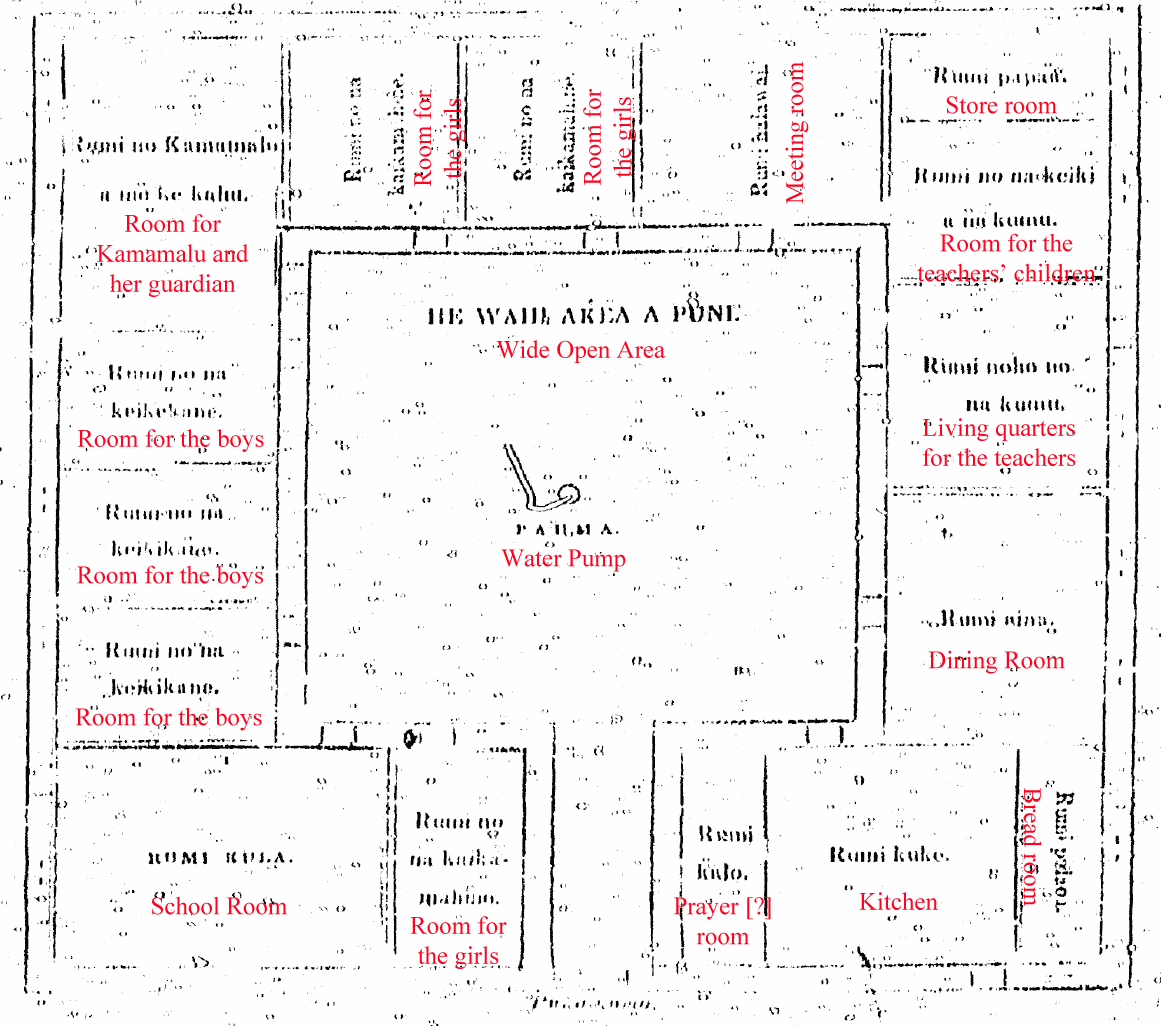
Chiefs' Children's School Diagram

Ka Nonanona, Buke 1, Pepa 2, Aoao 5. Iulai 20, 1841.

THE CHIEFS’ CHILDREN’S SCHOOL.

This is the schoolhouse for the children of the alii, in Honolulu, Oahu, upland of the stone house of Kekauluohi. This schoolhouse was built by the alii in the year of our Lord 1839. They are the ones who paid for the costs, not the missionaries. The costs were perhaps two thousand dollars, and the cost was well worth this fine building. The alii paid out the money and the missionaries hired the haole and Hawaiians who did the labor. Above, you will see what this building is like. The length is the same as the width. It is 76 feet long, and so is its width. It is made with adobe, and its walls are about ten feet tall, and its thickness is two feet. The partitions are made of adobe as well and are one foot thick. The thatching of this building is actual pili grass. Look at the illustration above, the entrance is made clear, as are the other doors, and the…

(Nonanona, 7/20/1841, p. 5)

KA HALE KULA ALII.

Ka Nonanona, Buke 1, Pepa 2, Aoao 5. Iulai 20, 1841.

…windows; clear also are the rooms for the teachers and the students.

There is an open space in the middle of the building; it is six feet wide and so too is the length; there is a water pump within it. Maniania [Manienie] grass grows there, so it is a nice place to play as well as to sit. There is a small lanai and a stone wall surrounding this wide area, which is a place to go when it is raining or when the sun is hot. The outside of the entire building is covered with mortar [poho]. Poho is not great; it will just fall off, and it soon loses its integrity. The inside of the building is covered with plaster [puna], and it is very good and sturdy; the children cannot make the plaster fall easily. The rooms are plastered all around and on top, and there is a fine floor below.

The building is appropriate for what we are using it for.

There are perhaps many who have heard of this schoolhouse but who have not seen it. Therefore, the instructors thought to put a description in this paper, as well as what is being done in this schoolhouse in later issues of the newspaper.

By me, Cooke.

[Maybe if the Hawaiian-Language Newspapers like this one are rescanned clearly, the image of the schoolhouse would indeed be clear and we could see the doors, windows, and rooms.

I was not sure if “Rumi kalo” could refer to a “Taro room”. And it seems that at the center on the bottom of the diagram is “Puka komo” for “Entrance”.]

(Nonanona, 7/20/1841, p. 6)

ani; i akaka no hoi...

Ka Nonanona, Buke 1, Pepa 2, Aoao 6. Iulai 20, 1841.

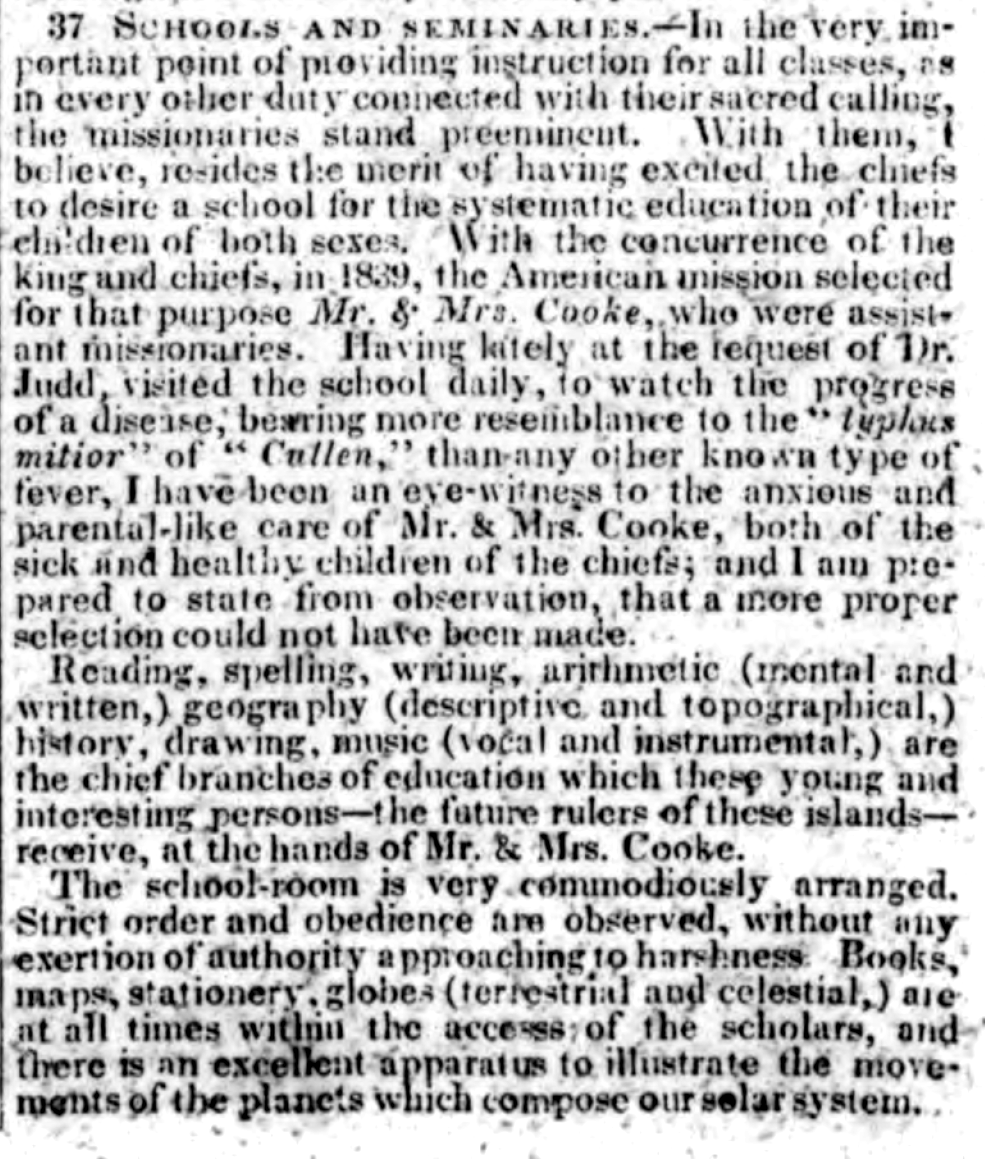
The Chiefs’ Children’s School and its beginnings. 1844.

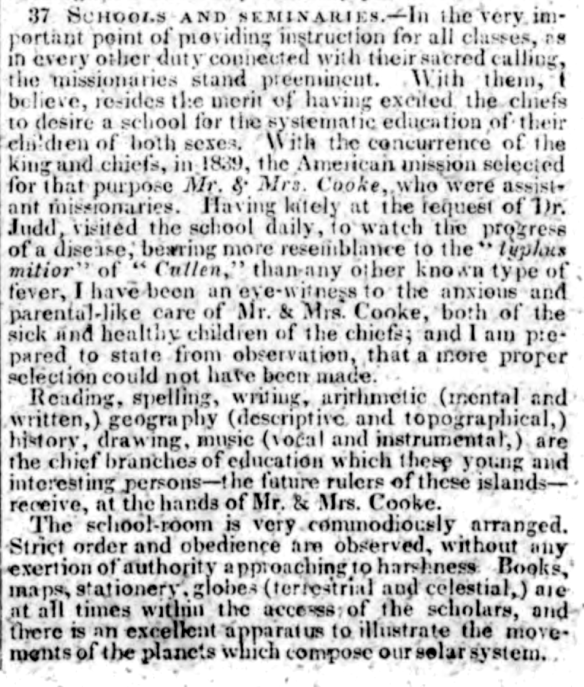
Schools and Seminaries.—In the very important point of providing instruction for all classes, as in every other duty connected with their sacred calling, the missionaries stand prominent. With them, I believe, resides the merit of having excited the chiefs to desire a school for the systematic education of their children of both sexes. With the concurrence of the king and chiefs, in 1839, the American mission selected for that purpose Mr. & Mrs. Cooke, who were assistant missionaries. Having lately at the request of Dr. Judd, visited the school daily, to watch the progress of a disease, bearing more resemblance to the “typhus mitior” of “Cullen,” than any other known types of fever, I have been an eye-witness to the anxious and parental-like care of Mr. & Mrs. Cooke, both of the sick and healthy children of the chiefs; and I am prepared to state from observation, that a more proper selection could not have been made.

The school-room is very commodiously arranged. Strict order and obedience are observed, without any exertion of authority approaching to harshness. Books, maps, stationery, gloves (terrestrial and celestial,) are at all times within the access of the scholars, and there is an excellent apparatus to illustrate the movements of the planets which compose our solar system.

(Friend, August 1, 1844, p. 35)
37. Schools and Seminaries.

The Friend, Volume II, Number VIII, Page 35. August 1, 1844.

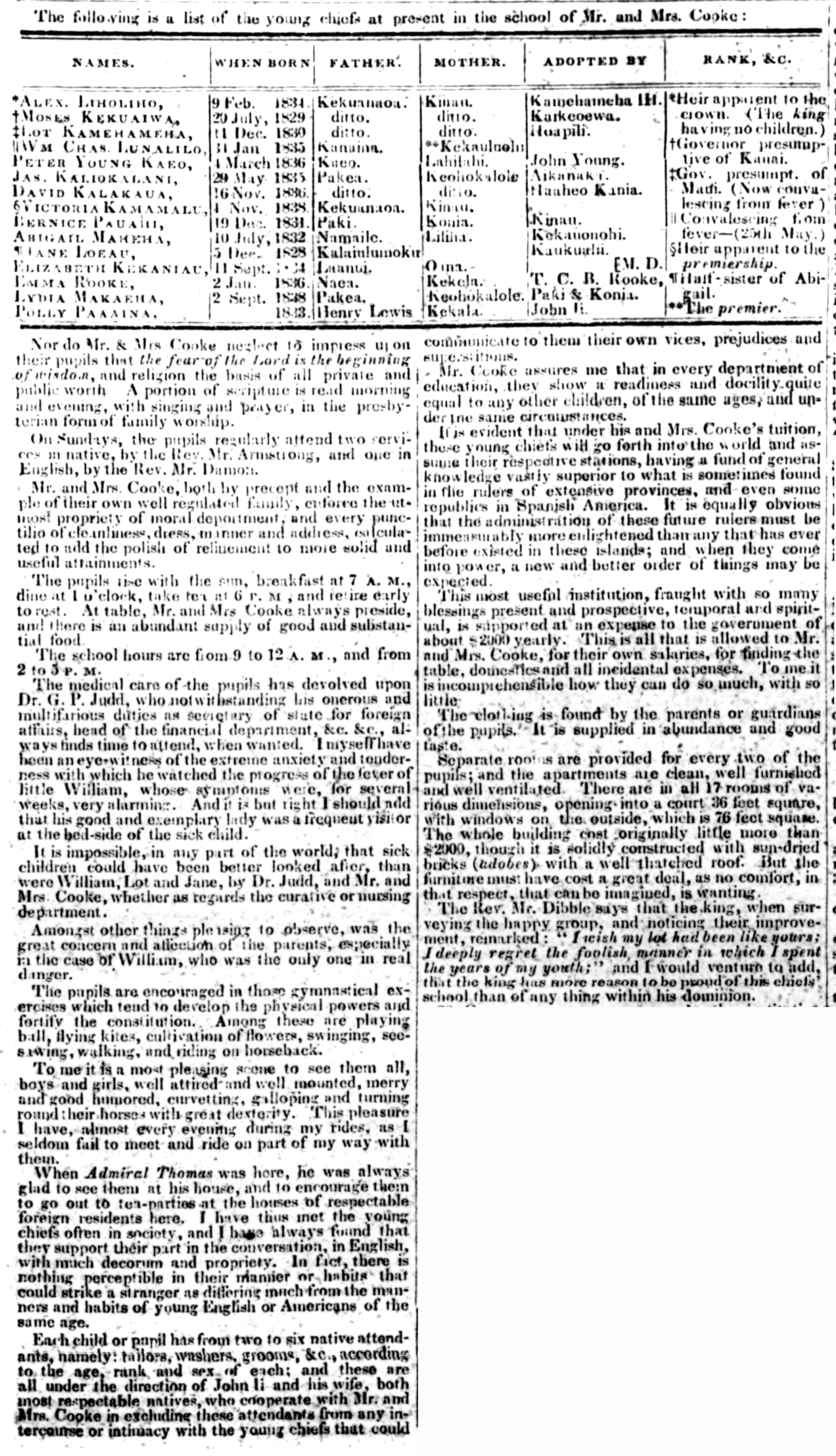
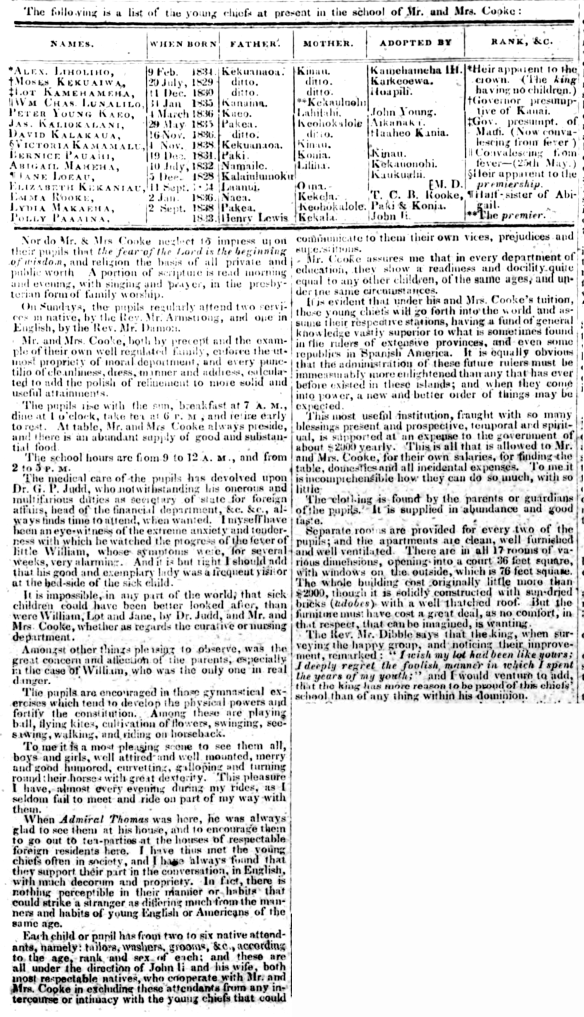
The following is a list of the young chiefs at present in the school of Mr. and Mrs. Cooke:

NAMES. WHEN BORN FATHER MOTHER ADOPTED BY
*Alexander Liholiho, 9 Feb. 1834. Kekuanaoa. Kinau. Kamehameha III.
†Moses Kekuaiwa, 20 July 1829. ditto. ditto. Kaieoewa [Kaikioewa].
‡Lot Kamehameha, 11 Dec. 1830. ditto. ditto. Hoapili.
‖William Charles Lunalilo, 31 Jan. 1835. Kanaina. **Kekauluohi.
Peter Young Kaeo, 4 March 1836. Kaeo. Lahilahi. John Young.
James Kaliokalani, 29 May 1835. Pakea [Kapaakea]. Keohokalole. Aikanaka.
David Kalakaua, 16 Nov. 1836. ditto. ditto. Haaheo Kania [Kaniu].
§Victoria Kamamalu, 4 Nov. 1838. Kekuanaoa. Kinau.
Bernice Pauahi, 19 Dec. 1831. Paki. Konia. Kinau.
Abigail [Lanihau] Maheha, 10 July 1832. Namaile. Liliha. Kekauonohi.
¶Jane Loeau, 5 Dec. 1828. Kalaiulumoku [Kalaniulumoku] [Liliha.] Kaukualii.
Elizabeth Kekaniau [Kekaaniau], 11  Sept. 1834. Laanui. Oana.
Emma Rooke, 2 Jan. 1836. Naea. Kekela. T. C. B. Rooke, M. D.
Lydia Makaeha [Kamakaeha], 2 Sept. 1838. Pakea [Kapaakea]. Keohokalole. Paki & Konia.
Polly Paaaina, 1833. Henry Lewis. Kekala [Kekela]. John Ii.

*Heir apparent to the crown. (The king having no children.)
†Governor presumptive of Kauai.
‡Gov. presumpt. of maui. (Now convalescing from fever.)
‖Convalescing from fever—(25th May.)
§Heir apparent to the premiership.
¶Half-sister of Abigail.
**The premier.

Nor do Mr. & Mrs. Cooke neglect to impress upon their pupils that the fear of the Lord is the beginning of wisdom, and religion the basis of all private and public worth. A portion of scripture is read morning and evening, with singing and prayer, in the presbyterian form of family worship.

On Sundays, the pupils regularly attend two services in native, by the Rev. Mr. Armstrong, and one in English, by the Rev. Mr. Damon.

Mr. and Mrs. Cooke, both by precept and the example of their own well regulated family, enforce the utmost propriety of moral deportment, and every punctilio of cleanliness, dress, manner and address, calculated to add the polish of refinement to more solid and useful attainments.

The pupils rise with the sun, breakfast at 7 A. M., dine at 1 o’clock, take tea at 6 P. M., and retire early to rest. At table, Mr. and Mrs. Cooke always preside, and there is an abundant supply of good and substantial food.¹

The school hours are from 9 to 12 A. M., and from 2 to 5 P. M.

The medical care of the pupils has devolved upon Dr. G. P. Judd, who not withstanding his onerous and multifarious duties as secretary of state for foreign affairs, head of the financial department, &c., &c., always finds time to attend, when wanted. i myself have been an eye-witness of the extreme anxiety and tenderness with which he watched the progress of the fever of little William, whose symptoms were, for several weeks, very alarming. And it is but right I should add that his good and exemplary lady was a frequent visitor at the bed-side of the sick child.

It is impossible, in any part of the world, that sick children could have been better looked after, than were William, Lot and Jane, by Dr. Judd, and Mr. and Mrs. Cooke, whether as regards the curative or nursing department.

Amongst other things pleasing to observe, was the great concern and affection of the parents, especially in the case of William, who was the only one in real danger.

The pupils are encouraged in the gymnastical exercises which tend to develop the physical powers and fortify the constitution. Among these are playing ball, flying kites, cultivation of flowers, swinging, see-sawing, walking, and riding on horseback.

To me it is a most pleasing scene to see them all, boys and girls, well attired and well mounted, merry and good humored, curvetting, galloping and turning round their horses with great dexterity. This pleasure I have, almost every evening during my rides, as I seldom fail to meet and ride on part of my way with them.

When Admiral Thomas was here, he was always glad to see them at his house, and to encourage them to go out to tea-parties at the houses of respectable foreign residents here. I have thus met the young chiefs often in society, and I have always found that they support their part in the conversation, in English, with much decorum and propriety. In fact, there is nothing perceptible in their manner or habits that could strike a stranger as differing much from the manners and habits of young English or Americans of the same age.

Each child or pupil has from two to six native attendants, namely: tailors, washers, grooms, &c., according to the age, rank and sex of each; and these are all under the direction of John Ii and his wife, both most respectable natives, who cooperate with Mr. and Mrs. Cooke in excluding these attendants from any intercourse of intimacy with the young chiefs that could communicate to them their own vices, prejudices and superstitions.

Mr. Cooke assures me that in every department of education, they show a readiness and docility quite equal to any other children, of the same ages, and under the same circumstances.

If is evident that under his and Mrs. Cooke’s tuition, these young chiefs will go forth into the world and assume their respective stations, having a fund of general knowledge vastly superior to what is sometimes found in the riders of extensive provinces, and even some republics in Spanish America. It is equally obvious that the administration of these future rulers must be immeasurably more enlightened than any that has ever before existed in these islands; and when they come into power, a new and better order of things may be expected.

This most useful institution, fraught with so many blessings present and prospective, temporal and spiritual, is supported at an expense to the government of about $2000 yearly. This is all that is allowed to Mr. and Mrs. Cooke, for their own salaries, for finding the table, domestics and all incidental expenses. To me it is incomprehensible how they can do so much, with so little.

The clothing is found by the parents or guardians of the pupils. It is supplied in abundance and good taste.

Separate rooms are provided for every two of the pupils; and the apartments are clean, well furnished and well ventilated. There are in all 17 rooms of various dimensions, opening into a court 36 feet square, with windows on the outside, which is 76 feet square. The whole building cost originally little more than $2000, though it is solidly constructed with sun-dried bricks (adobes) with a well thatched roof. But the furniture must have cost a great deal, as no comfort, in that respect, that can be imagined, is wanting.

The Rev. Mr. Dibble says that the king, when surveying the happy group, and noticing their improvement, remarked: “I wish my lot had been like yours; I deeply regret the foolish manner in which I spent the years of my youth;” and I would venture to add, that the king has more reason to be proud of this chiefs’ school than of any thing within his dominion.

(Friend, August 1, 1844, p. 36)
The following is a list...

The Friend, Volume II, Number VIII, Page 36. August 1, 1844.

¹This comment about the abundance of food reminded me of something Liliuokalani said in Hawaii’s Story by Hawaii’s Queen. “…our instructors were especially particular to teach us the proper use of the English language; but when I recall the instances in which we were sent hungry to bed, it seems to me that they failed to remember that we were growing children. A thick slice of bread covered with molasses was usually the sole article of our supper, and we were sometimes ingenious, if not over honest, in our search for food: if we could beg something of the cook it was the easier way; but if not, anything eatable left within our reach was surely confiscated. As a last resort, we were not above searching the gardens for any esculent root or leaf, which (having inherited the art of igniting a fire from the friction of sticks), we could cook and consume without the knowledge of our preceptors.”

Speaking of Hawaii’s Story by Hawaii’s Queen, i was expecting the new much-awaited edition to be available already, but hopefully it will be out in bookstores soon! I am thinking of putting up related articles like this one (mostly from the Hawaiian-Language Newspapers) to perhaps give a fuller picture of topics covered in the Queen’s book.

[This is written by Robert Crichton Wyllie, and is found in a very enlightening treatise describing many aspects of life in Honolulu in the 1840s. “NOTE On the Shipping, Trade, Agriculture, Climate, Diseases, Religious Institutions, Civil and Social Conditions, Mercantile and Financial Policy of the Sandwich or Hawaiian Islands, viewed in relation to other groups of islands, and to the natural and acquired advantages of the Sandwich or Hawaiian Islands.” Friend, June 1–September 24, 1844.]

New Hawaiian Language Textbook, 1939.

Hawaiian Language Book

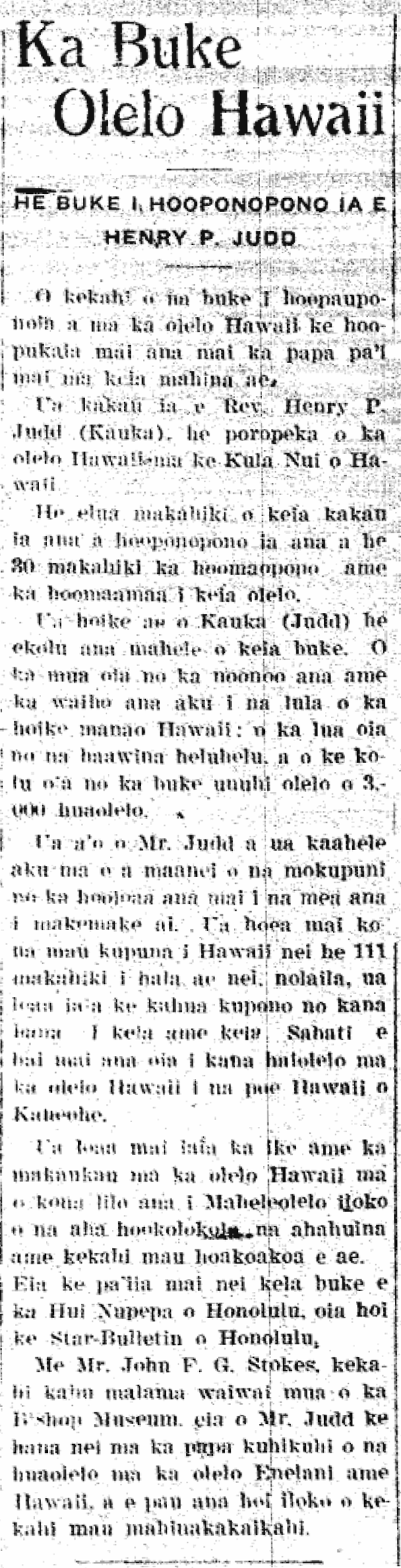
A BOOK EDITED BY HENRY P. JUDD

A book completed in the Hawaiian language is being published by the press next month.

It was written by Rev. Henry P. Judd (Kauka), a professor of the Hawaiian language at the University of Hawaii.

The writing and editing took two years, and it was 30 years of learning and practicing of the language.

Kauka (Judd) says there are three sections to this book. The first part is the studying and the giving of rules of Hawaiian expression; the second is reading lessons; and the third is the translation of 3,000 words.

Mr. Judd has taught and travelled here and there in the islands obtaining what he was after. His kupuna came to Hawaii nei 111 years ago, and therefore, he has the appropriate place for his work. Every Sunday, he gives his sermons in Hawaiian to Hawaiians in Kaneohe.

He gained his knowledge and proficiency in the Hawaiian language through his becoming a translator [Maheleolelo] in the courts, the [Evangelical] Conferences, and other gatherings.

This book is being published by the Newspaper Company of Honolulu, that is the Star-Bulletin of Honolulu.

With Mr. John F. G. Stokes, one of the first trustees of the Bishop Museum, Mr. Judd is now in the process of making a word list in English and Hawaiian, which will be completed in a few months.

[This is referring to the book: Judd, Henry P. The Hawaiian language. Honolulu: Honolulu Star-Bulletin, Ltd., 1939.]

(Hoku o Hawaii, 7/26/1939, p. 1)

Ka Buke Olelo Hawaii

Ka Hoku o Hawaii, Volume XXXIV, Number 13, Aoao 1. Iulai 26, 1939.

E o, e ka Wahine Hele La o Kaiona, 1913.

Aloha Pauahi the Alii

This coming Friday, the 19th of December is the day to remember, for all those Hawaiian hearts with love for their Chiefs, the birthday of the Princess Mrs. Pauahi Bishop, the Mother who left behind the glory of her name with her lahui from one generation to the next, all the way until the very last Hawaiian child. Being that she is the Royal Mother who remembered the youth of the people of her own flesh, skin, and blood, by dedicating her wealth to the establishing of the Kamehameha Schools where our youths are to be educated.

We commemorate the sacredness and the grandeur of her name, “The Mother of Her People,” and upon our breasts is a bouquet of unforgettable flowers pinned with deep sadness of love. She now sleeps the eternal sleep, but her name is remembered with awe amongst the children whom she supported, along with their parents. We now voice from our lips with appreciation—”Aloha Pauahi, the Alii.”

E o e ka wahine hele la o Kaiona
Alualu wai li’ula o ke kaha puaohai
O ka ua lani polua, po anu o ke Koolau,
Kuu hoa o ka malu kiu, malu kukui o Kahoiwai.

[And more on the celebration one hundred years ago, at the Kamehameha Schools.]

(Holomua, 12/13/1913, p. 4)

Aloha Pauahi ke Alii

Ka Holomua, Buke I, Helu 11, Aoao 4. Dekemaba 13, 1913.

More news from Kamehameha School …in Hawaiian, 1940.

News of Kamehameha School

(Written by Henrietta Laeha)

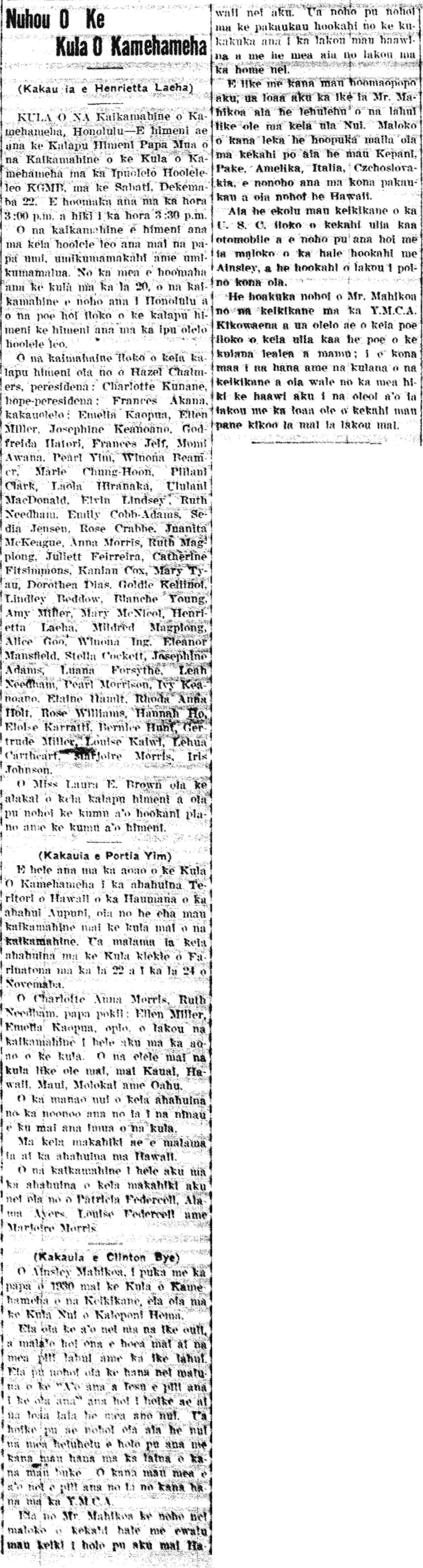
KAMEHAMEHA Girls’ School, Honolulu—The Upperclassmen Glee Club of the Kamehameha Girls’ School will sing at the KGMB Radio Station, on Sunday, December 22. It will begin at 3:00 p. m. until 3:30 p. m.

The girls singing in this broadcast are from the tenth-, eleventh-, and twelfth-grades. Because the school will be on vacation on the 20th, the girls who live in Honolulu and who are in the glee club will be singing at the radio station.

The girls in that glee club are: Hazel Chalmers, president; Charlotte Kunane, vice-president; Prances Akana, secretary; Emelia Kaopua, Ellen Miller, Josephine Keanoano, Godfreida Hatori, Frances Jelf, Momi Awana, Pearl Yim, Winona Beamer, Marie Chung-Hoon, Piilani Clark, Laola Hiranaka, Ululani MacDonald, Elvin Lindsey, Ruth Needham, Emily Cobb-Adams, Sedia Jensen, Rose Crabbe, Juanita McKeague, Anna Morris, Ruth Magplong, Juliett Feirreira, Catherine Fitsimmons, Kanian Cox, Mary Tyau, Dorothea Dias, Goldie Keliinoi, Lindley Beddow, Blanche Young, Amy Miller, Mary McNicol, Henrietta Leaha, Mildred Magplong, Alice Goo, Winona Ing, Eleanor Mansfield, Stella Cockett, Josephine Adams, Luana Forsythe, Leah Needham, Pearl Morrison, Ivy Keanoano, Elaine Hamit, Rhoda Anna Holt, Rose Williams, Hannah Ho, Eloise Karratti, Bernice Hunt, Gertrude Miller, Louise Kaiwi, Lehua Carthcart, Marjoire Morris, Iris Johnson.

Miss Laura E. Brown is the director of the glee club, and she is also the piano instructor and the singing teacher.

(Written by Portia Yim)

Going to represent Kamehameha School at the Territory of Hawaii Conference of the National Student Association [? ahahuina Teritori o Hawaii o ka Haumana o ka ahahui Aupuni], are four girls from the girls’ school. This conference was held at Farrington High School from the 22nd to the 24th of November.

Charlotte Anna Morris, Ruth Needham, children class; Ellen Miller, Emelia Kaopua, youths; were the girls who represented the school. The delegates came from many different schools, from Kauai, Hawaii, Maui, Molokai, and Oahu.

The main reason for this meeting was to think over the problems that come before the school.

This coming year, the meeting will be held on Hawaii.

The girls who went to the meeting last year were Patricia Federcell, Alama Ayers, Louise Federcell and Marjorie Morris.

(Written by Clinton Bye)

Ainsley Mahikoa, who graduated with the class of 1930 from Kamehameha School for Boys, is at University of Southern California.

He is there studying the social sciences [? ouli] and that includes the study of different peoples and their knowledge. He is also working on “The teachings of Jesus pertaining to life” of which he related that he gained a lot. He also said that there is a lot in his reading pertaining to his line of work. His studies are related to his work at the Y. M. C. A.

Mr. Mahikoa is living with eight other boys who went there together from Hawaii. They sit together at one table to discuss their studies as if they were living at home.

According to his explanation, that Mr. Mahikoa has gained a lot of knowledge of other peoples at that University. In his letter, he said that one night, there was a Japanese, Chinese, American, Italian, Czechoslovakian, sitting around his table with him, a Hawaiian.

There were three boys from USC who were in an automobile accident who live with him in the same dorm along with Ainsley, and one of them lost his life.

Mr. Mahikoa is a counsellor for the boys at the Central Y.M.C.A. and it is said that the boys who were in that accident were ones who liked to have fun, and because Mahikoa was used to the ways of boys, he was the only one that could talk to them without being talked back to.

[I was assuming that all of the news written in by Kamehameha students of that time would be done in English, but happily it was not so!]

(Hoku o Hawaii, 12/11/1940, p. 3)

Nuhou O Ke Kula o Kamehameha

Ka Hoku o Hawaii, Volume XXXV, Number 33, Aoao 3. Dekemaba 11, 1940.

Kamehameha Schools column in Hoku o Hawaii, 1940.

NEWS FROM KAMEHAMEHA SCHOOL FOR BOYS

By John Desha

KAMEHAMEHA SCHOOL. May 22 (Special)—Four seniors from the Big Island were graduated on May 30. They were Frances Nohoikaiu, Odetta Needham, George Mills, and Nephi Needham.

All of these students have attained a standard of which they can be proud.

George Mills and Nephi Needham have taken up at Kamehameha the agriculture course.

Frances Nohoikaiu and Odetta Needham have taken the general course at Kamehameha school for Girls.

Calvin Christ, also of Hawaii, is graduating this year. Calvin is in his high-eleventh year but is graduating with six other high-eleventh students. He has taken up the electrical course at Kamehameha and is planning to return to Hawaii where he intends to work.

KAMEHAMEHA SCHOOLS, May 26 (Special) — Memorial services were held for Bernice Pauahi Bishop by the Kamehameha Schools at Mauna Ala cemetery at Nuuanu on Friday, May 24.

While the school band played “Hawaii”, the students marched in and formed in a semicircles before the grave of Mrs. Bishop. The program ran in the following order:

“He Inoa No Pauahi” — Led by Daniel Hano.

“Pauahi O Kalani” — Led by Bernice Campbell.

“Boys’s School Pledge” — Led by Richard Hart.

“Pauahi Ke Alii” — Led by Amy Miller.

“Girls’ School Pledge” — Led by Florence Spencer.

“Decorating the Grave” — By the various class presidents.

“Only Remembered” — Led by Bernhardt Alama.

“Girls’ School Call” — Led by Josephine Keanoano.

A number of townspeople were present, including graduates and parents.

By D. Akaka.

KAMEHAMEHA SCHOOLS. May 22 (Special). Keanohou Ludloff of Hilo was recently elected to the post of treasurer for the coming year of the Hi Y Warriors club.

The other officers who were also elected are Robert Gomard, president, John Saber [?], vice-president, and Arthur Doo, secretary.

The present officers of the Hi Y club are James G???, president, Reuben Anderson, vice-president, John Desha, secretary, and Robert Fountain, treasurer.

“Ka oki ana o ka piko o Hale Lama” was the first sentence of a Hawaiian chant that was chanted by Kahuna pule Kahului Anderson and was interpreted by Moki Burrows, wearing malos, as “The cutting of the piko o Hale Lama” which is the ceremonial dedication of Hale Lama. A brief history of Hale Lama was presented by Louis Agard. the paina was followed by a program of dances and songs. “Aloha oe,” which was sung by the boys conducted the ritual ceremony. This ceremony marked the completion of a grass hut, constructed by students at Kamehameha schools.

Invited guests were as follows: Mrs. Lahilahi Webb, Mrs. Mary Pukui, Mrs. Keith Jones, Mrs. Margaret Bardwell, Miss Maude K. Scheiffer, Mrs. Antoinette Faahong, Dr. and Mrs. Homer F. Barnes, Mr. and Mrs. Pat Rankin, Mr. and Mrs. L??? G. Hudson, Miss Juliana Jones, Miss Pat Namaka Wiggin, Mr. William Jones and Mr. Jack Q. Haydgen. Sponsoring the paina were the 24? members of the Hui Kumulipo and 41? members of the Hui Oiwi which were successfully advised by Miss Mabel Catlin and Mr. Donald Mitchell a total of about 100 persons attended the ceremony.

[If only papers like Hoku o Hawaii were rescanned as clearly as possible, maybe more information would be available from articles like these. Information can only be appreciated if it is legible! It is however awesome that you can actually make out that attending the opening ceremony for Hale Lama were people like Lahilahi Webb, Mary Kawena Pukui, and Pat Namaka (Wiggin) Bacon!

Oooh, and D. Akaka? Senator Daniel Akaka, class of ’42?

Once again, i am sorry if some of the names i typed are incorrect!]

(Hoku o Hawaii, 6/5/1940, p. 4)

NEWS FROM KAMEHAMEHA SCHOOL FOR BOYS

Ka Hoku o Hawaii, Volume XXXV, Number 6, Aoao 4. Iune 5, 1940.