A Dance to benefit the Liliuokalani Educational Society, 1888.

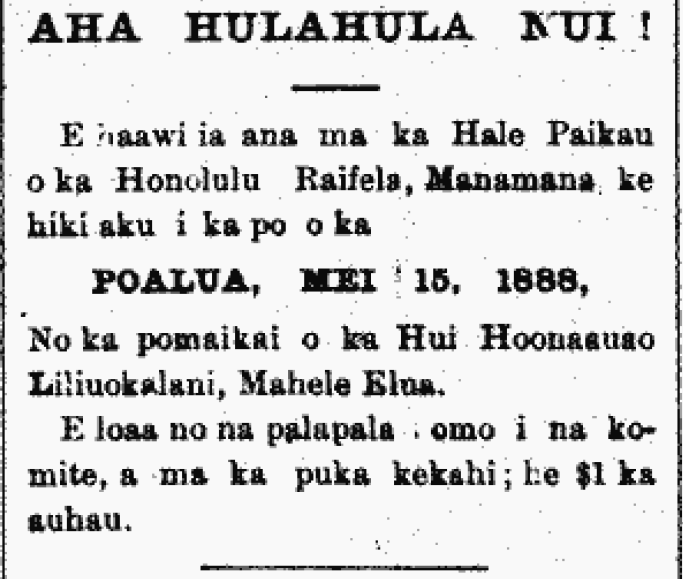
A BIG DANCE!

To be held at the Armory of the Honolulu Rifles, Manamana when reaching the night of

TUESDAY, MAY 15, 1888.

For the benefit of the Hui Hoonaauao Liliuokalani, Mahele Elua [The Liliuokalani Educational Society, Division Two].

Tickets of entry may be obtained from the committee, and also at the door; $1 is the cost.

(Makaainana, 5/3/1888, p. 3)

AHA HULAHULA NUI!

Ka Makaainana, Buke III, Helu 3, Aoao 3. Mei 3, 1888.

More on Liliuokalani Educational Society, 1892.

[Found under: “HAWAII NEWS”]

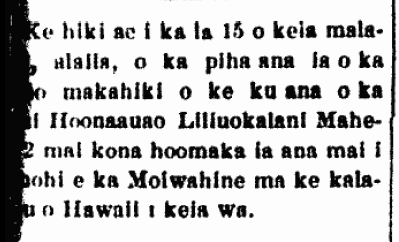
On the 15th of this month, it will be the [???] anniversary of the Hui Hoonaauao Liliuokalani, Mahele 2 [Liliuokalani Educational Society, Division 2] from its inception by the Queen of Hawaii at this time.

[This article in theory states the year that the Liliuokalani Educational Society, Division 2 begins, but that year is not visible. Here is another article which is cut off because of tight binding. It is a sad thing to have to randomly go back and flip through fragile newspaper pages just to find what a word or phrase is. And if a whole bunch of people need to find different things, the papers will deteriorate quickly, and soon, a good image will be impossible because the pages will be dust…]

(Kuokoa, 5/7/1892, p. 3)

Ke hiki ae i ka la 15...

Ka Nupepa Kuokoa, Buke XXXI, Helu 19, Aoao 3. Mei 7, 1892.

Liliuokalani Educational Society, 1890.

[Found under: “LOCAL & GENERAL NEWS”]

The First Division of the Liliuokalani Educational Society will meet at Washington Place, three [?] o’clock Monday afternoon.

[Granted, this is a single sentence, but there is not much known about the Liliuokalani Educational Society, and every little mention is important…

This newspaper is bilingual, Hawaiian and English, and is also called “The National Herald”. The images are not very clear, and the typescript as a result is riddled with “@”s, which indicate that the area is illegible. Hopefully they (and all of the other newspapers) can be re-shot so that there will be legible images—the information they hold is priceless!]

(Ahailono a ka Lahui, February 1, 1890, p. 5)

The First Division of the Liliuokalani Educational Society...

Ka Ahailono a ka Lahui, Volume 1, Number 20, Page 5. February 1, 1890.

Because February shouldn’t be the only Hawaiian Language month… 1948.

THE MOTHER TONGUE

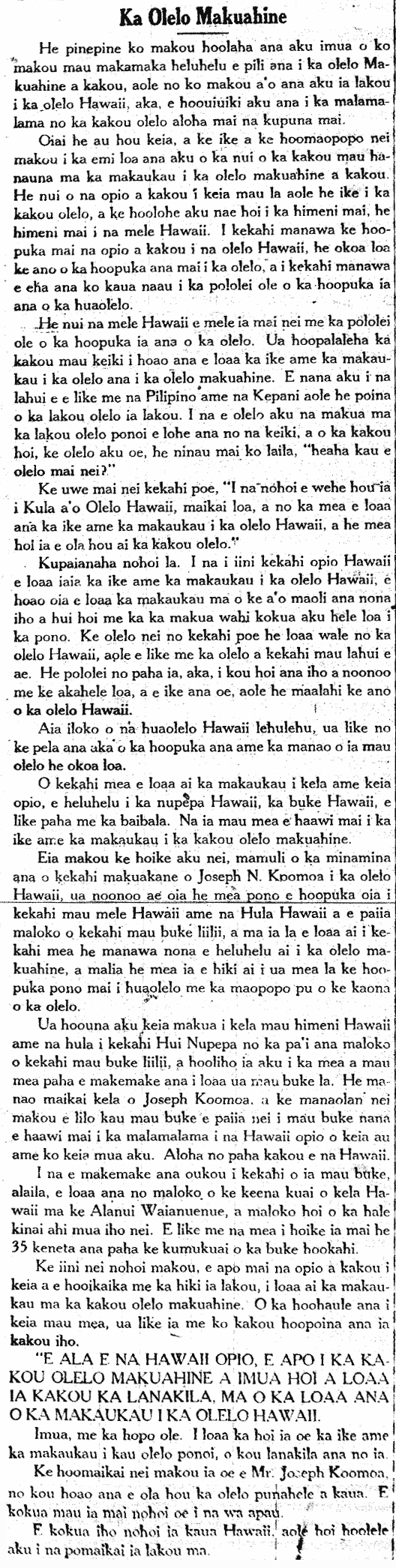
We frequently speak to our dear readers about our Mother tongue, not about our teaching them the Hawaiian language, but that the light of our beloved language from our forefathers is being extinguished.

Being that this is a new era, and we see and realize that there is a drastic reduction in the number of our generations capable in our mother tongue. There are many of our youths these days who have no knowledge of our language, but when you listen to them singing, they sing Hawaiian songs. Sometimes when our children speak Hawaiian, their production of the language is so strange, and sometimes our naau [gut, heart] aches at their mispronunciation of words.

There are many Hawaiian songs sung with incorrect pronunciation. Our children are neglecting trying to acquire knowledge and proficiency in speaking the mother tongue. Look at the other ethnicities like the Filipinos and the Japanese, they haven’t forgotten their language. If parents spoke in their own language then the children would hear; and when we talk to them, they’ll ask, “he aha kau e olelo mai nei? [what are you saying?]”

Some people bewail, “If only Hawaiian-Language Schools were reopened, that would be a good thing because we’d get knowledge and proficiency in the Hawaiian language and it would revive our language.”

That is astonishing. Should a young Hawaiian have the desire to acquire knowledge and competency in the Hawaiian language, he should try to get this competency by studying diligently by himself and to get together with an adult for help and there would be great progress. Some say that Hawaiian can be gotten just like that, not like the languages of other people. Perhaps it is true, but if you go back and think with great seriousness, you will see that the Hawaiian language is not easy.

Within the many Hawaiian words, spellings might be the same, but the pronunciation and meanings of those words are different.

One thing that will give every youth proficiency is the reading of Hawaiian newspapers and Hawaiian books like perhaps the bible. Those things will give knowledge and competence in our native language.

We point out that because of the great love of a certain father, Joseph N. [Nihiaumoe] Koomoa, for the Hawaiian language, he thought it would be important to publish some Hawaiian songs and Hawaiian Hula and print some booklets, and through that someone could make time to read the Hawaiian language and perhaps that way the person could pronounce the words while understanding the kaona [underlying meanings].

This man sent those Hawaiian songs and hula to a Newspaper company to be printed in booklets, and it will be sold to the person or persons who want those books. This is a good idea of Joseph Koomoa’s, and we hope that your books that are being printed will become books that give knowledge to the Hawaiian youths of this age and of the future. Aloha to us, O Hawaiians.

Should you want one of those books, they will be available at the shop of that Hawaiian on Waianuenue Avenue, and also the former fire station [?] According to what was announced, the books will probably cost 35 cents each.

We want our youngsters to get a hold of this and and improve themselves to the best of their ability so that they can get proficiency in our mother tongue. Letting these go would be like forgetting our own selves.

“RISE YOUNG HAWAIIANS, GRASP OUR MOTHER TONGUE AND GO FORTH AND LET US BE TRIUMPHANT BY BEING PROFICIENT IN THE HAWAIIAN LANGUAGE.

Forge forward with no fear. So that you can get knowledge and proficiency in your own language—that will be your triumph.

We give our congratulations to you, Mr. Joseph Koomoa, for you attempt to revive the prized language of ours. You will be helping for all times [E kokua mau ia mai nohoi oe i na wa apau. ?]

Help ourselves Hawaiians, and don’t let the benefits go to those others [E kokua iho nohoi ia kaua Hawaii, aole hoi hoolele aku i na pomaikai ia lakou ma. ?]

[Anyone know of any copies of these music booklets by Joseph N. Koomoa still in existence???]

(Hoku o Hawaii, 2/11/1948, p. 2)

Ka Olelo Makuahine.

Ka Hoku o Hawaii, Volume XLI, Number 19, Aoao 2. Pepeluali 11, 1948.

Laying of the cornerstone of Liliuokalani School, 1912.

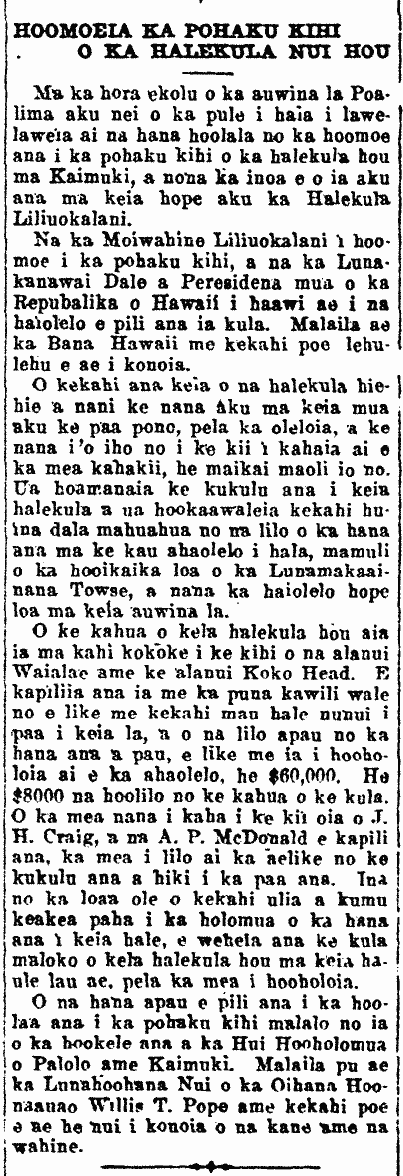
The Cornerstone of the New Great School is Laid.

At three o’clock on the afternoon of last Friday (4/12/1912), a ceremony was conducted to lay the cornerstone of the new school house in Kaimuki, that will be called hereafter, Liliuokalani School.

Queen Liliuokalani laid the cornerstone, and Legislator Dole, and former President of the Republic of Hawaii gave a speech about the school. The Hawaiian Band was there along with many invited guests.

When it is completed, this will be one of the most distinguished and beautiful schools, according to what is being said. And when you look at the artist’s rendering, it is indeed splendid. Authorization for building and funds were set aside in the previous session of the Legislature, through the efforts of Legislator Towse, and it was he that gave the final speech that afternoon.

The grounds of this school is near the corner of Waialae and Koko Head. It is being constructed of cement, like many of the great buildings being built these days. And the entire costs will be, as decided by the legislature, $60,000. $8000 was spent to purchase the land. The artist who drew the rendering was J. H. Craig. A. P. McDonald is the one doing the constructing; he received the contract to build the school to completion. Should there be no accidents or hinderances to the progress, the school will be unveiled this coming fall, as per what was decided.

Everything concerning the dedication of the cornerstone fell under the Improvement Club of Palolo and Kaimuki. Present also the head of the DOE, Willis T. Pope, as well as many men and women invited to attend.

[Although sadly this school has been closed, I hear there will be a 100th year celebration of the laying of the cornerstone to be held on the Queen Liliuokalani School grounds, on the 12th of April, with gates opening at 3:00 p. m.

See also from Chronicling America these related articles in English:

Evening Bulletin, 4/13/1912, p. 11,

Hawaiian Gazette, 4/16/1912, p. 7.

And about the actual opening of the school:

Hawaiian Gazette, 10/15/1912, p. 7.]

(Kuokoa, 4/19/1912, p. 6)

HOOMOEIA KA POHAKU KIHI O KA HALEKULA NUI HOU.

Ka Nupepa Kuokoa, Buke XLVIII, Helu 16, Aoao 6. Aperila 19, 1912.

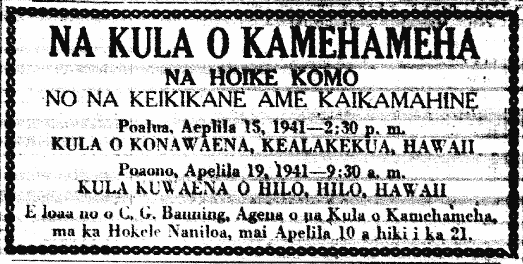
Entrance exams for Kamehameha Schools, 1941.

KAMEHAMEHA SCHOOLS

ENTRANCE EXAMS

FOR BOYS AND GIRLS

Tuesday, April 15, 1941—2:30 p. m.

KONAWAENA SCHOOL, KEALAKEKUA, HAWAII.

Saturday, April 19, 1941—9:30 a. m.

HILO INTERMEDIATE SCHOOL, HILO, HAWAII

C. G. Banning, Agent for the Kamehameha Schools will be available at the Naniloa Hotel from April 10 until the 21st.

(Hoku o Hawaii, 4/9/1941, p. 2)

NA KULA O KAMEHAMEHA

Ka Hoku o Hawaii, Buke XXXV, Helu 50, Aoao 2. Aperila 9, 1941.

Changing Hawaiian Language, 1844.

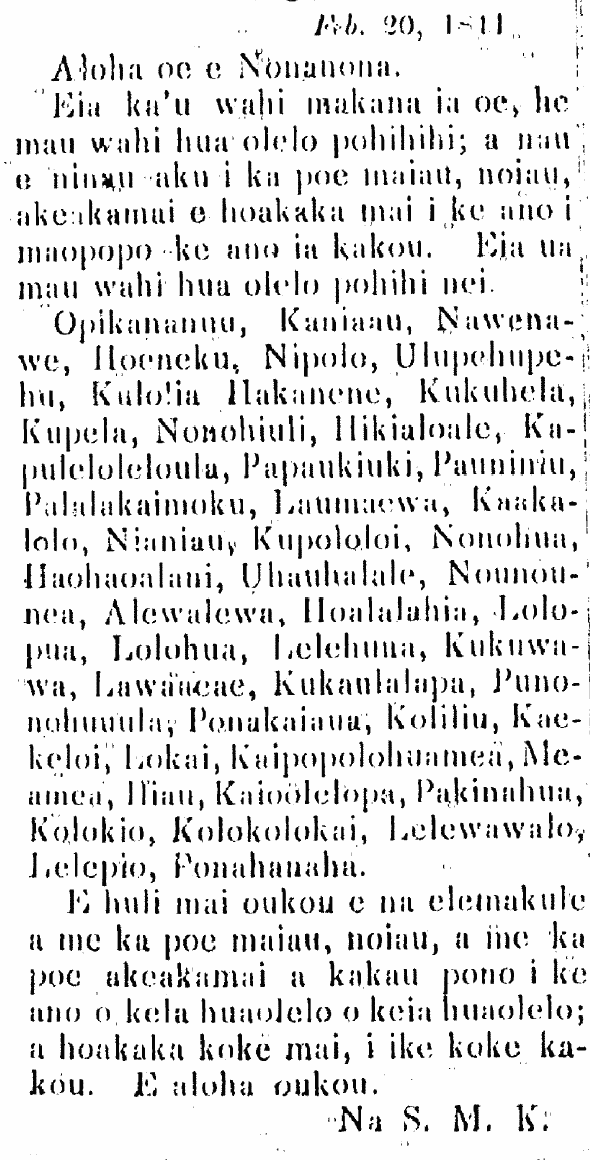
February 20, 1844.

Aloha to you, O Nonanona.

This is my gift to you, some unclear words; and it is for you to asks the skilled, the wise, the seekers of knowledge to clarify their nature, so that it is understood by us. And here are those unclear words.

Opikananuu, Kaniaau, Nawenawe, Hoeneku, Nipolo, Ulupehupehu, Kulolia, Hakanene, Kukuhela, Kupela, Nonohiuli, Hikialoale, Kapuleloleloula, Papaukiuki, Pauniniu, Palalakaimoku, Laumaewa, Kaakalolo, Nianiau, Kupololoi, Nonohua, Haohaoalani, Uhauhalale, Nounounea, Alewalewa, Hoalalahia, Lolopua, Lolohua, Lelehuna, Kukuwawa, Lawaaeae, Kukaulalapa, Punonohuuula, Ponakaiaua, Koliliu, Kaekeloi, Lokai, Kaipopolohuamea, Meamea, Iliau, Kaioolelopa, Pakinahua, Kolokio, Kolokolokai, Lelewawalo, Lelepio, Ponahanaha.

All you oldsters, and the skilled, the wise, and the seekers of knowledge, set down in writing the meanings of each word, and clarify them soon so that we may quickly know. Aloha to you all.

By S. M. K. [Samuel Manaiakalani Kamakau]

[It is only 1844, and the young Kamakau is asking for clarification of vocabulary. The Hawaiian language apparently is already changing quickly, and Kamakau has already began collecting. He will be printing many traditional mele in the papers and does his famous history in the 1860s…]

(Nonanona, 3/5/1844, p. 109.)

Feb. 20, 1844...

Ka Nonanona, Buke 3, Pepa 21, Aoao 109. Maraki 5, 1844.

The changing Hawaiian language, 1880.

SOME THOUGHTS ON THE HAWAIIAN LANGUAGE.

Before the arrival of the teachers and the educated haole from foreign lands, documents were not written in the Hawaiian language. But not long after the teachers began living here, they sought to write down this language, and in the year 1822, the first book was printed in Hawaiian. From that time until this day, the progress of book printing has been quick.

In the year 1834, the first Hawaiian-language newspaper was published. These days, newspaper publishing has become a big industry, and the nation is enriched by the spreading of knowledge and enlightenment by reading the newspapers.

This blessing described above has been accompanied by a problem, and I would like to express some thoughts on the subject. Therefore, O Readers, please be kind as I explain to you some things on the topic.

If we observe a newborn child, he comes into the world not knowing how to speak; but after a few months, he takes up this new task and attempts speaking a few words.

When a child gets new ideas and learns new things, he searches for new words, and along with the increase in his knowledge and awareness, so too does his number of words he can properly produce; and should he later become enlightened, he will be very well equipped with words for all of his thoughts.

By this, we understand that words are manifestations of thought.

Just as a child searches for new words, so too does a people when they acquire a new idea, or new things; they want to search for new fitting words to represent those new ideas or things. With the spreading of knowledge in this land, Hawaiians have come to know many new things which they did not think of before, like animals, plants, food, clothing, tools, usable electricity, iron, copper, silver, gold, and names for foreign lands, as well as descriptions for many new ideas. If the new vocabulary added to the Hawaiian language by educated foreigners and by Hawaiians searching for knowledge were counted, they probably would total no less than a thousand, or a number of thousands. The majority of these words are valuable words for the people, valuable for those who ponder and search for knowledge; however, a small fraction of these words are useless, and has been included in our language in error; and as a result of this mistaken inclusion, the true nature of the Hawaiian language has nearly been altered, and it has become strange and confusing. When the Bible was translated into Hawaiian, it was not possible without also introducing new words into the Hawaiian language.

Here are some words we gained through this translation: anela [angel], liona [lion], berita [covenant (from Hebrew, b’rith)], kumumanao [subject], and there are many new words of that sort.These words were not introduced into the language without thought, it was done with careful consideration with much thought as to the nature of the word being translated.

But during the years gone by, many words have crawled into the language and are being printed in the newspaper that are very strange, not at all akin to how the old people of Hawaii really spoke.

The majority of these improper new words are spread through the newspapers; they are holes always left wide open where may enter, if not watched over, foreign words not understood in the language of Hawaii nei.

I should perhaps tell you some of these worthless words which I have seen, lest someone asks, “Where are these words which you have decided to criticize? We don’t know them.”

Here are some of those words: duke [duke], visakauna [viscount], baroneti [baroness]. What in the world are these things? Who will answer? These words were seen and continue to be seen in some newspapers printed in Honolulu.

Here is one more: kakela. In my mind, as I understand it, the word kakela is not a Hawaiian word, but a recently acquired word. The haole word that was altered and became that which was written above is castle.

What it is, is a fortified structure solidly built to fend off robbers or enemies [it is interesting that the word “enemi” is used here, because it is also one of those Hawaiianized English words of which he speaks]. Who would understand the meaning of this word if he didn’t speak English? Here is yet another: bateri [battery]. It is a brand new word. Who can say what it means? Only after perhaps agreeing on a loan of a million dollars, with which they would purchase a number of huge cannons, would Hawaiians understand the meaning of bateri.

The word hokele (English, hotel) has perhaps become a Hawaiian word, so I suppose I can’t criticize it. But what is a coroneta [coronet]? Let one who knows answer.

As for the word kanikela [consul], I guess I can’t criticize it much, for it has almost become a fixed word that is understood in Hawaiian.

Here however is a word that has only just entered recently which I thought over with consternation, that is fea (fair in English). Only the kamaaina here in Honolulu will most likely know the meaning of this word, and not the general public.

These are some atrocious words: Regimana (English, regiment), a thousand soldiers; kaina, “all sorts of kaina” (English, kind); this is really bad; materemonio (English, matrimony), marriage; uko ole (English, useless). These words should be discarded for good.

In the consideration of those knowledgeable and skilled in the subject of the appropriateness of words, it is clear that these are words that should be allowed into the Hawaiian language, for if they are allowed to be included, then this language will be a thing that is scorned. There are many other words that I can give, but those were maybe sufficient.

Here is another problem with allowing these words in, because good, clear words from the past will be forced out.

These new words which I criticize resemble shadows, or a gust of wind, because it is just a wind or dust without substance within.

For a word is a manifestation of thought, and void of thought, a word becomes nothing.

This critique does not apply to all words, as was said earlier. Because like a child, when he has a new idea or ideas, he desires new words as representations for his thoughts, and so too must a people that are progressing search for and acquire new vocabulary—good representations for the new ideas that come up and are incorporated. However, before taking up these new representations, it is necessary to consider it carefully, for we may already have in the gracious, native Hawaiian language, a representation very similar to this new word, this malihini that we are about to welcome.

It is a fact that the Hawaiian people have discarded their blunt stone chisels of the olden days, because they are no longer valued now that we have sharp metal chisels; but that is no reason to set aside the stone poi pounder, or even the ulu maika stone—these are still valuable to this day, and if these were abandoned, then the lahui would be made poor. This is can be well applied to the vocabulary of Hawaii nei. For it is true that the Hawaiian language has acquired many words from the outside, and thus the language has benefited and been enriched. But for this reason, if important words from the past were abandoned, and these new words not understood by the many were grabbed haphazardly, the Hawaiian language would become a thing worthless, emaciated and castrated.

Regular old words taken and used regularly by people from the old times to this day, those are the blood, the breath, the prize of the true language of the Hawaiian Archipelago. And the abandoning, the leaving to the side, and the forgetting of these familiar words that were sanctified by Hawaii’s kupuna from ancient times, would be wrong in my mind; and the taking up of brand new inappropriate words as replacement for the old words that were abandoned—the foolishness of this is like abandoning fish and poi and instead filling the stomach with just haole food, snacks that are no good.

“A lahui that takes up another language and forgets their own, that lahui will live conquered and defeated.” That is what was said by an educated man.

This being said, it is not my desire to criticize the educated search in the English language or perhaps other foreign languages; it is a good and much appreciated thing.

I do however want to raise an emphatic voice and to ward off the speedy acceptance without proper consideration of strange new words with no worth, making the Hawaiian language a mixed up and unclear thing.

For this reason, the heads of newspapers; the translators of stories from foreign languages into Hawaiian; and all knowledgeable ones wanting the well being, the steadfastness, and the independence of Hawaii nei; must all be vigilant and guard against the improper inclusion of words that are ill-fitting and ill-suited to the inherent nature of the fine, melodic [palale?] language of the Hawaiian Islands.

N. B. Emerson.

Honolulu, April 26, 1880.

(Ko Hawaii Pae Aina, 7/31/1880, p. 4)

HE MAU MANAO NO KA OLELO HAWAII.

Ko Hawaii Pae Aina, Buke III, Helu 31, Aoao 4. Iulai 31, 1880.

Hawaiian-Language Newspapers and the past and the future, 1906.

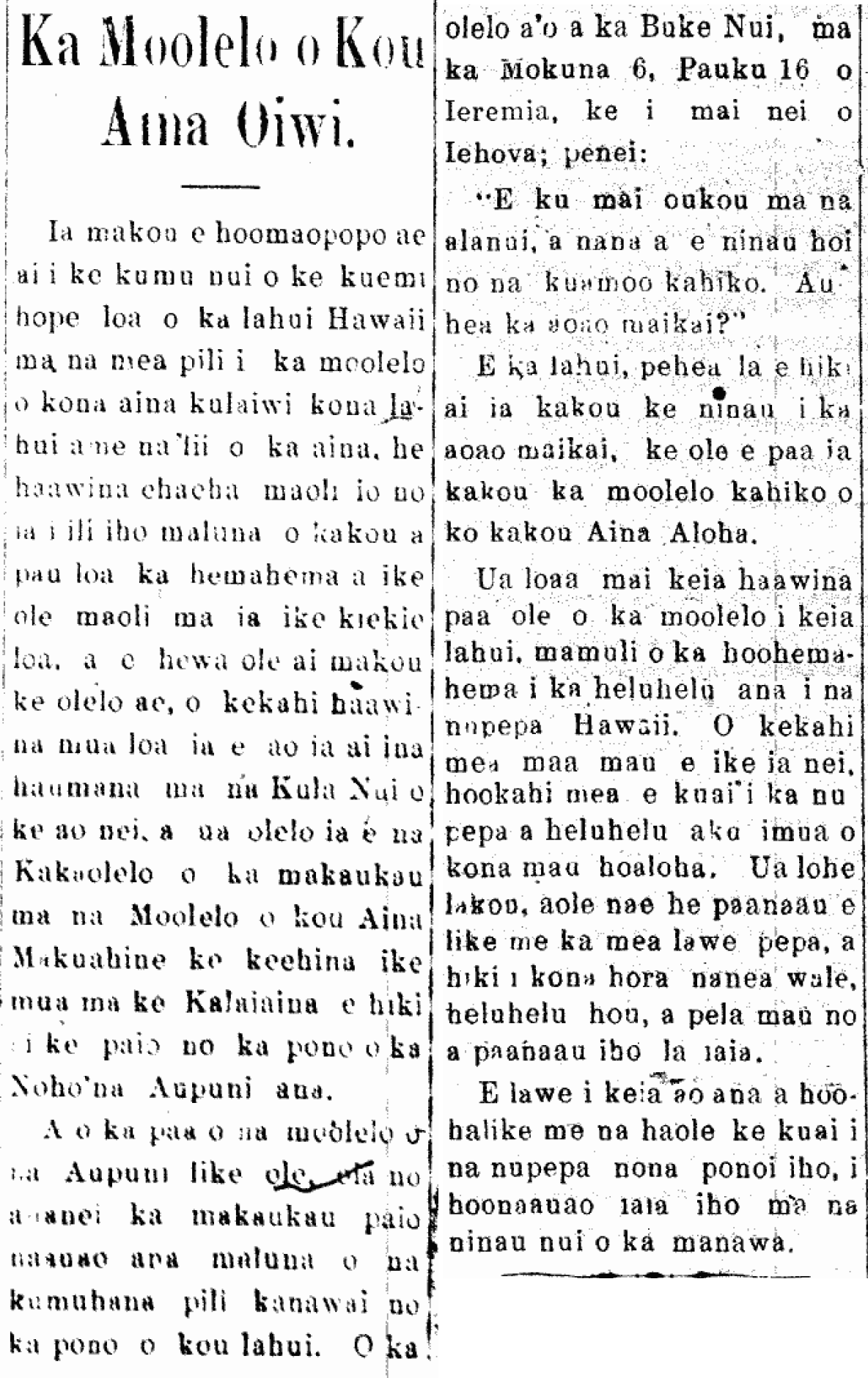
The History of Your Native Land.

As we contemplate the main reason for the falling far behind of the Hawaiian people in matters dealing with the history of their homeland, their lahui, and the alii of the land, we are all racked with intense pain at the haphazard and total lack of knowledge in this terribly important study; and it would not be wrong for us to say that it should be one of the first subjects that should be taught to the students at schools of higher education across the world; and it is said by the Orators that being knowledgeable in the History of your Motherland is the first step in Politics where you’d be able to fight for the good of the Rule of the Nation.

And understanding the histories of all Nations is what will prepare you to fight intelligently on legal grounds for the benefit of your lahui. In the teachings of the Great Book, in Jeremiah 6:16, Jehovah says to us:

“Stand ye in the ways and see and ask for the old paths. Where is the good way?”

O Lahui, how will we be able to ask of the right way if we do not know the old history of our Beloved Aina?

This lack of knowledge of the history of this people comes from not consistently reading the Hawaiian newspapers. Something frequently seen is one person buying a paper and reading it before his friends. They hear it but they don’t retain it like one who subscribes to the paper, who can re-read it at his leisure and thus commit to memory the information.

Learn from this instruction, and do as the haole, who buys his very own newspapers to educate himself in current events.

[The Hawaiian-Language Newspapers is a massive history book—a history on the most part told by Hawaiians living while the “history” was happening. As it was argued more than a hundred years ago, in order to fight for things like Sovereignty, Land, and Water, shouldn’t we know the history as told by Hawaiians? Perhaps we shouldn’t focus solely on what is written down in law books, but also on what Hawaiians actually said and did about these laws, about water rights, about land ownership, about fishing bans, etc., etc. etc.?

For sure this is no easy task. The original newspapers aren’t going to last forever. The current images for many of them are not totally clear (if there are images at all). They need to be word-searchable so that if you search for something, you will find it. There needs to be more people doing translations of them. But then again, Kamehameha Paiea didn’t exclaim, “Forward my younger brothers and drink of the sweet waters”…]

(Na’i Aupuni, 1/17/1906, p. 2)

Ka Moolelo o Kou Aina Oiwi.

Ka Na'i Aupuni, Buke I, Helu 44, Aoao 2. Ianuari 17, 1906.

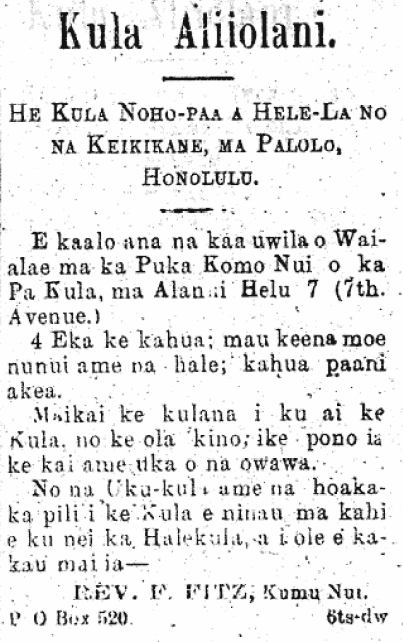
Aliiolani School ad, 1907.

Aliiolani School.

A Boarding and Day School for Boys, in Palolo, Honolulu.

Street cars of Waialae pass by the Front Entrace of the Campus, on 7th Avenue (Alanui Helu 7).

Campus of 4 acres; spacious dorm rooms and buildings; large playground.

The area where the school sits is good for the health; the ocean and the upland valleys are clearly visible.

For Tuition and details about the School, inquire at where the Schoolhouse stands, or write to—

REV. F. FITZ, Head Instructor.

P. O. Box 52o.

(Na’i Aupuni, 1/4/1907, p. 3)

Kula Aliiolani.

Ka Na'i Aupuni, Buke III, Helu 4, Aoao 3. Ianuari 4, 1907.