Charles Mathews performs at the Royal Hawaiian Theatre, 1871.

[Found under: “NOTES OF THE WEEK.”]

Charles Mathews in the Cannibal Islands.—This celebrated Comedian, who gave us a taste of his powers last February, writes a characteristic letter, in which he gives his impressions of us. We copy:

Reached Honolulu the capital of the Island of Oahu, and the seat of the government of the Hawaiian group, on Saturday, the 19th; eighteen days, four thousand and thirteen miles and three quarters! (accuracy again—exact as an architect’s estimate £4,000 35s. 1–2d.). Head winds (of course) all the way; longest passage (of course) ever known, and certainly the weariest. Heavy rolling seas, not a sail, or fish sighted, the only excitement we had arisen from the odd novelty of two Thursdays coming together in one week, two 9ths of February, arm-in-arm. At Honolulu, one of the loveliest little spots upon earth, I acted one night “by command, and in the presence of His Majesty Kamehameha V, King of the Sandwich Islands” (not ‘Hoky Poky Wonky Fong’ as erroneously reported), and a memorable night it was. Continue reading
“King of the Cannibal Islands,” 1830 / 1872.

By 1830 at least, there was a mocking ballad called “King of the Cannibal Islands” that was popular in the United Kingdom (as seen in newspaper advertisements for various concerts). Click here for lyrics printed on a broadside in 1858. By many accounts this was written in response to Kamehameha II going to England in 1824.

As a result of another famous trip taken by a Hawaiian monarch in 1874, the lyrics are adapted in America (the original song popular there much earlier).

THE KING OF THE CANNIBAL ISLANDS.

[From the N. Y. Graphic.]

Tam? Tam! Kalakaua the great
Is booming through the Golden Gate;
The Polynesian potentate,
The King of the Cannibal Islands.

Chorus—Hunki-dori-doodle-dum,
Ministers all upon a bum;
Honolulu! How they come
With the King of the Cannibal Islands.

From sugar-coated Hawaii
He comes strange countries for to see;
And ‘Frisco greets him: “How are ye?
O King of the Cannibal Islands.
Hunki-dori, etc. Continue reading

Stanford University Hawaii Club, 1905.

LEIS AT STANFORD

AN INTERESTING SOCIETY FORMED AT THE UNIVERSITY AT PALO ALTO—LEIS OF ROSES AND SCORE CARDS OF LAUHALA AT A CARD PARTY OF THOSE WHO HAVE LIVED IN THE ISLANDS.

STANFORD UNIVERSITY, April 13, 1905.—A number of Island people met on the evening of April 7, at the home of Mr. and Mrs. A. D. Larnach, and formed what was named the “Hui Hawaii” which is intended to bring together the Hawaiians about Stanford University in a social way. It was decided to have this a most informal affair and not to choose any regular officer, but simply to have it made known at one meeting who is to entertain at the next one. Anyone who has been in the Islands is to be eligible to membership. Continue reading

Ku kilakila o Kamehameha, Kuu home hoonaauao… rang out in Long Beach, 1926.

THERE WAS GREAT DELIGHT IN THE SINGING OF MISS LOUISE POHINA

A newspaper from Long Beach, California described how the recent singing of Miss Louise Pohina became something that the haole who showed up to hear her were greatly delighted in, joining in with those who went to offer their thanks and congratulations to her, the singers, and the skilled dancers.

There was a concert given in this city by the Ebell Club, with Miss Pohina singing some numbers and Lillian Edwards of Pasadena playing the piano; at the concert, the audience kept clapping for each song performed by Miss Pohina, and one of those songs was Kamehameha Waltz. Continue reading

The Kawaihau Glee Club, 1904.

[Found under: “SOCIETY”]

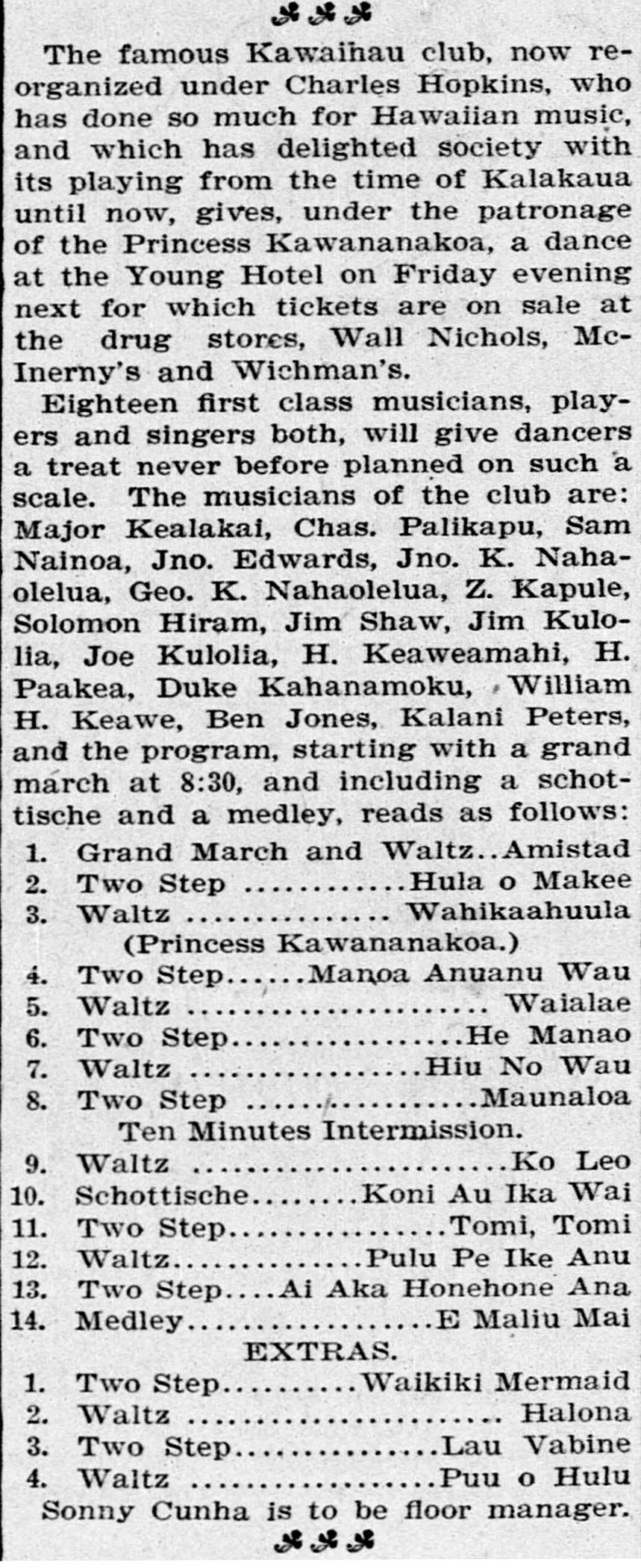
The famous Kawaihau club, now reorganized under Charles Hopkins, who has done so much for Hawaiian music, and which has delighted society with its playing from the time of Kalakaua until now, gives, under the patronage of the Princess Kawananakoa, a dance at the Young Hotel on Friday evening next for which tickets are on sale at the drug stores, Wall Nichols, McInerny’s and Wichman’s.

Eighteen first class musicians, players and singers both, will give dancers a treat never before planned on such a scale. The musicians of the club are: Major Kealakai, Charles Palikapu, Sam Nainoa, John Edwards, John K. Nahaolelua, George K. Nahaolelua, Z. Kapule, Solomon Hiram, Jim Shaw, Jim Kulolia, Joe Kulolia, H. Keaweamahi, H. Paakea, Duke Kahanamoku, William H. Keawe, Ben Jones, Kalani Peters, and the program starting with a grand march at 8:30, and including a schotische and medley, reads as follows:

1.  Grand March and Waltz ….. Amistad
2.  Two Step ….. Hula o Makee
3.  Waltz ….. Wahikaahuula (Princess Kawananakoa)
4.  Two Step ….. Manoa Anuanu Wau
5.  Waltz ….. Waialae
6.  Two Step ….. He Manao
7.  Waltz ….. Hiu No Wau
8.  Two Step ….. Maunaloa

Ten Minutes Intermission.

9.  Waltz ….. Ko Leo
10. Schottische ….. Koni Au Ika Wai
11.  Two Step ….. Tomi, Tomi
12.  Waltz ….. Pulu Pe Ike Anu
13.  Two Step ….. Ai Aka Honehone Ana
14.  Medley ….. E Maliu Mai

EXTRAS.

1.  Two Step ….. Waikiki Mermaid
2.  Waltz ….. Halona
3.  Two Step ….. Lau Vabine
4.  Waltz ….. Puu o Hulu

Sonny Cunha is to be floor manager.

(Pacific Commercial Advertiser, 6/19/1904, p. 6)

The famous Kawaihau club...

Sunday Advertiser, Volume II, Number 77, Page 6. June 19, 1904.

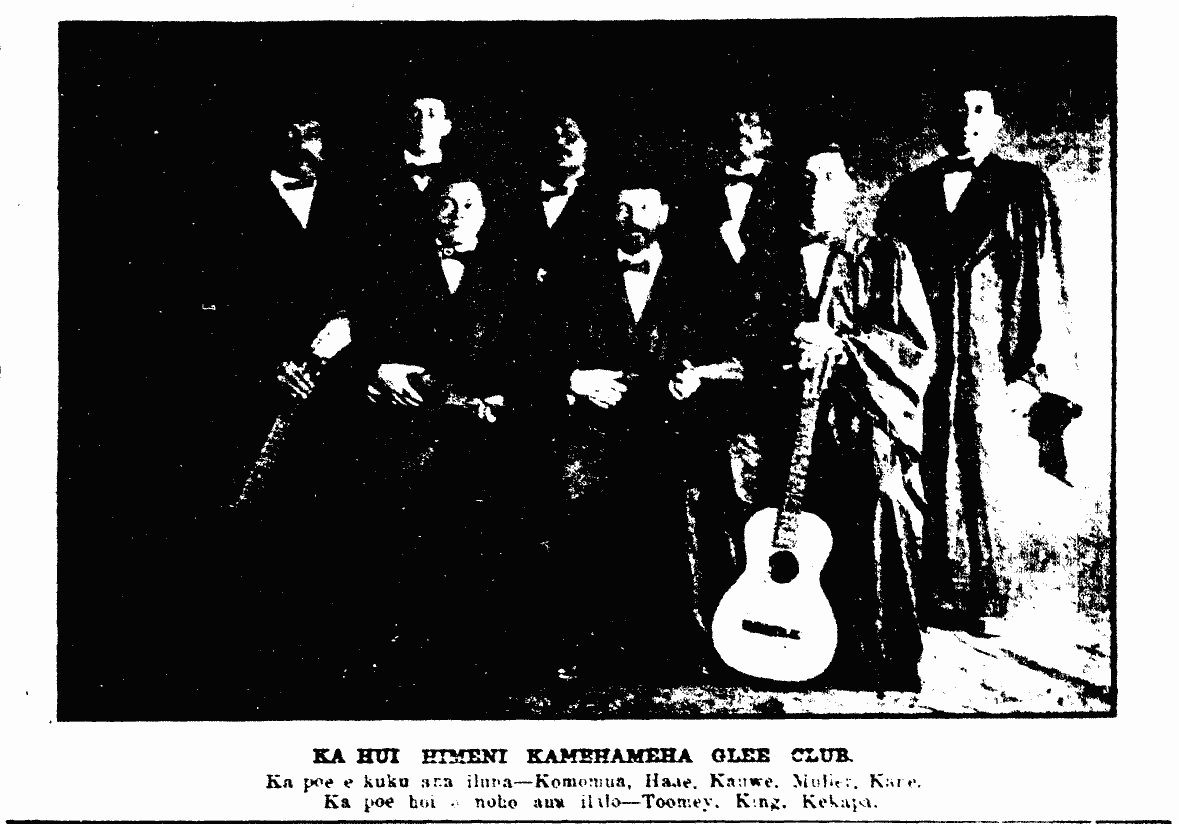
Kamehameha Glee Club on stage, 1912.

THE TWO OF US IN THE JOYFUL NIGHT OF HALALII

In K. P. Hall [Knights of Pythias Hall], tomorrow night, Saturday, the people of town will hear for themselves the singers of the Island of Keawe, known by the name “Kamehameha Glee Club,” because on that night, those singers will entertain with their deep voices, pleasing the girls of Honolulu nei so that they will not be able to sleep at night because of the beauty and sheer vigor.

Their fame of this glee club of the students of Kamehameha and Hawaiian teachers is only heard of, but during this concert of the Hawaiian Band Organization to be soon held; actually seen is the swaying of all those who listen to them; the ears tingle, making the singers of this town no match [lihi launa ole] for them.

This glee club has been travelling around Hawaii from one place to another, with much acclaim; songs that have become commonplace [paku-a] and not fun to listen to are like brand new songs when these boys sing them, and that is how they have gained fame. Continue reading

The Maori and Hawaiians, 1911.

Hawaiians and Maori Talk to Each Other.

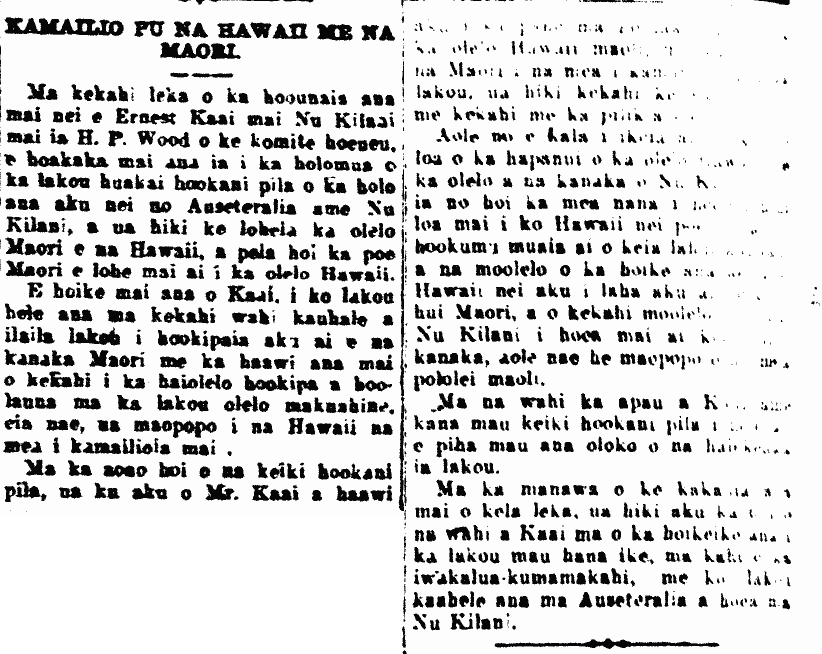
In a letter sent by Ernest Kaai from New Zealand to H. P. Wood of the Hawaiian Promotion Committee [which seems to be a precursor to the visitor’s bureau], he shows the progress of their musical touring of Australia and New Zealand. The Hawaiians could hear the Maori language and the Maori could hear the language of Hawaii.

Kaai said that when they went to some villages, they were hosted by Maori people, where one of them said words of welcome and friendship in their mother tongue. But the Hawaiians understood what was being said.

From the side of the musicians, Mr. Kaai stood and gave [rest of the paragraph unclear].

It was not long ago that [also unclear here, but they seem to be talking about the relationship between Aotearoa and Hawaii].

Everywhere that Kaai and his musical group went, the theaters would be filled with them.

When this letter was written, the number of places that Kaai them performed at was about 21, with them going around Australia and reaching New Zealand[?]

[A great deal of the Hawaiian Language Newspapers are bound into book form, and because they were purposely printed without much empty margins, often the printed portions that fall in the margin area of the books are not legible, especially when scanned. To get a clear image of the entire page, the books will have to be unbound first. That, it seems, takes a great amount of funding.]

(Kuokoa, 6/30/1911, p. 8)

KAMAILIO PU NA HAWAII ME NA MAORI.

Ka Nupepa Kuokoa, Buke XLVII, Helu 26, Aoao 8. Iune 30, 1911.

Chinese New Year in Hilo, 1890.

[Found under: “NA MEA HOU O HILO”]

Konohi Day of the Chinese.

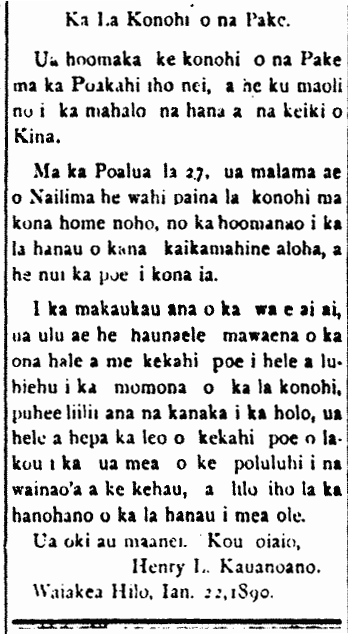
The new year of the Chinese began on this past Monday, and the activities of the boys of China were worthy of great admiration.

On Tuesday, the 27th, Nailima held a konohi party at his residence, to celebrate the birthday of his beloved daughter, and there were many who were invited.

When they were ready to eat, there rose a disturbance between the home owner and some people who were bedecked with the delicacies of the konohi day; the people split up and fled and some of their voices had become slurred because they were drowsy on “the chilly waters of the dew,” and the glory of the day became as of naught.

I will stop here. Yours truly,

Henry L. Kauanoano.

Waiakea, Hilo, Jan. 22, 1890.

(Kuokoa, 2/8/1890, p. 3)

Ka La Konohi o na Pake.

Ka Nupepa Kuokoa, Buke XXIX, Helu 6, Aoao 3. Feberuari 8, 1890.

Emma Nakuina educates teachers on Hawaiian history, 1920.

HAWAIIAN STORIES PRESENTED BEFORE THE TEACHERS’ SCHOOL.

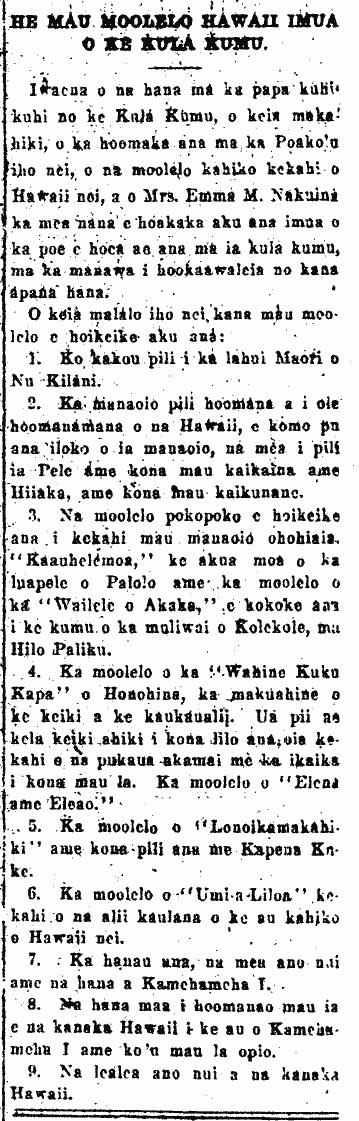
In the syllabus of the School of Education this year, beginning on this past Wednesday, were old moolelo of Hawaii nei. And it is Mrs. Emma M. Nakuina who is teaching them before those who come to the teachers’ school during the time set aside for her course.

These below are the moolelo that she will be teaching:

1. Our ties with the Maori of New Zealand.

2. The religion or superstition of the Hawaiians, and along with those beliefs are things relating to Pele and her younger sisters and Hiiaka, along with her brothers.

3. Short stories which show amazing beliefs, like the story of “Kaauhelemoa,” the chicken god of the crater of Palolo and the story of “Akaka Waterfall,” which is close to the head of the Kolekole River in Hilo Paliku.

4. The story of “The Kapa-Beating Woman” of Honohina, the mother of the chiefly child. That child grew up to become one of the strong and skilled warriors of his time. The story of “Elena [Eleau?] and Eleao.”

5. The moolelo of “Lonoikamakahiki” and his association with Capt. Cook.

6. The moolelo of “Umi-a-Liloa,” one of the famous alii of old Hawaii nei.

7. The birth, the important things, and accomplishments of Kamehameha I.

8. The usual activities recalled by Hawaiians in the time of Kamehameha I as well as during my childhood.

9. The major entertainments of Hawaiians.

(Kuokoa, 7/9/1920, p. 4)

HE MAU MOOLELO HAWAII IMUA O KE KULA KUMU.

Ka Nupepa Kuokoa, Buke LVIII, Helu 28, Aoao 4. Iulai 9, 1920.