More on honey, 1861.

[Found under: “This and That of Hawaii nei.]

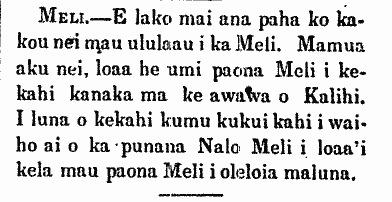
Honey [Meli].—Our forests will perhaps be filled with Honey. Earlier, a certain person in Kalihi valley had ten pounds of Honey. The Bee [Nalo Meli] hive was atop a kukui tree where that amount of Honey mentioned above was gotten.

(Kuokoa, 11/1/1861, p. 2)

Meli.

Ka Nupepa Kuokoa, Buke I, Helu 2, Aoao 2. Novemaba 1, 1861.

Festivities at Hilo Union School, 1927.

A FAIR AT HILO UNION SCHOOL

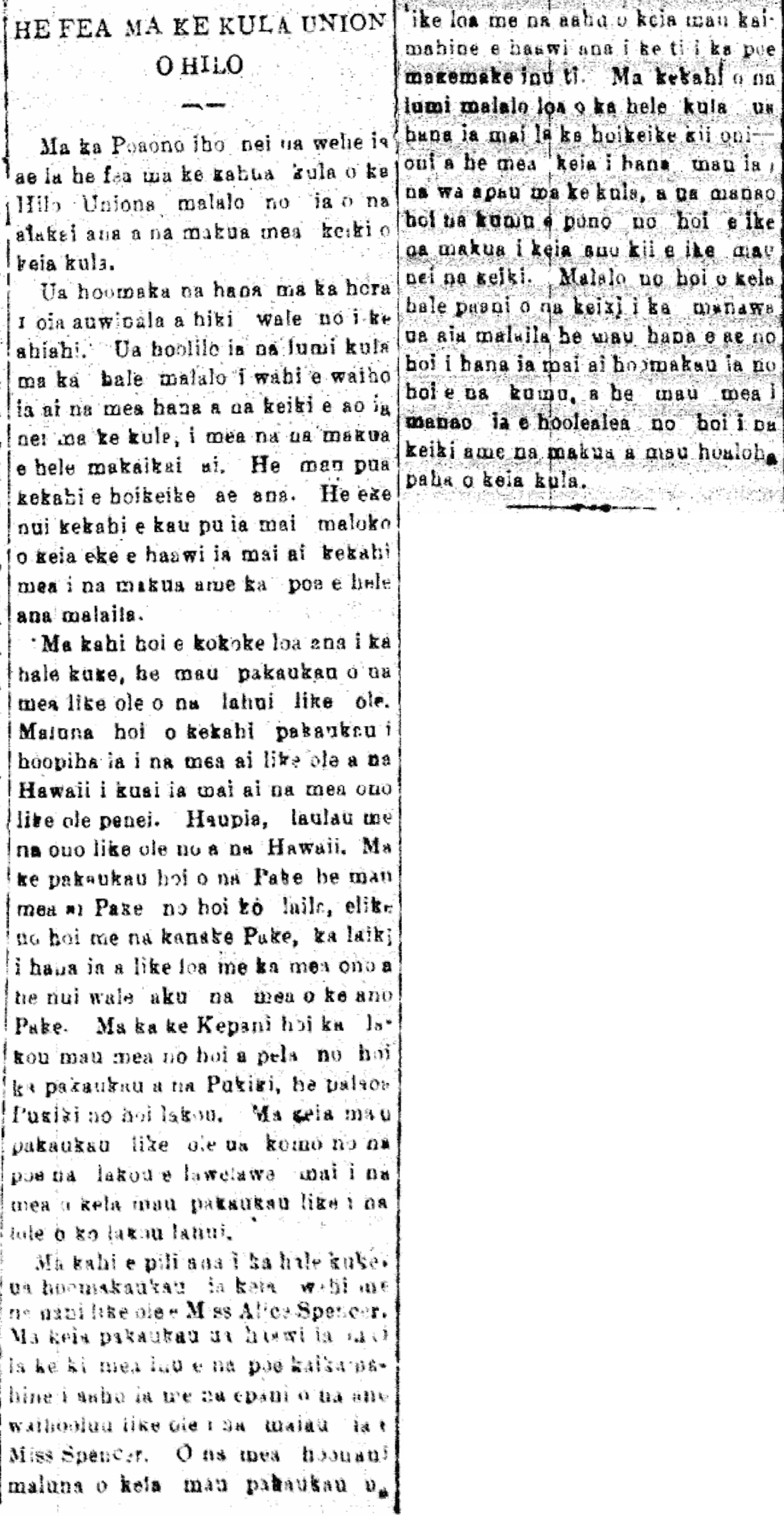
This past Saturday there was held a fair on the school grounds of Hilo Union, under the direction of the parents of the students of this school.

The activities began at 1 in the afternoon until the evening. The classrooms on the first floor was where the work of the children being taught at that school were placed, so that the parents could view them. There were also flowers on display. There was also a large bag, and from within this bag an item was given to the the parents and the people who came.

In an area near the kitchen, there were tables of all sorts of goods from all the ethnicities. One of the tables was filled with all the many delicacies of the Hawaiians. Haupia, laulau, and the other good foods of the Hawaiians. On the table of the Chinese, there was Chinese foods like Chinese candy, rice made into sweets, and many other Chinese items. On the Japanese one, was Japanese goods, and so too with the Portuguese table, they had Portuguese bread. On all of these tables, the people taking care of the items were dressed in the clothing of their people.

Near the kitchen, there was a place decorated by Miss Alice Spencer. On this table, tea to drink was served by girls dressed in aprons of all colors skillfully [made?] by Miss Spencer. The decorations on these tables were identical to the clothes of the girls serving tea to those who wanted to drink tea. In one of the rooms all the way at the bottom of the school, a movie was shown, and this is something always done, and the teachers thought it would be good for the parents to see the type of movie seen all the time by the children. Below that play house of the children in times of rain, there were other activities to do, set up by the teachers, and it was thought that these activities would entertain the children, parents, and friends of this school.

[Just passed by Hilo Union the other day and thought I’d put this article up that I had put aside some time ago.]

(Hoku o Hawaii, 5/3/1927, p. 2)

HE FEA MA KE KULA UNION O HILO

Ka Hoku o Hawaii, Buke XX, Helu 49, Aoao 2. Mei 3, 1927.

Buy local first—Love’s Bakery, 1909.

Support Local Businesses.

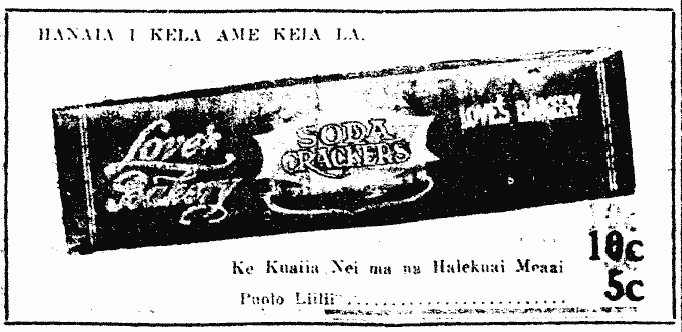
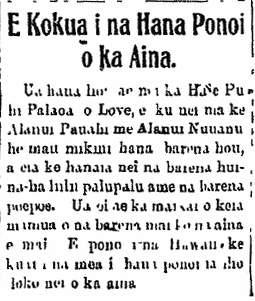
New cracker machines were installed at Love’s Bakery at Pauahi and Nuuanu Streets, and now being baked are light soda crackers [barena huina-ha liilii palupalu] and saloon pilot crackers [barena poepoe]. These are better than the crackers from outside of Hawaii. Hawaiians should purchase what is produced locally.

(Kuokoa Home Rula, 3/19/1909, p. 1)

E Kokua i na Hana Ponoi o ka Aina.

Kuokoa Home Rula, Buke VII, Helu 12, Aoao 1. Maraki 19, 1909.

Hula and King Kalakaua’s 50th Jubilee, 1886.

THE LUAU FEAST AT THE PALACE GROUNDS.

Nov. 23, 1886.

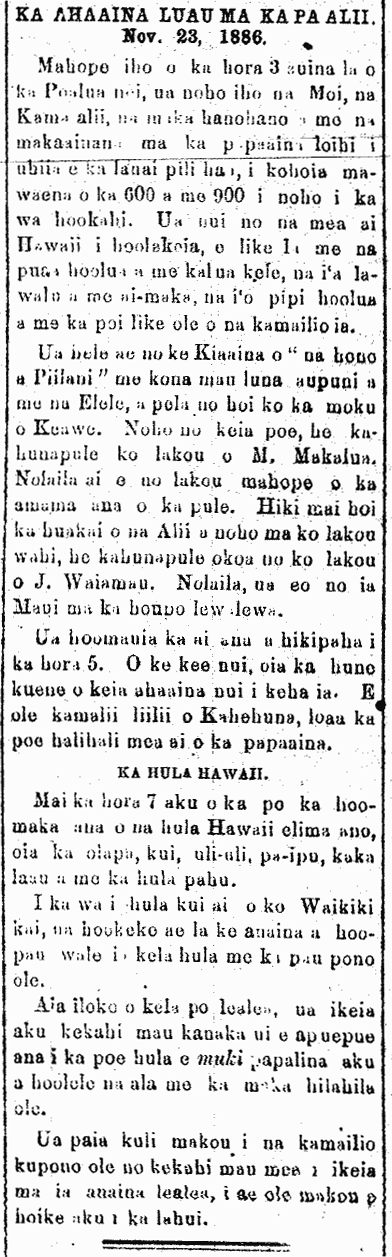
After 3 o’clock in the afternoon of this Tuesday, the King, the Princes and Princesses, the dignitaries, and the makaainana sat at a long table housed by a pavilion with corrugated iron roofing [lanai pili hao], which could sit an estimated 600 to 900 people at a time. There was much Hawaiian foods supplied, like laulau [puaa hoolua] and roasted pork [puaa kalua kele]; fish wrapped in ti leaves and baked [lawalu] and raw [ai-maka]; baked beef [i’o pipi hoolua] and all types of poi spoken of.

The Governor of the “bays of Piilani”¹ as well as his government officials and Delegates, along with those of the island of Keawe.² These people sat along with their pastor, M. Makalua. They began eating after the prayer was over. The entourage of the King and Queen arrived and sat in their area, and they had their own pastor, J. Waiamau. Therefore, Maui was victorious over their hunger [?? Nolaila, ua eo no ia Maui ma ka houpo lewalewa].

The eating continued perhaps until 5 o’clock. A big problem was the dearth of waiters for the grand feast that was boasted about. Thanks to the small children of Kahehuna [School], there were those to serve the food for the feast.

HAWAIIAN HULA.

From 7 o’clock in the night, Hawaiian hula of five types commenced, that being olapa, kui, uli-uli, pa-ipu, kaka laau, and hula pahu.

When those of Waikiki kai danced their hula kui, the audience complained, and that hula was put to an end without ending properly.

During that joyful night, some youths were seen attempting to get the dancers to kiss their cheeks, and to [?? hoolele na ala] without any sign of shame.

We were deafened by all the improper talk of some of the things seen in that partying crowd that we will not agree to tell the nation.

¹The governor of Maui was John Owen Dominis.

²The governor of Hawaii was Virginia Kapooloku Poomaikelani

(Ko Hawaii Pae Aina, 11/27/1886, p. 4)

KA AHAAINA LUAU MA KA PA ALII.

Ko Hawaii Pae Aina, Buke IX, Helu 48, Aoao 4. Novemaba 27, 1886.

Moni ka haae, 1913.

ADVERTISEMENT.

RICH HAWAIIAN FOOD—FIRST CLASS.

1. “KULOLO,” Royal Cocoanut Pudding.

2. “HAUPIA,” Sweet Violet Cocoanut Cream Delicacy.

3. “UALA HOOLU’A,” Roasted Potatoes.

4. “KOELEPALAU,” Minced Puna-Paiaala Cocoanut Cream.

5. “PUAA KALUA-KELE,” Roasted Pork.

6. “PUAA HOOLU’A LAULAUIA,” Selected Pork in Ti Leaves.

7. AKE MOMONA MAIKAI a me na ono e ae.

Come visit and inquire of MRS. MARY KUPIHEA.

Special Stall.—Hawaiian Fisheries Market.

DON’T FORGET.

(Kuokoa, 2/7/1913, p. 8)

Ka Nupepa Kuokoa, Buke XLIX, Helu 6, Aoao 8. Feberuari 7, 1913.

Ka Nupepa Kuokoa, Buke XLIX, Helu 6, Aoao 8. Feberuari 7, 1913.

New Years celebration in Kalawao, 1888.

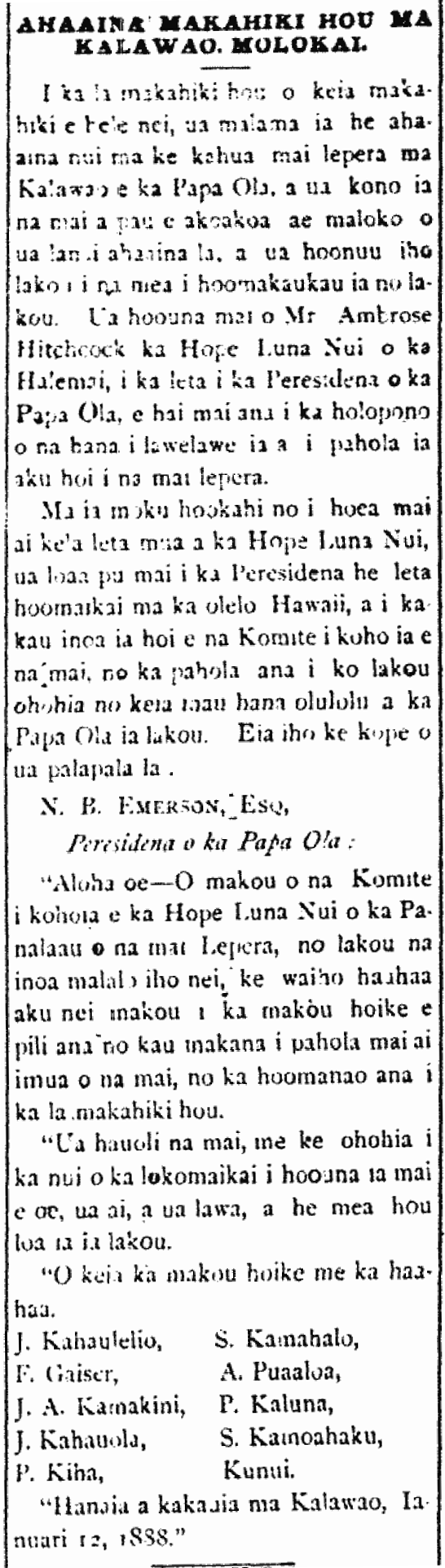
NEW YEAR’S FEAST IN KALAWAO, MOLOKAI.

On new year’s day of this year, a feast was held in the land of the leprosy patients at Kalawao by the Board of Health, and all of the patients were invited to gather within the party lanai where they feasted upon the things prepared for them. Mr. Ambrose Hitchcock [Hutchinson], the Assistant Superintendent of the Hospital, sent a letter to the President of the Board of Health, reporting on the good outcome of the efforts done for the leprosy patients.

Upon that same ship which arrived the letter from the Assistant Superintendent, the President [of the Board of Health] also received a letter of appreciation in Hawaiian, which was signed by the Committee chosen by the patients, to express their delight in the kind act done by the Board of Health for them. Here is a copy of that document.

N. B. Emerson, Esq.,

President of the Board of Health:

“Aloha oe—We are the Committee chosen by the Assistant Superintendent of the Leprosy Colony, whose names appear below; we humbly put before you our expression in response to your gift spread before the patients, to celebrate the new year.

“The patients are joyous and delighted with the great blessings sent by you, they ate until full, and this a something brand new for them.

“This is our expression, respectfully,

J. Kahaulelio,  S. Kamahalo,

F. Gaiser,  A. Puaaloa,

J. A. Kamakini,  P. Kaluna,

J. Kahauola,  S. Kamoahaku,

P. Kiha,  Kunui.

“Done and signed at Kalawao, January 12, 1888.”

[I think that the phrase, “this is something brand new for them,” is something to ponder and consider.]

(Kuokoa, 1/21/1888, p. 2)
AHAAINA MAKAHIKI HOU MA KALAWAO, MOLOKAI.

Ka Nupepa Kuokoa, Buke XXVII, Helu 3, Aoao 2. Ianuari 21, 1888.

Eagle Brand Condensed Milk in Hawaii, 1923.

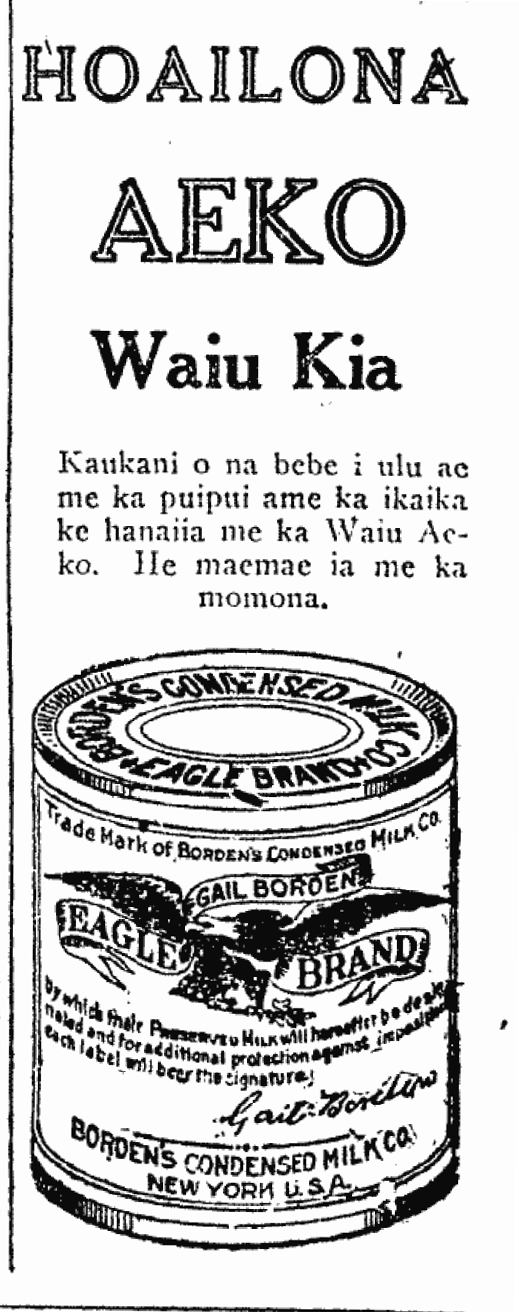
EAGLE
BRAND

Condensed Milk

Thousands of babies grew up big and strong being fed Eagle Milk. It is wholesome and nourishing.

[From the Eagle Brand website: “Eagle Brand Sweetened Condensed Milk was credited with significantly lowering the infant mortality rate in North America. Gail Borden’s discovery provided milk that would remain safe and wholesome—at that time, an important contribution to the nourishment of infants and children.”]

(Kuokoa, 5/10/1923, p. 3)

HOAILONA AEKO WAIU KIA

Ka Nupepa Kuokoa, Buke LXII, Helu 19, Aoao 3. Mei 10, 1923.

I scream, you scream? 1867.

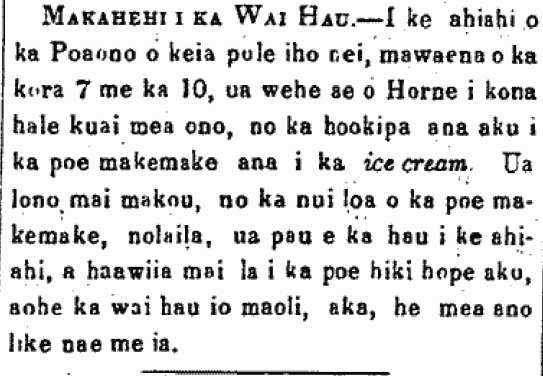
Amazement at the Wai Hau.—On the evening of this past Saturday, between the hours of 7 and 10, Horne [Horn] opened up his sweets shop to welcome those who wanted ice cream. We hear that because of the great number of people interested, all the ice cream was gone that evening and those that came after were given something that was not actually ice cream, but something similar.

[Here’s an advertisement for this shop much later in Thrum’s Annual for 1886, but we see that the establishment was opened in 1863!]

(Au Okoa, 9/26/1867, p. 2)

Makahehi i ka Wai Hau.

Ke Au Okoa, Buke III, Helu 23, Aoao 2. Sepatemaba 26, 1867.

Early report on poi palaoa in California, 1859.

Poi Palaoa.

O Hae Hawaii;

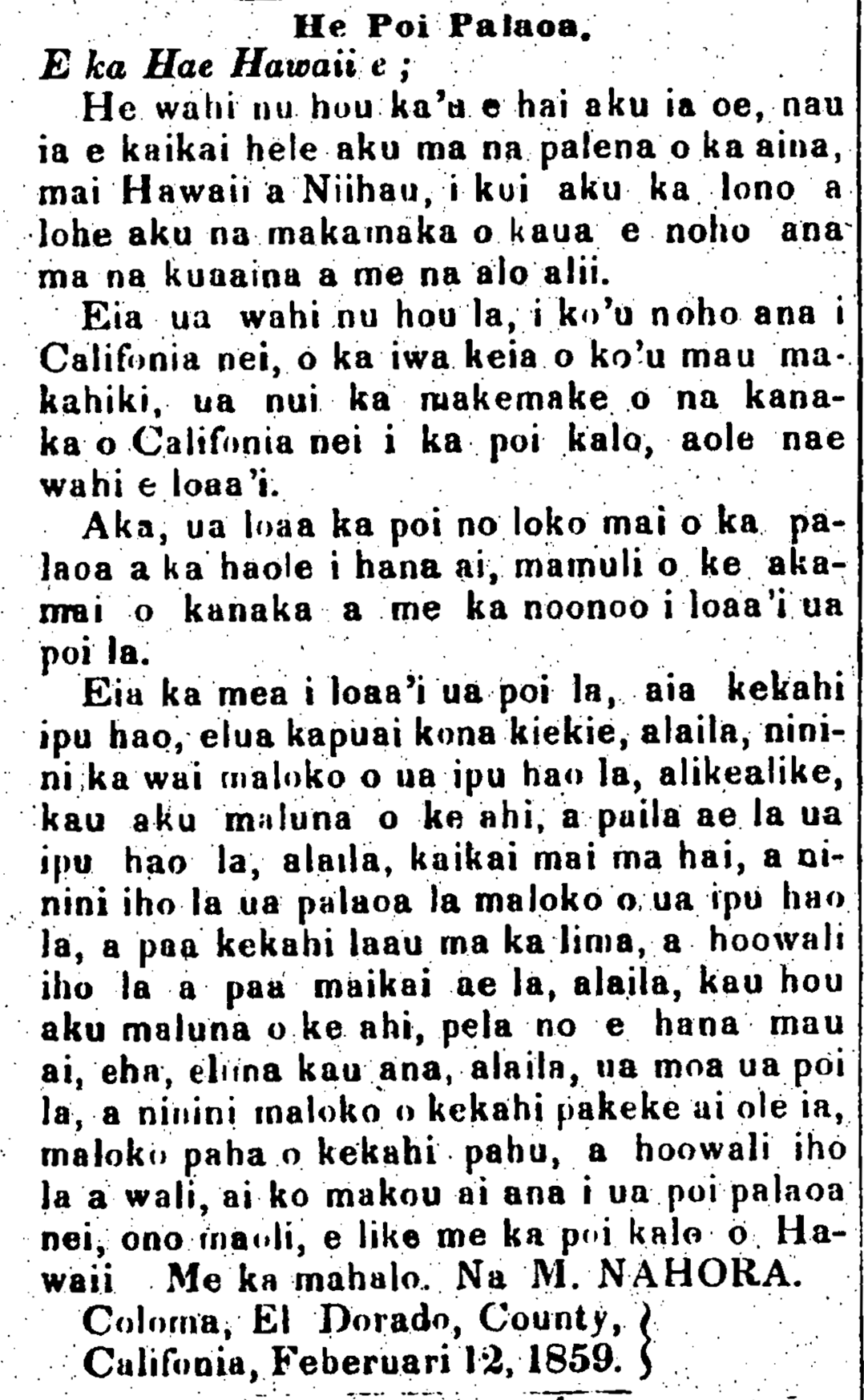
I have some news to report and it will be for you to carry it around to the borders of the land from Hawaii to Niihau, so that the news is heard by our friends living in the countryside [kuaaina] and in the royal court [alo alii].

Here is the news: this is my ninth year of living here in California, and the Hawaiians in California desire poi greatly, but have no way to get it.

But we get poi from the flour that is made by the haole, and through the ingenuity of the Hawaiians who by thinking came up with that poi.

This is how you acquire the poi; get a pot that is two feet high and pour water into it half way and place on top the fire; when it boils, carry it aside and pour in flour into the pot; hold a stick in one hand and stir until firm then put back on the fire; keep doing this, and put back on the fire four or five times at which point the poi is cooked; pour into a bucket or in a barrel perhaps, and mix until smooth; when we eat poi palaoa it is truly delicious like taro poi of Hawaii. With appreciation, By M. NAHORA.

Coloma, El Dorado County,

California, February 12, 1859.

(Hae Hawaii, 3/16/1859, p. 199)

He Poi Palaoa.

Ka Hae Hawaii, Buke 3, Helu 50, Aoao 199. Maraki 16, 1859.