THE HAWAIIAN FLAG, 1894.

KA HAE HAWAII.

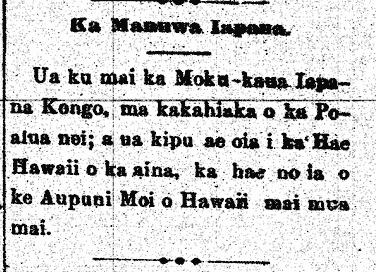
The Hawaiian Flag at this time is the Flag of the Monarchy, from times long ago; it is not the Flag of the Republic of Hawaii. That Flag is placed below the Palace; it is a Flag with a single star.

They despise all symbols relating to the Monarchy, and therefore all of the Hawaiian crowns affixed to the gates of the Palace have been removed, and the printing of the image of the crown has been discarded from all government notices; and this is how they attempt through all means to erase all of the streets and squares; they changed Palace Square [Kuea Alii] to Union Square [Union Square] and the Palace [Halealii] to the Executive Building [Hale Hooko], and so forth.

However, as for the Hawaiian Flag, it will prevail, yesterday, today, and for all times. The Hawaiian Flag of the Monarchy is what was saluted to by the warships this past Wednesday.

[Let us not deny the Hawaiian Flag for newly fashioned ones. May it indeed prevail for all times. E welo mau ka Hae Hawaii!]

(Leo o ka Lahui, 9/7/1894, p. 2)

KA HAE HAWAII.

Ka Leo o ka Lahui, Buke II, Helu 1022, Aoao 2. Sepatemaba 7, 1894.

“Peacock Government,” 1894.

THE PEACOCK GOVERNMENT [AUPUNI PIKAKE].

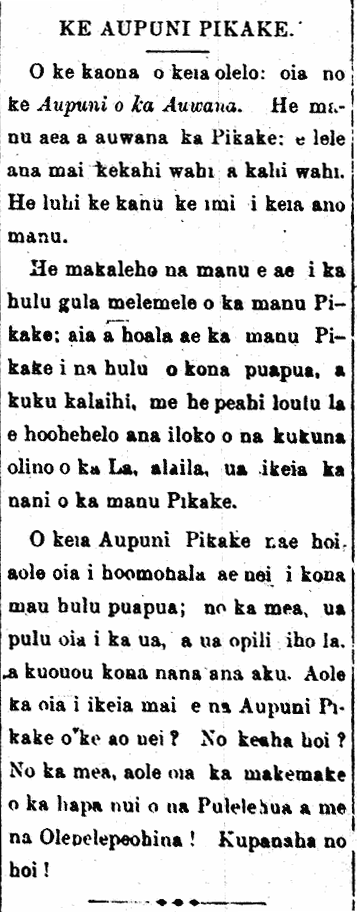
The concealed reference [kaona] of this term: that is a Wandering Government. The Peacock is a bird that is shiftless and a wanderer: it flies from one place to another. A keeper will grow weary looking for this kind of bird.

The other birds are covetous of the golden-yellow feathers of the Peacock; when the Peacock raises its tail feathers and they stand rigid like a loulu fan that shines brightly in the dazzling rays of the Sun, it is then that the beauty of the Peacock is seen.

This Peacock Government however has not spread out its tail feathers, because it is wet and numbed by the rain, and it appears droopy [? kuouou]. It is not recognized by the world’s Peacock Governments. Why is that? Because it is not favored by most of the Butterflies [Pulelehua] and Monarch Butterflies [Olepelepeohina]! How very amazing!

[Who is the Pikake? Who are the Pulelehua and the Olepelepeohina?]

(Leo o ka Lahui, 7/6/1894, p. 2)

KE AUPUNI PIKAKE.

Ka Leo o ka Lahui, Buke II, Helu 977, Aoao 2. Iulai 6, 1894.

PETITION OF THE PEOPLE PROTESTING AGAINST ANNEXATION, 1897.

PALAPALA HOOPII KUE HOOHUI AINA A KA LAHUI.

PALAPALA KUE HOOHUIAINA.

I ka Mea Mahaloia WILLIAM McKINLEY; Peresidena, a me ka Aha Senate, o Amerika Huipuia.

Me ka Mahalo:—

No ka Mea, ua waiho ia aku imua o ka Aha Senate o Amerika Huipuia he Kuikahi no ka Hoohui aku ia Hawaii nei ia Amerika Huipuia i oleloia, no ka noonoooia ma kona kau mua iloko o Dekemaba, M. H. 1897; nolaila,

O Makou, na poe no lakou na inoa malalo iho, na Hawaii oiwi, a me na kupa makaainana a poe nooho hoi no ka Apana o …………………….Mokupuni o ……………………., he poe lala no ka Ahahui Hawaii Aloha o ko Hawaii Paeaina, a me na makaainana e ae i like ka manao makee me ko ka Ahahui i oleloia, ke kue aku nei me ka manao ikaika loa i ka hoohuiia aku o ko Hawaii Paeaina i oleloia ia Amerika Huipuia i oleloia ma kekahi ano a loina paha.

IKEA—ATTEST:

…………………….

Kakauolelo—Secretary:

INOA—NAME.     Ι AGE.

PROTEST AGAINST ANNEXATION.

To His Excellency WILLIAM McKINLEY, President, and the Senate, of the United States of America.

Greeting:—

Whereas, there has been submitted to the Senate of the United States of America a Treaty for the Annexation of the Hawaiian Islands to the said United States of America, for consideration at its regular session in December, A. D. 1897; therefore,

We, the undersigned, native Hawaiian subjects and residents of the District of …………………… Island of ……………………., who are members of the Hawaiian Patriotic Leagues of the Hawaiian Islands, and other citizens who are in sympathy with the said League earnestly protest against the annexation of the said Hawaiian Islands to the said United States of America in any form or shape.

…………………….

Presidena—President.

INOA—NAME.     Ι  AGE.

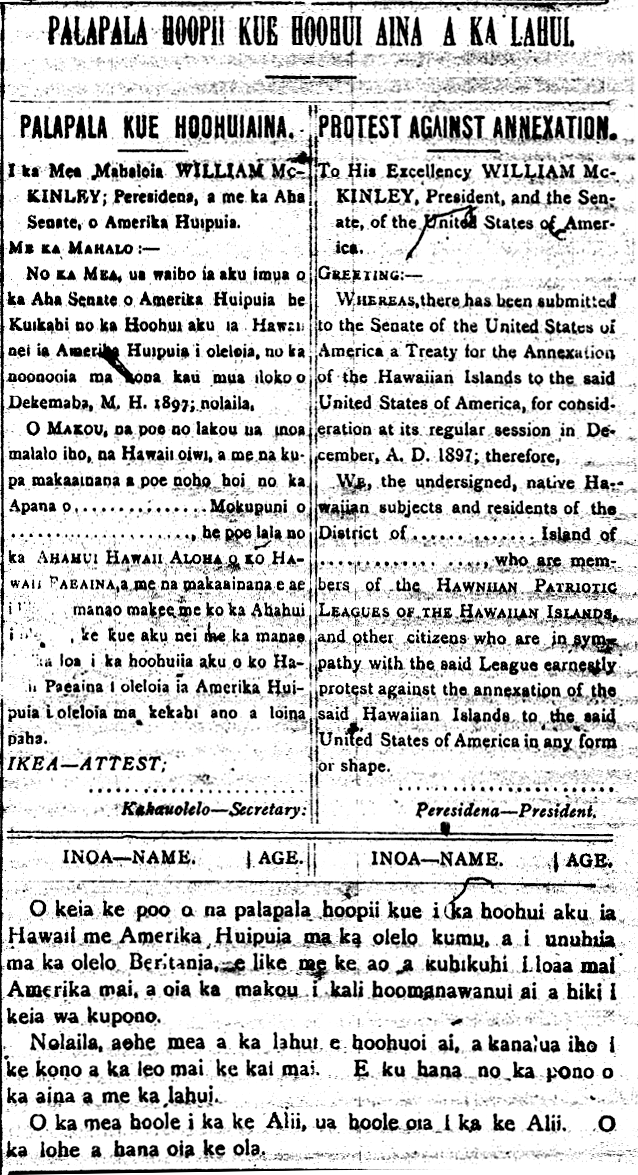
This is the heading of the petitions protesting the annexation of Hawaii to the United States of America in the original language, and translated into English, and as per the instruction and direction coming from America, we waited patiently until this proper time.

Therefore, there is nothing for the lahui to be suspicious about, or to be wary when the voice from the sea beckons. Stand up and do what is pono for the land and the people.

The person who denies that of the Alii denies that of the Alii [this is probably a typo that should have read, “O ka mea hoole i ka ke Alii, ua hoole oia i ka ke Akua,” The person who denies that of the Alii denies that of God]. Listening and acting is the way to survival.

[Check here for the images of the anti-annexation petitions put up by the University of Hawaii, Hamilton Library, Hawaiian Collection.]

(Aloha Aina, 9/18/1897, p. 5)

PALAPALA HOOPII KUE HOOHUI AINA A KA LAHUI.

Ke Aloha Aina, Buke III, Helu 38, Aoao 5. Sepatemaba 18, 1897.

Another Solomon Meheula passes on just three years earlier, 1922.

SOLOMON MEHEULA GROWS WEARY OF THIS LIFE.

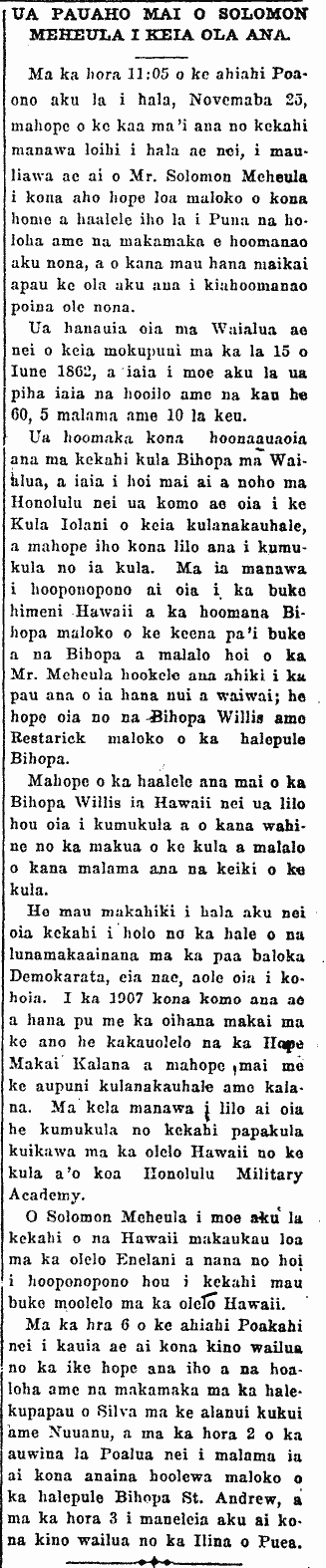
At 11:05 in the evening of this past Saturday, November 25, after being sick for a long time, Mr. Solomon Meheula gasped his last breath at his home, and he left in Puna his friends and fellows remembering him and all of his fine works that will live on as a monument to him.

He was born over there in Waialua, on this island, on the 15th of June 1862, and now that he sleeps, he spent 60 winters and summers plus 5 months and 10 days.

His education was began at an Episcopal school in Waialua, and when he returned to live in Honolulu nei, he entered the Iolani School of this town, and after he became a teacher for that school. During this time he edited the Episcopal Hymnal in the press of the Episcopal Church, and it was under Mr. Meheula’s guidance that this great and valuable work was completed; he was an assistant to the Bishops Willis and Restarick in the Episcopal Church.

After Bishop Willis left Hawaii nei, he again became a school teacher, and his wife was the matron of the school, and the children of the school were under her care.

A number of years ago, he was one of those who ran for representative under the Democratic party, however, he was not elected. In 1907 he entered and began working at the police department as a secretary under the County Deputy Sheriff and thereafter with the city and county government. At that time, he became a teacher in a special Hawaiian-language class for the military school, the Honolulu Military Academy.

The late Solomon Meheula was one of the Hawaiians who was fluent in English, and he rearranged a number of story books into Hawaiian.

At 6 o’clock in the evening of this Monday, his remains were placed for the last visitation by his fellows and friends at the Silva Mortuary on Kukui Street and Nuuanu Avenue, and at 2 o’clock in the afternoon of this Tuesday, his funeral was held at the Episcopal church, St. Andrew, and at 3 o’clock his remains were carried to the Puea Cemetery.

(Kuokoa, 11/30/1922, p. 1)

UA PAUAHO MAI O SOLOMON MEHEULA I KEIA OLA ANA.

Ka Nupepa Kuokoa, Buke LXI, Helu 48, Aoao 1. Novemaba 30, 1922.

Arrival of the children of Sun Yat Sen, 1912.

Children of Sun Yat Sen Welcomed with Enthusiasm

With the arrival of the Steamship Shinyo Maru last Monday from Japan and China, it carried aboard her the children of Dr. Sun Yat Sen, and they were warmly welcomed by the local Chinese of this town.

For the two weeks that the children spend here in Honolulu nei, they will be honored guests of the Chinese societies, and there will be constant parties given for them until they leave for San Francisco. Continue reading

Old school mile markers! 1866.

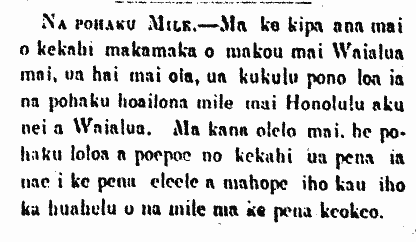
Mile stones.—When one of our friends from Waialua came visiting, he told us, the stone mile markers from Honolulu to Waialua have been set up. From what he said, they are tall and rounded rocks that have been painted black, and afterwards the numerals of the miles will be painted on in white.

(Kuokoa, 11/24/1866, p. 2)

Na Pohaku Mile.

Ka Nupepa Kuokoa, Buke V, Helu 47, Aoao 2. Novemaba 24, 1866.

A protest by the United States of America, 1843.

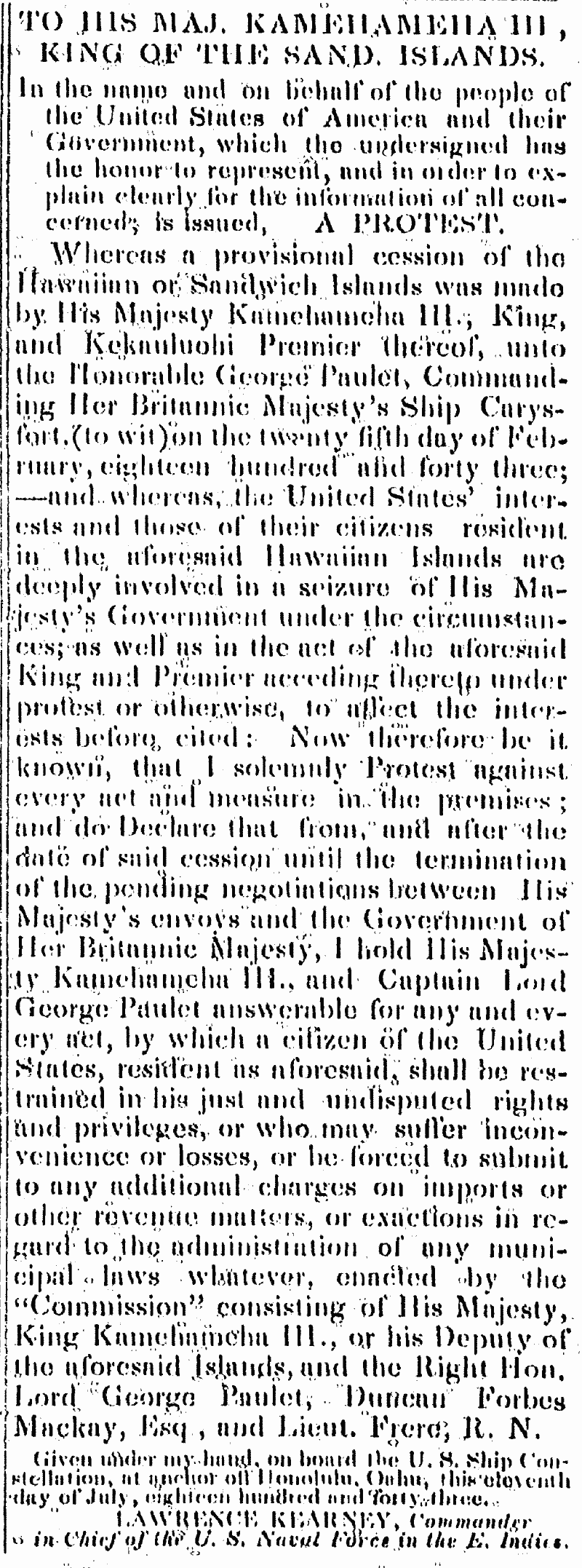
TO HIS MAJ. KAMEHAMEHA III, KING OF THE SAND. ISLANDS.

In the name and on behalf of the people of the United States of America and their Government, which the undersigned has the honor to represent, and in order to explain clearly for the information of all concerned, is issued, A PROTEST.

Whereas a provisional cession of the Hawaiian or Sandwich Islands was made by His Majesty Kamehameha III., King, and Kekauluohi Premier thereof, unto the Honorable George Paulet, Commanding Her Britannic Majesty’s Ship Carysfort, (to wit) on the twenty fifth day of February, eighteen hundred and forty three;—and whereas, the United States’ interests and those of their citizens resident in the aforesaid Hawaiian Islands are deeply involved in a seizure of His Majesty’s Government under the circumstances; as well as in the act of the aforesaid King and Premier acceding thereto under protest or otherwise, to affect the interests before cited: Now therefore be it known, that I solemnly Protest against every act and measure in the premises; and do Declare that from, and after the date of said cession until the termination of the pending negotiations between His Majesty’s envoys and the Government of Her Britannic Majesty, I hold His Majesty Kamehameha III., and Captain Lord George Paulet answerable for any and every act, by which a citizen of the United States, resident as aforesaid, shall be restrained in his just and undisputed rights and privileges, or who may suffer inconvenience or losses, or be forced to submit to any additional charges on imports or other revenue matters, or exactions in regard to the administration of any municipal laws whatever, enacted by the “Commission” consisting of His Majesty, King Kamehameha III., or his Deputy of the aforesaid Islands, and the Right Hon. Lord George Paulet, Duncan Forbes Mackay, Esq., and Lieut. Frere, R. N.

Given under my hand, on board the U. S. Ship Constellation, at anchor off Honolulu, Oahu, this eleventh day of July, eighteen hundred and forty three.

LAWRENCE KEARNEY, Commander in Chief of the U. S. Naval Force in the E. Indies.

(Nonanona, 7/25/1843, p. 21)

TO HIS MAJ. KAMEHAMEHA III., KING OF THE SAND. ISLANDS.

Ka Nonanona, Buke 3, Pepa 5, Aoao 21. Iulai 25, 1843.

Palapala hoole na Amerika Huipuia, 1843.

NA KAMEHAMEHA III., KE LII O KO HAWAII NEI PAE AINA.

Ma ka inoa, a ma ka aoao hoi o na kanaka o Amerika Huipuia a me ko lakou aupuni, (owau, ka mea i kakauia ka inoa malalo, he luna au no ia aupuni) a i mea hoi e hoakaka aku i na kanaka a pau i kuleana ma keia mea, ua hoopukaia’ku nei,

KEIA PALAPALA HOOLE.

No ka hoolilo ana o Kamehameha III, ke alii, a me Kekauluohi ke kuhina, i keia pae aina o Hawaii nei ia George Paulet, kapena o ka moku Beritania, Carysfort, ma ka la 25 o Feberuari, 1843; a no ka owiliia hoi o ka waiwai a me na hana a ko Amerika poe noho maanei, i loko o ia kaili ana o keia aupuni, a iloko hoi o ia hana a ke alii, a me ke kuhina, ma ia hoolilo ana, (me ka hoole paha, me ka ole paha)—

Nolaila, ke hoike aku nei au i keia: Ke hoole ikaika aku nei au i keia mau hana a pau.

Eia hoi ka’u e hai aku ai: Mai ka la ma i lilo ai keia aupuni a hiki i ka wa e pau ai ka hana pu ana a na luna o Kamehameha III, me ko Beritania aupuni, maluna o Kamehameha III, a me Kapena Haku George Paulet e kau ai ka hewa o kela hana, keia hana e poho ai ka pono akaka o ko Amerika poe e noho nei i keia pae aina. [O laua no ke hewa] ina paha e keakeaia ke kahi kanaka o Amerika Huipuia, a ina paha e poho ko lakou waiwai, a ina paha e koiia lakou e uku i dute hooi ma ka waiwai i laweia mai, a ma na mea e paha o ke aupuni, a ina paha e hooukuia lakou ma ka hooko ana i kekahi o na kanawai a pau i hanaia e “ka poe luna Beritania,” oia hoi ke alii, Kamehameha III, a o kona pani hakahaka paha, a me Haku George Paulet, a me Duncan Forbes Mackay Esquire, a me Lieutenant Frere, no ka manuwa Beritania.

Hanaia keia ma kuu lima maluna o ka moku manuwa o Amerika Huipuia, o Constellation ka inoa, a ke ku nei ia mawaho, ma Honolulu (Oahu.) i keia la umikumamakahi o Iulai, 1843.

LAWRENCE KEARNY, aliii nui maluna o na manuwa a pau o Amerika Huipuia ma Asia.

(Nonanona, 7/25/1843, p. 21)

NA KAMEHAMEHA III., KE LII O KO HAWAII NEI PAE AINA.

Ka Nonanona, Buke 3, Pepa 3, Aoao 21. Iulai 25, 1843.

Princess Kaiulani proclaimed heir to the crown, 1891.

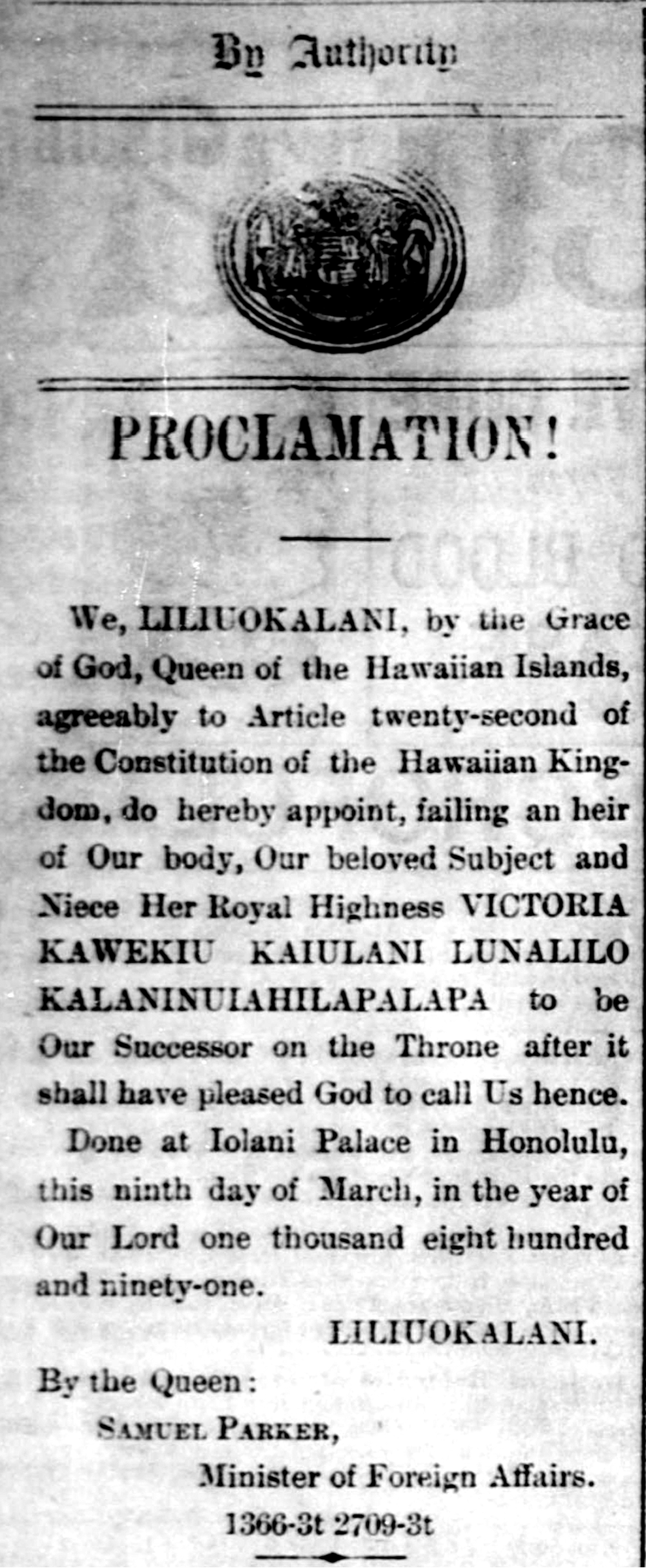
By Authority

PROCLAMATION!

We, LILIUOKALANI, by the Grace of God, Queen of the Hawaiian Islands, agreeably to Article twenty-second of the Constitution of the Hawaiian Kingdom, do hereby appoint, failing an heir of Our body, Our beloved Subject and Niece Her Royal Highness VICTORIA KAWEKIU KAIULANI LUNALILO KALANINUIAHILAPALAPA to be Our Successor on the Throne after it shall have pleased God to call Us hence.

Done at Iolani Palace in Honolulu, this ninth day of March, in the year of Our Lord one thousand eight hundred and ninety-one.

LILIUOKALANI.

By the Queen:

Samuel Parker,

Minister of Foreign Affairs.

[Sometimes there are typesetting errors in newspapers, which is why important numbers are often given in numeric form as well as in words. The Hawaiian proclamation found in the Leo o ka Lahui only used the numeric form of the date, and the typesetter seems to have flipped the “9” over.]

(Hawaiian Gazette, 3/17/1891, p. 4)

By Authority

Hawaiian Gazette, Volume XXVI, Number 11, Page 4. March 17, 1891.