Pardons granted by Governor Pinkham, 1915.

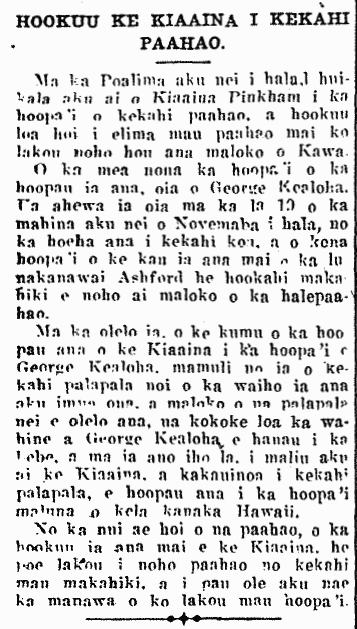
GOVERNOR PARDONED A PRISONER.

This past Friday, Governor Pinkham forgave the punishment of a prisoner, and released for good five convicts from their imprisonment at Kawa.

The one who was pardoned was George Kealoha. He was found guilty on the 10th of this past month, November, for injuring a soldier, and the sentence he received from Judge Ashford was one year in prison.

From what was said, the reason for that the Governor ended the sentence of George Kealoha was because of a plea put before him, and in this document, it said that the wife of George Kealoha was very close to giving birth, and therefore, the Governor listened and signed his name to a document to end the sentence of that Hawaiian man.

Because of the many prisoners, they were released by the Governor; they were people who were imprisoned for some years but yet did not serve out their sentence.

(Kuokoa, 3/5/1915, p. 1)
HOOKUU KE KIAAINA I KEKAHI PAAHAO.

Ka Nupepa Kuokoa, Buke LIII, Helu 10, Aoao 1. Maraki 5, 1915.
Much more on the protest mat, 1990.

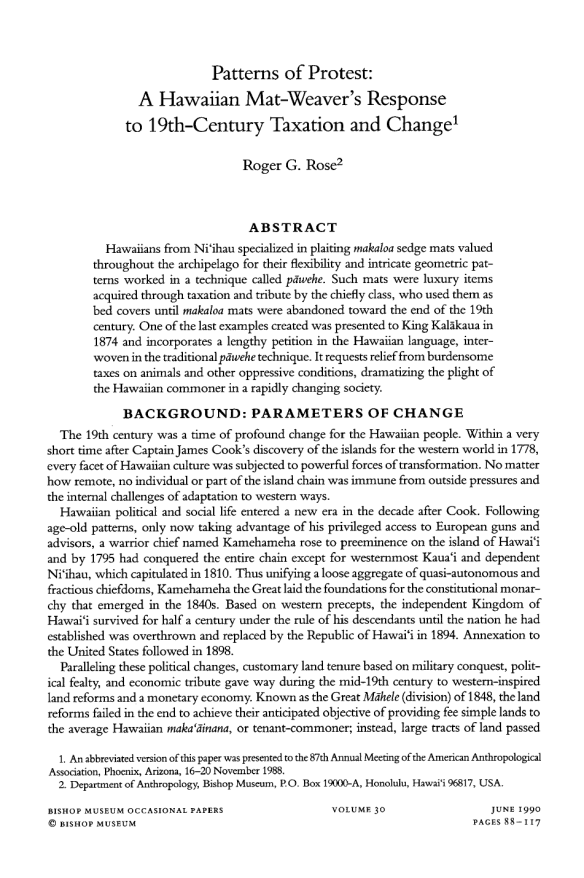
For much, much more on Kalai’s mat of protest, see Roger G. Rose’s “Patterns of protest : a Hawaiian mat-weaver’s response to 19th-century taxation and change,” found in Bishop Museum Occasional Papers, Vol. 30 (June 1990). It can be found online by clicking here below:

Patterns of protest : a Hawaiian mat-weaver’s response to 19th-century taxation and change

Patterns of protest : a Hawaiian mat-weaver’s response to 19th-century taxation and change, Roger G. Rose

Kalai’s fame spreads to far away Pennsylvania, 1874.

[Found under: “Varieties.”]

King Kalakaua, of the Sandwich Islands, has requested an old woman named Kalai, who sent him a mat into which she had woven a petition praying for the removal of taxes on animals, to weave two mats, one with the American and the other with the English coat-of-arms, to be exhibited at our Centennial Exhibition as specimens of Hawaiian handiwork.

[There is mention of this also in the National Republican (Washington, DC) on 6/19/1874.]

(Juniata Sentinel and Republican, 6/24/1874, p. 1)

King Kalakaua...

Juniata Sentinel and Republican, Volume XXVIII, Number 25, Page 1. June 24, 1874.

The famous Niihau protest mat on display at the Bishop Museum, 1874 / 2015.

[Found under: “NOTES OF THE WEEK.”]

A Valuable Gift.—His Majesty received on Monday last a choice Niihau mat, presented to him by Mr. George Gay of Niihau. In this mat is wrought in red letters, a petition, praying that the taxes may be removed on all animals, and for other changes in the laws. The petition, which is in Hawaiian, is quite lengthy, and when copied off covered a page and a half of cap paper. It is the handiwork of an old woman named Kalai, who has been occupied 11 months in making it. She commenced it to give to the late Lunalilo, but on hearing of his death and the election of Kalakaua, sent it to the latter. His Majesty has requested her to work tow mats for the Philadelphia Centennial Exposition—one to show the American coat-of-arms and the other the British coat-of-arms, designs of which will be sent to her to copy. Should she execute the order, these will be very attractive specimens of Hawaiian handiwork.

—Some years ago a native brought to us a Niihau mat three fathoms in length and less than one in width, in which was wrought in red letters the Lord’s prayer in Hawaiian. It was beautifully done, and must have cost him many months of labor. We engaged to take it at his price, but before he delivered it, he found a customer who offered him just double what he had valued it at. Such specimens are very rare, and of course valuable. If made by days’ work, it would be valued at hundreds of dollars.

[This mat was put on display at the Bishop Museum just yesterday. Go check it out if you are on Oahu nei.]

(Hawaiian Gazette, 4/29/1874, p. 3)

A Valuable Gift.

Hawaiian Gazette, Volume X, Number 17, Page 3. Aprila 29, 1874.

Name song for David Kawananakoa, 1893.

HE INOA NO KAWANANAKOA.

He inoa nou e Kalani Kawika
No ka pua i mohala i Makanoni,
Nau i hoolana me ka wiwo ole
Ka manao haaheo i ka puuwai
Hoouna ia oe maka mikiona
I wahaolelo no ka Lahui
Haulani aku oe a oia loa
Na kai ehuheu o ka Moana
Na kilihune ua o ka Hooilo
Hau iniki ili a o Kaleponi
Ka makani hui koni o ka Akau
O ka noe halii ma ka Hikina;
Mea ole wale no i ka uilani
Ka uwila hoohana a o Hawaii
E ake no a hookoia
Na kikoni wela a ka puuwai
I ka hapai mai a ke aloha
O ka ewe hanau o ka Aina
Aia ka palena o Wakinekona
Kapikala kaulana a o Nu Ioka
Ike i ka nani a o Amerika
I ka uluwehi o ka Hale Keokeo
Ilaila olu pono kahi manao
Lana malie iho me he wai ala
Launa oluolu me ke aloha
Me ka manao lana o ka lanakila
Ninau mai e ka Pelekikena
Pehea Hawaii Nui o Keawe
Oia mau no o ke onaona
Ka pua nani o ka Pakipika
E popohe ana ia me ka nohea
E hooheno ia ai e ka malihini
Ina no oe a e ike ana
I ka lihilihi ula o ka Lehua
Aole e nele kou awihi
I ka ui kaulana o ke Ao nei
A oia no hoi Ko’u manao
A i alo mai nei o ke Kai loa
Eia ka Elele o ke Kuini
Puuwai Hao Kila Makeneki
Ua ino na hana a ke Koae
Kahi manu aea pili pohaku
E ake ana no a hoopunana
Malalo o ka malu lau laau
I malumalu ai kana punua
I manao ai e hoolaukoa
A piha i ka hulu owala mai
Kapapa hewa ana ma ke kuono
I ka ono i ka hua Ohelopapa
O ke kihapai o Elenale
Hookaha i ka nani o ka Aina
Ke Gula hu wala a o Hawaii
Pehea la ia i kou manao
Me nei oe la noonoo mai
E wiki oiai ka manawa pono
Aia Enelani ua enaena
Kulou ke poo o ka Aeko
I ka ea ana mai puua ka waha
Ua hewa na hua a ke Koae
Aohe moneka nana e kala
Ua pono kou manao e Kalani
E hoi no oe me ka hanohano
Lawe ae no oe a kiekie
He loaa mai na kupuna mai
Me oe ke aloha o ke Kahikolu
E ka Iwakiani o Hawaii
A he lei Mokihana onaona Oe
I pilia me ka Lauae o Makana
E o e Kalani pua laha ole
O Kawananakoa kou inoa.

Miss. Kekoaohiwaikalani

Puahaulani Hale

Honolulu, March 1, 1893.

(Leo o ka Lahui, 3/7/1893, p. 3)

HE INOA NO KAWANANAKOA.

Ka Leo o ka Lahui, Buke II, Helu 656, Aoao 3. Maraki 7, 1893.

David Kawananakoa speaks on annexation, 1893.

WILL APPEAL TO CONGRESS.

Ex-Queen Liliuokalani’s Commissioner Arrives at the National Capital.

Washington, Feb. 18.—Paul Neuman, the envoy of Queen Liliuokalani to the United States, accompanied by Prince David, of the royal family, and two servants, reached the city late last night, and took apartments at the Richmond. To-day Mr. Neuman held a conference with acting Secretary of State Wharton, with whom he had a long talk concerning the object of his visit. Mr. Wharton could, of course, do nothing, and Mr. Neuman expressed himself as satisfied that his only chance for successfully representing the claims of the ex-Queen lay through the medium of Congress. Prince David said: “We do not intend to make a struggle against annexation. If the United States government sees fit to annex Hawaii we shall make no complaints.”

[I am not sure if this statement was ever published in any Hawaii newspaper.]

(Indianapolis Journal, 2/19/1893, p. 4)

WILL APPEAL TO CONGRESS.

The Indianapolis Journal, Page 4. February 19, 1893.

Kekaulike appointed governor of Hawaii Island, 1880.

[Found under: “Ma ke Kauoha.”]

It pleases the Chief, the King, to appoint Her Highness Kekaulike as Governor for the island of Hawaii, in the place left behind by Her Highness, the Princess Likelike.

(Kuokoa, 9/18/1880, p. 2)

Ua oluolu i ke alii...

Ka Nupepa Kuokoa, Buke XIX, Helu 38, Aoao 2. Sepatemaba 18, 1880.


Party thrown by Arthur A. Wilder, 1916.

JUDGE WILDER THROWS A PARTY

Amongst the news spoken of in Honolulu nei, is the party given by Judge Wilder at the Hotel New Willard; it was a party adorned with a great amount of food along with the beauty of the decorations.

In the very short time it was organized, there were many malihini who showed up at the party, and speeches were given by members of Congress who were invited.

In a majority of the speeches given, appreciation was mentioned for the kindness of Hawaii’s people for welcoming the group of Congressmen the previous summer. Continue reading

Peter Buck to become an American citizen, 1943.

Resolution Approved

Before the session of the legislature of 1943 was postponed, the house of representatives approved a resolution asking Congress [Ahaolelo Lahui] to pass a special law to naturalize Peter Henry Buck, and make him an American citizen.

Dr. Buck is 62 years old now, and he is the director of the Bishop Museum of Honolulu, and he is a kamaaina to all the people he meets.

This resolution clarifies that Dr. Buck is English, however he is half haole and half another ethnicity, but it is appropriate that he be naturalized as an American citizen, but he cannot become a citizen under the current laws.

Dr. Buck is restricted from becoming a citizen because of the Maori blood flowing through him, and the law states that those who are able to become citizens a whites and descendants of African people.

If this resolution reaches or is received by the senate, and should they approve this request of our local legislature, and they pass a special law to allow this man to become an American citizen, then this man will indeed become a citizen and he will be able to vote like we do.

(Hoku o Hawaii, 5/5/1943, p. 1)

Apono I Olelo Hooholo

Ka Hoku o Hawaii, Volume XXXVIII, Number 2, Aoao 1. Mei 5, 1943.

Road construction, 1848.

[Found under: “Na Palapala Maoli.”]

Kahalii, Hilo, October 2, 1848.

This is news from Waipio, in Hamakua, there is a Government road. The cliff of Waipio was carved into, and there is what appears to be a fine road, not from the people of old, not from Liloa, from Hakau, from Umi, from Kamehameha I; but it is from the reign of Kamehameha III in which the bad areas were fixed.

This project was started from Pueohulunui all the way to Koaekea, and it reached to the top of the cliff of Kahuahine, and came out below Waimihi.

There are three new noted places [pana] on this road: Puehu, Pohakalae, and Kamaipualo; a man and his Horse can travel from below, as well as oxen with a load of poi on its back, until the reach the top; The people of Waipio are beloved; they made a fine road that is nice looking, like a Nuhekalawela; their Tax Collector [Lunaauhau], Kapau put in effort, and all the bad areas were worked out; Hilo is the land that is bad that has not been worked on; people go to Hamakua, to Puna, but the cliffs of Hilo have not been dug up; let’s dig up the cliffs. With appreciation,

By E. S. Kalauwaka.

(Elele Hawaii, 10/24/1848, p. 37)

Kahalii, Hilo...

Ka Elele Hawaii, Buke 4, Pepa 10, Aoao 37. Okatoba 24, 1848.