Local coverage of Queen Emma’s visit to New York, 1866.

LOCAL NEWS.

NEW YORK AND THE VICINITY.

Movements of the Queen Dowager of Hawaii—She attends church twice yesterday—Interesting interview with deaf mutes—Queen Emma passed a comparatively quiet day on Saturday. She had her photographs taken in various positions at two photographic galleries in the morning, being accompanied by Miss Spurgin, Major Hopkins, her maid servant, and Mr. John Welsh. She also, in company with Miss Spurgin, did some shopping on Broadway during the day. The Rev. Dr. Gallaudet, Rector of St. Ann’s Church for Deaf Mutes, visited Her Majesty in the evening, and invited her to attend his church yesterday. The invitation was accepted. Gen. Darling and Col. Gerhard, of Gov. Fenton’s staff, also called and extended a formal invitation to the Queen to visit Albany, which she promised to do on her return from Boston, in the evening Her Majesty and suite dined with Hon Moses H. Grinneli and suite, and at 10 o’clock the royal party returned to the Brevcort House.

Early yesterday morning Old Trinity was crowded in every part by visitors, who, from appearances, had been attracted there by the announcement that the Queen would be present. At about half-past ten  her Majesty entered the Church accompanied by her suite, and proceeded up the main aisle, proceeded by the sexton and Rev. Dr. Vinton, who conducted her to the pew which the Prince of Wales occupied when he was here. The royal [unclear line] In the first pew were her Majesty Queen Emma, and Mr. Odel (Hawaiian Consul) and [unclear] Second—Major Hopkins, Miss Spurgin, and Mr. Chilton, Government Agent from Washington. Third—Mr. John Walsh, Mr. J. V. B. Marshall and the Swiss maid servant. As her Majesty entered the pew she knelt and remained some moments in silent prayer, and as she rose an elegant prayer book bearing a suitable inscription, and bound in royal purple with illuminated rubrics was presented to her. A suitable writing was also within the book, staiting that it was presented to her Majesty in memory of her visit and her fellowship with the Apostolic Church. Morning prayer was intoned throughout by the Rev. Dr. Vinton; the first lesson was read by Rev. Joseph J. Kinegood, of Eastern Pennsylvania. The second by Rev. Sidney Corbett, of Quincy, Ill. In the ante-communion service the epistic was read by Rev. Mr. Elesegood, and the gospel by Rev. Dr. Vinton. The music was splendid and consisted of Onseley’s service in G. the anthem, “O! Lord our Governor.” Ps. VIII, V. 1, 3, 4, by Marcello, also in G. This was the anthem sung at the Coronation of the Queen of England, and at the visit of the Prince of Wales to Trinity Church. The 41st hymn concluded the musical portion of the exercices. The solos were by Master Knowles and Mr. Yatman. In the anthem both organs were used, as they were in the [unclear] Voluntary (hallelujah chorus) Organists, Mr. W. A. M. Diller and Mr. Arthur G. Messeter. In the morning service the prayer for a safe return from sea was said, it having special reference to the Royal party. The Rev. Dr. Vinton preached the sermon from the words, “If I perish, I perish.” Esther IV: 16. He gave an account of the deposition of Queen Vashti and the elevation of Queen Esther, and remarked that this must have been no chance work, but was pre-ordained by the Almighty for the preservation of her people. He concluded by directing all to do their duty fearlessly in this world and Christ would hold out the golden sceptre of his love to those and bring them to this presence. A collection was then taken up for the benefit of the church in the Sandwich Islands, after which the congregation retired. As the Queen entered her carriage she was loudly cheered by the crowds who had collected outside the church. The party then retired to the hotel. The Queen and suite again attended St. Ann’s Church on Eighteenth street, near Fifth avenue, at 3 1/2 P. M. and witnessed the service for deaf mutes. The Rev. Dr. Gallandet explained many of the signs before the service commenced and stated some interesting circumstances connected with the church. The services were conducted by Rev. Dr. Vinton, and the sermon was preached by the Rev. Eastman Benjamin, the whole being interpreted by Rev. Dr. Gallaudet in the sign language. At the close an address was delivered by Rev. Dr. Vinton, who stated that the present was an occasion of thankfulness, inasmuch as a lady born in one of the isles of the sea and who had been lifted to a throne, had come among them to witness the miracle which had been performed, of causing the deaf to hear and the dumb to speak. It was delightful to show this miracle to her Majesty, whom God had made the instrument of making a nation Christian, which only a few years ago had been steeped in heathenism. She was now on a mission for the purpose of raising houses of mercy in her own land, and he hoped God would prosper it. By invitation, the Queen and suite remained after service, and a number of questions were asked the mutes and answered. Her Majesty, who by the way writes an elegant female hand, wrote the following, and handed it to one of the lady deaf mutes:—”My delight has been very great at being able to have prayed with you this day. I shall always remember brothers and sisters in you here when I am far away in my own land, far off, in my prayers. Do you believe we shall meet in Heaven and why?—Emma R.” The lady mute immediately wrote the following—”We, deaf mutes, are very happy to see her Majesty Queen Emma, of the Sandwich Islands to-day; and moreover we are greatly delighted in sitting with you in the house of the Lord. For myself I believe that there will be a mutual recognition in heaven.” Her Majesty then shook hands with several of the mutes, and also with the clergyman. She was accompanied to the carriage by the Rev. Dr. Gallaudet, who pressed her hand  and said, “God bless you.” She thanked him with a smile, and was driven to the hotel. This morning the Queen and suite will take the eight o’clock train to Philadelphia, en route to Washington. Mr. Cheiton, the special envoy from Mr. Seward, will accompany the royal party. The Queen will be received at Washington by Attorney General Stansbury, Acting Secretary of State.

(New York Sun, 8/13/1866, p. 1)

LOCAL NEWS.

The New York Sun, Year 33, Number 10,629, Page 1. August 13, 1866.
Queen Emma’s foreign travels and patriotism abroad, 1866.

Hawaiian Boy in New York.

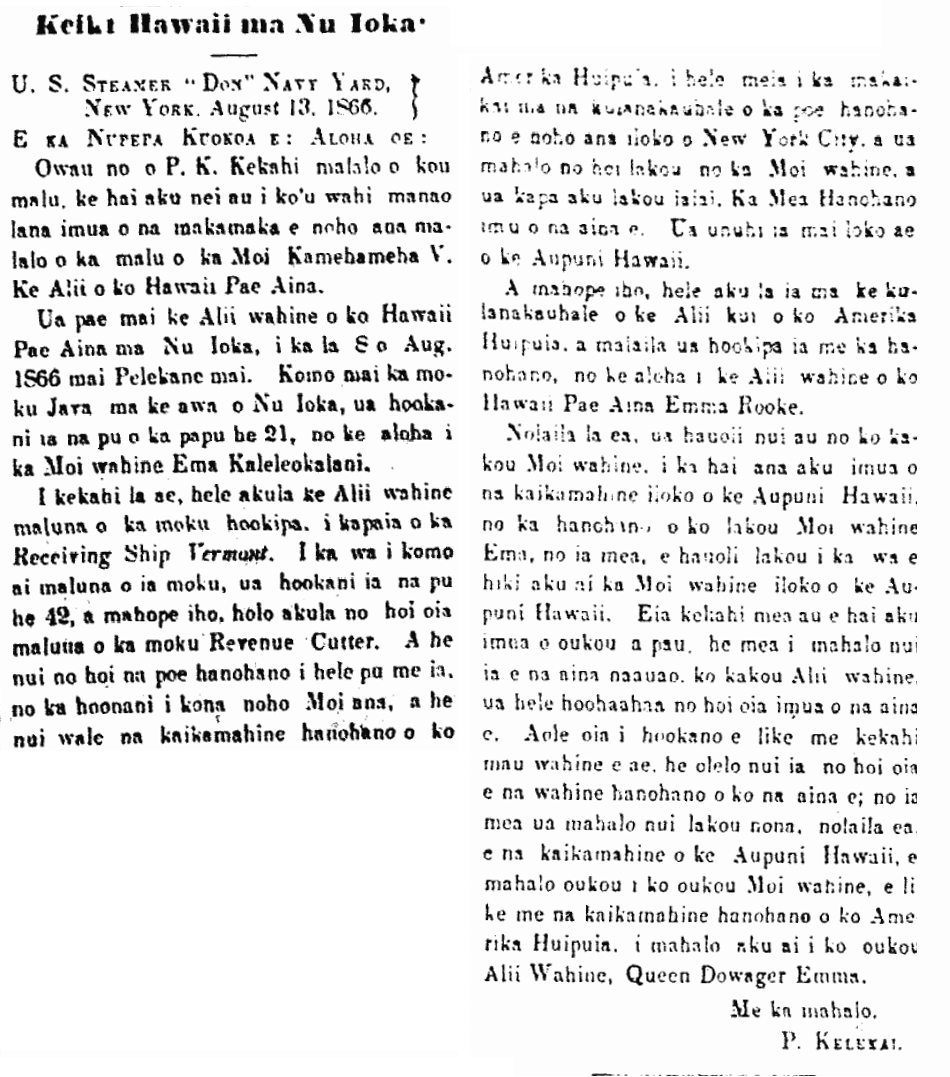
U. S. Steamer “Don” Navy Yard,

New York, August 13, 1866.

O Kuokoa Newspaper: Aloha oe:

I am P. K. Someone under your care; I am stating my hope before the friends living under the protection of King Kamehameha V, the King of the Hawaiian Islands.

The Queen of the Hawaiian Archipelago landed in New York on the 8th of August, 1866 from Britain. The ship Java entered New York harbor and a 21 gun salute was sounded at the fort, in aloha for Queen Emma Kaleleonalani.

Another day thereafter, the Queen went aboard the welcoming vessel called the Receiving Ship Vermont. When she went aboard, a 42 gun salute was sounded, and afterwards, she went aboard the Revenue Cutter ship. There were many distinguished people who went along with her to show honor to her Queenship, and there were many prominent girls of the United States of America who went touring along with her within New York City, and they felt admiration for the Queen and they called her Her Excellency before all other foreign lands [? imua o na aina e]. She was brought from the Nation of Hawaii.

Thereafter, she went to the city of the president [? alii kui] of the United States, where she was hosted with dignity for their aloha for the Queen of the Hawaiian Islands, Emma Rooke.

Therefore, I am overjoyed for our Queen, as I speak before the girls of the Nation of Hawaii about the grandeur of their Queen Emma, and because of this they should be joyful when the Queen arrives in the Hawaiian Nation. Here is another thing which I say before you all, our Queen is someone who is greatly honored by the enlightened nations, by her travelling in foreign lands with humility. She is not pretentious like some other women; she is greatly spoken of by reputable women of other nations, and they hold her in high esteem; therefore, O Girls of the Hawaiian Nation, be respectful of your Queen, like the fine girls of the United States who admire your Queen, the Queen Dowager Emma.

With appreciation,

P. Kelekai.

(Kuokoa, 10/ 13/1866, p. 3)

Keiki Hawaii ma Nu Ioka

Ka Nupepa Kuokoa, Buke V, Helu 41, Aoao 3. Okatoba 13, 1866.

Queen Emma abroad,

Queen Emma.

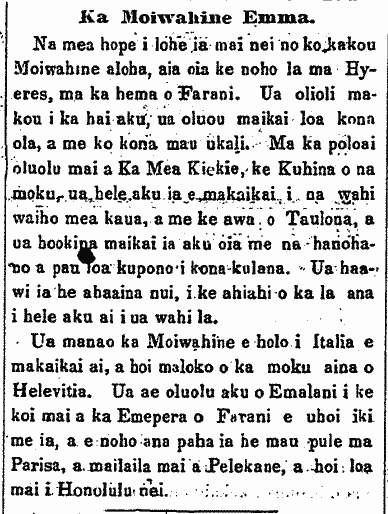
The latest heard of our beloved Queen is that she is staying at Hyeres, in the south of France. We are greatly pleased to say that she is in excellent health, and so are her attendants. By the kindly invitation of His Highness, the Naval Minister,  she toured the places where arms are stored, and the harbor of Toulon, and she was well received with all honors appropriate for her stature. There was given a grand reception on the evening of the day on which she went there.

The Queen plans to go to tour Italy, and to return by way of the Helvetic state. Emalani kindly agreed to the urging by the Emperor of France to return for a bit with him and to stay for some weeks in Paris, and from there to Britain and all the way back to Honolulu nei.

[There is much printed in the Hawaiian-Language Newspapers about Queen Emma’s travels abroad. Here is but one report informing her people of her progress.]

(Au Okoa, 4/23/1866, p. 2)

Ka Moiwahine Emma.

Ke Au Okoa, Buke II, Helu 1, Aoao 2. Aperila 23, 1866.

Ia oe e ka la e alohi nei… 1874.

The Birthday of the King.

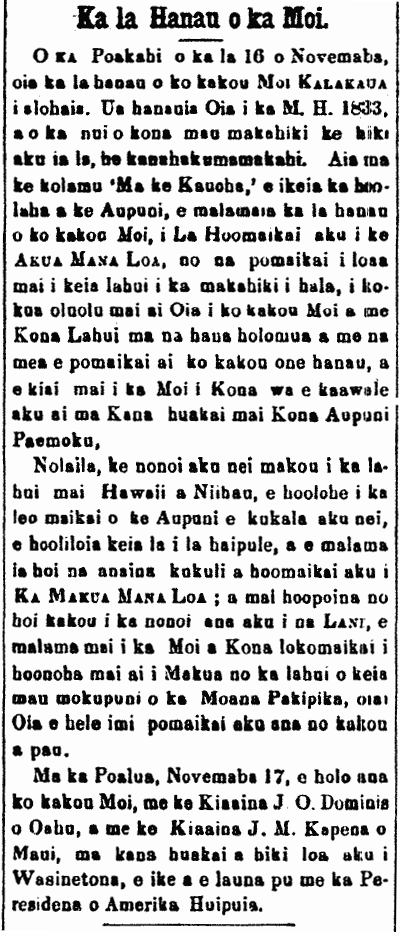
Monday, the 16th of November, is the birthday of our beloved King Kalakaua. He was born in the year 1833, and he will be making forty-three years old. In the column ‘Ma ke Kauoha’ [By Authority], seen is the Government notice that the birthday of our King will be held as a Day of Thanks to the Almighty God, for the blessings received by our lahui this past year; He has kindly assisted our King and His People in progressive endeavors and in things that will benefit our homeland, and may He watch over the King during His time away from his Kingdom of Islands on His travels.

Therefore, we ask the lahui from Hawaii to Niihau to heed the good announcement of the Government, that this day shall be a day of prayer, and that meetings will be held to kneel and give appreciation to the Almighty Father; and let us not forget to ask of the Heavens to watch over the King who He in his benevolence has placed as a Father to the lahui of these islands in the Pacific Ocean, while He will be travelling to seek blessings for us all.

On Tuesday, November 17th, our King and the Governor of Oahu, J. O. Dominis, along with the Governor of Maui, J. M. Kapena, will go on a trip to Washington to meet with the President of the United States of America.

(Kuokoa, 11/7/1874, p. 2)

Ka la Hanau o ka Moi.

Ka Nupepa Kuokoa, Buke XIII, Helu 5, Aoao 2. Novemaba 7, 1874.

Kamehamalu dies in far away London, 1824.

DEATHS.

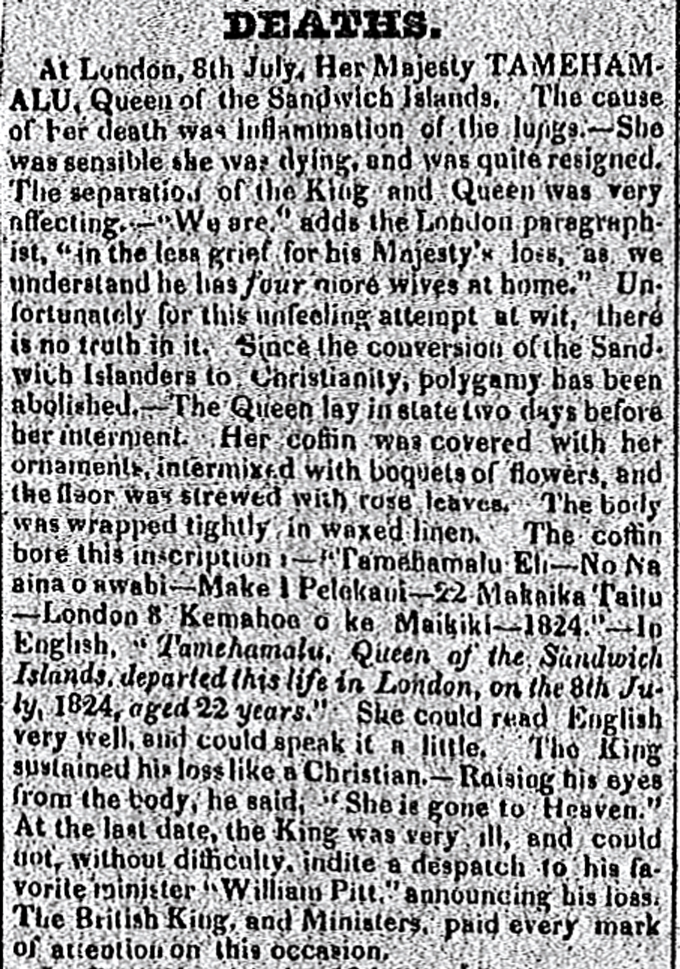
At London, 8th July, Her Majesty TAMEHAMALU, Queen of the Sandwich Islands. The cause of her death was inflammation of the lungs.—She was sensible she was dying, and was quite resigned. The separation of the King and Queen was very affecting.—”We are,” adds the London paragraphist, “in the the less grief for his Majesty’s loss, as we understand he has four more wives at home.” Unfortunately for this unfeeling attempt at wit, there is no truth in it. Since the conversion of the Sandwich Islanders to Christianity, polygamy has been abolished.—The Queen lay in state two days before her interment. Her coffin was covered with her ornaments, intermixed with bouquets of flowers, and the floor was strewed with rose leaves. The body was wrapped tightly in waxed linen. The coffin bore this inscription:—”Tamehamalu Eli—No Na aina o awahi—Make i Pelekani—22 Makaika Taitu—London 8 Kemahoe o ke Maikiki—1824.”—In English, “Tamehamalu, Queen of the Sandwich Islands, departed this life in London, on the 8th July, 1824, aged 22 years.” She could read English very well, and could speak it a little. The King sustained his loss like a Christian.—Raising his eyes from the body, he said, “She is gone to Heaven.” At the last date, the King was very ill, and could not, without difficulty, indite a despatch to his favorite minister “William Pitt,” announcing his loss. The British King, and Ministers, paid every mark of attention on this occasion.

[Mahalo to Ramona Ho by way of the Antonios for getting this great article to me!

It is important to note that although Chronicling America is a great site for looking up information, it does have its limitations. 1) It does not include all of the states. 2) All of the newspapers in a given state are not necessarily made accessible. 3) Even if a given newspaper is included, it does not necessarily mean that all issues of that paper are accessible. 4) The years included are only from 1836–1922.]

(New-Hampshire Patriot & State Gazette, 8/30/1824, p. 3)

DEATHS.

New-Hampshire Patriot & State Gazette, Volume XVI, Number 804, Page 3. August 30, 1824.

Another “Memoirs of Obookiah” translation, 1867.

Book of the Moolelo of Heneri Opukahaia.

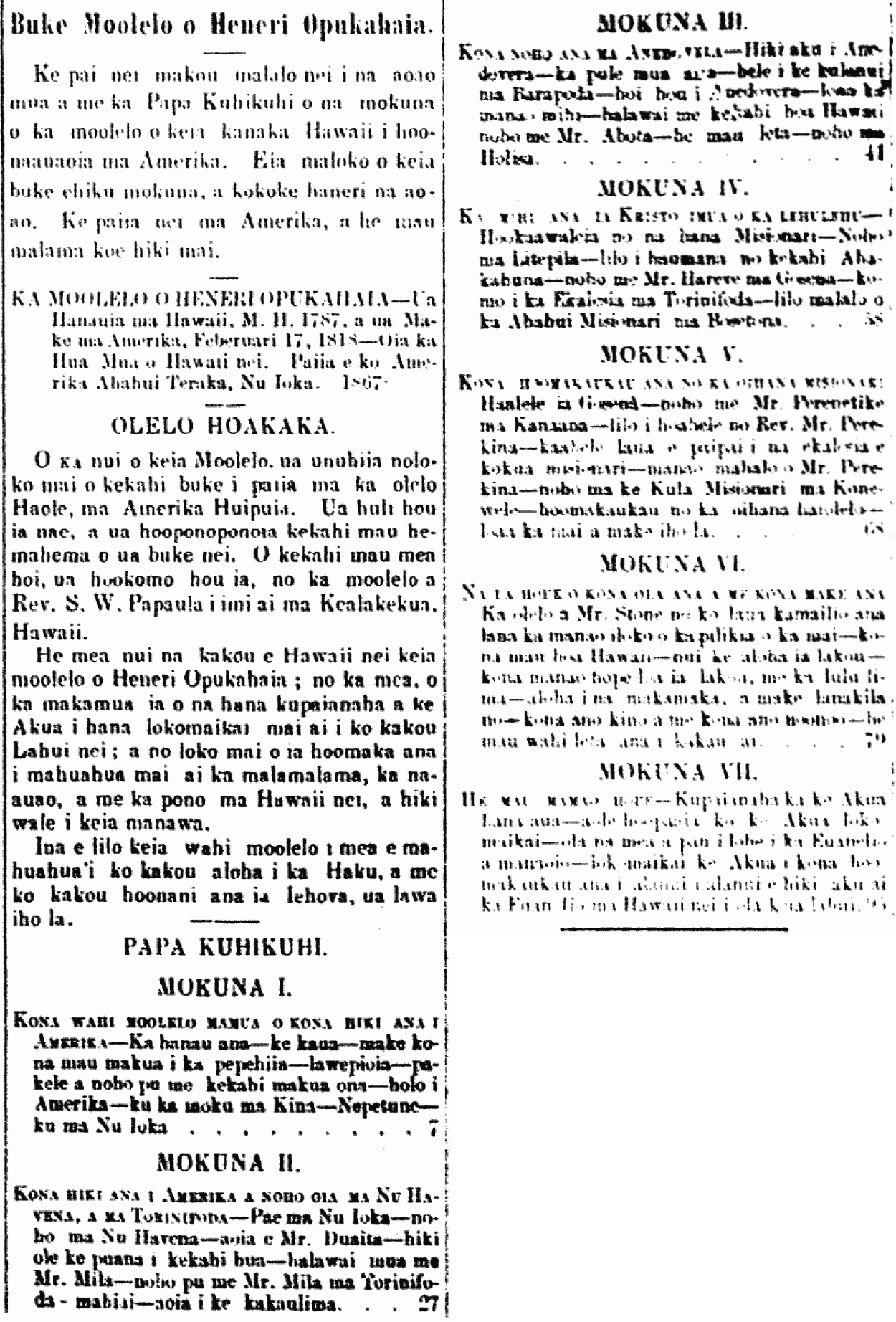
We are printing below the first pages of and the Table of Contents of the Chapters of the story of this Hawaiian that was educated in America. In this book is seven chapters, and it is almost a hundred pages. It is being printed in America and it will be here in a few more months.

THE STORY OF HENERI OPUKAHAIA—Born in Hawaii, A. D. 1787, and Died in America, February 17, 1818—The First Fruit of Hawaii nei. Printed by the American Tract Society [Amerika Ahahui Teraka], New York, 1867.

INTRODUCTION.

The majority of this Moolelo was translated from a book published in English in the United States of America. However, information was researched, and some of the errors of the book was corrected. Some things were added from the moolelo that Rev. S. W. Papalua investigated at Kealakeakua, Hawaii.

This story of Heneri Opukahaia is something important to us Hawaiians; for this is the first of the miracles that God performed benevolently upon our People; and through this start, the enlightenment, the knowledge, and the righteousness of Hawaii has increased until this day.

Should this moolelo become something which increases our love for God and our glorification of Jehovah, that will be enough…

[A couple of years later in 1867, the original translation was appended to and corrected with the information collected by that same S. W. Papaula of Napoopoo, and published in book form under the title: “KA MOOLELO O HENERI OPUKAHAIA, UA HANAUIA MA HAWAII, M. H. 1787, A UA MAKE MA AMERIKA, FEBERUARI 17, 1818. OIA KA HUA MUA O HAWAII NEI.”]

(Kuokoa, 5/18/1867, p. 3)

Buke Moolelo o Heneri Opukahaia.

Ka Nupepa Kuokoa, Buke VI, Helu 20, Aoao 3. Mei 18, 1867.

More on Opukahaia, 1865.

The Story of Opukahaia.

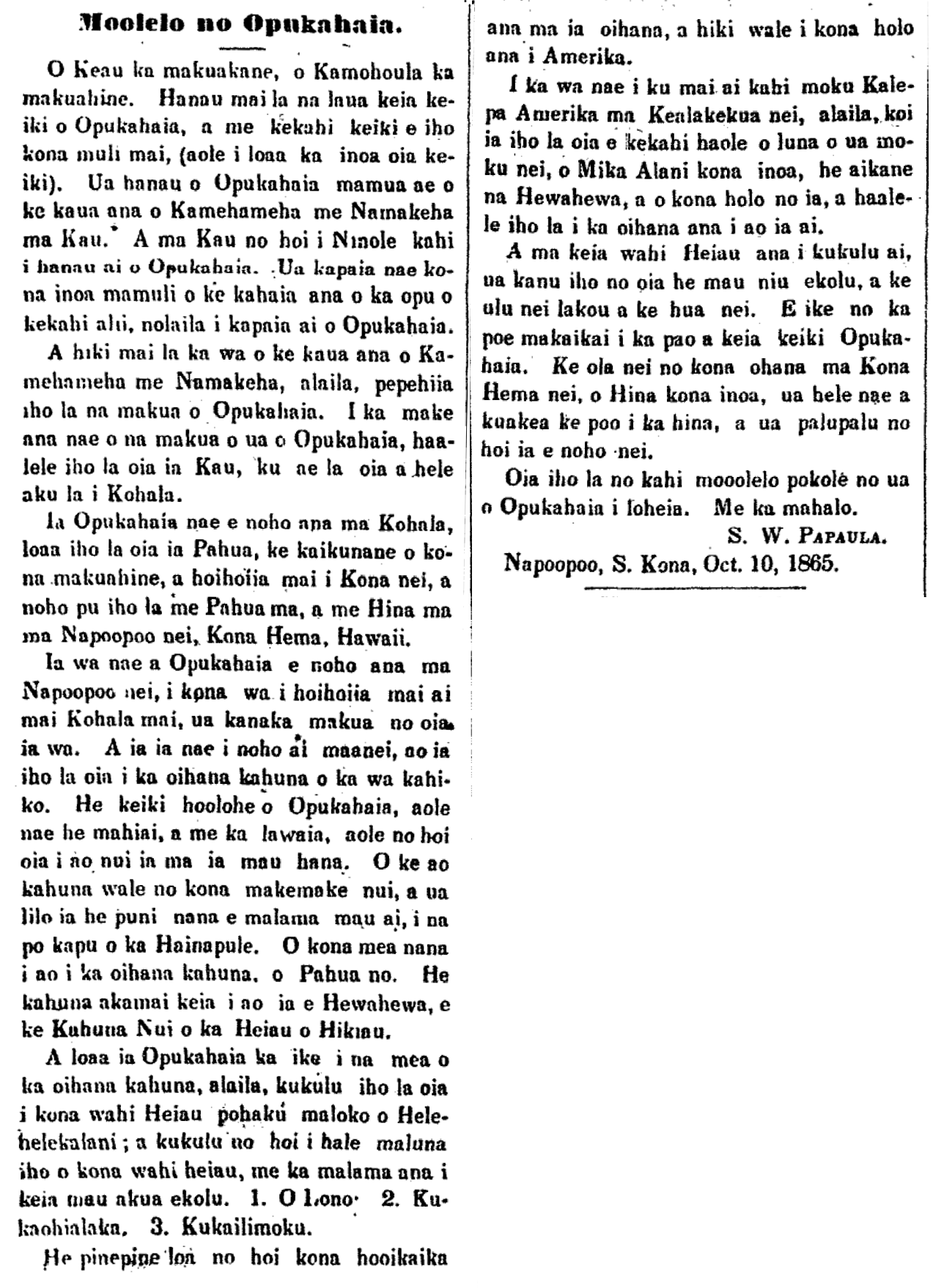
Keau was the father, Kamohoula was the mother. From the two was born this child, Opukahaia, along with another younger child (the name of that child is not known). Opukahaia was born soon before the battle between Kamehameha and Namakeha at Kau. And at Kau in Ninole, is where Opukahaia was born. He was named for the slitting of the stomach of a certain alii, and that is why he was called Opukahaia [“the cutting of the stomach”].

When the time of warfare between Kamehameha and Namakeha arrived, the parents of Opukahaia were killed. When his parents were killed, Opukahaia fled Kau, and went to Kohala.

While he lived in Kohala, Opukahaia was found by Pahua, the brother of his mother, and he was returned here to Kona, and lived with Puhua them and Hina them here in Napoopoo, South Kona, Hawaii.

The time when Opukahaia was living here in Napoopoo, when he was brought back from Kohala, he was an adult at the time. While he lived here, to him belonged the occupation of the kahuna of the olden days. Opukahaia was obedient; he was however not a farmer nor a fisherman, for he was not taught much about those things. He really just wanted to be taught kahuna things, and this was something that he was very interested in doing constantly, on sacred nights of Prayer [? Hainapule]. The one who taught him the ways of the kahuna was Pahua. He was a skilled kahuna taught by Hewahewa, the Great Kahuna of the Heiau of Hikiau.

After Opukahaia received the knowledge of the occupation of the kahuna, he constructed his stone Heiau within Helehelekalani, and he built a house atop his heiau, while he worshiped three gods. 1. Lono, 2. Kukaohiakala, 3. Kukailimoku.

He was constantly honing his skills, until he left for America.

When the American trading ship appeared here at Kealakekua, he was prodded by a haole aboard the ship, named Mika Alani, who was an aikane of Hewahewa; and so he went and left the work that he was trained in.

And at this Heiau which he built, he planted three coconuts, and they are growing and fruiting. The cave [? pao] of this boy, Opukahaia, can be seen by those who visit here. His relative still lives here in South Kona, her name is Hina; she is gray-haired and is frail now.

This is a short story of what is heard of Opukahaia. With mahalo.

S. W. Papaula.

Napoopoo, S. Kona, Oct. 10, 1865.

[This seems to be written in response to the translation being published in Kuokoa at the same period. Papaula is adding to the information given in the translation. This ability to quickly add to or correct information published in the newspapers was one of the many advantages newspapers had over books.]

(Kuokoa, 11/4/1865, p. 4)

Moolelo no Opukahaia.

Ka Nupepa Kuokoa, Buke IV, Helu 44, Aoao 4. Novemaba 4, 1865.

More on the California Midwinter International Exposition from Bila Kanealii, 1894.

The Midwinter Exposition.

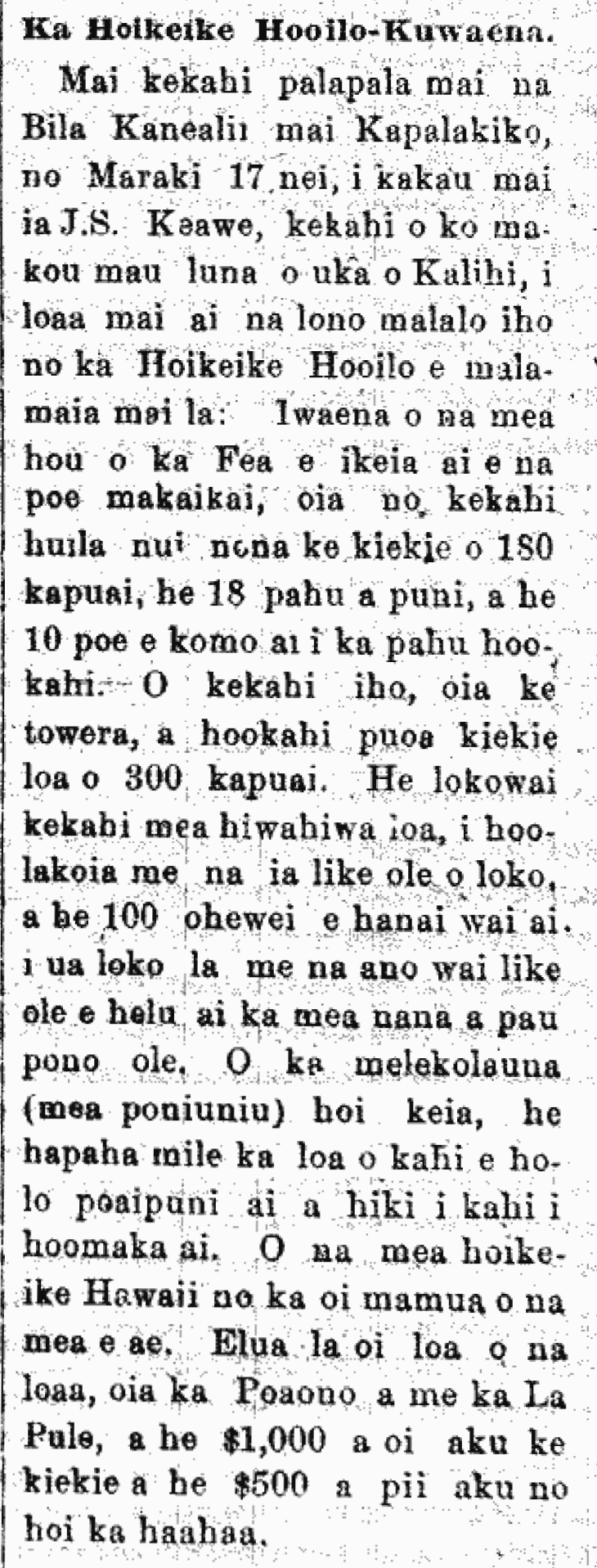
J. S. Keawe, one of our officers in the uplands of Kalihi writes that he received the news below about the Winter Exposition being held, from a letter of March 17th by Bill Kanealii from San Francisco: From amongst the new things at the Fair to be seen by the visitors, there is a huge wheel that is 180 feet tall with 18 boxes all around, with each box holding 10 people. Another is the tower with a very tall steeple 300 feet high. The lake is another thing of high esteem; it is stocked with all sorts of fish, with 100 pipes feeding water into the lake with all kinds of water, so many that the visitor would not be able to count them all. The merry-go-round [melekolauna] (a thing that spins), is a quarter mile long travelling around until reaching the place where it starts from. The Hawaii display is the best of all. There are two days that the proceeds are the highest, that being Saturdays and Sundays, where $1,000 or more is the most and $500 or more is the least.

(Makaainana, 4/2/1894, p. 3)

Ka Hoikeike Hooilo-Kuwaena.

Ka Makaainana, Buke I—-Ano Hou, Helu 14, Aoao 3. Aperila 2, 1894.

James B. Pakele reports from San Francisco, 1894.

Behold California, a Land of Cold.¹

J. U. Kawainui,

Aloha oe,

Here I am in California in good health. This is a very cold land, but there is always something new, there is no night here; the nights are like days.

These past few days, I have almost travelled all around the town; I went to visit the sugar refinery of the Millionaire², the place where they build warships, the place where money is minted, and the place where the soldiers drill (the Pressido [Presidio]).

I was at the Cliff House this past Thursday, it is a place that many visitors travel to, I saw the animals of the sea, but that place was very cold. After that, I went to the New City Hall and I spent almost a day visiting the various offices; it is a large structure perhaps eight times the size of Iolani Palace.

There are many poor people here with no place to sleep, and there are also many rich people.

PERTAINING TO THE GREAT EXHIBITION.

I went into the different exhibition halls of the Fair, so astonishing to see; there were all kinds of beautiful things.

I was in Alameda County, a large building, and within it, there was every variety of fruit.

Arizona Indian Building is the exhibition hall of the Indians [Ilikini]. There I saw their way of dancing; their dress is fine, but their dancing isn’t great.

I went into the building of hand crafts and saw the making of the clothes that we wear and so forth, and the exhibition hall of all kinds of animals. This week, one of the handlers was killed, mauled by a lion; the reason for this was the the lights went out when the handler was sweeping inside, at which point it jumped and tore at him. I saw the blood and the suit which is placed out as a display in the pen; today there was a service over his dead body. All the people in the fair attended the funeral, the Hawaiian youths sang in Hawaiian, “In Jesus’ Hands” [“Ma ko Iesu mau lima.”] .

The most highly attended thing is the display of Kilauea in Hawaii; the haole men and women are very taken by Hawaiian things, but above all is the hula kui; all the time is filled with hula kui.

There are two bands constantly playing in the Park, but they aren’t good like the Hawaiian boys; I am always being asked by many people if I will be attending the college that John Wilson³ is attending; I have a letter urging me to go there (Stanford University).

James B. Pakele.

San Francisco, February 17, 1894.

¹”Ike ia Kaleponi he Aina Anu” hearkens back to the mele “E Nihi ka Hele”.

²Spreckels Sugar Company of Claus Spreckels, known here as the Ona Miliona [Millionaire].

³See more on John Henry Wilson in Men of Hawaii.

[For related articles and information, see the previous posts, and the posts soon to come as well! Oh… and coincidentally, i noticed i recently posted James B. Pakele’s death announcement from 1913. He died at Queen’s Hospital on January 30.]

(Kuokoa, 3/3/1894, p. 1)

Ike ia Kaleponi he Aina Anu.

Ka Nupepa Kuokoa, Buke XXXIII, Helu 9, Aoao 1. Maraki 3, 1894.

More on Emily Kaihumua and the Australia, 1894.

The things you can find on the internet these days! Look at this excerpt taken from the Immigrant Ships Transcribers Guild’s page! The six Hawaiians (plus one more) that left Honolulu for SF aboard the Australia mentioned in the previous post!!

SS Australia

Honolulu to San Francisco

February 10, 1894

1  Bill Kanealii, 61y, Male, Married, Farmer, Able to Read/Write, Nationality: 
    Hawaiian, Last Res.: Honolulu, Destination: San Francisco, Has ticket to 
    destination, Passage paid by Haw'n Exhibito, money is blank, has been to SF
    1864, Join relative or friend: No, is under contract to labor

 2  Sam Kolikoli, 18y, Male, Single, Cowboy, Able to Read/Write, Nationality: 
    Hawaiian, Last Res.: Honolulu, Destination: San Francisco, Has ticket to 
    destination, Passage paid by Haw'n Exhibito, money is blank, has been to 
    SF 1886, Join relative or friend: No, is under contract to labor

 3  Luther Kaihumua, 19y, Male, Single, Cowboy, Able to Read/Write, Nationality:
    Hawaiian, Last Res.: Honolulu, Destination: San Francisco, Has ticket to 
    destination, Passage paid by Haw'n Exhibito, money is blank, In US before: 
    No, Join relative or friend: No, is under contract to labor

 4  Arthur Kaihumua, 17y, Male, Single, Cowboy, Able to Read/Write, Nationality: 
    Hawaiian, Last Res.: Honolulu, Destination: San Francisco, Has ticket to 
    destination, Passage paid by: Haw'n Exhibito, money is blank, In US before: 
    No, Join Relative or friend: No, is under contract to labor	

 5  Emily Kaihumua, 22y, Female, Widow, Able to Read/Write, Nationality: Hawaiian,
    Last Res.: Honolulu, Destination: San Francisco, Has ticket to destination, 
    Passage paid by: Haw'n Exhibito, money is blank, In US before: No, Join 
    relative or friend: No, is under contract 
    to labor	

 6  James Shaw, 28y, Male, Married, Painter, Able to Read/Write, Nationality: 
    Hawaiian, Last Res.: Honolulu, Destination: San Francisco, Has ticket to 
    destination, Passage paid by: Haw'n Exhibito, money is blank, In US before:
    No, Join relative or friend: No, is under contract to labor

 8  James B Pakele, 26y6m, Male, Single, Carpenter, Able to Read/Write, Nationality:
    Hawaiian, Last Res.: Honolulu, Destination: San Francisco, Has ticket to 
    destination, Passage paid by self, possesses $100, In US before: No, Join 
    relative or friend: No, is not under contract to labor