Emma Nakuina tells the story of Hiiaka, 1883.

HIIAKA.

A Hawaiian Legend by a Hawaiian Native. A Legend of the Goddess Pele, Her Lover Lohiau and her Sister Hiiakaikapoliopele.

The crater of Kilauea on Hawaii, is the residence of the Goddess Pele. She had eight sisters, all called Hiiaka, with some distinguishing ending, as Hiiaka-noholae, (Hiiaka living on the headland), Hiiaka-wawahilani, (Hiiaka the heaven breaker,) Hiiakaikapoliopele, (Hiiaka in Pele’s heart) etc. The latter commonly called the Hiiaka is the heroine of this legend. Pele had also several brothers Kamohoalii, Lonomakua, Lonoonolii, etc.

All her brothers and sisters were subordinate to her, but Kamohoalii was her favorite brother and Hiiakaikapoliopele the favorite sister. Tradition is not very explicit as to the source of Kamohoalii’s power, but he has always been regarded as the very sacred royal brother of Pele. The brothers and sisters seem to have had great respect foreach other and never trespassed on one another’s privileges, or interfered with each other ‘s actions. Uwekahuna the high bluff of the crater walls beyond the sulphur banks is supposed to contain a large cave, his dwelling, and the bluff is known as “Ka-pali-kapu-o-Kamohoalii” (the tabu cliffs of Kamohoalii.) Smoke from volcanic fires has never been known to be blown against them. True believers stoutly insist that smoke could never by any possibility bend or be blown against it, as that would be a gross violation of the royal privileges of the sacred brother. Continue reading
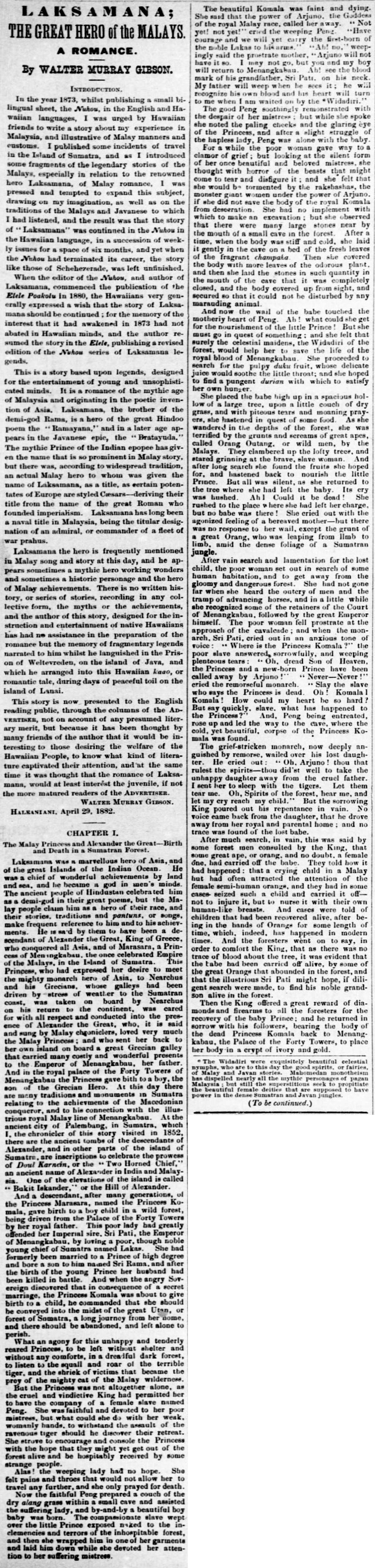
“Laksamana” in English by Walter Murray Gibson, 1882.

LAKSAMANA;

THE GREAT HERO of the MALAYS.

A ROMANCE.

By WALTER MURRAY GIBSON.

Introduction.

In the year 1873, whilst publishing a small bilingual sheet, the Nuhou, in the English and Hawaiian languages, I was urged by Hawaiian friends to write a story about my experience in Malaysia, and illustrative of Malay manners and customs. I published some incidents of travel in the Island of Sumatra, and as I introduced some fragments of the legendary stories of the Malays, especially in relation to the renowned hero Laksamana, of Malay romance, I was pressed and tempted to expand this subject, drawing on my imagination, as well as on the traditions of the Malays and Javanese to which I had listened, and the result was that the story of “Laksamana” was continued in the Nuhou in the Hawaiian language, in a succession of weekly issues for a space of six months, and yet when the Nuhou had terminated its career, the story like those of Scheheserade [Scheherazade of One Thousand and One Nights], was left unfinished.

When the editor of the Nuhou, and author of Laksamana, commenced the publication of the Elele Poakolu in 1880, the Hawaiians very generally expressed a wish that the story of Laksamana should be continued; for the memory of the interest that it had awakened in 1873 had not abated in Hawaiian minds, and the author resumed the story in the Elele, publishing a revised edition of the Nuhou series of Laksamana legends.

This is a story based upon legends, designed for the entertainment of young and unsophisticated minds. It is a romance of the mythic age of Malaysia and originating in the poetic invention of Asia. Laksamana, the brother of the demi-god Rama, is a hero of the great Hindoo [Hindu] poem the “Ramayana,” and in a later age appears in the Javanese epic, the “Bratayuda.” The mythic Prince of the Indian epopee gas given the name that is so prominent in Malay story, but there was, according to widespread tradition, an actual Malay hero to whom was given the name of Laksamana, as a title, as certain potentates of Europe are styled Cæsars—deriving their title from the name of the great Roman who founded imperialism. Laksamana has long been a naval title in Malaysia, being the titular designation of an admiral, or commander of a fleet of war prahus.

Laksamana the hero is frequently mentioned in Malay song and story at this day, and he appears sometimes a mythic hero working wonders and sometimes a historic personage and the hero of Malay achievements. There is no written history, or series of stories, recording in any collective form, the myths or the achievements, and the author of this story, designed for the instruction and entertainment of native Hawaiians has had no assistance in the preparation of the romance but the memory of fragmentary legends narrated to him whilst he languished in the Prison of Weltevreden, on the island of Java, and which he arranged into this Hawaiian kaao, or romantic tale, during days of peaceful toil on the island of Lanai.

This story is now presented to the English reading public, through the columns of the Advertiser, not on account of any presumed literary merit, but because it has been thought by many friends of the author that it would be interesting to those desiring the welfare of the Hawaiian People, to know what kind of literature captivated their attention, and at the same time it was thought that the romance of Laksamana, would at least interest the juvenile, if not the more matured readers of the Advertiser.

Walter Murray Gibson.

Haleaniani, April 29, 1882.

[The actual tale starts here…

It was introduced in the Nuhou, on 10/14/1873, pp. 4–5; the translation of the tale is printed from 11/4/1873 to 4/28/1874. In the Nuhou, it actually states that the story was translated from the Malay language.]

(Pacific Commercial Advertiser, 4/29/1882, p. 5)

LAKSAMANA;

The Pacific Commercial Advertiser, Volume XXVI, Number 44, Page 5. April 29, 1882.

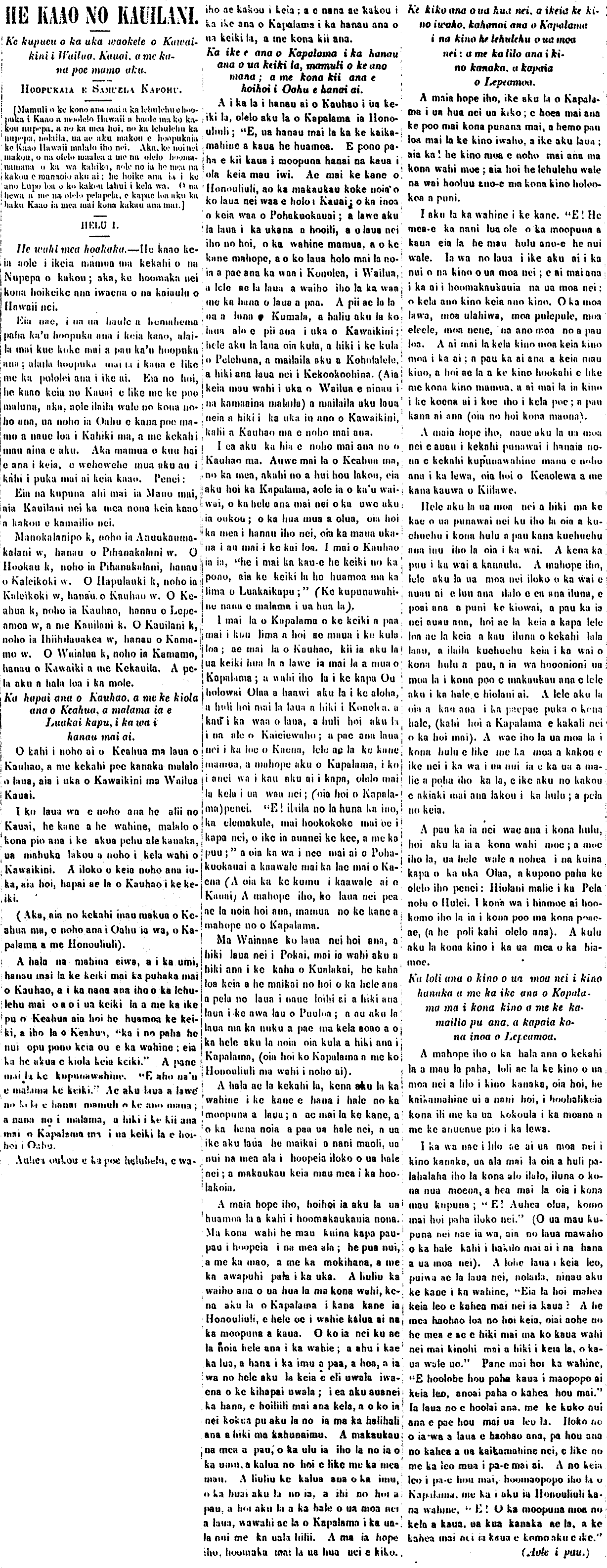
A Kauai story of Kauilani by Samuela Kapohu, 1869.

KAAO OF KAUILANI.

The wondrous one of the forests of Kawaikini in Wailua, Kauai, and his descendants thereafter.

Published by Samuela Kapohu.

{Because we were asked by the public to print Hawaiian and haole Stories in our newspaper, and being that the newspaper is for the people, therefore, we agreed to print the Hawaiian Kaao below. However, we ask pertaining to the deceitful words and the superstitious words of the olden days, those are not something for us to believe in; it shows the great ignorance of our lahui of that time. As for the sins and obscene words, they are to be deleted by the writer of the Kaao from what he writes.}

NUMBER 1.

A clarification.—This kaao has not been seen before in one of our Newspapers; but it is beginning to be shown amongst the communities of Hawaii nei.

However, if there are deletions or perhaps my telling of this kaao is unskilled, don’t object straight off, but when my telling is over, then that other person should put his out as he understands it to be true. And this is a story from Kauai, as shown in the title above, but he did not live only there, his descendants populated Oahu and moved all the way on to places of Kahiki and other lands. But before I speak about this, I will explain first where this kaao originated. Like this:

Here are the royal kupuna from Mano; Kauilani is the one who this kaao is about of which we are speaking.

Manokalanipo (m) dwelt with Anuukaumakalani (f), born was Pihanakalani (f). Hookau (m) dwelt with Pihanakalani, born was Kalekoki (f). Hapulauki (m) dwelt with Kaleikoki (f), born was Kauhao (f). Keahua (m) dwelt with Kauhao, born was Lepeamoa (f) and Kauilani (m). Kauilani (m) dwelt with Ihiihilauakea (f), born was Kamamo (f). Waialua (m) dwelt with Kamamo, born was Kawaiki and Kekauila. And so forth all the way until the ancestral root.

The pregnancy of Kauhao, and its discarding by Keahua, and it was cared for by Luakaikapu [the grandmother] when it was born.

[And so begins Samuel Kapohu’s telling of the story of Kauilani. This serial appears in the Kuokoa from 9/18/1869 and concludes on 2/12/1870.]

(Kuokoa, 9/18/1869, p. 1)

HE KAAO NO KAUILANI.

Ka Nupepa Kuokoa, Buke VIII, Helu 38, Aoao 1. Sepatemaba 18, 1969.

Prince Leleiohoku’s glittering gold bar, 1922.

[Found under: “Makalei, ka Laau Pii Ona a ka I’a o Moaula-Nui-Akea i Kaulana”]

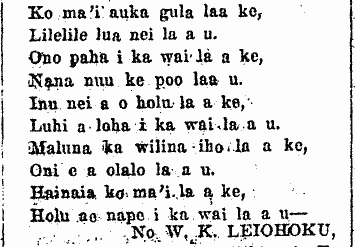
Ko ma’i auka gula laa ke,
Lilelile lua nei la a u.
Ono paha i ka wai la a ke,
Nana nuu ke poo laa u.
Inu nei a e holu la a ke,
Luhi a loha i ka wai la a u.
Maluna ka wilina iho la a ke,
Oni e a olalo la a u.
Hainaia ko ma’i la a ke,
Holu ae nape i ka wai la a u—

No W. K. LEIOHOKU [W. P. LELEIOHOKU]

[Many times mele are used to enhance stories, and there is no telling where you might find a mele, old or new. This procreation chant for William Pitt Leleiohoku for instance is included in this story to add to the mood following a description of the deeds of the “kalohe”.]

(Kuokoa, 2/17/1922, sec. 2, p. 2)

Ko ma'i auka gula laa ke...

Ka Nupepa Kuokoa, Buke LXI, Helu 7, Mahele Elua, Aoao 2. Feberuari 17, 1922.

William Hyde Rice’s Hawaiian Legends in English, 1923.

[From the Preface of “Hawaiian Legends by William Hyde Rice”]

The collection of Hawaiian legends of which a translation is given in the following pages represents the work of many years by William Hyde Rice of Kauai. However, it is only within the last few years that Mr. Rice has translated the legends from his Hawaiian manuscripts. He has tried to make his version as literal as possible, preserving at the same time the spirit of the original Hawaiian, its flavor, rhythm, and phrasing. He has avoided adding modern embroidery of fancy, as well as figures of speech foreign to the Hawaiian language and to its thought and expression.

….

Mr. Rice has been exceptionally well prepared for this work, as he has been familiar with the Hawaiian language from his earliest childhood. In fact until he was twenty, he never thought in English but always in Hawaiian, translating mentally into his mother tongue. In 1870 when he became a member of the House of Representatives, during the reign of Kamehameha V, Governor Paul Kanoa and S. M. Kamakau, the historian, both well-known Hawaiian scholars, gave Mr. Rice much help with his Hawaiian, especially teaching him the proper use of various complicated grammatical constructions, and explaining obscure variations in pronunciation and meaning.

The sources of the legends in this collection are varied. A number of the stories Mr. Rice remembers having heard as a child, and now rare ones were gathered in later years. Many are from more than one source, but have corresponded even in details, and almost word for word. The legend of Kamapuaa, for instance, is one of the first which Mr. Rice remembers hearing. When a boy, the places mentioned in this story were pointed out to him: the spot where the demi-god landed, where he found the hidden spring, and where he rooted up the natives’ sugar-cane and sweet potatoes. The story of “The Small Wise Boy and the Little Fool” he has also been familiar with since childhood. The places mentioned in this tale can likewise be pointed out.

Most of the legends are from Kauai sources, but a number have been gathered from the other islands of the group. Whenever Mr. Rice heard of an old Hawaiian who knew any legends, he went to him, sometimes going to several to trace a special story, as for instance, the “Jonah and the Whale” story, “Makuakaumana”, which after a long search he finally procured from Mr. Westervelt. This curious story seem to be more modern than the others of the collection. While hunting for a reliable version of this story, Mr. Rice incidentally heard the story of “Manuwahi” at Heeia from an old Hawaiian.

“The Bird Man”, “Holuamanu”, “The Destruction of Niihau’s Akua”, and “The Girl and the Mo-o”, were obtained from Mr. Francis Gay, who is one of the best living scholars of the Hawaiian language. The Niihau legend was heard from several other sources as well. Mr. Gay also gave the legends of the “Rainbow Princess” and the “Shrimp’s Eyes”; the ti plants mentioned in the latter legend can still be pointed out, growing at the mouth of a little valley near Holuamanu. The Hawaiian manuscript of part of the Menehune story was obtained from J. A. Akina, while the story of the “Rain Heiau” was told to him in 1912 by a man named Naialau, who has since died at Kalaupapa. “How Lizards Came to Molokai” and Paakaa and Ku-a-paakaa” were told Mr. Rice by a man from Hawaii named Wiu, while the Rev. S. K. Kaulili, who is still living at Koloa, Kauai, gave him the most complete version of the “Rolling Island”.

During Mr. George Carter’s term as Governor, a reception was given in his honor, at Hanalei, where Mr. Rice was much interested in the very fine oli (chanting) of an old Hawaiian, named Kaululua. From him he obtained a number of legends, including that of “Ulukaa” from corresponding versions of other already in his collection. Other legends have been lost forever on account of ill-timed ridiculing by some chance companion, for Mr. Rice has found that the old people who know the legends are very sensitive, and when they find an unsympathetic auditor, refuse to continue their stories.

[It is often just as important to read the front matter and the back matter of a book than simply heading straight to the main text itself. Many times you can learn a lot of important information.

The stories credited to W. H. Rice found in the Hoku o Hawaii are probably the ones Rice collected over the years.]

(Rice, William Hyde. “Hawaiian Legends. Bernice P. Bishop Museum Bulletin 3.” Honolulu: The Museum, 1923.)

Hawaiian Legends

Hawaiian Legends by William Hyde Rice

A birthday, a name song, and never knowing where you will find information, 1891.

[Found in the story: “He Moolelo Kaao No Kamapuaa.”]

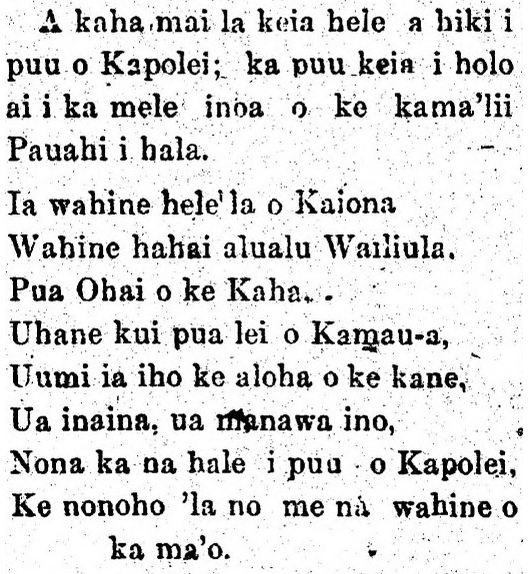
Ia wahine hele la o Kaiona,
Wahine hahai alualu Wailiula,
Pua Ohai o ke Kaha,
Uhane kui pua lei o Kamau-a,
Uumi ia iho ke aloha o ke kane,
Ua inaina, ua manawa ino,
Nona ka na hale i puu o Kapolei,
Ke nonoho ‘la no me na wahine o ka ma’o.

[On her 183rd birthday, here is a mele inoa for the princess found in of all places, a story about Kamapuaa. There is a scene where Kamapuaa is coming upon Puu o Kapolei, and the writer interjects: this is the hill about which goes the mele inoa for the deceased princess Pauahi. You never know where you can find information, you just have to look…]

(Leo o ka Lahui, 7/1/1891, p. 4)

He Moolelo Kaao No Kamapuaa.

Ka Leo o ka Lahui, Buke II, Helu 227, Aoao 4. Iulai 1, 1891.

Another Aladdin translation, 1916.

A MOOLELO KAAO
OF
ALADDIN, THE PEASANT CHILD
AND THE SUPERNATURAL LAMP

Aia maloko o ke kapitala o kekahi o na okana aina waiwai loa a palahalaha hoi o ke aupuni nui o Kina, e noho ana kekahi kanaka humuhumu lole o Masetafa kona inoa, aohe ana hana i kaulana e ae a o keia hana wale no o ka humuhumua tela lole paha, elike me ia e kamaaina nei iwaena o kekahi poe Pake o nei mau la.

MOKUNA I.

He iluhune keia Masetafa, aohe i lawa kana mau wahi loaa e hiki ai e hoolawa kupono iaia iho ame kana wahine ame hookahi keikikane a ke Akua i hoopomaikai mai ai iaia ma keia ola ana, elike me ke kupono nei i makemake ia.

O keia keikikane o Masetafa, nona ka inoa o Aledian, a nona hoi keia moolelo kaao e paneeia aku nei no ka pomaikai o ko ke Kilohana Pookela poe heluhelu moolelo, no ka ilihune no hoi paha o na makua, elike no hoi me na keiki a ka poe ilihune o nei mau la, aole i hoonaauao maikaiia, ua hoopalaleha loaia kona malama a a’oia ana, a ma ia ano ua lilo keia i keiki palaualelo, a e hookuu mauia ana oia e hele a e hana elike me kona makemake, a e hoomaopopoia, o na hana apau ana i hana ai he mau hana hewa loa, no ka mea, aole oia i a’oia i na aoao maikai ame na hana maikai, ame na hua maikai e loaa mai ana mailoko mai o na hana maikai…

[Perhaps this and the translation of the previous post were done from G. S. Beaumont’s “The Arabian Nights’ Entertainments: or, The Thousand and One Nights,” published in 1811. However, the S. K. Kaai version seems a little more simplistic. This later translation seems to follow closely Beaumont’s English and appears in the Nupepa Kuokoa from 11/3/1916 and concludes on 3/9/1917.]

(Kuokoa, 11/3/1916, p. 6)

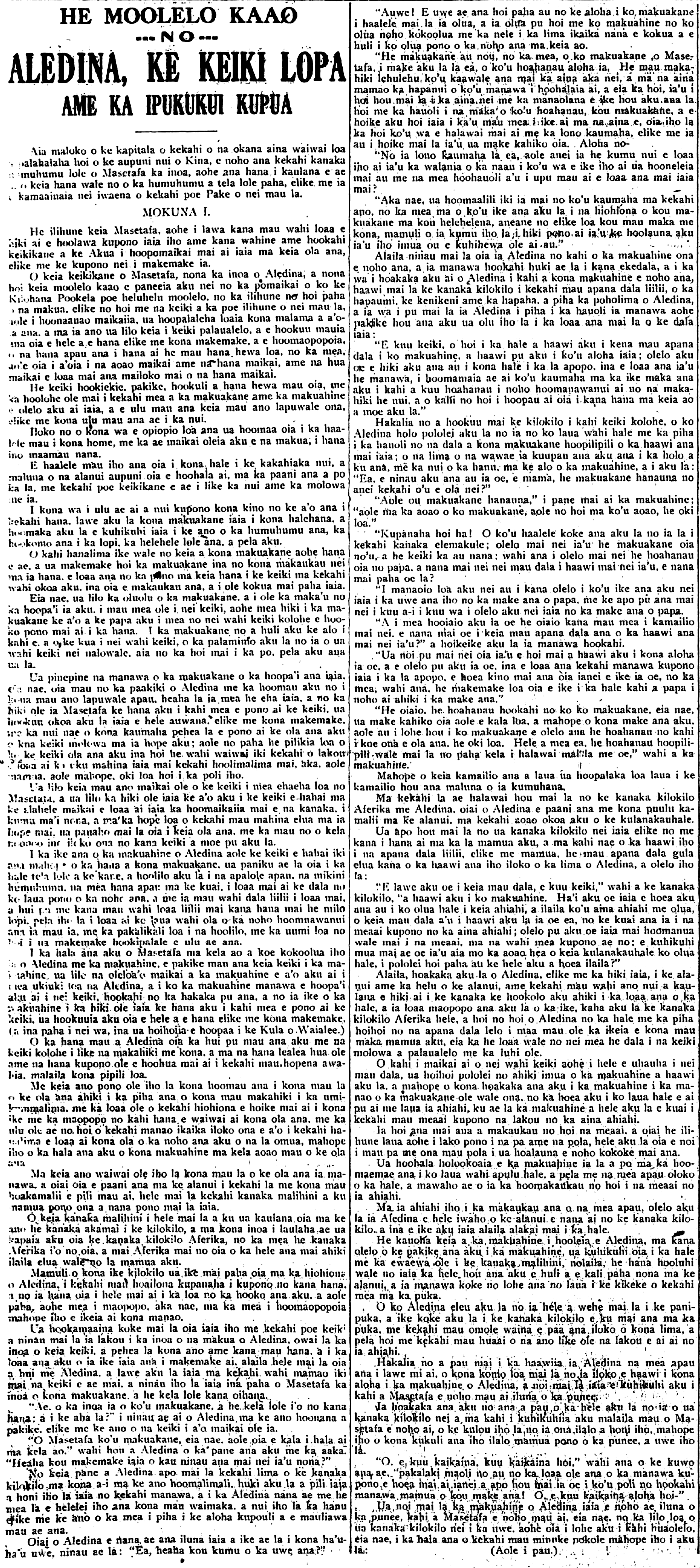
HE MOOLELO KAAO NO ALEDINA, KE KEIKI LOPA AME KA IPUKUKUI KUPUA

Ka Nupepa Kuokoa, Buke LIV, Helu 44, Aoao 6. Novemaba 3, 1916.

More from the Grimms: “Little Snow-White,” 1861.

A KAAO ABOUT BEAUTIFUL-SNOW.

Translated from the German.

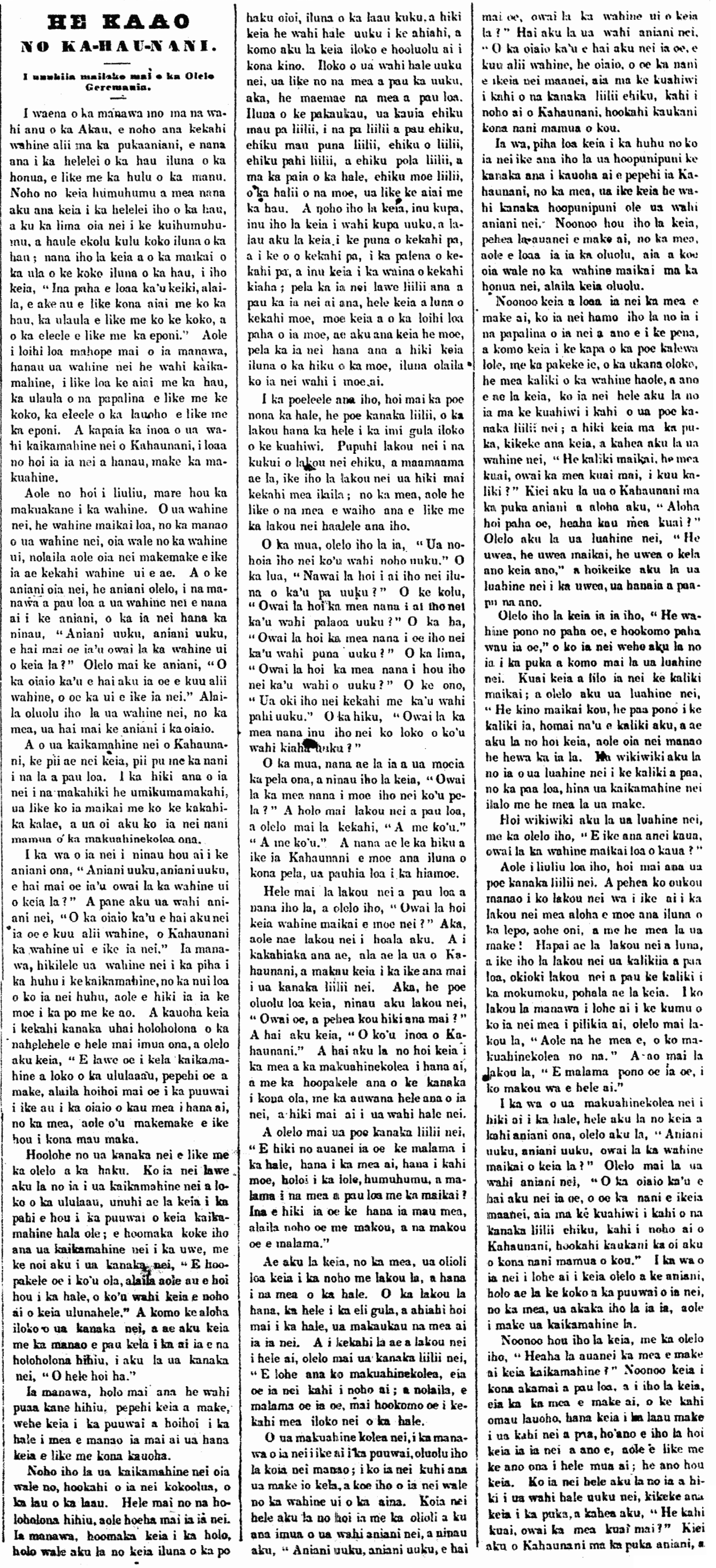
I waena o ka manawa ino ma na wahi anu o ka Akau, e noho ana kekahi wahine alii ma ka pukaaniani, e nana ana i ka helelei o ka hau iluna o ka honua, e like me ka hulu o ka manu. Noho no keia humuhumu a mea nana aku ana keia i ka helelei iho o ka hau, a ku ka lima oia nei i ke kuihumuhumu, a haule ekolu kulu koko iluna o ka hau; nana iho la keia a o ka maikai o ka ula o ke koko iluna o ka hau, i iho keia, “Ina paha e loaa ka’u keiki, alaila, e ake au e like kona aiai me ko ka hau, ka ulaula e like me ko ke koko, a o ka eleele e like me ka eponi. ” Aole i loihi loa mahope mai o ia manawa, hanau ua wahine nei he wahi kaikamahine, i like loa ke aiai me ka hau, ka ulaula o na papalina e like me ke koko, ka eleele o ka lauoho e like me ka eponi. A kapaia ka inoa o ua wahi kaikamahine nei o Kahaunani, i loaa no hoi ia ia nei a hanau, make ka makuahine….

[Here is another (perhaps more familiar) tale Grimms translated by J. W.]

(Kuokoa, 12/16/1861, pp. 1–2)

HE KAAO NO KA-HAU-NANI.

Ka Nupepa Kuokoa, Buke I, Helu 5, Aoao 1. Dekemaba 16, 1861.

...olelo aku, "O hele ma kahi e...

Ka Nupepa Kuokoa, Buke I, Helu 5, Aoao 2. Dekemaba 16, 1861.

More from Dumas: “Three Musketeers,” 1878.

HE MOOLELO
—NO NA—

KIAI EKOLU.

—A ME KE—
Koa Opio Wiwo Ole!
ATAGANANA.

{Translated by a generous pen for the Pride of the Hawaiian Nation.}

CHAPTER 1
NUMBER 1.

To the Newspaper “Ko Hawaii Pae Aina:” My pen is a stranger to your straight borders and your wide columns of news: and at the request of your captain that I write a moolelo or kaao for our Pride, therefore, I have taken my pen nib to translate the story of the “Three Musketeers,” a moolelo that I used to read all the time in days gone by, and a moolelo that I believe will mesmerize those who love kaao, and they will read it over and over so that they can memorize it and tell it by heart. One of my schoolmates.

{O Readers, do be so kind as to forgive me for the names of the people in this moolelo; they are similar with the kaao of The Count of Monte Cristo.}

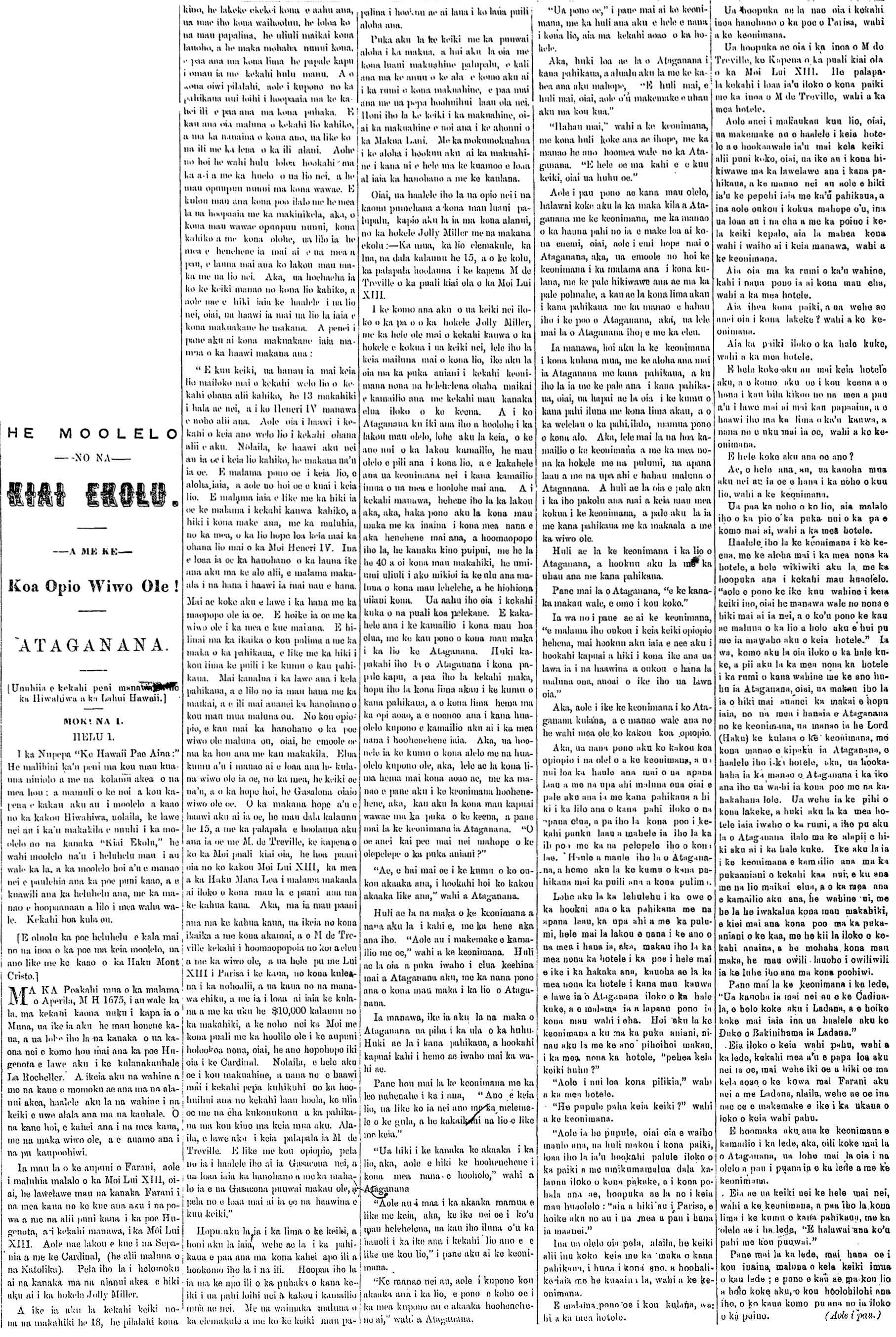
MA KA Poakahi mua o ka malama o Aperila, M. H. 1675, i au wale ka la, ma kekahi kaona nuku i kapa ia o Muna, ua ike ia aku he mau honene kaua, a ua lohe iho la na kanaka o ua kaona nei e komo hou mai ana ka poe Hugenota e lawe aku i ke kulanakauhale La Rocheller. A ikeia aku na wahine a me na kane e momoku ae ana ma na alanui akea, haalele aku la na wahine i na keiki e uwe alala ana ma na kauhale. O na kane hoi, e kahei ana i na mea kaua, me na maka wiwo ole, a e auamo ana i na pu kaupoohiwi…

[The translation of Alexander Dumas’ “The Three Musketeers” began on 3/2/1878, and the last segment found is on 12/7/1878 (mid-Chapter XVI). I could find no explanation for there only being a quarter of the entire work.]

(Ko Hawaii Pae Aina, 3/2/1878, p. 1)

HE MOOLELO NO NA KIAI EKOLU.

Ko Hawaii Pae Aina, Buke I, Helu 9, Aoao 1. Mei 2, 1878.

Updated Elepaio Story, 1894.

DON’T WORRY.

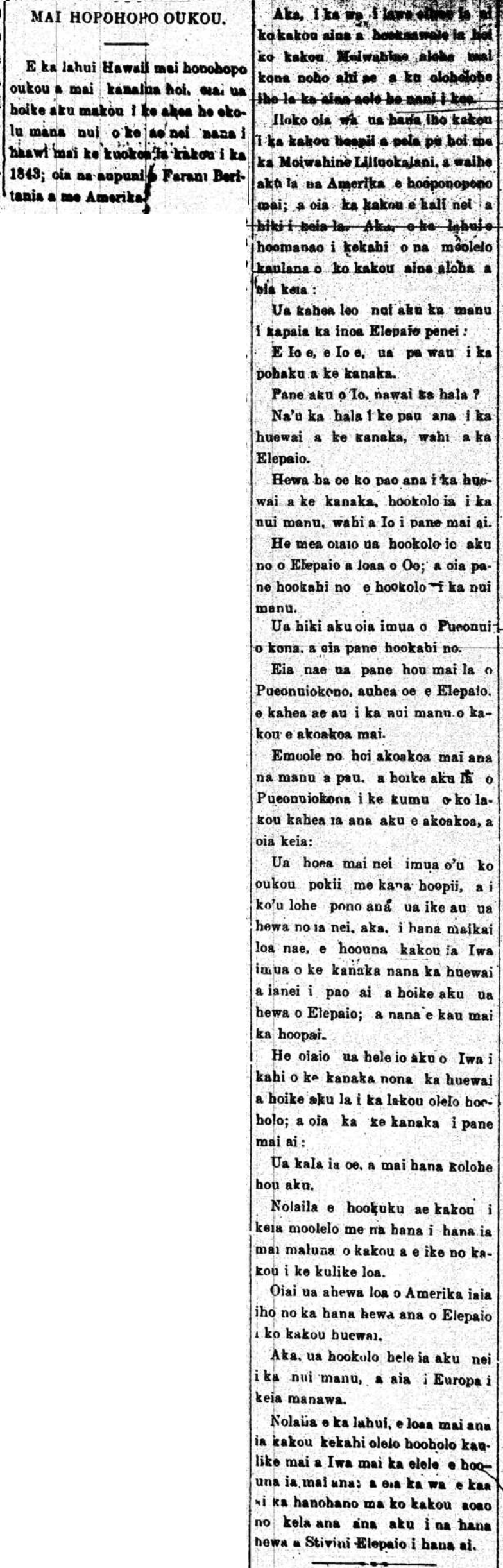
O Hawaiian people, don’t worry and don’t be uncertain. for we have publicly shown that there are three great powers of the world who have granted independence to us in 1843, that being France, Britain, and America.

But when our land was stolen and our beloved Queen was taken from her throne and our land stood bare without any beauty remaining,

During that time, we composed our protest, along with Queen Liliuokalani, and left if for America to make right; and it for this that we wait until today. But O Nation, do recall one of the famous stories of our beloved land, this being:

The bird called Elepaio called out loudly:

“O Io, O Io, I was hit by the rock of the man.”

Io answered, “Who was at fault?”

“I was wrong for pecking at the huewai of the man,” answered Elepaio.

“You are indeed at fault for puncturing the huewai of the man; let it be judged by the many birds,” was Io’s answer.

It was so, Elepaio was judged; he came upon Oo, and his answer was the same, that it be judged by the many birds.

Elepaio arrived before Pueonuiokona, and his answer was the same.

But Pueonuiokona went on to say, “Say Elepaio, I will call our many fellow birds to come together.”

In no time, all the birds came together, and Pueonuiokona revealed the reason for them being called to assemble, like this:

“Before me appeared your younger sibling with his protest, and when I heard correctly, I knew he was wrong, however, the best thing to do would be for us to send Iwa before the man to whom belonged the huewai that Elepaio pecked, and to tell him that Elepaio was guilty, and it is for him to set the punishment.”

And it was so, Iwa went to the place of the man to whom belonged the huewai, and told him of their decision; this is what the man said:

“You are forgiven, and don’t do anymore harmful acts.”

So we compare this story with the actions carried out upon us, and we see that they are exactly the same.

For America totally blames itself for the wrong done by Elepaio to our huewai.

But it is going around being judged by the many birds, and is currently in Europe.

So therefore, O Nation, we will receive a fair judgement from Iwa, the messenger that is being sent; and that will be when the dignity shall be awarded to our side through the judgement of the crimes carried out by Stevens Elepaio.

(Leo o ka Lahui, 10/11/1894, p. 2)

MAI HOPOHOPO OUKOU.

Ka Leo o ka Lahui, Buke II, Helu 1047, Aoao 2. Okatoba 11, 1894.