Another political mele for Curtis Piehu Iaukea, 1904.

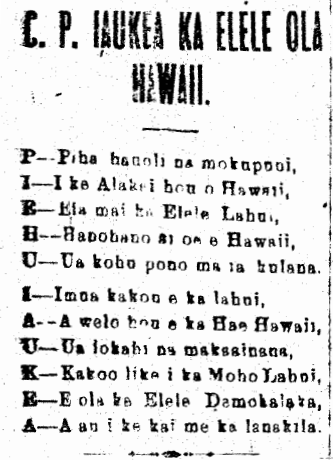
C. P. IAUKEA THE REPRESENTATIVE THAT WILL SAVE HAWAII.

P—Piha hauoli na mokupuni,
I—I ke Alakai hou o Hawaii,
E—Eia mai ka Elele Lahui,
H—Hanohano ai oe e Hawaii,
U—Ua kohu pono ma ia kulana.

I—Imua kakou e ka lahui,
A—A welo hou e ka Hae Hawaii,
U—Ua lokahi na makaainana,
K—Kakoo like i ka Moho Lahui,
E—E ola ka Elele Demokalaka,
A—A au i ke kai me ka lanakila.

[The islands are filled with joy,
In the new Leader of Hawaii,
Here is the Representative,
In whom you, O Hawaii, will be proud,
He will be right for the position.

Let us move forward, O Lahui,
And let the Hawaiian Flag flutter once more,
The citizens are unified,
And support together the Candidate of the People,
Long live the Democratic Representative,
And travel the sea in victory.]

[Once again inspired by a post by Nanea Armstrong-Wassel. Here is the mele she speaks of  by Ernest Kaai, “Lanakila Iaukea,” found in the Kuokoa, 10/26/1906, p. 4, here.]

(Aloha Aina, 11/5/1904, p. 4)
C. P. IAUKEA KA ELELE OLA HAWAII.

Ke Aloha Aina, Buke X, Helu 46, Aoao 4. Novemaba 5, 1904.
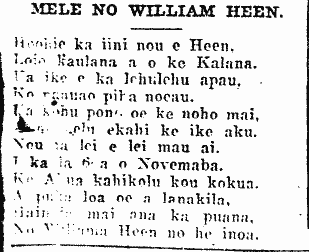
Another political mele for William Haehae Heen, 1923.

A MELE FOR WILLIAM HEEN.

Hoohie ka iini nou e Heen,
Loio kaulana a o ke Kalana.
Ua ike e ka lehulehu apau,
Ko naauao piha noeau.
Ua kohu pono oe ke noho mai,
[Unclear passage] ekahi ke ike aku.
Nou ia lei e lei mau ai,
I ka la 6 [?] a o Novemaba.
Ke Akua kahikolu kou kokua,
A puka loa oe a lanakila.
Haina ia mai ana ka puana,
No Wiliama Heen no he inoa.

[The dignified is the desire for you O Heen
Famous attorney of the County
All are aware
Of your knowledge filled with wisdom
[Unclear passage] is foremost to see
On the 6th [?] of November.
The Trinity is your aid,
And you will win the election.
Let the story be told,
The name song of Wiliama Heen.]

[This is just another of the many political mele for William Haehae Heen. This post was inspired by a post earlier this week by Nanea Armstrong-Wassel!]

(Kuokoa, 11/1/1923, p. 5)

MELE NO WILLIAM HEEN.

Ka Nupepa Kuokoa, Buke LXII, Helu 44, Aoao 5. Novemaba 1, 1923.

A mele for the pāʻū of the Queen, 1893.

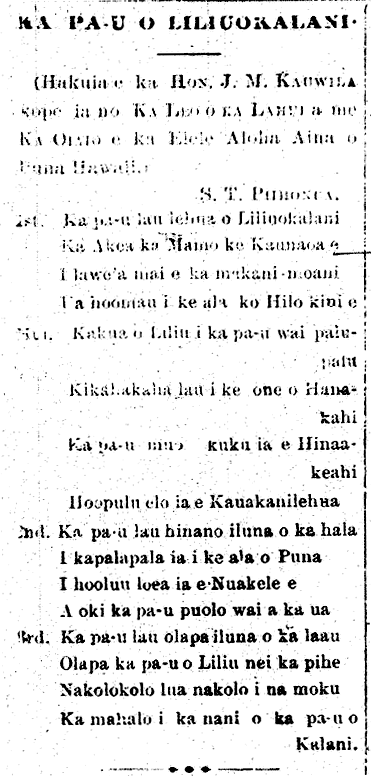
THE PA-U OF LILIUOKALANI

(Composed by the Hon. J. M. Kauwila, and copied for Ka Leo o ka Lahui and Ka Oiaio by the Aloha Aina Representative of Puna, Hawaii.)

S. T. Piihonua.

1st.  Ka pa-u lau lehua o Liliuokalani
Ka Akea [? Akoa] ka Mamo ke Kaunaoa e
I lawe’a mai e ka makani moani
Ua hoomau i ke ala ko Hilo kini e

Hui.  Kakua o Liliu i ka pa-u wai palupalu
Kikahakaha lau i ke one o Hanakahi
Ka pa-u muo kuku ia e Hinaakeahi
Hoopulu elo ia e Kauakanilehua

2nd.  Ka pa-u lau hinano iluna o ka hala
I kapalapala ia e ke ala o Puna
I hoolulu loea ia e Nuakele e
A oki ka pa-u puolo wai a ka ua

3rd.  Ka pa-u lau olapa iluna o ka laau
Olapa ka pa-u o Liliu nei ka pihe
Nakolokolo lua nakolo i na moku
Ka mahalo i ka nani o ka pa-u o Kalani.

(Leo o ka Lahui, 5/8/1893, p. 3)

KA PA-U O LILIUOKALANI

Ka Leo o ka Lahui, Buke II, Helu 700, Aoao 3. Mei 8, 1893.

Prince Leleiohoku’s glittering gold bar, 1922.

[Found under: “Makalei, ka Laau Pii Ona a ka I’a o Moaula-Nui-Akea i Kaulana”]

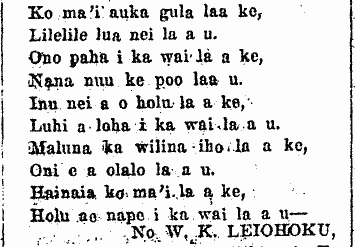
Ko ma’i auka gula laa ke,
Lilelile lua nei la a u.
Ono paha i ka wai la a ke,
Nana nuu ke poo laa u.
Inu nei a e holu la a ke,
Luhi a loha i ka wai la a u.
Maluna ka wilina iho la a ke,
Oni e a olalo la a u.
Hainaia ko ma’i la a ke,
Holu ae nape i ka wai la a u—

No W. K. LEIOHOKU [W. P. LELEIOHOKU]

[Many times mele are used to enhance stories, and there is no telling where you might find a mele, old or new. This procreation chant for William Pitt Leleiohoku for instance is included in this story to add to the mood following a description of the deeds of the “kalohe”.]

(Kuokoa, 2/17/1922, sec. 2, p. 2)

Ko ma'i auka gula laa ke...

Ka Nupepa Kuokoa, Buke LXI, Helu 7, Mahele Elua, Aoao 2. Feberuari 17, 1922.

Death of Kekelaokalani, 1880.

FUNERAL.

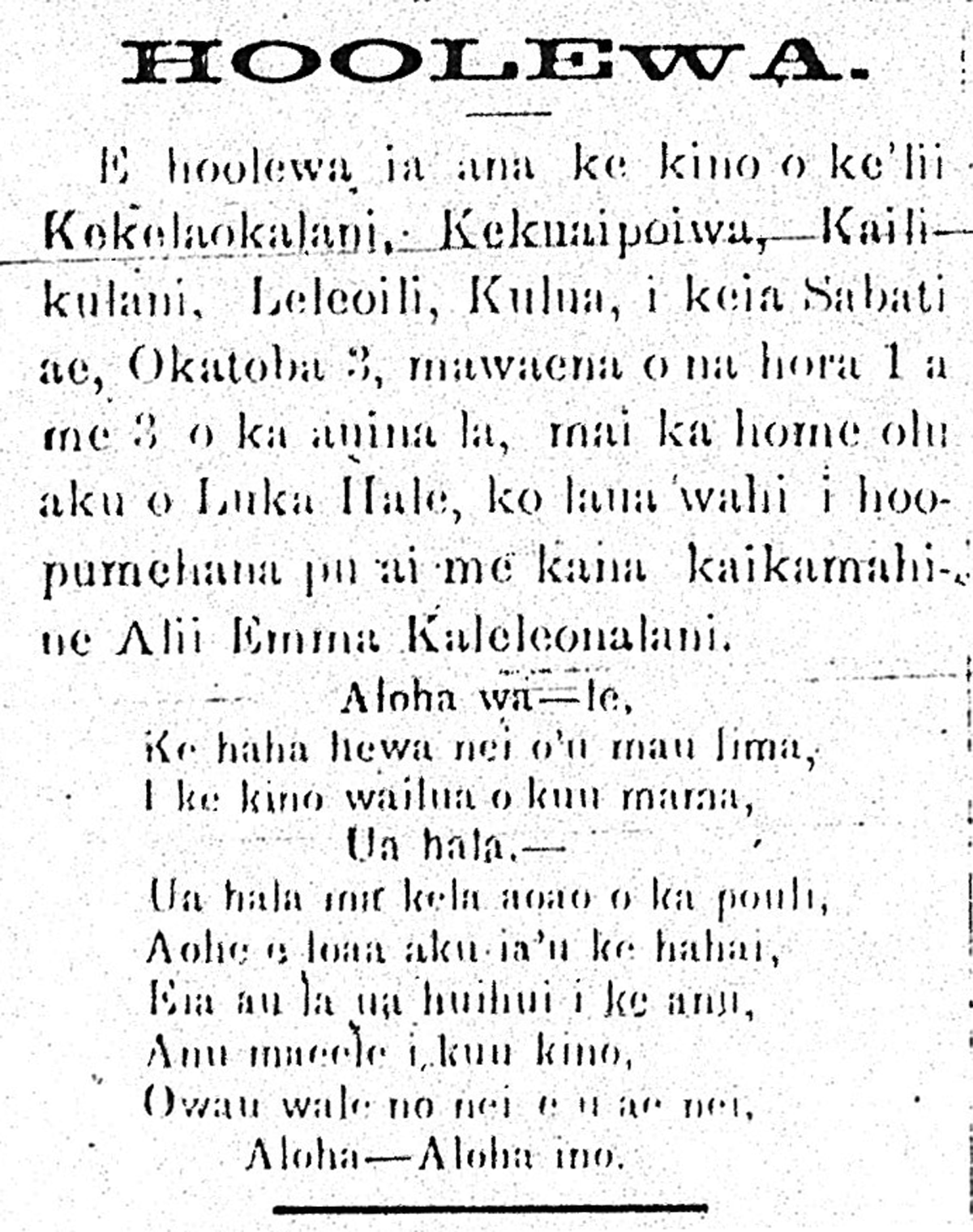
A service will be held over the remains of Kekelaokalani, Kekuaipoiwa [Kekuiapoiwa], Kailikulani, Leleoili, Kulua, on the following Sunday, October 3, between the hours of 1 and 3 in the afternoon, at the pleasant home, Rooke House [Luka Hale], the place where they made warm with their daughter, the Royal One, Emma Kaleleonalani.

Aloha wa—le,
Ke haha hewa nei o’u mau lima,
I ke kino wailua o kuu mama,
Ua ha—la,
Ua hala ma kela aoao o ka pouli,
Aohe e loaa aku ia’u ke hahai,
Eia au la ua huihui i ke anu,
Anu maeele i kuu kino,
Owau wale no nei e u ae nei,
Aloha—Aloha ino.

[Much Aloha,
My hands search in vain,
Over the body of my dear mama,
She has gone,
She has gone to the other side of the darkness,
I shall not catch her should I follow after her,
Here I am chilled in the cold,
My body is numbed,
It is I alone who mourns,
Aloha—How woeful.]

(Elele Poakolu, 9/29/1880, p. 1)

HOOLEWA.

Ka Elele Poakolu, Buke I, Helu 4, Aoao 1. Sepatemaba 29, 1880.

Mele inoa for Queen Kapiolani, 1881.

A Name Song.

For Queen Kapiolani Napelakapu; from Holoholoku comes this mele for the wife of Aikanaka, the King of Kauai; Hinaaikamala [Hinaaikamalama] was the wife of Aikanaka; which was recorded by S. Hinau. A small portion was copied here below.

Nani kuu hilahila e noho nei-e
Hele wale ka manene a ka lima-e
A ka laulau hoi mai-e
Hohoi maua me kuu nele-e
Me ka hilahila pau pu no-e
Ahi loloko wewela i ka makemake-e
I ka hu-honua a ka waimaka-e
O kuu maka kai ike i ka eha-e
Halanalana no e hanini-e
Kahanu kolopaa oia hanu-e
Ka lapalapa huila o ke kanaka-e
Ka hinu holo ia a ke aloha-e
Nana i kuikui nawali au-e
Nakunaku ka pua hau i ka wai e-e
Napanapa ka lau ke ike ku-e
He ukiuki keia i ka lono-e
Lono wau ua pa kanaka oe-e.

[This can also be seen in the mele “Nani Kuu Maka e Au Wale Nei-e,” found on pages 264–267, of Na Mele Aimoku, Na Mele Kupuna, a me Na Mele Ponoi o ka Moi Kalakaua I. It is credited to Niau. There is also an appended note that the top of this mele has been lost.

It is also unfortunate that this newspaper, Ka Elele Poakolu, is still not available online in any form.]

(Elele Poakolu, 5/11/1881, p. 2)

He Mele Inoa.

Ka Elele Poakolu, Buke II, Helu 10, Aoao 2. Mei 11, 1881.

Mother’s Day at Honokaa Union Church, 1942.

[Found under: “Meahou O Na Kohala Ame Hamakua.”]

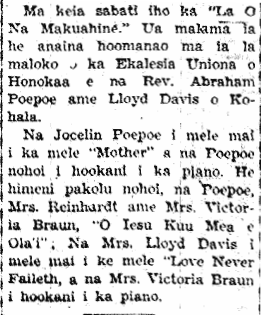
This past Sunday was the “Day of Mothers.” A commemoration was held at the Union Church of Honokaa by the Rev. Abraham Poepoe and Lloyd Davis of Kohala.

Jocelin Poepoe sang the song “Mother” and Poepoe [? Abraham] played the piano. There was a trio with Poepoe, Mrs. Reinhardt and Mrs. Victoria Braun, singing “O Iesu Kuu Mea e Ola’i,” and Mrs. Lloyd Davis sang “Love Never Faileth,” and Mrs. Victoria Braun played the piano.

[This was found in the regular column written by Hattie Linohaupuaokekoolau Saffery Reinhardt on news from North and South Kohala and Hamakua.]

(Hoku o Hawaii, 5/13/1942, p. 1)

Ma keia sabati iho ka "La o Na Makuahine."...

Ka Hoku o Hawaii, Volume XXXVII, Number 3, Aoao 1. Mei 13, 1942.

Let everyday be Mother’s Day, but… 1941.

[Found under: “Na Hunahuna Mea Hou o Maui.”]

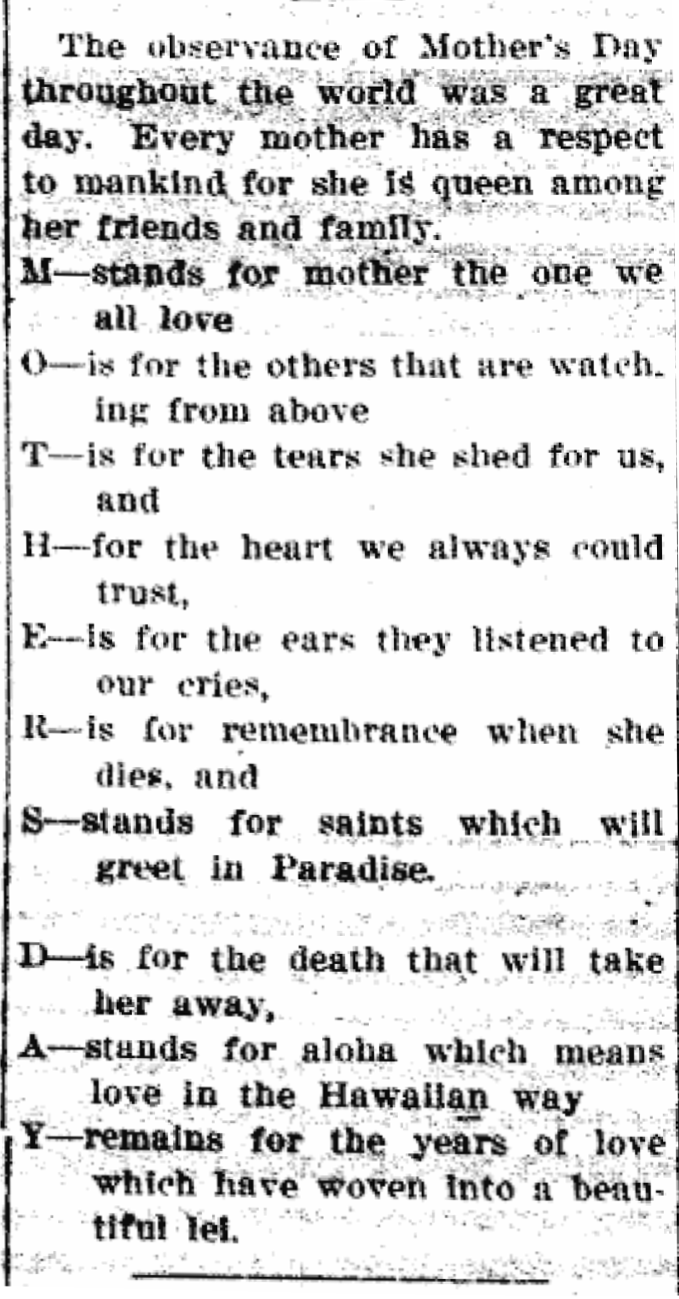
The observance of Mother’s Day throughout the world was a great day. Every mother has a respect to mankind for she is queen among her friends and family.

M—stands for mother the one we all love

O—is for the others that are watching from above

T—is for the tears she shed for us, and

H—for the heart we always could trust,

E—is for the ears they listened to our cries,

R—is for remembrance when she dies, and

S—stands for saints which will greet in Paradise.

D—is for the death that will take her away,

A—stands for aloha which means love in the Hawaiian way

Y—remains for the years of love which have woven into a beautiful lei.

[This appears in Mrs. Banham’s regular column on news items from Maui. Acrostics also appear in Hawaiian-Language Newspapers in the Hawaiian Language from very early on.]

(Hoku o Hawaii, 5/14/1941, p. 1)

The observance of Mother's Day...

Ka Hoku o Hawaii, Volume XXXVI, Number 3, Aoao 1. Mei 14, 1941.

Another beautiful patriotic mele by Eleanor Prendergast, 1893.

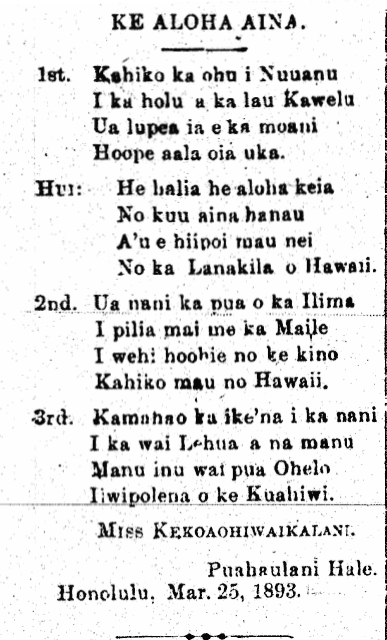
KE ALOHA AINA.

1st. Kahiko ka ohu i Nuuanu
I ka holu a ka lau Kawelu
Ua lupea ia e ka moani
Hoope aala oia uka.

Hui: He halia he aloha keia
No kuu aina hanau
A’u e hiipoi mau nei
No ka Lanakila o Hawaii.

2nd. Ua nani ka pua o ka Ilima
I pilia mai me ka Malie
I wehi hoohie no ke kino
Kahiko mau no Hawaii.

3rd. Kamahao ka ike’na i ka nani
I ka wai Lehua a na manu
Manu inu wai pua Ohelo
Iiwipolena o ke Kuahiwi.

Miss Kekoaohiwaikalani.

Puahaulani Hale.

Honolulu, Mar. 25, 1893.

(Leo o ka Lahui, 4/25/1893, p. 1)

KE ALOHA AINA.

Ka Leo o ka Lahui, Buke II, Helu 691, Aoao 1. Aperila 25, 1893.

A patriotic mele criticizing the Rev. Joseph S. Emerson, 1893.

THE KAPUUKOLO CHURCH SCANDAL.

There is a saintly son of a gun,
Whose name is J. S. Emerson,
Who goes about in pious style,
To ease his anti-monarch bile.
And enters with his devout brother,
Hawaiian’s meeting: tries to smother,
All aloha for their Queen and land,
By fairy tales of witchcraft brand.
And sweetly says: “My christian friends,
“In order now to gain our ends,
“Will you ally yourselves with one,
“Who being but a native son.
“Has dared to infringe the haole’s plan
“And makes himself (deceitful man)
“The priest of God and Baal too?
“Shall such associate with you?
“Perish the thought! No! brethren dear,
“Not though my father’s sons, ’tis clear,
“Have robbed you of your lands and living,
“And taught you not that way to heaven.
“We’ll sweetly sing, in chorus clear
“The haole takes the government here
“Having taken all else, and let your Queen,
“Rely on none who here are seen.
“Associate she with heathens foul,
“Pig, kahunas, chickens, awa bowl!
“Shall such be helped with christian prayer,
“And our God asked for her to care.”
He stayed his speech and called for votes,
The answer from indignant throats,
Came fast and furious on his ears:
“Take out from here your lying sneers.
“Hypocrite! usurper! rebel! beast!
“Such words become your family least,
“Who live on what the royal hand,
“Gave bounteous of Waialua’s land.
“As pay for early prayer and praise,
“Raised by your father in those days,
“When missionaries first came here,
“And taught us a new God to fear.
“Go, hound! unto your wealthy home,
“Reflect on whence your creature comforts come,
“Think if you can what doom will be,
“Ingratitude’s God will bring to thee.
“Hide your grey locks in deepest shame
“Let another take your father’s name,
“Go, and ne’er again pollute,
“This sacred place with your foul boot.”
They went: None blessed their homeward way:
All seemed relieved: Arose the lay,
Of praise to God: and all agree,
To pray for Queen and Hawaii.

[Here is an article with descriptions of what led to this mele.]

(Hawaii Holomua, 2/11/1893, p. 4)

THE KAPUUKOLO CHURCH SCANDAL.

Hawaii Holomua, Buke III, Helu 7, Aoao 4. Feberuari 11, 1893.