Samuel K. Kekoowai on the Daughters of Hawaii and Hanaiakamalama, 1923.

HANAIAKAMALAMA

This is a building near the end of the route of the electric car, and it stands on a hill.

As a result of the graciousness of one of the members of the Daughters of Hawaii [Ahahui o na Kaikamahine o Hawaii], this writer [Samuel K. Kekoowai] was introduced to Mrs. J. Swanzy, the leader of this association, and by her kindness I was welcomed to see the walls of that house which is filled with beautiful decorations of the monarchy, and their images hanging from the walls, set up almost like the museum of Kamehameha [Bernice Pauahi Bishop Museum].

This group, the Daughters of Hawaii, upholds the name of Queen Emma Kaleleonalani, and her birthday is cherished by them, and the writer observed the commemoration held by the association which holds dear the name placed upon them, the Daughters of Hawaii.

In the story told to me within the house, Kaleleonalani was raised by her hanai guardian [kahu hanai], Dr. Rooke [Kauka Luka], until she married Liholiho Kamehameha 4, however, there is another version that I have been told by another.

On that 20th day of this June, I saw the back room totally filled with those who came, from the members to visitors, and most were whites and there were a few Hawaiians [??? a o-a na Hawaii].

The story of the circuit of Queen Emma Kaleleonalani around Oahu nei was told, beginning at Waimanalo at the place of John Cummins [Keoni Kamaki], and to Kaneohe at the place of Wainui Pii, and then on to Waikane at the place of Kameaaloha; at Kahana there was a Chinese named Apakana, on to Punaluu there was Naili, to Laie at the place of Kupau, to Kahuku at the place of Kaluhi, to Waialua at the place of Kaiaikawaha. Continue reading
Traditional place names and the Daughters of Hawaii, 1918.

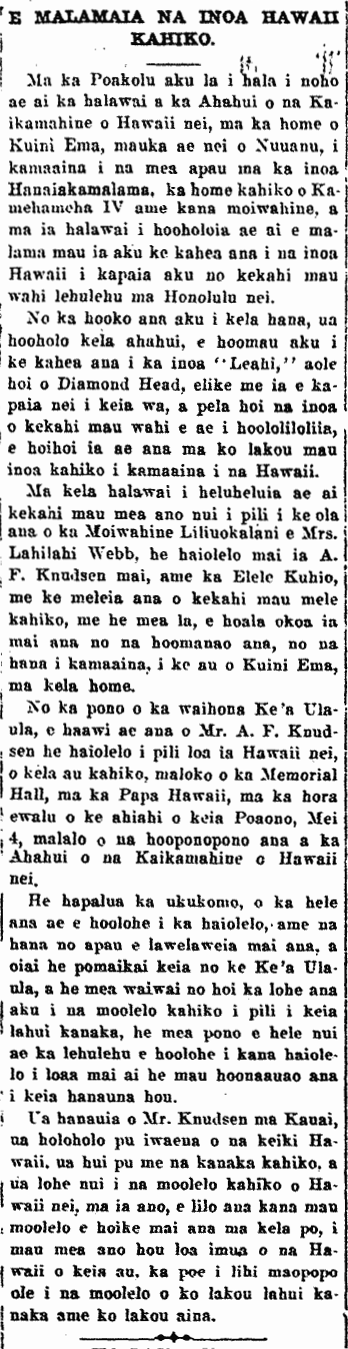
OLD HAWAIIAN NAMES TO BE PRESERVED.

This past Wednesday the Daughters of Hawaii [Ahahui o na Kaikamahine] held a meeting at the home of Queen Emma in the uplands of Nuuanu, known by all by the name Hanaiakamalama, the old home of Kamehameha IV and his queen; and at that meeting it was decided that the calling of many places in Honolulu nei by their Hawaiian names will be preserved forever.

To carry out this endeavor, the organization decided to continue calling the name “Leahi,” and not Diamond Head, as it is being called now, and so too with other names that have been changed; they will be returned to their old names that Hawaiians are familiar with.

At that meeting several things were read pertaining to the life of Queen Liliuokalani  by Mrs. Lahilahi Web, a speech by A. F. Knudsen, and Representative Kuhio, along with the singing of some old mele, just as if they were recreating memories of familiar deeds from the time of Queen Emma in that home.

For the treasury of the Red Cross, Mr. A. F. Knudsen will give a speech specifically pertaining to Hawaii nei of the olden days, at Memorial Hall of the Hawaiian Evangelical Association [Papa Hawaii], at eight o’clock on the evening of this Saturday, May 4, under the direction of the Daughters of Hawaii nei.

The entrance will be half price to go and listen to the speech and for all activities that will be put on, and being that it is a benefit for the Red Cross, and that it is beneficial to listen to this history pertaining to the Hawaiian lahui, all the people should go to hear his speech so that the new generations can get some education.

Mr. Knudsen was born on Kauai and went around amongst the Hawaiian children, and met the old people, and listened to the old stories of Hawaii nei; and because of this, the stories he tells that night will be something totally new for Hawaiians of today, the people who know hardly any of the stories of their lahui and their land.

(Kuokoa, 5/3/1918, p. 4)

E MALAMAIA NA INOA HAWAII KAHIKO.

Ka Nupepa Kuokoa, Buke LVI, Helu 18, Aoao 4. Mei 3, 1918.

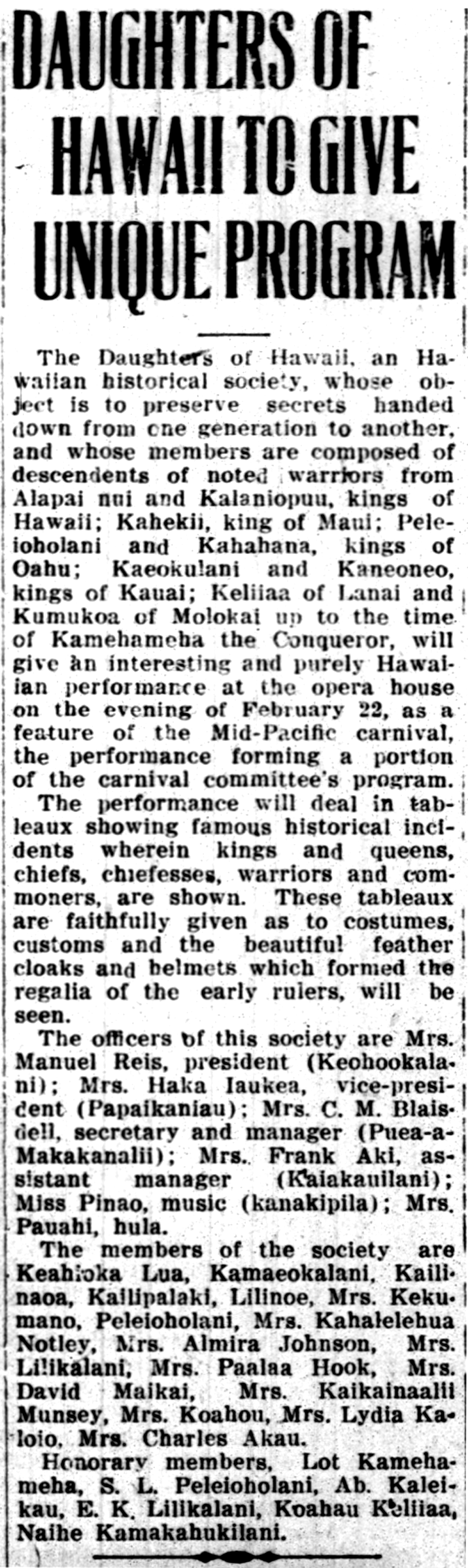
Daughters of Hawaii to Put on Historical Play, 1913.

DAUGHTERS OF HAWAII TO GIVE UNIQUE PROGRAM

The Daughters of Hawaii, an Hawaiian historical society, whose object is to preserve secrets handed down from one generation to another, and whose members are composed of descendents of noted warriors from Alapai nui and Kalaniopuu, kings of Hawaii; Kahekili, king of Maui; Peleioholani and Kahahana, kings of Oahu; Kaeokulani and Kaneoneo, kings of Kauai; Keliiaa of Lanai and Kumukoa of Molokai up to the time of Kamehameha the Conqueror, will give an interesting and purely Hawaiian performance at the opera house on the evening of February 22, as a feature of the Mid-Pacific carnival, the performance forming a portion of the carnival committee’s program.

The performance will deal in tableaux showing famous historical incidents wherein kings and queens, chiefs, chiefesses, warriors and commoners, are shown. These tableaux are faithfully given as to costumes, customs and the beautiful feather cloaks and helmets which formed the regalia of the early rulers, will be seen.

The officers of this society are Mrs. Manuel Reis, president (Keohookalani); Mrs. Haka Iaukea, vice-president (Papakaniau); Mrs. C. M. Blaisdell, secretary and manager (Puea-a-Makakanalii); Mrs. Frank Aki, assistant manager (Kaiakauilani); Miss Pinao, music (kanikapila); Mrs. Pauahi [? Mrs. Puahi], hula.

The members of the society are Keahioka Lua, Kamaeokalani, Kailinaoa, Kailipalaki, Lilinoe, Mrs. Kekumano, Peleioholani, Mrs. Kahalelehua Notley, Mrs. Almira Johnson, Mrs. Lilikalani, Mrs. Paalaa Hook, Mrs. David Maikai, Mrs. Kaikainaalii Munsey, Mrs. Koahou, Mrs. Lydia Kaloio, Mrs. Charles Akau.

Honorary members, Lot Kamehameha, S. L. Peleioholani, Ab. Kaleikau [Abraham Kaleikau], E. K. Lilikalani, Koahau Keliiaa, Naihe Kamakahukilani.

(Honolulu Star-Bulletin, 2/18/1913, p. 5)

DAUGHTERS OF HAWAII TO GIVE UNIQUE PROGRAM

Honolulu Star-Bulletin, Volume XX, Number 6514, Page 5. February 18, 1913.

Daughters of Hawaiian Warriors? 1915.

[Found under: “Nuhou Kuwaho”]

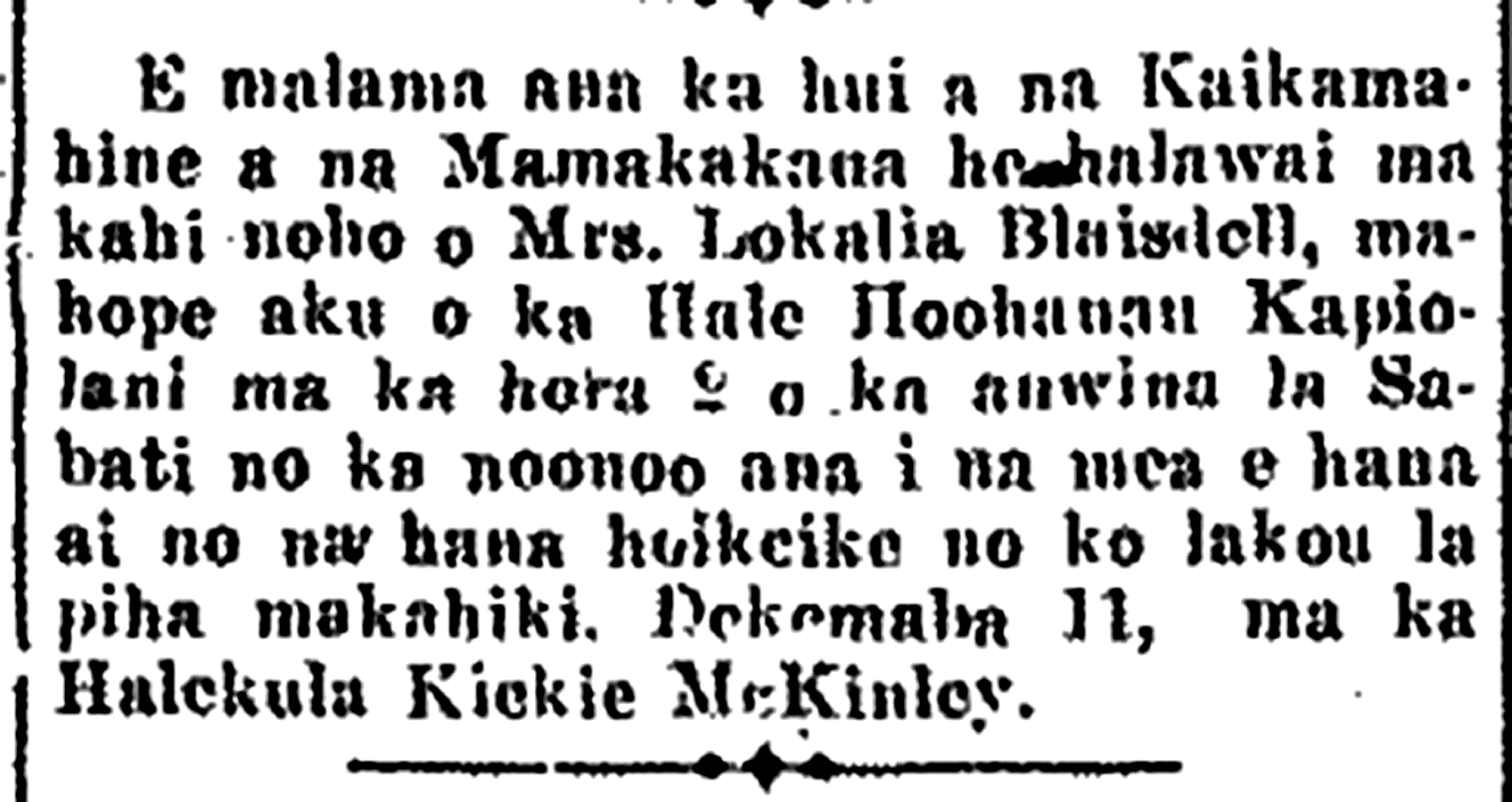
The association of Daughters of the Mamakakaua will hold a meeting at the residence of Mrs. Lokalia Blaisdell, behind the Kapiolani Maternity Home at 2 o’clock in the afternoon, Sunday, to consider what to do at the presentation for the day of their anniversary. December 11, at the McKinley High School [Halekula Kiekie McKinley].

(Kuokoa, 12/3/1915, p. 4)

E malama ana ka hui a na Kaikamahine...

Ka Nupepa Kuokoa, Buke LIII, Helu 49, Aoao 4. Dekemaba 3, 1915.

Ahahui Mamakakaua forms, 1917.

NEW HAWAIIAN SOCIETY FORMED

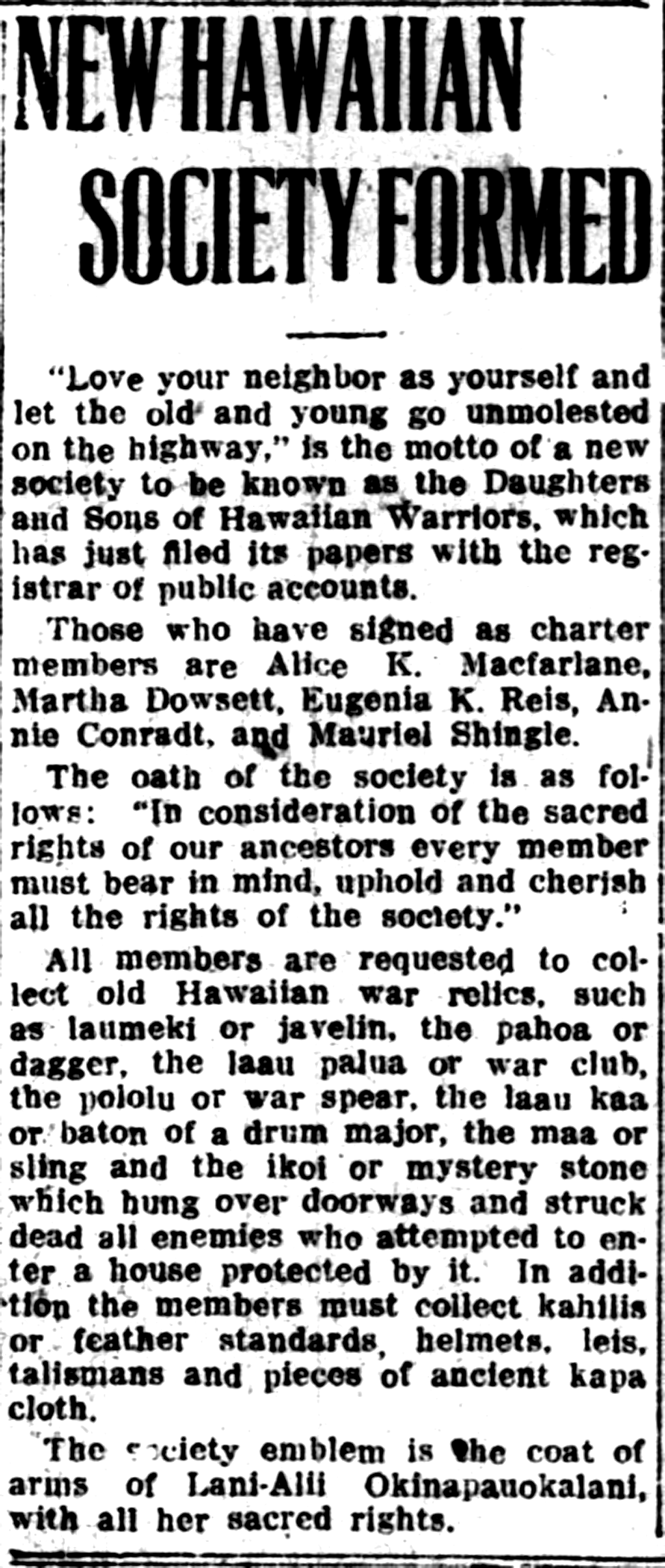
“Love your neighbor as yourself and let the old and young go unmolested on the highway,” is the motto of a new society to be known as the Daughters and Sons of Hawaiian Warriors, which has just filed its papers with the registrar of public accounts.

Those who have signed as charter members are Alice K. Macfarlane, Martha Dowsett, Eugenia K. Reis, Annie Conradt, and Mauriel Shingle [Muriel Campbell Shingle].

The oath of the society is as follows: “In consideration of the sacred rights of our ancestors every member must bear in mind, uphold and cherish all the rights of the society.”

All members are requested to collect old Hawaiian war relics, such as laumeki or javelin, the pahoa or dagger, the laau palua [laau palau] or war club, the pololu or war spear, the laau kaa or baton of a drum major, the maa or sling and the ikoi or mystery stone which hung over doorways and struck dead all enemies who attempted to enter a house protected by it. In addition the members must collect kahilis or feather standards, helmets, leis, talismans and pieces of ancient kapa cloth.

The society emblem is the coat of arms of Lani-Alii Okinapauokalani, with all her sacred rights.

(Honolulu Star-Bulletin, 10/24/1917, p. 14)

NEW HAWAIIAN SOCIETY FORMED

Honolulu Star-Bulletin, Volume XXV, Number 7966, Page 14. October 24, 1917.

Red Cross knitting drive, 1917.

Red Cross Knitting

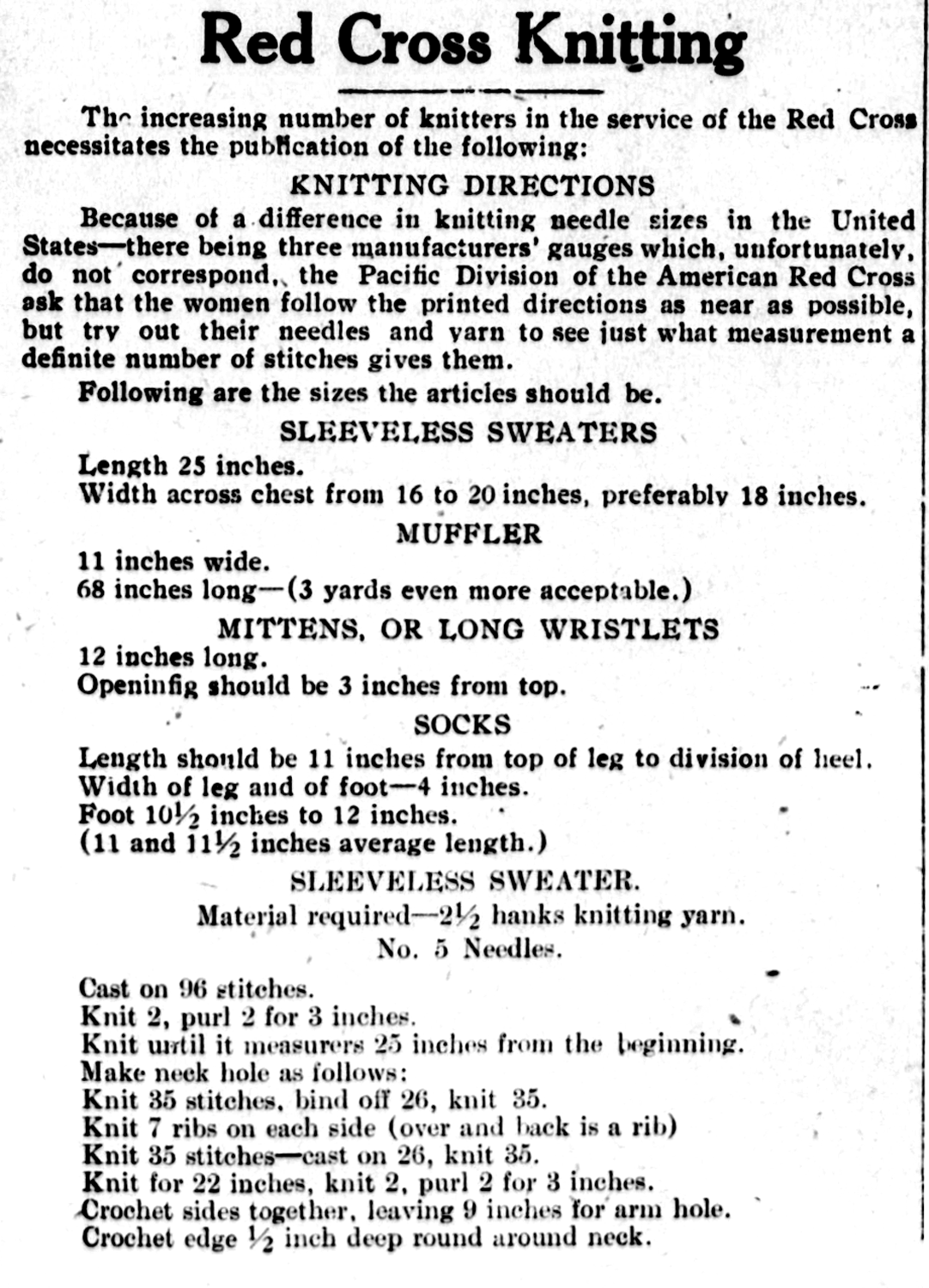
The increasing number of knitters in the service of the Red Cross necessitates the publication of the following:

KNITTING DIRECTIONS

Because of a difference in knitting needle sizes in the United States—there being three manufacturers’ gauges which, unfortunately, do not correspond, the Pacific Division of the American Red Cross ask that the women follow the printed directions as near as possible, but try out their needles and yarn to see just what measurement a definite number of stitches gives them.

Following are the sizes the articles should be.

SLEEVELESS SWEATERS

Length 25 inches.
Width across chest from 16 to 20 inches, preferably 18 inches.

MUFFLER

11 inches wide.
68 inches long—(3 yards even more acceptable.)

MITTENS, OR LONG WRISTLETS

12 inches long.
Openifig should be 3 inches from top.

SOCKS

Length should be 11 inches from top of leg to division of heel.
Width of leg and of foot—4 inches.
Foot 10½ inches to 12 inches.
(11 and 11½ inches average length.)

SLEEVELESS SWEATER.
Materials required—2½hanks knitting yarn.
No. 5 Needles.

Cast on 96 stitches.
Knit 2, purl 2 for 3 inches.
Knit until it measures 25 inches from the beginning.
Make neck hole as follows:
Knit 35 stitches, bind off 26, knit 35.
Knit 7 ribs on each side (over and back is a rib)
Knit 35 stitches—cast on 26, knit 35.
Knit for 22 inches, knit 2, purl 2 for 3 inches.
Crochet sides together, leaving 9 inches for arm hole.
Crochet edge ½ inch deep round around neck.

(Garden Island, 12/4/1917, p. 4)

Red Cross Knitting

The Garden Island, Volume 13, Number 49, Page 4. December 4, 1917.

Luau at Kaumakapili Church put on by Princess Liliuokalani, 1887.

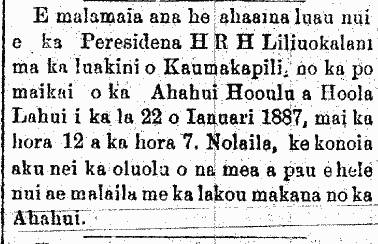
There will be a grand luau put on by the President, H. R. H. Liliuokalani, at Kaumakapili Church, for the benefit of the Hooulu and Hoola Lahui Society [Ahahui Hooulu a Hoola Lahui] on the 22nd of January 1887, from 12 to 7 o’clock. Therefore, the kindness of all is requested to come there with their donations for the Ahahui.

(Ko Hawaii Pae Aina, 1/15/1887, p. 4)

E malamaia ana he ahaaina luau...

Ko Hawaii Pae Aina, Buke X, Helu 3, Aoao 4. Ianuari 15, 1887.

Kalua Kahaleanu and her pāʻū riding group, Kahikinaakala i Haehae, 1906.

APPRECIATION.

I give my thanks to you, Mrs. Kalua Kahaleanu, for your establishing this Horse-Riding Group called Kahikinaakala i Haehae; I was elated to see in the Kuokoa that you became leader of that pa-u horse-riding group, so I accept you that you may carry on with delight and with no doubts; tied together securely, and it is I who will bind us together with appreciation.

Yours Truly,

MRS LIZZIE KAINANA PUAHI,

President of the Pa-u Riding Group Kaonohiokala.

Waikiki, July 23, 1906.

(Kuokoa, 8/3/1906, p. 4)

HE HOOMAIKAI.

Ka Nupepa Kuokoa, Buke XLV, Helu 31, Aoao 4. Augate 3, 1906.

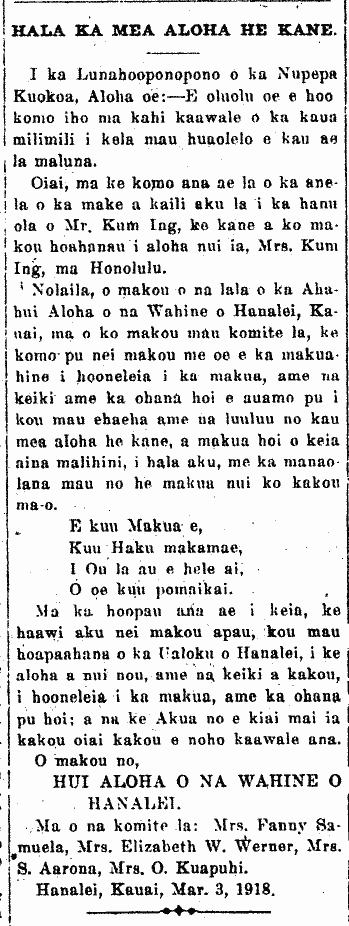
Tam Kum Ing dies, 1918.

HER BELOVED, HER HUSBAND HAS GONE.

To the Editor of the Kuokoa Newspaper, Aloha oe:—Please include in an open space of our favorite, the words placed above.

Being that when the angel of death entered and took the life breath of Mr. Kum Ing, the husband of our much beloved friend, Mrs. Kum Ing, at Honolulu.

Therefore, we, the members of the Ahahui Aloha o na Wahine o Hanalei, Kauai, through our committees, we join with you, oh mother who is left without a father, along with the children and family who carry the pain and sadness for your beloved husband, and father in that unfamiliar land, who has gone; with the constant hope that we have a great father beyond.

O Dear Father,
My precious Lord,
To You I go,
You are my blessing.

At the conclusion of this, all of us, your fellow laborers in the downpouring rain of Hanalei, give our great aloha for you and our children who are without a father, and the ohana as well; and it is God who will watch over us even as we live apart.

We, the

HUI ALOHA O NA WAHINE O HANALEI.

By way of the committee: Mrs. Fanny Samuela, Mrs. Elizabeth W. Werner, Mrs. S. Aarona, Mrs. O. Kuapuhi.

Hanalei, Kauai, Mar. 3, 1918.

(Kuokoa, 3/22/1918, p. 8)

HALA KA MEA ALOHA HE KANE

Ka Nupepa Kuokoa, Buke LVI, Helu 12, Aoao 8. Maraki 22, 1918.

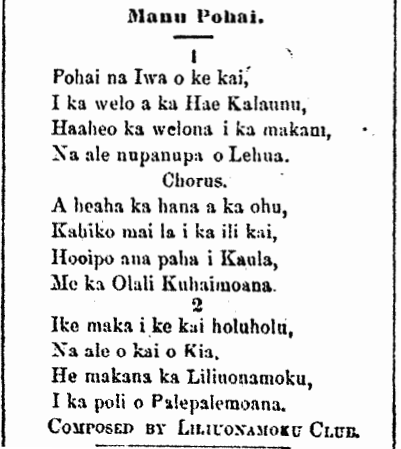
Mele by Liliuonamoku Club, 1877.

Manu Pohai.

1

Pohai na Iwa o ke kai,
I ka welo a ka Hae Kalaunu,
Haaheo ka welona i ka makani,
Na ale nupanupa o Lehua.

Chorus.

A heaha ka hana a ka ohu,
Kahiko mai la i ka ili kai,
Hooipo ana paha i Kaula,
Me ka Olali Kuhaimoana.

2

Ike maka i ke kai holuholu,
Na ale o kai o Kia,
He makana ka Liliuonamoku,
I ka poli o Palepalemoana.

Composed by Liliuonamoku Club.

(Kuokoa, 11/24/1877, p. 4)

Manu Pohai.

Ka Nupepa Kuokoa, Buke XVI, Helu 47, Aoao 4. Novemaba 24, 1877.