Hawaiian-Language Newspapers and the past and the future, 1906.

The History of Your Native Land.

As we contemplate the main reason for the falling far behind of the Hawaiian people in matters dealing with the history of their homeland, their lahui, and the alii of the land, we are all racked with intense pain at the haphazard and total lack of knowledge in this terribly important study; and it would not be wrong for us to say that it should be one of the first subjects that should be taught to the students at schools of higher education across the world; and it is said by the Orators that being knowledgeable in the History of your Motherland is the first step in Politics where you’d be able to fight for the good of the Rule of the Nation.

And understanding the histories of all Nations is what will prepare you to fight intelligently on legal grounds for the benefit of your lahui. In the teachings of the Great Book, in Jeremiah 6:16, Jehovah says to us:

“Stand ye in the ways and see and ask for the old paths. Where is the good way?”

O Lahui, how will we be able to ask of the right way if we do not know the old history of our Beloved Aina?

This lack of knowledge of the history of this people comes from not consistently reading the Hawaiian newspapers. Something frequently seen is one person buying a paper and reading it before his friends. They hear it but they don’t retain it like one who subscribes to the paper, who can re-read it at his leisure and thus commit to memory the information.

Learn from this instruction, and do as the haole, who buys his very own newspapers to educate himself in current events.

[The Hawaiian-Language Newspapers is a massive history book—a history on the most part told by Hawaiians living while the “history” was happening. As it was argued more than a hundred years ago, in order to fight for things like Sovereignty, Land, and Water, shouldn’t we know the history as told by Hawaiians? Perhaps we shouldn’t focus solely on what is written down in law books, but also on what Hawaiians actually said and did about these laws, about water rights, about land ownership, about fishing bans, etc., etc. etc.?

For sure this is no easy task. The original newspapers aren’t going to last forever. The current images for many of them are not totally clear (if there are images at all). They need to be word-searchable so that if you search for something, you will find it. There needs to be more people doing translations of them. But then again, Kamehameha Paiea didn’t exclaim, “Forward my younger brothers and drink of the sweet waters”…]

(Na’i Aupuni, 1/17/1906, p. 2)
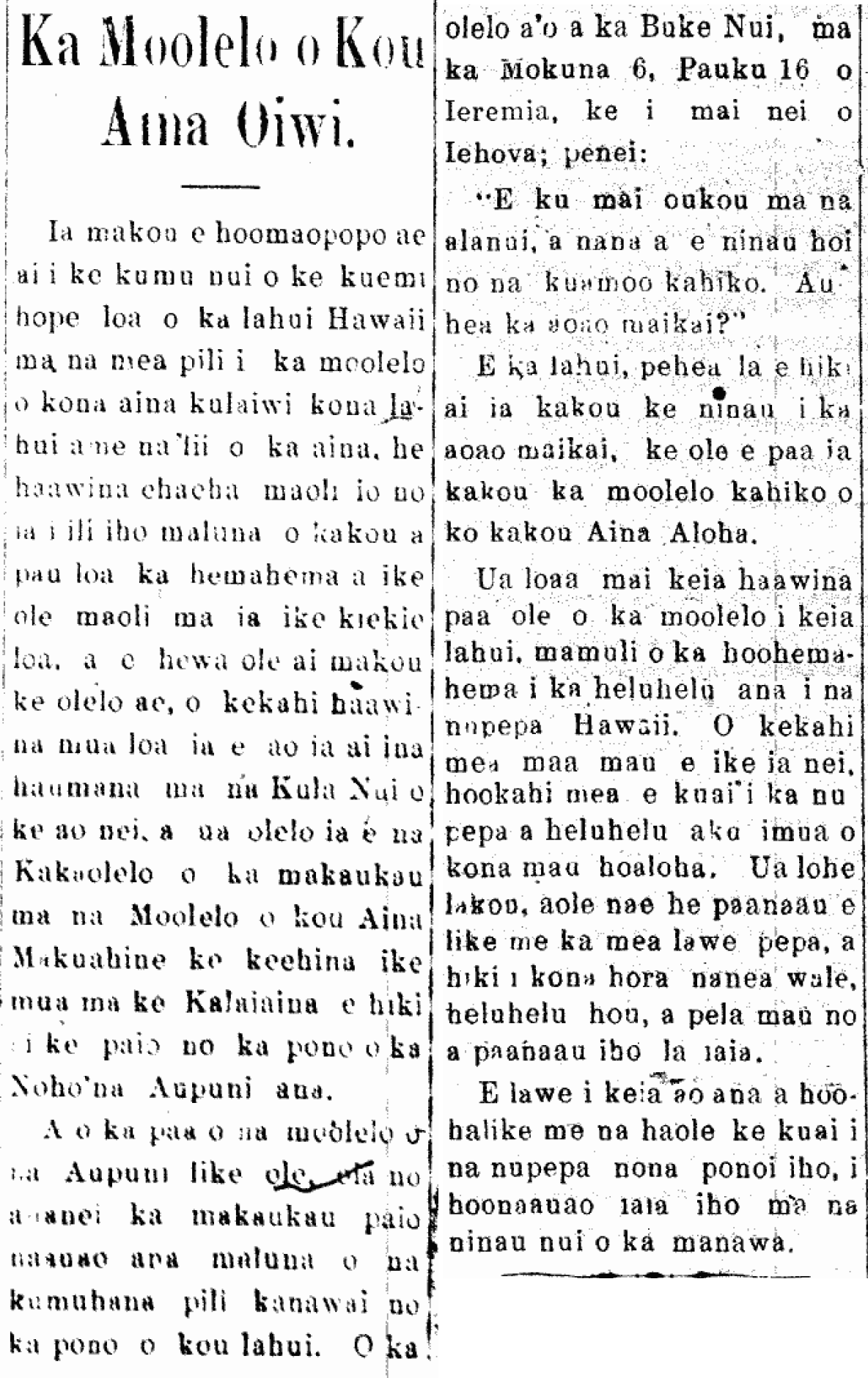
Ka Moolelo o Kou Aina Oiwi.

Ka Na'i Aupuni, Buke I, Helu 44, Aoao 2. Ianuari 17, 1906.
I hear this will be a good thing, but spaces are limited! 2012.

Mai Poina: The Annexation Debate

Description

ANNEXATION REVISITED IN LIVING HISTORY PRESENTATION
Mai Poina: The Annexation Debate to be staged Feb. 23-26

HONOLULU – Historical figures Joseph Kaulia and Emma Nāwahī lead a compelling visit to pre-annexation Hawai‘i in Mai Poina:The Annexation Debate, a living history presentation to be staged February 23-26 at the Judiciary History Center in Ali‘iōlani Hale.

[For more information, click here.]

Another flag story, 1893.

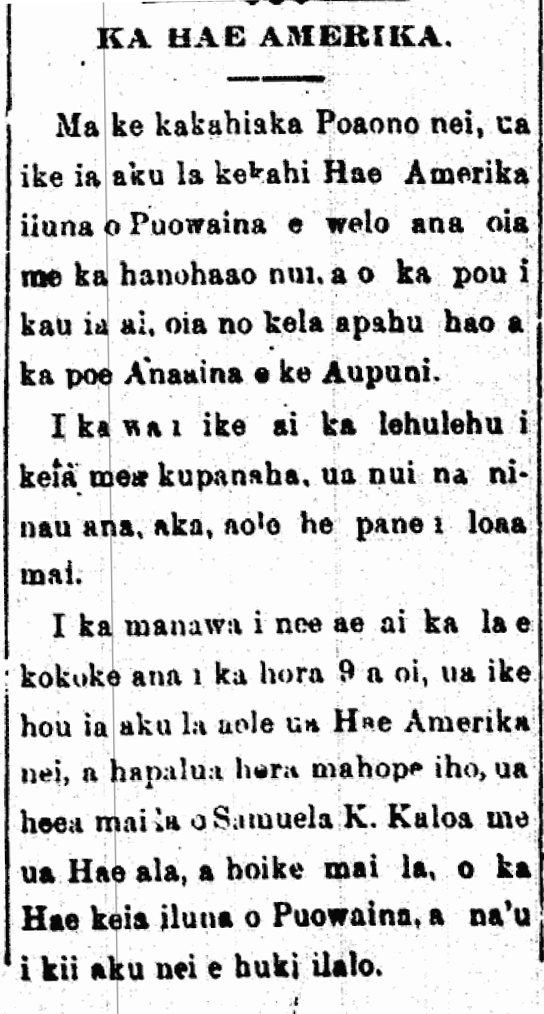
THE AMERICAN FLAG.

On this Saturday morning, an American Flag was seen above Puowaina fluttering proudly, and the pole upon which it was placed was that piece of metal of the Government Surveyors.

When people saw this astonishing thing, there were many questions, but no answers.

When the day progressed to 9 o’clock or more, it was seen now that the American Flag wasn’t there, and half an hour later, Samuela K. Kaloa arrived with that flag and said that this was the Flag that was up at Puowaina, and it was I who went and took it down.

(Leo o ka Lahui, 4/18/1893, p. 3)

KA HAE AMERIKA.

Ka Leo o ka Lahui, Buke II, Helu 686, Aoao 3. Aperila 18, 1893.

Beautiful flag story, 1893.

HAWAIIAN FLAG.

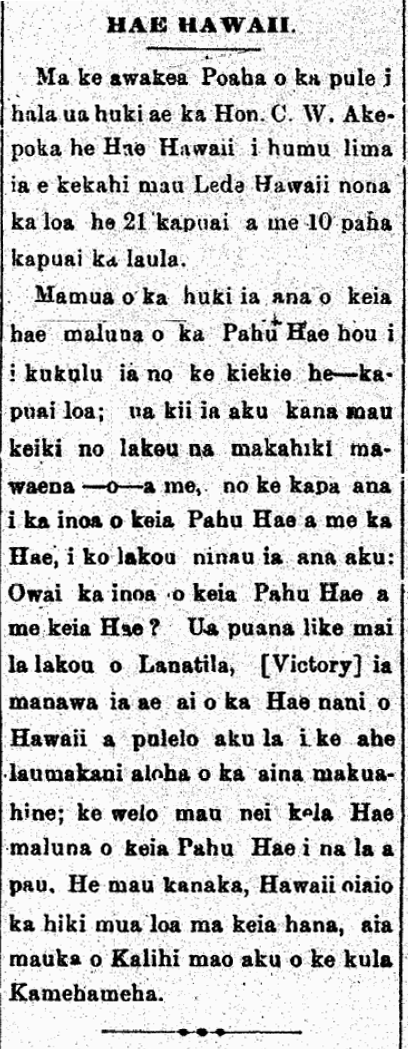
On Thursday afternoon of this last week, Hon. C. W. Ashford raised a Hawaiian Flag hand sewn by some Hawaiian Ladies, whose length was 21 feet and width was perhaps 10 feet.

Before the raising of this flag upon a new Flag Pole built ___ feet tall, his children were called, whose ages are between ___ and ___, to name this Flag Pole and the Flag; when they were asked: What is the name of this Flag Pole and this Flag? They answered together, “Lanatila [Victory];” it was then that the beautiful Flag of Hawaii rose and fluttered in the beloved soft gentle breeze of the motherland; that Flag waves continuously upon this Flag Pole everyday. These are true Hawaiians who have done this first, it is in the uplands of Kalihi past Kamehameha School.

(Leo o ka Lahui, 5/1/1893, p. 3)

HAE HAWAII.

Ka Leo o ka Lahui, Buke II, Helu 695, Aoao 3. Mei 1, 1893.

This would be a powerful picture to see, 1893.

The picture was taken of the Committee who delivered the Memoriala of the Hawaiian Nation and placed it before the Honorable James H. Blount (Balana) on the 1st of April, 1883 totaling 19 members. Should there be anyone who wants a copy of this, go to the Office of Ka Leo o ka Lahui and ask John Kapamawaho Prendergast for the cost to purchase an image and he will tell you.

[Anybody know if there is a copy of this somewhere?]

(Leo o ka Lahui, 4/25/1893, p. 3)

Ua pau i ke Pai ia...

Ka Leo o ka Lahui, Buke II, Helu 691, Aoao 3. Aperila 25, 1893.

Patriotic mele of a different sort, 1893.

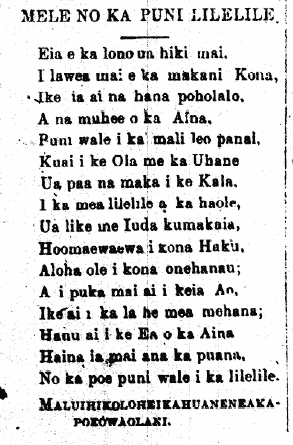
MELE NO KA PUNI LILELILE

Eia e ka lono ua hiki mai,

I lawea mai e ka makani Kona,

Ike ia ai na hana poholalo,

A na muhee o ka Aina,

Puni wale i ka mali leo panai,

Kuai i ke Ola me ka Uhane,

Ua paa na maka i ke Kala,

I ka mea lilelile a ka haole,

Ua like me Iuda kumakaia,

Hoomaewaewa i kona Haku,

Aloha ole i kona onehanau;

A i puka mai ai i keia Ao,

Ike ai i ka la he mea mehana;

Hanu ai i ke Ea o ka Aina,

Haina ia mai ana ka puana,

No ka poe puni wale i ka lilelile.

Maluihikoloheikahuaneneakapoeowaolani.

[There are not only patriotic compositions that laud and encourage, but there are also those like this one here which ridicule and disparage. This one goes something like:]

A SONG FOR THOSE WHO COVET SHINY THINGS.

The news has arrived,

Carried by the Kona breeze,

Witnessed are the deeds of deceit,

By the squids¹ of the Land,

Fawning after the sweet talk of reciprocity,

Selling away Life and Soul,

Eyes set on Riches,

That shiny thing of the haole,

Just like Judas the traitor,

Scorning his Lord,

With no aloha for his homeland;

If he’d come forth into the Light,

He’d see that the sun is a thing of warmth,

He’d breathe in the Ea² of the Land.

Let the story be told,

Of those who covet shiny things.

Maluihikoloheikahuaneneakapoeowaolani.

¹A squid can swim as easily backward as forward, so you never know if it is coming or going, and is thus used to describe a two-faced person.

²Ea can be seen as a play on the idea of Air as well as Sovereignty.

(Leo o ka Lahui, 2/21/1893, p. 3)

MELE NO KA PUNI LILELILE.

Ka Leo o ka Lahui, Buke II, Helu 646, Aoao 3. Feberuari 21, 1893.

Patriotic mele, 1893.

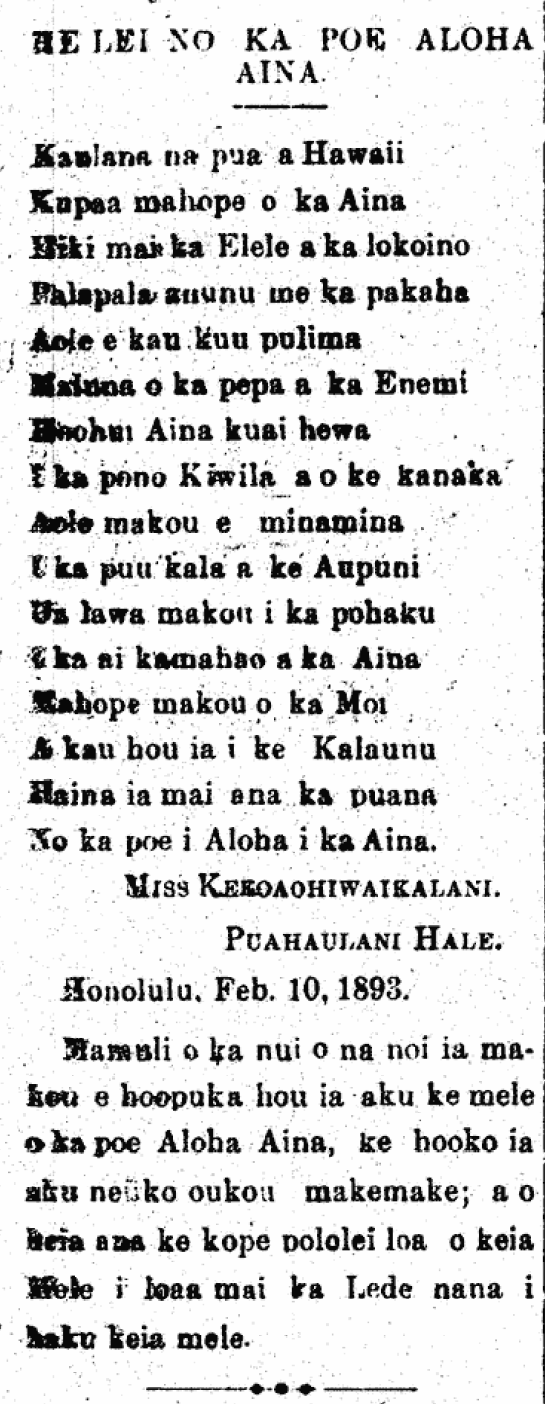
[Here is a patriotic mele famous to this day, it is also known as Mele Ai Pohaku, but familiar to most as Kaulana na Pua. This composition is published many times and in more than one Hawaiian-Language Newspaper. It is a song which both lauds and encourages.]

AN ADORNMENT FOR THE PATRIOTS.

Famous are the blossoms of Hawaii

Who stand steadfast behind the Land

When the evil Messenger arrives

With his documents of greed and plunder

I won’t affix my signature

To the papers of the Enemy

That Annex and sell wrongfully

The Civil rights of the people

We will not feel longing

For the sums of money of the Government

We are satisfied with the stones

The amazing food of the land

We stand behind the Sovereign

She will be placed back upon the Throne

Let the refrain be told

Of the people who Love the Land.

Miss Kekoaohiwaikalani.
Puahaulani Hale.
Honolulu, Feb. 10, 1893.

Because of the many requests for us to reprint the song of the Patriots, we are fulfilling your desire; and this is a correct copy of this song which we received from the Lady who composed this song.

(Leo o ka Lahui, 5/11/1893, p. 3)

HE LEI NO KA POE ALOHA AINA.

Ka Leo o ka Lahui, Buke II, Helu 703, Aoao 3. Mei 11, 1893.

All sorts of rumors spread on the streets, 1893.

RUMORS.

There are all sorts of stories spreading about on the sidewalks. Some of the news is shocking, some are exaggerations, and some are just baseless stories. Here is what is known—the Reformists’ idea to incite dissension is hard-pressed.

(Hawaii Holomua, 1/16/1893, p. 2)

NA LONO LAUAHEA.

Hawaii Holomua, Buke III, Helu 140, Aoao 2. 1/16/1893.

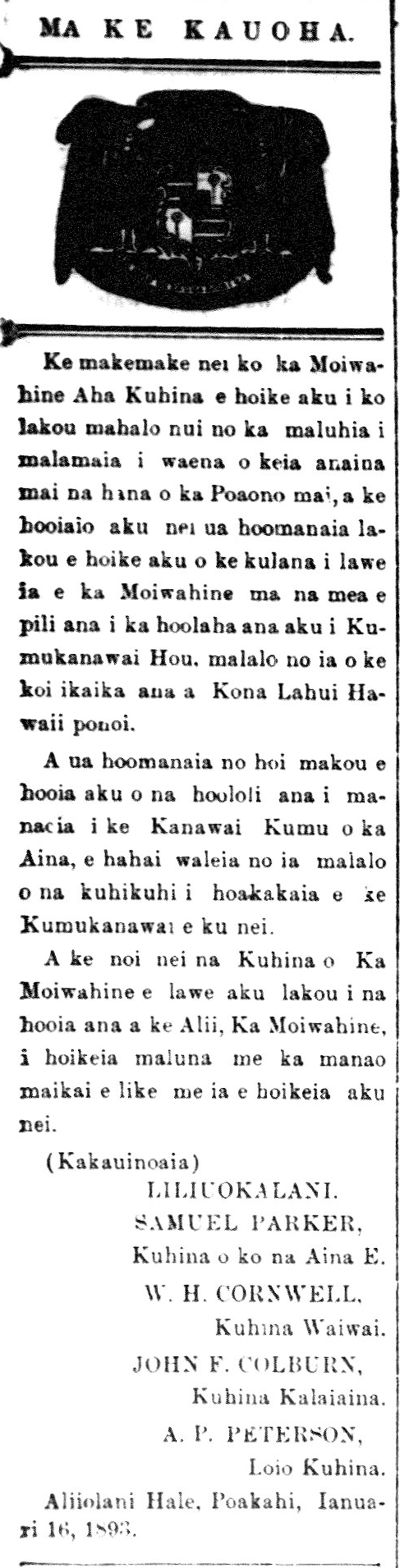
Proclamation by the Cabinet of Ministers of Queen Liliuokalani, 1893.

BY AUTHORITY.

Her Majesty’s Ministers desire to express their appreciation for the quiet and order which has prevailed in this community since the events of Saturday, and are authorized to say that the position taken by Her Majesty in regard to the promulgation of a new Constitution, was under stress of Her native subjects.

Authority is given for the assurance that any changes desired in the fundamental law of the land will be sought only by methods provided in the Constitution itself.

Her Majesty’s Ministers request all citizens to accept the assurances of Her Majesty in the same spirit in which it is given.

(Signed)

LILIUOKALANI,

SAMUEL PARKER,
Minister of Foreign Affairs.

W. H. CORNWELL,
Minister of Finance.

JOHN F. COLBURN,
Minister of the Interior.

A. P. PETERSON,
Attorney-General.

Iolani Palace [Aliiolani Hale], January 16th, 1893.

[English taken from Chronicling America, The Hawaiian Gazette, 1/17/1893, p. 4]

(Hawaii Holomua, 1/16/1893, p. 2)

MA KE KAUOHA.

Hawaii Holomua, Buke III, Helu 140, Aoao 2. Ianuari 16, 1893.