On the Kauikeolani Children’s Hospital, 1914.

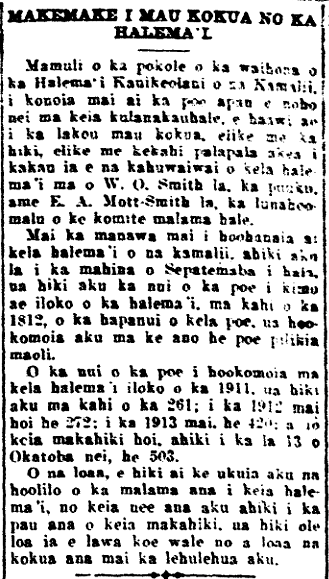
ASSISTANCE WANTED FOR THE HOSPITAL.

Because of a shortage of funds at the Kauikeolani Children’s Hospital, everyone living in this town is asked to give their assistance, as they are able, as per a flyer composed by the trustees of the hospital by way of W. O. Smith, the treasurer, and E. A. Mott-Smith, the chairman of the house committee.

From the inception of this children’s hospital until this past September, the number of patients hospitalized there reached about 1812, and most of them were in great difficulty.

The number of patients at the hospital in 1911 reached about 261; in 1912 there were 272; in 1913 there were 420; and this year, up until the 13th of October, there were 503.

With the proceeds, the expenses to run this hospital can be paid off until the end of the year; there is no way that there would be enough other than through receiving contributions from the public.

(Kuokoa, 11/13/1914, p. 4)

MAKEMAKE I MAU KOKUA NO KA HALEMA'I.

Ka Nupepa Kuokoa, Buke LII, Helu 46, Aoao 4. Novemaba 13, 1914.

On ice and challenges and such, 1919 / timeless.

On Assisting Destitute Hawaiians

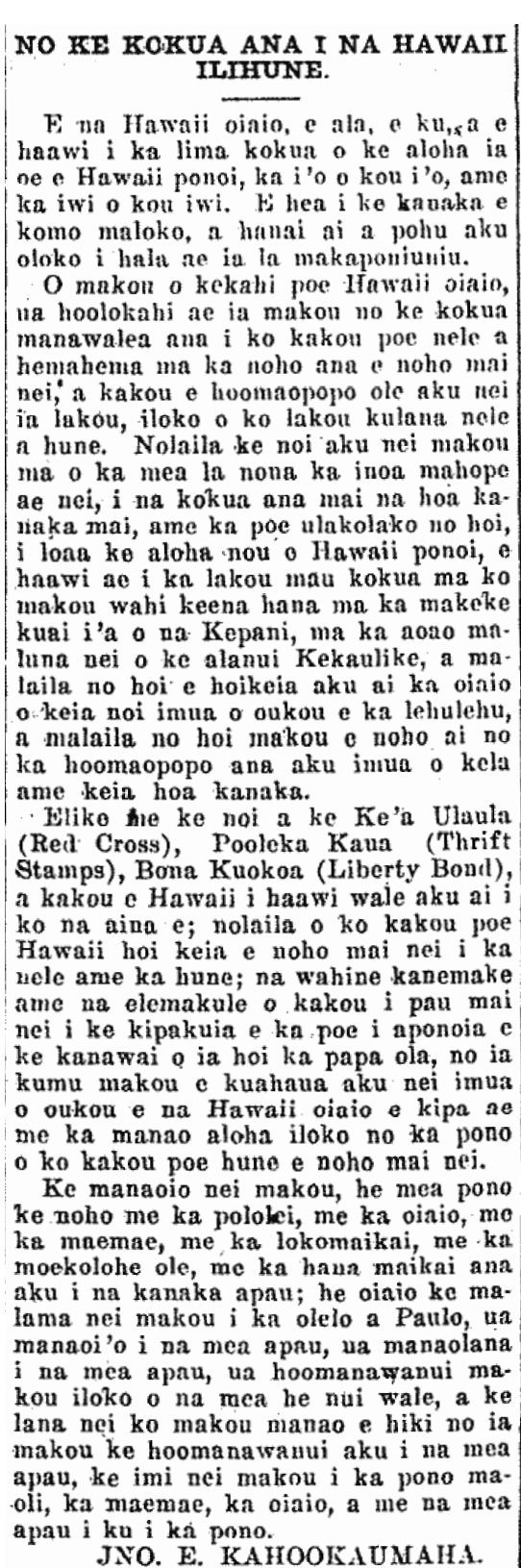
O True Hawaiians, rise, stand, and give a helping hand of aloha, oh to you, Hawaii’s own, the flesh of your flesh, the bone of your bone. Call out in welcome, feed, and nourish them, so they may make it through the days of hunger.

We are a number of true Hawaiians joining together to freely help our own facing hardship and difficulty in making a living; those who we do not know, in their poor and destitute condition. Therefore we ask by way of the one named later, for assistance from our fellow kanaka and wealthy people who have aloha for you, O Hawaii’s own, to give their donations to our office in the Japanese Fish Market on the upper side of Kekaulike Street, and there will be shown the truth of this plea before you, the people, and it is there that we will stay to make it understood to each and every fellow kanaka.

Just as with the pleas of the Red Cross (Kea Ulaula), Thrift Stamps (Pooleka Kaua), Liberty Bonds (Bona Kuokoa), to which we Hawaiians gave freely to those of foreign lands; this is our own Hawaiian people who are living in poverty, widows, and elderly who were kicked out by those who are responsible under the Law for their care, that being the Board of Health, and for that reason, we announce before you all, O True Hawaiians, come see us with aloha for the good of our own people living in poverty.

We believe in being honest, true, chaste, benevolent, virtuous, and in doing good to all men; indeed, we may say that we follow the admonition of Paul-We believe all things, we hope all things, we have endured many things, and hope to be able to endure all things. If there is anything virtuous, lovely, or of good report or praiseworthy, we seek after these things.¹

JOHN E. KAHOOKAUMAHA.

¹This is the thirteenth article in the Mormon articles of faith.

(Kuokoa, 3/28/1919, p. 2)

NO KE KOKUA ANA I NA HAWAII ILIHUNE.

Ka Nupepa Kuokoa, Buke LVII, Helu 13, Aoao 2. Maraki 28, 1919.

[The Aloha Aina also ran this announcement, but by this time, the typesetting done in this newspaper was not carefully done. There are frequent typesetting errors throughout. This can be seen in the parallel announcement found below.

One striking change however found in the Aloha Aina announcement is the phrase: “ka Papa Make (ka Papa Ola)” replacing “ka papa ola,” where they refer to the Board of Health as “the Board of Death”.]

No ke Kokou ana Ina Hawaii Ilihune

Ke Aloha Aina, Buke XXXIV, Helu 12, Aoao 4. Maraki 28, 1919.

George Freeth awarded for saving lives, 1910.

GEORGE FREETH RIDING A SURFBOARD.

AWARDED FOR SAVING LIVES.

Because a haole that is a kamaaina in Honolulu named George Freeth saved the lives of seven Japanese fishermen, he was honored by the Legislature of Hawaii with a gold medal on the 1st of August.

The value of the gold medal is about a hundred and fifty dollars, and upon it is written words speaking of the haole saving the Japanese fishermen on the 16th of December, 1908. Continue reading

Hilo Hawaiian Civic Club’s Annual Holoku Ball, 1941.

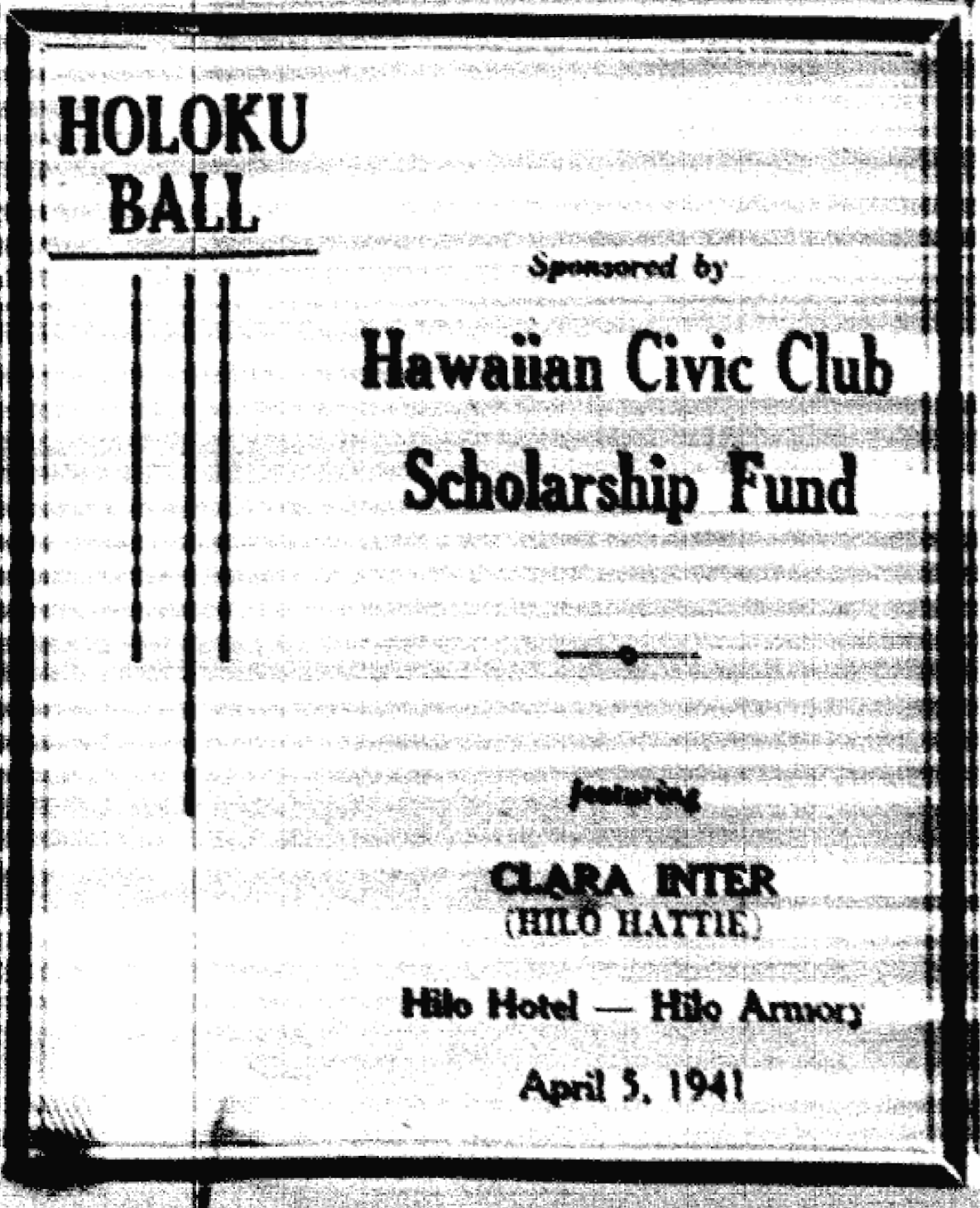
HOLOKU
BALL

Sponsored by

Hawaiian Civic Club

Scholarship Fund

featuring

CLARA INTER

(HILO HATTIE)

Hilo Hotel —Hilo Armory

April 5, 1941

(Hoku o Hawaii, 4/2/1941, p. 4)

HOLOKU BALL

Ka Hoku o Hawaii, Volume XXXV, Number 49, Aoao 4. Aperila 2, 1941.

Hilo Hattie on her way to Hilo, 1941.

On Her Way

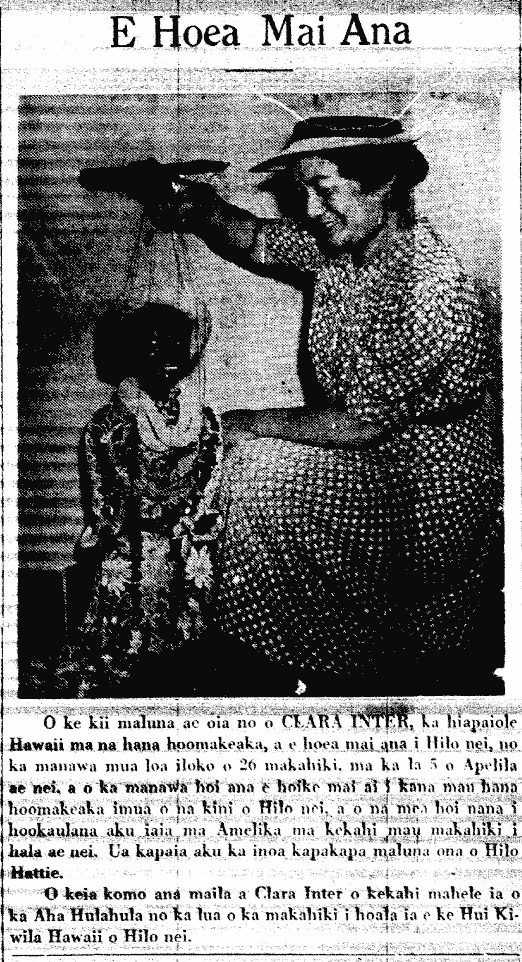
The picture above is of CLARA INTER, the Hawaiian champion of comedy, and she is coming to Hilo nei, for the first time in 26 years, on the 5th of this coming April; and this is when she will be showing her humor before the people of Hilo, and what she was made famous for in America some years ago. She is nicknamed Hilo Hattie.

Clara Inter is part of a Dance [Holoku Ball] put on for the second year by the Hawaiian Civic Club of Hilo [Hui Kiwila Hawaii o Hilo].

(Hoku o Hawaii, 3/26/1941, p. 1)

E Hoea Mai Ana

Ka Hoku o Hawaii, Volume XXXV, Number 48, Aoao 1. Maraki 26, 1941.

Admiral George Beckley donates Mooheau Bandstand, 1905.

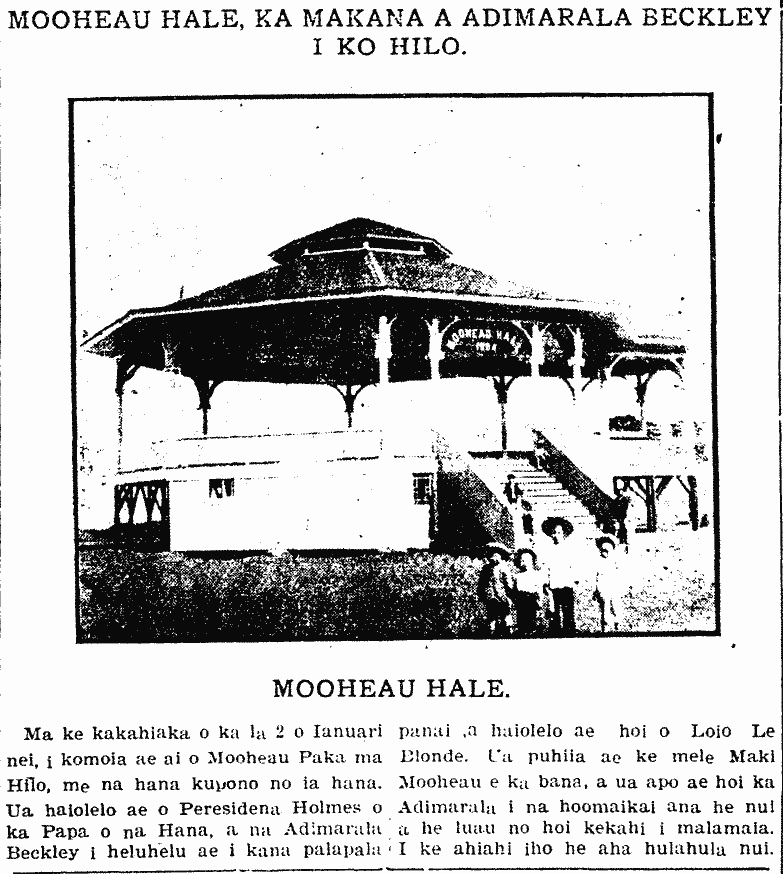
MOOHEAU HALE, GIFT OF ADMIRAL BECKLEY TO HILO’S PEOPLE.

MOOHEAU HALE.

On the morning of the 2nd of January, Mooheau Park in Hilo was entered with fitting pomp. President Holmes of the Board of Trade [Papa o na Hana] gave a speech, and Admiral Beckley read his response, and then Attorney Le Blonde spoke. The song, Mooheau March was played by the band, and the Admiral received many thanks and there was held a luau. That evening, there was a great ball.

[I wonder what this march sounded like composed special for this event by Joaquim Carvalho. For more on Professor Carvalho (and if you can read Portuguese) see this page on Portuguese immigration and band music in Hawaii nei.]

(Kuokoa, 1/6/1905, p. 5)

MOOHEAU HALE, KA MAKANA A ADIMARALA BECKLEY I KO HILO.

Ka Nupepa Kuokoa, Buke XLIII, Helu 1, Aoao 5. Ianuari 6, 1905.

Interesting advertisement, 1873.

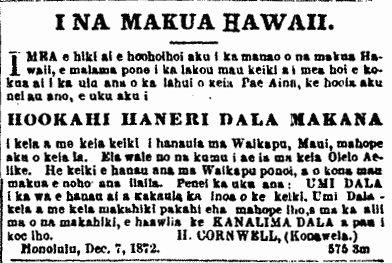
TO HAWAIIAN PARENTS.

As incentive to have Hawaiian parents care properly for their children, and to assist in the growth of the lahui of this Archipelago, I promise forthwith to pay

ONE HUNDRED DOLLAR PRIZE

For each child born in Waikapu, Maui, after this date. Here are the conditions to this Agreement. It is a child born in Waikapu proper, and their parent must live there. Here is how the payment works: TEN DOLLARS when they are born and the child’s name is recorded. Ten Dollars each year for four years thereafter, and on the fifth year, the total FIFTY DOLLARS remaining will be given.  H. CORNWELL, (Konawela.)

Honolulu, December 7, 1872.

[I wonder what the rest of this story is. It is interesting to note that this precedes the reign of Kalakaua and his famous proclamation, “Hooulu Lahui”.

It seems Henry Cornwell and his brother-in-law, James Louzada, had by then made a good amount of money on sugar in Waikapu.]

(Kuokoa, 3/8/1873, p. 3)

I NA MAKUA HAWAII.

Ka Nupepa Kuokoa, Buke XII, Helu 10, Aoao 3. Maraki 8, 1873.

Words of praise for C. R. Bishop on today, his birthday, 1896.

MEMORIALS.

….¹

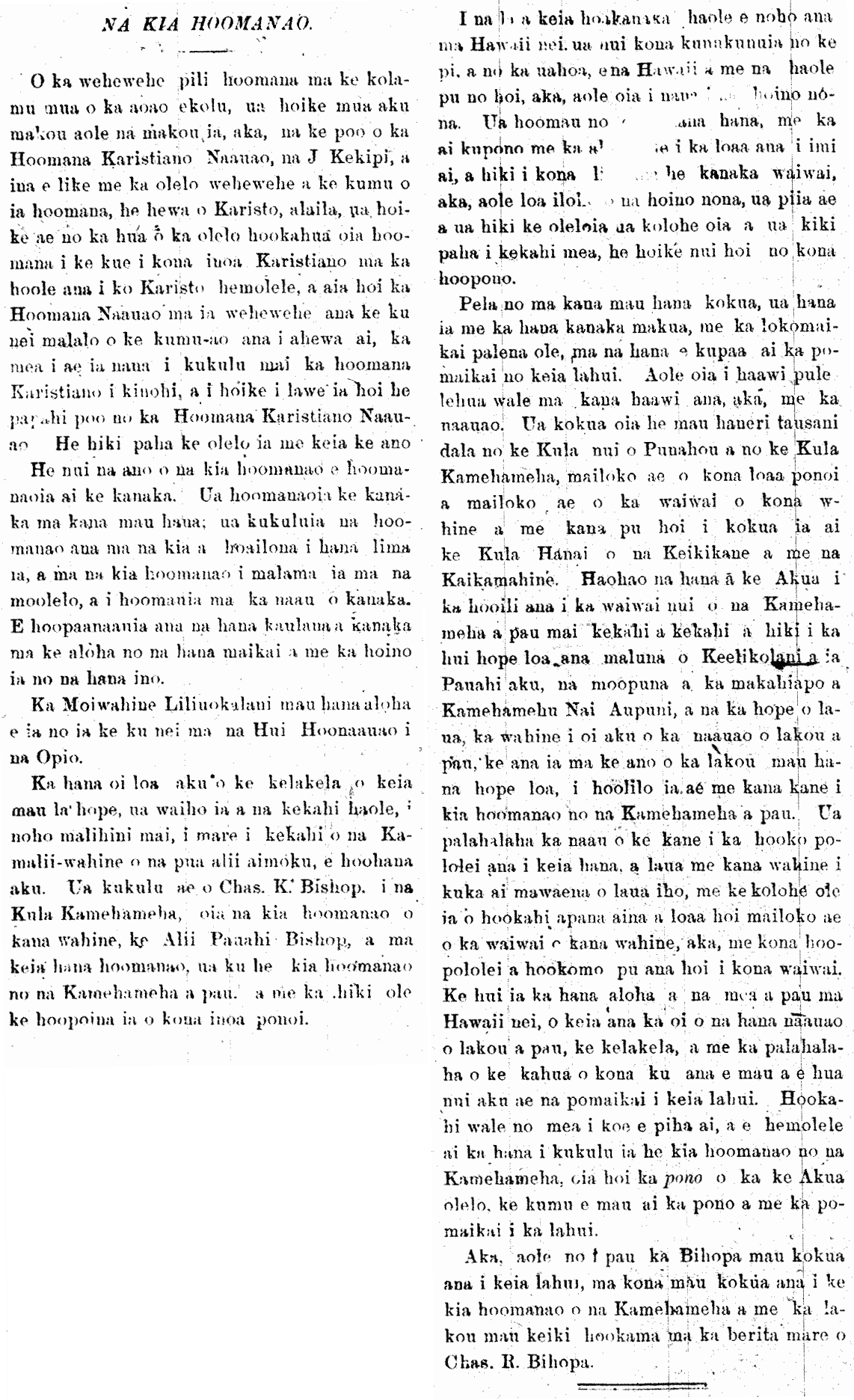
There are many kinds of memorials [kia hoomanao] to remember people by. A person is remembered for his deeds, in memorials built as pillars and monuments, in reminiscences, and preserved in the hearts of the many. Famous deeds of people are remembered with aloha for the good, and with scorn for the bad.

Queen Liliuokalani’s beloved efforts stand today as the Hui Hoonaauao i na Opio [Liliuokalani Educational Society].

The epitome of great deeds of these past days was done by a haole who lived here as a malihini and married one of the Princesses amongst the royal youth. Charles R. Bishop built the Kamehameha Schools, the memorial for his wife, the Alii Pauahi Bishop; and by this act of commemoration, a memorial now stands for all of the Kamehamehas, and it is impossible to forget their name.

 In the days when this haole friend was living here in Hawaii, he was often criticized for his stinginess and defiance by Hawaiian and haole alike, but he paid no care to this criticism. He continued with his work, ate healthily, [illegible digital image], until he was a rich man; but in all the criticism for him, there is no way that it could be said that he was a scoundrel or that he cheated someone; and this says a lot for his uprighteousness.

Likewise with his charity work, he acted with maturity and kindness without end in his steadfast support for the benefit of this lahui. In giving, he was not frivolous in his giving, but gave wisely. He donated hundreds of thousands of dollars to the Punahou College and to the Kamehameha Schools, from his own estate and from that of his wife’s; and from his own, also benefited were the Boarding School for  Boys and Girls. How wondrous is God in his passing down the great entire wealth of the Kamehamehas from one to another until it all came down to Keelikolani and then to Pauahi, the grandchildren of the first born of Kamehameha Nai Aupuni; and it was the last of the two, the one most knowledgeable of them all, as measured by their final deeds, which she created with her husband as a memorial for all of the Kamehamehas. This man was of a great mind in his carrying out meticulously this work which he and his wife discussed between themselves, without misappropriating a single parcel of land included in the estate of his wife, but instead he was conscientious and included his own estate. When put together with all the other beloved deeds by everyone in Hawaii nei, this is measured as the most wise of them all, the height and breadth of its foundation will go on and bear forth much benefits for this lahui. There is but yet one thing to complete and to perfect the building of this memorial to the Kamehamehas, that being the righteousness of God’s words, the basis upon which the good and the blessings of the lahui will continue.

But Bishop’s help for our people is not done in his continued assistance to the memorial to the Kamehamehas and their foster children [keiki hookama] in the covenant of marriage of Charles R. Bishop.

¹The first paragraph was left out because it was somewhat irrelevant to this particular post, and was commentary on J. Kekipi and the Christian Science [Hoomana Karistiano Naauao] faith.

(Oiaio, 2/21/1896, p. 2)

NA KIA HOOMANAO.

Ka Oiaio Puka La, Buke I, Helu 37, Aoao 2. Feberuari 21, 1896.

150 years ago—The beginnings of the Kaahumanu Society, 1864.

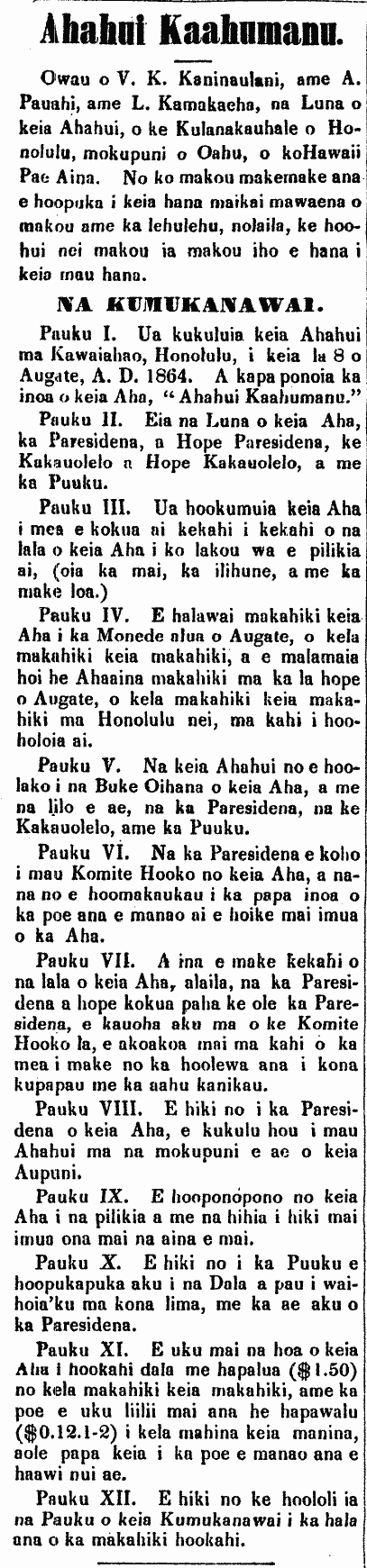
Ahahui Kaahumanu.

I am V. K. Kaninaulani, along with A. Pauahi,¹ and L. Kamakaeha, are the Officers of this Association, of the Town of Honolulu, Island of Oahu, of the Hawaiian Archipelago. Because of our desire to announce this fine endeavor amongst ourselves and the people, we come together to undertake these tasks.

CONSTITUTION.

Clause I. This Association was established at Kawaiahao, Honolulu, on this day the 8th of August, 1864. This Association is officially called, “Ahahui Kaahumanu.”

Clause II. The Officers of this Association are the President, the Vice President, the Secretary, the Vice Secretary, and the Treasurer.

Clause III. This Association was established to assist each other member of this Association when they are in need (in sickness, poverty, and death)

Clause IV. The yearly meeting of this Association will be on the second Monday of August of each year, and a yearly Banquet will be held on the last day of August every year in Honolulu nei, at the location designated.

Clause V. The Association will supply Record Books [Buke Oihana] of the Association, as well as any other expenses for the President, Secretary, and the Treasurer.

Clause VI. The President will select Executive Committees for this Association, and they will prepare lists of names of those who want to present themselves before the Association.

Clause VII. Should a member of this Association die, then the President or if not the President, then a representative will order by Executive Committee to gather in mourning attire at the place of the deceased for the funeral over her body.

Clause VIII. The President of this Association is empowered to establish other Associations on the other islands of this Nation.

Clause IX. The Association shall resolve all problems and difficulties brought before it from other lands.

Clause X. The Treasurer may expend all funds at her disposal with the approval of the President.

Clause XI. Members of this Association shall pay a dollar and a half ($1.50) yearly, or installments of an eighth ($0.12.1-2) every month; it is not prohibited to give more.

Clause XII. Clauses of this Constitution may be changed after one year.

¹Pauahi is often referred to as A. Pauahi. [Would there be anyone who knows what that initial stands for?]

(Kuokoa, 8/20/1864, p. 4)
Ahahui Kaahumanu.

Ka Nupepa Kuokoa, Buke III, Helu 34, Aoao 4. Augate 20, 1864.
Joseph Nawahi, born on this day in 1842, was not only a patritot, but a beautiful singer to boot, 1875.

Relating to Kaumakapili Church.

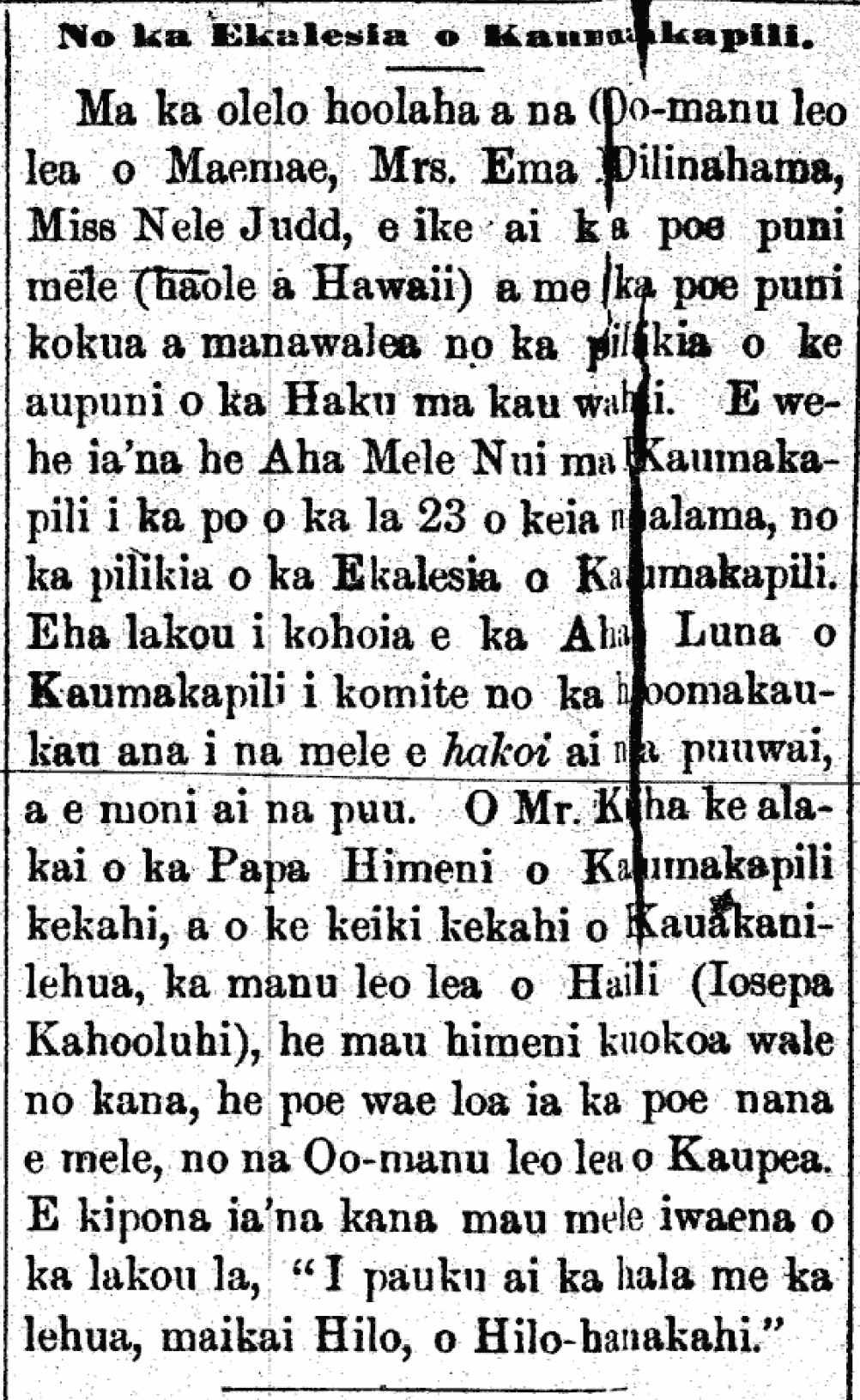
In the announcement of the sweet-voiced Oo birds of Maemae, Mrs. Emma Dillingham [Ema Dilinahama] and Miss Nelly Judd [Nele Judd], those who love music (both English and Hawaiian) as well as those who love helping and donating to the troubled kingdom of the Lord in some way. There will be held a Grand Concert at Kaumakapili on the night of the 23rd of this month, for the difficulties of Kaumakapili Church. There are four chosen by the Leadership of Kaumakapili as a committee to prepare mele to excite the heart and to whet the appetite. Mr. Kiha, the leader of the Kaumakapili Choir is one of them, and the son of the Kanilehua rain, the sweet-voiced bird of Haili (Joseph Kahooluhi) is another, who will only be singing solos; those singing were chosen carefully from amongst the beautiful-voiced Oo birds of Kaupea. His songs will be mixed in amongst theirs, “So that the hala will be sectioned in with the lehua; wonderful is Hilo, Hilo Hanakahi.”

[We all know that Joseph Kahooluhi Nawahiokalaniopuu was one of the great patriots of all times, and we even know about his fine painting skills, but did you know that he composed mele and that he had a sweet singing voice? The newspapers are like treasure boxes filled with all sorts of pearls.]

(Lahui Hawaii, 12/16/1875, p. 2)

No ka Ekalesia o Kaumakapili.

Ka Lahui Hawaii, Buke I, Helu 51, Aoao 2. Dekemaba 16, 1875.