Letter from Iosepa, Utah, 1913.

Word From Utah.

Iosepa, Toole County, Dec. 19, 1912.

Solomon Hanohano, Editor of the Kuokoa, Aloha oe:—Because we want to know of the news from our birth lands, we decided to subscribe to the Kuokoa. As the new year is arriving, it would be a means for us to see the news of our home and the progress of the political scene or its regression, as well as the victories or discouragements of our fellow makaainana.

This is an important year for the country, being that the great power of the nation has gong to the Democrats; the important question is this: Will the poor citizens of the land really benefit, or will they once again perhaps drift about like during Cleveland’s presidency, but it will be time that tells.

If those who were elected actually carry out what they promised with their lips to the people, then benefits will indeed result, however if it is like what Isaia said: “This people draweth nigh unto me with their mouth, but their heart is far from me.” Then those words of that old kamaaina of Lahaina will appear: “He says, when oh when will that happen.”¹ Recognized are the wealthy, and ignored are the poor. [Ikeia aku la no na kii maka nunui, nana oleia iho la na wahi kii maka liilii]. Continue reading

22 (122) years from the overthrow, 1915 (2015).

Amazing! Hawaii Has Not Been Americanized?

By our understanding, it has been nearly 22 whole years from when Hawaii was transferred under the administration of various governments until today, through the Kingdom of Queen Liliuokalani being stolen. It is a fact that the American flag did not wave from the flagpoles of Iolani during all of those years, being that during the first two years or perhaps three, the mountains, the ridges, the rivers, and the shores of Hawaii (but not the people of the land) were under the administration of the P. G. (P. I. G. in actuality), and for two or three years after that, under the name of the Republic of Hawaii, and for 16 years until today under the Territory of Hawaii. After the Kingdom of Hawaii was turned into the P. (I.) G. of Hawaii and thereafter, the Republic of Hawaii, and finally to the Territory of Hawaii, there is but only one good thing that we see during these many changes, that is the name HAWAII, and we believe that should the government in Hawaii nei change every year, for a 100 years, Hawaii will live on in its name.

During these years of changing of the political administration of this beloved land of Hawaii nei, America was the only foreign nation that posited itself greatly into Hawaii nei, and because of its support did these changes occur, being that it was Americans who instigated these actions; and during all of these changes, there was but one motivation, that being the annexation of this land to the United States of America. We do not forget the big-talking deceitful words of those people, “Should Hawaii be annexed to America, it will be with shovels that the people of this land will be scooping up silver and gold, and work will be had by all who ask.” These were the benefits that were projected upon the walls of Hawaii nei, but that is not the truth of what is being seen today.  It is not silver and gold that the people of the land are scooping with shovels. It is only in the pockets of the few that silver and gold flows. There are no jobs that “Uncle Sam” is just giving away, unless you have a starched collar, some gloves, and skin like that of an angel, and speak the words of the Cherubim; that is what the people of this land need to get ready so that they can acquire food and other necessities of life. Continue reading

William Nevins Armstrong, 1894.

WHO IS HE?

Mr. W. N. Armstrong

Again.

Mr. W. N. Armstrong has adopted the position of lecture and political teacher in the country and we have no doubt that he feels very proud of the audience that gathers around him in the Club and in the League. We have received a number of communications asking us who this Mr. Armstrong is an although his importance—as viewed by himself—has never dazzled our optics we are able  to furnish a little information about this would be professer in national and political science as far as his connections with the Hawaiian Government is concerned. Continue reading

Missionary descendants, 1894.

Who indeed are the missionaries.

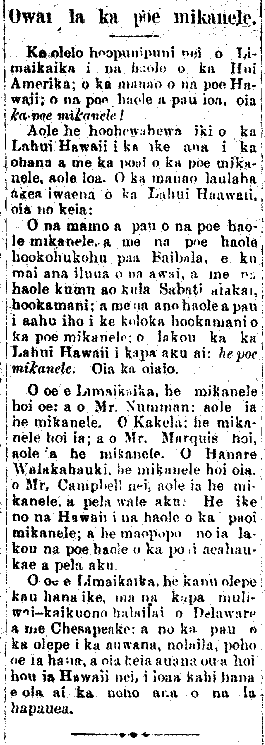
Armstrong is telling lies to the American League [Hui Amerika] about the thoughts of the Hawaiians; that all of the haole are the missionaries!

The Hawaiians are not mistaken in the least as to their recognition of the family and circle of missionaries, not at all. The general thought amongst the Lahui Hawaii is this:

All of the descendants of the haole missionaries and the haole who make as if they are steadfast to the Bible, who stand at the pulpit, and of the hypocritical haole Sunday school leaders; and all of the haole who wear the disguise of the missionary; those are who the Lahui Hawaii call: the missionaries. That is the truth.

You, O Armstrong, you are a missionary; and Mr. Neumann, he is not a missionary. Castle, he is a missionary; and Mr. Marquis though is not a missionary. Henry Waterhouse, he is a missionary; Mr. Campbell is not a missionary, and so forth. The Hawaiians do indeed know who is in the circle of missionaries; and they know who the haole are who are in the circle of vagrants.

As for you, O Armstrong, your trade is growing oysters on the banks of the calm Delaware and Chesapeake River and Bay, and due to the oysters going elsewhere, you took a loss and that is why you wandered back here to Hawaii nei, to find a job to support you in your old age.

[I am not sure who the “Mr. Marquis” referred to here is.]

(Oiaio, 2/16/1894, p. 2)

Owai la ka poe mikanele.

Ka Oiaio, Buke VI, Helu 7, Aoao 2. Feberuari 16, 1894.

Render unto Caesar… 1893.

The Pastor, the Pulpit, and the Church.

[Written for Ka Leo o ka Lahui.]

A pastor is one who travels. He goes far and wide. A pastor is knowledgeable and enlightened; he has spiritual wisdom, and his spirit is filled with aloha and patience; he does not grumble, is not snappy, nor impatient, nor hurtful; he has no contempt for others, when misfortune befalls him. He is truly devout, and prays sincerely for all, leaving none out; it is not right for a pastor to say:—”Ah! He will fall for he disregards the teachings of the pious.” The pastor should not say: “Because of his sins, he is cast out by God from above.”

When Christ was on this earth, he said: Do no harm to those that bring harm to you; love your enemy and pray for those who hurt you.

A Doctor is there for the sick, while a pastor is there to teach the sinners. Continue reading

Plans for Independence Day, 1885.

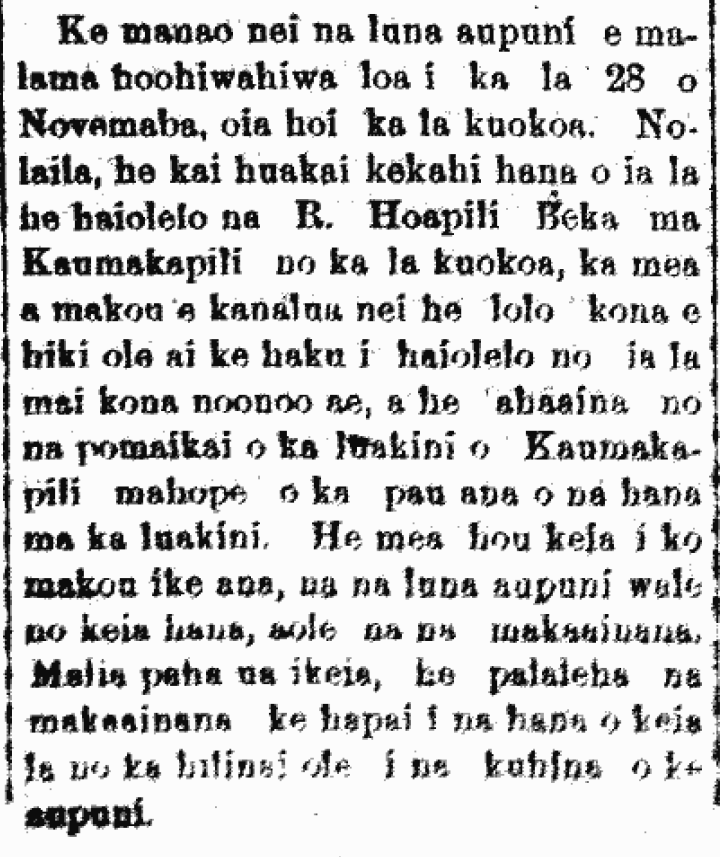
The heads of the nation are planning on a great celebration on the 28th of November, that being La Kuokoa. Therefore, there will be a parade on that day; a speech by Robert Hoapili Baker [R. Hoapili Beka] at Kaumakapili for independence day, the one that we are questioning as to whether he has a brain that can compose a speech for that day by himself; and a banquet for the benefit of Kaumakapili Church after the activities at the church are through. This is something new that we see, that the heads of the nation themselves are doing this, and not the makaainana. Perhaps it was seen that the makaainana were neglectful in observing this day because of their lack of trust in the ministers of the government.

(Ko Hawaii Pae Aina, 11/14, 1885, p. 2)

Ke manao nei na luna aupuni...

Ko Hawaii Pae Aina, Buke VIII, Helu 46, Aoao 2. Novemaba 14, 1885.

Anna Berry, daughter of Kentucky congressman, speaks on annexation, 1898.

THE INJUSTICE OF ANNEXATION

As Viewed by an American Woman Miss Anna E Berry of Newport—The Kentucky Congressman’s Daughter Writes Entertainingly of the Native Hawaiians—A Petition to the President.

[Among the ladies who accompanied the congressional party to Hawaii in September was Miss Anna Berry, daughter of Congressman Berry of Kentucky, who has written charmingly of the islands. She brought back many souvenirs of her visit, which are to be seen in her Newport home. The best of all is the Royal Hawaiian standard, the flag which was floating over Queen Liliuokalani when she was deposed. It is to be noted that Miss Berry returned to America with a woman’s sense of the injustice of annexation, from the viewpoint of the native Hawaiian, while the men of the party came back a unit for annexation. The Hawaiian minister to whom Miss Berry refers as a descendant of a Kentucky Governor is Rev. Desha, of Hilo. His grandfather was Governor Desha, of Kentucky, and his father was Isaac B. Desha, who committed a sensational murder at Doggett’s Tavern, a well-known inn of early Kentucky days on the Licking River. The murderer was sentenced to death, and saved by his own father’s pardoning power. The case was one of the most remarkable in American criminal history. He fled to Hawaii where one of his half-native sons is a leading Kanaka minister, and the other is a postal employee.—The Editor of the Kentucky Post.

The recent visit of Senator Morgan and four members of the United States House of Representatives to the Hawaiian Islands aroused among the various peoples of the “Paradise of the Pacific” sentiments and feelings as opposite as the poles. There are indeed various peoples in Hawaii—a very scrapbag of a population—the good with the bad. Here Portuguese and Chinese, Japanese and Germans, Americans and natives jostle one another. Continue reading

Republicans and Hawaiians, 1902.

TO JOSEPH KALANA

Mr. Editor: Please give me a column in the fearless spokesmen of the lahui.

I am very regretful should you be a true Hawaiian, being that I always see in our newspapers of the mother tongue you announcing to the far and wide of the Archipelago, “Let Us be Republican.”

Do you not know the one who overthrew the monarchy? Do you not know the “head” of those who overthrew the government? Do you not know the desire of the people you support to obliterate us Hawaiians, and that this is verified from Governor Dole’s very own mouth? Do you not know the great desire of the Republicans to limit our voting power which was corroborated by the Governor in Boston by him saying: “We demand that the whites be supported and the native Hawaiians put down.’ ‘Ke kauoha nei makou e kakooia ka poe keokeo a e kulai a kuaia na kanaka Hawaii ilalo.” Continue reading

Robert Wilcox sounds off, 1898.

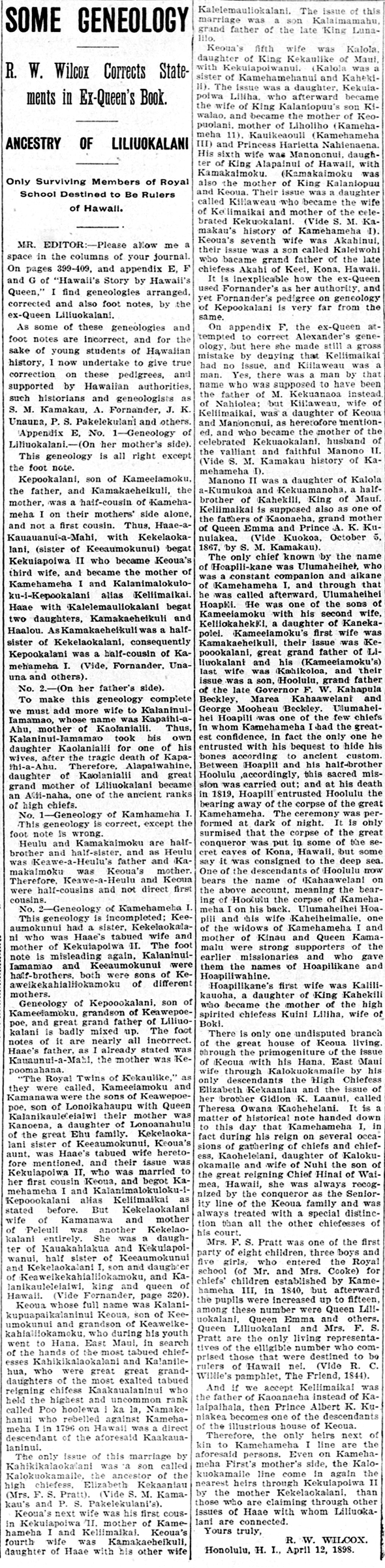
SOME GENEOLOGY

R. W. Wilcox Corrects Statements in Ex-Queen’s Book.

ANCESTRY OF LILIUOKALANI

Only Surviving Members of Royal School Destined to Be Rulers of Hawaii.

MR. EDITOR:cPlease allow me a space in the columns of your journal. On pages 399–409, and appendix E, F and G of “Hawaii’s Story by Hawaii’s Queen,” I find geneologies arranged, corrected and also foot notes, by the ex-Queen Liliuokalani

As some of these geneologies and foot notes are incorrect, and for the sake of young students of Hawaiian history, I now undertake to give true correction on these pedigrees, and supported by Hawaiian authorities, such historians and geneologists as S. M. Kamakau, A. Fornander, J. K. Unauna, P. S. Pakelekulani and others.

Appendix E, No. 1—Geneology of Liliuokalani.—(On her mother’s side).

This geneology is all right except the foot note.

Kepookalani [Kepoookalani], son of Kameeiamoku, the father, and Kamakaeheikuli, the mother, was half-cousin of Kamehameha I on their mothers’ side alone, and not a first cousin. Thus, Haae-a-Kauauanui-a-Mahi, with Kekelaokalani, (sister of Keeaumokunui) begat Kekuiapoiwa II who became Keoua’s third wife, and became the mother of Kamehameha I and Kalanimokuioku-i-Kepookalani alias Keliimaikai. Haae with Kalelemauliokalani begat two daughters, Kamakaeheikuli and Haalou. As Kamakaeheikuli was a half-sister of Kekelaokalani, consequently Kepookalani was a half-cousin of Kamehameha I. (Vide, Fornander, Unauna and others).

No. 2.—(On her father’s side).

To make this geneology complete we must add more wife to Kalaninui-Iamamao, whose name was Kapaihi-a-Ahu, mother of Kaolanialii. Thus, Kalaninui-Iamamao took his own daughter Kaolanialii for one of his wives, after the tragic death of Kapaihi-a-Ahu. Therefore, Alapaiwahine, daughter of Kaolanialii and great grand mother of Liliuokalani became an Alii-naha, one of the ancient ranks of high chiefs.

No. 1—Geneology of Kamehameha I.

This geneology is correct, except the foot note is wrong.

Heulu and Kamakaimoku are half-brother and half-sister, and as Heulu was Keawe-a-Heulu’s father and Kamakaimoku was Keoua’s mother. Therefore, Keawe-a-Heulu and Keoua were half-cousins and not direct first cousins.

No. 2—Geneology of Kamehameha I.

This geneology is incompleted; Keeaumokunui had a sister, Kekelaokalani who was Haae’s tabued wife and mother of Kekuiapoiwa II. The fott note is misleading again, Kalaninui-Iamamao and Keeaumokunui were half-brothers, both were sons of Keaweikekahialiiokamoku of different mothers.

Geneology of Kepoookalani, son of Kameeiamoku, grandson of Keawepoepoe, and great grand father of Liliuokalani is badly mixed up. The food notes of it are nearly all incorrect. Haae’s father, as I already stated was Kauaunui-a-Mahi [Kauauanui-a-Mahi], the mother was Kepoomahana.

“The Royal Twins of Kekaulike,” as they were called, Kameeiamoku and Kamanawa were the sons of Keawepoepoe, son of Lonoikahaupu with Queen Kalanikauleleiaiwi their mother was Kanoena, a daughter of Lonoanahulu of the great Ehu family. Kekelaokalani sister of Keeaumokunui, Keoua’s aunt, was Haae’s tabued wife heretofore mentioned, and their issue was Kekuiapoiwa II, who was married to her first cousin Keoua, and begot Kamehameha I and Kalanimalokuloku-i-Kepoookalani alias Keliimaikai as stated before. But Kekelaokalani wife of Kamanawa and mother of Peleuli was another Kekelaokalani entirely. She was a daughter of Kauakahiakua and Kekuiapoiwanui, half sister of Keeaumokunui and Kekelaokalani I, son and daughter of Keaweikekahialiiokamoku, and Kalanikauleleiaiwi, king and queen of Hawaii. (Vide Fornander, page 320).

Keoua whose full name was Kalanikupuapaikalaninui Keoua, son of Keeumokkunui [Keeaumokunui] and grandson of Keaweikekahialiiokamoku, who during his youth went to Hana, East Maui, in search of the hands of the most tabued chifesses of Kahikikalaokalani and Kalanilehua, who were great great grand-daughters of the most exalted tabued reigning chiefess Kaakaualaninui who held the highest and uncommon rank called Poo hoolewa i ka la, Namakehanui who rebelled against Kamehameha I in 1796 on Hawaii was a direct descendant of the aforesaid Kaakaualaninui.

The only issue of this marriage by Kahikikalaokalani was a son called Kalokuokamaile, the ancestor of the high chiefess, Elizabeth Kekaaniau (Mrs. F. S. Pratt). (Vide S. M. Kamakau’s and P. S. Pakelekulani’s).

Keoua’s next wife was his first cousin Kekuiapoiwa II, mother of Kamehameha I and Keliimaikai. Keoua’s fourth wife was Kamakaeheikuli, daughter of Haae with his other wife Kalelemauliokalani. The issue of this marriage was a son Kalaimamahu, grand father of the late King Lunalilo.

Keoua’s fifth wife was Kalola, daughter of King Kekaulike of Maui with Kekuiapoiwanui. (Kalola was a sister of Kamehamehanui and Kahekili). The issue was a daughter, Kekuiapoiwa Liliha, who afterward became the wife of King Kalaniopuu’s son Kiwalao, and became the mother of Keopuolani, mother of Liholiho (Kamehameha II), Kauikeaouli (Kamehameha III) and Princess Haarietta Nahienaena. His sixth wife was Manononui, daughter of King Alapainui of Hawaii, with Kamakaimoku. (Kamakaimoku was also the mother of King Kalaniopuu and Keoua. Their issue was a daughter called Kiilaweau who became the wife of Keliimaikai and mother of the celebrated Kekuokalani [Kekuaokalani]. (Vide S. M. Kamakau’s histor of Kamehameha I). Keoua’s seventh wife was Akahinui, their issue was a son called Kaleiwohi who became grand father of the late chiefess Akahi of Keei, Kona, Hawaii.

It is inexplicable how the ex-Queen used Fornander’s as her authority, and yet Fornander’s pedigree on geneology of Kepookalani [Kepoookalani] is very far from the same.

On appendix F, the ex-Queen attempted to correct Alexander’s geneology, but here she made still a gross mistake by denying that Keliimaikai had no issue, and Kiilaweau was a man. Yes, there was a man by that name who was supposed to have been the father of M. Kekuanaoa instead of Nahiolea; but Kiilaweau, wife of Keliimaikai, was a daughter of Keoua and Manononui, as heretofore mentioned, and who became the mother of the celebrated Kekuaokalani, husband of the valiant and faithful Manono II. (Vide S. M. Kamakau history of Kamehameha I).

Manono II was a daughter of Kalola-a-Kumukoa and Kekuamanoha, a half-brother of Kahekili, King of Maui. Keliimaikai is supposed also as one of the fathers of Kaonaeha [Kaoanaeha], grand mother of Queen Emma and Prince A. K. Kunuiakea. (Vide Kuokoa, October 5, 1867, by S. M. Kamakau).

The only chief known by the name of Hoapili-kane was Ulumaheihei, who was a constant companion and aikane of Kamehameha I, and through that he was called afterward, Ulumaheihei Hoapili. He was one of the sons of Kameeiamoku with his second wife, Keliiokahekili, a daughter of Kanekapolei. Kameeiamoku’s first wife was Kamakaeheikuli, their issue was Kepoookalani, great grand father of Liliuokalani and his (Kameeiamoku’s) last wife was Kahikoloa, and their issue was a son, Hoolulu, grand father of the late Governor F. W. Kahapula Beckley, Maraea Kahaawelani and George Mooheau Beckley. Ulumaheihei Hoapili was one of the few chiefs in whom Kamehameha I had the greatest confidence, in fact the only one he entrusted with his bequest to hide his bones according to ancient custom. Between Hoapili and his half-brother Hoolulu, accordingly, this sacred mission was carried out; and at his death in 1819, Hoapili entrusted Hoolulu the bearing away of the corpse of the great Kamehameha. The ceremony was performed at dark of night. It is only surmised that the corpse of the great conqueror was put in some of the secret caves of Kona, Hawaii, but some say it was consigned to the deep sea. One of the descendants of Hoolulu now bears the name of Kaawelani on the above account, meaning the bearing of Hoolulu the corpse of Kamehameha I on his back. Ulumaheihei Hoapili and his wife Kaheiheimalie, one of the widows of Kamehameha I and mother of Kinau and Queen Kamamalu were strong supporters of the earlier missionaries and who gave them the names of Hoapilikane and Hoapiliwahine.

Hoapilikane’s first wife was Kalilikauoha, a daughter of King Kahekili who became the mother of the high spirited chiefess Kuini Liliha, wife of Boki.

There is only one undisputed branch of the great house of Keoua living through the primogeniture of the issue of Keoua with his Hana, East Maui wife through Kalokuokamaile by his only descendants the High Chiefess Elizabeth Kekaaniau and the issue of her brother Gidion K. Laanui [Gideona K. Laanui], called Theresa Owana Kaohehelani. It is a matter of historical note handed down to this day that Kamehameha I, in fact during his reign on several occasions of gathering of chiefs and chiefess, Kaohelelani, daughter of Kalokuokamaile and wife of Nuhi the son of the great reigning Chief Hinai of Waimea, Hawaii, she was always recognized by the conqueror as the Seniority line of the Keoua family and was always treated with a special distinction than all the other chiefesses of his court.

Mrs. F. S. Pratt was one of the first party of eight children, three boys and five girls, who entered the Royal school (of Mr. and Mrs. Cooke) for chiefs’ children established by Kamehameha III, in 1840, but afterward the pupils were increased up to fifteen, among these number were Queen Liliuokalani, Queen Emma and others. Queen Liliuokalani and Mrs. F. S. Pratt are the only living representatives of the elligible number who comprised those that were destined to be rulers of Hawaii nei. (Vide R. C. Willie’s pamphlet, The Friend, 1844).

And if we accept Keliimaikai was the father of Kaoanaeha instead of Kalaipaihala, then Prince Albert K. Kuniakea [Albert K. Kunuiakea] becomes one of the descendants of the illustrious house of Keoua.

Therefore, the only heirs next of kin to Kamehameha I line are the aforesaid persons. Even on Kamehameha First’s mother’s side, the Kalokuokamaile line come in again the nearest heirs through Kekelaokalani, than those who are claiming through other issues of Haae with whom Liliuokalani are connected.

Yours truly,

R. W. WILCOX.

Honolulu, H. I., April 12, 1898.

[It is worth noting that Wilcox repeatedly calls Liliuokalani, “ex-Queen” and submits this critique to the Pacific Commercial Advertiser, a newspaper which is at this time ostensibly against the monarchy. His criticisms are written in English most certainly because the Queen’s book was published in English.

If you still haven’t got the recently published new and revised edition of the Queen’s Story, you should consider picking up a copy!]

(Pacific Commercial Advertiser, 5/25/1898, p. 5)

SOME GENEOLOGY

The Pacific Commercial Advertiser, Volume XXVII, Number 4928, Page 5. May 25, 1898.

Voting advice, 1861 / Timeless.

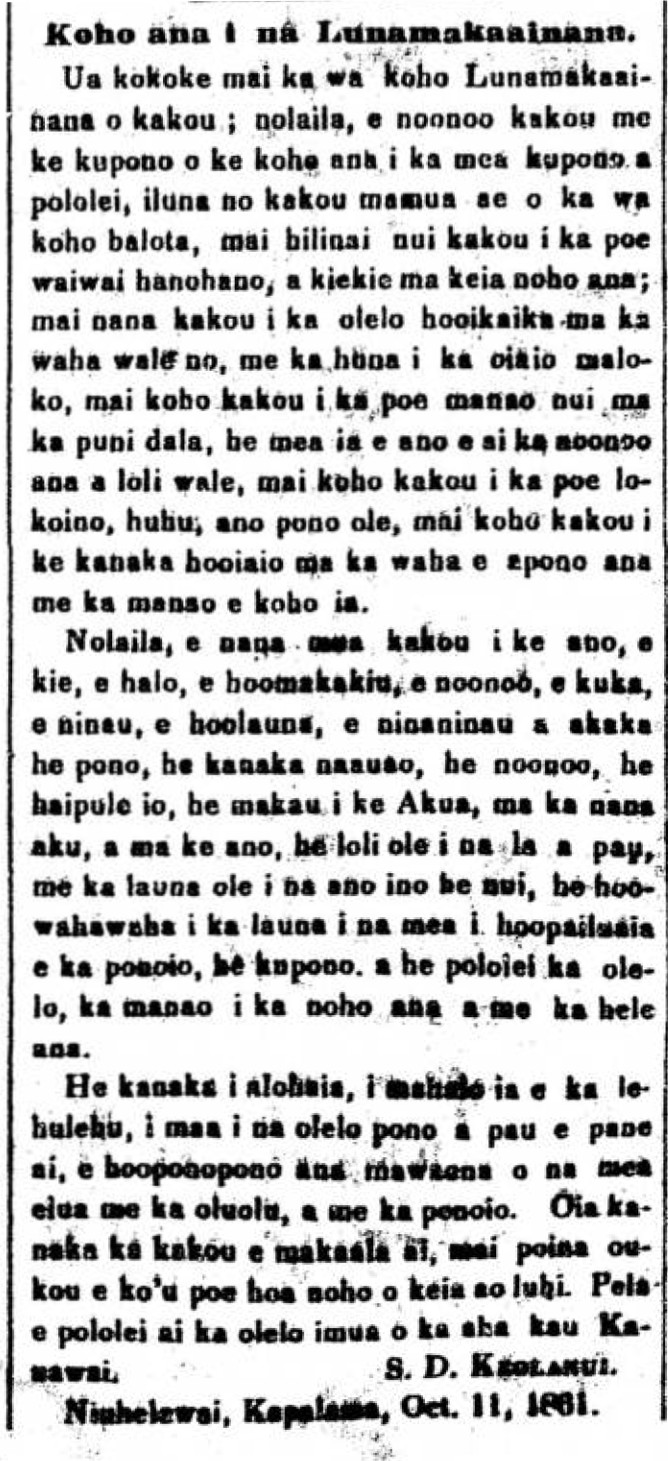
Voting for Representatives.

The time for electing our Representatives is approaching; therefore, let us think carefully about voting for the appropriate and right one before it is time to vote; let’s not put great trust behind the famous, wealthy people, and those high up in this world; let us not look solely at great claims made while they hide the truth within, let us not vote for those who are greatly concerned with money for it will alter and easily change their thinking, let us not vote for the heartless, the wrathful, the improper; let us not choose those convincing with the mouth, but vote for those who are chosen with consideration.

Therefore, let us look first at the person’s nature; let us peer, focus on, investigate, consider, discuss, question, associate with, examine; and when it is clear that the person is right, enlightened, thoughtful, devout, fearful of God, in appearance and in character, doesn’t change from day to day, doesn’t associate with the many evils characters, while treating with contempt the associating with those who are sickened by righteousness; upright and straightforward are their words, thoughts, lifestyle and course of action.

A person who is loved and appreciated by the people, who regularly speaks all that is right to mediate between two parties graciously and truthfully. That is the person who we should keep our eyes on; do not forget, my fellow dweller of this wearisome world. In this way, the words before the Legislative session will be truthful.

S. D. Keolanui.

Niuhelewai, Kapalama, Oct. 11, 1861.

[It is interesting to see that much of Keolanui’s advice still rings true over 150 years later.]

(Hoku o ka Pakipika, 10/17/1861, p. 4)

Koho ana i na Lunamakaainana.

Ka Hoku o ka Pakipika, Buke I, Helu 4, Aoao 4. Okatoba 17, 1861.