G. W. Kahiolo / G. W. Poepoe, feminist of his day, 1864.

The Value of Girls

SEEKING KNOWLEDGE EARNESTLY.

O Kuokoa Newspaper; Aloha oe.—We see the words placed proudly above, “the value of girls seeking knowledge earnestly.”

Teaching girls knowledge is something not important for Hawaiian parents, who say, “When boys are educated, they can go on to Lahainaluna, and return and find a job and get riches.” But educating girls is a waste of their parents efforts, and so forth.

Come now! look at this that makes clear the truth of the words above. The Law was passed that boys would be segregated in separate schools where possible, and men teachers would be selected for the boy students, and women teachers for the girl students.

And the Principal of our District, J. S. Low, has put this into practice, selecting women teachers in this past September, as per his Announcement: D. Kaholua (f), as teacher for Kapalama; Emaria Kalauli (f), teacher for Kawaiahao; and so forth; the number of female teachers in our District is six; they have reaped the wealth from their seeking education.

However, the majority of women teachers are from Molokai; they are intelligent and educated, they were taught well by Mr. Hitchcock [Hikikoke] and Mr. Dwight [Duaika], the teachers of Molokai.

What about you all, indifferent ones, skeptics, and the foolish? Stop this; put effort into education; the Law has allowed knowledgeable women to become Teachers, like these women that we see these days.

G. W. Kahiolo.

(Kuokoa, 1/16/1864, p. 3)
Ka Waiwai o na Kaikamahine

Ka Nupepa Kuokoa, Buke III, Helu 4, Aoao 3. Ianuari 16, 1864.

Kamehameha Schools Song Contest, yesterday and today, 1944 / 2014.

[Found under: “News From Boys, Girls Kamehameha School”]

By HARRIETTE HURLEY

People who enjoy Hawaiian music have expressed the desire to know the meanings of the Hawaiian songs. Translations of the two prize songs to be used in the Kamehameha School for Girls’ song contest to be held on February 13, appear below.

Mrs Mary Kawena Pukui, translator at the Bishop Museum and director of Hawaiian activities at the Kamehameha Preparatory School, has translated the songs.

The junior division prize song is Pa’au’au Waltz. Selected for the senior division prize song is Lei Awapuhi.

Translation of Lei Awapuhi

I hear the voice of a loved one say
Let me pluck and wear the flower
To string a lei for my leaf bud to wear
My love was strongly attracted
To the choicest flower that ever bloomed
Let me, darling, string it into a lei,
O let your ginger lei be mine. Continue reading

Papaikou School graduates, 1919.

This is a picture of the students who graduated from the school of Papaikou, Hawaii. The total number of children are eleven, but the astonishing thing is that there are no Hawaiian children amongst this crowd. From the children who graduated, eight of them are Japanese, five boys and three girls. Where are the Hawaiian children, the hope of this race to be looked to in the future? These children are prepared to enter Hilo High School in this new school year.

(Kuokoa, 8/15/1919, p. 1)

He kii keia no na haumana...

Ka Nupepa Kuokoa, Buke LVII, Helu 33, Aoao 1. Augate 15, 1919.

Western medical school for Hawaiians, 1870.

Kahunas.

We understand that one of our physicians, who is thoroughly conversant with the native language, has been authorized to form a class of eight or ten Hawaiian young men, (graduates of the highest schools,) for instructions in the principles and practice of medicine.

There has never been made, that we are aware of, any systematic or earnest effort to instruct Hawaiian youth in the medical art. The knowledge that is necessary to be acquired to make a skillful and thoroughly competent practitioner is not to be obtained in this country, which as yet, does not possess medical schools and colleges, and the difficulties in the way of sending Hawaiian pupils abroad to obtain a medical education, are so various and insurmountable, as almost to preclude any hope of being overcome. Continue reading

Dr. G. P. Judd starts a medical school for Hawaiians, 1870.

Medical School.—In the English government newspaper [Hawaiian Gazette], we saw an editorial [manao pepa] pertaining to the establishing of a medical school for Hawaiian youths, perhaps eight or ten in number. After asking about, we were told that it is Dr. G. P. Judd who suggested the idea of starting that type of fine school of which we have faith that this proposed school will go well. Because these youths will be taught the haole medicine in the Hawaiian language by that elder doctor of ours, the one that is fluent in Hawaiian, and it is he in his knowledge of medicine who translated the Anatomy Book which is being taught in the high schools. Ten room are set up above the Residence of Dr. Stangenwald [Minuteole] for those ten students. We dearly hope that it goes well.

(Manawa, 11/21/1870, p. 2)

He Kula Kauka.

Ka Manawa, Buke I, Helu 3, Aoao 2. Novemaba 21, 1870.

Pahala School, 1936.

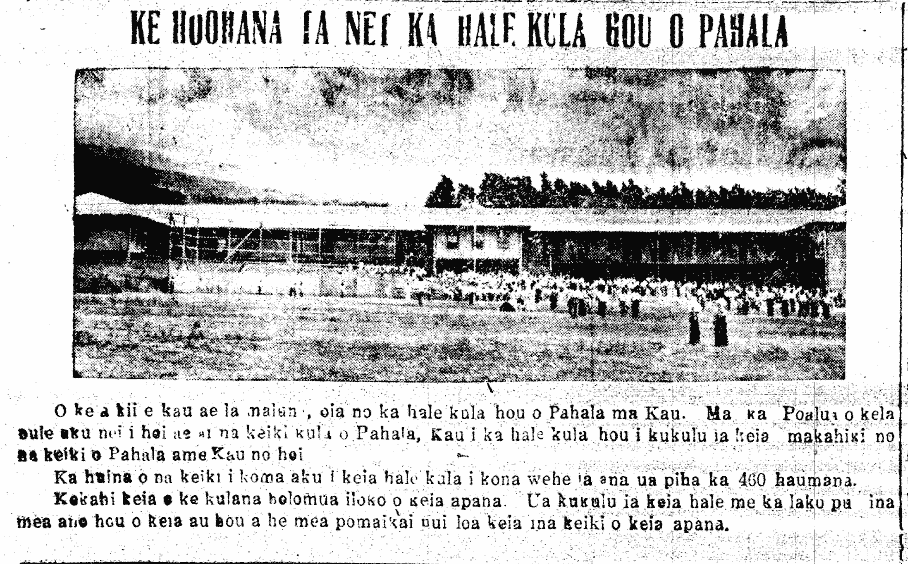
THE NEW SCHOOL OF PAHALA BEING BUILT

This picture above is of the new school of Pahala in Kau. On Tuesday of this past week, the children of Pahala, Kau returned to the new school house built this year for the children of Pahala and Kau.

The total number of children entering this school when it opened is 460 students.

This is one of the signs of progress in this district. This school and the yard equipment are of the newest models of this new age, and this is a great blessing for the children of this district.

(Hoku o Hawaii, 9/23/1936, p. 2)

KE HOOHANA IA NEI KA HALE KULA HOU O PAHALA

Ka Hoku o Hawaii, Volume XXXI, Number 21, Aoao 2. Sepatemaba 23, 1936.

James A. E. Kinney and his ohana, 1943.

At Sea

The picture above is of James A. E. Kinney, the son of K. W. Kinney of Hana, Maui, and one of the writers to Ka Hoku o Hawaii. It is believed that A. E. Kinney is at Sea with the Air Force, doing air surveillance [kilo ea]. He graduated from the air surveillance school in Grand Rapids, Michigan this past April and returned to his post at West Palm Beach, Florida, and thereafter it was decided to send him to sea.

A Hawaiian Youth

James Apollo Everett Kinney was born of the loins of Mr. K. W. [Kihapiilani William] and Mrs. Sarah Kaleo Kinney, at the McBryde Sugar Plantation in Kauai, when his father was working burning cane, and he was 32 years old. Continue reading

Sam Lia Kalainaina’s daughter weds, 1940.

A FINE MARRIAGE

MR. AND MRS. EMILIANO BARROGA

Joined in the holy covenant of marriage were Miss Anna Keolaanalani Lia Kalainaina, the only daughter of Mr. and Mrs. Samuel Lia Kalainaina of Kukuihaele, Hamakua, with Emiliano Barroga, a Filipino youth, an Owner of some passenger buses between Kukuihaele, Honokaa, and based in Hilo, and he holds many shares in a Insurance group in Manila; by the Catholic Priest, Father Henry, at the Catholic Church of Honokaa, on August 31 at 6:00 P. M.

After the ceremony was over, married couple, the parents, and the crowd headed for Kukuihaele Hale, as the family and many friends of all ethnicities were waiting to welcome them with a great Banquet to honor the Young Couple. Continue reading

Keoua Hale becomes Honolulu High School, 1895.

Honolulu High School [Kula Kiekie o Honolulu].

The illustration above is of the beautiful house of Princess R. Keelikolani, standing in Honolulu, and called Keoua Hale. It is said that when many drawings of houses were placed before the alii for her to choose from, she looked through the many and chose the drawing of this house and instructed the artist, “build me a house like that.” Therefore, a house like the one in the picture was constructed to completion which now stands proudly, the building which graces that portion of Honolulu on Emma Street on the land of Kaakopua. Continue reading

Fifty years of Kamehameha School for Girls, 1944.

Jubilee Reached

On this past Sabbath, there was held a huge party in Honolulu, to commemorate the Jubilee of the establishment of the Kamehameha School for Girls.

The Girls’ school was built in 1894, and there are three of the girls from the school who graduated in 1897 still living, Continue reading