Just curious, 2016.
Reply

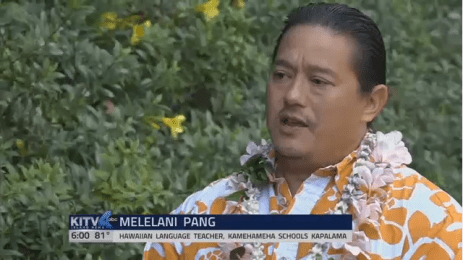
KAPOLEI, Hawaii – Hawaiian language teachers discuss curriculum in Hawaii high schools in efforts to keep students engaged and perhaps attract more.
THIS IS A PICTURE OF THE FOOTBALL MATCH BETWEEN THE BOYS OF KAMEHAMEHA AND PUNAHOU THIS PAST SATURDAY, ONE OF THE MOST FIERCEST OF GAMES SEEN, AND THE BOYS OF PUNAHOU RAN AWAY WITH THE VICTORY ON THEIR SIDE, AND THE NAME OF CHAMPION IN THAT SPORT WENT TO PUNAHOU THIS YEAR.
(Kuokoa, 11/21/1919, p. 1)
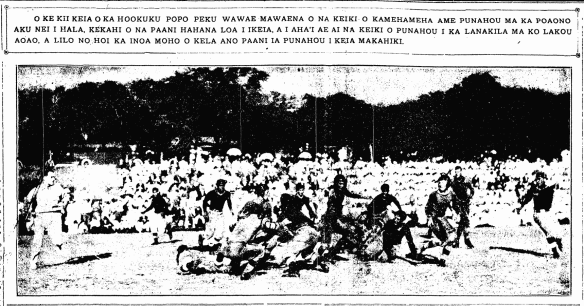
Ka Nupepa Kuokoa, Buke LVII, Helu 47, Aoao 1. Novemaba 21, 1919.
AN INTERESTING SOCIETY FORMED AT THE UNIVERSITY AT PALO ALTO—LEIS OF ROSES AND SCORE CARDS OF LAUHALA AT A CARD PARTY OF THOSE WHO HAVE LIVED IN THE ISLANDS.
STANFORD UNIVERSITY, April 13, 1905.—A number of Island people met on the evening of April 7, at the home of Mr. and Mrs. A. D. Larnach, and formed what was named the “Hui Hawaii” which is intended to bring together the Hawaiians about Stanford University in a social way. It was decided to have this a most informal affair and not to choose any regular officer, but simply to have it made known at one meeting who is to entertain at the next one. Anyone who has been in the Islands is to be eligible to membership. Continue reading
Some interesting comments of the solution of the language difficulty in the public schools of the islands are contained in the reports of Normal Inspectors to Superintendent Atkinson. There are few, if any, countries in the world where so much diversity of language confronts the teachers as in Hawaii, and two of the inspectors express the opinion that in quick solution of the problem of speech Hawaii leads the world.
Inspector J. K. Burkett, of the First and Fourth Circuits, says:
“When we consider how mixed is the population, from how many nationalities our teaching force is recruited, and how the whole is mixed as it were in the crucible of English, bringing forth not a garbled and provincial English speech, but one based upon the best models, the outcome is truly marvelous. There is probably no country on the face of the globe which has succeeded in solving this difficult problem of speech, so quickly as this has. The work of the schools in my districts has been directed to the thorough instilling of English, colloquial English. But though English is the foundation and the study most carefully and thoroughly instilled, it is not the final end of our effort. The course of study is carefully followed, and we have every branch given its full due. Some schools may be more successful than others, some teachers command better results than others, but the whole school system of these two districts stands at a very high average. I would like before closing to register my unqualified sentiments of satisfaction with the teaching force of the districts, and would say that few places in the Union can show as able and as energetic teachers as we have. Especial credit must be given to those who have had no other advantage than the education of our own schools, completed in the Honolulu Normal. These young men and young women have proved what local work can and will do, if properly guided and earnestly carried out.
“I look for a great future for education in these Islands. With much toil and much careful thought, many most difficult problems have been solved and a most valuable foundation has been laid. Upon this a magnificent super-structure will be raised which will do honor to the Territory and its people.”
Charles W. Baldwin, Inspector for the Third Circuit says:
“In conclusion I may say, though the Inspector feels that he has failed in much, that failure has been due to the facts already set forth in this report—the need of methods more in harmony with those of our Normal school has been so great that almost his entire attention has been towards the accomplishment of that object. While there is yet much to criticize, of the schools as a whole it is certain that they are a decided step in advance of the work that was being done when the Inspector first undertook his new duties. Of the future it may be said that, if our present educational system is allowed to remain untrammelled, that we will excel all schools in methods for teaching English; and nowhere on earth will teachers be found better fitted to handle non-English speaking children.”
(Hawaiian Star, 3/5/1903, p. 7)
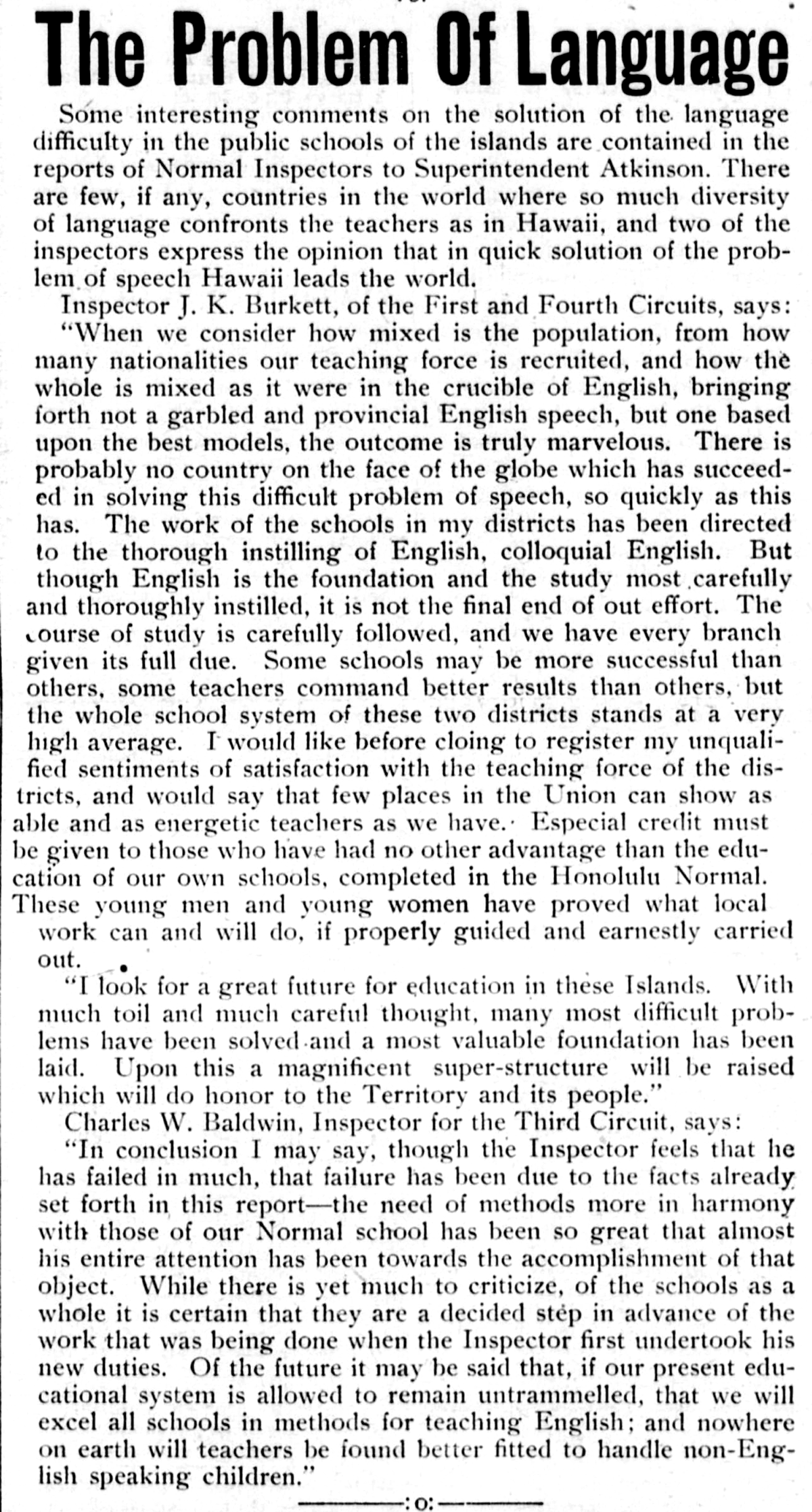
The Hawaiian Star, Volume X, Number 3419, Page 7. March 5, 1903.
Mr. Solomon Hanohano, Editor, Aloha oe: Please allow me some space of the pride of the people, so that everyone from Hawaii, island of Keawe, all the way to the sun-snatching island of Manokalanipo (Kauai), knows of the marriage of Henry Wilfred Waiau of the calm seas of Kona, where you had affection in the days of your youth, distinguished by the passing of the cloud banks and the hinano flowers in the calm, with the type-setting girl of the garden island of Manokalanipo.
After Henry Wilfred Waiau spent a year or more on Kauai, Miss Isabela Kaheapuulani Akiona of the island of Manokalanipo, the island that snatches the shining rays of the sun from the tip of Kumukahi and setting at the base of Lehua, proudly took him (H. W. Waiau) and placed him in the sacred stage of the covenant of matrimony at 8 oʻclock in the evening of last Wednesday, and the two of them were joined by Rev. W. Kamau of the church of Lihue, Kauai.
Continue reading
Mr. Editor; Aloha oe:
Perhaps it is well that I explain in your newspaper a thought responding to W. P. Waha of Honomaele Uka, Hana, Maui.
In the newspaper, Kuokoa, Buke 10, Helu 27, of the 8th of this past July, Waha published an opinion pertaining to the Practice of Hawaiian Medicine. From what I saw searching from beginning to end; this is what I mainly got out of it, that “he is jealous, malicious, and a slanderer, ” and so forth. You just chomp your mouth like a wild shark of the sea saying, “All of the Hawaiians are dying because of whom? Yes! They are dying because of you Heads of the Government!” If that is the intent of the questioner, then I ask of you, “Is that indeed true?” Let us all look at the thoughts of this malicious inciter, being that the Heads of our Nation are not looking to kill off the Hawaiian Lahui, and ways to kill them, but it is you, and it is you yourselves who offer yourselves off to die; and you enjoy grumbling to our Heads of Government. Take a short look at this, you fault finder; During the past session of the Legislature, in the year 1870, $4,000 was put to teach Hawaiian youths Medicine, and in the month of November of last year, the government chose the proper person in which they trust, as a teacher for the school, and it is being taught now. There is no other reason for this action except because of the aloha for you, O Hawaiian people.
Take another look; some Hawaiian medical kahuna are licensed, so that they can practice medicine in the country and areas where there are no doctors. The ignorant and uneducated practitioners are being sued. If you look at these actions by our Government Heads, it appears as if they are concerned that our Lahui will perish. Continue reading
Honolulu, Dec. 29—Perhaps it is because the desires of Mrs. Owana Wilcox Beleveu [Belliveau] were not appeased over the estate of Queen Liliuokalani that here she is fighting over the estate of the Aliiwahine Pauahi and she is trying to find a way to break the Will, as if she is related to Chiefess Pauahi. What does she expect by starting all of this?
It is heard that she is looking for an attorney on her side to break the Will of Princess Pauahi, and the money to be dedicated to Educate the boys and girls of the Hawaiian Lahui. Something that will result through this action by this woman is the dishonor to the name of Hawaiians, and this improper action will be something reported in other lands. When they find out about this, Hawaiians will definitely not approve of this deceitful act.
(Aloha Aina, 1/3/1918, p. 2)
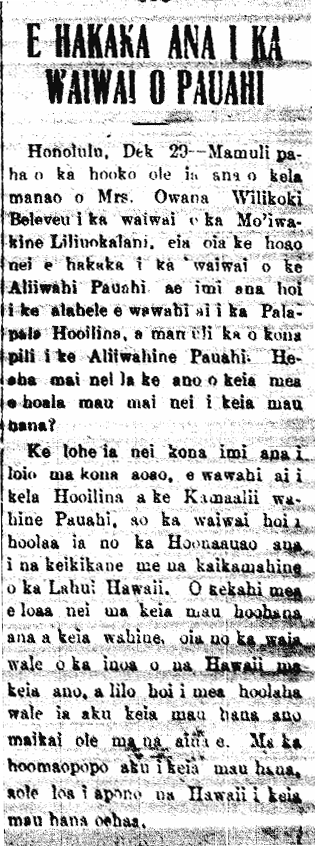
Ka Hoku o Hawaii, Buke 12, Helu 32, Aoao 2. Ianuari 3, 1918.
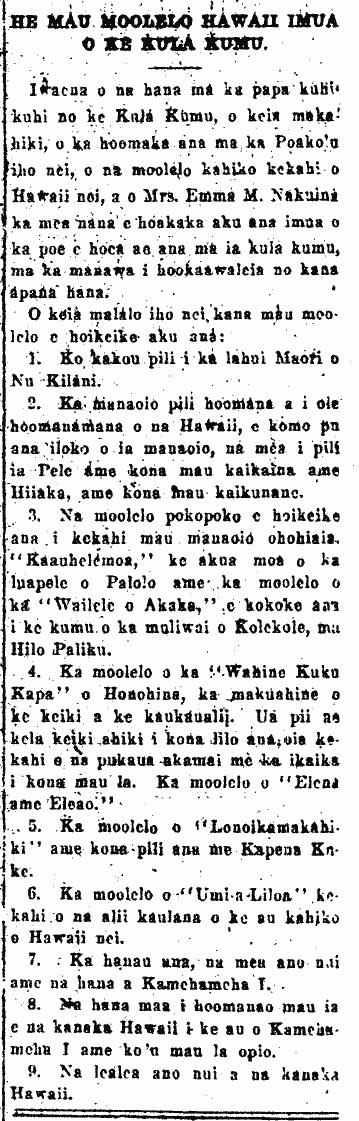
In the syllabus of the School of Education this year, beginning on this past Wednesday, were old moolelo of Hawaii nei. And it is Mrs. Emma M. Nakuina who is teaching them before those who come to the teachers’ school during the time set aside for her course.
These below are the moolelo that she will be teaching:
1. Our ties with the Maori of New Zealand.
2. The religion or superstition of the Hawaiians, and along with those beliefs are things relating to Pele and her younger sisters and Hiiaka, along with her brothers.
3. Short stories which show amazing beliefs, like the story of “Kaauhelemoa,” the chicken god of the crater of Palolo and the story of “Akaka Waterfall,” which is close to the head of the Kolekole River in Hilo Paliku.
4. The story of “The Kapa-Beating Woman” of Honohina, the mother of the chiefly child. That child grew up to become one of the strong and skilled warriors of his time. The story of “Elena [Eleau?] and Eleao.”
5. The moolelo of “Lonoikamakahiki” and his association with Capt. Cook.
6. The moolelo of “Umi-a-Liloa,” one of the famous alii of old Hawaii nei.
7. The birth, the important things, and accomplishments of Kamehameha I.
8. The usual activities recalled by Hawaiians in the time of Kamehameha I as well as during my childhood.
9. The major entertainments of Hawaiians.
(Kuokoa, 7/9/1920, p. 4)
Ka Nupepa Kuokoa, Buke LVIII, Helu 28, Aoao 4. Iulai 9, 1920.
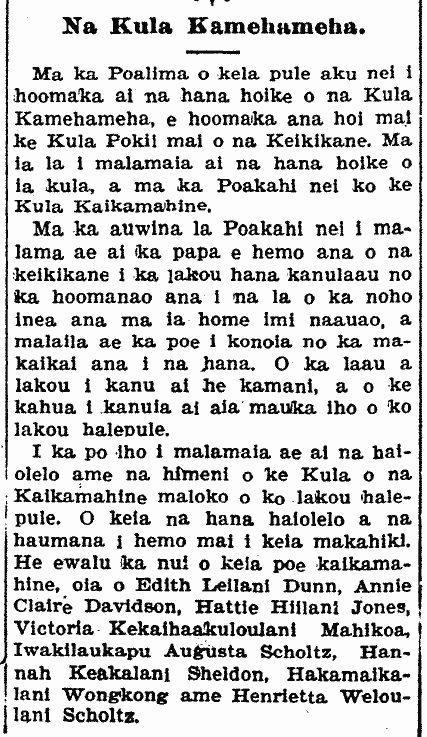
The Kamehameha Schools held their exhibition on this past Friday, starting with the Boys’ Primary School. On that day the exhibition of that school was held, and on this past Monday for the Girls’ School.
On Monday afternoon, the boys’ senior class held a tree planting to memorialize the days of living in hardship at this home of learning, and present were those invited to watch the activities. The tree that they planted was a kamani, and the area where it was planted was upland of their chapel.
Later that night, speeches and songs were performed by the Girls’ School in their chapel. These were speeches by the students graduating this year. There were eight girls: Edith Leilani Dunn, Annie Claire Davidson, Hattie Hiilani Jones, Victoria Kekaihaakuloulani Mahikoa, Iwakilaukapu Augusta Scholtz, Hannah Keakalani Sheldon, Hakamaikalani Wongkong [Hakamaikalani Wong Kong] and Henrietta Weloulani Scholtz.
(Kuokoa, 6/10/1904, p. 2)
Ka Nupepa Kuokoa, Buke XLII, Helu 24, Aoao 2. Iune 10, 1904.
 nupepa