Sweet love song, 1886.

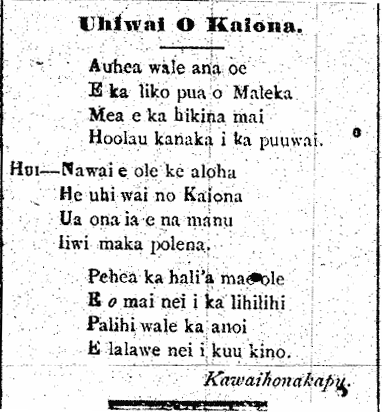
Uhiwai O Kaiona

Auhea wale ana oe
E ka liko pua o Maleka
Mea e ka hikina mai
Hoolau kanaka i ka puuwai

Hui—Nawai e ole ke aloha
He uhi wai no Kaiona
Ua ona ia e na manu
Iiwi maka polena.

Pehea ka hali’a mae ole
E o mai nei i ka lihilihi
Palihi wale ka anoi
E lalawe nei i kuu kino.

Kawaihonakapu.

(Nupepa Elele, 7/24/1886, p. 4)

Uhiwai O Kaiona.

Ka Nupepa Elele, Buke VIII, Helu 4, Aoao 4. Iulai 24, 1886.

Fishing for oopu and wi in Puepaku, Hilo, 1878.

[Found under: “NA MEA HOU O PUEPAKU, HILO.” by J. Kanaeholo]

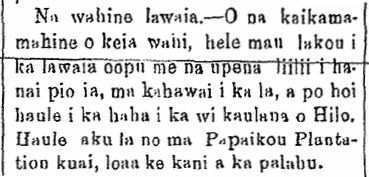
Fishing women.—The girls of this area [Pueopaku, Hilo], go fishing often for oopu with small arched nets at the river in the daytime, and at night they go down to pick the famous wi of Hilo. They head down to Papaikou Plantation to sell them, and they come into the cry of the turkey [palahu].¹

¹Whereas the cry of the nene, “unele, unele,” is associated with lacking, the cry of the turkey, “pokeokeo,” is associated with riches.

(Ko Hawaii Pae Aina, 10/26/1878, p. 1)

Na wahine lawaia.

Ko Hawaii Pae Aina, Buke I, Helu 43, Aoao 1. Okatoba 26, 1878.

Description of the Nene by Kepelino, 1863.

THE STORY

—OF—

The Birds of Hawaii nei

NUMBER 5.

Nene Bird.

The Nene is a bird from the high uplands, and it is a big bird; it resembles a Turkey [Pelehu] and it is that height, its legs are long, and its toes are flat, its neck is nicely slim, its head is small, its eyes are like the eyes of a Chicken [Moa], its beak is short, it has a fine loud voice, and its call sounds like, “unele, unele, unele.”

It is said in the old Hawaiian stories, that the Nene and the Fly [Nalo] were deprived of their wealth, and that is why the Nene cries in that manner, “unele, unele” [“without, without”] and the Nalo chose its place to live as Kapalapilau [“Rotting dab of excreta”], and that is still what they do.

The Nene does not eat Rats [Iole] and other things like the Hawk [Io], and the Owl [Pueo], it only eats leaves of vegetation and flowers of grasses. Continue reading

Nene being cared for by Herbert Shipman, etc. 1941.

[Found under: “Hunahuna Meahou o Hamakua Ame Kohala” by Mrs. Reinhardt.]

Last week, two men living and working at the Kilauea National Park came to Honokaa School, their names being Gunther Olsen and friend. The school was filled with its 496 students from 1st grade to 6th, to see pictures of the mountains of this island. Olsen described the different birds while his companion showed pictures of the birds on a white cloth. Truly beautiful were the pictures of the mamo, O-o, Elepaio, Iiwi, Apapane, and so forth. The names of the birds of ours were clearly pronounced in Hawaii by that man.

According what was said by this man, in Keaau is being cared for at the home of Herbert Shipman, NENE birds, which are believed to be going extinct, but they are increasing. Our birds were much more beautiful in the olden days before other birds were imported from all over, the birds that are a problem for the crops growing in our gardens. They eat flowers of the peppers [nioi], and that is why the nioi doesn’t fruit as they did in years past.

After the pictures of the birds were shown, pictures were shown of the burning fires of Pele atop Mokuaweoweo last year. These men climbed up Mokuaweoweo on horseback and when they reached a certain point, the horses were left and they went on foot until the crater. Where they were was scorching. While the fires were boiling, snow was seen on both sides covering the ground. Continue reading

David Kanealii and his new wife visits the home of his parents, 1918.

SEEING THE BELOVED HOME OF MY PARENTS.

O Editor of the Nupepa Kuokoa:—Please have patience for my package that I put before you, and place it upon one of the open decks of our newspaper, which will send it out so those from Hawaii Island will see it and those of Lehua Island will hear it.

On the 14th, Mrs. Napewai [Naapuwai] Kanealii and her husband D. Kanealii left this town and went to Kauai, and in the morning of the 15th, we landed in Nawiliwili, were taken by the tossing of the machine to Wainiha and were lovingly welcomed in the home of Joseph Kanealii. Continue reading

More from the mele aloha aina by G. K. Keawehaku, 1919.

[From the mele: “OIA ANEI? OIA NO.”]

Me he punohu ula la,
No Alenuihaha oluna ae;
Me he onohi ahiahi la,
No Alalakeiki oluna ae;
Me he ua nonoula la,
No Naeheehe oluna ae;
Me he leikoko-ula la,
No Kealaikahiki oluna ae; Continue reading

Section of a sweet mele aloha aina by Gabriel K. Keawehaku, 1919.

[From the mele: “OIA ANEI? OIA NO.”]

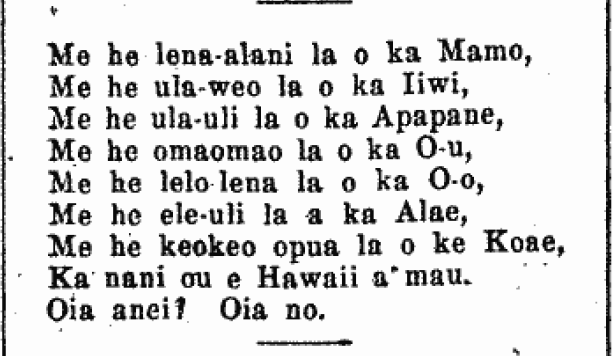
Me he lena-alani la o ka Mamo,
Me he ula-weo la o ka Iiwi,
Me he ula-uli la o ka Apapane,
Me he omaomao la o ka O-u,
Me he lelo-lena la o ka O-o,
Me he ele-uli la a ka Alae,
Me he keokeo opua la o ke Koae,
Ka nani ou e Hawaii a mau.
Oia anei? Oia no.

[This is an awesome way to think about colors!]

(Kuokoa, 9/12/1919, p. 8)

Me he lena-alani la o ka Mamo...

Ka Nupepa Kuokoa, Buke LVII, Helu 37, Aoao 8. Sepatemaba 12, 1919.

More on John K. Waiamau and others, 1893.

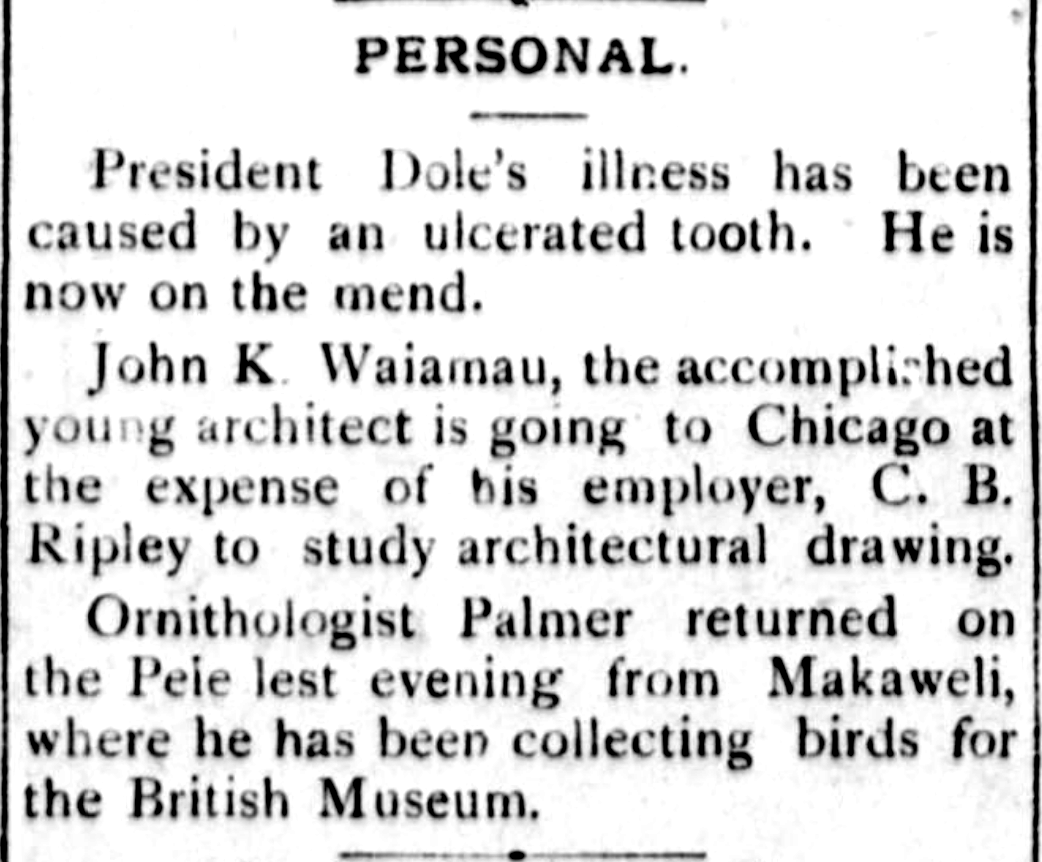
PERSONAL.

President Dole’s illness has been caused by an ulcerated tooth. He is now on the mend.

John K. Waiamau, the accomplished young architect is going to Chicago at the expense of his employer, C. B. Ripley to study architectural drawing.

Ornithologist Palmer returned on the Pele last evening from Makaweli, where he has been collecting birds for the British Museum.

(Hawaiian Star, 8/18/1893, p. 2)

PERSONAL.

The Hawaiian Star, Volume I, Number 122, Page 2. August 18, 1893.

The dwindling numbers of the Hawaiian hawk, 1889.

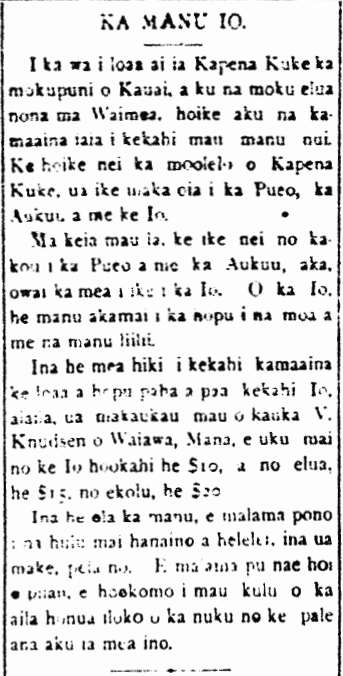
THE IO BIRD.

When Captain Cook came upon the island of Kauai and his two ships docked in Waimea, the kamaaina showed him a number of large birds. Captain Cook’s journals say that he saw a Pueo, an Aukuu, and an Io.

These days, we see indeed the Owl [Pueo] and Heron [Aukuu], but who sees the Hawk [Io]? The Io is skilled at snatching chickens and small birds.

If some kamaaina is able to find and catch an Io, V. Knudsen of Waiawa, Mana, is always prepared to pay $10 for it; and for a pair, $15; and for three, $20.

If the bird is live, be careful with the feathers and do not harm them and have them fall off; and so too if it is dead. Also be careful lest it rots, and put a few drops of kerosene in its beak to ward off rotting.

(Kuokoa, 3/30/1889, p. 2)
KA MANU IO.

Ka Nupepa Kuokoa, Buke XXVIII, Helu 12, Aoao 3. Maraki 30, 1889.

Kaumualii’s Mahiole, 1873.

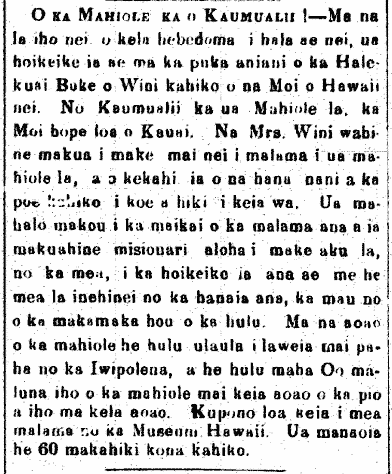
It is the Feather Helmet of Kaumualii!—During the days of this past week, displayed in the window of Whitney’s Bookstore the regalia of the Ancient Kings of Hawaii nei. The Mahiole is Kaumualii’s, the last King of Kauai. Mrs. Whitney [Wini] the elder who just passed was the one who was taking care of the mahiole, and it is one of the things remaining today of the beautiful works of the people of old. We praise the fine upkeep by the beloved missionary mother who passed, for on display, it seemed as if it was made yesterday; the feathers appeared new. On the sides of the mahiole were red feathers taken from the Iiwi polena, and feathers of the maha Oo are on top of the mahiole from this side to that of the crest. This should definitely be kept in the Hawaiian Museum. We believe that it is 60 years old.

[It is interesting to note what is not said in a similar article in English.]

(Au Okoa, 2/27/1873, p. 3)

O ka Mahiole ka o Kaumualii!

Ke Au Okoa, Buke VIII, Helu 46, Aoao 3. Feberuari 27, 1873.