Vital Statistics. 1912.

MARRIAGES.

S. W. Naiwi to Miriama Kaaeamoku, July 13.

Kaluna Humoku to Pahuwalu, July 15.

W. A. Kuhn to Elizabeth Kawaauhau, July 16.

John Wilson to Annie Harbottle, July 17.

Robert B. Bodnar to Amelia K. Allen, July 18.

Kalani Nawahie to Nani Makaimoku, July 20.

BIRTHS.

To David Lui and Maria Kekaa, a daughter, July 14.

To James Kekelaokalani White and Rosalia, a daughter, July 15.

To Charles Kauhane and Lucy Kanakaoluna, a son, July 15.

To Oliver Kauhane and Mary Lobert, a daughter, July 17.

To Joe Tavares and Theresa Kekahu, a son, July 17.

To Lambert K. Meheu and Kaiminaauao, a daughter, July 17.

To Luke Mia and Alice Benjamin, a son, July 19.

To Peter Tai and Rose James, a son, July 20.

To Ah Kim and Hoopii Kuaana, a son, July 22.

DEATHS.

Kamaka, at Pawaa, near the streetcar junction [huina kaa uwila], July 19.

Ruth Namahoe, on the road to the Insane Asylum, July 20.

Luika Kauakahi, at the Queen’s Hospital, July 20.

M. W. Phillips, on Richards Street, July 21.

Sam Kaleimakalii, on School Street, July 24.

(Kuokoa, 7/26/1912, p. 8)

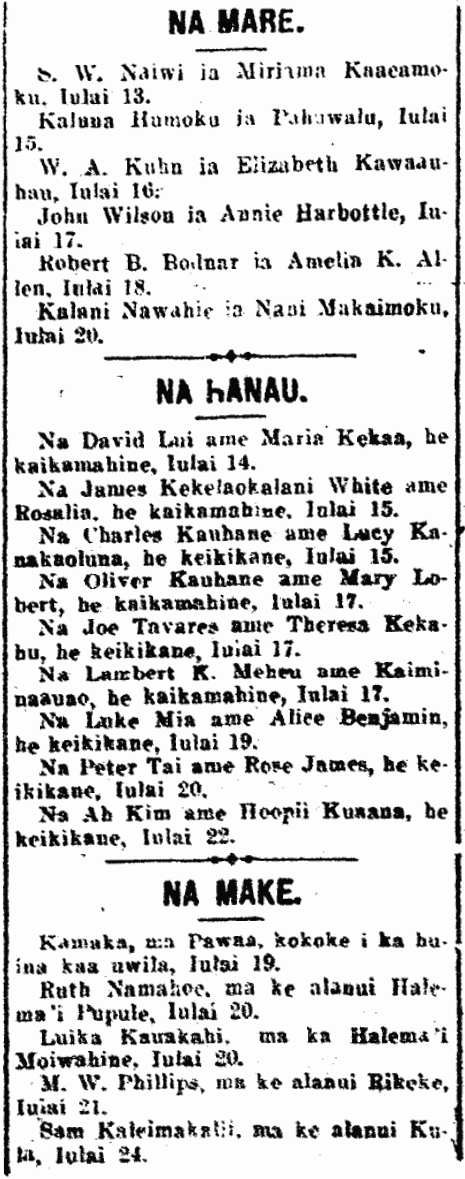
NA MARE. / NA HANAU. / NA MAKE.

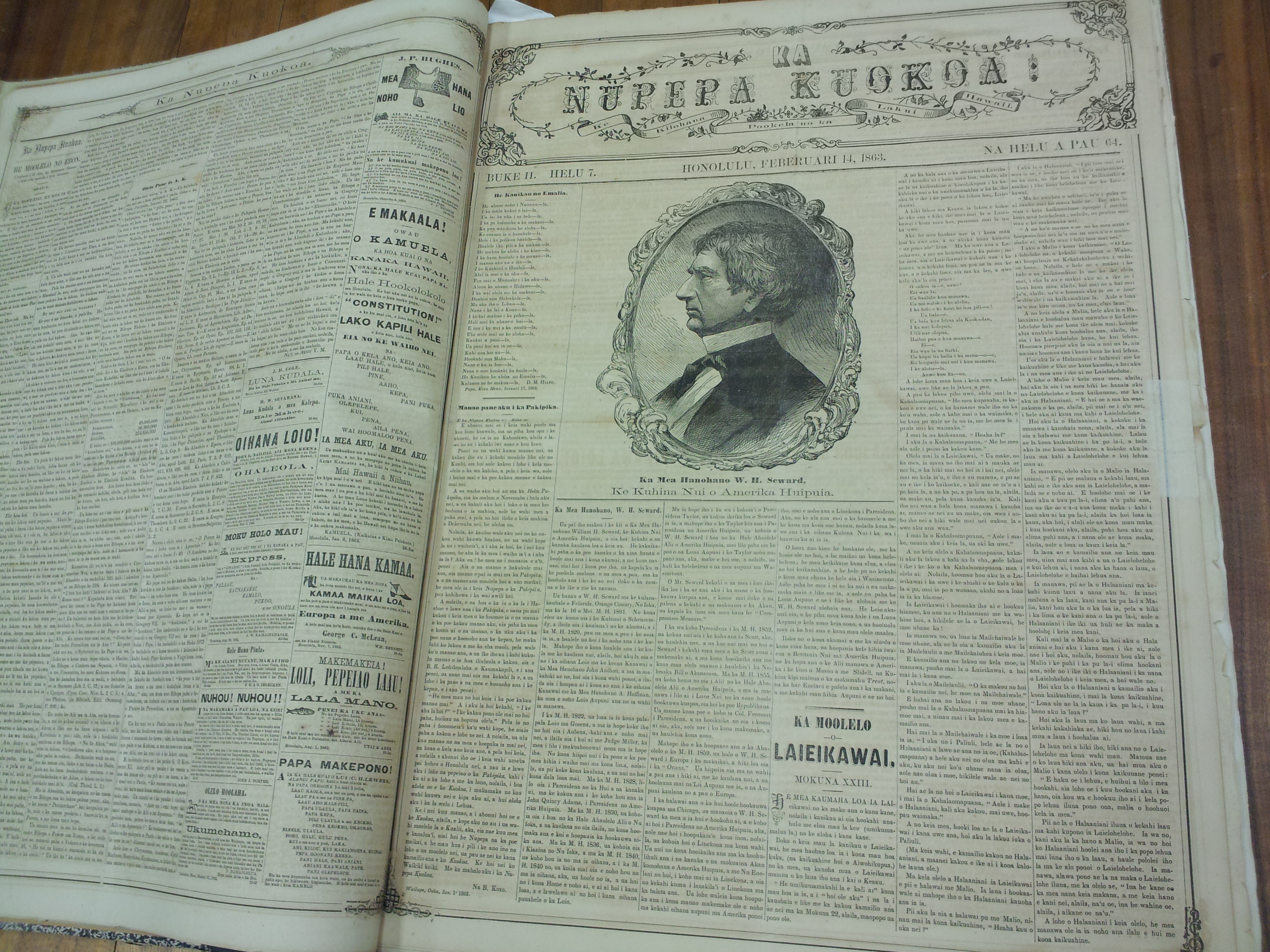
Ka Nupepa Kuokoa, Buke XLVIII, Helu 30, Aoao 8. Iulai 26, 1912.

Pond atop Punchbowl? 1902.

Mysterious Pond.

An amazing pond was found atop Puowaina by  some people who visited there; they found this amazing waters among lantana plants. Close to this pond was planted a patch of sweet potatoes by an old Hawaiian man; he did not know of this new thing until he was weeding near the pond. While he was working [hono ana ?], to his surprise, he saw this pond their. When he looked at it, its mouth was five feet long, and so too of the depth. The water is five feet or more then you reach black sand. According to what some people say, this is magical waters. It is said to be kupua water, like what is common among amazing things, but there is no trace of the story of this water. It is truly a mysterious spring. The water in the pond these days has somewhat receded.

(Kuokoa, 6/27/1902, p. 5)

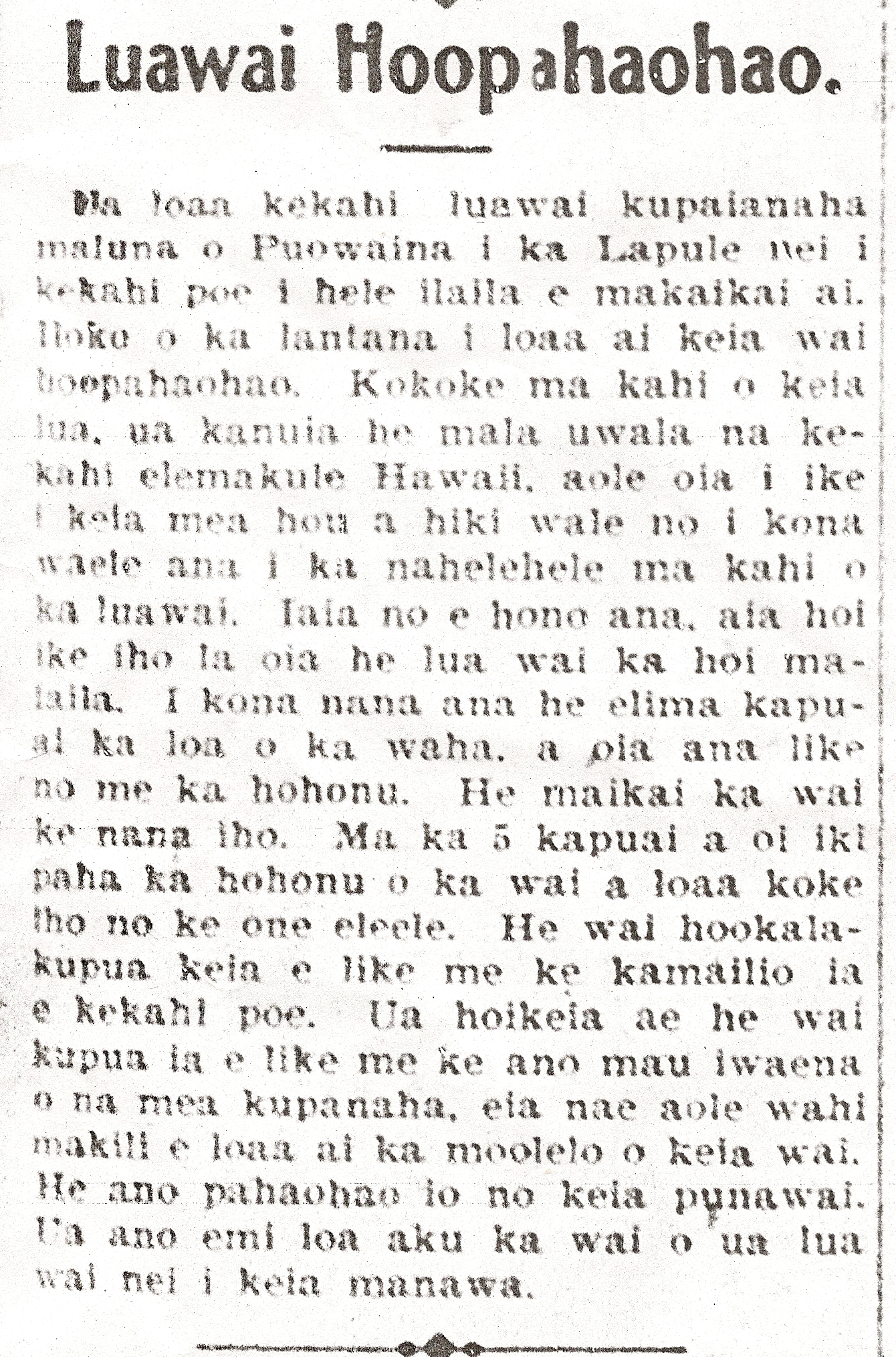
Luawai Hoopahaohao.

Ka Nupepa Kuokoa, Buke XL, Helu 26, Aoao 5, Iune 27, 1902.

The above image was taken directly from the microfilm. Here for comparison is the same article as it appears online:

Luawai Hoopahaohao.

Ka Nupepa Kuokoa, Buke XL, Helu 26, Aoao 5. Iune 27, 1902.

Niihau purchased for $10,800. 1864.

The Haole are Really Working Niihau.

O Kuokoa Newspaper; Aloha to you:—I met up with the newspaper article under News of Hawaii, in Issue 15 of the 9th of April, about the selling of Niihau to Mr. James Francis Sinclair, for $10,800, along with the lands of Kuakanu, which are the konohiki lands of Halewela and Kahuku, which the Government sold to the one named above, along with the konohiki lands, and this whole island has gone to the haole; perhaps you all and those others as well have heard that Niihau was sold, along with those penny-pinching folks who don’t get the shining beacon of Hawai nei through the Kuokoa Newspaper. And it is we who know of the great, who know of the small, and who know of the wide, that knows of the selling from Kii to Kawaihoa, from the Makahuena Point to Pueo Point; everything upon the land is bought and there is nothing left for us, the Hawaiians, under the haole owners.

Their Way of Living: They are pleasant and good, and speak nicely with the people, but they are not very proficient in the Hawaiian language. The haole say, “mahope aku kumaki” [?] There are ten Hawaiians, caretakers [hoaaina] of the land, chosen from amongst the locals, but two are from elsewhere, they are newcomers, one from Hawaii and the other from Maui, and including them there are ten caretakers. Here are each of their names which the haole selected: A. Puko, D. Kauki, Hetesia, J. H. Kanakaiki, P. R. Holiohana, H. Haokaku, Mose Kanohai, Ioela, Kapahee and Pouli; Kanakaiki is from Napoopoo, Hawaii, and Holiohana is from Hana, Maui, and are locals from there. Those caretakers are in charge of the three work days every month just like the konohiki of the chiefs, should there be work by haole owner to be done.

Their Number: Mr. James Francis Sinclair them total twelve in number; two brothers, three sisters, five children, one mother, and one in-law, which totals twelve; they live in Kununui; they are religious, with one God, but their religion is very different; their houses were constructed in Britain and brought to Niihau: three houses, one currently stands, and two more to follow; we appreciate how nice and beautiful it is to see.

Dealing with the Animals: There are two horses per man and woman, and should there be three, it is killed, and so forth; as for dogs, there are none left, they were all killed, from the big ones to the small ones because sheep were being killed, and so the government is without money from the dog tax, also the goats were all killed. You Kauai people who own horses and sheep, get them quick, don’t dawdle, or they will be taken by the haole.

Things Grown by the People.

The Hawaiians consume what they produce, and they also assist with the land owners in the watering of the sweet potato, ke pola akaakai [?], and chickens, as long as they were pleasant, or else that was that.

On the Number of Sheep

Set loose on Niihau are the sheep which you have perhaps seen in our Newspaper; as for the count, you probably have not heard; this is the truth as to the abundance or dearth: the number of sheep is 3,400, with 1,400 belonging to the Hon. W. Webster and 2,000 belonging to the King; there is no end to their desire for sheep.

Sugar Cane Cultivation.

Niihau will be planted with sugar cane if the test on one acre goes well; and if the cane grows nicely, then planting will commence, but if it doesn’t grow, that’s it, because it is an arid land.

This is an undesirable land for those foreigners seeking to make money because it is dry and scorched by the sun, and crops die; but here are people who are after wealth, and they tell us, the locals, that this is very valuable land for sheep and cane; our good friend, H. M. Whitney, the local of Waimea and Niihau, along with his parents, are familiar with this island and its extreme heat in the Makalii months [summer]. I will stop writing as the Naulu rain of Niihau is falling. With aloha.

P. R. Holiohana.

Kihalaui, Niihau, May 2, 1864.

[This P. R. Holiohana (later it seems he goes by the name P. R. Holi) writes in to the newspapers often from Niihau on a number of subjects.]

(Kuokoa, 6/4/1864, p. 1)

Hana io ka Haole ia Niihau.

Ka Nupepa Kuokoa, Buke III, Helu 23, Aoao 1. Iune 4, 1864.

Night fishing violations, 1932.

There were many who were arrested by the Fishing Warden; these were people who had no rights to fish as per the Law dealing with people who are not natives [citizens?] of Hawaii.

They are allowed to fish at night, only if they get a license, which can be used for a year.

[I wonder if this gets typescripted by someone who has no Hawaiian language knowledge, if any of the key words will be found doing a word search (lawaia, kanawai, …) Or, will it look more like this:

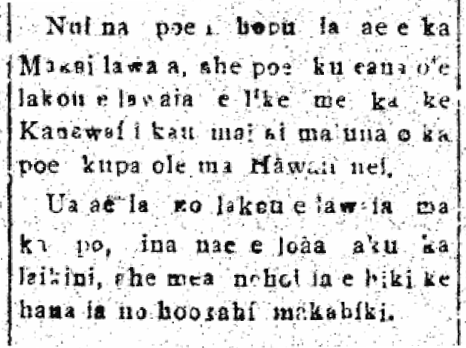
Nui na poe i hoou la ae e ka Makai lawa a, ahe poe ku eana o’e lakou e la@aia e like me ka ke Kauewai i kau mai ai ma una o ka poe kupa ole ma Hawaii nei.

Ua ae la eo lakau e law@ia ma ka po, ina nac e loaa aku ka laikini, ahe mca nohoi ia e @iki ke haua ia no hookahi makahiki.

This is actually one of the articles that aren’t as bad as many…]

(Hoku o Hawaii, 4/5/1932, p. 3)

Nui na poe i hopu ia...

Ka Hoku o Hawaii, Buke XXV, Helu 43, Aoao 3. Aperila 5, 1932.

Crown Lands and Government Lands, 1896.

GOVERNMENT LANDS.

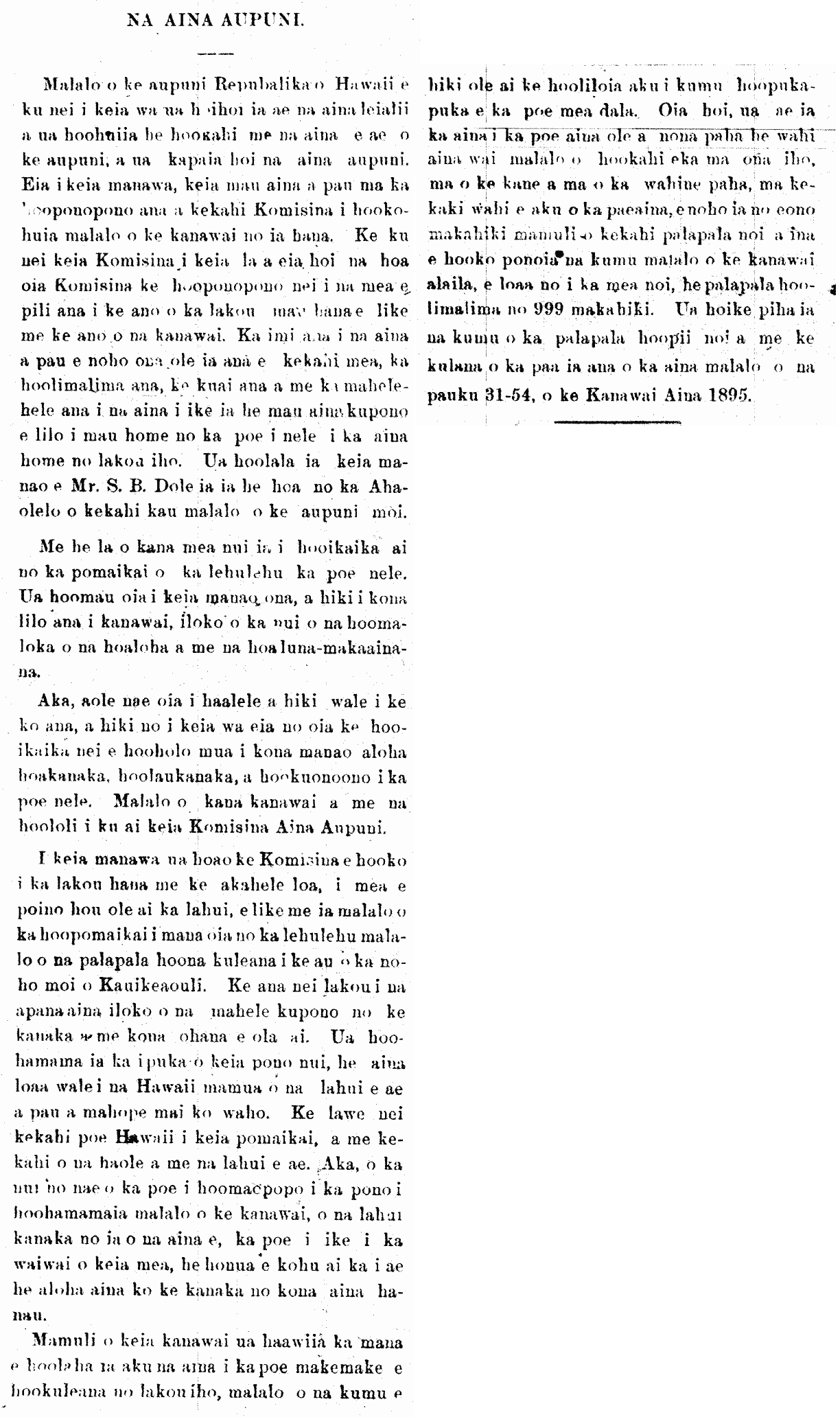
Under the Republic of Hawaii that stands now, the crown lands have been returned and added with the other lands of the government, and are referred to as government lands. Currently, the entirety of these lands are under the authority of a Commission appointed for that purpose under the law. The Commission is active today and its members are putting into order matters that pertain to their duties as per the laws. The finding of all lands that are not to be owned by someone, as well as the leasing, selling, and dividing of lands that are recognized as lands fitting to be homes for people without homesteads for themselves. This idea was devised by Mr. S. B. Dole while he was a member of the Legislature for a session under the monarchy.

It seems that this was what he focused on, for the good of those without. He kept at this idea until it became law, amidst much skepticism by friends and fellow representatives.

But he did not relent until he succeeded, and now he is working to move forward his loving idea for his fellow man, to increase, and to make prosperous, the poor people. Under his law and its revisions, this Government Lands Commission was created.

At this time, the Commission is trying to carefully carry out their duties so that the lahui will not once again be hurt like under the benefits intended for the masses with the quiet land titles in the time of Kauikeaouli’s rule. They are surveying parcels from areas suited for a man and his family to live. The doors to this great right is opened and Hawaiians will receive land before all other ethnicities and then thereafter those from the outside. There are some Hawaiians taking advantage of this opportunity, along with some haole and other ethnicities. But the majority of those that know of the good offered up by this law are the people of foreign lands, the ones who know the value of land for which one is able to say that he is patriotic to the land of his birth.

By this law, power is give to advertise land to those who claim land for themselves, under the condition that they cannot use it for profit. The land is available to those without land or those with wetlands of less than an acre under his name, or under the husband or wife in some other area of the archipelago; they will live on the land for six years after the request for land and should they meet the qualifications under the law, the applicant will receive a lease or 999 years. The requirements for the application and stipulations of the lease are shown in full in sections 31–54 of the Land Act of 1895.

[Just as it is today, it was back then. Different newspapers and sources had different stances. It is perhaps not best thing to base your opinions on a single article or the words of a single person. It is important to try and see all that was written and handed down in other ways (for ink and paper is not necessarily the best way that information is passed down), and then decide what you think on the subject…

Oh, and see here for the Land Act of 1895.]

(Oiaio Puka La, 4/3/1896, p. 2)

NA AINA AUPUNI.

Ka Oiaio Puka La, Buke I, Helu 67, Aoao 2. Aperila 3, 1896.

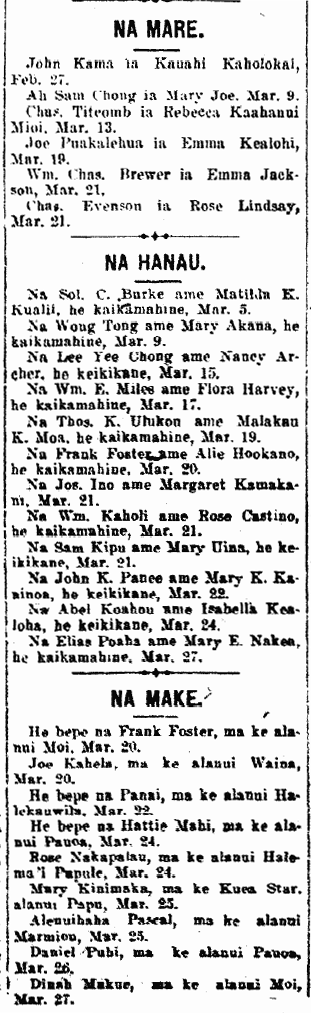
Vital Statistics, 1912.

MARRIAGES.

John Kama to Kauahi Kaholokai, Feb. 27.
Ah Sam Chong to Mary Joe, Mar. 9.
Charles Titcomb to Rebecca Kaahanui Mioi, Mar. 13.
Joe Puakalehua to Emma Kealohi, Mar. 19.
William Charles Brewer to Emma Jackson, Mar. 21.
Charles Evenson to Rose Lindsay, Mar. 21.

BIRTHS.

To Solomon C. Burke and Matilda K. Kualii, a daughter, Mar. 5.
To Wong Tong and Mary Akana, a daughter, Mar. 9.
To Lee Yee Chong and Nancy Archer, a son, Mar. 15.
To William E. Miles and Flora Harvey, a daughter, Mar. 17.
To Thomas K. Ulukou and Malakau K. Moa, a daughter, Mar. 19.
To Frank Foster and Alie [Alice ?] Hookano, a daughter, Mar. 20.
To Joseph Ino and Margaret Kamakani, Mar. 21.
To William Kaholi and Rose Castino, a daughter, Mar. 21.
To Sam Kipu and Mary Uina, a son, Mar. 21.
To John K. Panee and Mary K. Kaainoa, a son, Mar. 22.
To Abel Koahou and Isabella Kealoha, a son, Mar. 24.
To Elias Poaha and Mary E. Nakea, a daughter, Mar. 27.

DEATHS.

A baby of Frank Foster, on King Street, Mar. 20.
Joe Kahela, on Vineyard Boulevard, Mar. 20.
A baby of Panai, on Halekauwila Street, Mar. 22.
A baby of Hattie Mahi, on Pauoa Street, Mar. 24.
Rose Nakapalau, at the Insane Asylum, Mar. 24.
Mary Kinimaka, at Star Square [Kuea Star ?], Fort Street, Mar. 25.
Alenuihaha Pascal, on Marmion Street, Mar. 25.
Daniel Puhi, on Pauoa Street, Mar. 26.
Dinah Makue, on King Street, Mar. 27.

(Kuokoa, 3/29/1912, p. 8)

MARE. / HANAU. / MAKE.

Ka Nupepa Kuokoa, Buke XLVIII, Helu 13, Aoao 8. Maraki 29, 1912.

More James Auld. 1894.

[Found under: “This and That”]

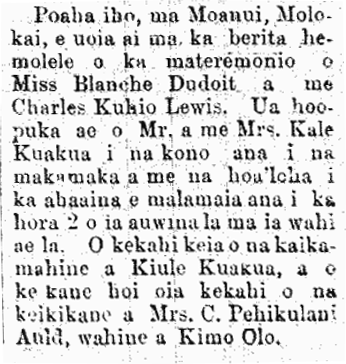
This Thursday, at Moanui, Molokai, Miss Blanche Dudoit and Charles Kuhio Lewis were bound together in the holy covenant of matrimony. Mr. and Mrs. Kale Kuakua [Charles Dudoit] sent out invitations to intimates and friends to a party held at 2 in the afternoon there. This is one of the daughters of Kiule Kuakua [Jules Dudoit], and the husband is one of the sons of Mrs. C. Pehikulani Auld, the wife of Kimo Olo [James Auld].

[I am not sure if this is James Auld, the newspaperman, or another generation. Anybody have birth and death dates?

There are many Hawaiianized names like “Olo” for “Auld”, and “Kuakua” for “Dudoit”. There should be a site that lists them in one easy to look up format!]

(Makaainana, 4/2/1894, p. 8)

Poaha iho...

Ka Makaainana, Buke I----Ano Hou, Helu 14, Aoao 8. Aperila 2, 1894.

More on that wedding celebration up in Pauoa. 1898.

WEDDING PARTY IN PAUOA.

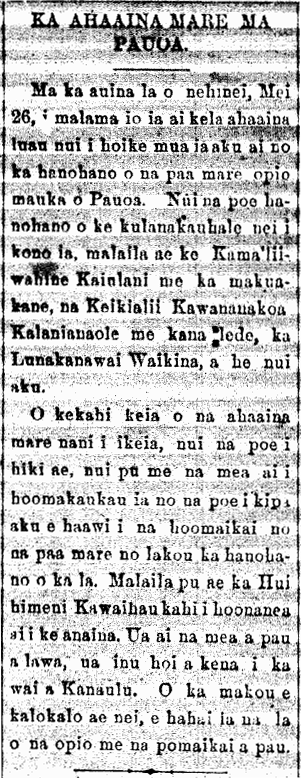
Yesterday afternoon, May 26, that grand luau was indeed held that was mentioned earlier, to honor the wedded couples in the uplands of Pauoa. There were many important people of Honolulu that were invited; attending was Princess Kaiulani and her father, Princes Kawananakoa and Kalanianaole and his wife, Judge Waikina [Whiting], and many more.

This was one of the beautiful wedding celebrations seen; there were many people who came, along with the abundant foods prepared for the guests who gave their congratulations to the wedded couples who were being honored that day. There too was the Kawaihau Glee Club who entertained the crowd. Everyone ate their fill, and drank till satiated of the waters of Kanaulu. We pray that the days following the youths be full of blessings.

[This is the wedding celebration mentioned earlier.

Also, does anyone know what the “wai a Kanaulu” is a reference to? It seems that it is a phrase that is used widely… ]

(Aloha Aina, 6/4/1898, p. 7)

KA AHAAINA MARE MA PAUOA.

Ke Aloha Aina, Buke IV, Helu 23, Aoao 7. Iune 4, 1898.