On the birthplace of Prince Jonah Kuhio Kalanianaole, 1924.

THE AHAHUI KAMEHAMEHA SECURES THE BIRTHPLACE OF KUHIO

From the Advertiser bureau on Kauai we received news that clarifies a memo from the Ahahui Kaumualii to that office, the branch of the Ahahui Kamehameha on Kauai, pertaining to the agreement by the board of directors of the McBryde Sugar Company to sell to that association the place where Prince Kuhio was born at Koloa, Kauai. Continue reading

Great granddaughter born to Samuel K. Kekoowai, 1922.

ANOTHER DESCENDANT BORN TO THE WRITER OF THE MAKALEI

A letter arrived from my granddaughter informing her tutu that she brought forth into this world of light, a daughter from her loins, on Thursday, the 12th of this October, 1922, at 9:30 a.m.

She asked also for me to name that great-grandchild of mine, and so I followed through and gave the ancestral name, Miss May Kaaoliko Kahalakupumaikai-o-Aina-manuhaaipo Manouluae. Continue reading

Kamehameha IV visits Nihoa, 1857.

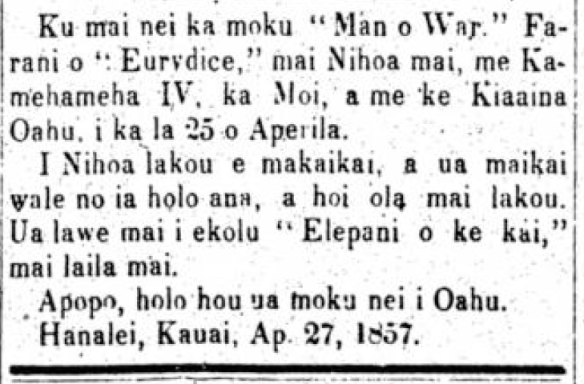
The French man of war “Eurydice” arrived from Nihoa with Kamehameha IV, the King, and the Governor of Oahu [Kekuanaoa], on the 25th of April.

They were on Nihoa touring, and the trip was fine, and they returned in good health. They brought back three “Elephants of the sea,” from there.

Tomorrow, the vessel will return to Oahu.

Hanalei, Kauai, Ap. 27, 1857.

(Hae Hawaii, 5/13/1857, p. 26)

HaeHawaii_5_13_1857_26

Ka Hae Hawaii, Buke 2, Ano Hou.—Helu 7, Aoao 26. Mei 13, 1857.

Keahualono, wahi pana of Hawaii Island, 1916.

KE AHU-A-LONO

This is the border between the two Kona districts and Kohala, and the name of this heap of rocks  [ahu pohaku] is called after Lonoikamakahiki-Kapu-a-ka-Lani, one of the high ruling chiefs of Hawaii nei who is famous in genealogical histories of the high ruling chiefs of Hawaii Island of Keawe.

When Lonoikamakahiki went with his troops and camped at this place, the Marshals [Ilamuku] built this mound of rocks and called it by the name “Ke Ahu-a-Lono,” after the name of Lonoikamakahiki, the ruling chief. That is how this pile of rocks is known until today, an unforgettable monument built by the foremost war leaders [pukaua] of Lonoikamakahiki, so that the generations of this time would remember the truly famous deeds of our forefathers who passed on; and of that sacred name Lonoikamakahiki-Kapu-a-ka-Lani. The locals of Puuanahulu are familiar with this ahu pohaku.

(Hoku o Hawaii, 2/17/1916, p. 4)

HokuoHawaii_2_17_1916_4.png

Ka Hoku o Hawaii, Buke 10, Helu 37, Aoao 4. Feberuari 17, 1916.

The birthday of Princess Ruta Keelikolani Keanolani Kanahoahoa Muolaulani Keikiheleloa Keanohalia Kaleonahenahe Kohalikolani, 1871.

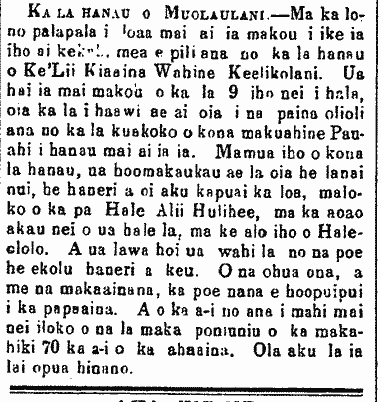
The birthday of Muolaulani.—In a report we received, we learned some things about the birthday of the Royal Governess Keelikolani. We were informed that on the past 9th, that was the day she gave delightful parties, for the day that her mother Pauahi suffered the pangs of labor and gave birth to her. A bit before her birthday, she set up a great lanai a hundred feet or more in length on the grounds of Hulihee Palace, on the right side of the building in the front of Haleolelo. This was large enough for over three hundred people. Her retainers and her people were those who filled out the party. And the taro that she farmed in those days of famine in the year of ’70 was the taro at the feast. Long live the land of the calm of the billowy clouds white like hinano blossoms.

[This reminded me of a video I recently saw on Facebook, speaking of another Haleolelo, this one on the other side of Hawaii Island, giving honor to the Princess and what she stood for. Click here for Oiwi TV’s video featuring Haleolelo.]

(Au Okoa, 2/16/1871, p. 3)

AuOkoa_2_16_1871_3.png

Ke Au Okoa, Buke VI, Helu 44, Aoao 3. Feberuari 16, 1871.

Visit to Haleakala, 1876.

ABOUT HALEAKALA.

O Lahui Hawaii; Aloha oe:—

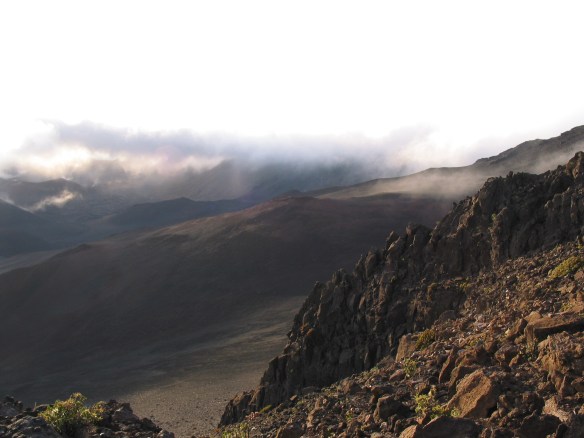
Perhaps there are not that many people who have travelled to the top of that famous mountain Haleakala in East Maui. It was the perfect time, because when I awoke this morning at maybe three o’clock and my eyes were set upon that mountain, I was filled with great admiration. I woke up my kamaaina and we got the horses ready, and at my urging, we left Makawao; and soon I’m writing this letter from the high rocks of this mountain at 9 o’clock in the morning. We are looking at the schooner greatly beloved by the friends of this land, that being the Moi, whose prow was rooting through the lapping sea of Kahului, and the famous pond in the cold, that being Kanaha. The mist is moving down to Iao and blanketing Kapela and her beautiful flowers, and the pili of Kakae disappeared, just leaving the hills in view, and it was as if waters were rushing the dam of Iao. The shady valleys at the edge of Nawaieha are imposing, seeming to duel with the rows of waves of Kahului.

105-0568_IMG

Haleakala 2003. Mau no ka nani hemolele!

Continue reading

Fount of knowledge, H. B. Nalimu, turns 96! 1931.

GOOD NEWS

On the eleventh of November, 1835, Henry Benjamin Nalimu was born, at Papaaloa, North Hilo, Hawaii, the land of birth of his parents.

On November, he became ninety-six years old at “Kamaluokaohai,” at 1536 Alewa Drive, the home of his grandchildren.

Nalimu is a descendant of his ancestor I, who was a famed strategist of Kamehameha ka Na’i Aupuni.

The I, the Mahi, and the Palena, were famous troops of Kamehameha, and leaders of Kamehameha, and I commanded the troops of I.

In 1840, Nalimu left Papaaloa and lived in Pi’opi’o, Hilo, until 1847.

At that time, Kamehameha began to give land to the makaainana.

In 1852, Nalimu entered into the Hilo Boarding School.

D. B. Lyman was the principal at the time, and it was he who built that college on land given by the alii for that school.

In 1857, Nalimu became the assistant kahu of the church of Hilo, under the old Missionary Coan [Koana, Titus Coan].

He accompanied Coan to the cliffs of Hilo, climbing up and going down into the rivers. There were no bridges and no good roads at the time. The walked the trails until Kalapana. The shoes they wore were ti-leaf sandals [kamaa la’i], and pandanus root sandals [kamaa aahala], so that their feet would not be harmed by the rocks. Continue reading

Coconut grove of Kamehameha V at Kalamaula, Molokai, 1923.

[Found under: “NA ANOAI”]

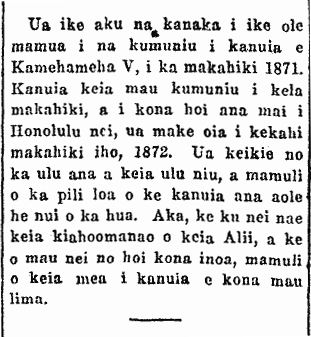
Those who did not know before of the coconut grove planted by Kamehameha V in 1871 now know. These coconut trees were planted that year, and when he returned here to Honolulu, he died a year later in 1872. This coconut grove has grown very tall, and because they were planted close together, there are not much fruit. But it stands as a monument to this Alii, and is called by his name because it was planted by his own hands.

[Check out Nanea Armstrong-Wassel’s post on more famous ulu niu!

It is also interesting to note that in the article “KA HUAKAI MAKAIKAI IA MOLOKAI” by W. J. Coelho, describing a trip around Molokai, found in Kuokoa, 7/6/1922, p. 3, it says:

I spoke of the coconut grove of Kamehameha V in Kalamaula. It is said that it was Kamehameha V who planted that coconut grove in 1864. The truth is that it was Meyer senior [Maea makua]—during the time of the King, Kamehameha IV who planted it. That was when Meyer married the mother of the Meyer family. When they were wed, they went upland of Kalae, and built a little house. It was a grass hut. Meyer began to work hard and peddled butter. After, Meyer was granted the care over the lands of Kamehameha IV, he planted coconuts by the beach, as a place to go for his lord the alii. It was Meyer who planted them, and not anyone else. Meyer himself told an important man of Honolulu, and it was from him I got this information.]

(Kuokoa, 4/26/1923, p. 2)

Ua ike aku na kanaka i ike ole mamua...

Ka Nupepa Kuokoa, Buke LXII, Helu 17, Aoao 2. Aperila 26, 1923.

David Hauola Makekau and “Leahi,” 1919.

[From: “KUU KAMAAINA I KA UA KUKALAHALE.”]

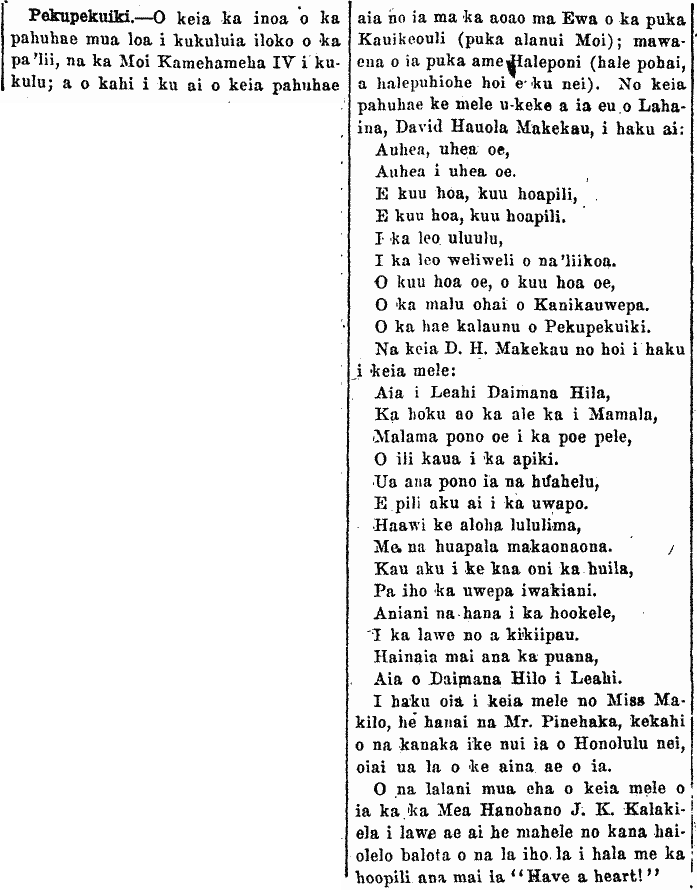
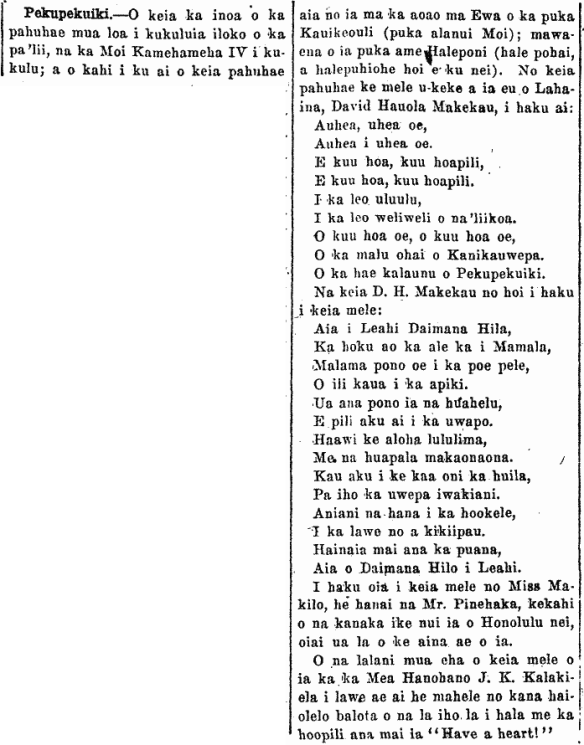
Pekupekuiki.—This is the name of the first flagpole put up in the palace grounds; it was erected by King Kamehameha IV; and this flagpole stood on the Ewa side of the Kauikeaouli gate (the King Street gate); between the gate and Haleponi, “the Coronation Building” (the gazebo and bandstand that stands now). For this flagpole is the u-keke song composed by that spry one of Lahaina, David Hauola Makekau:

Auhea, uhea oe,
Auhea i uhea oe.
E kuu hoa, kuu hoapili,
E kuu hoa, kuu hoapili.
I ka leo uluulu,
I ka leo weliweli o na ʻliikoa.
O kuu hoa oe, o kuu hoa oe,
O ka malu ohai o Kanikauwepa.
O ka hae kalaunu o Pekupekuiki.

It was this D. H. Makekau who indeed composed this mele:

Aia i Leahi Daimana Hila,
Ka hoku ao ka ale ka i Mamala,
Malama pono oe i ka poe pele,
O ili kaua i ka apiki.
Ua ana pono ia na huahelu,
E pili aku ai i ka uwapo.
Haawi ke aloha lululima,
Me na huapala makaonaona.
Kau aku i ke kaa oni ka huila,
Pa iho ka uwepa iwakiani.
Aniani na hana i ka hookele,
I ka lawe no a kikiipau.
Hainaia mai ana ka puana,
Aia o Daimana Hila i Leahi.

He composed this song for Miss Makilo, a hanai child of Mr. Pinehaka [? William Pinehasa Wood], one of the well-known men of Honolulu nei, in those days he lived there [? oiai ua la o ke aina ae o ia].

The first four lines of the mele are what the Honorable J. K. Kalakiela recently took to as part of his election speech adding, “Have a heart!”

[The awesome things you find while watching Merrie Monarch! This description is found in an awesome treatise on place names of Honolulu, “My Familiarity with the Land of the Kukalahale Rain,” which runs in the Kuokoa from 12/20/1918 to 1/24/1919 (although it indicates there is to be more to come), describing famous places of Honolulu in days gone by, written by the Anela o Mekiko, Gabriel K. Keawehaku.

Mahalo to the boys of Na Kamalei o Lililehua for their lively hula inspiring me to do a little searching.

For more on the gates of Iolani Palace, click here for Nanea Armstrong Wassel’s post!

For more on the Hale Poni, again click here for Nanea Armstrong Wassel’s post!!]

(Kuokoa, 1/24/1919, p. 3)
Pekupekuiki.

Ka Nupepa Kuokoa, Buke LVII, Helu 4, Aoao 3. Ianuari 24, 1919.